THE FANTASTIC FOUR: FIRST STEPS movie review

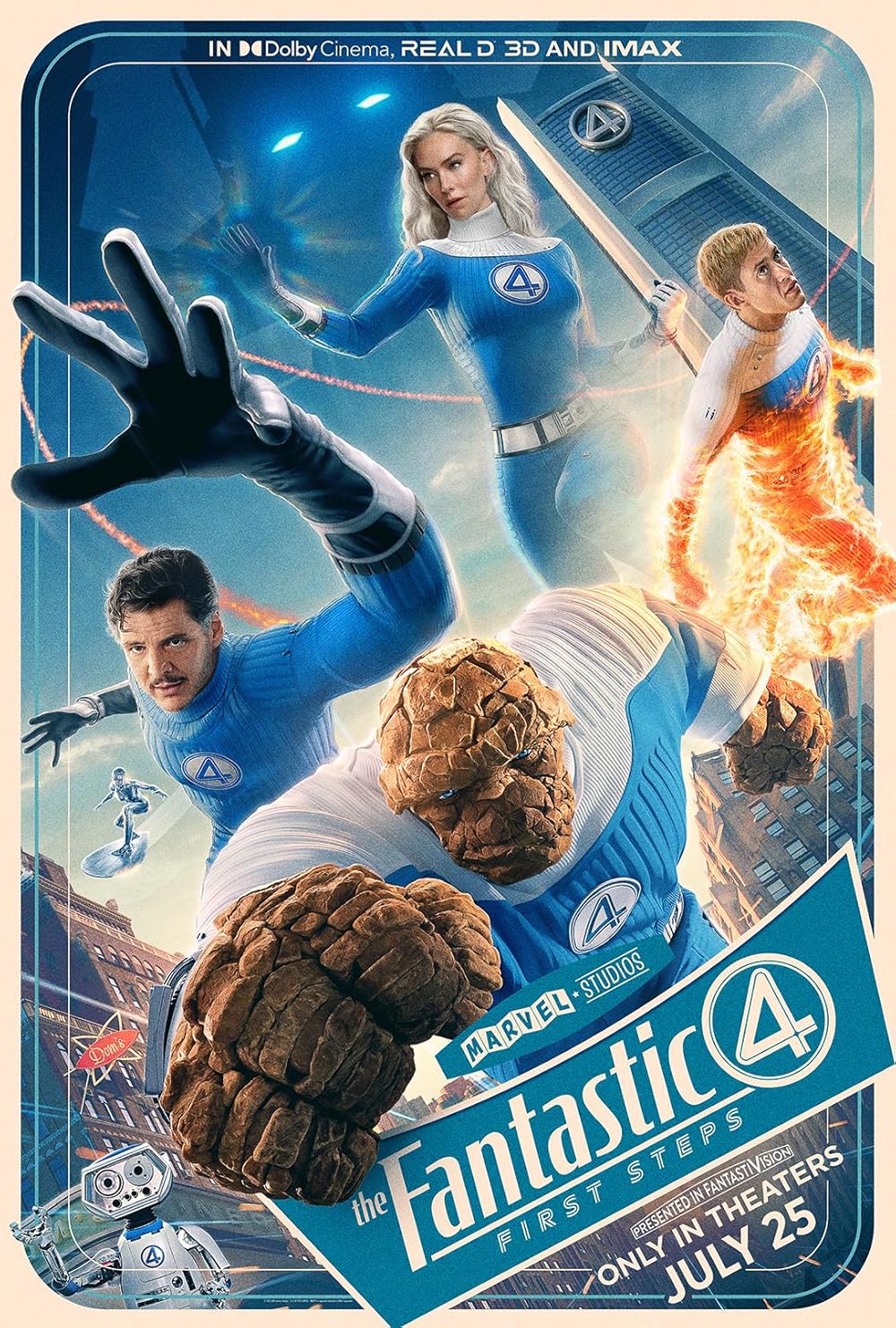
Fantastic? Let’s not get ahead of ourselves. Somewhere, Doctor Doom is laughing—because the real villain here is the script. The Fantastic Four: First Steps is a superhero movie that boasts an eye-catching retrofuturistic aesthetic and the welcome return of a classically evil villain, but it stumbles narratively with a lopsided screenplay, fragmented character dynamics, and a superfluous Silver Surfer who’s more prop than presence. With a protracted first act, truncated second act, and anticlimactic third, the swing the screenplay makes results in a foul ball–not a complete miss. Ultimately, it feels like a blueprint more than a building—an origin story more concerned with establishing than enthralling. It may offer the glimmer of potential, but that potential is still waiting for a film that knows how to make the most of these characters and each other. For a franchise reboot that proudly wears its Jet Age design language on its sleeve—from sleek, chrome-laced laboratories to wardrobe choices evocative of a Tomorrowland dreamscape—it’s ironic that the narrative propulsion of First Steps feels so grounded.

Mister Fantastic, Invisible Woman, Human Torch, and the Thing face must defend the Earth against the evil Galactus and his henchman Silver Surfer.

One of Fantastic Four: First Steps‘ undeniable triumphs is its commitment to a bold, 1960s retrofuturistic aesthetic that feels lovingly ripped from the pages of a Silver Age comic book or the Saturday morning cartoons of yesteryear. From the clean, curved architecture to the brightly colored jumpsuits and analog-style gadgetry, the film creates a world brimming with mid-century optimism—where science gleams, and adventure is just a rocket launch away. It’s visually delightful, evoking a kind of lost future that’s both nostalgic and fresh. However, the illusion occasionally falters due to jarring technological inconsistencies—most notably, the inexplicable presence of flying police cars in a world where most other vehicles appear rooted in vintage combustion-era design. And, I’d be remiss not to mention the futuristic pregnancy test that doesn’t jive with the world around it. These moments by no means sink the aesthetic, but they do momentarily snap the viewer out of the carefully constructed retro bubble.

Had the screenplay been better developed, then it may have been a “fantastic” superhero movie. The first act overstays its welcome by devoting undue time to setup that borders on exposition overload. By the time the plot remembers to move forward, the second act breezes by in a montage-like sequence of conflicts and discoveries, depriving the audience of organic development. Then, just as stakes are positioned to crescendo, the third act fumbles its own climax—settling for a resolution that feels more contractual than cathartic. While I appreciate the under two-hour runtime, I would not be surprised if there are entire scenes and sequences left on the cutting room floor.

But the most glaring issue isn’t pacing—it’s people. Or rather, the lack of connection between them. The titular quartet never quite gels. Chemistry between Reed, Sue, Johnny, and Ben is virtually nonexistent, with interactions that feel less like family dynamics and more like coworkers meeting on a Monday morning Zoom call. Attempts at humor or sentimentality fall flat, not because the lines are poorly written (though many are), but because the actors rarely feel like they’re occupying the same emotional wavelength. Pescall and Kirby have solid chemistry, and separately Quinn and Moss-Bachrach have fantastic comedic chemistry; but collectively, Marvel’s first family is lacking in sufficient chemistry. However, compared to previous cinematic attempts, seeking to adapt the Fantastic 4 for the big screen, this one is the strongest attempt.

Silver Surfer’s inclusion is more puzzling than pivotal. A character of mythic stature reduced here to a glorified Uber driver with a shiny board. She floats in and out of scenes with little impact on the plot, contributing neither urgency nor depth. Her presence suggests a franchise desperate to expand its cosmic CV but unsure of how to weave her meaningfully into the narrative tapestry. In fact, Silver Surfer could be removed from the story, and pretty much everything plat out much in the same way. No mistaking it, there IS an interesting backstory there, but it was barely tapped and even less developed. I am not suggesting Silver Surfer needs a movie or TV series, but a few more minutes of development in this movie, wouldn’t have hurt anything.

I did enjoy the refreshing return of a classic villain in Galactus. So often, modern cinema and television go to great lengths to demonstrate how villains are merely misunderstood or solely formed by societal factors–not Galactus. He’s neither misunderstood nor sympathetic. Just evil. In an era where antagonists are often softened by tragic backstories or moral ambiguity, the choice to lean into a classically malevolent foe is surprisingly refreshing. The character brings weight and threat to the film, standing as a stark reminder that sometimes the best villains are the ones who like being bad.

To the movie’s credit, audiences can watch it without having to know much about the Fantastic 4 and there is little need to watch any preceding movies or TV series. That said, I’ve been told that there are TV series and movies that will help to better understand or appreciate certain elements–but not required. When it’s all said and done, The Fantastic Four: the First Steps is sufficiently enjoyable and doesn’t overstay its welcome. Feels like a late summer movie, and there’s nothing innately wrong with that.
Ryan is the general manager for 90.7 WKGC Public Media in Panama City and host of the public radio show ReelTalk “where you can join the cinematic conversations frame by frame each week.” Additionally, he is the author of the upcoming film studies book titled Monsters, Madness, and Mayhem: Why People Love Horror. After teaching film studies for over eight years at the University of Tampa, he transitioned from the classroom to public media. He is a member of the Critics Association of Central Florida and Indie Film Critics of America. If you like this article, check out the others and FOLLOW this blog! Follow him on Twitter: RLTerry1 and LetterBoxd: RLTerry
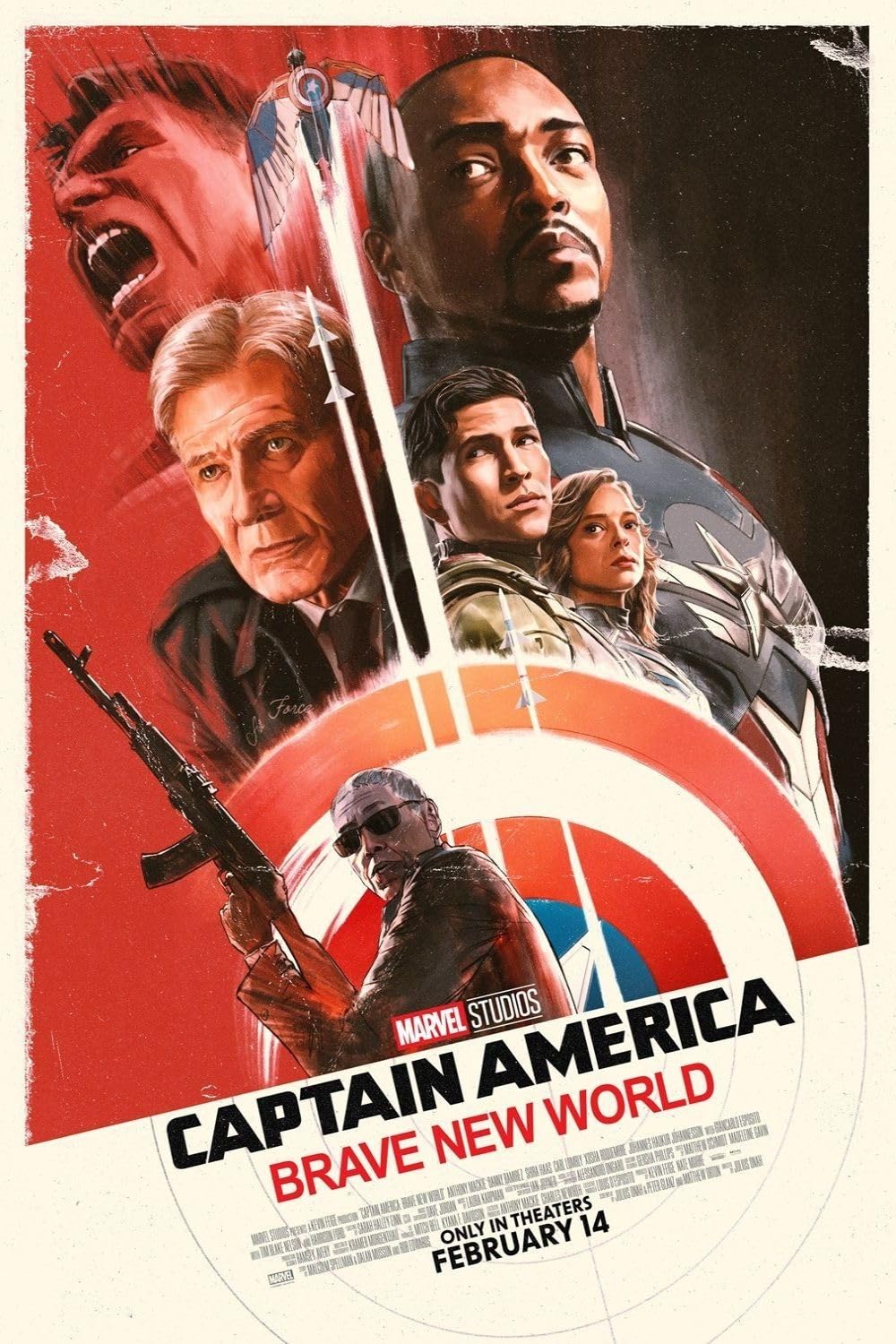
CAPTAIN AMERICA: BRAVE NEW WORLD movie review

Disney+: the Movie. The latest installment in the MCU feels like a Disney+ episode or show idea that was artificially inflated into a feature film. Captain America: Brave New World neither has the intrigue of an espionage thriller nor the excitement of a superhero movie. The plotting unfolds in a manner reminiscent of a serialized television series, evidenced by disjointed scenes that could very well function as individual episodes respectively. The movie is also plagued with gross levels of slapdash, uninspiring CGI that take an already vapid story and reinforce the one-dimensional delivery. From beginning to end, the pacing issues are evidenced by the diegetic momentum that ramps up then fizzles repeatedly causing any modicum of suspense or urgency to diminish as soon as it forms, resulting in a mitigation any potential of a cinematic spectacular.

Sam finds himself in the middle of an international incident after meeting with President Thaddeus Ross. He must soon discover the reason behind a nefarious global plot before the true mastermind has the entire world seeing red.

Captain America: Brave New World exemplifies the trend of blurring the lines between television and cinema. The long and short of it is: the significant influence the MCU TV shows have had upon the theatrical releases. This observation is two-fold (1) screenwriting and (2) technical achievement. While the former is the more significant problem, the latter is the easiest to identify. Specifically, the movie’s color grading, shot composition, and digital effects are nearly indistinguishable from MCU streaming series on Disney+. Unfortunately, this blurring of the lines between cinema and television results in a lack of the grandeur typically associated with MCU theatrical releases.

The latter could be more forgivable is the former was of a higher caliber. While writer Rob Edwards has certainly demonstrated his gift for screenwriting in previous Disney films (the Academy Award nominated Treasure Planet, being one), the other two writers have primarily worked in Disney+ television–and it shows–in spades. The plotting, pacing, character development (or lack thereof, as it were) is straight out of Disney+. The lack of urgency and stakes are also problematic, as well as the near absence of the “fun” factor. I will be the first to acknowledge that I don’t typically care for comic book or superhero movies; that said, even I will admit that the the first two phases of the MCU were (mostly, anyway) fun popcorn movies. Not the case with this latest installment. If the movie wasn’t going to be fun, then it should’ve been intriguing or spellbinding–not the case either. It’s pretty average all the way around.

I will forever be a champion for practical effects–even practical effects that are supplemented with CGI. But this movie screams TV-budget CGI the whole time. This is particularly true in the rather anticlimactic showdown. You cannot replace the way real light bounces off real objects into the camera lens, and this movie demonstrates the danger in relying heavily on CGI in an attempt to wow the audience. The strength of a picture should be in the plotting, subtext, and character development–not in the CGI. Since the movie was not going to lean into the fun factor, the CGI should’ve been dialed way back.

Even though it was wonderful to see Harrison Ford on the big screen again, he appeared to have been experience little fun while making this movie; furthermore, the performance was pretty well phoned in. Likewise, Anthony Mackie was not himself as Sam. This Sam was greatly lacking in charisma and wit. While his performance may not have been as phoned-in as Ford’s, there was still a flatness to the performative dimension. Danny Ramirez, however, did appear to be having fun on this movie, and I would’ve liked to have seen him given more to do in order to draw me into the story.

Captain America: Brave New World struggles to distinguish itself as a cinematic experience, with its disjoined plot, production quality, and lack of meaningful character development, resulting in a movie that appears to have far more in common with a Disney+ television series than with a feature motion picture.

Ryan is the general manager for 90.7 WKGC Public Media in Panama City and host of the public radio show ReelTalk about all things cinema. Additionally, he is the author of the upcoming film studies book titled Monsters, Madness, and Mayhem: Why People Love Horror. After teaching film studies for over eight years at the University of Tampa, he transitioned from the classroom to public media. He is a member of the Critics Association of Central Florida and Indie Film Critics of America. If you like this article, check out the others and FOLLOW this blog! Follow him on Twitter: RLTerry1 and LetterBoxd: RLTerry
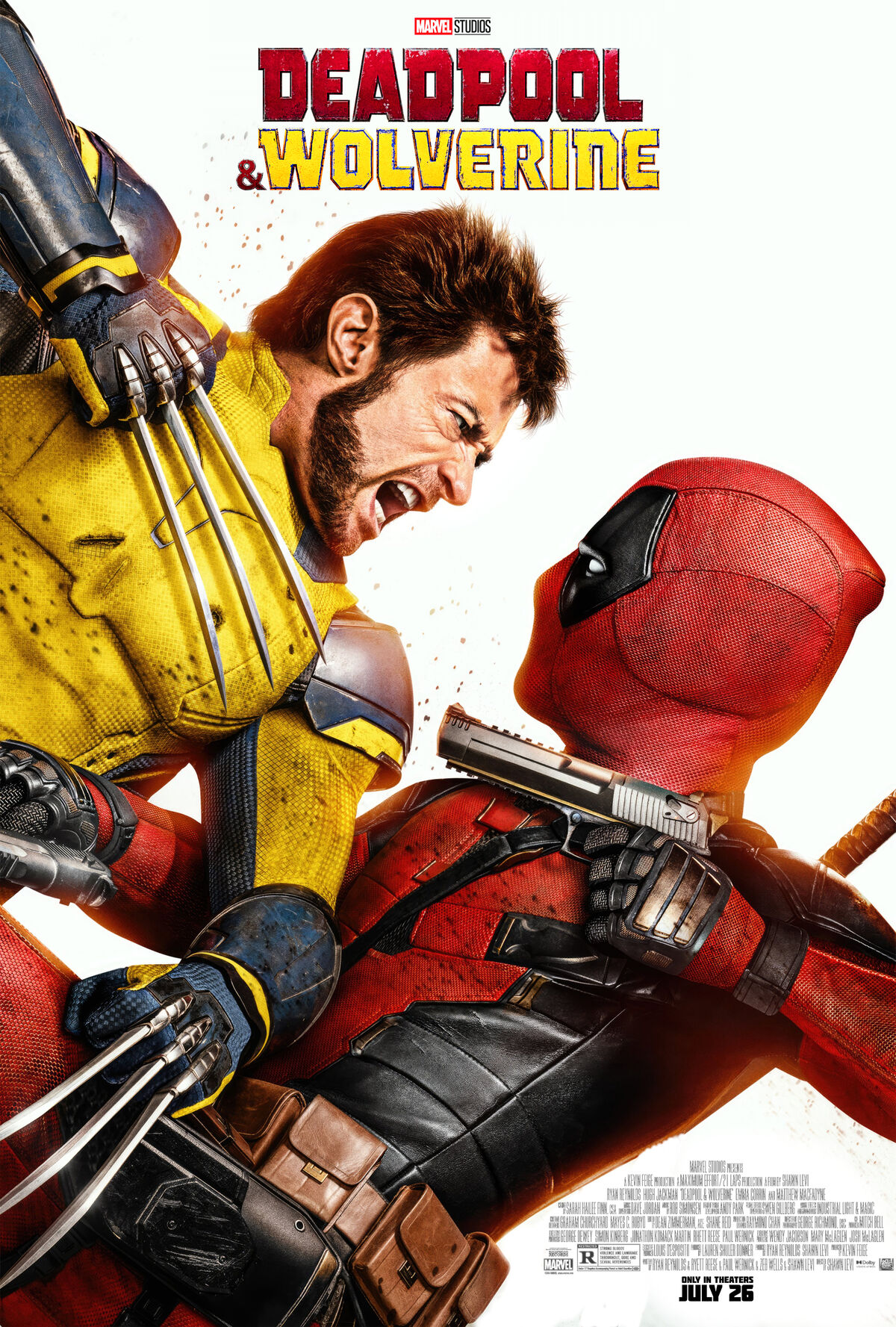
DEADPOOL & WOLVERINE movie review

Exhausting. Deadpool & Wolverine is a step down from its predecessors in terms of quality and cleverness of storytelling. While clearly intended to be a movie that reinvigorates the MCU, the screenwriting is both pandering and derivative. While effective in smaller doses, the hyper-meta humor is overplayed to the point of being obnoxious. Moreover, there are many gags that are recurring to the point of boredom. While expertly choreographed, shot, and edited, the endless barrage of fight sequences overstays its welcome. In terms of the premise, the whole multiverse idea that has been integrated into so many superhero movies (both MCU and DCEU) is overplayed. Had the movie been closer to 90-100 minutes, then perhaps the pacing would’ve been better and the Deadpool jokes, satire, and gags would not have felt overplayed, but the 2+ hours runtime works against the full potential of the narrative. If you can’t get enough of the Deadpool schtick, then you’ll undoubtedly like this movie. But if you were hoping for something as clever as the first two Deadpool movies, then you may be as disappointed as was I.

When the multiverse is threatened by a powerful Omega class mutant, Deadpool’s services are retained to protect the multiverse from complete collapse. In order to defeat this new deadly enemy, Deadpool teams up with the Wolverine, whom is recovering from psychological injuries.

Because of the movie’s setup, I had hoped that Deadpool and Wolverine’s goal would have been to eliminate all timelines except the sacred timeline (I guess that’s supposed to be the real/our world), putting an end to the multiverse, but that wasn’t the motivation or goal. So, I suppose that means the multiverse theory will continue steamrolling through this and other franchises. The whole multiverse theory needs to die. At this point, it is way past its half-life and rather limiting on the stories that can be told. Sounds counterintuitive, right? For how could a multiverse limit the stories that can be told? Simple. Everything is connected in a codependent sort of way. In a cinematic (including television counterparts) multiverse, no story, character, or plot is truly independent of the other; therefore, a filmmaker is unable to craft an original story; for any story involving the characters in a multiverse, has to fit in with the rest of the multiverse.

In a manner of speaking, a multiverse actually mitigates freedom of expression and variety of storytelling. When filmmakers return to crafting original expressions of stories and plots for comic book characters, then the quality of comic book movies may agin reach the levels of the Burton-verse. To this day, Batman 89 and Batman Returns are still the two best examples of superhero/comic book movies with X-Men the Animated Series being the best example of a superhero/CBM television series.

Fortunately, Hugh Jackman’s Wolverine’s gritty, no nonsense personality helps to balance out Ryan Reynolds’ manic Deadpool. While I have many reservations with this movie, I cannot deny the great chemistry between the two of them. Jackman’s X-Men the Animated Series inspired Wolverine was my favorite part of the whole movie. Partly because I grew up with X-Men TAS and have enjoyed the X-Men 97 series. Seeing that yellow and blue suit filled me with such happiness. Additionally, there are other nods to X-Men TAS and the Fox X-Men movies, including a particular surprise cameo that I know my friend Shawn of the Solving for X podcast will immensely enjoy! (If you’re an X-Men fan, then you should add this podcast to your lineup). What I liked most about this movie was the X-Men dynamic. Even though I have my reservations, I am curious how this newest iteration of cinematic X-Men will be adapted for the big screen. It is my hope that it will have the quality of storytelling of X-Men TAS that successfully addressed difficult topics in the real world both creatively and accessibly, all while bringing everyone to the table. Just as Professor X dreamed humans and mutants could engage in meaningful discourse one day.

Breaking the fourth wall and meta-humor can be effective tools for both humor and plot/character development; however, recurring pot shots and real-world references detract from the cleverness of the humor, and can ultimately take the viewer out of the movie. More so than the previous installments in the Deadpool franchise, this one is particularly packed with, what I am calling, hyper-meta humor. Hyper in that it’s so over the top and repetitive that it loses its charm quickly and grows stale. Most movies serve as a means of escape from the dullness, harshness, or complexities of reality; this is certainly true of superhero/comic book movies–or rather, was. I don’t know about you, but I don’t go into most movies hoping to be reminded of reality. Unless of course, for example, it’s based on a true story or a melodrama that is intended to evoke a real-world emotive response. So many of the jokes in Deadpool & Wolverine take me out of the movie, especially one recurring pot shot, that I won’t mention, that is borderline disrespectful of an historic Hollywood institution.

Despite most of the movie, in my opinion, to be lacking in genuine, clever humor, I manages to at least laugh here and there. The problem with a movie built entirely on the humor of middle school boys is that the move is ironically inappropriate for that same age group. When the first Deadpool released (by 20th Century Fox), they did the responsible thing by reminding parents that, even though this was a superhero movie, that its intended audience was 17+. I’ve yet to see an effort on Disney/Marvel’s part to remind potential audiences that this movie is rated R, and not appropriate for younger audiences due to the sexual innuendoes and language. Violence wise, other than the increased amount of blood, it’s on par with many PG-13 movies. When Deadpool hit the scene, he was different from that of most other superhero characters at that point, and his schtick was refreshingly funny; now, with the increased amount of middle school base humor in many comic book movies (mainly the MCU), it’s no longer refreshing and now borderline obnoxious. If I had to select one word that best describes Deadpool & Wolverine it would be obnoxious.

Ryan teaches Film Studies and Screenwriting at the University of Tampa and is a member of the Critics Association of Central Florida and Indie Film Critics of America. If you like this article, check out the others and FOLLOW this blog! Interested in Ryan making a guest appearance on your podcast or contributing to your website? Send him a DM on Twitter. If you’re ever in Tampa or Orlando, feel free to catch a movie with him.

Follow him on Twitter: RLTerry1 and LetterBoxd: RLTerry
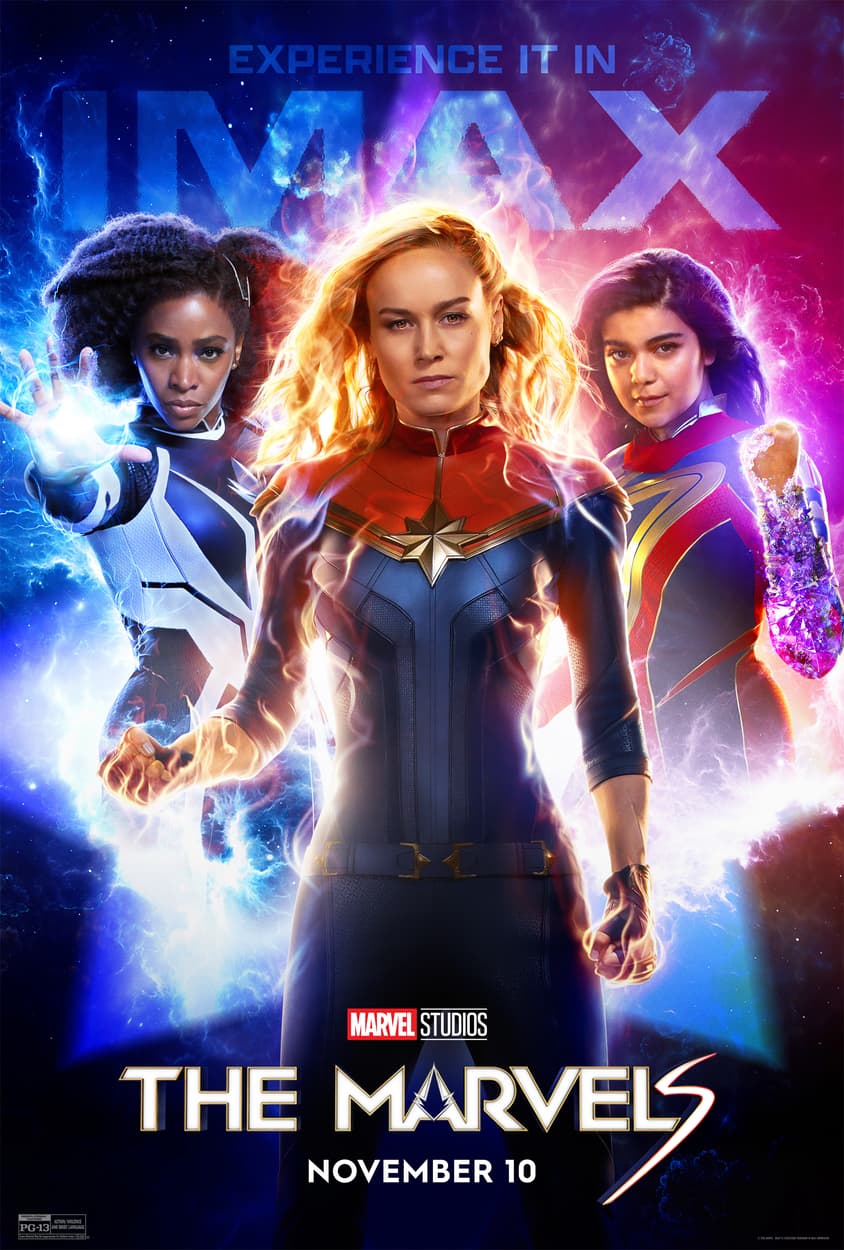
THE MARVELS movie review

by Amanda Firestone, Guest Contributor and Film Professor

I don’t know about you, but I’m burned out on superhero movies. By the time we got to Infinity War (2018) and Endgame (2019), I wasn’t sure I could sit through another CGI-explosion, epic battle fight fest. And I didn’t – until Wakanda Forever hit the screen (2022). While I loved seeing Shuri become Black Panther, that same drained feeling returned after two hours and forty-one minutes in the theater seat. Leaving the cinema, I complained to my spouse that superhero filmmakers squeeze in fight after fight, sacrificing tight storytelling. For what? I’m not sure.

Like Wakanda Forever, the draw for me to see The Marvels is the woman-led cast. When I look at the MCU lineup, I can’t help but notice that men’s stories are prioritized, particularly in Phases One and Two. While women characters are important to the teams or the general narratives, they frequently are outnumbered by their men counterparts. The Marvels unfailingly centers audiences on Carol Danvers, Monica Rambeau, and Kamala Khan. While the ever-present Nick Fury provides support, the three heroes strategize together to defeat their common enemy, Dar-Benn, who is also a woman.

In many ways, the joy of the film is the simplicity. It brings together three characters who initially have some friction. They build trust and confidence in their team, and then they fight the baddie. For my taste, Nia DaCosta understood the assignment; the movie is one hour and forty-five minutes long, and that means the pacing is solid without so many of those masturbatory fight scenes that bog down other Marvel films.

Another way that The Marvels avoids bloat is by bypassing frequent rehashing of MCU information. When I was leaving the theater, the critic behind me complained that he didn’t know what was going on because the film didn’t take the time to explain all of the backstories for the Marvels. He hadn’t seen their respective origin stories. We all know the MCU is sprawling, and very few fans are die-hard completists. The film spent the first 15-20 minutes introducing each character and situating her in her world. It was sufficient to say, “hey, this one’s a loner superhero; this one’s a teenaged superhero with a fangirl crush on the loner; this one’s a scientist superhero who has family drama with the loner.” For people who see The Marvels as their intro to the MCU, they have Captain Marvel, Ms. Marvel, and WandaVision to seek out if they want to add more layers to their knowledge. But, those other sources are not necessary to understand the heart of the movie – build a team and fight the baddie.

Speaking of villains, another success for this movie is Dar-Benn, a Kree Accuser who becomes emperor after the destruction of the Supreme Intelligence. The sun that her planet orbits is dying and as a result, so is the planet. Dar-Benn is a ruler on a mission to save her people – at any cost. While her methods are brutal, there’s a lot of empathy to be had for her, which makes her conflicts with The Marvels more interesting on an emotional level, particularly as we head to the final showdown.

I felt so much joy watching this film. Yes, there was some fanservice in the picture (one of the most dangerous creatures in the universe features prominently), and as a Marvel fan it’s nice to see those call backs. More than that, it was just an all-around great popcorn flick. There was a great balance of levity, seriousness, and intensity. I cared about the characters, and that’s especially true for the newcomers like Dar-Benn. It’s well-worth the cost of the ticket and the time.

Assessment 4.5/5 stars

Dr. Amanda Firestone is an Associate Teaching Professor at the University of Tampa where she teaches film and media studies classes including Women in Film. She is the co-editor of Resist and Persist: Essays on Social Revolution in 21st Century Narratives, Harry Potter and Convergence Culture: Essays on Fandom and the Expanding Potterverse, and The Last Midnight: Essays on Apocalyptic Narratives in Millennial Media

SPIDER-MAN: ACROSS THE SPIDER-VERSE movie review

Oh, what a tangled web [they] weave…with this cacophony of story threads. The highly anticipated sequel to the Best Animated Feature Oscar-winning Into the Spider-verse opens this week, but unfortunately, it suffers from a bad case of sequelitis brought on by a gluttonous consumption of excess. Spider-man: Across the Spider-verse works in title only–and all too well, as it were. The title says it all, and that is precisely what audiences get in this comic philhar-tragic symphony in the key of overindulgence.

After reuniting with Gwen Stacy, Brooklyn’s full-time, friendly neighborhood Spider-Man is catapulted across the Multiverse, where he encounters a team of Spider-People charged with protecting its very existence. However, when the heroes clash on how to handle a new threat, Miles finds himself pitted against the other Spiders. He must soon redefine what it means to be a hero so he can save the people he loves most.

Across the Spider-verse is what happens when a story idea doesn’t pass the elevator pitch litmus test (wherein an idea can be explained sufficiently enough in three-minutes or less). Quite simply, there is such a proliferation of story webs that there is virtually no plot–there is certainly no resolution before the (and this isn’t a spoiler) cliffhanger ending. Story webs lead into story webs that leads into even more story webs. Suffice it to say, it’s as if writers and producers took every incarnation of Spider-man comic series, threw them into a blender, and served the concoction o audiences. Unless you are read up on decades of Spider-man comics, you will be hard-pressed to follow any storyline. Perhaps the better expression of a collision of Spider-verses would have been in a television series that could have explored a different thread of comics each season.

Clearly, Sony took the extremely positive reception of the first one, focussed on recurring praises, and amplified those to the nth degree. Never mind that more than the visual expression of the story, plotting is crucial to structure, pacing, and coherency. The animators and artists are showcasing brilliance in animated filmmaking, but the clear evidence of screenwriting is nowhere to be found. Without a well-defined central character, a well-defined external goal, and a well-defined character of opposition between the central character and the goal, there is no plot–merely a sequence of loosely connected scenes or fragments of ideas. A fever dream, if you will.

While Across the Spider-verse suffers narratively, it certainly excels in the art of animation. The stylistic animation and editing is outstanding! Much like with the first movie, this one takes the emotive detail found in a single frame of a comic book (or graphic novel) and combines that approach with hand-drawn inspired motion picture animation. There are certainly problems with the story (or stories, as it were), but Sony Pictures Animation has demonstrably shown commitment to the boundless imagination and capabilities of animation. Across the Spider-verse, in how it is expressed in this movie, can only happen within the world of animation. In no way could this movie be expressed in a live-action way. Perhaps the writers were asleep at the wheel, but the animators gave each universe of Spider-man characters its own color palate and animation style.

Make sure to watch Across the Spider-verse in a premium format at your cinema, because the strength in this animated movie has little to do with the story as much as it does the stylistic animation. When a film, animated or live action, strikes a balance between style and substance, it can be enjoyed on the big or small screen without detracting from the storytelling; but when the movie struggles narratively but excels in form, then experiencing it on the big screen is the best approach.

Ryan teaches Film Studies and Screenwriting at the University of Tampa and is a member of the Critics Association of Central Florida and Indie Film Critics of America. If you like this article, check out the others and FOLLOW this blog! Interested in Ryan making a guest appearance on your podcast or contributing to your website? Send him a DM on Twitter. If you’re ever in Tampa or Orlando, feel free to catch a movie with him.

Follow him on Twitter: RLTerry1 and LetterBoxd: RLTerry