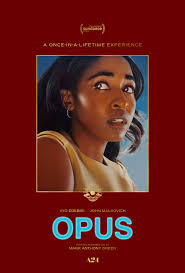
OPUS (2025) film review

An enigmatic puzzle with missing pieces. What starts as a fascinating psychological mystery quickly devolves into a series of disjointed, cryptic sequences that offer more questions than answers. Opus is certainly a haunting experience that delivers striking visuals, but the stylistic storytelling lacks substance, resulting in a film that is ultimately hollow. Like with so many A24 and Neon films, Opus is rich in atmosphere, but lacks strategic plotting, proper pacing, and demonstrable working knowledge of screenwriting mechanics. Moreover, it falls into an all too familiar trap of prioritizing aesthetic over storytelling. Opus is yet another example of modern arthouse cinema mistaking ambiguity for depth. The film posits many otherwise thoughtful questions, but leaves you wondering why you should even care about what you just watched.

Journalist Ariel (Ayo Edebiri) works for an acclaimed music magazine but has grown tired of her arrogant boss Stan (Murray Bartlett) assigning her good pitches to more senior writers. But following the reclusive, visionary pop star Alfred Moretti (John Malkovich) emerging from hiding after more than thirty years, Ariel’s boss is invited to his secluded, remote compound where he will be releasing a new album. Ariel and her boss are invited to attend as press. But not long after arriving, Ariel deduces that the compound’s collection of ardent admirers of Alfred are actually a cult with deadly plans for the guests.

Most of the film’s problems can be traced back to its screenplay. Like with many (if not most, in my opinion) writer-directors, this story likely made much more sense in Mark Anthony Green’s head, than it did on paper. I find that writer-directors often have excellent movie ideas and eyes for shot composition, but lack a working knowledge of screenwriting mechanics. Had Green collaborated with a more established screenwriter, then the film may not have had the plotting issues that plagued it the whole time.

Adding to the film’s plotting issues is its reliance on repetition rather than escalation. Scenes blend into one another with minimal variation, creating a sense of stagnation rather than rising tension. Ariel’s, our central character’s, journey is more about cycling through eerie encounters and vague hallucinations than actually uncovering deeper truths. Without a clearly defined external goal for Ariel, Opus feels like a film more concerned with its own mystique than engaging its audience. The goal could’ve been something as simple as getting the article published, but the film never quite has a throughline on which to land the diegetic plane.

While strong, the performative dimension of the film is underscored with style over substance. Ayo Edebiri’s performance is layered and emotionally compelling. Unfortunately, the film gives her little to work with beyond surface-level tension. John Malkovich, always a commanding presence, delivers an eerie gravitas, but his role feels more like a cryptic device than a fully developed character.

One of the biggest shortcomings in character development is the lack of meaningful relationships. While Opus teases conflicts between Ariel and her boss Stan, these tensions never evolve into anything substantial. All around, the film’s characters never form real, emotional connections, leaving their interactions feeling hollow. Without compelling relationships, the film struggles make us care about any of the characters, much less the central character of Ariel.

Opus seems content to let its themes remain vague, as though interpretation itself is the art. This approach works in moderation but ultimately leaves the film feeling like an unfinished composition—beautiful in pieces but lacking a resonant core.

A24 has perfected the art of marketing “prestige horror” films that emphasize mood over traditional storytelling. While this approach has resulted in some modern masterpieces such as “The Blackcoat’s Daughter,” “Hereditary,” and “Midsommar,” it has also encouraged a wave of films that mistake ambiguity for intelligence. Opus is a prime example of this trend, prioritizing its hypnotic cinematography and eerie sound design over a screenplay that provides emotional or intellectual engagement.

This raises the question: Has arthouse cinema become so obsessed with being enigmatic that it has lost sight of storytelling? Moreover, has the proliferation of “arthouse” films become the very thing they opposed: the mainstream? Films like Opus appear to be forcing audiences to assign meaning where there may be none, and delivering a film that looks great but is ultimately forgettable. The present trajectory of many arthouse film is trending is becoming the new cinematic fast food: tasty but forgettable and lacking in nutrition. In striving for profundity, these films, risk alienating viewers who crave narrative satisfaction alongside visual artistry.

There’s no denying Opus is visually arresting and technically impressive. Mark Anthony Green’s direction is meticulous, and Ayo Edebiri delivers a gripping performance. But beneath its meticulously crafted atmosphere lies a film that lacks emotional weight or thematic clarity. For fans of slow-burn psychological horror and puzzle-box storytelling, Opus may still be a rewarding experience. For others, it’s yet another reminder that style, no matter how dazzling, can never replace substance or sheer entertainment value.
Ryan is the general manager for 90.7 WKGC Public Media in Panama City and host of the public radio show ReelTalk about all things cinema. Additionally, he is the author of the upcoming film studies book titled Monsters, Madness, and Mayhem: Why People Love Horror. After teaching film studies for over eight years at the University of Tampa, he transitioned from the classroom to public media. He is a member of the Critics Association of Central Florida and Indie Film Critics of America. If you like this article, check out the others and FOLLOW this blog! Follow him on Twitter: RLTerry1 and LetterBoxd: RLTerry
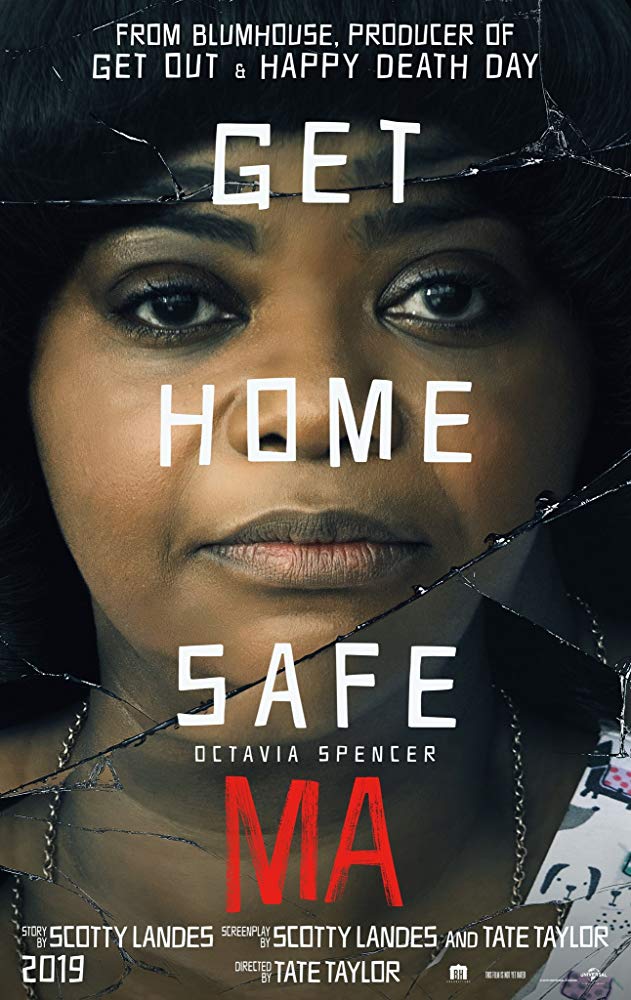
“MA” Horror Movie Review

A delightfully disturbing and thought-provoking Carrie meets Misery horror movie. Oscar-winner Octavia Spencer delivers an outstanding performance; however, the movie is unfortunately hampered by a weak screenplay with flat characters. In short, the reason to watch this movie is for the terrifying performance by Spencer, solid world-building, and commentary on high school bullying and teen sexual assault. Tonally, MA is a throwback to 70s and 80s slasher horror complete with the slow-burn windup, off-beat comedic schticks, and a descent into gnarly violence. Not all the kills cause you to wince as the screen holds your eyes hostage in the pleasurable unpleasure, one of the kills will leave you cheering–no seriously, it will. Built upon the premise of the sins of the parents will be visited upon the children, the screenplay does not hold back when taking us to some very dark places that fester with anger, fear, and resentment. With so much going for it, it’s unfortunate that the movie suffers from on-the-nose dialogue, leaving little room for subtext. Furthermore, most of the characters lack significant dimension that could have propped up this movie. Some interesting relationship dynamics and backstory are touched on, but never followed through in a meaningful way. While Spencer is truly the glue holding this movie together, there are some highlights worth discussing.

A lonely middle-aged woman befriends some teenagers and decides to let them party in the basement of her home. But there are some house rules: One of the kids has to stay sober, don’t take the Lord’s name in vain, and never go upstairs. They must also refer to her as Ma. But as Ma’s hospitality starts to curdle into obsession, what began as a teenage dream turns into a terrorizing nightmare, and Ma’s place goes from the best place in town to the worst place on Earth. (IMDb)

While most of the characters lack any true dimension (except Ma), the ensemble cast is comprised of some highly relatable characters. At the forefront of the cast is our title character of Sue Ann (or Ma). If you are coming to this movie as a single individual over 30, then you will likely identify with her by empathizing with her backstory and understanding what it’s like to feel that life is a parade passing as you wave it by. Furthermore, Sue Ann suffered repeated bullying, rejection, and even teen sexual assault that left a lasting psychological trauma. Or maybe you are the former popular high school Erica who moved away from her jerkwater town to Los Angeles, lived a wealthy life, just to wind up a divorcee and back in your hometown as a cocktail waitress. Perhaps you are the new girl at school Maggie, who grew up in Los Angeles but now is back in dismal Ohio during your junior or senior year of high school because your dad left your mom (Erica) for another woman. You could be the Regina of your group of friends, the dude bro, or the all American boy with a touch of geek. Whatever your high school experience or how it affected your adulthood, there is likely a character with whom you can identify.

Although the film could have commented more on the PTSD associated with high school bullying in a more meaningful way, and derived even more horror from it, it does serve as an exploration of the real, lasting effects on the psyche. A brief character analysis of Sue Ann reveals someone who is trying to capture that which evaded her in high school: the parties, the romance, the care-free friends. Because of the abominable treatment of Sue Ann by many of her classmates in high school, she suffered a trauma that mitigated her ability to socialize properly and psychologically mature. Therefore, as she grew older, she was constantly reminded of that which she could not experience in high school. So, when she saw a moment to reconnect with her youthful self in being needed by the group of teens outside of the gas station to buy alcohol, she seized the opportunity. Of course, the fact that our all American boy Andy is the son of the guy she crushed on in high school, definitely helped her make the decision to help. Unfortunately, her high school crush was responsible for the sexual assault she endured. A sin for which both father and son would pay. It doesn’t take long for the teens to see the cracks in Sue Ann’s fragile veneer. While the teens enjoyed Sue Ann’s party house and the charismatic Ma, things were fine. When they rejected her, things took a grave turn for the worst. And just like that, she was reminded of the torment from their parents in high school and began to plot her revenge on both the teens and their parents. In this respect, she is a little like Freddy Krueger because in A Nightmare on Elm Street we have the concept of the sins of the parents will be visited upon the children.

If you went or are going into Ma with the desire to see a terrifying horror movie from start to finish, then I need to warn you that this is a slow burn horror movie. Not, that slow burn is without its intrigue and suspense, after all, this is where the world and relationship building happens. However, this movie does not reach its horror status until the third act. But once the horror hits, it hits hard–gnarly even. Even the kills/tortures that you saw in the trailer still pack a powerful punch. Most of kills are nightmarishly real. Very little visual effects here; you get the benefit of some highly authentic practical effects. Yes, even the lip sewing scene. Probably one of the most disturbing torture and kills involves animal blood; this moment is nice homage to both Misery and Carrie, but not a copy of either. There is a poetry to the tortures and kills. No one is targeted out of sheer happenstance, but targeted because of whom or what they represent. The sins by which Sue Ann judges the teens or parents are directly connect to or represented in the manner in which they meet their demise. More than the creativity in the actions of Sue Ann, the reasons why she feels the way she does are the most interesting. Even though we should be disgusted at the actions of Sue Ann, we cannot help but empathize with her because of her troubled history and past trauma. She wants what any of us want: to love, have our love returned, and be accepted.

Is it a great horror movie? No. But is is a solidly good one? Yes. If for no other reason, you watch Ma for the outstanding performance by Octavia Spencer! She is absolutely captivating and will leave you with many WTF moments. Interestingly, this is not Spencer’s first time in a horror movie; she was in Rob Zombie’s Halloween II. I hope that we get to see her in more horror movies in the future because she did such a fantastic job with this one. If you’re looking for a fun, popcorn horror movie that–to its credit–does have some thought-provoking content, then you’ll enjoy Ma.

You can catch Ryan most weeks at Studio Movie Grill Tampa, so if you’re in the area, let him know and you can join him at the cinema.

Ryan teaches screenwriting at the University of Tampa. If you like this article, check out the others and FOLLOW this blog! Interested in Ryan making a guest appearance on your podcast or contributing to your website? Send him a DM on Twitter!

Follow him!

Twitter: RLTerry1

Instagram: RL_Terry