WICKED: FOR GOOD movie musical review

Some movies soar on broomsticks; this one never quite gets off the ground.
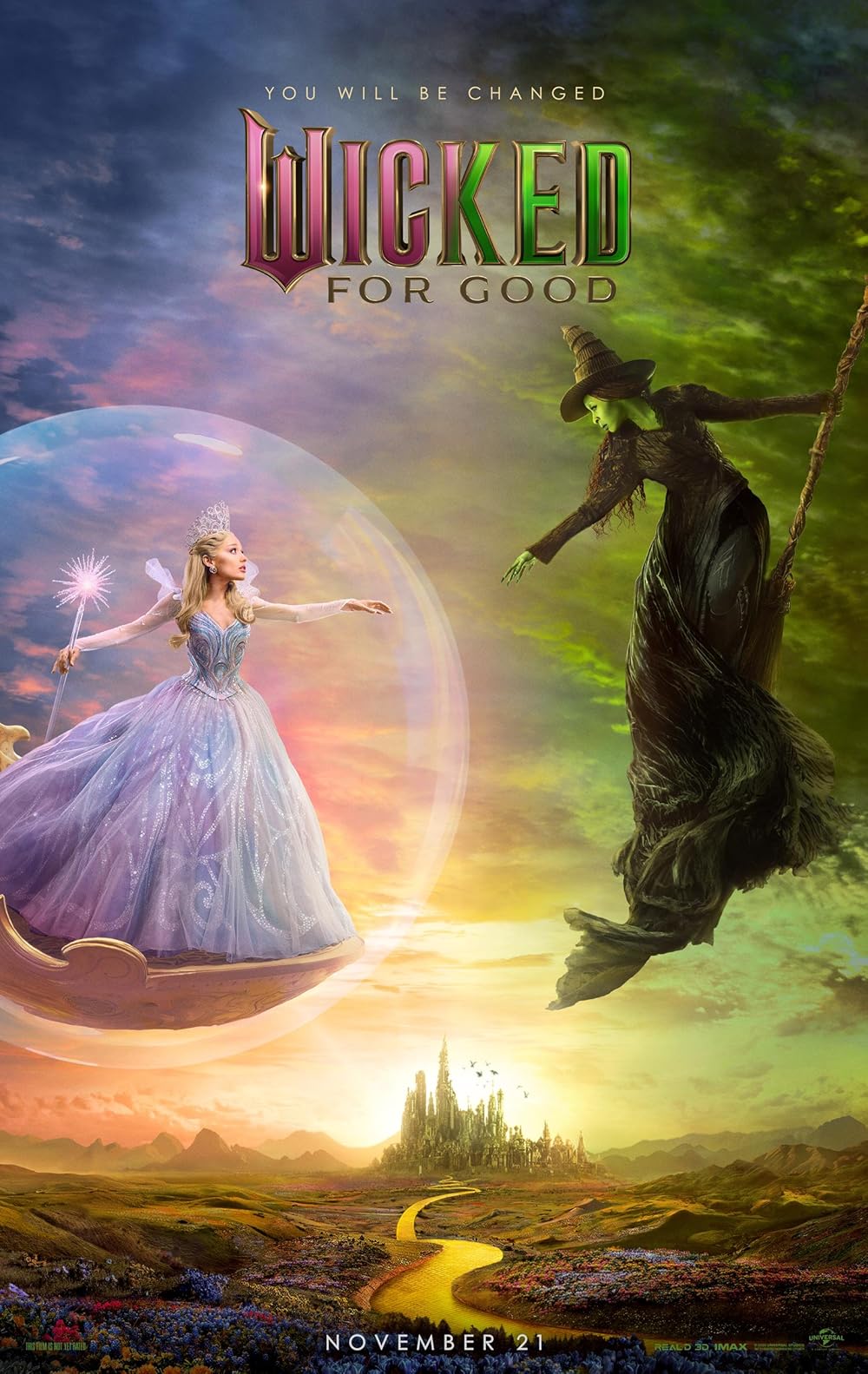
Wicked: For Good arrives with sky-high expectations, a beloved Broadway pedigree, and a cinematic world forever shaped by the 1939 Wizard of Oz. And while the heart for the material is undeniably present—director Jon M. Chu’s affection radiates through nearly every frame—the execution is fraught with problems that prevent the film from casting the spell it so eagerly attempts. It’s a movie overloaded with spectacle yet starved of narrative discipline, regrettably proving that sometimes a production can have all the right ingredients and still mix the potion incorrectly. There’s no question Jon M. Chu loves this material—his enthusiasm is evident. But passion alone isn’t enough. The film desperately needed stronger producing and organizational forces to ground the project, refine its pacing, and balance its emotional register. Instead, we get a production that feels at once over-managed and under-shaped.

Now demonized as the Wicked Witch of the West, Elphaba lives in exile in the Ozian forest, while Glinda resides at the palace in Emerald City, reveling in the perks of fame and popularity. As an angry mob rises against the Wicked Witch, she’ll need to reunite with Glinda to transform herself, and all of Oz, for good.

The most glaring issue in this movie is the pacing. This story never needed to be two movies. One Broadway show, one complete screen adaptation—simple math. Instead, Wicked and Wicked: For Good, collectively, feel like a single narrative forcibly stretched and compressed simultaneously. Scenes either end abruptly or linger with self-importance, giving the whole film a stop-and-start rhythm that betrays any emotional momentum. Moments that should breathe are suffocated, while others that should be tightened sprawl endlessly. Narratively, the film leans heavily on contrivances rather than character and plot development. Plot turns feel telegraphed or unearned, creating a sense that events are happening because the script demands it—not because the characters have earned the journey. Emotional beats are pushed rather than developed; the film tugs at heartstrings it hasn’t taken the time to weave. Many sequences feel manipulative instead of meaningful, leaving the viewer aware of the strings being pulled rather than swept up in the melody.

The film maintains the emotional equivalent of flooring the accelerator from beginning to end. Everything is heightened, everything is urgent, everything is presented at maximum volume. Without quieter resets, the story becomes exhausting rather than exhilarating. The lack of modulation leaves little room for nuance, making even potentially impactful moments blur together into one extended crescendo.

And then there’s the Oz problem itself–it was bad enough in the first movie, but this one amplifies all the flaws in this picture. From the opening Universal logo and Wicked title card, both stylized to resemble their 1930s counterparts, it’s clear the film wants to position itself adjacent to the classic Wizard of Oz. (And yes, I am aware that the Broadway show is based on books and not the 1939 classic, but this is a screen adaptation that is going to by default be connected spiritually and literally to the events, imagery, and characterizations of the original movie, but I digress). Whenever Wicked intersects with that iconic imagery, the visual and narrative disconnect is jarring. Tonally, textually, and aesthetically, nothing matches. Two of the most egregious examples are the Wicked Witch of the West’s castle, a location fundamentally misaligned with its 1939 counterpart in both history and design, and Glinda’s bubble. Hello??? She is clearly a magical being and travels by a magical bubble. To rob her of those elements is to rob her original characterization. For a film so eager to evoke some level of nostalgia, its disregard for consistency with cinema’s most beloved fantasy feels baffling.

The editing is among the film’s most distracting flaws—awkwardly timed transitions, uneven scene construction, and moments that feel spliced for convenience rather than cohesion. The cinematography dazzles with color and movement but contributes little to storytelling. It’s all flash, no narrative substance: beautiful images that ultimately amount to little more than digital confetti. And we cannot talk editing without addressing teh cringe CGI–the kind of digital spectacle that feels less like movie magic and more like a rough animatic accidentally exported at full resolution. Emerald City looks less like a tangible place and more like a high-end screensaver—everything polished to a rubbery sheen, with no texture, grit, or atmospheric depth. Characters often appear detached from their surroundings, as if composited into a digital diorama rather than inhabiting a lived-in world. Instead of mixing practical sets with digital enhancements, the film leans heavily on full-CG environments and even characters, resulting in octane-fueled and intimate moments feeling artificial. It’s like looking upon a world of fantasy that feels more like a giant animated backdrop with actors placed within versus a world that feels tangible.

Not even the presence of Michelle Yeoh is enough to elevate the film’s sense of class or gravitas. Although, it’s hard to blame her, given that she’s phoning in a performance built on scraps of narrative substance. In this second installment, her character is little more than an ornament of prestige, offering neither meaningful development nor any real impact on the story. Jeff Goldblum, likewise, delivers a surprisingly muted turn, coasting on his trademark charisma without ever fully engaging. When two performers known for commanding the screen seem this disengaged, it speaks less to their abilities and more to a film that gives them virtually nothing with which to work.

Wicked: For Good reaches for greatness but ultimately fails to stick the landing. It’s a film overflowing with heart yet undercut by structural missteps, contrived plotting, mismatched continuity, and a visual approach that prizes spectacle over substance. For a story about defying gravity, it’s ironic that this adaptation never quite lifts off the ground.
Ryan is the general manager for 90.7 WKGC Public Media and host of the show ReelTalk “where you can join the cinematic conversations frame by frame each week.” Additionally, he is the author of the upcoming film studies book titled Monsters, Madness, and Mayhem: Why People Love Horror. After teaching film studies for over eight years at the University of Tampa, he transitioned from the classroom to public media. He is a member of the Critics Association of Central Florida and Indie Film Critics of America. If you like this article, check out the others and FOLLOW this blog! Follow him on Twitter: RLTerry1 and LetterBoxd: RLTerry
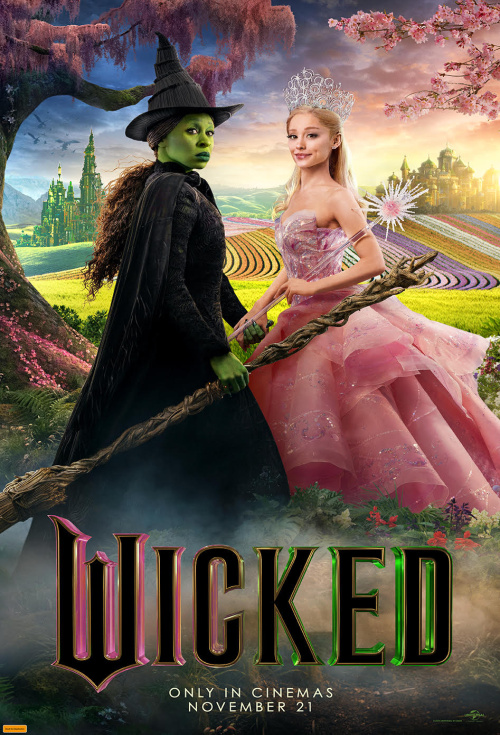
WICKED movie musical review

By Kurt Feigelis

“A true cinematic spectacle!”

Dear Journal,

It’s been so long since we talked it honestly feels like the first time. Well it happened the Wicked movie finally came out–well partly. I was lucky enough to attend the Press Screening in Tampa. The beloved musical from Broadway has been turned into a film (or more correctly two film installments), and everything leading up to this movie makes you think it wouldn’t work. But surprisingly it did.

I know you know the show, but just in case you forgot. This is the story of the Witches of Oz, of The Wizard of Oz, and boy did a lot happen before Dorothy dropped in. It follows Elphaba (Cynthia Erivo), while at Shiz University and her inevitable journey in becoming the Wicked Witch of the West. Alongside her roommate Glinda (Ariana Grande), an unlikely friendship grows. The themes of being an outsider and yearning to belong rings true in this adaptation. 

Everything leading up to this release makes you think that it should not have worked. Split into two films, Part 1 is too long, the cast has “too many stars”, and has been in development hell for over a decade. Rumors of a movie have been online for about as long as the musical has been on Broadway. Cast rumors include everyone from the original Broadway Cast, to Lea Michele and Amy Adams. But the core of the team was the producers, some of the same names you will find from the original Broadway show, and I think that is why the film works. The rare exception where the producing team delaying the movie for the right cast and director worked. Maybe development hell isn’t always a bad thing.

Wicked Part 1 sings with the feel of classic cinema. I think that came down to the Direction of Jon M. Chu (Crazy Rich AsiansIn the Heights). With a focus on real and large 360° sets, practical FX, live singing, and stunts. There is this feeling of realism to this fantastical world. The attention to detail and to do as much on camera as possible captures a live energy most movie musicals do not. Chu has a history of work in music videos, musical films, and large ensemble casts. This properly prepared him for this piece. 

Erivo is just wonderful as Elphaba. This roll is so well known with productions of the show playing all over the world in six different languages. But this is what the magic of what film does. In the theatre you got to play big, to the back of the house. Here, she is able to play it small, the little moments and movements play big for the screen. You get a closer connection to Elphaba you cannot get from the stage.  

Grande shines as well, and you know me, this was the role I was most concerned about. Grande is a very talented performer but many times it is Ariana Grande singing, when she is acting it’s always Ariana, not her character. I am happy to say she truly disappears into Glinda, the (very) Good Witch of the North. This is a testament to her work with vocal and acting coaches she started using even before she auditioned for the part. The comedic role is so often overlooked, but Grande brings something deep to Glinda in this adaptation. Erivo and Grande together, their friendship, is the heart of the movie. The rest of the supporting cast are as wonderful as you would expect with the names listed. There honestly wasn’t a surprise there. 

The musical numbers are pure entertainment. Usually in a movie musical the song and dance just doesn’t seem natural but Wicked does it right. The songs are already well know but they are modified and changed just enough to make them truly cinematic. The Wizard and IPopularDancing Through Life, and the film’s finale Defying Gravity are highlights for sure. 

If you want to nitpick some issues, the sound mixing was unbalanced throughout the movie. Between some of the musical numbers and dialogue scenes, there is an inconsistency. I don’t know if it was the theatre I was in, or the film itself. But, I feel it was the film. There are times when the score is overpowering the vocals. A film this long is always a bit intimidating, especially when trying to bring in a new audience.   But somehow the pacing works. The film doesn’t feel long while watching it. The extra moments with the characters and being brought into this world is much needed. There was not much added into this half of the story. But when transitioning from the stage to the screen. We need extra time for the camera to bring us into the world, to sit and connect to the characters. That is the reason for the additional time. Like Kill Bill, it feels more organic than forced or a money grab like other movies that get split into two.

Live musicals and Broadway adaptations are still a hard sell for audiences, even more so after Joker 2. I think the movie will do well, but with Gladiator II and Moana 2, there is stiff competition, Universal knows this which is why they upped the release date. It feels as though if a movie doesn’t make $1 Billion, it’s not a success to producers or the zeitgeist. Wicked Part 1 will do well with those who love the musical already, but I don’t know if new audiences will be pulled into this one. Which is a shame because it is a good film on its own. I’m curious what newcomers will say about the story and its quirkiness. 

The fandom of Wicked have been talking rumors for over ten years for this film. Then picking apart every visual and audio clip, still, and poster leading up to the premier. Sometimes the fandom does a disservice to what they love. Because of this I think the studio is nervous about the movie, releasing multiple interviews, behind the scenes and clips of the movie online leading up the premier. But out of context these clips are splitting its audience already familiar with the show. The reality is, the film does work. But remember this an adaptation not a remake or recreation of the stage show. Cinema has the power to expand the storytelling and that is what Wicked Part 1 is doing here.

Journal, in the end we need to remember what this movie is. It is the long awaited film adaption of a beloved Broadway Musical. To those that have seen the show I think they will love this movie without taking anything away from what they can see on stage. For a new audience, I think like Chicago, this will breathe new life into an existing phenomenon. People familiar with the show and The Wizard of Oz will see homages to both throughout the film. 

Part 2 comes out sometime in 2025, probably in November as well. We don’t know the run time of the follow up, or any details at all really, but until then we have this film to enjoy. What comes next is all the speculation, rumors and judgments for Part 2 that we had with Part 1. There is something about judging something or someone before getting to know it (or see it) that is unsettling given the story we are all here for. I think Elphaba might have something to say to us about this, but she wouldn’t be surprised.

You’re Movie Buddy,
Kurt Feigelis
R.L. Terry ReelView contributor

JURASSIC WORLD DOMINION movie review

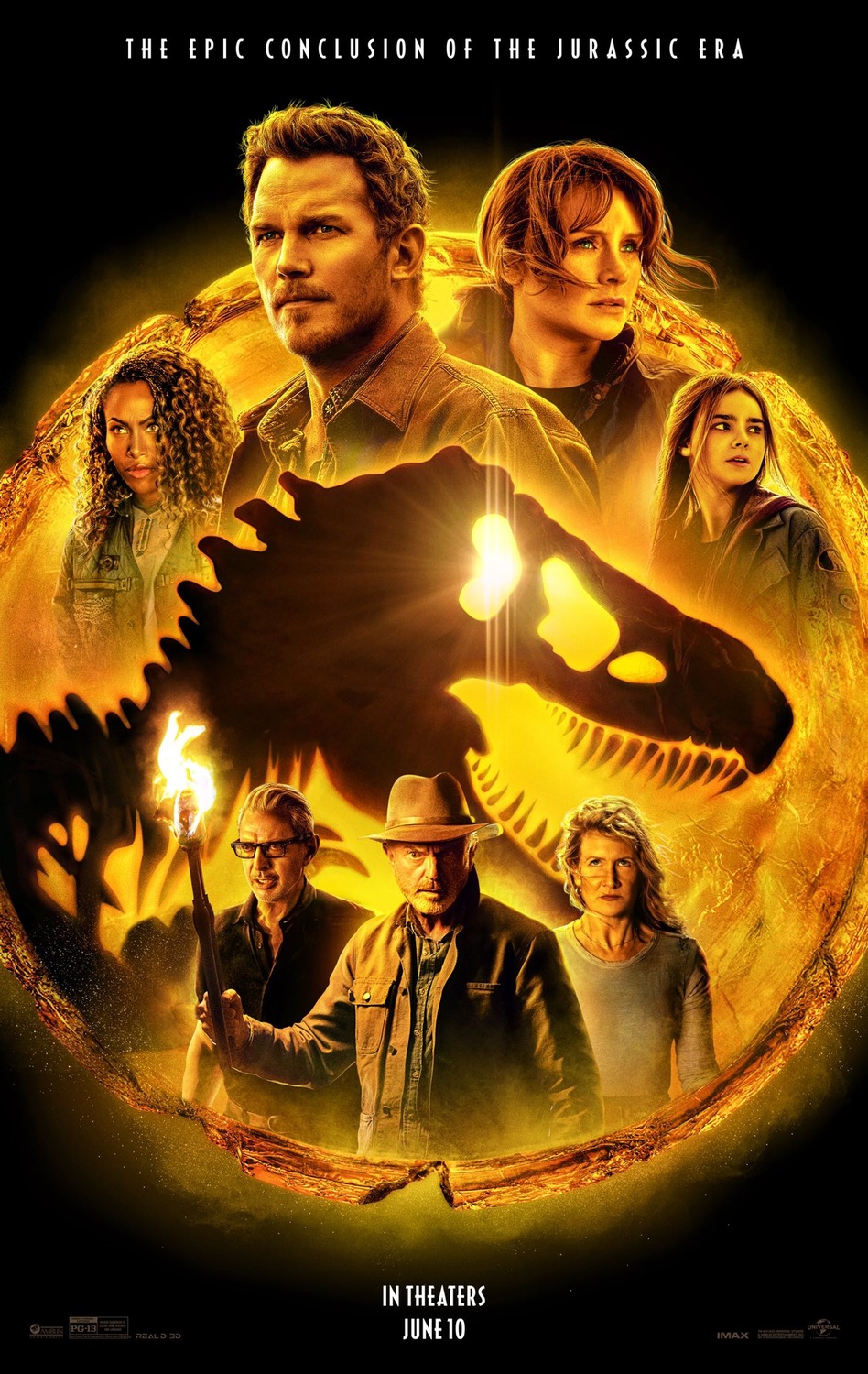
Some stories are best left extinct. Looks like we need to implement the lysine contingency with this one. Don’t bring anything back that you cannot control. Jurassic World Dominion represents the final nail in the coffin of this once best picture quality motion picture property. It’s as if the writers never watched the original Jurassic Park nor read Crichton’s masterful novels Jurassic Park or The Lost World; simply watched highlight reels and read Sparknotes. After the disappointing Fallen Kingdom, I was hoping the writers and producers would take that as a cue to return to the legacy franchise’s roots. Instead, this bloated, glorified B-movie (and that’s being generous) delivers an abysmal story, a convoluted web of competing plots, and wasted characters, all underscored by a CGI crapfest of dinosaurs (or, it could be the inverse). Extinct is the magic that made the original one of the most beloved motion pictures of all time. Furthermore, this movie is perpetually in the third act, leaving little room for setup and development. With so much brilliant material from which to pull in the original film and two novels, how on earth did we get the preposterous slapdash story (rather, collection of stories) that we did??? It truly pains me to have to write about the franchise this way, as Jurassic Park is my No.1 favorite film of all time. I think I’ll cleanse my cinematic palate and rewatch Maverick for a third time or watch Jurassic Park at home. Even the first Jurassic World is far more enjoyable than Dominion.

The future of mankind hangs in the balance as humans and dinosaurs coexist following the destruction of Isla Nublar, another Biosyn/InGen dark secret is revealed, giant locusts pose an eminent threat to agriculture, and Owen and Claire embark on a dangerous rescue mission. (Yeah, all of that is in the movie).

There is soooo much going on, here. Clearly, Trevorrow, Emily Carmichael, and Derek Connolly struggled on any singular outside-action story, and made the unfortunate decision to just go with all of their ideas, everywhere, all at once. And when that didn’t work (surprised, as they may have been), they knew they had to get the Jurassic Trinity back (Dern, Neill, and Goldblum) in order to try to make something of this diegetic mess that was probably greenlit while drunk. Seeing the original cast all together is one of the few highlights from the movie, but I wish they had been given more agency and depth. Moreover, character development is a struggle all the way around.

While one may attempt to argue that all art is completely subjective–I assure you that is not the case. Yes, there is subjectivity in art, but there are also accepted best practices and conventions that are time-tested and should be adhered to in order to tell a thoughtful story with logical plotting (unless you know how to break them, and this movie did not). Jurassic World Dominion is objectively found wanting. Not even so bad, it’s good, just bad. Cheesy B-movies with dinosaurs from the first half of the 20th century are more coherent.

When I watch movies like this (like this, meaning movies that really should be taken seriously out of respect for the source material and predecessors), I wonder how on earth could a team of writers forget the screenwriting fundamental convention and best practice of simple plot, complex characters. Instead, in Jurassic World Dominion, we get simple characters, complex plots. The inverse of what works dietetically and cinematically. The outside-action story (supported by strategic and coherent plotting) should be easy to follow; however, the emotional/cerebral subplots and character development add the thoughtful complexities that provide depth for cinema. While none of the Dominion stories Trevorrow attempted to bring to to the silver screen are compelling in any way (and contradict past precedent plotting or themes set in the franchise), any two of them would have made for a better main and subplot than any combination of all 4+ of them.

The fan service is both prolific and incredibly forced. Is there anything wrong with strategically placed fan service–those moments or references that only legacy fans will appreciate? No, definitely not. Is there anything wrong with fan service that isn’t emotionally earned in the present movie? Yes, definitely yes! From beginning to end, the fan service is everywhere, and very few of those moments pay off dramatically or emotionally. Perhaps if Maverick had come out first, then Trevorrow’s team would have observed how to integrate nostalgia and throwbacks perfectly. Nostalgic gestures like most of the ones in this movie are empty–devoid of any substance. There is one moment, in particular, that is so unlikely (the logic escapes me) to have happened that it’s practically impossible; however, it’s written into the movie in an attempt to forcibly craft some poetic justice.

If you’ve read the novels Jurassic Park or The Lost World, then you’ll remember how significant the character of Lewis Dodgson is. And, I did appreciate how Trevorrow brought Dodgson and Biosyn back because the roles they play in the novels, especially The Lost World, are incredibly signifiant to the plot. No spoilers, but Dodgson is way more than the guy that paid off Nedry to steal the embryos and giving rise to the GIF and callback “Dodgson, Dodgson, we’ve got Dodgson, here!” I just wish Trevorrow and his team took more inspiration from the novels than a singular character and company. Honestly, The Lost World novel could have been adapted to fill the role as the tertiary movie in the Jurassic World trilogy, considering very little of the plot in the novel was used in the movie adaptation.

Thematically and subtextually, Dominion experiences great trouble. The themes are both counterintuitive to itself and the preceding five films. Much of the subtext defies all known logic, both logic in terms of real-life ecology and how the science of the films was presented in the past. Instead of using the world of the films to write the next and final chapter in the Jurassic era, Trevorrow forces his ecological and anthropological opinions on the plot and characters. Nothing wrong with a writer-director doing that, but it has to be setup diegetically in order to have the payoff the writer-director desires. Otherwise, it sticks out like a puzzle piece that doesn’t quite fit the rest of the puzzle. Nothing in science supports predators and prey or two competing carnivores peacefully coexisting in some sort of ecological utopia; it’s illogical.

To end on a positive note, and aside from the return of the original cast, there is only one part (well, it’s really two scenes) that put a big smile on my face. And it’s the return of the Dilophosaurus!! And considering she makes an appearance in the trailer, this is not a spoiler. It’s only taken since 1993 to give Dilophosaurus some (non-holographic) screen time! I’m glad it wasn’t turned into a main dinosaur in this movie; how she was reintroduced and used was just right, and has a great payoff.

If you love the original Jurassic Park and first 2/3 of The Lost World, then you’re probably going into this one with the wrong mindset. If you go in with a desire to be entertained by a glorified popcorn B-movie, then you’ll likely have more fun than I did. Perhaps I went in with the wrong mindset, thinking that it was going to fix what Fallen Kingdom failed to do. Do yourself a favor, and watch it in IMAX, Dolby, or other premium format because it is a visual spectacle that is in perpetual third act gear the whole time.

Ryan teaches Film Studies and Screenwriting at the University of Tampa. If you like this article, check out the others and FOLLOW this blog! Interested in Ryan making a guest appearance on your podcast or contributing to your website? Send him a DM on Twitter or email him at RLTerry1@gmail.com! If you’re ever in Tampa or Orlando, feel free to catch a movie with him.

Follow him on Twitter: RLTerry1

“Thor Ragnarok” movie review

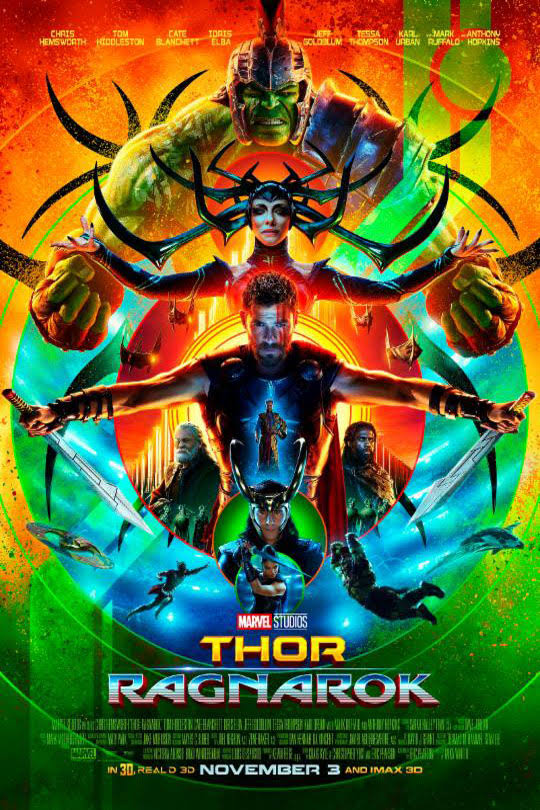
Norse mythology meets Gladiator meets 80s vintage video game in this non-stop adrenaline pumping action film. Suffice it to say, everything you’ve heard about Thor Ragnarok from your friends is true. It is an incredibly fun movie that is equally well written and directed. For anyone who follows my blog, it is no secret that I typically do not like the Disney-Marvel films (and for good reason), but the focus of this review is on THIS particular film. I state that because, honestly, I very much enjoyed this film! So, it comes from liking the structure, characters, plot etc. not just from being a fan boy, or lack thereof in this case. Not only an excellent third sequel, but this movie can easily stand on its own. Whether you have watched the other MCU (Marvel Cinematic Universe) films or not, you can rest assured that you can enjoy this superhero movie. With the way the initial trailers were cut, I thought that this was MCU’s way of jumping onto the 80s nostalgia band wagon–not so. Oh, there is definitely an 80s video game vibe about the film, but the focus is on the characters and storytelling, not the nostalgia. There is also a self-aware element of this film. Not to the extent Deadpool is self-aware, but Chris Hemsworth’s Thor has a twinkle about his eye that winks at the audience so that we know that he is aware of the corniness and ridiculousness of the characters and plot. But the magic of this film is just how well balanced the content of the film is. There were many times that the plot lended itself to falling apart, but the solid cast held the film together and provided audiences with one of the best movies in the MCU.

When Thor learns of a dark, hidden family secret, he must confront the deadliest enemy he has ever faced off with in his life. But the legendary hero encounters far more than he ever expected. The mighty Thor finds himself imprisoned on a faraway planet and forced to battle in gladiator-style games. Little does he know that the winningest challenger on the planet is his former ally The Hulk. Thor must survive the deadly gladiator-like battles in order to build his team to defeat Hela, the Asgardian goddess of death who is destroying his home world.

One of the principle themes in this film that enables this one to be more and deeper than other MCU films is just how similar it is to a conventional war picture. There are hints of courts of intrigue as well. The complex plot provides a comprehensive foundation upon which a more superficial story can be developed in order to appeal to wide audiences, with few appreciating the deeper themes and subtext. But it takes more than effective and well-developed writing to build such a solid movie, it takes multi-dimensional characters portrayed by impeccable screen talent. You’ll find all of that in Thor Ragnarok. Although his screen time is brief, Anthony Hopkins’ Odin commands the screen with confidence, wisdom, and sincerity. Few actor’s can take a few minutes of screen time and put more cinematic magic in it than Hopkins. After all, he won his Oscar for Silence of the Lambs for his collectively few minutes on screen. Joining the cast are Jurassic Park’s Jeff Goldblum and the beautiful, talented Cate Blanchette. Goldblum’s Grandmaster of Sakkar is hilarious and brilliant. As you’d expect a Goldblum character in a film like this to be: detached intellectually from that which is seen as conventional, smart-alecky; yet, he is also petty, sadistic, and relentless. Blanchette’s Hela is elegant, sadistic, and intelligent. She is perfectly able to be the comic book-esque villain she needs to be, all while bringing about a pedigreed acting to it.

All the technical elements of the film works excellently together. The most memorable of those elements is the music, for me, followed by the visual effects. I absolutely loved the nod to Willy Wonka and the Chocolate Factory during Thor’s transport to through Sakkar. This works because (1) the scene it shot and edited similarly to the boat scene in the aforementioned movie and (2) Goldblum’s Grandmaster is a Willy Wonka type. Throughout the film, there are 80s video game sound effects and a score that could fit into a nostalgic 8bit video game. However, the nods to Willy Wonka and video games do not overpower the more conventional score. Whereas the visual effects could have gone overboard and made the film play off as a video game, the video game like effects where carefully integrated in order for the film to maintain a high show quality.

The film was initially sold as a funky, colorful, comedic MCU film. And there are times that the film also encroaches upon that animated feel, but it never crosses that line–thankfully. The more serious aspects to the film balance out the slapstick moments. All of this works together to execute perfect pacing and plot/character development. Like with most MCU films, the more adventurous parts of the film are not quite adventurous enough to be an adventure film and there is typically a predictable nature about the film. I find that this film is not as predictable as previous MCU movies, but there is still that experience with this one. There is one particular part to the showdown of the film that prohibits this from falling victim to another cliche MCU ending with an epic battle, bodies flying through the air, and cities on fire, but I cannot reveal that without giving away the ending.

Looking for a fun movie to watch with your friends? Then this is a solid choice. Although the film has its diegetic flaws, the ways it succeeds outweighs the shortcomings. You also do not have to have seen the other Thor movies and really don’t even need to have seen the previous Avengers films, albeit helpful to understand some of the minor plot points. It’s definitely one that has re-watchabbility.