SPEAK NO EVIL horror movie review

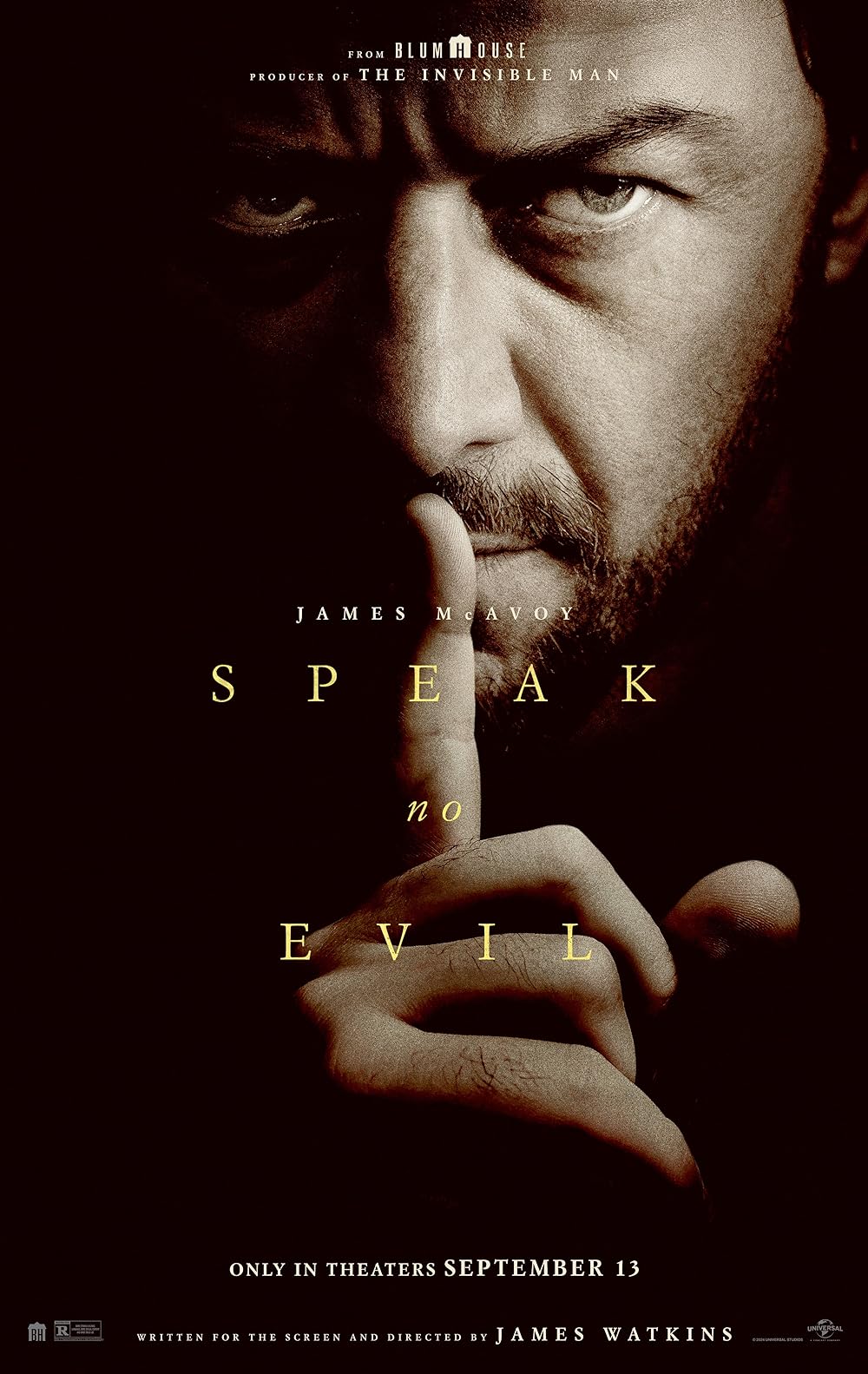
An entertaining and terrifying thrill ride. Blumhouse and Universal’s Speak No Evil, starring James McAvoy, excels in plotting and atmosphere but falters in character building and development. Based on the Danish film by the same name, director James Watkins’ version is a methodical and spellbinding descent from dream to nightmare. The highlight of the film is McAvoy’s completely manic performance that is simultaneously comedic and unsettling. Whilst Watkins attempts to bestow upon the high concept narrative thoughtful social commentary on image, isolation, and identity, the commentary is inconsistent and lacks the gravitas to truly be compelling or provocative.

A dream holiday turns into a living nightmare when an American couple and their daughter spend the weekend at a British family’s idyllic country estate.

That which is most personal is most relatable, and can be the most terrifying. And what can be more personal and relatable than the need for a relaxing vacation in the peaceful countryside? That is precisely where this decent into a nightmare begins. Speak No Evil may take its time (albeit justified) in setting up the conflict, but once that second act kicks into gear, it is a nonstop thrill ride into isolation and violation. Keep the cast small, the film is able to spend sufficient time in developing the plot and keeping with proper pacing for the tight storytelling. From the very beginning, the piping is laid for everything that audiences will encounter in the second and third acts, with every shot, scene, and sequence pointing towards the shocking conclusion.

Violence on screen is minimal; however, when it hits, it HITS. But that hit isn’t always visual; many times it is psychological in nature, which in many ways, is even more terrifying. Throughout this film, the terror on screen is transferred into the minds of the audience. Part of that is because of the degree of relatability in this story. Many of us have been on vacation in a new place or even moved to a new place unfamiliar to us–perhaps in or to another country–and we are often desperate for friendship or companionship of any kind in order to begin to feel more at home. Therefore, the setup of this film is one to which many of us can relate–and that’s what makes it particularly terrifying. The thought that we could unwittingly befriend a monster.

While the social commentary on isolation, identity, and image is inconsistent and weak, I appreciate what Watkins was trying to do; although, there is one aspect of the film that was screaming for a redemption arc that was so obviously squandered (and actually hurt the quality of the film). Speak No Evil depicts many expressions of isolation. Isolation from friends and family, isolation from the urban core, isolation within one’s family. And it’s this isolation that greatly heightens the level of suspense and terror.

Additionally, the film depicts the identities (or facades) that we project to the world when we are hiding something or feel insecure because we wield it like a sort of armor. Moreover, this identity can also harbor inconsistencies that lead to a lack of authenticity and meaningful motivation. Perhaps this identity is merely a facade that is intended to make others feel uncomfortable or to project an image that sets one apart simply out of fear of being found out as little more than keeping up with what’s trending on social media. Furthermore, the attempted commentary on image is depicted in a variety of ways throughout the film.

The weakness in the film is found in the character building and development. Not with all the characters, but enough that it mitigates the potential of the film to deliver a compelling story. Without getting into spoilers, I want to discuss where the film had an opportunity an an effective character redemption arc, but pandered to what’s presently trending in movies instead of providing a constructive character arc that would’ve benefitted the film by adding a since of compelling meaning. Strong characters are not strong because those around them are weak; to craft a strong character through that methodology makes for a weakened (and less compelling) character because ostensibly standards have been lowered.

Strong characters are at their strongest when other characters are strong, complete with dimension as well. There is a character in the movie that lost their job, and have been personally struggling with feelings of anger, inadequacy, and failure–that is completely relatable as it is very much a human response to losing ones income and livelihood. Where the film fails is setting this character up to overcome the feeling of failing their family and at life, but never doing anything with it, and merely reinforce weakness. I imagine this was done to make their counterpart appear stronger. But it amounts to lazy storytelling that reinforces negative imagery.

The character that is the most entertaining is James McAvoy’s Paddy. I cannot think of any other actor working today that could’ve brought this character to life nearly as well as McAvoy. In an otherwise par for the course performative dimension in the film, he brings a kinetic energy that draws audiences into the macabre, twisted tale. From the very beginning, we can tell that there is something a little off about his character, but never enough to know precisely where he stands. When he goes full-on manic mode, we are in for the ride because he makes us laugh and gasp in horror all at the same time.

Everything about this movie would make for a fantastic house at next year’s Halloween Horror Nights at Universal Orlando and Hollywood. The farmhouse at the center of the movie is a labyrinth and hints at a variation of the hillbilly horror aesthetic. I can see how this film’s characters and setting could adapt well to an HHN house, so I would not be surprised if we see this intellectual property featured at next year’s HHN.

Speak No Evil may lack dimension that could’ve made it a more compelling narrative than what we received; however, it’s still an entertaining thrill ride that will have you laughing and screaming. A solid popcorn horror movie that has some degree of rewatchability.
Ryan teaches Film Studies and Screenwriting at the University of Tampa and is a member of the Critics Association of Central Florida and Indie Film Critics of America. If you like this article, check out the others and FOLLOW this blog! Interested in Ryan making a guest appearance on your podcast or contributing to your website? Send him a DM on Twitter. If you’re ever in Tampa or Orlando, feel free to catch a movie with him.

Follow him on Twitter: RLTerry1 and LetterBoxd: RLTerry

“Split” movie review

splitIntensely captivating! M. Night Shyamalan stages a successful return to the horror-thriller genre in the brilliantly intriguing motion picture Split. When Universal Pictures, arguably the king of the American horror film, Blumhouse Productions, and Shyamalan combine their respective visual storytelling skills, the result is a dynamic thriller full of outstanding twists and turns. Shyamalan, long known for surprise or bizarre endings, provides audiences with the biggest surprise of all: he is back, and it’s a completely satisfying cinematic experience! Beginning with 2015’s The Visit, Shyamalan has been working on a comeback; and Split is the final evidence needed to support his successful return to the silver screen. James McAvoy delivers an outstanding performance–or should I say performances–every minute of the film. Although the concept of building a suspense-thriller around a character with dissociative identify disorder (DID), formerly known as multiple personality disorder, is not a new one–after all Norman Bates is the most iconic example. M. Night Shyamalan puts his own spin on the character-type by adding his special blend of what can only be referred to as “shyamalan-ness.” You’ll definitely want to see it again in order to catch everything that you missed the first time.

A film that many psych majors will find fascinating! While the mental divisions of those with dissociative identity disorder have long fascinated and eluded science, it is believed that some can also manifest unique physical attributes for each personality, a cognitive and physiological prism within a single being. Though Kevin (McAvoy) has evidenced 23 personalities to his trusted psychiatrist, Dr. Fletcher (Betty Buckley), there remains one still submerged who is set to materialize and dominate all the others. Compelled to abduct three teenage girls led by the willful, observant Casey (Anya Taylor-Joy), Kevin reaches a war for survival among all of those contained within him – as well as everyone around him – as the walls between his compartments shatter apart. (IMDb).

Just when you think the movie is going one direction, it throws you for an unpredictable loop. Split provides audiences with the same level of captivation as M. Night delivered in Signs or even in The Visit. Very much character-driven, this film could have easily taken a turn for the campy or par-for-the-course approach to a central character with DID; but Shyamalan proves that a familiar premise can be crafted into a whole new experience. After the incredible success of 1999’s The Sixth Sense, audiences everywhere set the bar for Shyamalan quite high–in fact he was prematurely compared to a 21st century Alfred Hitchcock. While it is highly unlikely that any director will reach the iconic status of Hitchcock, Shyamalan was seen as a director who would provide a similar experience to that which earned Hitchcock the moniker the master of suspense. Evidence of his admiration of Hitchcock can be been in the title sequence of Split. It bares a striking resemblance to the opening title sequence from Psycho. 

However, the danger in prematurely setting expectations too high is that you may likely be setting yourself up for disappointment. And that is precisely what happened with Shyamalan. From killer plants to invisible supernatural entities, he began to lose the cache he earned in the early 2000s. M. Night would spend years disappointing audiences to the point that he became a joke–a parody–perfect material for Family Guy. Then just when all hope for Shyamalan to regain the admiration of movie patrons–especially those who enjoy horror/suspense/thrillers–he gives us The Visit in 2015. That film was the glimmer of hope he needed to begin to rebuild his status as a thriller/suspense/horror filmmaker. And with the incredibly satisfying Split, M. Night Shyamalan is BACK!

Films like Psycho and Split only work as well as their respective director and cast–primarily the villain. Obviously, Psycho stands up to the test of time and will forever be a favorite of many cinephiles and a testament to the power of visual storytelling, Split had to be a new experience while still channeling the director that Shyamalan admires and patterns himself after. The success of Split rested upon the performance of McAvoy as Kevin (and the 23 others with a 24th on the horizon). McAvoy’s performance in this film is quite possibly the best of his career. Each identity is clearly seen as individuals. From his facial expressions to his gait to the manner in which he carries himself, every identity is unique in voice and appearance. Even in the middle of a conversation, one identity goes away while another surfaces into “the light.” Although there are only a few identities that have prominence in the diegesis, the others give audiences just enough nuance to register them as having a presence in the subconscious of Kevin.

For all the excellence in cinematic storytelling Split has to offer, there is no denying that it may be controversial in that it uses DID to construct a “beast.” There are already members of the mental-illness community who have expressed disdain for the subject matter and context of the film. However, prematurely dismissing this film as offensive to those suffering from cognitive disorders would be ill-conceived. After screening the film, it is clear that the focus is not on DID itself (or any other cognitive disorder that Kevin may have), nor is Kevin crafted to be an unredeemable monster; but, this film uses DID and the character of Casey (one of the young ladies who is captured at the beginning of the film) as tools through which to explore childhood trauma, abuse, and coping mechanisms. Isn’t that what films do? Push the envelop in an effort to provide a different perspective on an issue, problem, or circumstance? Horror is often concerned with “other” scenes–revealing that which should remain hidden–and Shyamalan does precisely that in Split.

If you enjoy horror, suspense, or thriller films, then you are definitely going to enjoy Split. There is so much to take in, that you may want to watch it again in order to catch everything that you may have missed the first time. Even if you are skeptical or think the content may be offensive to the mental-illness community, you may be surprised that there is a lot that can be gleaned from the narrative. With brilliant performances, excellent writing, and outstanding direction, Split should be on your radar of films to watch this weekend.

Written by R.L. Terry

Edited by J.M. Wead

“X-Men: Apocalypse” movie review

XMenApocalypseEpic! It isn’t often that one word can sum up the screening experience of a movie, especially when going into the film, one had lots of hesitations that stemmed from the questionable trailers. Prepare yourself for the heaviest of the X-Men movies future or past. Probably the best feeling to take away from this one is the storytelling quality of the cartoon paired with Bryan Singer’s unparalleled handling of what is arguably the most successful Marvel franchise over the decades (that may be changing with the unprecedented popularity of The Avengers). While some may describe this movie as a failed attempt at reliving the glory days of the X-Men, I venture to say that there is enough evidence to support this being a strong third movie. As much as I enjoyed the movie–and do not mistake me, I did–there was a LOT going on in this movie and it came close to failing to effectively and successfully tell A complete three-act story. Just like in Batman v Superman, where Warner Bros bit off more than they could chew, 20th Century Fox came close to making the same mistake. Thankfully, the story was just strong enough to drive excitement and thrill through the minds and bodies of the audience.

X-Men: Apocalypse is the third movie in the Bryan Singer reboot (fourth installment if you count the original X-Men movie from 2000). The world of Ancient Egypt was once the center of the universe; and in that great empire, there lived the original mutant [Apocalypse] (Oscar Isaac). He grew in strength and power to the point that he ruled the world. After several of his fellow Egyptians betrayed him in attempt to bury him alive, he was cast into a deep sleep hundreds of feel beneath the surface. Due to a dedicated group of followers thousands of years later, Apocalypse was awaken and he has set out to reclaim the planet as his own and raise his children. Determined to build his mutant army, he begins to recruit the most powerful X-Men including Storm (Alexandra Shipp). When Professor Xavier (James McAvoy) encounters Apocalypse while in Cerebro and is captured, the still-fractured X-Men must go to great and nearly impossible lengths to rescue him and save the world. Teaming up with new student Scott (Tye Sheridan), Jean Grey (Game of Thrones’ Sophie Turner), and Nightcrawler (Kodi Smit-McPhee), Quicksilver (American Horror Story’s Evan Peters), Mystique (Jennifer Lawrence), Beast (Nicholas Hoult), and Havoc (Lucas Till) will battle Apocalypse and his four horsemen including Storm, Angel (Ben Hardy), Psylocke (Olivia Munn), and Magneto (Michael Fassbender).

What a cast! The quality of talent in and of itself is an outstanding accomplishment and is responsible for a great deal of the success of the film. Writers create characters and directors craft them, but it is the actor who ultimately brings the characters to life for the silver screen. Each and every actor is an excellent match to their respective characters. In addition to the actors we have been introduced to in past films, the newcomers quickly cement themselves in this and future movies. With so much material and less than three hours to deliver a movie that could be on par with the previous two and The Avengers films, it was vitally important to have an impressive cast that could win you over instantly. There simply wasn’t time for an actor to grow on you or to decide how you felt about a particular character. Each actor needed to his a homerun as soon as they stepped out of the dugout. I paid close attention to Sophie Turner because I was only familiar with her from Game of Thrones, and I just wasn’t sure how I would feel about her as one of the omega class X-Men (Jean Grey). Oh, I knew she looked the part, but could she pull it off??? And the answer to that is a resounding yes.

Much like Captain America: Civil WarX-Men: Apocalypse is nothing short of a superhero extravaganza. And although they are similar in many respects, there are two completely different tones in the respective movies. Are they both serious? Yes, but the former also includes comedic relief sequences and dialog (and yes, if you read my review, I found those to be poorly handled but I am not going to revisit that tarmac scene or the annoying Spider-Man in this article) while the latter retains the serious tone throughout the movie. However, it is successful in not becoming a parody of itself as was the case with Batman v Superman. I will state this: Civil War does boast a dynamic plot that flows smoothly the whole time, whereas Apocalypse flows smoothly most of the time, but at others, it does feel a mite bumpy. We could discuss symptoms of the problems all day, but the root of the problem is simply trying to tell too much story in one movie. To be honest, I have a felling that I am going to decide that I like X-Men more but that is likely because, in all fairness, I grew up with the cartoon. What works for X-Men, much like Captain America, is the fact that the audience does not need to be familiar with the comics in order to enjoy the movie. Singer makes sure that anyone who enjoys high concept comic book superhero action movies will enjoy this film. Well, that is, unless you happen to be a diehard comic book aficionado. This movie is simply exciting and visceral.

Memorial Day weekend will either be dominated by powerful mutants or charicatures from the other side of the mirror. Although X-Men will probably not perform as well as Civil War, I don’t think Alice has a chance of topping this quintessential summer blockbuster on the unofficial start to the summer. Unless you live here in Florida where summer started in March. Haha. Speaking of Florida, and in particular Orlando where MegaCon 2016 is being held, knowing that most of the theaters would be filled with cosplayers and enthusiastic fans, I had the challenge of finding a theatre in the area at which to watch the movie and not face cols out auditoriums and nose-bleed seats. I was successful in finding a small privately owned theatre in the vicinity and has the whole thing practically to myself. Running camera for a medical convention, so I am writing from the Rosen Shingle Creek instead of my condo in Tampa. It’s been quite nice to stay on site versus driving an hour here for the event each day. Happy Memorial Day!