
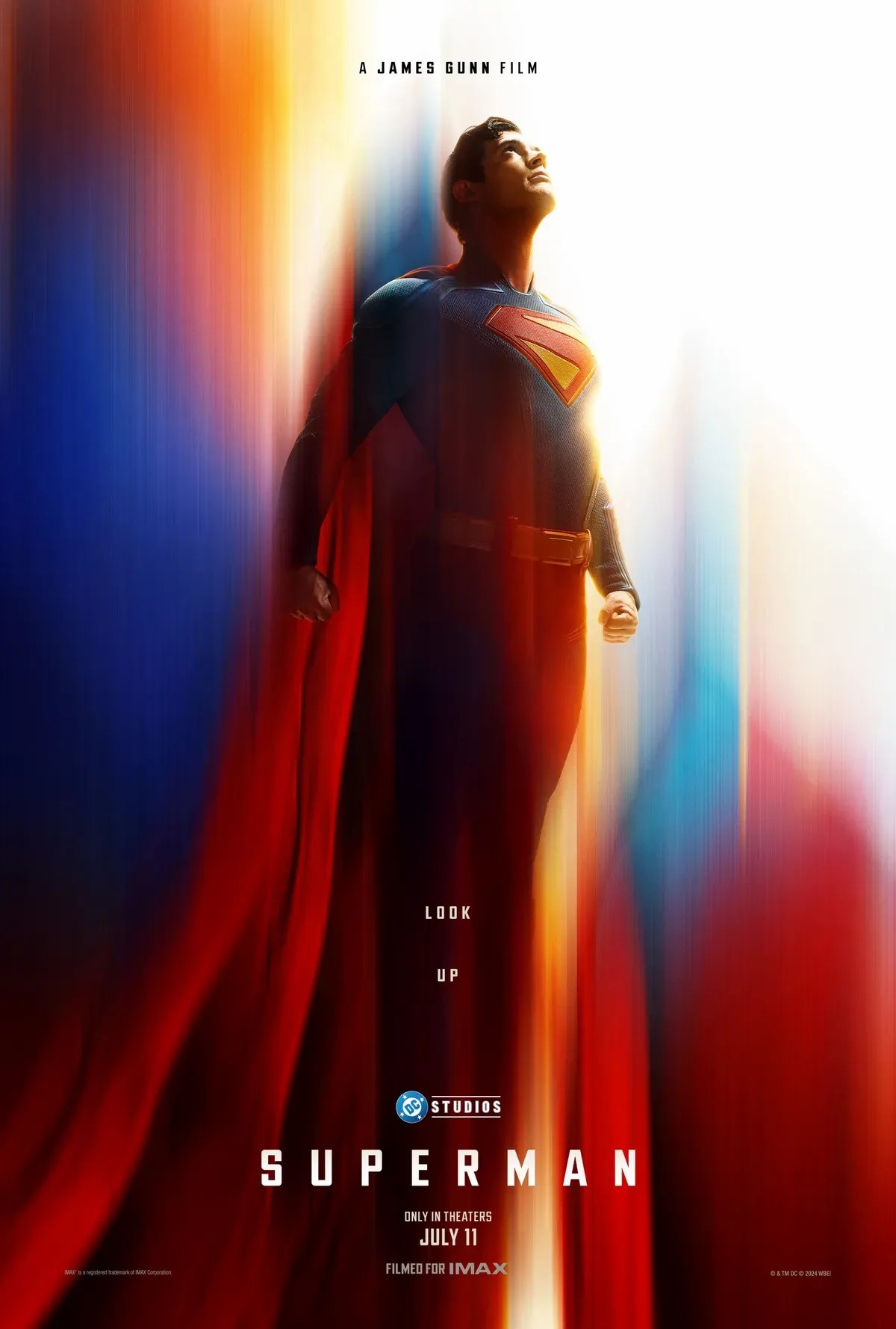
SUPERMAN (2025) movie review

SuperFULL. James Gunn’s Superman is bursting at the seams with plots and characters, resulting in an overwhelming experience. But, the lead characters and hero’s journey are truly super. While weak on narrative, Gunn’s take on the man of steel sticks the landing on the lead characters. And it’s the characters that will keep you sufficiently enough vested in the movie.

When Superman gets drawn into conflicts at home and abroad, his actions are questioned, giving tech billionaire Lex Luthor the opportunity to get the Man of Steel out of the way for good. Will intrepid reporter Lois Lane and Superman’s four-legged companion, Krypto, be able to help him before it’s too late?

While the plotting and many characters lack fine-tuning, David Corenswet’s Clark/Superman and Nicholas Hoult’s Lex Luthor feel like extensions of their comic book origins–in all the best ways possible. Corenswet delivers a Superman that displays the strength and powers that are synonymous with the character, but Gunn adds in a discernible human dimension that has long-since been missing in Superman to make him more human, more relatable. Hoult’s Lex Luthor is nightmarishly deplorable and demonstrates the power of greed. Rachel Brosnahan’s Lois Lane strikes a fantastic balance between hard-hitting journalist and romantic; the chemistry between Corenswet and Brosnahan land on an ideal formula for character development and an old-fashioned romance.

Gunn underscores the movie with some thoughtful social commentary on the fickleness of society, terrifying power of social media, and fickle nature of broadcast media. He cleverly embeds this timely commentary beneath the movie’s spectacle, offering a pointed critique of our shallow, performative culture. Through Clark’s interactions with a world obsessed with optics and outrage, the film holds a mirror to the hollow validation of social media, where sincerity is traded for virality and truth becomes secondary to trend. Gunn also confronts the fickle nature of society itself — how easily the public elevates heroes only to tear them down at the slightest misstep, revealing more about our own insecurities than the hero’s flaws. Even broadcast media doesn’t escape unscathed; the film paints it as a machine of half-truths and spectacle, perpetuating narratives that distort rather than illuminate. In these ways, Superman emerges not just as a story of a man learning to save the world, but as a subtle indictment of a world that seems increasingly uninterested in being saved — at least, not sincerely.

James Gunn’s choice to craft a more human, more relatable Superman is not just a bold creative pivot — it’s an overdue course correction for a character who, for decades, has too often felt like a distant monument rather than a man. Traditionally, Superman has been written and portrayed as a flawless demigod: morally unassailable, physically unstoppable, and emotionally impenetrable — admirable, yes, but also alienating and, frankly, boring. Gunn understands that audiences connect most deeply not with perfection but with struggle, doubt, and vulnerability. By leaning into Clark Kent’s humanity — his insecurities, his quiet kindness, his yearning to belong — Gunn breathes new life into a character long encased in marble. In doing so, he not only makes Superman interesting again but also reminds us that heroism is not about being invincible; it’s about being profoundly, recognizably human.

For all its noble intentions and flashes of brilliance, Gunn’s Superman suffers from a narrative that simply has far too much going on — and not in a way that feels rich or layered, but cluttered and exhausting. In trying to weave together a pantheon of ancillary characters, subplots, and Easter eggs, the film forgets that its emotional core should be Clark Kent’s journey, not a checklist of cameos and teases for future installments. The supporting players, while individually intriguing on paper, pile up to such an extent that they suffocate the story rather than enrich it, leaving audiences with a nagging sense of being overwhelmed rather than immersed. Instead of honing in on what makes Superman compelling, the movie disperses its energy in too many directions, diluting its impact and leaving the viewer wishing it had trusted more in simplicity — and in its titular hero.

Definitely not your dad or grandfather’s Superman; however, this is a Superman that remains super yet connects with audiences through the human dimension.
Ryan is the general manager for 90.7 WKGC Public Media in Panama City and host of the public radio show ReelTalk “where you can join the cinematic conversations frame by frame each week.” Additionally, he is the author of the upcoming film studies book titled Monsters, Madness, and Mayhem: Why People Love Horror. After teaching film studies for over eight years at the University of Tampa, he transitioned from the classroom to public media. He is a member of the Critics Association of Central Florida and Indie Film Critics of America. If you like this article, check out the others and FOLLOW this blog! Follow him on Twitter: RLTerry1 and LetterBoxd: RLTerry
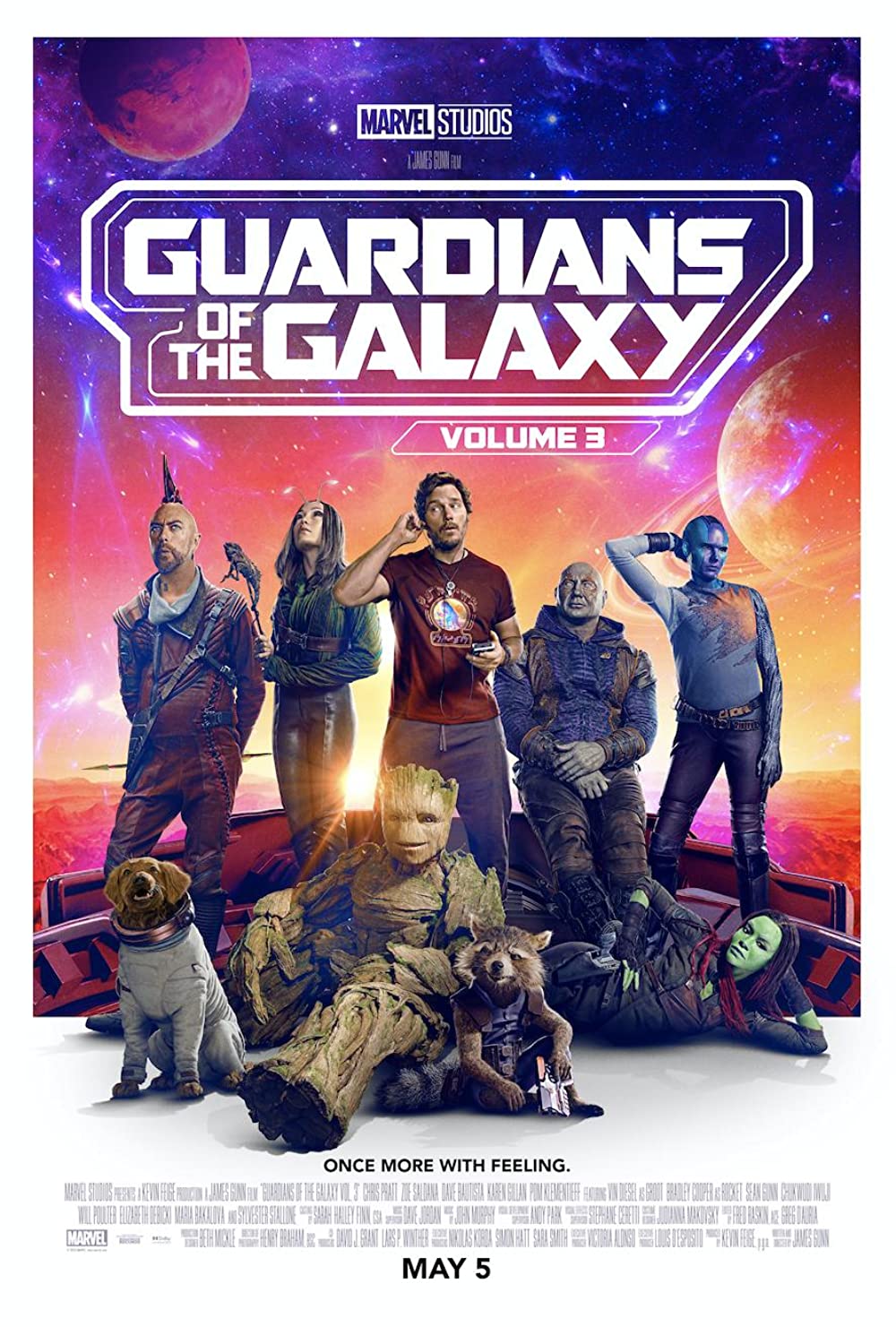
GUARDIANS OF THE GALAXY VOL.3 movie review

Whoa! That’s a lot of movie, and a lot to unpack. While James Gunn’s MCU swan song Guardians of the Galaxy vol.3 works well as an allegory of the Third Reich, exploring the atrocities of that nightmarish ideology and movement, the superhero movie is greatly lacking in entertainment value.

Still reeling from the loss of Gamora, Peter Quill must rally his team to defend the universe and protect one of their own. If the mission is not completely successful, it could possibly lead to the end of the Guardians as we know them.

The story is emotionally manipulative and many scenes and dialogue are inappropriate for young audiences. (As a reminder, kids are NOT little adults; kids are lacking in critical thinking skills). Furthermore, the movie suffers from squeezing too much plot into a single movie–the film overstays its welcome by about 30–45-minutes.

Clearly, James Gunn loves theses characters, and I can tell that he is a writer that genuinely cares (a trait I spotlight in my screenwriting classes), but I feel he forgot that a large segment of his MCU audience is comprised of kids, whether he accepts or likes that fact or not, and should have considered that dynamic when crafting this story. A storytelling element that is common amongst the MCU, especially within the Guardians of the Galaxy previous two movies, is levity. There is too little levity to counterbalance the dark elements of the movie. As such, the movie is incredibly heavy and sucks all the joy out of going to the cinema to attend a superhero movie. The movie is not completely without redeeming qualities or uplifting moments, but they are vastly outweighed by the somber tone of the movie as a whole.

Even though the film’s incredibly dark visual elements and themes are tastefully handled for older teen and adult audiences, as whole, this MCU installment is not appropriate for kids. If the movie’s marketing made it a point that this Guardians of the Galaxy movie was not for kids, I wouldn’t have a big a problem with content of the movie, but it’s the fact that kids were not dissuaded in any way from attending this, insofar as I am aware. When Deadpool first released, there was an entire tongue in cheek campaign to remind parents and siblings that this Marvel movie was not for kids–tastefully handled. Perhaps the studio dropped the f-bomb and increased the crass language and violence as a means to warm kids up to Deadpool 3, but that is a completely unhealthy approach as is disrespectful of what it means to be a child and young.

Looking to another franchise with which a whole generation of kids grew up, the Harry Potter movies became more mature as the seminole audience grew. Which is important, as life IS complicated and success, grief, loss, death, and disappointment are part of the human experience. However, the movies never became overly violent, increased crass language, or went to too dark a place (without counterbalancing it with levity and more lighthearted moments). Guardians of the Galaxy vol.3 is representative of the direction Marvel and Disney are going, and it’s not good nor healthy. If the MCU wants to create more movies that are adult in nature, then do that–but don’t take what has appealed to kids and decide to increase the more mature content. As I understand it, there is a whole universe of Marvel characters, and I am confident that a sub-franchise can be started that is geared towards mature audiences from the onset. And when kids get older, they can choose to eventually experience the Marvel movies that were, at one time, inappropriate for them.

What I found most fascinating about the movie is the commentary on the Third Reich (and for those that don’t remember, that is the ideology turned movement that was manifested by the Nazi party). Without going into great detail, one of the common practices at Nazi-controlled concentration camps was to further medical science by experimenting on the prisoners. Unfortunately, some of what we know today, some of the advancements that we use for healing today, came out of those nightmarish compounds. The idea was to learn from the experiments in order to increase the life experience of the master race perfect–correct that which was flawed. Moreover, the idea of a master society was carried into the idea of creating a utopia (something the Nazis had in common with the Soviets). But of course, utopia is an impossibility, and the pursuit of it often comes at the cost of life, individuality, and freedom.

The big bad villain in this movie known as the High Evolutionary is representation of and analogous with Hitler. At the core of the High Evolutionary’s goals and ambitions is the same ideology that drove and inspired Hitler. Furthermore, his speeches that feel they could have been written for a modern day Hitler. I appreciate what James Gunn did here, because it is monstrously challenging to craft a story around such heavy subject matter. Analogy and extended metaphor are outstanding tools to use in storytelling to provide commentary on a topic without talking about it. The ideology that inspired Hitler didn’t go away with him and his party, but it’s still out there, and must be kept at bay. Fictional storytelling can be used as a means to explore an observation of reality that may otherwise be uncomfortable.

If only as much thought had been put into the sets and effects of the movie. Like the perennial house guest that has worn out their welcome but continues to return anyway, prolific CGI continues to be employed instead of showcasing the craftsmanship of practical effects, real sets, and models. I’ve said it before, and I will say it again, CGI can never replace the way real light bounces off real objects into the camera lens. When I look at a monstrous creation of CGI, I am never left with the feeling that I witnessed the hand of an artist—brilliant engineer, yes–artist, no. Furthermore, not only is the CGI screaming in your face, but the movie’s music and sound effects mixes are also deafening. The kid seated next to me had his hands over his ears for a good portion of the movie. There is nothing subtle or nuanced about this movie.

Guardians of the Galaxy vol.3 represents James Gunn’s MCU swan song as he is now working on DCEU (or whatever it’s going to be called) movies. And he certainly left an indelible mark upon the MCU because few other directors (if any) could have worked the magic he did with the Guardians, a one-time obscure Marvel comic series. While I have many reservations of taking your kids to see this movie, it is one that should inspire thoughtful conversations about the parallels the villain(s) shares with the Third Reich.

Guardians of the Galaxy review | Guardians of the Galaxy vol.2 review

Ryan teaches Film Studies and Screenwriting at the University of Tampa and is a member of the Critics Association of Central Florida and Indie Film Critics of America. If you like this article, check out the others and FOLLOW this blog! Interested in Ryan making a guest appearance on your podcast or contributing to your website? Send him a DM on Twitter. If you’re ever in Tampa or Orlando, feel free to catch a movie with him.

Follow him on Twitter: RLTerry1 and LetterBoxd: RLTerry
“Guardians of the Galaxy: Vol.2” movie review

Par for the course and predictable. This movie review was written by R.L. Terry ReelView contributor and writer/producer Leon Z. Coming to you all the way from Germany where Guardians of the Galaxy Vo.2  was released last week, I thought you would be interested to hear from someone other than me this week–think of it as a fresh perspective. Meanwhile, I will be watching it in Tampa tomorrow evening at 7.

“Set to the backdrop of ‘Awesome Mixtape #2,’ Marvel’s Guardians of the Galaxy Vol. 2 continues the team’s adventures as they traverse the outer reaches of the cosmos. The Guardians must fight to keep their newfound family together as they unravel the mysteries of Peter Quill’s true parentage. Old foes become new allies and fan-favorite characters from the classic comics will come to our heroes’ aid as the Marvel cinematic universe continues to expand.“
-Marvel Studios

Guardians of the Galaxy Vol. 2 is a bit of a disappointment when compared to the first one. This might be because the novelty factor the first one had for being a funny superhero movie is gone, or because it’s just very predictable and lacks excitement and emotional engagement. Pretty much all of the CGI action extravaganzas fall flat because there is never any real danger for the characters so the viewer does not care about them. There were times in this movie where the action was pretty much all CG, which I didn’t care much about since nowadays pretty much everything can be done with a computer but audiences don’t seem to get enough of it. But fortunately, the filmmakers are not overly reliant on those scenes. The movies strong points are its humor and character development. Although most of the setup and payoff jokes are very predictable, there are still many jokes that hit. Since the movie is primarily about Peter “Starlord” Quill meeting his father, there is actually some character development; and not just for him, but also for the other guardians–well except for Groot, Rocket and Drax so basically just Gamora, but some secondary characters from the first one like Yondu and Gamora’s sister, Nebula an although some of it is clichéd it still works, mostly.

Most of the emotional moments are genuine, but some of them are a little to on the nose.

The movie also introduces new secondary characters like Peters appropriately named father Ego and his companion Mantis, which are moderately interesting, Mantis probably more so than Ego because her interactions with Drax, which cause a lot of laughter.

What drags the movie’s quality down significantly is that it is just so predictable and cliché, which makes you care a lot less because you already know what will happen most of the time.

Overall, I would recommend this movie to Marvel fans and casual moviegoers; but for more hardcore cinephiles, this movie–if at all–is a one time watch.

Written by Leon