The Psychology of Horror: An Exploration of Freud’s ‘Uncanny’ through “Psycho”

“Oh no, don’t go in that house!” “Watch out! He’s right behind you.” Some of the most memorable movies of all time are horror films, of which, some of the best and most revolutionary were made in the 1930s and 40s by the original production house of horror Universal Studios. The early horror films set the foundation upon which all other horror films would be judged. Ask anyone, and the single most famous scene in all of cinema is the famous shower scene from Hitchcock’s Psycho, widely regarded as the most pivotal horror film in all cinema history. The aforementioned scene gains a greater eerie feel upon the close of the movie when the audience realizes that Norman has little to no control over his mind and actions. There is something about horror films that beckons the audiences to find enjoyment in that which in real life would not be enjoyable—and not only see it once but repeat it over and over again. And furthermore, find the unfamiliar and grotesque fascinating to behold as what should remain hidden comes to light. The return of the repressed.

Throughout history, from the fights in the Roman Coliseum to Michael Myers’ slaying of people in Halloween, audiences have been both entertained and repeatedly drawn to stories and shows that highlight horrific acts of violence or feelings of terror and anxiety. Perhaps there is a deep seeded reason as to why millions of people find entertainment value in horror films. This question has been tackled by many psychiatrists and psychologists, each has come up with a different explanation as to “why horror?” Most notably, famed psychiatrist, Sigmund Freud provided great insight into an explanation of why people find horror films fascinating in his essay on the Uncanny.

Although many of the conclusions drawn by Freud have been challenged over the years, he spent a great deal of time on the uncanny; and his analysis on such has helped a great deal in understanding the psychology behind horror. The word uncanny comes from the German word unheimlich, which is literally translated as something unfamiliar. However, that which is unfamiliar is not necessarily uncanny. In particular, he was interested in the return of the repressed. And, in this return of the repressed, “other” scenes, to which we do not have direct access, would reveal themselves. It is this revelation that is what Freud terms the uncanny. This theory is an explicitly aesthetic inquiry regarding what in art (or life) produces sensations of dread and horror, repulsion, and a return to such unpleasurable sensations. There are many elements or groups of elements that Freud deemed as uncanny. Each one is burdened to exceed intellectual uncertainty in order to fit the definition of uncanny as laid out by Freud.

In order to fully understand unheimlich, it is necessary to understand the antithesis of the aforementioned which is heimlich. The word Heimlich means something that belongs to the familiar, something not strange, and is friendly. Diving into a deeper reading of the word Heimlich, it can also mean something that is concealed from the conscious—not accessible by our conscious mind. Freud even goes as far as to suggest that this refers to something that is kept from sight so that others do not get to know about it. Knowing the definition of Heimlich, it is easier to understand how and why Freud chooses to use it in his evaluation of art (in which, we have literature, theatre, and cinema). According to Freud, “unheimlich is the name for everything that ought to have remained…secret and hidden, but has come into the light.” In his study on the uncanny, Freud takes on the literary imagination (this same literary analysis can and is used to analyze film) by dividing his theory up into three sections. He first defines the concept of the uncanny, then performs an examination of the context required for understanding the experience of the uncanny, and finally explores the effects of the uncanny on the psyche through literature and fiction. Some of the running themes throughout his essay are loss of eyes, castration, the double-ego, and self-reflexivity. Through the framework laid out by Freud, scholars and film critics can explore the themes in horror film as it relates to the human subconscious.

Freud explains the realm of the uncanny as the place at which aesthetics and psychoanalysis merge because it deals with a particular feeling or sensation combined with emotional impulses. The substances or manifestations of the uncanny are elements that are fearful and frightening. Proceeding with Freud’s definition of the uncanny being a class of frightening elements, plaguing the psyche, ushering an individual back to what is familiar (heimlich) and known (as opposed to what is unknown). Freud refers to the uncanny as that “which should have remained secret and hidden, but has come to the light.” Furthermore, he goes on to further describe the uncanny as the “mark of the return of the repressed.” The concept of the uncanny is a type of unwilling or mistaken exposure to something surprising, unexpected, or horrific.

Freud claims that the source of the uncanny in literature is the recurrence of something long forgotten and repressed. However, not everything that returns from the psychic depths of repression is uncanny. The mere return of repressed feelings and experiences is not sufficient for the uncanny to occur. It requires something repressed having returned but represented by an unexpected and outside the realm of reality. This is easily accomplished in literature (and by extension, movies, and plays) because fantasy is different from reality. Just because something works as uncanny in a work of literature doesn’t mean it can work in real-life as well. Within literature, if the author makes a pretense to realism, then he or she opens the door to supplying the story with the uncanny. Often times, the uncanny in literature and film is the projection of the psyche of the central character on another object or person combined with a warped view of the objective and subjective of a given situation. It’s like something within the fictional world creeps into the real world. And, this is definitely manifested within the character of Norman Bates in Psycho.

Within the horror genre, there are many different stories or narratives that exist. And, each type of horror film tells its story in different ways; however, they are all concerned with getting the same emotional response from the “people out there in the dark,” as famously stated by Norma Desmond in the timeless film noir classic Sunset Boulevard. Sometimes the audience will go on a journey into the crazed mind of a psychopathic serial killer or they may witness a supernatural monster terrorizing a small Bavarian village. In either case, Freud believes that the writers of horror are concerned with exposing the audience to “other” scenes. And, these “other” scenes are rooted in the subconscious. Freud’s psychoanalytic theory is a perfect lens through which to evaluate horror films and the effects of them.

The character of Norman Bates became a revolutionary breakthrough in cinema and entertainment as Freud’s psychoanalytic theory gained prominence in a major motion picture. Not only using it as a character archetype but using the motion picture’s exposition, via the psychiatrist at the end of the film, as a way to explore the subconscious of Norman. Keeping inline with the pace and substantive matter of the film, Hitchcock meticulously and skillfully used the characters and dialog to frame and reveal Norman’s feelings, subconscious thoughts, and conscious behaviors despite the aforementioned being very pleasant. Although the feelings and behaviors were unpleasant, subconsciously Norman enjoyed them. And, Freud touches on this too. He refers to it as the pleasurable unpleasureable. Despite Freud’s revelations of the subconscious mind, the subconscious is not something anyone has access to or can, much less, exhibit control over its goals. Therefore, as Norman was unable to exhibit control over the actions and tendencies of his subconscious mind, he did not realize he subconsciously allowed his mother to take control over his body and turn this “normal” guy into a serial killer.

Understanding Freud’s theory of the uncanny can best be fully grasped and comprehended by applying it to a particular scene(s) in a work of horror. In this case, the actions leading up to, and including, the infamous shower scene in Alfred Hitchcock’s masterpiece Psycho will be used. Before the screeches of the violins, before the more than fifty cuts (edits) to the film, and before the audience slowly spins away from the lifeless eye of Marion Crane (Janet Leigh), Norman Bates (Anthony Perkins) shows signs of being intrigued with generating erotic feelings of arousal in his mind and body. Prior to removing the portrait of the bird from the wall of his office, Norman exhibited mostly homosexual-ish signs. He did not appear to be sexually attracted to Marion and behaved more like a new girlfriend than a potential sexual partner. However, this is all about to change.
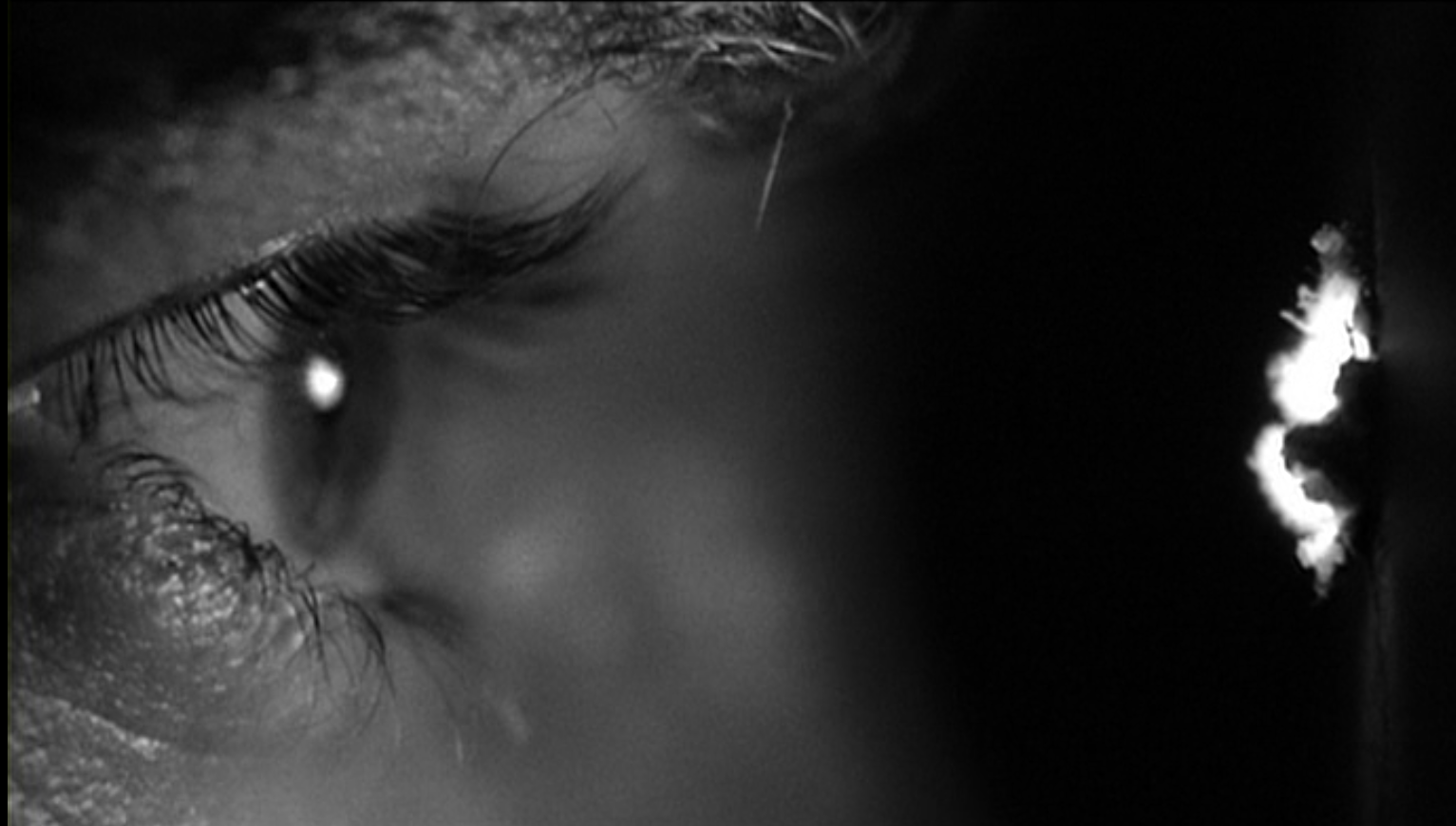
To quickly navigate the scene prior to applying Freud’s theory of the uncanny to it, Norman bids farewell to Marion after a good dinner turns to the creepy side. Marion begins to disrobe and prepare to take a relaxing shower. Unbeknownst to her, Norman has removed a portrait of a bird from his wall and is using a peephole to gaze into her room. After spending some time on an extreme closeup of Norman’s eye, Marion puts on a robe and sits down at the desk. Norman replaces the picture on the wall and heads back to his house. Marion does some math (pertaining to the $40 thousand she stole) and then gets in the shower. Not long into the relaxing hot water, Marion is attacked by a shadowy figure resembling an old woman. She is stabbed repeatedly and left to die. We slowly spin out from Marion’s lifeless eye to close out the scene.

There is a great juxtaposition in the Norman before his peeping-tom voyeuristic actions and during (and after) his choice to peep into the bedroom on the unsuspecting Marion. It is as though there was something repressed–hidden down deep inside–Norman that unexpectedly returned to the surface of the conscious. This return then prompted him to go from exhibiting homosexual (or perhaps asexual) behaviors to clear hormone-driven heterosexual male behaviors.  Although on the juvenile side, Norman clearly shows that he not only wants to be friends with Marion but to experience sexual relations with her. And, he gets his rocks off by watching her disrobe. Interestingly, the fact he is behaving similarly to a 14 or 15-year-old male plays directly to the notion that these heterosexual emotions were repressed since he was young.

But, Norman does not continue indefinitely gazing into the room of Marion; he eventually replaces the picture and heads to his house and sits. Perhaps he is in contemplation of what he wants and what he knows he cannot have. He clearly wrestles with this uncanny appearance of these feelings he is not used to experiencing. An important aspect to the uncanny is that the individual has no control over when this return of repressed unfamiliar feelings emerges. So, this isn’t something that he, in all likelihood knows how to control. So, instead of controlling it, these repressed feelings begin to take over his conscious by using pathways in the unconscious (the home of that which is uncanny).

Back in the bathroom of Marion’s room, Marion steps into the shower and is soon attacked by a dark shadowy old-woman-like shadow. This shadow is Norman dressed as his mother. Since the uncanny lives in the unconscious, over which we can exhibit no control, it develops its own mechanisms of dealing with this return of the repressed. By killing the object that aroused these unconscious feelings, the unconscious is able to then return to a balance. Of course, this isn’t truly a balance because it is directly linked to socio-pathological behaviors that rely on violence to purge the emotions and drive them back to the unconscious where they belong.

Norman’s initial response, following the iconic brutal murder of Marion, was denial and projected blame onto Mother. From the time the audience is first introduced to Norman, they are presented with an individual who is timid, shy, and nervous. But, when Mother breaks through his cognitive defense mechanisms, he becomes aggressive, destructive, and volatile. As a result of this cognitive struggle between the conscious and subconscious, the presence of Mother causes pain, anguish, and both internal and external conflicts within the mind of Norman. As the psychiatrist Dr. Fred Richmond, in the movie, stated, “At times he could be both personalities, carry on conversations. At other times, the mother half took over completely. Now he was never all Norman, but he was often only mother. And because he was so pathologically jealous of her, he assumed that she was jealous of him. Therefore, if he felt a strong attraction to any other woman, the mother side of him would go wild.”

Through the psychiatrist’s psychoanalysis, rooted in Freud’s theories, the audience learns that Mother was a permanent part of his mind. After watching the movie, the audience is only ever faced with a brief moment of the pathological side of Norman. However, this brief moment is enough for the psychiatrist to conduct a preliminary evaluation of Norman’s psyche. Playing to the unheimlich of the film, umheimlich referring to what’s “uncanny” about the film (or more literally translated as unfamiliar), despite the mere glimpse into the crazy side of Norman, the audience begins to allow fear and terror to take over and imagine what he is truly like. Oddly enough, even though the audience is terrified of Norman, they also sympathize with him because of the trauma exercised on Norman from his domineering mother, thus debilitating Norman for the rest of his life.

Using Freud’s model and theory of The Uncanny to evaluate these famous scenes from Psycho, it is clear that Freud was ahead of his time and was able to explain what would drive someone to behave in such a horrific manner. By breaking it down this way, Freud actually makes Norman seem like someone that could exist in real life, and that is perhaps the most terrifying aspect to the movie. The fact that Norman could be your next-door neighbor, is enough to spark fear and horror into the lives of those who watch this masterpiece.

If you enjoyed this article, please share and SUBSCRIBE! The button is at the top of the page.

Ryan is a screenwriting professor at the University of Tampa. If you like this article, check out the others and FOLLOW this blog!

Follow him!

Twitter: RLTerry1

Instagram: RL_Terry

Thrillz (theme parks): Thrillz.co

The Strangers Prey at Night (2018) movie review

Terrifyingly good! “Is Tamara home?” If those words haunted your memories for months after the first time, you’re in for another round of terror. The original is the only nightmare-inducing horror movie to frighten me so much that it was years before I could watch it again. Of course, I was also much younger and did not appreciate horror films to the extent that I do today. Although the sequel is not AS terrifying as the original, it is still incredibly intense and takes your adrenaline for a good ride. Even after the movie ended and I was leaving the auditorium, my heart was still racing. There isn’t anything innovative or in particularly memorable about the movie except the high tension level the whole time, but it does approach the rape-revenge horror movie plot with a new twist. What I appreciate about this modified home-invasion horror plot is just how much fun it is to watch with everyone else in the auditorium. Ordinarily, Thursday night pre-screenings of horror films (and many other genres) are not completely booked, but the two shows at the Thursday night preview were nearly sold out. Should you choose to check into the creepy trailer park, you’re in for some solid scares.

On Mike and Cindy’s way to take their daughter McKinzie to a boarding school along with their son Luke, they check into a lakeside trailer park owned by Cindy’s aunt and uncle. Unbeknownst to them, they are checking into their worst nightmare as masked individuals stalk and prey upon the unsuspecting family. Even before one hand of cards can be dealt, the family receives a visit from a mysterious girl. Creeped out by the visit, the family begins to suspect that something is wrong. Shortly thereafter, the family finds themselves in a desperate fight for survival as three masked psychopaths seek to quench their insatiable thirst for blood. “Why? Well, why not???”

For the sake of not spoiling anything, I’m going to keep this one on the shorter side. But I wanted to touch on the plot because it differs from the pacing and structure of the original. Whereas the first movie (2008) was mostly a cut and dry home-invasion, this one takes the home-invasion in a different direction and adds in rape-revenge.

On the former, the setting of The Strangers Prey at Night is a whole trailer park and not just a single house; however, there are a few times throughout the movie that the family finds themselves close quarters with the three masked psychopaths. Despite this similarity with the original, this film does not provide nearly the level of claustrophobia that our central characters had in the first one. Still, the extreme confinement can be found in this installment because there is just one way in or out, and the rest is surrounded by a fence. Instead of just a home being invaded, an entire campground is under the siege of bloodthirsty psychos. In a way, this is far more dangerous because there are more places to hide, and therefore your senses will be greatly heightened to the world around you.

My latter point regarding the type plot found in this horror film points to a new take on the rape-revenge plot. Now before you question what I am talking about (for those who are unfamiliar with the term), the rape-revenge plot is characterized by the victim of a violent crime turning on his or her would-be killer and becoming the attacker him or herself. A couple great examples of this are in the films Last House on the Left and the grindhouse classics like Spit on Your Grave and Death Proof. Essentially Act I consists of the male or female character being raped (or another violent act such as torture or attempted murder), Act II follows the rehabilitation (or mostly, anyway) of the victim, and Act III features the male or female victim enacting revenge on and/or kills the rapist (or torturer). The aforementioned theme is found within the plot structure but does put the film’s unique flavor on it. To reveal what the twist is exactly would reveal too much about the movie.

Interestingly, this installment leaves the end open enough for a followup. Not entirely sure The Strangers needs to become a franchise–it really doesn’t–but it’s definitely set up to continue to make money with subsequent releases. If you’re looking for a solid fright night that does NOT principally rely upon jump scares, and successfully increases the tension throughout the movie that will keep your pulse rate racing, then this is definitely a movie for you. I also appreciate that the movie does not rely upon gore to make it a “horror” movie, but actually uses twists, turns, and anticipation to deliver the terror.

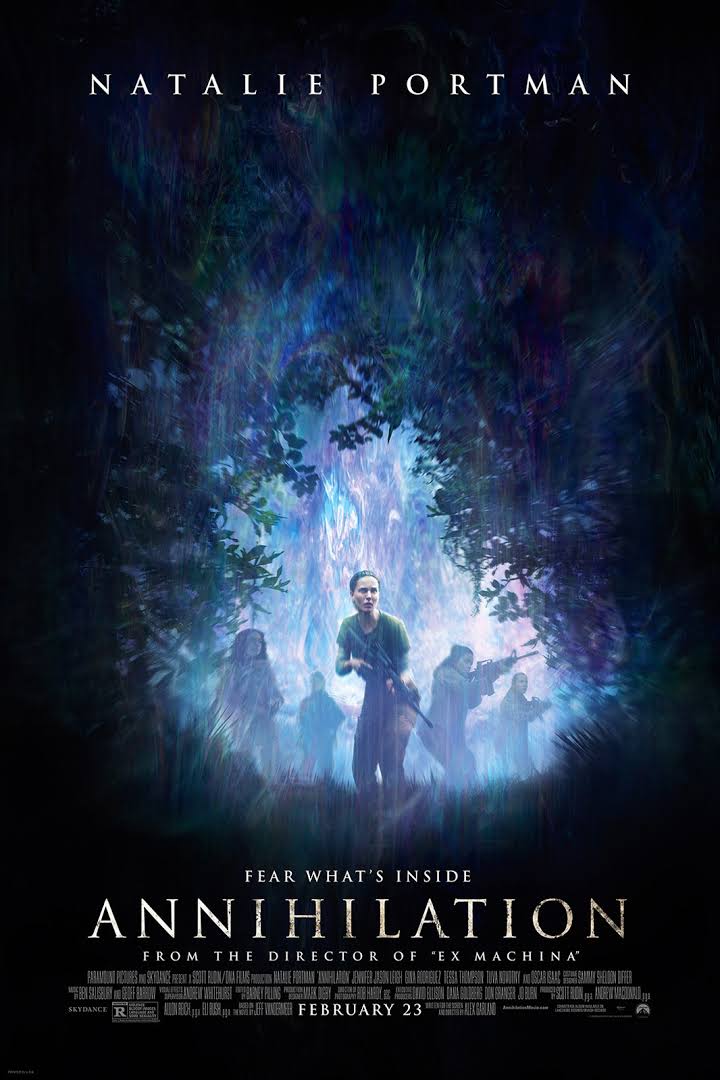
“Annihilation” film review

Outstanding craftsmanship that provides a trippy, surrealist experience! It’s been a long time since I’ve seen a horror science-fiction film like this one–one that harkens back to the manner in which Stanley Kubrick terrified audiences with his cinematic masterpieces. The brilliance of this film is the visually disturbing storytelling that’s built upon metaphysical and philosophical queries as well as Freud’s uncanny. Written and directed by Alex Garland (Ex Machina) and based upon the Southern Reach book series by Jeff VanderMeer, Annihilation boasts an all-female lead cast that takes the audience on a gripping, nail-biting adventure into the unknown that is frocked with wonder and tragedy. Falling in line with extraterrestrial films, this one exists somewhere between Alien and Arrival with influences from Kubrick and even Salvador Dali. Don’t wait for it to be released on Netflix internationally to avoid watching it at your local cinema; this IS a film best viewed, experienced, and enjoyed on the BIG screen–and not the 65in in your living room. For those who look for and appreciate science-fiction and/or horror films that explore psycho-social and institutional themes, then this is truly a film for you. Cognitively engaging and physiologically disturbing, Annihilation is a turbulent, horrific adventure.

After a mysterious meteor-like object strikes a lighthouse in Area X (most likely the swamplands of northwestern Florida), an increasingly growing membrane-like phenomenon is slowly swallowing up the land around it. When several paramilitary and scientific expeditions do not return from exploring the anomaly, biology professor Lena Kane (Natalie Portman) is aggressively recruited to work on the next team of scientists to track, report, analyze and potentially rescue former teams from what’s being called “the shimmer.” Professor Kane and her team have no idea that they will be facing their worst nightmares inside the shimmer as they explore this unknown world filled with dangerous opposition from the creatures that live within and the psychosis-like tension between the team members themselves.

Definitely not a film for the general masses. And you know what??? That is perfectly fine. In fact, that’s why this film works so incredibly well as an avant-garde-like science-fiction horror film. Had it directed for the masses, the film would not be nearly as stimulating psychologically and physiologically. Much like Garland did with the Oscar-winning Ex Machina, he crafts a world based on the best-selling series that takes the audience on a disturbing journey into the macabre, which juxtaposes the physical and metaphysical dimensions. Garland’s Annihilation is a masterful cinematic work that combines excellent writing with exceptional imagery and stunning practical effects. If Dali were alive today, this is the kind of film that he would have wanted to work on because there is such a heavy surrealist approach to the production design and visual effects. But this film is so much more than just the cinematic beauty of the motion picture. There are philosophical questions that one may ask oneself that create an added dimension of engagement that further immerses the audience into the world of the film.

Much like with Ex Machina, Garland shows an obsession with the need to see and see through when observing an unknown entity that may or may not be sentient. Paralleling how he set up the glass wall between Caleb and Ava (the AI) in the compound/lab designed by Nathan (Oscar Isaac, who is also in Annihilation), Garland sets up the interrogation room in which we are first introduced to Lena while she is being interviewed by the team in hazmat suits. I love the play on perspectives, vantage points if you will in both movies. That fluctuation between a filtered and unfiltered view of the phenomenon under observation offers much depth to the storytelling. In Annihilation, we are initially introduced to the shimmer, and world within, through sensors, readouts, and other “filters” but then we are thrust into the horrifying flora, fauna, and animal life without any type of protective boundary. Freud refers to the revealing of that which should remain hidden or the return of the repressed (which we literally get to witness in this film) as that which is uncanny (click for article). Just as our characters are constantly searching for clarity, you will find yourself paying close attention to the unknown to gain an unhindered understanding of what you are witnessing.

Not your average science-fiction horror film, this one will truly get under your skin–much like The Shimmer invades the bodies of those who choose to enter the dark twisted, refracted world of that which lies beyond our senses. Truly terrifying, this film is one for those who love a sci-fi horror that will prompt you to contemplate the themes and subtext of the movie. One of the quandaries that face the characters, and by extension, the audience is the idea of self-destruction versus suicide–the physiological versus the psychological components. For those who may worry that the film is “too intellectual,” the story is told in such a way that it not only appeals to film critics, academics, or horror aficionados but can be enjoyed by those who like a good, disturbing scare. The fact that there is the “intellectual” dimension to the film adds to the experience for those who appreciate that element in visual storytelling.

Lin Shaye and Liam Neeson | January Box Office Gold

Both Insidious and The Commuter are gems in the graveyard that is typically true “January” release films. I say true because films like The Shape of WaterI Tonya, and The Post are wide-released in January but were originally released on a limited run during the Holidays in order to qualify for The Oscars. For those who follow cinema closely, it’s no surprise that months like January and September are typically referred to as movie graveyard because that is ordinarily where movies go to die that cannot stand up to Spring, Summer, Fall, or Holiday release times. However, the last couple of years have seen some very strong films in January/February. Last year’s examples are Get OutLogan, and A Cure for Wellness. Last week’s Insidious: the Last Key and this week’s The Commuter are very much paint-by-the-numbers horror/action films respectively; but the cast–in particular, the leads–makes these films fun and even exciting to watch. From background actress to leading horror queen, Lin Shaye truly makes the Insidious films ones to be experienced on the big screen. Her flair for paranormal/supernatural films is uncanny, and take mediocre horror movies and transform them into movies you don’t want to wait until it comes to VOD. Likewise, Liam Neeson wowed audiences with his trademark character with a “particular set of skills” in the Taken movies, and has since played similar characters in other films. When you see his name, you expect that character-type and often times you get it! The Commuter may be a cliche action-thriller, but Neeson makes the film one that is a non-stop ride, one you don’t’ wanna miss when it leaves the station.

But why do both Shaye and Neeson draw the audiences the way they do? By all accounts, movies like the Insidious and Taken franchises or some iteration of the aforementioned are filled with horror and action tropes that seldom provide a truly new experience for audiences. However, their movies generally do very well at the box office and are consistently thrilling to watch. Placing Neeson in an action thriller or Shaye in a supernatural horror is essentially a guaranteed box office success for audiences and investors. In a manner of speaking, what we are dealing with here are legitimate movie stars. Truth be told, 21st-century cinema does not see movie stars in the same way that the early and mid 20th century did. In early days of cinema, films were built on the back of the studio system stars. It was a Betty Hutton film, a Humphrey Bogart movie, a William Holden picture, a Bette Davis film, etc. I’d argue that Tom Cruise is the closest to a contemporary era movie star in the traditional sense that we have. But by extension, you can apply the same attributes to Liam Neeson and  Lin Shaye by the cache that they bring to their films–they are a box office draw. Just their respective names are enough to invigorate audiences and generate ticket sales. At the end of the day, that’s when you know you have a true movie star. The name alone is enough to excite audiences and drive ticket sales.

Both actors are equally talented in their respective ways. The level of talent, entertainment, and thrill is consistent. You are never disappointed in their performances. If you remove/replace either of them in Insidious: the Last Key or The Commuter, the movies would likely not play out nearly half as well as they presently do. I’m not knocking the writing, directing, scores, editing, or cinematography, I am stating that the films are nothing remarkable in and of themselves; however, Shaye and Neeson bring a powerful screen presence with them that take the mediocre horror and action films to transform them into a cinematic experience that is incredibly enjoyable.

Support Local! Exploring Central Florida’s Community Haunts

Written by Ryan L. Terry & Derek Rosenberg

While Universal parks have Halloween Horror Nights, Busch Gardens parks host Howl-O-Scream, Knott’s Berry Farm celebrates Halloween with Knott’s Scary Farm as well as many other theme parks’ Halloween events, don’t forget that your area may also offer some great local haunts to terrify you during this festive season made up of what haunts you in your nightmares. Whether you are searching for a local haunt that has that quintessential small town Halloween feel or you seek a haunt that takes you where no theme park can without getting sued, there is likely a haunted house or trail located within driving distance of your house that beckons for you to brave the horrors that lie within.

I must confess, I have not supported my local Central Florida area haunts in the past–and that’s always bothered me. Always spent my time at the Universal, Disney, Busch Gardens, and SeaWorld events. So this year, I made it a point to make it to at least one, if not more, in order to support local Halloween enthusiasts who enjoy crafting something enjoyably terrifying for the community to enjoy during the Halloween season. And you know what I found? Local haunts are great! They can do things that theme parks aren’t able to do for reasons of liability. They can also do little things that enhance the experience by giving the haunt a more intimate feel. I am certainly not disappointed with my experience; and friends of mine that have supported local haunts this year as well, have commented that the haunted trails and houses offered uniquely fun experiences.

Our first stop is Sir Henry’s Haunted Trail! Located between Tampa and Orlando in Plant City, famous for the annual Strawberry Festival, Sir Henry’s offers two trails and a house. The house was an addition to the annual trails because it was located in Bartow, FL where it suffered major damage from Hurricane Irma. The folks at Sir Henry offered to include the house in order for the owners to recuperate the money it takes to build and support a haunted house AND for additional exposure from people who wouldn’t ordinarily drive the hour from Orlando or Tampa for a local house. Talk about an excellent example of a community uniting after a disaster! I gathered from that story that the owners, designers, and builders of local haunted attractions must be a close-knit community that steps in to help one another out, all while maintaining friendly competition amongst each other.

Parking was free! That was a great start to Sir Henry. You can purchase admission individually for the trails and house (three total attractions), or you can buy a combo ticket. My two friends and I purchased the combo ticket for $30 (saved $6). Individually, the attractions sell for $12/ea. From the moment we walked in, we knew that it would be fun. There were fire pits roaring, people roasting marshmallows, local vendors selling souvenirs and Halloween decorations, and kids whose parents obviously dropped them off for a night of nightmarish experiences. It felt like I stepped into a Halloween event held in one of those towns found in shows on The CW–you know the ones I’m talking about. I was thoroughly impressed by the craftsmanship and simple but effective technologies used in bringing these houses to life. A big difference between the theme park events and these local haunts is the group size. At Sir Henry, groups are broken up into smaller groups of three or four. Furthermore, guests are sent through the trails and house in intervals. This is instrumental in a desire for each guest to experience a scare without seeing it up ahead with other group. The trails and house were definitely maze-like in the design, because we took a few wrong turns and had to backtrack–only to find our pathway blocked by scareactors.

One of my favorite effects that I saw at Sir Henry’s was the fog and green laser that made it look like a swamp. Come to find out, that effect is achieved by cooling the fog to a temperature that causes it to remain condensed and about 3-4 feet above the ground. The addition of the green laser effect actually made it feel like I was wading through a swamp as my friends and I were navigating the maze. Being out in a field was a lot of fun and much different than being in a theme park setting. I really had no idea where scares were going to be; and therefore, I was always processing from turn to turn with heightened senses. It was a great feeling! Demented colonists, abandoned subdivisions, deadly butchers, chainsaw wielding sociopaths, you’ll find them all at Sir Henry’s Haunted Trail in Plant City, Florida.

Let’s head over to Winter Haven, located between Orlando and Lakeland.

The Shallow Grave has been a staple haunted attraction in Winter Haven, Florida for the last 5 years. I have always heard great things about this haunt and had never taken the time to experience it, but couldn’t pass it up this year, after hearing it will be their last year due to low attendance numbers. Built in a 13,000 square foot warehouse, Shallow Grave offers two haunted mazes giving you two very different experiences. Parking is $5 in the field across the street and as soon as we arrived the atmosphere was electric. They have several different ticket options including General Admission for $25 (includes both houses, one admission per house), Quick Death for $40 (allows you to skip the lines, one admission per house), Feargasm Pass for $35 (unlimited access to both houses), Season Pass for $150 (admission to each house for all 14 nights they are open), and the Combo Pass with Chamber of Terror for $55. They also sell Shallow Grave t-shirts to really support your local haunt. There are a few animatronic figures or statues outside the houses that add to the creepy atmosphere and allow for some great photo ops. Standing in line was where we got our first taste of how this is different than your typical theme park haunt. Scareactors are milling about outside the houses, pushing through the lines and popping up to scare guests before they even make it inside. They then tend to be happy to pose for a photo to show off their costumes and makeup.

Now we get into the houses. Updated for 2017 we first have Betrayal. You find yourselves on the haunted property of Thaddeus Van Buren during a rise of the undead. Shambling zombies and chainsaw wielding hillbillies stalk this maze which includes a rundown house and graveyard. This felt like a pairing of the Texas Chainsaw Massacre with a zombie flick, which are two of my favorite genres. The returning house this year is Pavor Nocturnus (latin for night terror) which delves into the realm of phobias and those subconscious fears you might not realize you have. This house covers spiders, caves, snakes, swamps, voodoo, prison, hospitals, and asylums in all the best and worst ways possible. With sets and props that match Busch Garden’s Howl-O-Scream quality, scareactors grisly costumes and makeup, and not your average animatronics and puppets, you haven’t been through a maze quite like these before. These are the scariest houses I’ve ever been through, which comes from several reasons. They only let groups of 6 through the house at a time and there isn’t always a clear indication of which way you are supposed to go, so it does truly feel like you’re having to find your way through this maze of horrors. The scareactors are also able to touch you and although it’s typically only a light squeeze of your arm, it’s a whole different experience once that barrier of “safety” is shattered. Having been going to haunted events at theme parks for the last 12 years, I can say that this is one of the best experiences I’ve ever had. It’s a real shame that this is their last year and I’ve only gone once. I’m hoping they find a new home or financial backer so we can see The Shallow Grave return in the future.

Now, we head to Downtown Tampa for quite the unique experience!

When buying tickets we went with the Combo Pass so that we could also check out the Chamber of Terror in Tampa, Florida. This haunt is built on the SS American Victory, a WWII-era cargo shipped docked behind the Florida Aquarium in Channelside. Parking is available at the Channelside Parking Garage across the street from the aquarium. Ticket options include General Admission for $25, Immediate Demise for $40 (skip the line pass), and the Combo Pass with The Shallow Grave for $55 (skip the lines pass for both locations). From the moment you walk up to this haunt it feels different than any other because you’re walking up to an actual ship. Walking down the darkened alley to the water for the reveal of a huge ship is pretty spectacular. Scareactors amble around outside ready to scare you in line as a taste of what’s to come. Soon you will find yourself deep in the hold of this haunted ship, inhabited by Captain Berwick and his undead crew, lashing out to terrorize you and hoping to add some new bodies to their hoard.

Our combo pass allowed us to skip the line so we almost immediately were sent up the gangplank onto the deck of the ship. The steel door swings open and a group of 6 are beckoned through by an undead shipmate who leads you to the elevator. Here you are shut into a box where the only light is being shown in your face by a scareactor holding a flashlight and shouting while lowering us down into the depths of the ship. What follows is a twisting, turning maze of narrow corridors and staircases that take you through many different sections of the ship including the main deck, which gives you a nice view of the water. This haunt is interesting because each section of the ship plays out like an interactive scene that plays for your group before being reset for the group following well behind you. The costuming and props are great and the scareactors have no problem invading your personal space, especially in the crew quarters. The different levels of the ship disorient you into not knowing where the next scare is coming from and where the terror will take you next. While I didn’t find this haunt as scary as Shallow Grave, it was still a lot of fun and a different experience than I’ve had before. I definitely plan to check out the Chamber of Terror in the years to come to see what changes are made and for more nautical haunt fun.

The final stop on our tour of Central Florida’s local haunts was Scream-A-Geddon in Dade City. Having only been around for a few years, it’s the newest local haunt in greater Orlampa (Orlando/Tampa). We had such a great time! A fantastic variety of haunts including three houses, one trail, and a hayride! That’s right. A Hayride in Florida! From the moment we entered, we could tell that we were in for a spooktacular time. The theme of the event revolves around a classic carnival setup. The ticket windows, entrances, and midway resemble a classic carnival or traveling circus. The scareactors are not confined to the houses, but there are roaming sociopaths and ghastly hillbillies throughout the midway. In addition to the official haunts, Scream-A-Geddon also offers a gift shop, carnival food, and even games. If you’re feeling a big cold, there are two giant fire pits as well. With the night being unseasonably cold for Florida, the climate added to the experience because it felt like how Halloween is supposed to feel in the air.

Blackpool Prison is where the worst of the worst criminals are sent and during a blackout the inmates take control. This was our first house of the night and it was probably the best place to start. Here we were introduced to an element that makes Scream-A-Geddon different than most other haunts, the interactive glow stick necklace. Before you go inside the house, those who are 18 or older are given the option to either go in as a spectator or to where a glow stick necklace to become part of the horror, which allows the scareactors to interact with you. We’re sent into the prison in a group of 6, with 2 in our party wearing necklaces, and I took point. I was almost immediately grabbed by an inmate, taken into a cell, and shoved up against a wall where the inmate screamed in my face that I was going to die in this prison. I was then sent back out of the cell and, having been separated from my group, had to walk alone through the house for a while. Our friend Dani was also grabbed several times and between us we were yelled at, shoved against walls, locked into jail cells, threatened with bodily harm, and in Dani’s case with having her teeth pulled out. The house was very dark and smoky to simulate a rioting prison during a blackout, with threatening inmates and the few prison guards still left alive begging for our help. The set pieces weren’t as spectacular as other haunts, but the atmosphere coupled with walking through sections of this house alone makes that forgivable. This was a great introduction of the best parts of Scream-A-Geddon and got us ready for what was to come in our second house.

We then headed over to check out Infected: Ground Zero, the new house for 2017. Following a meteorite crashing near a rural campsite, a viral infection rapidly spreads, leading to a military quarantine of the area. Before heading out into the chaos we are again asked if we wanted to spectate or take part, Dani and I opted in again and were sent in as a group of 6. Dani was almost immediately grabbed and pulled away from our group and we didn’t see her again until we made it out of the house. This haunt is a maze through quarantine tents, dilapidated cars, and a house of cannibalistic horror. I was eventually grabbed and stuck in an X-ray room where I was hit with a bright light and blast of air and toward the end of the haunt I was pulled into a tent off the main path where the scareactor began shaving my hair to help stave off the infection. The end section was a squared off maze of lit tents, a central tower that spewed fire out the top every 60 seconds or so, and a chainsaw wielding madman chasing you through to the exit. After we made it out we were reunited with Dani where she told us of her experiences inside, which included: being zipped in a body bag and left alone for a few minutes, being forced onto a table where a buzz saw was ran across her forehead, and nearly being grabbed by another scareactor to be given a shot with the antidote. The frantic nature of this haunt was incredible and never knowing what the next section might hold made it the best experience Scream-A-Geddon has to offer and an experience that should not be missed.

The next two haunts on our tour placed us in the middle of the woods–Dead Woods to be precise. At this offering, you are sent on a deathly journey through the woods surrounding a nearly abandoned settlement with only a few cabins remaining. Lurking within the walls of these cabins in the woods, are deadly settlers who refused to leave when the rest of the village took to the city. While the haunts of this attraction were spread a little too thin for my taste–lots of “dead” space–the design of the cabins was great! Derek, Dani, and I really enjoyed the concept and layout. In the future, Scream-A-Geddon may want to consider making each cabin a different theme or including a greater variety of scares. This was also the longest wait, and over all woods did not justify the wait time. Don’t get me wrong, it was fun. But I think this attraction could use a little more “haunt” to compensate for the longer than average wait. Having to use a light stick to find our way was a lot of fun and added to the experience of being lost in the woods. Although using a faceod of a cabin would have sufficed for some haunts, this offering boasted five full cabins that we walked through and encountered the locals who were not happy that we were uninvited house guests. Probably because we witnessed all the sinister things they were up to. Walking through the haunted woods on our self-guided tour, was a great experience!

From walking through haunted woods to riding on a tractor-drawn hay wagon, we headed over to Cursed Hayride. This was my favorite experience at the carnival of terrors because it offers a unique experience. Unique for this part of Florida because hay isn’t something that you see in numerous quantities around the area, especially if you live in an urban core. I hadn’t been on a hayride in more than a decade. Although the ride load, unload and guest circulation could be improved a little, the wait wasn’t terrible. And certainly worth the experience. The theme was two part haunted farm and one part Old Western ghost town. The ride was filled with several pyro effects and scareactors to terrify you on your journey. A small group of girls on our hay wagon were particularly terrified and were all over the wagon. Along your ride, you will encounter farm equipment the has a mind of its own and will try to bail you will the hay. Watch out for a giant man-eating gator too. My favorite part was going through the ghost town. Reminded me a lot of the Western scene in the late Great Movie Ride at Disney’s Hollywood Studios. In fact, I remarked “what is this, Joisey???” An homage to the gangster on GMR. The tour through the ghost town was complete with a bank robbery, shoot out between the law and outlaws, and a terrifying priest. Such a unique experience that ranks highly for me this season.

Our last experience of the night was Bedlam 3D, which is a trip through a carnival madhouse gone mad. No interactive glow stick necklaces here, everyone gets the same experience. Taking some cues from Circus of Superstition 3D that ran at Busch Garden’s Howl-O-Scream for many years, we are sent through a glow in the dark, neon colored, clown invested, insane asylum. The 3D used here is similar to what you’ll see at other haunted theme park attractions, but is different than what you see in the theater. ChromaDepth 3D relies on the color spectrum where red appears to pop out at you, and blue appears to recede, with differing levels of depth effect for colors that fall in between. This was not the scariest house, but it was incredibly fun. The 3D effects, paint, and laser lights made the house very disorienting. The whole house is lit by black lights, so everything glowed, and it gave a really unsettling effect on the clowns’ makeup and costumes. Some good uses of drop doors, moving props, and a bungie scare really gave this house a zany feel and the scareactors were having a great time confusing guests on which way they needed to go through the maze. This was honestly one of the best 3D haunts I’ve ever been through and a really fun way to end our night.

Well, there you have folks! We’ve explored some excellent haunts outside the world of the theme parks, and hope we have encouraged you to support your local haunts (those that are open on Halloween and the remainder of the week). It really is so important to support your local haunted attractions because they have some great ideas and love to scare you! Whether the local haunt is someone’s sole livelihood or a glorified hobby, they should be encouraged to keep going and developing ideas because this is a way to support your local artistic community. As much fun as you have being scared, those who direct, act in, or build these community offerings love to see you having fun. And in order for these haunts remain around for you to enjoy, it’s important to spend the time and money at them so they can keep growing! This Halloween, remember to support local!