“Darkest Hour” film review

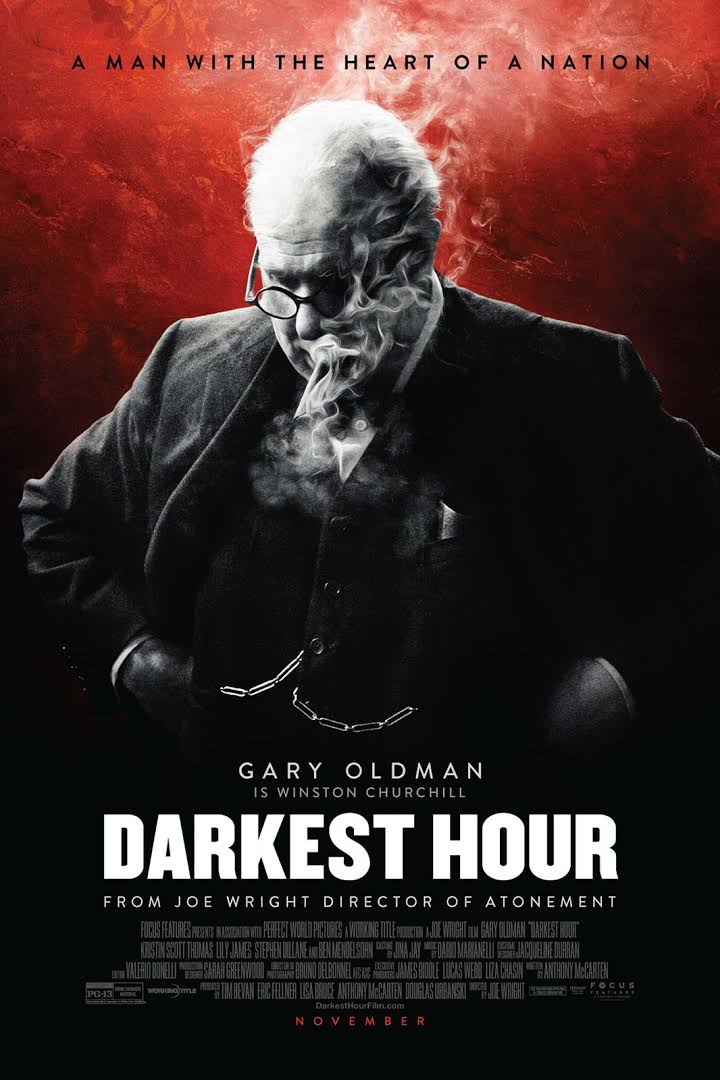
Outstanding! A gripping film that serves as a testament to rising above all odds to lead and protect. An inspirational biographical drama during one of the western world’s darkest hours. Gary Oldman’s performance as the famous United Kingdom Prime Minister is absolutely remarkable. For history enthusiasts, you will swear that you are watching THE Winston Churchill battle his own homefront of politicians and protecting against the Nazi advancement prior to the United States stepping in following Pearl Harbor. The impact of this film is greatly enhanced by the release of Nolan’s Dunkirk earlier in 2017 as this film depicts what was going on in Churchill’s office prior to the valiant rescue operation. The climax of the film includes Churchill’s “We Shall Fight” speech that rallied Parlament behind him–at least during WWII. Screenwriter Anthony McCarten chooses to interject as much amusement and humor as possible in order to balance out the otherwise cranky Churchill and the dire, deadly position that the people and government of the United Kingdom were at the time. Although it is not uncommon for historical dramas to take creative liberties in telling a visual, cinematic story, Darkest Hour sticks closely to historic accounts but does add in material that aids in constructing a cinematic film.

A thrilling biographical drama that takes place during the crucial days of the Nazi’s march to the sea to conquer western Europe. With France nearly fallen, the United Kingdom is faced with the most deadly enemy it has ever faced in all centuries leading to this very moment. The United Kingdom is searching for a new Prime Minister in the wake of an abrupt end to Churchill’s predecessor. With both the liberal and conservative sides of parliament at each other’s throats, it would take a special leader to unite the government in order to defeat the Nazis. Generally unpopular, but being the only public servant that had the least opposition from both sides, Churchill was a reluctant choice by the King and his colleagues in Parliament. Darkest Hour depicts Churchill’s rise to power and the giants he faced on his first days in office. While he is known to be an unapologetic monolith, a force to be reckoned with, this film also shows his more humble side. All within the span of a few weeks, Churchill is tasked with leading Parliment, unifying the government and people, and protecting the free world.

If you haven’t seen Dunkirk, you should watch it prior to Darkest Hour or at the very least follow up with it because it helps to paint a portrait of what was facing Churchill on his first day in office. Oldman’s performance is nothing shy of exceptional. Although all the performances are excellent, including Lily James’ supporting role, Oldman’s contribution to the film aids in creating the masterpiece that is Darkest Hour. The altruistic behaviors and vulnerable sides of Churchill are brilliantly woven into the narrative, an important move because in films past, he was always shown to be the brilliant orator and rallier that history remembers him as. Oldman’s commitment to character, in terms of speech, posture, and more is incredible; his personal commitment aside, the overall look and feel of Churchill is supported by amazing makeup work and costuming. The energy that each and every character brings to the screen is unquestionably precise and highly effective. While this is a story that takes place during wartime, the character-driven nature of the film is more closely aligned with a heavy courtroom drama than a typical war film. No mistaking it, it is still a war movie, just not in the traditional sense.

While the actors can bring unique, exceptional energy and screen presence to a film, it is often built upon the foundation of excellent writing. Despite the film exceeding the two-hour mark, no scene ever comes across as filler, unnecessary, or simply extra information. Screenwriter McCarten’s adaptation of the life and times of Winston Churchill is precise, efficient, and powerful. He chooses a no holds barred approach that is unapologetic as Churchill himself. As closely as McCarten aligned his screenplay against what we know from history, he chose to invent one particularly inspirational scene in which the Prime Minister leaves his chauffeur and takes the London Underground (what we call a subway)–a mode of transportation that he remarks never using earlier in the film. It is this scene that paves the way for the bombastic, poignant “We Will Fight” speech that will nearly have you standing up in your seat during his ovation on screen. Such a brilliant move by McCarten to invent a scene that truly feels like it very much could have taken place. It’s a scene that also shows Churchill’s heart for the people he was trying his damndest to protect against the evil across the English Channel.

Joe Wright’s Darkest Hour is a must-see film! His direction of this biographical drama is an outstanding work of cinematic excellence. Few directors could have captured the power of these events and the determination of Churchill as Wright has done. The approach of Wright and McCarten may prove to be precisely what is needed for Oscar nominations. Highly recommend for anyone who is fascinated by history or more specifically the events that took place at the time of and leading up to Dunkirk. Darkest Hour also displays a remarkable adhesion to history while adding in elements that provide a much more comprehensive experience that work to inspire audiences.

“The Greatest Showman” movie musical review

Stunningly sensational! Ladies and gentlemen, children of all ages witness the larger than life movie musical adaptation of the life of P.T. Barnum directed by Michael Gracey. Dazzling! 20th Century Fox’s The Greatest Showman is an incredible work of motion picture and performing arts magic. Never before has the magic of the American circus been captured so brilliantly. As the movie stares, “a man’s station is truly limited only by his imagination.” From the costumes to the music and choreography, this film is sure to inspire anyone who has a dream and wants to realize it. The music will have you singing along, clapping, and even tapping your toes because the emotions will get you right to the core. Ordinarily, a movie like this could generate an interest in budding performing artists and showbusiness enthusiasts to “run away and join the circus,” but the big top had its swan song earlier this year. One can only speculate that had this film been released last year that the circus that still bears his name Ringling Bros. and Barnum & Bailey would still be touring today. Sadly, the circus had its final performance in May 2017. From the moment the movie opens, you will be completely immersed in the world of P.T. Barnum, a world unfamiliar with the concept of shows that were sheer spectacle, illusion, and simply designed to put smiles on faces. It’s entirely possible that this may prove to be the greatest films of 2017, and certainly one of the greatest movie musicals ever made.

Simply stated, The Greatest Showman is the film adaptation of the life of P.T. Barnum (Hugh Jackman) and depicts how he was inspired to essentially create the very concept of showbusiness. From his successes to his failures, this movie showcases the very beginning of the American circus, a tradition that would last for nearly 150 years. Filled with incredible original music, this original movie musical displays how one man’s vision became a worldwide sensation.

My first observation of this film is just how polarizing it seems to be. On one hand, some critics and websites praise it for being an absolute delight while others are rating it rotten. Unapologetically, I feel strongly that this film musical is nearly flawless. As to how accurately it reflects the life of P.T. Barnum, I cannot speak to that because I have not spent hours researching his life; however, from what I do know about him, the movie seems to have captured the inspiration and vision accurately, as well as his faults and pitfalls. While standard holiday issue biopics are nothing new, what with The Darkest Hour also on the horizon this season, Gracey turns what could have been just another biographical film about an American icon into a larger than life dazzling display of precise choreography, effective montages, and just plain fun! Ringing Bros. may have closed the bigtop for the last time, but the soul of P.T. Barnum lives on in what Feld Entertainment (parent company to Ringling Bros and Barnum & Bailey) does. Without P.T. Barnum, we may not have the concept of showbusiness as we know it today. Despite staying away from the usual meaty themes found in Christmastime biopics, this film packs a powerful punch and supports the need for entertainment and the arts in our lives.

The high degree of passion Jackman displays for his character cannot be overstated. Though Gracey shows his directing prowess in this film, it is the labor of love of Jackman who has been trying to get this movie musical made for the better part of a decade. While the cliche underdog story may not be anything new, the method through which the story is told is a must-see spectacle. What works best in the movie are the extravagant and intricately choreographed musical numbers. The infectious and inspirational songs of The Greatest Showman were written by La La Land Oscar winners Benj Pasek and Justin Paul while the brilliant choreography was staged by Ashley Wallen. Each and every musical number is powerful and truly adds to the fantastic experience of this film. Moreover, this movie musical typifies the height of the visual and performing arts in terms of the ability to create an imaginative atmosphere that generates sheer delight in the minds and eyes of the audience.

In many ways, this movie is an extension of the circus that many of us grew up watching as kids and even adults. The circus was never about deep, complex stories; it was about entertaining audiences of all ages and bringing smiles to faces. And this film will certainly bring joy into your life this holiday season! Such a perfect movie for the week leading into Christmas because it is fun for the whole family.

“Dunkirk” film review

Journalism meets cinematic visual storytelling. Christopher Nolan’s war epic Dunkirk provides audiences with a different kind of war movie experience. Different in that the narrative is nonlinear and highly experimental. From a technical perspective, the film is flawless. The cinematography, sound design, and score all work together to create an immersive experience in which that fourth wall is nearly removed. One of my friends that I saw the film with last night described it as being a fly on the wall within each timeline. With little dialog, the focus is on the various groups of the army, air force, and civilians. The stylistic film reminds me of photo/video journalism. Dunkirk demonstrates that an emotionally satisfying experience can be delivered without conventional storytelling. In many ways Norma Desmond would be proud of Nolan’s film because “[he] didn’t need dialog, [he] had faces.” Dunkirk invites audiences in for a rare glimpse into the reality of war, and the reality of not only the armed forces but the civilian assistance that truly made the difference and just why this particular war story is so remarkable. Be sure to brush up on your knowledge of the events of Dunkirk before watching the film. You’re definitely going to need to have a base of knowledge of the theatre before becoming the proverbial fly on the wall.

Instead of a plot synopsis, here is what Wikipedia has as a summary of the history of Dunkirk Evacuation. This is definitely going to be helpful prior to watching the film.

During the Second World War (1939–1945), in the May 1940 Battle of France, the British Expeditionary Force (BEF) in France aiding the French, was cut off from the rest of the French Army by the German advance. Encircled by the Germans they retreated to the area around the port of Dunkirk. For years, it was assumed that Adolf Hitler ordered the German Army to stop the attack, favouring bombardment by the Luftwaffe. However, according to the Official War Diary of Army Group A, its commander, Generaloberst Gerd von Rundstedt, ordered the halt. Hitler merely validated the order several hours after the fact. This lull in the action gave the British a few days to evacuate by sea and fortify defences. Winston Churchill, the British Prime Minister, ordered any ship or boat available, large or small, to collect the stranded soldiers. 338,226 men (including 123,000 French soldiers) were evacuated – the miracle of Dunkirk, as Churchill called it. It took over 900 vessels to evacuate the Allied forces and although over two-thirds of those rescued embarked via the harbour, almost 100,000 were taken off the beaches. More than 40,000 vehicles as well as massive amounts of other military equipment and supplies were left behind, their value being less than that of trained fighting men. The British evacuation of Dunkirk through the English Channel was codenamed Operation Dynamo. Forty thousand Allied soldiers (some who carried on fighting after the official evacuation) were captured or forced to make their own way home through a variety of routes including via neutral Spain.

If you are approaching Dunkirk from a desire to see a Saving Private Ryan, then you may want to rethink going to see this film. With little convention in the storytelling, this film puts you on the beach, in the air, or on the sea alongside the civilians, pilots, soldiers, and officers. The focus is not on the characters, special effects, or the bloody atrocities of war, but focussed on highlighting a significant event in WWII history that has largely gone unknown except for those in France and the UK. You are very much like a journalist who is capturing the imagery with your camera. It’s a snapshot of war, not necessarily the story of war. War history buffs, this IS a film for you!

“Patriots Day” movie review

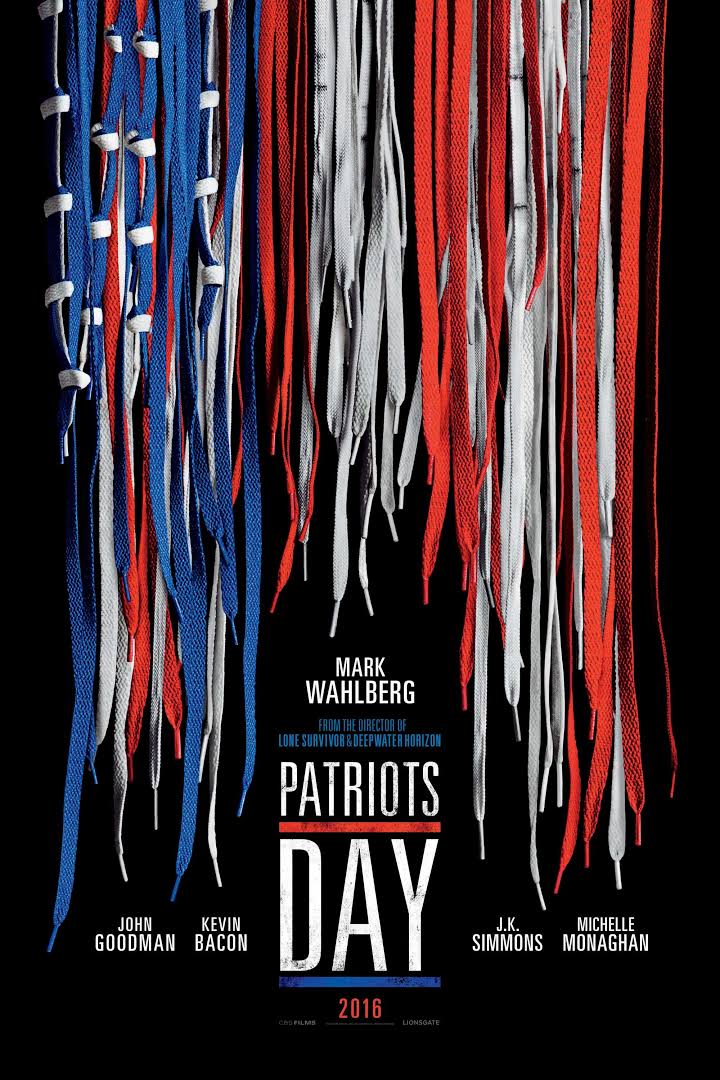
patriotsdayEmotionally intense–not for the faint of heart. Patriots Day is the dramatic account of the Boston Marathon Bombing and manhunt for Dzhokhar Tsarnaev and his brother Tamerlan Tsarnaev. Starring a powerhouse cast on top of extensive research, this film couldn’t come at a better time when there exists such a low general public opinion of law enforcement. Boston Police Department (BPD) shines as it shows that law enforcement officers and officials truly care about the city they are responsible for protecting. Although tragedies often are more conducive for a documentary film, writer-director Peter Berg combines the information found in a doc film with cinematic storytelling techniques to successfully construct a narrative that will rock you to the core and keep you on the edge of your seat. With the inclusion of first person, news, and surveillance footage, Patriots Day does not shy away from the visceral horror that befell the City of Boston and surrounding areas. You think you may know the story, as I did, but nothing will prepare you for coming face to face with one of the most tragic events in modern U.S. history.

Ordinarily, this is where I summarize the plot; but the plot is mostly known all too well. Fortunately, this film goes beyond the news reports and constructs a diegesis (story/narrative) around the stories of eye-witnesses, victims, the wounded, medical first responders, and law enforcement–both local and federal.

Mark Wahlberg, John Goodman, Kevin Bacon, J.K. Simmons, and the rest of the principle and supporting cast deliver outstanding portrayals of the real men and women who were instrumental in the response to and apprehension of the bombers as well as those who fell victim to the arson and shrapnel. It isn’t often that films depicting tragedies are produced this close to the events contained therein. Occasionally, there are films about tragedies that are truly better suited for a documentary; but, in order to convert it to a cinematic motion picture, a love story is added for diegetic affect. That is not the case with Patriots Day. The focus is on the BPD, FBI, and medical first response to the bombing and massive manhunt that ensued immediately after the explosions. There are certainly romantic relationships indirectly connected to the narrative, but they are mostly included to juxtapose the everyday life that everyone thought they were going to have on April 15, 2013 against the horrifying events that transpired at America’s longest running marathon, which has become such an iconic event each year.

Logistically and diegetically, there is a simple answer as to how this tragedy was so successfully translated to the silver screen so close to the day it occurred whereas other tragic events (mass shootings, bombings, aero-spacial, maritime, etc) are more conducive for and translate to a documentary better. This tragic event is a combination of (1) the explosions themselves (2) the manhunt afterwards and (3) the impressive work of law enforcement. There is more to this story than the bombing itself. Certainly the bombing was the catalyst for the events that ensured afterwards, but the real story is of the incredible actions of law enforcement and other first responders. While there seems to be a general focus in broadcast news media on the negative actions–whether perceived or otherwise–of law enforcement officers, this powerful film shows police officers in a positive light–shows them as individuals who love the city under their protection and stop at nothing to protect the innocent. This is so important in today’s climate of scrutiny of public safety officials.

The cinematography, visual effects, and production design are flawless. So incredibly realistic that you will likely feel transported from your seat into the film itself. To my surprise, the film included interviews with key figures directly involved with or affected by the Boston Marathon Bombing. It’s not uncommon to include photos with textual exposition on the lives of central figures in a historical film; but this film goes beyond telling you “where they are now” or what happened after the events in the film. It includes video footage of interviews–you get to hear from the individuals upon whom the characters were based. I could not think of a better ending to a film such as this one. Patriots Day works because it is the best of what a documentary offers with the brilliance of cinematic storytelling techniques.

For those of you who appreciate historical films depicting tragic events, then this is one that you need to watch. It is not a film to be enjoyed in the conventional sense, but one that packs a powerful message and neither glorifies nor undermines the real historic event. Such a visceral film. Rated R for adult language.

Written by R.L. Terry

Edited by J.M. Wead

“Inferno” movie review

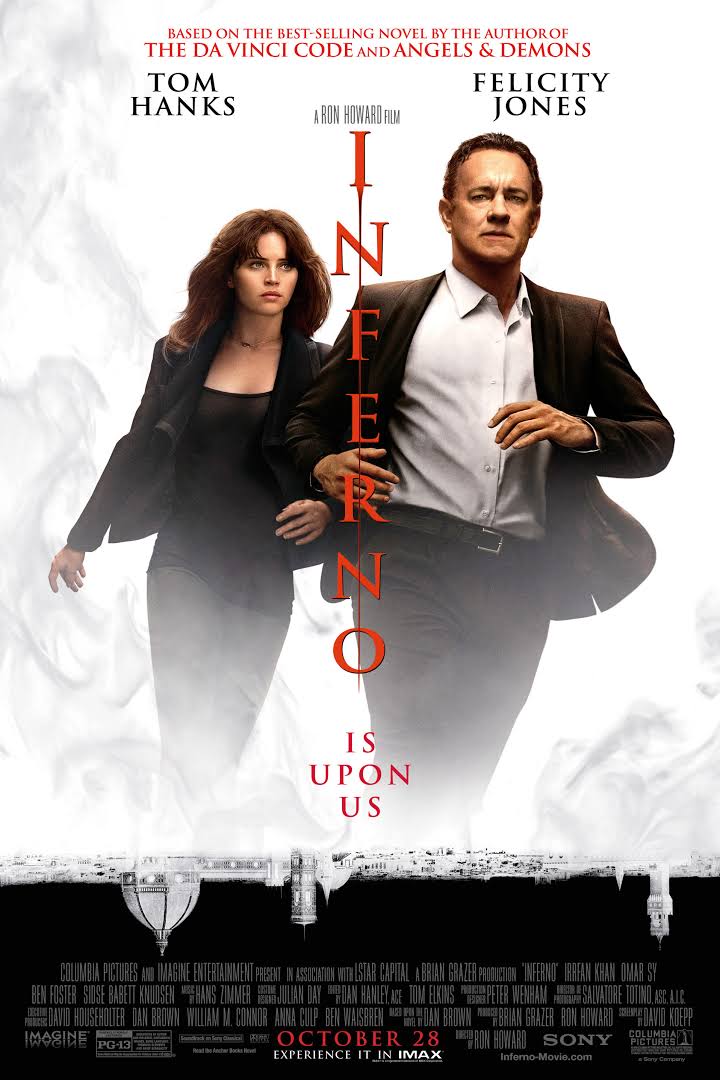
infernoFamed symbologist Robert Langdon is back in a fiery installment in the franchise that bears his name. Sony Pictures and Imagine Entertainment’s Inferno is a non-stop rollercoaster of an adventure film that combines art, history, literature, bio-medical science, and weapons of mass destruction in a heart-pounding thriller that makes academia and public health look sexy. As expected, Tom Hanks delivers an outstanding performance as the Indiana Jones of symbols and puzzles and the visual storytelling is excellent. From the moment the film opens with incoherent subjective flashes through the eyes of Langdon suffering from amnesia, shaky camera movements, and glimpses of disturbing apocalyptic imagery to the final showdown beneath Instanbul’s Hagia Sophia, Inferno will command your attention for the two-hour runtime. Unlike the two previous installments in the Langdon franchise, there is a conspicuous lack of commentary on organized religion by deciphering puzzles and revealing coverups and more of a focus on art history and rhetoric. This focus provides a far more believable plot than found in The Da Vinci Code and lesser so in Angels and Demons. With bio-medical warfare being at the center of this film, the movie paints a realistic portrait of how a Dante-spouting sociopath might try to fix the world’s problems by wiping out half the population with a destructive plague.

Waking up in a state of incoherency and amnesia in an Italian hospital in Florence, Robert Langdon (Hanks) is thrust into running–or hobbling, rather–for his life. Under the guidance and protection of a beautiful ER doctor (Felicity Jones), Langdon barely escapes with his life. Dazed and confused, Langdon must concentrate on piecing together a puzzle–no surprise there–but this time, the puzzle begins with how he got to Italy and why he is carrying a bio-medical tube. From puzzle to mystery, Langdon and Dr. Brooks (Jones) are forced into an adventure that blind-sided them. After discovering a connection between a dead sociopathic billionaire madman and the Italian poet Dante (The Divine Comedy), Langdon and Brooks race across Europe to stop a devastating plague from killing off more than half of the world’s population. Between stopping the plague and constantly under siege by the WHO (World Health Organization) and a private security firm, Langdon is truly racing against the clock to piece together his own life while making the connections in the puzzle left by the deceased sociopath to save the world.

Although in previous installments in the Langdon franchise have the symbologist traversing across Europe and even the world, this film’s plot is mostly concentrated in Florence. Home to some of the most notable works of art in the world, Inferno might work as an unconventional travel guide for the tourism industry in Italy. Far less cerebral than The Da Vinci Code and to a lesser extent Angels and DemonsInferno is far more visceral, exciting, and thrilling. The lack of religious/historic irony will definitely stick out to those who either read the books and/or watch the movies (I am the latte); however, that does not hinder the film’s delivery of an action-adventure taking place within the worlds of the arts and medical science. With the previous installment Angels and Demons being released in 2009, the high-impact feeling of Inferno is incredibly important because there has been such a long gap between the films. Still, the plot of Inferno does not have the finesse that both previous films have. Although this installment is incredibly enjoyable and entertaining, it lacks the opportunity to question, think, and analyze the mystery at hand.

Another contrast between this present installment and the previous two is the character-heavy plot. Occasionally, the film felt overrun with characters. Albeit, most of the characters are interesting and also possess brilliant minds, at times the plot is overcrowded. Perhaps that was intentional since the billionaire madman claims that the population should be reduced because of overcrowding the earth; however, it’s more likely that writer David Koepp and director Ron Howard were attempting to get as much of the novel on screen as possible. Not having read the novel, I am unable to comment on the translation from page to screen beyond inference. Despite the character-heavy plot, the film is not without the trademark art, history, literature, and enigmas that are synonymous with the Langdon series of books/films. Beginning with a reimagined map of Hell based on the one described by Dante in The Divine Comedy and illustrated by Botticelli, the film’s plot does come back to the puzzles but most of the time is spent being chased by nearly everyone.

The best part about this film is just how exciting it is. If you are even remotely interested in it, you won’t be disappointed. As this is a franchise, and franchises tend to have intentional or unintentional patterns of behavior within the cast of characters or similarly functioning plot devices, there are definitely elements in this installment that are found in the previous two. There is one plot twist that bares a striking resemblance to one in The Da Vinci Code. The non-stop action will likely kindle an interest in pursuing a career as an academic or official with the WHO. Perhaps, the study of symbols, numbers, and taxonomy, will be of greater interest to current students. There are just enough loose ends and unanswered questions that keep the film from being too predictable.

Looking for an exciting cinematic adventure for the weekend? That is, when you are not either at or recovering from a Halloween party. Check out Inferno! Not Halloween-themed at all, but it is a fun adventure full of excitement and you’ll learn a thing or two about art, history, and literature.