POOR THINGS film review

Imaginative and provocative! Yorgos Lanthimos’ adaptation of POOR THINGS is a fascinating motion picture that takes audiences on a whimsical, otherworldly exploration, but unfortunately suffers from sluggish pacing midway through the adventure. This interpretation of Frankenstein, in both substance and form, delivers a labyrinth of social commentary on expectation versus reality, pretense versus disillusionment and the consequences of metaphoric prisons.

Brought back to life by an unorthodox scientist, a young woman runs off with a lawyer on a whirlwind adventure across the continents. Free from the prejudices of her times, she grows steadfast in her purpose to stand for equality and liberation.

The most striking element of the film is stunning production design! It’s whimsical and dark, gothic and post-modern all at the same time. Audiences will be completely transported to a highly stylized variation of the real world that is clearly inspired by the gothic imagination of Tim Burton filled with quirky characters that feel lifted right out of a Wes Anderson film. If it sounds like a Frankenstein’d film, you’d be correct because the very apparatus of the film is a bunch of pieces sewn together to create a new whole that arrives on screens by way of The Isle of Dr. Moreau. There is even a nod to a famous sene and shot in Metropolis!

From what I could tell, the entirety of the film was shot on a sound stage with highly theatrical, emotive sets and costuming. Lanthimos combined the best of German Expressionism and French Surrealism to craft a 19th century world that both felt part of our own, yet, not of our world. I liken the highly stylized designs to the motion pictures of Tim Burton in the 1980s-90s with exaggerated shapes, harsh shadows, and a substantial helping of dark whimsy. This intentional move to create a world that resides in this liminal space between that which we know to be real(istic) and fantasy works to the film’s advantage because we are prompted at the very beginning that we are about to embark on a bizarre adventure. Lanthimos’ story needed this stylized version of our 19th century world to be the playground for his quirky characters so that we believe and become vested in the journey. 

Without getting into plot points that spoil the film, it’s difficult to go into the degree of detail that I would like in order to analyze the very apparatus of the film itself, as it is in many ways self-reflexive of the narrative itself. But, I’d be remiss to not spend some time on spotlighting the Frankenstein’s creation-like form the film takes in telling this reimagined interpretation of Frankenstein. It is not simply by chance that this Lanthimos film looks different that his previous works such as The Lobster, The Killing of a Sacred Deer, and The Favourite, he intentionally took discernible tropes and elements of his own cinematic authorship and combined it with the gothic-inspired stylized worlds of Burton with the quirky characters and dry humor of Anderson to create a new experience for audiences. In essence, he Frankenstein’d his film, which is populated by Frankenstein and Isle of Dr. Moreau characters and animals. There are animals that are right out of the latter and characters that are expressions of the former. 

Poor Things captures the imagination and whisks audiences away to this whimsical world, but this adventure is not without its rich subtext and theming. Honestly, this is going to be one of those films wherein each member of the audience may read it differently. In my screening alone, I overheard conversations ranging from #MeToo to modernity versus postmodernism to capitalism versus socialism and even a critique of the affects of Victorian culture on society. 

My reading of the film consists of arguments around the ideas of the expectation versus reality, the expectations placed upon us by the world and society in which we live (which can feel like a prison) and the reality of when the world and society do not meet our expectations placed upon it. Moreover, we can expand upon this idea by including what happens to us when we become disillusioned by the pretenses and facades that are projected by various individuals in our lives—we learn who and how they really are. And lastly, the film depicts many different images of prisons. These prisons can be our family of origin, our occupation(s), or the norms and mores of society—we feel trapped and long for adventure; we long to stimulate our senses with new experiences that challenge the status quo.

Tony McNamara and Alasdair Gray’s screenplay is mostly well-crafted; however, after a solid first act, the second act drags on and on to the point there are many redundant scenes and repeated sexual exploits that cross the line from being able to justify them dramatically to self-indulgent and gratuitous. As a film professor, my philosophy for sex, drugs, and violence in screenplays (and in motion pictures)  is that as long as it can be justified dramatically and adds to character or world-building, then it is appropriate. However, it’s when these elements are used for shock value or to indulge warped fantasies that they become inappropriate. And I must say that the sexual content of the film borders on gratuitousness.

I don’t bring this up as some sort of moral judgment on the film as much as I bring it up because it’s due to this borderline gratuitousness that the second act gets bogged down, which it could have easily been written much more leanly. Beyond the repeated sexual exploits of the second act, there are other sequences and scenes that simply drag. Sufficient time developing the story is one thing, but some of the sequences and scenes become superfluous and excessive, revisiting the same conflicts or relationships over and over to the point that it feel pedantic. 

Fortunately, after the protracted second act, the third act returns to proper pacing and delivers a satisfying resolution. However, there is a coda (of sorts) that I could take or leave. It is definitely setup, but was it necessary? I’ll leave that up to you. 

For everything in the film that works so incredibly well, it needed another editing pass to mitigate the self-indulgent second act that continues to the improper pacing. Fortunately, the cast is superb and the candid, brutal honest of the film is intoxicatingly funny. Because of the phenomenal production design, it is a film that will be best experienced on the BIG screen, so I advise not waiting until it’s available to rent on-demand to watch at home. 

Ryan teaches Film Studies and Screenwriting at the University of Tampa and is a member of the Critics Association of Central Florida and Indie Film Critics of America. If you like this article, check out the others and FOLLOW this blog! Interested in Ryan making a guest appearance on your podcast or contributing to your website? Send him a DM on Twitter. If you’re ever in Tampa or Orlando, feel free to catch a movie with him.

Follow him on Twitter: RLTerry1 and LetterBoxd: RLTerry

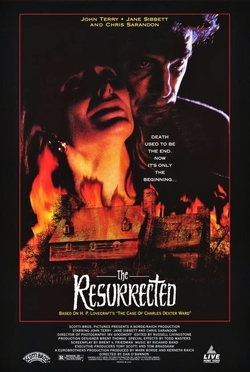
“The Resurrected” (1991) Horror Film Review

Not the Easter resurrection that many of us celebrate this weekend, but the brilliant Lovecraftian horror film that you’ve likely never heard of, much less seen! Often when it comes to holidays, I enjoy reviewing films that fit the theme of the special day. And with Easter coming up on April 12th, what better film to review than one actually entitled The Resurrected? I don’t know about you, but until this past weekend, I’d neither seen nor heard about this film. After watching it, I am blown away as to how such an outstanding horror film got left to obscurity. Attempting to understand how this became a forgotten film, I came up with a combination of a couple reasons (1) it was straight-to-VHS and (2) there was another little horror film that you may be aware of from 1991 that took the world by storm (and still mesmerizes and terrifies us today). Ever hear of the film called The Silence of the Lambs??? Because of the critical and audience success, not to mention winning the Big 5 Academy Awards, it’s entirely possible that the success of SOTL cast a big shadow on The Resurrected (aka Shatterbrain). Now, I am not claiming that the latter is on the same critical level as the former, SOTL is the superior motion picture; however, with SOTL being a horror film, I believe that it stole attention away from The Resurrected. Perhaps the following review will inspire people to seek out this film. The Resurrected was Dan O’Bannon’s first feature length film following his directorial debut his of Return of the Living Dead. If his name sounds familiar, that because you either know Return of the Living Dead or perhaps his work on the greatest sci-fi horror of all time Ridley Scott’s Alien, for which he wrote the original screenplay. With such horror and cinematic pedigree, it’s no wonder why The Resurrected was such a fantastic entry into the horror library! 

As the title suggests, this film deals with the return of what was dead, or what Freud calls the uncanny. From the German word unheimlich, meaning unholy, the return of the repressed, or the appearance of that which should have remained hidden, audiences encounter a Dr. Frankenstein like character whose obsessive experiments have taken a turn for the mad and macabre. Fixated on and fascinated with bringing the dead back to life, Charles Dexter Ward (Chris Sarandon) builds an unsettling laboratory in an old family estate where he shuts himself off to his wife and the world so he can work uninterrupted as he dabbles in a combination of witchcraft and science to reanimate the dead. When his wife Claire (Jane Sibbett) suspects that her husband may be up to something far more sinister than the “science” he claims he’s working on, she hires private investigator John March (John Terry) to look into her husband’s research. When March discovers that Charles Dexter Ward may not be whom he claims to be, all hell breaks lose—almost quite literally.

Between Return of the Living Dead and The Resurrected, I am astonished as to why O’Bannon never returned to the director’s chair. Perhaps it’s because MGM did not believe in this film enough to give it a theatrical release. Since MGM also released Ridley Scott’s Thelma and Louise that year, maybe its resources were tied up in that film’s road to the Oscars; therefore, it didn’t care enough about O’Bannon’s second film. It’s a shame because he has a stylistic approach that’s both poetic and shocking. Fortunately, his direction is stylized in ways that enhance the audience experience without detracting from the story and becoming an attraction for the sake of being stylized. Stylization with substance, that is O’Bannon. Instead of including shocking visual material for purposes of being mere gimmicks, he uses these moments to drive the plot and character development forward; everything in the film is intentional designed to move the story forward. I love seeing the hand of the director in a movie, and The Resurrected is oozing with evidence that O’Bannon cared about every frame of every moment in his sophomore film. What this film is, is the combination of what O’Bannon learned from working with Ridley Scott on Alien and what he learned from his freshman film Return of the Living Dead. Every screenplay needs a writer who cares, and every film need a director who cares. 

While it’s unfortunate that this film is seldom part of horror discussions, it certainly isn’t the first 90s horror film that seems to have fallen off the radar. The way The Resurrected flew under the radar reminds me of John Carpenter’s In the Mouth of Madness. Fortunately for the latter, it has found a cult following in recent years, but the former still hasn’t received the attention form horror audiences that it both deserves and earned. Which is unfortunate because this movie offers the kind of genre charm that was quintessentially 80s/90s.

What a screenplay! Everything about this story works so incredibly well. There are three genres at work in Brent V. Friedman’s screenplay for The Resurrected: neo-noir, science-fiction, and supernatural. While successfully crossing genres can be dangerous, with a risk of not delivering on any of them, Friedman proves that he is a master visual storyteller that can create the stuff of nightmares without relying simply on shock or gore. In fact, the moments of visceral horror are very few. But when they hit, they HIT! The A story is the traditional detective meets gorgeous client with an unusual request, the B story is about a mad scientist, and the C story is where we get into the supernatural. Each of these stories weave in and out of one another beautifully to create a truly outstanding work of poetic horror. Fans of direct or inspired adaptations of H.P. Lovecraft horror, will absolutely love the storytelling in this film. In fact, I may recommend this film to all horror fans, but feel that it is required watching for Lovecraftian horror fiends! Friedman’s screenplay works so well, that you will feel that O’Bannon write it himself. One of the common areas of weakness in late 1980s-early 90s horror is pacing. Lots of great practical effects, production design, and even performances, but the writing can be poorly paced and vapid. Not so with this film! So between O’Bannon’s excellent direction and a gripping screenplay, The Resurrected will hook you from the very first scene and hold your attention hostage for the entire film.

Beyond the strong direction and writing, perhaps my favorite park of the movie is the spinechilling practical and special effects! No CGI could ever look nearly as dimensional as all the practical effects generated by modeling, stop motion, miniatures, fake blood, prosthetics, and more! Nowadays, I find it difficult to buy into an actor interacting with something that isn’t really there. Oh we see it after the motion graphic artists and editors work their magic, but no amount of quality of CGI can authentically replicate the way real light bounces off real objects, then into the camera lens. The special effect artists did things that are mindblowing even by today’s standards for visual effects. While my area of expertise is not the mechanics and optics of special effects, I can usually extrapolate a good idea of how something was accomplished, but I am at a loss for words with the effects I witnessed in The Resurrected. One moment in particular that I want to mention, as I don’t want to give away all this movie has to offer, has to do with the reanimated remains of a human body that are dissolving into some grotesque creature that is violently growling and gnashing its teeth. An incredible feat of cinematic proportions! And that’s only one of the most elaborate practical effect scenes; strategically places throughout the movie are glorious moment of special effects that immerse the audience into the macabre Lovecraftian story, and prove that something real, dimensional, tanglible to interact with will always be far more convincing than actors interacting with chroma-green abstract objects on set.

This really is one of the best horror movies that you’ve never heard of, much less seen. While you cannot currently stream it anywhere, except through more nefarious means, you can buy the Blu-Ray on Amazon and other retail outlets. Whether you prefer genre or more complex horror, you will find something to love about this movie.

Ryan teaches screenwriting at the University of Tampa. If you like this article, check out the others and FOLLOW this blog! Interested in Ryan making a guest appearance on your podcast or contributing to your website? Send him a DM on Twitter or email him at RLTerry1@gmail.com! If you’re ever in the Tampa area, feel free to catch a movie with him!

Follow him!

Twitter: RLTerry1

Instagram: RL_Terry