“Allied” movie review

alliedQuite the duplicitous plot! Robert Zemeckis’ Allied released by Paramount Pictures is a thrilling tale of espionage and love. We have certainly seen a few different “spy” movies over the last couple of years; some more about espionage and others more about the drama that ensues afterwards. Fortunately, Allied feels like a genuine spy movie that actually contains espionage. The production design and costumes are a beautiful throwback to the fabulous 40s. You’ll find yourself reaching for a glass of champagne and swing dancing to Benny Goodman’s timeless big band jazz hit Sing, Sing, Sing. There is one city synonymous with WWII, espionage, and romance and you will appropriately return to that iconic city of Casablanca in Allied. This is definitely not a reimagined Casablanca but there are indirect references to that movie sprinkled throughout this new story. Films like this one require top notch talent, and both Brad Pitt and Marion Cotillard deliver outstanding performances to accompany this staple in film genres. Not limited to the love story between Pitt’s and Cotillard’s respective characters, the movie also includes some deadly shootout scenes and dangerously close encounters with the Nazis behind enemy lines.

Commander and intelligence officer Max Vatan (Pitt) is stationed in the famous city of Casablanca in French Morocco where he teams up with French resistance movement leader Marianne Beausejour (Cotillard). Impressed by her ability to so effectively blend in and create her authentic cover, Vatan soon finds himself falling in love with his partner. Following the assassination of a Nazi ambassador, Beausejour and Vatan flee to London to start their life together. Everything is going beautifully for the happy couple in their second year of marriage with a child when Vatan’s superiors confront him with the suspicion that Marianne is in fact a Nazi spy. Refusing to believe it to be true, Max must now conduct his own investigation into his wife’s history to protect the ones he loves so dearly.

I absolutely adored the look and feel of the film as it echoes the era of the Golden Age of Hollywood. Although this movie plays off a tad listless as a result of failing to elicit a strong emotional response from the audience, it is not without it outstanding elements. It benefits from solid acting and beautiful cinematography as well as some fantastic symbolism. Robert Zemeckis’ talent for visual storytelling is clearly visible in this period film. The weakness in the ability to successfully leave a lasting emotional impact on the audience is in the writing and executive producership of Steven Knight (Eastern Promises). For films that are not as much about the spectacle as they are the drama between characters and the challenges faced therein, it is vitally important that the personal/interpersonal relationships transcend the screen and directly impact the audience. All the makings were there for a deeply moving cinematic story, but it just doesn’t quite make that transition from the mostly superficial and distant.

Mirror, mirror, on the wall…(interesting fun fact: this misquoted line from Snow White is actually “magic mirror on the wall”). But, I digress. The strategic use of mirrors is an  incredible use of visual storytelling and symbolism. For those who have studied film or literary rhetoric, the mirror is a classic means of conveying duplicity (two sides, faces, etc of a character). Even without knowing that this was a spy movie, I would have been able to infer that from how the mirrors are shot and placed within the composition of the 24 frames a second. When using powerful symbolism as part of the visual story, it conveys so much more meaning in a scene than words could actually describe. Mirrors have long sense been a powerful metaphor even before moving pictures. But motion pictures allow for a greater use of the importance it plays in a cinematic story. Not limited to duplicity, mirrors can also be used as a metaphor for self-reflection. Whether talking duplicity or reflection, the mirror aids in conveying so much to the audience in this movie.

Ordinarily, I am not a fan of classic films getting remakes; however, there are always exceptions when the core or essence of the film is held in tact but the production design, direction, and cinematography are brought up to speed with contemporary cinema. If you’re a fan of WWII era films or the timelsss spy movie, then you will definitely enjoy Allied. After witnessing the significance of Casablanca in this movie, I am actually looking forward to a remake if there ever is one. Provided. That the overall look and feel of the movie is in line with classical motion picture storytelling. I could definitely see Robert Zemeckis directing a remake of Casablanca. Occasionally there are directors who can strike the balance between a classic tale told through contemporary technology, and Zemeckis definitely struck that balance in Allied.

Don’t allow the weak writing to dissuade you from watching it; there is actually a lot to enjoy in this film. After the slow burn during the first act, acts II and III are full of intrigue and suspense.
“Arrival” movie review

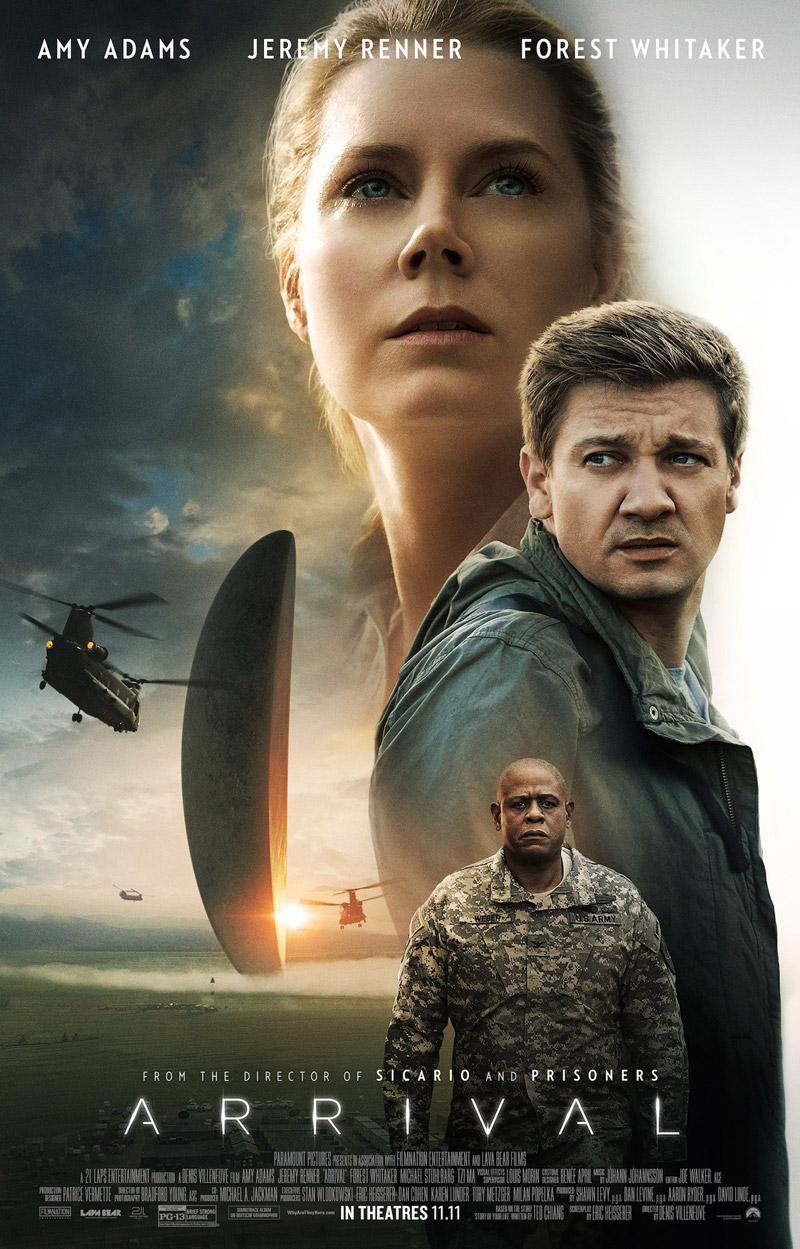
arrivalposterYou’ll want to see it again. Prepare yourself for an extraordinary cinematic journey in this science-fiction thriller complete with commentary on the human condition. From the exhilarating cinematography to the incredible awe-inspiring visual effects, Arrival will have you hooked from the very beginning. Based on the book Story of Your Life and Directed by Denis Villeneuve (SicarioPrisoners), Arrival boasts an outstanding cinematic experience that is as much cerebral as it is visceral. Your very perceptions of time and memory will be questioned and force you to open your mind to endless possibilities. Poignantly, this film takes you on a journey that will show you that we need to change and that we can change. On the verge of avant-garde, Arrival pushes the limits of traditional visual storytelling and creates an innovative method for conveying social commentary within the science-fiction genre. Following the final fade to black, you’ll want to discuss this film with your friends. Reignite your sense of wonder. Arrival is more than a story; it’s an experience!

After twelve egg-like unidentified objects land on earth, the U.S. Government calls upon expert linguist Dr. Louise Banks (Amy Adams) and theoretical physicist Ian Donnelly (Jeremy Renner) to crack the mystery and develop a means of communication with the homogenous alien species. While much of the world is on the brink of an all-out assault on the aliens, Banks is determined to establish a rapport and open communications with the species. Starting with basic words and working up to complex sentences, Banks knows she has to learn the aliens’ language in order to better understand why they have come. When things take a turn for the worst, Banks and Donnelly have precious little time to stop countries from engaging in battle with risk of war. With so little time to unravel the mystery of why the aliens are here and what they want, Banks will find herself on a mind-blowing journey of her own.

You’ve just got to see it. There is so much that I want to talk about, but it would spoil so much of the film. I’ve mentioned before that there are great ‘movies’ that are mediocre ‘films,’ but this is a prime example of an excellent movie AND brilliant film. The brilliance of this film is not in the stunning visuals, although that is certainly part of it; the brilliance lies within the cinematic and experiential storytelling. During the big reveal at the end of the film, your mind will be blown. You’ll find yourself wanting to watch it again to more clearly understand the strategic placement of the pieces of the puzzle. During a time in which the country appears so incredibly fractured, this film will provide audiences with a renewed sense of wonder and appreciation for that which one may not fully understand. Making the tough calls and putting one’s life at risk of what is right is also woven throughout this story. The theme of Arrival is not fully realized until the latter half of the film. More than a surface-level story about that which I cannot mention without giving it away, this film possesses a dynamic range of themes just beckoning for interpretation. As this film bares much similarity to avant-garde cinema in the reimagining of traditional storytelling, it will evoke a powerful emotional response.

Amy Adams and Jeremy Renner deliver outstanding performances in the lead roles. Taking center stage for most of the film, Adams breaks new ground as an actor in this role that is nearly a complete departure from most of her other roles. Both Adams and Renner display excellent chemistry in their respective characters. Although Adams is the central character and responsible for the drive of the plot, Renner is strategically placed to reinforce the affects Adams’ character has upon the plot. Forest Whitaker also plays a strong colonel and was an excellent choice for his role as well. The success of the cast can be attributed to both the outstanding direction from Villeneuve and the incredible screenplay by Eric Heisserer. Bradford Young’s cinematography is so simple but yet so beautiful and profound. It is of no surprise that this film is being touted as one of the best movies of the year and has a nearly unprecedented 100% on Rotten Tomatoes.

Whether you are a linguist yourself or just enjoy an exhilarating cinematic journey, Arrival is definitely the film to catch this weekend. For the Star Trek TNG or Voyager fans out there, you will find that Arrival possesses some of the same great content that sets Star Trek apart from other science-fiction shows due to the human condition being central to the overall plot. If you enjoy movies that prompt you to revisit how you perceive your life, time, or space, then you will not be disappointed. There are so many levels to this film. You’ll likely find yourself wanting to see it again after fully realizing the innovative plot. Hopefully this film receives some Oscar noms in the upcoming award season.

“Inferno” movie review

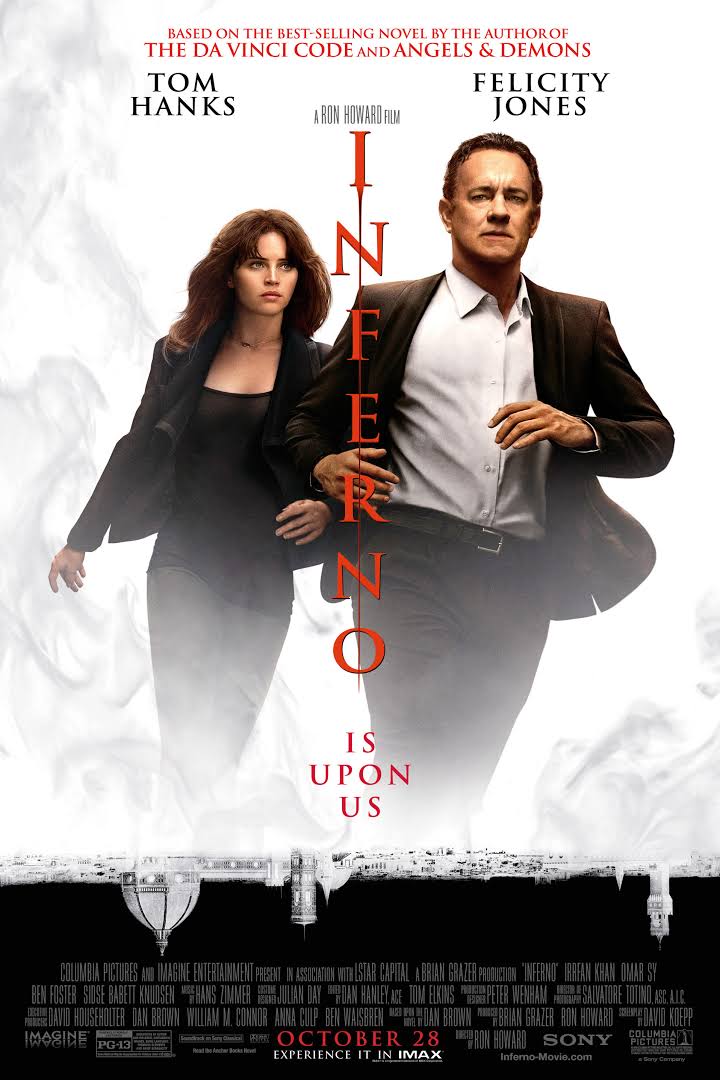
infernoFamed symbologist Robert Langdon is back in a fiery installment in the franchise that bears his name. Sony Pictures and Imagine Entertainment’s Inferno is a non-stop rollercoaster of an adventure film that combines art, history, literature, bio-medical science, and weapons of mass destruction in a heart-pounding thriller that makes academia and public health look sexy. As expected, Tom Hanks delivers an outstanding performance as the Indiana Jones of symbols and puzzles and the visual storytelling is excellent. From the moment the film opens with incoherent subjective flashes through the eyes of Langdon suffering from amnesia, shaky camera movements, and glimpses of disturbing apocalyptic imagery to the final showdown beneath Instanbul’s Hagia Sophia, Inferno will command your attention for the two-hour runtime. Unlike the two previous installments in the Langdon franchise, there is a conspicuous lack of commentary on organized religion by deciphering puzzles and revealing coverups and more of a focus on art history and rhetoric. This focus provides a far more believable plot than found in The Da Vinci Code and lesser so in Angels and Demons. With bio-medical warfare being at the center of this film, the movie paints a realistic portrait of how a Dante-spouting sociopath might try to fix the world’s problems by wiping out half the population with a destructive plague.

Waking up in a state of incoherency and amnesia in an Italian hospital in Florence, Robert Langdon (Hanks) is thrust into running–or hobbling, rather–for his life. Under the guidance and protection of a beautiful ER doctor (Felicity Jones), Langdon barely escapes with his life. Dazed and confused, Langdon must concentrate on piecing together a puzzle–no surprise there–but this time, the puzzle begins with how he got to Italy and why he is carrying a bio-medical tube. From puzzle to mystery, Langdon and Dr. Brooks (Jones) are forced into an adventure that blind-sided them. After discovering a connection between a dead sociopathic billionaire madman and the Italian poet Dante (The Divine Comedy), Langdon and Brooks race across Europe to stop a devastating plague from killing off more than half of the world’s population. Between stopping the plague and constantly under siege by the WHO (World Health Organization) and a private security firm, Langdon is truly racing against the clock to piece together his own life while making the connections in the puzzle left by the deceased sociopath to save the world.

Although in previous installments in the Langdon franchise have the symbologist traversing across Europe and even the world, this film’s plot is mostly concentrated in Florence. Home to some of the most notable works of art in the world, Inferno might work as an unconventional travel guide for the tourism industry in Italy. Far less cerebral than The Da Vinci Code and to a lesser extent Angels and DemonsInferno is far more visceral, exciting, and thrilling. The lack of religious/historic irony will definitely stick out to those who either read the books and/or watch the movies (I am the latte); however, that does not hinder the film’s delivery of an action-adventure taking place within the worlds of the arts and medical science. With the previous installment Angels and Demons being released in 2009, the high-impact feeling of Inferno is incredibly important because there has been such a long gap between the films. Still, the plot of Inferno does not have the finesse that both previous films have. Although this installment is incredibly enjoyable and entertaining, it lacks the opportunity to question, think, and analyze the mystery at hand.

Another contrast between this present installment and the previous two is the character-heavy plot. Occasionally, the film felt overrun with characters. Albeit, most of the characters are interesting and also possess brilliant minds, at times the plot is overcrowded. Perhaps that was intentional since the billionaire madman claims that the population should be reduced because of overcrowding the earth; however, it’s more likely that writer David Koepp and director Ron Howard were attempting to get as much of the novel on screen as possible. Not having read the novel, I am unable to comment on the translation from page to screen beyond inference. Despite the character-heavy plot, the film is not without the trademark art, history, literature, and enigmas that are synonymous with the Langdon series of books/films. Beginning with a reimagined map of Hell based on the one described by Dante in The Divine Comedy and illustrated by Botticelli, the film’s plot does come back to the puzzles but most of the time is spent being chased by nearly everyone.

The best part about this film is just how exciting it is. If you are even remotely interested in it, you won’t be disappointed. As this is a franchise, and franchises tend to have intentional or unintentional patterns of behavior within the cast of characters or similarly functioning plot devices, there are definitely elements in this installment that are found in the previous two. There is one plot twist that bares a striking resemblance to one in The Da Vinci Code. The non-stop action will likely kindle an interest in pursuing a career as an academic or official with the WHO. Perhaps, the study of symbols, numbers, and taxonomy, will be of greater interest to current students. There are just enough loose ends and unanswered questions that keep the film from being too predictable.

Looking for an exciting cinematic adventure for the weekend? That is, when you are not either at or recovering from a Halloween party. Check out Inferno! Not Halloween-themed at all, but it is a fun adventure full of excitement and you’ll learn a thing or two about art, history, and literature.

“Jack Reacher: Never Go Back” movie review

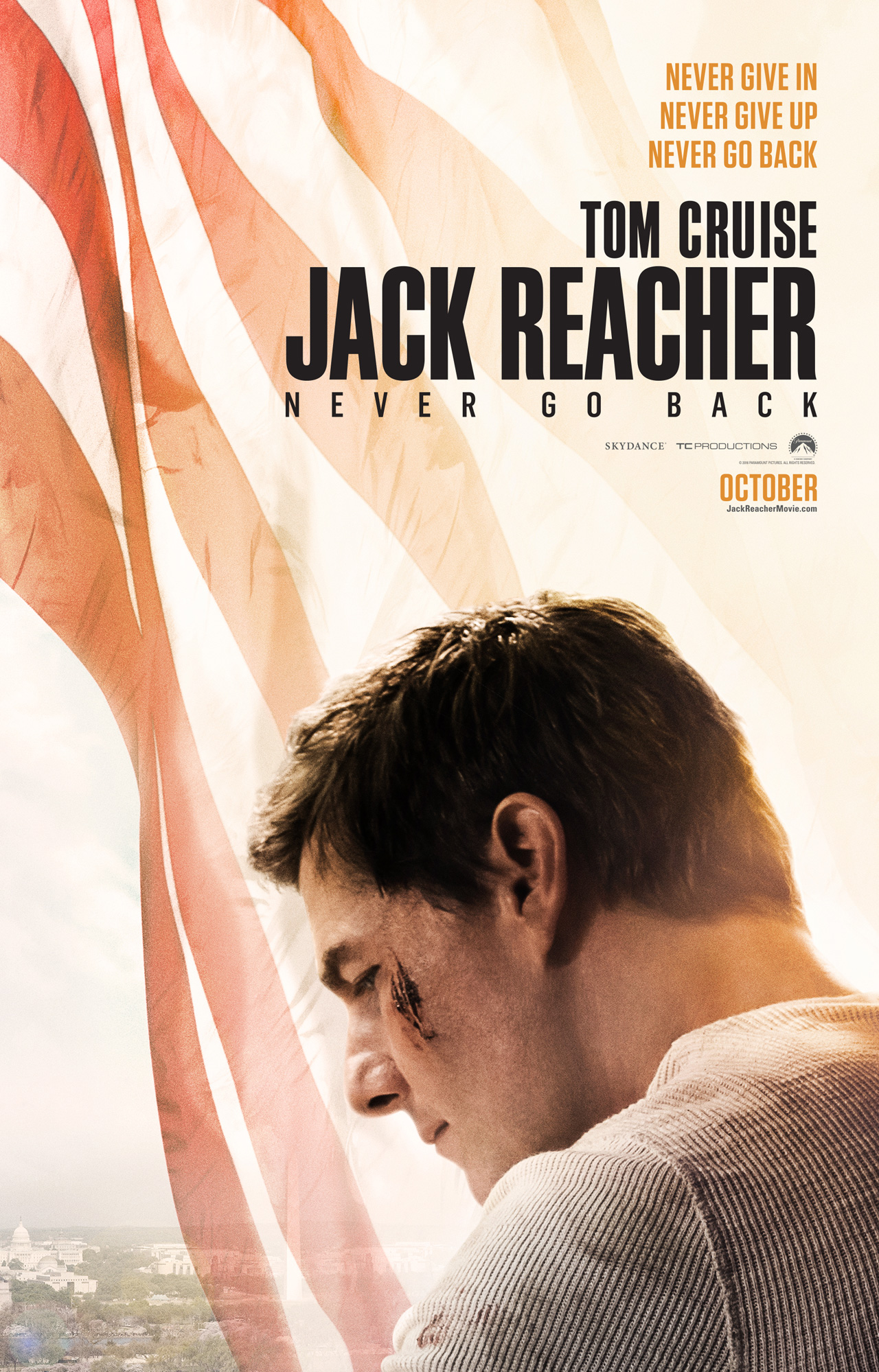
jackreacherposterOutstanding action movie! Paramount Pictures and Skydance’s Jack Reacher: Never Go Back simply does not disappoint. Jack Reacher may never become a household name like James Bond or Jason Bourne, but Tom Cruise proves once again that he truly is an action hero. Furthermore, Cruise is probably the best example of a movie star in the classical sense. You know an actor is truly a movie star when the public refers to his or her movies as “the new Tom Cruise movie.” Even the Bourne and Bond movies are not referred to by the respective actors. Lee Childs’ best-seller makes for an excellent cinematic military conspiracy action thriller! Separating this Reacher installment from the previous one and the Bond and Bourne movies is the fact that Childs and writer-director Edward Zwick give Reacher a pseudo-nuclear family. Although action movies are the epitome of high concept films, by adding a pseudo-nuclear family, a very human element is added to the story that adds some depth and allows for humor that otherwise wouldn’t work. Never Go Back comes complete with equal amounts of bad ass action and levity. Not terribly cerebral, this action-thriller provides audiences with a couple hours of high impact cinematic entertainment at which you can sit back, take your mind off life outside of the auditorium, and enjoy the action that only Tom Cruise can bring to the screen.

The Clint Eastwood-esque action hero is back. After busting a corrupt sheriff’s office in Oklahoma, Reacher (Cruise) finds himself amidst a conspiracy and coverup involving the C.O. (commanding officer) who took over his previous position. Mgr. Susan Turner (Cobie Smulders) is arrested on charges of espionage. Believing strongly that Turner is being setup, Reacher doesn’t hold back in solving the mystery and taking out those who would stand in his way. Crossing paths with the military police himself, Reacher soon finds out that the corruption runs deeper than he first thought. When faced with not only the dilemma of Turner but also the possibility that he may have fathered a child, Reacher must fight two concurrent battles. With mind and body under attack, Reacher stops at nothing to exonerate Turner and provide protection for his possible daughter.

Upon watching this film, I couldn’t help but notice the similarities between Never Go Back and Eastwood’s The Outlaw Josey Wales, by all accounts a masterpiece by the legendary actor and filmmaker. Both stories are about a renegade/loner who acquires a family of sorts. Although the film is very well produced, there is a flaw in that it is apparent that Reacher wants to ‘reach’ further and delve deeper than the superficial plot allows for. Evidence of this is in his dialog that suggests that he wants to be a more dynamic individual who is capable of love and devotion but gets stuck being the action hero all the time because violence is the only thing at which he excels. One of the most prominent themes in the movie is the juxtaposition between high intensity fight scenes and deadpan humorous family drama. By including contrasting elements, the film provides a real opportunity to love the protagonists and hate the antagonists.

Cruise definitely displays some of the best acting of his career in this installment of the Jack Reacher series. He does an excellent job of communicating the difficulty in balancing both the defensive and offensive in terms of protecting his “family” and providing empathetic nurture. I suppose one could infer that the film contains a reimagined “nature vs. nurture” quandary. His reaction to his possible daughter is classic. Throughout the dialog and blocking, it is clear that Reacher is struggling with how to be a dad-like figure but also keep his focus on solving the mystery. Just like any Eastwood-esque story about a loner who has a taste of what being part of a family  is like, the movie ends with a fated goodbye scene between his ‘daughter’ Samantha (Danika Yarosh) and himself. But just before it get too heartbreaking, Zwick throws in a pleasant twist.

If you are in the mood for a good old-fashioned military conspiracy action drama, then look no further. Jack Reacher: Never Go Back strikes a fun balance between kung-fu movies and quirky family dramas. Cruise will definitely not disappoint in this film He does what he always does. Provides us with solid action-star acting coupled with some humor along the way.

“The Girl on the Train” movie review

girlonthetrainA tastes great, less filling, David Fincher-esque flick. DreamWorks Pictures and Reliance Entertainment’s The Girl on the Train directed by Tate Taylor and starring Emily Blunt is the much anticipated film adaptation of the best-selling novel of the same name written by Paula Hawkins. With a slow windup and quick delivery, the suspense thriller plays off as a knockoff combination of Alfred Hitchcock’s Rear Window, Fincher’s Gone Girl, and George Cukor’s Gaslight. Despite the wild success of the novel, this film adaptation appears to have jumped the tracks. In fact, fans of the novel may find that this translation from page to screen is a bumpy ride. The film is not without its high points; the plot is certainly intriguing and Blunt’s portrayal of the protagonist is excellent; however, her outstanding performance is simply not enough to carry the weight of an otherwise flawed film. The film fails to truly create that sense of dread and heighten the anxiety levels of the audience. There were many missed opportunities to tighten up the writing during the windup and spend more time on a successful nail-biting punch during the third act. It’s one of those films that feels like Act I is 2/3 of the movie with Acts II/III being 1/6 each. Lots of verbal exposition when exposition through showing would have been more effective. Don’t get me wrong; it was a fun suspense thriller and the plot twist and turning point from Act II to III was quite the shocker; but, the film just never seemed to move beyond the surface level.

Rachel Watson (Emily Blunt) is not adapting to life as a divorcee very well. She has a pronounced drinking problem and cannot seem to hold a job. Rides the train into New York City from the countryside everyday, passing her old neighborhood. Starring into not only her old house but the house of a couple she feels are the embodiment of love, Rachel develops an unhealthy obsession with the characters that appear outside of the window as sh narrates their lives. When she learns that the young woman who lives in the house two doors up from where she used to live, has gone missing, she place herself in the midst of the investigation. Not having dealt with her own sordid past, Rachel begins to obsess over the mystery because of the empathy she feels for the missing girl. Once the authorities feel that Rachel has crossed the line too many times, they begin to look her direction. Determined to solve the case of the missing girl, Rachel must put together puzzle pieces that she never thought she would have to face again.

If I had to sum up the film adaption of The Girl on the Train, I would concisely put it this way: under-developed. From the locations themselves to the writing (screenplay) to the plot and characters, this mystery-thriller-suspense movie fails to impact the audience and truly elicit a strong emotional response. Tapping into emotions and affecting anxiety levels is paramount for suspense-thrillers. After such a long, drawn-out wind up and the rushed showdown, this film does not live up to the hype that the novel generated. Having not read the novel, I cannot comment on differences or even how the movie could have been done better; but screenwriter Erin Cressida Wilson could have done a better of job of creative a cinematic story fit for the silver screen. The flaws of the film so not stop with the writing, but director Tate Taylor’s vision, for the best-seller, should be checked because it appears as though he may need glasses. If it was not for Blunt’s commitment to the character of Rachel, the film would have had very little entertainment value. This is one of those films that was saved by attaching excellent talent.

This film falls into the same sub-genre as Gone Girl. But, what made Gone Girl so successful was the exceptional direction from David Fincher and simply the fact that author Gillian Flynn also wrote the screenplay. If an author can be trained to write the screenplay of the film adaption of their literary work, then that is always the best approach because they know the characters and plot better than anyone. Fincher also includes many WTF moments and treats the camera more than lens through which to witness a visual story but creates magic that takes the audience out of the threats and transports them into the movie. The Girl on the Train has a great premise and intriguing plot. The foundation IS there for a great movie adaptation. The writing not only doesn’t do the book justice, from what I have read, but fails to create a cinematic experience as well.

Other than Rachel, the rest of the cheaters are two-dimensional. We are given just enough information to make them mildly interesting, but the character development just isn’t there. Much like the detective in Gone Girl was as interesting to follow as the main cast, Detective Riley should have been just as well developed for this film. Rachel’s ex-husband, his wife, their nanny, and the nanny’s husband have the makings of a cast of characters filled with lies, deceit, betrayal, dark secrets, and intrigue (and to some extent, that comes across in the movie); however, all those elements are touched on but never truly fleshed out. Do those elements have a place in the plot of the film? Yes. But, do they play a dynamic a role as they could have? Not particularly. Most everything in the film is very surface level. All the makings are there for a film that could be nearly as thrilling as Gone Girl, but it’s all superficial. When location scouting for a film that relies upon houses, transportation, and proximity that are intricate to the plot, it is important to treat them AS cast. The two main houses and the train in this movie almost feel like they were selected out of convenience. Nothing about the locations or train grabbed me or generated a significant emotional response. However, I liked the proximity of the train to the houses and how the lake is on one side and the neighborhood on the other.

If you’re looking for a fun suspense-thriller to watch this weekend, then this one may fit the bill. But, you won’t get nearly the ‘train’ ride that you experienced in Gone Girl. Emily Bunt demonstrates a dynamic acting prowess compared to other characters that she has brought to life. Whether you choose to watch this film in a local cinema near you or wait for it to be on iTunes, Google Play, Amazon Prime, or HBO, the experience will be the same. At the end of the day, it’s a good movie but a poor film.