“Dunkirk” film review

Journalism meets cinematic visual storytelling. Christopher Nolan’s war epic Dunkirk provides audiences with a different kind of war movie experience. Different in that the narrative is nonlinear and highly experimental. From a technical perspective, the film is flawless. The cinematography, sound design, and score all work together to create an immersive experience in which that fourth wall is nearly removed. One of my friends that I saw the film with last night described it as being a fly on the wall within each timeline. With little dialog, the focus is on the various groups of the army, air force, and civilians. The stylistic film reminds me of photo/video journalism. Dunkirk demonstrates that an emotionally satisfying experience can be delivered without conventional storytelling. In many ways Norma Desmond would be proud of Nolan’s film because “[he] didn’t need dialog, [he] had faces.” Dunkirk invites audiences in for a rare glimpse into the reality of war, and the reality of not only the armed forces but the civilian assistance that truly made the difference and just why this particular war story is so remarkable. Be sure to brush up on your knowledge of the events of Dunkirk before watching the film. You’re definitely going to need to have a base of knowledge of the theatre before becoming the proverbial fly on the wall.

Instead of a plot synopsis, here is what Wikipedia has as a summary of the history of Dunkirk Evacuation. This is definitely going to be helpful prior to watching the film.

During the Second World War (1939–1945), in the May 1940 Battle of France, the British Expeditionary Force (BEF) in France aiding the French, was cut off from the rest of the French Army by the German advance. Encircled by the Germans they retreated to the area around the port of Dunkirk. For years, it was assumed that Adolf Hitler ordered the German Army to stop the attack, favouring bombardment by the Luftwaffe. However, according to the Official War Diary of Army Group A, its commander, Generaloberst Gerd von Rundstedt, ordered the halt. Hitler merely validated the order several hours after the fact. This lull in the action gave the British a few days to evacuate by sea and fortify defences. Winston Churchill, the British Prime Minister, ordered any ship or boat available, large or small, to collect the stranded soldiers. 338,226 men (including 123,000 French soldiers) were evacuated – the miracle of Dunkirk, as Churchill called it. It took over 900 vessels to evacuate the Allied forces and although over two-thirds of those rescued embarked via the harbour, almost 100,000 were taken off the beaches. More than 40,000 vehicles as well as massive amounts of other military equipment and supplies were left behind, their value being less than that of trained fighting men. The British evacuation of Dunkirk through the English Channel was codenamed Operation Dynamo. Forty thousand Allied soldiers (some who carried on fighting after the official evacuation) were captured or forced to make their own way home through a variety of routes including via neutral Spain.

If you are approaching Dunkirk from a desire to see a Saving Private Ryan, then you may want to rethink going to see this film. With little convention in the storytelling, this film puts you on the beach, in the air, or on the sea alongside the civilians, pilots, soldiers, and officers. The focus is not on the characters, special effects, or the bloody atrocities of war, but focussed on highlighting a significant event in WWII history that has largely gone unknown except for those in France and the UK. You are very much like a journalist who is capturing the imagery with your camera. It’s a snapshot of war, not necessarily the story of war. War history buffs, this IS a film for you!

“It Comes at Night” movie review

The Doore of Red Death. A24’s highly anticipated horror film It Comes at Night by writer-director Trey Edward Shults looks beautiful and beckons for attention, but fails to live up to the storytelling and payoff of A24’s The Green Room. Another A24 film in the vein of It Comes at Night is 2016’s The Witch, which was ultimately a failed attempt to capture the magic of a horror/mystery film and leave audiences with too many unanswered questions. The only “terrifying ambiguity” (to quote The Huffington Post), in this film, is just how terrifying it is to realize you just dropped money on a film that works better for Netflix, and the ambiguity comes from the plethora of underdeveloped plot elements. Essentially, It Comes at Night reminds me of a bad M. Night Shyamalan film (before he made his outstanding comeback with The Visit and Split) and after the successes of The Sixth Sense and Lady in the Water. Like the aforementioned era of ehh Shyamalan films, the wind up is excellent but the delivery lacks any emotional impact and you’re left with realizing that you never truly cared about any one of the characters. Character development is lacking, and the third act is incredibly weak. However, there is something in particular that I find very interesting; and after reading other reviews, it seems to be something that has escaped most (if not all) the critics at this point. That is the striking similarities between this film and the timeless classic short story The Masque of Red Death by the brilliant Edgar Allan Poe. From the painting on the walls of the house depicting the bubonic plague to the ominous red door, there are quite a few parallels between It Comes at Night and The Masque of Red Death.

Nestled deep in the woods is a secluded boarded up house belonging to a family of three seeking refuge from an unknown threat. Whatever has caused this family to live off the grid and fend for their very survival is tasteless and odorless. Forced to wear gas masks whenever venturing out into the woods and even around their own home, the family is forced to take drastic measures to ensure there ability to avoid coming into direct contact with the disease. With only now way in or out of the house guarded by a red door, the family has stopped at nothing to protect themselves. One night, the family’s house is broken into and they must decide what to do with the man and his family. Having dispensed with courteousness and generosity in order to guard against any and all possible threats, the family must decide whether to listen to the man or kill him right then and there. Their decision will spark a fire that spreads into their deepest fears.

*spoiler alert* But, the analysis is fascinating.

Okay, now I know that the preceding paragraph describes what should be a brilliant horror film, but the problem lies in the greatly flawed poor storytelling, development, and realization. Lack of connection to any one of the characters is also partly responsible for the lackluster experience of watching this horror-thriller with a hint of mystery and dystopia. The only saving grace the film has is the connection to elements of Poe’s Masque of Red Death. For starters, the camera draws the audience’s (and diegetic POV) attention to a painting of a depiction of the bubonic plague (or black death). At first, I was puzzled as to why this painting. Then as I go through the movie, I realize why. Between the constant reference to and runtime spent on talking about and showing the red door, it hit me that this film reimagined Poe’s short story and set it in a dystopian or post-apocalyptic time and place. If you are unfamiliar with The Masque of Red Death, then I encourage you to read it or watch it on YouTube. It is allegory on the inevitability of death no matter how  hard you protect yourself, how much money you have, or how powerful you are. It also contains allusions to the seven deadly sins and the fate of those who party in the wake of mass death among a lower class of people. Although I find the short short to be a stronger narrative than Shults’ variation on this reimagination of the classic tale.

Both the short story and this film contain people hiding out in a fortress. Whereas The Masque of Red Death‘s Prince Prospero is held up ins abbey with his wealthy and noble friends while the red death is killing off the rest of the kingdom, A24’s It Comes at Night features a typical American family living off the land and secured in their rather tutor-looking mountain lodge. Like in Red Death, the family in It Comes receives an uninvited guest one night. Here’s where we see some difference. In Poe’s story, the guest is dressed to attend the masquerade ball and in this film, the guest attempts to break into the home. Although both stories take different approaches to the second act, once thing is in common. And that is the taking in of an outsider. All through the second act, there are hints at something not being right–a constant uneasiness. That apprehension and anxiety regarding the unknown works in the respective stories favors. The emotional impact and psychological payoff differs between the short story and film. Yes, the endings are very similar but feel incredibly different. You’ll just have to read The Masque of Red Death and watch It Comes at Night to know for yourself.

If you’re searching for a thriller to watch this weekend, as it is rain in many parts of the country, then perhaps you should watch Universal Pictures’ The Mummy instead. However, if you are curious about how well It Comes at Night parallels Poe’s short story, this definitely check it out. Not entirely sure why it’s rated R, but in case that’s important to you. To quote Dr. Ian Malcolm, “well, there it is.”

Thank You for Your Interest in Our Company…

…unfortunately, we have chosen another candidate at this time but we will keep your resume on file for future positions that are more in line with your qualifications (the biggest lie next to “I have read the terms and conditions”). How many of you have received hundreds of those emails? I certainly have. So many, in fact, I could usually determine which recruitment automation software the company used. Occasionally, my name wouldn’t even be in the “to whom” area; it would simply read “dear candidate” or worse “dear NAME.” Hashtag, mail merge fail. When you constantly receive rejection emails from potential employers and collectively fewer than 15 interviews over more than two years, you breakdown emotionally and psychologically. How could it be? I did everything society says you’re supposed to do in order to make-it in this life. I had many years of valuable work and volunteer experience, bachelors and masters degrees, 12 indie films, and hundreds of peer-reviewed articles and a book. Still. I was unsuccessful in landing any position directly or even indirectly related to my professional and academic experience. After 956 unique resumes and cover letters and searching for over 26-months, I finally landed a position after graduate school AND it’s in my field; but, there were plenty of times along these more than two years that I was simply ready to give up. After a while of searching without even an interview, depression set in and it became physically sickening to continue to search for a job.

Although I was confident that I was doing everything I could in order to catch the attention of a company, I knew that I could not expect different results if I kept doing the same thing the same way (or some variation of it). I reached out to career services at USF and began working with the VP of career services. Having hope that he would be able to look over my resume and cover letter and be able to determine why I wasn’t receiving interviews, I was disappointed when he said that my resume, cover letter, and portfolio looked fine. He did mention that my cover letter was too long and I needed to edit the length, add more “you” and less “I,” and an active close; however, all that said, he was puzzled why I wasn’t landing interviews. Taking his advice, I edited my cover letter and highlighted how my skills would be valuable to a position instead of a longform version of what was already on my resume. So, I suppose looking back, my cover letter did need help. Fortunately, he said that my resume was an excellent one and even used it as an example for other students and recent under/graduates. After meeting with him a few times, I did get a few interviews coming in (collectively, over two years I had less than 15. I think the number is closer to 10 out of nearly 1K resumes/applications). Eventually, I stopped hearing from him. Even after I had an interview with a company that worked with career services–when I didn’t get the job–he reached out to them and asked why. He sad he was going to meet with me to discuss an area of improvement in my interview technique (that wasn’t terribly major), but he never got with me. And I emailed him a few times to set something up.

So, I was back to being on my own again. Even though searching for a job was beginning to really drain my confidence and energy levels, I was fortunate to have a job at USF, MOSI at the time, and a gig I still have editing an NPR show. So, I am not trying to paint a picture of sheer destitution because that would be unfair to those who are unemployed. But all my jobs together still came to less than $24K a year. Hardly enough to live on, independently (with a roommate). Although there was certainly financial struggles, I think the urge to give up was from exhaustion of having done everything right and still failing. There were also plenty of times that I wondered if I was going to have to move back home AGAIN, because I couldn’t seem to hack it. Little more than a year into my job search, I landed an additional part-time job at USF, which combined with my then-current one, gave me 40hrs at $15/hr. Other than not getting paid for holidays, no sick time, no vacation time, and losing a week of pay between Christmas and News Years (and yeah I know, that’s a lot of “not”), I was nearly able to be stable. Last fall, I was hired on at the University of Tampa as a part-time faculty member in the communications department teaching film and writing. Finally. I finally landed something that I could not have without my graduate degree. Of course, I am still juggling multiple part-time jobs at this point. Despite not getting paid between semesters, the job at UT worked wonders to assist me during my larger job search.

Most of my downtime at work and at home was spent on Indeed and on any company I could find through a Google search to find a job. Learned quickly that the LinkedIn jobs feature is completely useless, and even when positions were being posted but already taken. Just have to be posted because of EEO laws. Boy, did I learn a thing or two about EEO. There were a few occasions that I interviewed with mostly female companies. I would interview very well, meet all minimum qualifications plus the preferred, and still not land the job. Would find out later that it went to a female candidate. Although I may be over analyzing that, there were a few instances in which the recruitment process was incredibly fishy and left with the notion that they simply wanted to work with another female. Another time I had an awful interview experience was with a company that conducted the phone interview and decided to bring me in for the in-person one. The whole time during the in-person interview, I was questioned as to why I even bothered applying for the job because they feel that I didn’t have sufficient experience. Why did you even bother to bring me in to begin with??? Interviewed for a city government job, and one of the members on the panel was on his phone the whole time. Made eye contact only when he had to. And I was well-prepared. Had an interview setup at a company where I had two friends; it went poorly too. The interview itself went well, but they never got back with me and even asked my friends if I was applying for an entry level job that was compensated much less than I even made at USF. Long story short, I don’t think he paid attention to anything I said.

Financially things have progressively gotten tighter over the months. Sometimes there was relief when a little extra money would come in from a side gig but ultimately, it was getting harder and harder to continue to live sufficiently. Saved a lot of money by biking to work (after I got one for Christmas), and that proved to be excellent not only for my wallet but my health too. I began getting creative with food over the last couple years. I often cooked at home to begin with, but now I was breaking out all my mom’s old recipes and making them. Most of the recipes were casseroles, chicken/beef and rice, and others that could be stretched over a few days. My roommate grew a fondness for my mom’s recipes too. Now I know how my mom kept the family fed when my dad was in graduate school. One day, I was on the phone with my sister and she asked me if I ever seriously prayed about my situation. I responded, “well sure, I have.” She then asked if I was fervent or even offered up something of mine as an offering. Now that, I had not done. She reminded me of the Old Testament story of Hannah, who wanted a child so desperately. She made God a promise that she would dedicate him to God if He were to bless her with a son. Long story, short. He did, and she did. Now I did not have much to offer. I already gave as much as I could to others and would offer a helping hand whenever it was needed. But, I did have an income. And although I would tithe from my income, I was not regular. I made God the promise that if He were to open the door to a job that I would commit my first 10+% no matter how tough times got.

Around that time, I had a series of interviews with HSN (Home Shopping Network), Feld Entertainment (Disney on Ice, Disney Live, Marvel Universe Live, Monster Jam, etc), and contacted about an upcoming position at the University of Tampa as a supervisor in Media Services. All these came around the same time. Now, I am not saying that because I made a promise that I got the leads, but it is definitely something to ponder. After several interviews with HSN and having known the recruiter for 5 years over the course of interviews in the past, the position went to a friend of mine who was also a candidate. I literally got the news of my rejection (for the 4th time from that company) on my way to my in-person interview at Feld. As you can imagine, I was incredibly disappointed and even hurt once again. But, I could choose to dwell on the negative and allow that to affect my approaching interview or take it as a message that I have to absolutely kill this next one and leave a strong impact. I chose the latter. The following weekend after that interview was payday. And, with not teaching at UT over the summer and with having found out the previous week that I was losing that second job at USF (that added the 10 hours to the 30 I had in Mass Comm), I was facing dire straights once again. I seriously thought of not offering God the top 10+% because I could easily rationalize it as a need to keep due to my income essentially getting cut in half until UT started back up. But, I made a promise “no matter how tough times got.” So, I put money in my savings account and set aside my tithe+ and prayed that it would all work out. That following Tuesday, even after being told by Feld that the recruitment process would take weeks from the in-person interview, I received a phone call. I was pretty well sure that the recruiter was calling to tell me that I didn’t get the job, but to my amazement, I heard wonderful news. God sent me a miracle–little ol’ me.

I’ve been waiting more than two years to hear those words–we would like to offer you the position…–and it happened. I was speechless. I even received $2K more than I had on my application. I prayed for a miracle and I’ve no doubt that’s what I experienced. What happened to that possible UT job that I was contacted about even before it was posted??? I never heard back from UT on that one position and received rejection emails from other companies. Fortunately, working at Feld still allows me to continue teaching part-time at UT as a Film & Media Arts instructor and continue to edit the NPR show. Looking back, I feel strongly that I would not have received the interview, much less, an offer from Feld if it had not been for my four years at USF working in video production and the TV studios. My three years at Disney World, my bachelors degree, past films, Masters degree, and time at USF all worked together to open the door that the Lord brought to me. Interestingly, I wasn’t even looking at editing jobs as a rule of thumb because my producing skills were better than my editing skills (albeit, I am a competent editor and learned a lot through my work at USF), but this job popped up in an Indeed search several months ago. Who would’ve known that would be the job that I would land after more than 26mos of searching.

Over the months, I’ve been able to help others who are facing the same grim career landscape. With my vast experience with resume writing, submission, and interviewing, I have been able to coach others along the way. My story is one of many, but I wanted to–as briefly as I could–write it down in hopes that it may inspire you or keep you from falling into a deep depression like I did a few times during this long journey. Bottom line is, don’t give up. Learn all you can where you are in life. Surround yourself with encouragement. And, never underestimate the power of a prayer and promise.

“Wonder Woman (2017)” film review

WONDERful! No seriously, this is an excellent film! And I’m just not talking about the superhero genre. DC finally hit a homer with this one. This film also serves as evidence that Zack Snyder can TELL/produce a great story but should probably stay out of the director’s chair. Warner Bros. and Ratpac Dune’s Wonder Woman is the superhero film we needed. Trailing so far behind the Marvel brand and film quality, DC needed to produce a film that would make up for Batman v Superman and Suicide Squad AND catch up to Marvel. Seemingly setting out to accomplish the impossible, this film exceeded all measurable expectations and provided a comprehensive cinematic experience. With many themes, this film hits on many topics and does so with incredible precision and elegance. It’s almost as if this film is an extension of Diana Prince herself. Never addressed or referenced as Wonder Woman actually, Diana Prince’s origin story is powerful and ever so apropos in today’s socio-political climate. If only we could all have the courage, compassion, and determination that Wonder Woman embodies and represents. There are certainly elements of this film that are directly aimed at the female audience members, but this is a film for everyone to enjoy and appreciate. Again, not just a great superhero film, but a great film period. One that’s inspirational, evocative, and without need for qualifiers.

After receiving a mysterious package from Wayne Enterprises, Diana Prince (Gal Gadot) opens it to find an old photograph of a Greco-Roman female warrior standing with British military in war-ridden Belgium. Bruce Wayne wants the story. Long before she was Wonder Woman, Diana, daughter of the queen of the Amazons, was a spirited young lady growing up on a beautiful and mysterious island inhabited by a super race of warrior women placed on the planet to watch out over those who seek to corrupt it. Being the only child on the island, she wanted to be trained alongside the other women. When her mother expresses a lack of interest in her daughter training, Diana meets secretly with her aunt. Through the years, Diana grows in strength, agility, courage, and cunning. After she rescues Captain Trevor (Chris Pine) from a downed plane that pierced the invisibility shield that hid the island from the rest of the world, she learns of the Great War happening just outside of their borders and makes the decision to leave her home and help man defeat the enemy combatants who she believes are being led by Ares, the Greek god of war. Fighting alongside men, Diana is able to realize her true destiny and powers as she stops at nothing to end the war that is killing so many innocent people and destroying the planet.

Ever since her creation in 1941 by psychologist William Marston, Wonder Woman has always been treated the best when all pre-existing inhibitions typically added to a female character in a “man’s” role are removed, allowing the feminist ethos at her core to shine and erupt with unbridled passion and strength. Among other traits, the chief characteristic that separates her from other superheroes in both the Marvel and DC universes respectively is–no, not her gender–it is her ability to integrate truth, justice, compassion, and courage in everything she does to protect the planet entrusted to her people by the Greek gods. The key to understanding Wonder Woman is not through her brute strength or supernatural powers, but through her love and compassion for innocent people and her own integrity. Rarely has any film truly given women (or anyone, for the matter) a strong female protagonist who does not pander but exhibits excellence in well-developed strength of character and a complete eruption of the fantasies of many women to rise up to serve and protect. It would have been far too easy to sell Diana Prince as a vengeful women out to destroy men or seek revenge for the destruction that has befallen the planet; but no, that is not the Diana we see. We see a heroine of others–a completely unselfish hero who is of earth. Being of the earth is truly what separates her from someone like Super Man. Sure, some strong female characters from with the world of comics, literature, theatre, TV, or film have demonstrated strong characteristics and have been leaders; but Wonder Woman sands alone as a film that provides audiences with a female protagonist who is not merely a leader, but the engineer–the author–of her own destiny and story.

Why does this film work so well??? After all, that is the question you are likely asking yourself after so many DC flops (note: that does not count the Burton or Nolan films). The short answer is that Snyder was NOT in the driver’s seat on this ride; however, there is more to it than that. Snyder’s touch is certainly evident in many scenes (especially the action sequences); furthermore, he was greatly instrumental in the overall structure, but he took a backseat to the driver of this vehicle. His approach was important in the design of the car, and even building it, but when it came time to take it for a spin, he turned the steering wheel over to Director Patty Jenkins. Films featuring strong female protagonists most often seem to fair better when there is a women at the helm. And Wonder Woman is a testament to that observation. Whereas a male director would have likely spent some time sexualizing Diana, Jenkins spends the time on her courage and compassion. Instead of focusing on the terrain of Diana’s mystical home beautifully appointed with white cliffs and sapphire water or spending time on her sleek blade or even her trademark lasso of truth, Jenkins spends a significant amount of screen time on the terrain of Diana’s face. A face that communicates the heart, mind, and soul of Diana. Instead of a face displaying anger or disgust at the world of men, her face is often bright, hopeful, containing a winning smile with eyes overflowing with optimism. In terms of the production design itself, it only bares hints of Snyder’s penchant for beautiful music videos; the production design is one that takes itself seriously, but in the perfect amounts. Although the film is quite dark, there are sufficient moments of levity.

Perhaps you’re a stereotypical dude who does not care for films that feature female protagonists and feministic themes. No fear. Wonder Woman is actually a World War I film disguised as a superhero movie. As much as Wonder Woman works as an exceptional superhero movie, it is equally an impressive World War I film. Taking place in the days leading up to Armistice Day, this film displays the atrocities of war and the determination of both sides to win. You will find yourself in the trenches in France and Belgium with the Allied forces who, against all odds, are determined to defeat the enemy in order to stop genocide and widespread devastation. Placing Wonder Woman amidst the warriors of earth, connects her to humanity in ways that most superheroes cannot. Fighting for what you believe in is a major theme in this film. Some of the best war movies are those that “show don’t tell.” And Wonder Woman certainly shows what war really looks like instead of talking about it as some abstract concept or spending time in diplomacy. In fact, diplomacy is thrown out the window, and Diana lays the need to fight on the hearts of the bureaucratic leaders and soldiers alike. Pick up your sword and fight. Don’t just sit idly by while humanity is destroyed. There is a particular scene midway through the film that nearly brought me to tears because of the strong emotion and courage displayed by Diana.

Go see it! Wonder Woman is an exceptional film that will blow your mind. I had high expectations going into the film last night after the early reviews were released, but I was not prepared for the degree to which I would thoroughly enjoy the entire experience. It’s not only a film for women, it’s sincerely a film or everyone. Next time you are faced with great opposition, when it feels that the world is caving in around you, be a Diana Prince.

Written by R.L. Terry

Edited by J.M. Wead

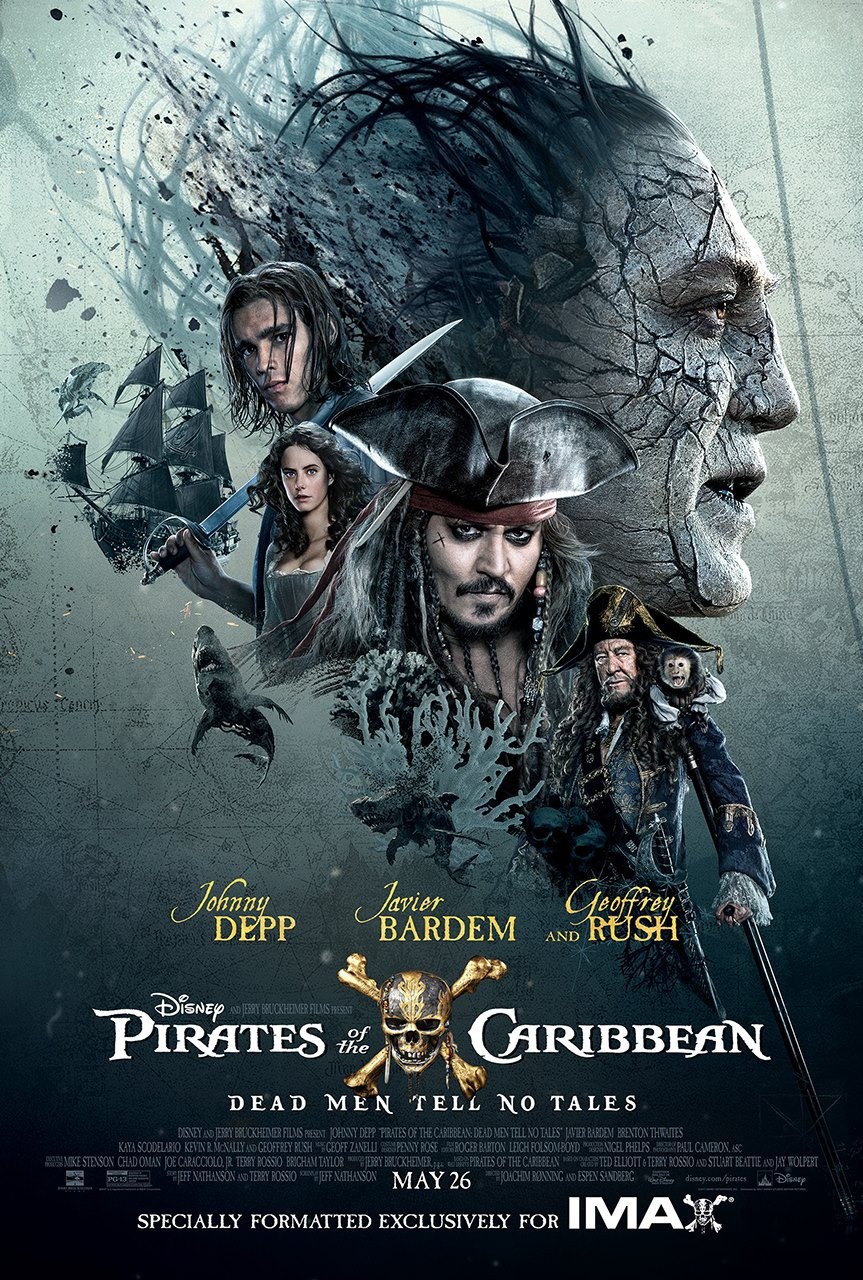
“Pirates of the Caribbean: Dead Men Tell No Tales” movie review

Of all the tales that the depths of the ocean contain, this one is quite shallow. Disney’s latest installment in the swashbuckling franchise Pirates of the Caribbean: Dead Men Tell no Tales proves that neither changing directors, writers, nor the inclusion of an undead Javier Bardem, can bail enough water out of a sinking ship. No doubt the next chapter in the life and times of Jack Sparrow was one to be anticipated by fans, but sadly the writing was not strong or developed enough to carry the waning film series. This film reminds me of the Child’s Play franchise. What??? That is likely what you’re saying. But hear me out. After the first two Chucky films, the studio realized that the series was not working as a hard horror film, so the studio went the camp route and capitalized on the ridiculousness of the characters and the situations. Dead Men Tell No Tales contains many camp elements such as completely ludicrous antics and escapes that are even too much for a Mission Impossible movie. Although there is an attempt at some closure between characters at the end of the film, it plays out as forced and on-the-nose. Still, there are moments that will mildly tug at your heartstrings during the showdown, but it’s not enough to add any dimension to this flat tale. One thing that this Pirates movie has going for it is the impressive visual effects. Both the editing and score are pretty outstanding, and certainly add to the experience of the film. However, if you watch the movie in 3D, as I did because there wasn’t a 2D option at the earliest showing, some of the magic of the undead pirates will be lost due to noticeability of editing. Over all, Disney’s Pirates of the Caribbean: Dead Men Tell No Tales is a great popcorn movie and a fun one to watch with friends or the family. Be sure to stay after the credits for a sneak peek at the next (and hopefully last) one.

Return to the swashbuckling world of the franchise inspired by the iconic Pirates of the Caribbean attraction at Disney Parks! Many years after the encounter with Davy Jones, Jack Sparrow (Depp) is being sought out by a young Henry Turner (Brenton Thwaites)–yes, that Turner. After witnessing his entire ship’s compliment slaughtered by ghost pirates led by Captain Salazar (Bardem), Turner is even more determined to find Captain Jack. Unbeknownst to Turner, Jack Sparrow’s fortune is not what it used to be. With his luck turned sour, Sparrow is captured and Turner must free him if the ghost pirates are to be stopped and the curse of Davy Jones lifted. By sheer happenstance, Sparrow is sentenced to die alongside an accused witch named Carina (Kaya Scodelario). If that wasn’t bad enough, Captain Barbosa (Rush) has been cornered by Salazar into leading him to Sparrow as well. Other than a need to find Jack, Turner, Salazar, and Carina all share a common interest in locating the trident of Poseidon. That trident is the key to unlocking the power of the ocean and breaking curses.

Like so many franchises that have come before, Disney’s Pirates of the Caribbean appears to have suffered the same fate. Although this can’t be said of every franchise, the area that fairly consistently fails to deliver is strong writing inclusive of plot and character development. Often times it seems that story is exchanged for merchandising, impressive visual effects, or pandering in longstanding franchises. After an outstanding opening sequence that instantly hooks you, the rest of the movie just plays out so paint-by-the-numbers that it becomes nearly predictable and lacks any real substance. Sometimes franchises fall into the trap of realizing that it can no longer take itself seriously and allows the camp factor to increase significantly. That is the one word that pretty much sums up this film: camp. Whether you are talking the perpetually drunk Jack Sparrow (yes, even more than usual), unbelievable escapes that defy all logic and past precedents set is previous films, or the supernatural playing off more as a joke than a serious plot device, there are many elements in this film that attempt to cover up poor writing by going for the flash in a pan approach.

One of the down sides to the recent Guardians of the Galaxy I found was the film only focusing on Acts I and III, leaving out the chunk of story development typically found in Act II. By the same token, Dead Men Tell No Tales spends most of the time in Act II, leaving Act I and again Act III to be rushed through. The common variable in both scenarios is a weak third act. To explain where I feel that this movie should have ended and the next one begin would give away a plot spoiler, so I won’t mention it. However, there is a place in this film in which there is a great opportunity to end this story on a high note of anticipation of what is to come but it just rushes through the rest of the story. Had more time been spent on developing a solid story, then this Pirates movie would definitely have turned out much better. Sadly, it seems like more time was spent in post-production and scoring the film. Certainly, the talent behind the lead characters is excellent. Perhaps the writing is poor and the screenplay was weak, but with a lead cast of Depp, Rush, and Bardem, the movie is fun to watch. And sometimes that’s all you want–a good popcorn movie.

If you ARE looking for a good popcorn movie to watch with your family or friends over the holiday weekend, then checkout Disney’s Pirates of the Caribbean: Dead Men Tell No Tales. Can’t promise that you will enjoy the story as much as the original, but you’ll still have a good time. Perhaps the sequel to this film will be stronger and pick up where this one failed to deliver.

Written by R.L. Terry

Edited by J.M. Wead