
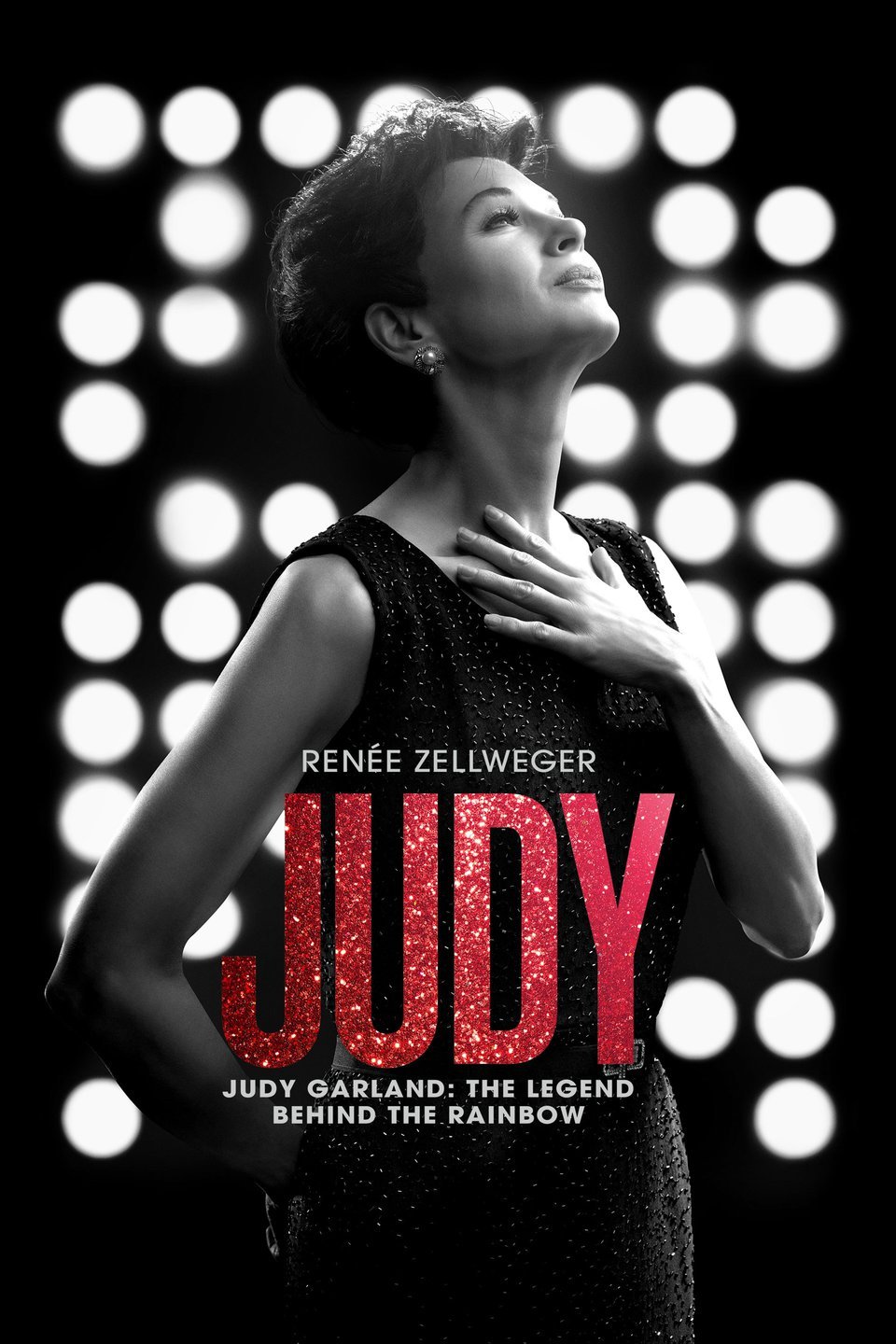
“JUDY” Biopic Film Review

A truly gripping motion picture that will bring you to tears during this somewhere over the rainbow redemption story. Bring tissues. Renee Zellweger is captivating as Judy Garland, and you’ll swear that you’re watching Garland on the big screen. Although we may be familiar with the broad strokes career of the legendary entertainer, this film goes beyond the headlines and tabloids to deliver a true life story that could ironically be titled A Star is Born, or perhaps reborn. Ironic in that this film shows the life of a movie star after the lights have faded and the offers stop coming in, much like the movie she starred in. It’s a rise and fall story, of sorts, but is more precisely a fall and rise story as the movie focusses in on the last year of Judy Garland’s life. If you are worried that the film ends on her death, you can be relived that the film chooses to stop the story prior to the end of the iconic star’s life. And it works so incredibly well! While there are many movies (not unlike A Star is Born) that focus on the rise and fall of a talent in showbusiness, this movie skips all the glitz and glamor to paint a realistic portrait of what it is like for those whom grow up in front of the camera, controlled by those around them, just to wind up in front of booing crowds, empty bank accounts, homelessness, and a tumultuous custody battle. Not to mention her addiction to pills that was caused by abusive treatment at the hands of the old studio system because of being force fed pills from an early age. Whether you are a fan of the iconic diva or not, if you love command performances, then you do not want to miss the uncanny performance of Zellweger as Judy. All the way down to the mannerisms, vocal inflections, and over all behavior, she IS Judy. Although we all know of the tragic ending, no mistaking it, this film is an inspirational story of redemption.

The money is gone, career on the rocks, and risking the loss of custody of her two youngest children, that is the last year’s of Judy Garland’s life. Unfortunately the other side of the rainbow for Judy was anything but magical. Three decades after starring in one of the greatest film musicals of all time The Wizard of Oz, the beloved actress and singer is in dire straights. She is left with virtually nothing except her name and what remains of her timeless voice that charmed millions throughout her early illustrious career. In order to prove that she can provide for her two youngest children, she accepts a gig in London playing to sold-out shows at the Talk of the Town night club. While there, she reminisces with friends and fans, fights her depression and anxiety over performing, and begins a whirlwind romance with her soon-to-be fifth husband.

“For one hour, I am Judy Garland, and the rest of the time I am just like everyone else…I want what everyone wants, I just seem to have a harder time getting it” is a paraphrased quote from the movie, but it illustrates how the actress and singer felt about her relationship with the world. The movie chronicles her inability to stay afloat financially in Los Angeles and must accept a gig in London where her personal troubles continue to follow and haunt her. Her character is so incredibly relatable because many of us have found ourselves in traps that we have stepped in and are at a loss as to how to get out. If you thought this was going to be another cliche musical biopic, then you would be mistaken. No pretense about it, this is an unapologetic look at the dark side of Hollywood in perhaps one of the greatest stories that is right up there with Norma Desmond. Now, I am not equating Judy with what is, in my opinion, the greatest film of all time Sunset Boulevard, but her story is not unlike the one experienced by Norma. The movie also comments on the far reaching effects of childhood trauma on the adult psyche. No one understood the extent that she was abused by the studio system except for Judy herself. If her present-day handlers knew what she went through during the years that American fell in love with The Wizard of OzMeet Me in St. Louis, and more, then they would not-so-casually write her off as a wrecked hasbeen who mismanaged her money and relationships. The film deals with perception versus reality. Strategically placed in the film are flashbacks to her childhood at MGM that provide context for moving the present story forward as each moment reveals a new layer to the legendary entertainer.

Zellweger delivers a performance for the ages in this film. More than a spot-on impression, she transforms into Judy Garland to the extent that you will almost believe that you are watching the iconic actress and singer on the big screen. It is clear that Zellweger studied Judy Garland for months in order to get into character. Her movement, speech pattern, posture, and other behaviors completely sell the audience on this audacious portrayal of such an icon. Never once does she break character and allow the actor to shine through, she remains committed to this phenomenally genuine portrayal of Judy Garland. We all know Zellweger can sing, after all, she wow’d us in Chicago (a rare example of when the movie adaptation IS better than the live show); but nothing will prepare you for the power of her singing in this movie. Other than Have Yourself a Merry Little Christmas, you will hear Zellweger sing other famous songs by Garland such as Get HappyThe Trolly SongCome Rain or Come Shine, and of course the encore of Over the Rainbow during the movie’s climactic, emotionally charged, showdown. Even when singing, Zellweger is determined to deliver the songs just as a late-40s Garland did, complete with all the stubbornness, anxiety, and even anger. I truly hope that Zellweger is nominated for this role.

Perhaps the reason why Liza Minelli was quite objectionably vocal about her mother’s portrayal in this movie is because there are creative liberties taken by the writers in order to further dramatize Judy’s story. As I’ve told my screenwriting class, dramatize don’t tell. If a “based on a true story” or biographical film was simply concerned with the timeline of events, the cold hard facts, and cause and effect, then it might feel more like a police procedural or college lecture. Hence why it is imperative that writers DO get a little creative in the dramatization of events for cinematic purposes. For instance, the facts are largely correct in this story as I have compared them to Wikipedia and other newspaper articles, but where I can see the difference is Judy’s reaction to the timeline of events. Articles and tabloids may be able to show what happened, but it is up to the screenwriters to dramatize the reaction to the conflict. So perhaps that is what Liza is upset with, she doesn’t agree with the story details between what we know from Hollywood history. One of the tangential components in the movie is Judy meeting up with “Friends of Judy” at the end of one of her shows. Judy joins them, rather than be by herself for a night of poorly made omelets and casual singing around a piano. It’s an emotionally moving tribute to all the gays who’ve loved her over the years. In all likelihood, this was written for the movie as there is no way of verifying if this night ever happened. This is the scene where I feel that she should’ve sang Have Yourself a Merry Little Christmas because tonally it was similar to that scene in Meet Me in St. Louis. Instead, she sings Get Happy.

Maybe this is an unconventional redemption story, but that quality is clearly communicated through the film. Rising up against the internal and external monsters in your life that have dragged you down so far that there is no end in sight. Whereas Judy may not have changed as dramatically as Scrooge did in  A Christmas Carol, she does change during the climax of the movie. If you want to know just how, then you need to go out and watch it!

Ryan teaches screenwriting at the University of Tampa. If you like this article, check out the others and FOLLOW this blog! Interested in Ryan making a guest appearance on your podcast or contributing to your website? Send him a DM on Twitter or email him at RLTerry1@gmail.com!

Follow him!

Twitter: RLTerry1

Instagram: RL_Terry
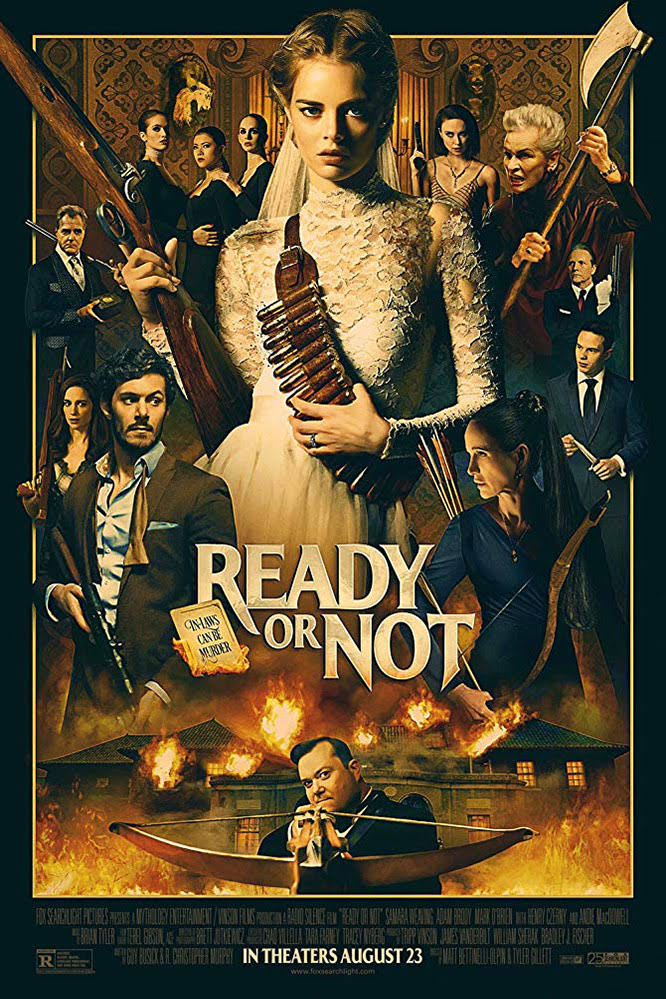
“Ready or Not” Horror Comedy Review

Outstanding! Ready or Not is a brilliant horror comedy from start to finish. Fantastic screenplay, cast, direction, effects, everything works flawlessly. Probably the most fun movie of the summer. It’s a no holds barred dark comedy full of entertaining, campy dialogue and gruesome kills. Not since the cult classic Clue, has there been such an excellent horror comedy heavily influenced by the concept of a game. Samara Weaving slays audiences as the wedding dress wearing Grace as she transforms into this movie’s answer to Kill Bill. Although most of the other characters are relatively flat, you forgive them because of the endless jokes about the insanely rich and the non-stop bloody comedy. Does the film have shortcomings? Sure does–the cinematography and lighting, for examples; however, this movie is so incredibly charismatic and it’s hilarious enough to more than makeup for the technical faults in this movie. When I state “everything works flawlessly,” I suppose it’s a bit hyperbole because it’s not a perfect film, but it knows its strengths, and those strengths support everything else to deliver a movie that will keep you highly entertained for the entire run time that is non-stop antics and action.

“Till death do us part” means so much more than you bargained for in this movie. A century ago, the Le Domas family made a faustian deal with Mr. Le Bail, quite literally the devil, to launch a board game empire. As with any deal with the devil, he will make sure you hold up your end of the bargain. For the Le Domas family, that means playing a game at midnight whenever someone new marries into the family. A blank playing card is placed into a mysterious wooden box, then a  simple turn of the crank prints the name of the game onto the card. All is fun and games, unless the game is hide and seek, which turns the Le Domas mansion into a hunting ground for newlywed Grace (Weaving) as she must now hide from the entire family until dawn, all while her new in-laws hunt her with guns, crossbows and other weapons.

You think your family is screwed up, you ain’t seen nothin’ yet! Why is this movie so good? It’s a horror comedy with a poignant point to make for audiences. It’s the combination of social commentary and non-stop excellently paced gory antics that make this one to watch. From one of Grace’s first lines “I honestly can’t wait to be a part of your moderately fucked up family,” we know we are being setup for one of the most absurdly fucked up families ever, and we are hooked. It’s just so incredibly, spectacularly ridiculous! The success of this movie is partially derived from screenwriter Guy Bustick’s (The Purge) excellent handle on a healthy and smart sense of humor and comedic timing. He has also demonstrated an ability to creatively comment on the divide between the haves and have-nots while the story not coming off as propaganda. He has a message, but the method he chooses utilizes the power of horror and comedy to deliver it in a way that provokes thoughtful discussions but highly entertains along the way.

But what is the thoughtful discussion point posited by this movie? Is it wealth? Not necessarily. But wealth certainly has a lot to do with it. Ready or Not comments on the insane actions and thoughts of people who place immense value in wealth and the proximity to it. Furthermore, the movie suggests that if you come between a family and their wealth–watch out–because you may be rubbed out. All throughout the movie, characters acknowledge, in various ways, that they associate with the family to be close to the money steeped in tradition. The love of money is a drug–not the money itself–the love of money is probably the most powerful drug with the greatest degree of addictiveness that we’ve ever seen. And that addiction to money is played out in this movie. Everyone from the blood family themselves to those whom married into the family, and the servants is addicted to the money. The family doesn’t want to lose their money and power because that IS their legacy, and the servants don’t want to not be associated with it. The fear of a curse that could end a dynasty is more important than people’s lives, even though some of the family members even state that they don’t believe in the curse. Instead of the family’s pride and joy being the decades of games that have brought laughter and smiles to billions of people, the family is more concerned with the money than its creations.

Samara’s Weaving’s Grace is such a treasure to watch! She goes from a blushing bride to a scream queen to a kick ass Uma Thurmon-like character in a matter of moments. Her transformation is so much fun to watch, and she owns every second of screen time she receives. Her level of charisma is on par with the over all tone of the film. She delivers a dynamite performance that you will love to watch every second. This movie has cemented her as a bad ass who can hold her own. Her performance is so highly entertaining that you forgive it of the rough edges and even the movie for the plot holes that are pretty visible. She strikes a balance between someone unbelievably kick ass but still vulnerable and human all at the same time; furthermore, her actions do not lend themselves to superhuman or John McClane levels of survivorship. Grace is 100% human and 100% bad ass all at the same time. Her wounds are severe, but she is determined to survive. In fact, she must’ve read the same book as Nancy Thompson in A Nightmare on Elm Street, because Grace is obviously “into survival.”

Here is a question likely on your mind: why was The Hunt cancelled and Ready or Not still hit theatres since they have a similar premise at their respective cores. Not having seen The Hunt, I can merely speculate, but from what I inferred from the trailers, The Hunt appears to take itself far more seriously than Ready or Not. The latter is a black comedy that satirizes the concept of the rich preying on the poor for comedic effect whereas the former gives off far more serious tone. This is one example of how comedy allows you to tell stories that simply don’t work in other tones; furthermore, the pairing of horror and comedy provide such a creative latitude for expressing plots that would otherwise be too dark (i.e. The Hunt).

Don’t hide from this movie, because if you do, you will miss out on an absolute blast at the cinema.

Ryan teaches screenwriting at the University of Tampa and teaches high school TV/Film production. If you like this article, check out the others and FOLLOW this blog! Interested in Ryan making a guest appearance on your podcast or contributing to your website? Send him a DM on Twitter or email him at RLTerry1@gmail.com!

Follow him!

Twitter: RLTerry1

Instagram: RL_Terry

“Where’d You Go, Bernadette?” movie review

If you loved Blanchette in her award winning role in Blue Jasmine, then you will love her in Richard Linklater’s Where’d You Go, Bernadette? Once again, Blanchette takes on the demanding role of someone struggling with an inner turmoil brought on by losing one’s identity. By no means is Bernadette the same character as Jasmine, but there are many similarities; however, these similarities are expressed in vastly different ways, which makes the story relatable and thought-provoking. Whereas this film has not been critically received nearly as well as Woody Allen’s Blue Jasmine, after watching it for myself, I absolutely loved it. Is it as strong a picture as Blue Jasmine? No. But it is still a film that I feel creative and academic persons will connect with because often the most creative or intelligent people can experience bouts of identity crisis, mania, and depression when he or she is not in the process of creating something for the world to see. Whether that world is as small as your hometown, your network on social media, or the global stage, there is a catharsis that is experienced when crafting something new. Take away that creative outlet and you may as well remove an arm or leg. Furthermore, destroy that which one has poured his or her soul into, then you metaphorically kill that creative person. The creation is an extension of the soul of the creator. I imagine that my fellow creatives and academics will also be able to identify with Bernadette much in the same manner as did I. Linklater’s film is an existential exploration of the creative genius when the very foundation of that genius is rocked off its foundation. There are many metaphorical visualizations of this concept in the film, including the catalyst that launches Bernadette into her acute downward spiral–the removal of that which was holding everything together. Perhaps the story execution lacked the precision that this plot truly required to be exemplary, but there is a strong message therein coupled with Blanchette’s excellent performance that makes Where’d You Go Bernadette? a thought-provoking movie to watch.

Former architect Bernadette Fox seems to have it all — a beautiful home in Seattle, a successful and loving husband, and a brilliant teenage daughter who’s about to attend boarding school. When Bernadette suddenly disappears without a trace, her concerned family sets off on an exciting adventure to solve the mystery of where she might have gone.

If you’re searching for a human movie, then you you have found the right one. The experience of watching this movie sticks with you long after the credits role. Not being familiar with the book, I cannot comment on the similarities and differences; fortunately, this allows me to evaluate this as a movie without influence from knowledge of the book. While most of the characters are mostly flat, the character of Bernadette is complex, vulnerable, and quite human. Despite being an architectural genius of on the level of Frank Lloyd Wright–something that most of us cannot identify with–we identify with her because of the struggle to manage personal and professional life when we’ve lost our way. The title Where’d You Go, Bernadette? works in two ways. (1) during the second and third acts of the movie, Bernadette’s family is literally searching for her and (2) after learning the news that her masterpiece house was bought simply to be destroyed, she ceased to be herself and became a new, even more eccentric and reclusive person. Essentially she took on a new identity, which posits the question, “where did she go?” The movie is a journey for Bernadette to find herself, and of course for her family to find her. Further evidence of the successful visualization of internal conflict, is when Bernadette removes the blackberry bushes in full knowledge that they will make way for a landslide, even though her neighbor wants the bushes gone. Just as the blackberry bushes were the only thing keeping the hillside together, the 20-Mile House was the primary component that kept Bernadette together. When it was destroyed, so was she.

Where this movie fails is in the adaptation from novel to screen. And I am not talking about commitment to details and such. Novels are internally driven whereas movies are visually driven. Sometimes there are novels that explore inner turmoil to such a degree that it makes visualizing it for the screen difficult to achieve. Without having read the novel, I cannot comment fully on why most of the characters are flat and the much of the dialogue is vapid, but my educated guess is that the novel explores the psychology of each character to a greater extent than a movie allows for. Where this movie excels is the performance delivered by Blanchette as the title character Bernadette. Whether quiet or a raving lunatic, she maintains a powerful screen presence that draws the audience in to the heart of the story. There is an unapologetic authenticity in Blanchette’s performance that feels fresh and powerful. It’s a command performance that should not be overlooked. Through her character of Bernadette, we witness just how complex depression, mania, and anxiety are. And not just how complex they are for the individual burdened with them, but for those around the individual.

I’m not naive to the movie’s shortcomings, but there is so much that I find was delivered with excellence that it helps to make up for the mostly weak screenwriting. I believe that the character of Bernadette offers us a fascinating character to explore as she offers great opportunities for relatability. Perhaps we aren’t genius architects, but many of us know what it’s like to see our creations destroyed or being prohibited by internal or external forces from creating.

Ryan teaches screenwriting at the University of Tampa and teaches high school TV/Film production. If you like this article, check out the others and FOLLOW this blog! Interested in Ryan making a guest appearance on your podcast or contributing to your website? Send him a DM on Twitter!

Follow him!

Twitter: RLTerry1

Instagram: RL_Terry
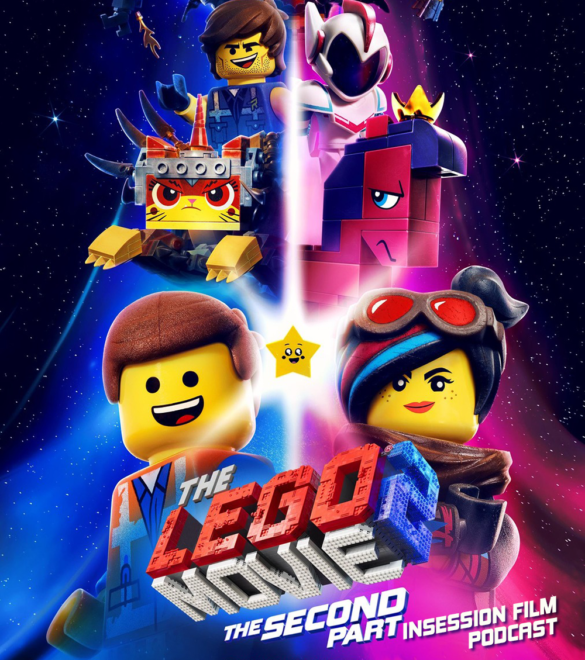
LEGO Movie 2 Review with InSession Film Podcast

Return to Bricksburg where everything is no longer awesome. Picking up where the first LEGO Movie left us, and jump right back into the action as the invaders from planet Duplo threaten the very existence of Bricksburg and its inhabitants. After the Duplo invasion reduces Bricksburg to a city that is barely recognizable. Now living in a dystopian society, a mysterious figure arrives and promptly kidnaps several of Emmet’s (Chris Pratt) friends, including Lucy/Wyldestyle (Elizabeth Banks). Emmet sets off on his rescue mission to save his friends, but along the way meets allies and enemies who test him at every turn. I enjoyed LEGO Movie 2 nearly as much as the first one! Unfortunately, hosts JD and Brendan do not quite share my sentiment; however, they provide some great talking points! But the only way for you to find out what we think of this movie is to listen to the episode.

For the full review, visit the InSession Film website for the podcast and written review! And if you don’t do so, follow InSession Film on Twitter and subscribe with your podcast service.

And you can also listen to the episode by clicking HERE.

Ryan teaches screenwriting at the University of Tampa. If you like this article, check out the others and FOLLOW this blog! Interested in Ryan making a guest appearance on your podcast or contributing to your website? Send him a DM on Twitter!

Follow him!

Twitter: RLTerry1

Instagram: RL_Terry
“Velvet Buzzsaw” One Movie Punch Review

The lowdown on high art.

The highly anticipated Netflix original satirical thriller Velvet Buzzsaw is now streaming. Go beyond the frame into the vicious word of the art business. Much like the hype surrounding Bird Box, this movie was also proceeded by a prolific number of memes on social media. Although this movie opened to mixed reviews from critics and audiences, I found it to be immensely enjoyable. Not to the point that it’s a great movie, but a solid thriller. A plot and setting that could have so easily been boring were intense and seductive. Who would have thought being a critic would be so alluring and perilous. Furthermore, this movie provides audiences with thought-provoking commentary on art and business. You witness all the players in the art business game: the creators, critics, clients, and curators. Essentially, the theme of this sexy, sinister, satire is the more we attribute a monetary value to art, that is inspired by a creator’s incredibly dark place, the more we run the risk of suffering, even vicariously, a deadly consequence for our selfish actions…

For the full review, visit the One Movie Punch website for the audio review and transcript! And if you don’t do so, follow One Movie Punch on Twitter and subscribe with your podcast service.

Ryan teaches screenwriting at the University of Tampa. If you like this article, check out the others and FOLLOW this blog! Interested in Ryan making a guest appearance on your podcast or contributing to your website? Send him a DM on Twitter!

Follow him!

Twitter: RLTerry1

Instagram: RL_Terry