NIGHTMARE ALLEY film review

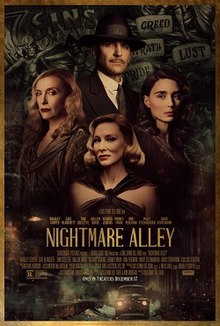
A phantasmagorical cautionary tale on the cruel predictability of the human condition that’s told through a beautifully orchestrated symphony of exploitation, deception, and just desserts, wrapped in a delicious neo-noir film. In the second big screen adaptation on the 1946 novel by William Lindsay Gresham, del Toro certainly applies his particular cinema stylo to Nightmare Alley, yet delivers a motion picture that stays true to its roots in film noir. Gresham’s book and Edmund Goulding’s critically acclaimed 1947 adaptation are the perfect source material for del Toro’s penchant for dark fantasies. But what this film allows for del Toro to do, that he hasn’t done before, is direct a neo-noir, complete with all the tropes and stylistic conventions. And he’s recently announced that there is a grayscale version of the film, which I will want to check out soon. Del Toro’s update to the dark dale explores characters that are impacted by vicious business practices built around exploitation and deception. Audiences will simultaneously find the story and performances, by the lead and supporting cast, both alluring and repulsive.

In 1940s New York, down-on-his-luck Stanton Carlisle (Bradley Cooper) endears himself to a clairvoyant and her mentalist husband at a traveling carnival. Using newly acquired knowledge, Carlisle crafts a golden ticket to success by swindling the elite and wealthy. Hoping for a big score, he soon hatches a scheme to con a dangerous tycoon with help from the mysterious psychiatrist Lilith (Cate Blanchette) who might be his most formidable opponent yet.

Much like we witness sleight of hand in the carnival acts managed by Willem DaFoe’s carnival barker character, del Toro himself is a master magician. Teaching film history as part of my cinema studies classes reminds me every semester of how the world thought of film as the work of a magician, and I love just how many layers of magic we have within this marvelous motion picture. Just as various characters are playing on the predictability and fears of the audiences within the film, del Toro is toying around with our perceptions of what is really going on. The art of misdirection and illusion is alive and well in Nightmare Alley. Unlike most of del Toro’s previous films such as Pan’s Labyrinth and The Shape of Water, there is neither a monster, in the conventional sense, nor mystical or supernatural dimension in this film other than the magic and mentalism of the metaphoric monsters in the film.

Taking place in the early 20th century at the time when carnival sideshows, with their seemingly endless variety of oddities (still a fun attraction at modern day fairs and carnivals), dotted the rural landscapes, this film is populated with characters that have in one way or another experienced some form of trauma that has prompted them to find solace or absolution in their (exploitive) work as a sideshow performer. And our central character of Stanton (Bradley Cooper) is of no exception. Following the dumping of a dead body and setting a house in an idyllic setting ablaze, Stanton joins a seedy carnival. Although we are never given explicit details as to why he did what he did, it works perfectly because we don’t always need to know what a character’s motivation is. This unknown makes them more terrifying and unpredictable.

From what I have read, there are a few changes from the book that del Toro made in this adaptation, and for all the better! One of these changes is not spending too much time on Stan’s backstory. We learn and see just enough to keep his history ominous–he keeps this film lean. Far too often, nowadays, writers and directors feel compelled to psychoanalyze and delve into all the reasons for immoral or unethical behavior, and somehow try to rationalize and explain. This explanation removes a significant degree of threat. All we need to know is that a trauma affected Stanton to the degree that he killed the source of the trauma in order to start a new life. And the same could be said for other characters and their respectful traumas. But for all their baggage, this ragtag group of sideshow acts forms a close-knit community.

Without getting into specifics, the story follows the character (negative) growth arc model, which is very much in line with many film noir motion pictures. Furthermore, del Toro includes the iconic femme fatale (in the form of Blanchette’s character) and a villainous mob-like boss that is not to be trifled with. Nightmare Alley embodies a cynical soul, which is often a characteristic of film noir. This cynical nature demonstrates two or more opposing forces that are opposite sides of the same coin, both equally corrupt. As Stan is refining his skill and showmanship for what would become his high society headlining mentalist act, he receives a dire warning not to do the “spook” show because it leads to a dark path, a path on which the actor starts to believe his or her own lies.

Through lead characters Stan and Lilith, we witness two strong-willed, cunning individuals that are equally master manipulators. There are few things more dangerous than a con-artist who believes their own spiel, and del Toro takes that dynamic to its inevitable conclusion. While the level of violence and gore in this film are rather subdued compared to his other work, when the gore hits, it HITS! There is one scene in particular that is reminiscent of the Pale Man scene in Pan’s Labyrinth. When you hits all the tropes necessary for a neo-noir, you can then bend the conventions a little in order to maintain your authorship of cinema. For fans of Sunset Boulevard (my pick for greatest film of all time), you will also love the rich character-driven conflict.

The film can be read as a cautionary tale on various systemic societal constructs and practices that prey on the most vulnerable. And many that ascribe to applied postmodernist worldviews, will find this resonating in the film. However, it can also be read through the lens that individuals may find themselves ripe for the picking to be a carnival’s next “geek” by intentionally making decisions that lead them to the carnival barker’s office. When you are in this weakened state, there are systems that will swallow you whole. So, I feel that it’s the opposite: a cautionary tale on what happens when we lead a humanist or nihilistic life; furthermore, this film is a fantastic metaphor on reaping what you sow. If you sow deception, eventually you will reap deception by (1) being deceived by someone or (2) maybe even deceiving YOURself by beginning to believe your own lies. The systems are a symptom of the broken world in which we live, a broken world whose source is, at the end of the day, a heart problem.

Ryan teaches American and World Cinema at the University of Tampa. If you like this article, check out the others and FOLLOW this blog! Interested in Ryan making a guest appearance on your podcast or contributing to your website? Send him a DM on Twitter or email him at RLTerry1@gmail.com! If you’re ever in Tampa or Orlando, feel free to catch a movie with him.

Follow him on Twitter: RLTerry1

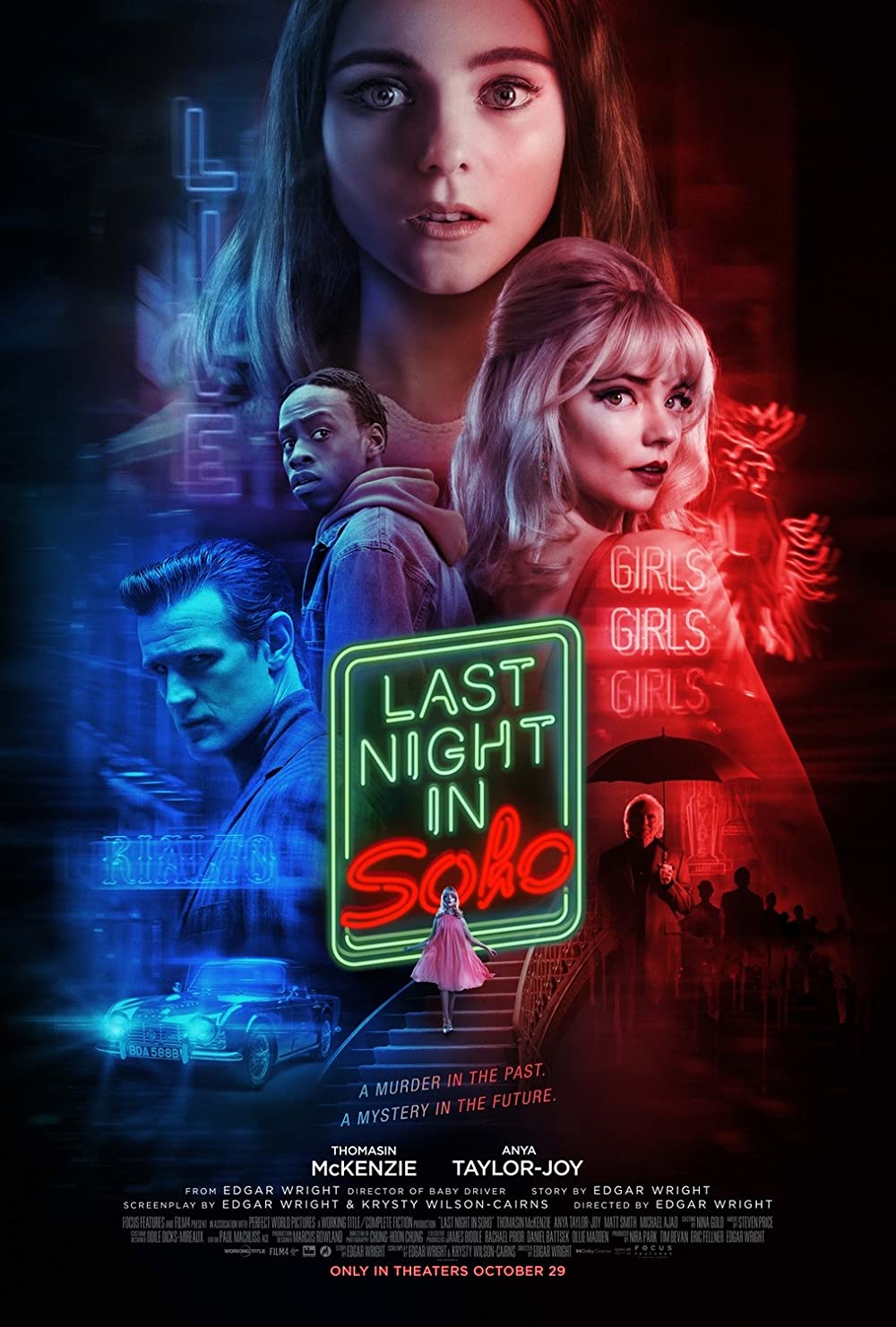
Last Night in Soho horror film review

Mesmerizing! Dressed to Kill meets Mulholland Drive meets Suspiria! It’s like Wright channeled the best of Lynch, de Palma, and Argento to craft his spellbinding thriller! One of the best films of the year, and one that commands a rewatch. Other than seeing the trailer a few times in the cinema, I did not spend any time reading up on this film–and I’m glad I didn’t. Just speculating here, but I could definitely see this film as one that cultivates a cult following and is talked about in classrooms much like Mulholland Drive. Quite different from the other films in Wright’s cinematic library, if you’re going into it for a Shaun of the Dead, Hot Fuzz, or World’s End, then you may be disappointed. Although they are dissimilar in most respects, the film that this one shares commonality with is Baby Driver. As I am writing this, I’ve only seen it once, but I need to see it again. Not because I didn’t understand it–quite the opposite–the storytelling is top shelf! But I want to pay closer attention to details to gain a greater appreciation for how this kaleidoscope delivered such an immersive cinematic experience. The vibrant 1960s in London some alive in this dream-like psychological horror punctuated with giallo-esque mystery and slasher elements and nostalgic fashion. Told though a Lynchian cinematic framework, the surrealist experience of this film will capture your imagination and beckon you into the seedy underbelly of the iconic Soho district of London. Much like in Suspiria, the idyllic atmosphere and setting descend into madness in a beautiful symphony of terror! Clearly, Last Night in Soho is Wright’s most personal film; we can not only see this passion but feel it in every frame.

An aspiring fashion designer is mysteriously able to enter the 1960s, where she encounters a dazzling wannabe singer. However, the glamour is not all it appears to be, and the dreams of the past start to crack and splinter into something far darker.

Edgar Wright’s Last Night in Soho reminded me of so many great films! And, in all the best ways possible. Now, I don’t state that to suggest that Wright’s latest offering is derivative. Quite the contrary. It’s a testament to the scope of his career and talent. But when you watch this, and can think of Dressed to Kill, Mulholland Drive, Battleship Potemkin, and Suspiria, then the degree of thoughtfulness is evidence that the filmmaker seeks to channel some of the best cinema of all time whilst delivering a fresh interpretation. Fashion from Dressed to Kill, story structure from Mulholland Drive, cinematography and editing from Suspiria and Battleship Potemkin, and score/soundtrack from Baby Driver.

Often times when a filmmaker attempts to integrate too much from a variety of sources of inspiration, the end result is a cluster that has no identity other than in that which its emulating. But Wright’s Last Night in Soho, delivers an experience that completely envelopes the audience in a fantastical story while audiences vicariously dance through the streets of Soho; streets that, on the surface are paved with an idyllic portrait of Soho in the 1960s, but beneath the pavement, beats the sinister heart of a gritty world of pleasure, pain, and violence. For the non cinephile members of the audience, they may feel an unusual dichotomy of simultaneously being overwhelmed by the technical elements yet underwhelmed by the dizzying narrative of emotional themes, references to past films, and motifs all playing together in a perfect orchestra of cinema.

Phenomenal cast! Thomasin McKenzie’s Ellie will capture your heart with her candid portrayal of the small town girl in the big city for the first time. But if you think you’ve seen this character before, think again. Yes, we’ve all seen this trope before, but she delivers an incredibly raw, unfiltered approach to this character-type. In fact, it’s probably one of the most authentic portrayals of the small town girl in the big city that I’ve seen in a long time. Never feels like a facade or contrived, but rather feels relatable. Playing opposite (or parallel) to McKenzie is Ana Taylor-Joy as Sandy. I’ve been hit or miss with Ana Taylor-Joy in the past, so I wasn’t entirely sure what to make of her casting in this film prior to seeing it. But I’m pleased to describe her performance as outstanding! She is perfectly cast in this role. I love how she communicates both strength and vulnerability in the promising young star character-type. When life deals her a raw deck, she plays a different game in order to survive the metaphoric prison in which she finds herself.

Comprised ostensibly of two parallel stories that emotionally share the same DNA, the montage (French for assembly) of this film will blow your mind! What Wright and his team have created here is a Battleship Potemkin and Man with a Movie Camera approach to the editing. I reference these tow films because of Soviet Montage. Without going into lots of details best left to a classroom, Soviet Montage (or editing/assembly) occurs when two separate images are assembled together (traditionally by cross-cutting), in which the relationship between the images gives the meaning (not the action OF or IN the images themselves). The audience views these two separate images, and subconsciously give them a collective context. Wright’s utilization of Soviet montage theory allowed him to explore how time and space can be presented and manipulated in Last Night in Soho. Furthermore, this stylistic approach (1) engages the sympathy of the audience and (2) advances the narrative. Where Wright takes the work of Eisenstein and Kuleshov to the next level is by going beyond cross and contrast-cutting to delivering these image juxtapositions within a single frame (or series of frames) by way of non-linear editing. We see both the past and present in the same image, usually by way of a mirror (or other reflection). It’s a technique that isn’t merely stylistic for the sake of being stylized, but allows for the tension to consistently rise without any break in the mode of storytelling. Brilliant!

I highly recommend this film for anyone that enjoys any of the films that I have referenced in this review. It’s been a while since we’ve had a motion picture that is truly inspired by the greats, and this is certainly one that will find itself to be considered a classic in the future.

Ryan teaches American and World Cinema at the University of Tampa. If you like this article, check out the others and FOLLOW this blog! Interested in Ryan making a guest appearance on your podcast or contributing to your website? Send him a DM on Twitter or email him at RLTerry1@gmail.com! If you’re ever in Tampa or Orlando, feel free to catch a movie with him.

Follow him on Twitter: RLTerry1
The Last Duel review

Captivating! Game of Thrones meets legal drama in a thought-provoking exploration of truth, perception, and inequality told through a Rashomon-like nonlinear story that is punctuated with dark comedy to provide emotional resets and strategic tonal shifts. Easily one of my fave films of the year! I was cautious going into this film because Ridley Scott has simply not lately been delivering what we came to expect from and love him for in Alien, Blade Runner, and Gladiator. So after many swings and misses, I was cautiously optimistic at best (and that’s being generous). Boy, was I wrong! The Last Duel is an outstanding film, full of thoughtful content, laugh out loud moments, and relevancy to contemporary topics. Perhaps the story takes place in the 1300s, but the characters are all archetypes we see today on screen and in real life. While the Rashomon-like approach to the central story is not new, it is an approach that isn’t used often, and can easily be abused, misused, or simply not dramatically justifiable. From the hilarious to intimate performances, the cast will keep your eyes glued to the screen. You’ve never seen a medieval period drama like this one before!

Jean de Carrouges (Matt Damon) is a respected knight known for his bravery and skill on the battlefield. Jacques Le Gris (Adam Driver) is a squire whose intelligence and eloquence makes him one of the most admired nobles in court. When Le Gris viciously assaults Carrouges’ wife Marguerite (Jodie Comer), she steps forward to accuse her attacker, an act of bravery and defiance that puts her life in jeopardy. The ensuing trial by combat, a grueling duel to the death, places the fate of all three in God’s hands.

The central focus of the plot is explored from three different perspectives, each depicting its own version of the truth. And never once did it feel repetitive; each time we revisit the incident, inclusive of the events leading up to, we learn something new. Furthermore, we learn what each version of the truth shares in common, thus affording the audience the opportunity to make the decision of what happened and how for themselves. This non-linear approach keeps the story incredibly engaging, by beckoning the audience to be completely intrigued by the events as they unfold. Even when observing a moment that we have already seen, but from a different perspective, there are brilliant nuances that separate the versions of the truth. Sometimes it’s how something was said or the expressed emotion when it was said; other times, it’s how something was done, and the attitude with which it was conducted.

While this story could have been incredibly dark from beginning to end, there is a healthy helping of levity to break up the dismal atmosphere and heavy subject matter. And it’s not limited to cleverly written humorous dialogue, there is a substantive amount of physical comedy as well. While Matt Damon and Jodie Comer play their characters fairly direct, without much in the way of humor, the characters played by Adam Driver, Ben Affleck, and Alex Lawther provide expertly timed and perfectly punctuated comedic relief. And of all those actors, it’s Affleck that get’s the lions share of the comedic bits. Some of it is slapstick, some high brow, and other parts are executed through dark comedy. Honestly, this is probably my favorite Affleck performance in a long time! He is so funny! Every time Affleck’s Count Pierre d’Alençon is on screen, he has some hilarious commentary or remark on the current state of affairs. While Alex Lawther’s King Charles doesn’t say much, his physical reactions are all that you need! Clearly the king simply wants to watch the world burn for fun, by allowing pretty much anything that is pitched to him, as long as he seen the entertaining value in it. Lastly, Driver’s Jacques Le Gris even has some moments that will make you laugh, including laughing at the most inappropriate moment; but there is simple something in his delivery of the lines and his physical acting that prompt you to chuckles and even laughter. For all the laugher that you will exhibit when watching this film, none of it is ever in poor taste or shows irreverence for a tough subject to cover.

Matt Damon and Jodie Comer’s performances as our two central characters will astound you! Damon delivers a stellar performance and Comer may have just secured herself a place on the best actress category in the award shows next year. Despite having seen Damon in plenty of serious roles, this is my favorite of his in a long time. I love when I get to see an actor surprise me! And he delivers plenty of surprising moments that convey a multitude of layers to his character, who will elicit sympathy from you even though you will disagree at his initial reaction to his wife’s report that is the catalyst for the duel. Jodie Comer shatters any expectations you go in with regarding how the central character’s wife typically acts. Her performance is one of those that you just know that she is channeling her heart and soul into every moment. You will feel her plight to be respected and believed for what she reports happened to her. Even though we do not spend an inordinate amount of time with her until her chapter, when her chapter begins, it is clear that she is the real star of the film!

While this may not look like a classic Ridley Scott film in the vein of ALIEN or Blade Runner, it does bear similarities in stylistic approaches to Gladiator. The sweeping landscapes, the intimate character moments, the visceral atmosphere sucking you into the setting of the story, it’s all here! While adhering to what we have come to expect from a medieval period drama, Scott checks off those boxes in a rubric-like fashion, but then crafts a modern story around the classic bones. That’s precisely what The Last Duel is, it’s a relevant story on the backdrop of a dark period in history. Scott’s adaptation of the actual events is delivered with raw gusto! Very few filmmakers could rise to the challenge to adapt such a heavy story, whilst keeping it entertaining–it is a motion picture after all–but he does all that and more! More than the reenactment of an actual event, this cinematic story has life, like we haven’t seen from Scott in nearly two decades (2005’s Kingdom of Heaven is the most recent motion picture if his that is truly excellent). The images aren’t simply beautiful frames flipping past the lens at 24fps, this film leaps off the screen with prolific energy.

This image has an empty alt attribute; its file name is profile_pic.jpg

Ryan teaches American and World Cinema at the University of Tampa. If you like this article, check out the others and FOLLOW this blog! Interested in Ryan making a guest appearance on your podcast or contributing to your website? Send him a DM on Twitter or email him at RLTerry1@gmail.com! If you’re ever in Tampa or Orlando, feel free to catch a movie with him.

Follow him on Twitter: RLTerry1

TITANE French Extremity Horror Review

Zero to sixty in three seconds, but loses traction toward the end. When I first read David Ehrlich describe Julia Ducournau’s Titane as “the sweetest movie ever made about a serial killer who has sex with a car,” I as instantly intrigued.  And for the first half of the movie, that is exactly what I got.  It was a brutal, thrilling, and raw (pun intended!) ride.  The main character, Alexia, is an erotic dancer at a car venue with a sadistic side – hinted at in her interactions with a fellow dancer in the showers and made even more obvious with her murder of a fanboy later in the evening.  While it may seem like a one-off act of self-defense, the mechanical precision and heartless manner in which she swiftly kills and stows her victim suggest otherwise.  We later learn she is a wanted serial killer terrorizing the south of France. 

Her heartless nature can be reflected in her relationship with cars.  After surviving an automotive accident as a child, a titanium plate is inserted into her head with the scars of the procedure following her onward into adulthood.  She physically has become more machinelike form this operation, and when discharged, she does not take solace with her parents, but rather begins to passionately kiss their car.  As an adult, this “auto” eroticism will manifest into her literally having sex with cars and later, even conceiving.

Alexia continues on with her killing spree, until one night she miscalculates – what she thinks is a quiet secluded night in to kill her colleague turns out to be a small gathering, with several guests in the home.  It becomes a massacre, as she stresses over making sure each new witness meets their demise in order to keep the situation under control.  But it all goes wrong when one girl escapes.  From this moment on, she will no longer be a mysterious killer able to move freely in plain sight, she will be a wanted criminal with her police sketch plastered everywhere.

At this point, around midway, the movie takes an odd pivot and never recovers the thrill of the first half.  What started as a violent adventure with a sensual huntress becomes a drawn-out family melodrama as the film slams on the brakes in tone and pacing.

Alexia is on the run and sees a sign for missing children that have been digitally aged.  She decides she can pose as one of them and goes into a bathroom to undergo a brutal transformation involving a haircut, binding her breasts, and several excruciating attempts – one finally being successful – to break her own nose.  She turns herself in at a police station and is now “Adrien” the long-lost son of an unknown man who instantly “recognises” her and takes her home – even refusing a DNA test to confirm.

Whilst Alexia was an alluring figure –leading men and women to their deaths through seduction, once she makes the transformation to Adrien, she loses that spark.  Even her attempt to murder her foster father comes across as half-hearted.  She, like this film, has lost her gusto.

Adrien hardly mutters a word – a presumptive attempt to prevent outing herself as a female – and takes on a shy, timid nature.  Maybe it is deeper- a commentary on the silencing of women in a “man’s world” and her change in demeanour and “worth” due to the loss of her alluring sexuality.  In any event, Alexia as Adrien must work hard to keep her secret, which becomes especially harder as she realises she is pregnant and beginning to show.  She binds her stomach and breasts at all times unless showering or sleeping.  Still, there are many close-call instances where she must quickly grab a blanket or a towel to prevent her foster father from seeing her naked body as he busts into the room unannounced.  The challenge is greater still when whatever is growing inside her starts causing motor oil to secrete from her mammary glands and groin.  

Her new father is a fire chief and gets his “son” to start working at the station.  Fitting in is difficult, with Adrien coming across as awkward and weak.  One fellow firefighter even starts to catch on to the ruse and poses yet another challenge to keeping the secret intact.  However, it soon becomes clear that the task will not be so difficult, as the father simply does not care if this person is truly his son.  Even when confronted about it, he refuses to discuss it.  And when his estranged ex-wife arrives to see their newly found son, she tells Alexia she knows she is a con (even seeing her naked to remove all doubt), but that she does not care because it is helping her ex-husband to cope with his trauma.  The father’s apathy to the truth and is finally made blatantly clear when the he ultimately does see Adrien’s breasts in the shower and is completely unphased, and then later when he helps her as she goes into labour.  She dies during childbirth, with the final scene showing the father embracing the new-born, who like its mother is a hybrid of human and titanium with a metal spine protruding on its back.

This film certainly has a lot to say – although it is not always clear what that is.  It touches on gender roles and androgyny, misogyny and the objectification of women, and delusion as a coping mechanism – willful ignorance, or even denial, can be bliss.  There are Biblical references, with a perverse protocol son scenario and even mention of Adrien being Jesus-like figure.  The line is blurred between the “human” and the “mechanical.”  And it certainly has its fair share of brutal bodily pain – from an older man shooting up steroids and overdosing to a woman scratching, taping, and even secreting motor oil from her pregnant body.  Whatever she has conceived with the car is causing her immense physical pain, with metal cutting through her flesh.  

Fire plays an important role, even Alexia’s car – yes, the one she has intercourse with – is covered in flame motives.  She later decides to entrap her family in a burning house as she makes her great escape from the law.  Her newfound father is a firefighter and finds himself surrounded by fire in both simulations and real-life scenarios.  The destructive power of fire acts to both destroy and provide opportunity – Alexia can leave her old family behind without a trace and later the fellow firefighter, who suspects Adrien is not what he/she seems, succumbs to a forest fire, his inquisitive distrust dying with him.  The father even sets himself on fire when a match falls on his alcohol drenched shirt from a drink he has coughed up on his chest.

The second half of Titane is almost unrecognizable from the first half – it feels like an entirely different film.  Had the movie unfolded in the reverse – the slow, crawling pace of the Adrien portion leading up to a motorized, satisfying payoff, perhaps as a flashback– then I probably would have left with a different view.  But starting with a bang and then faltering towards the conclusion, the film left me unsatisfied.  I found myself wishing that the movie that it started as was the movie it finished as; namely “the sweetest movie ever made about a serial killer who has sex with a car,” which, in the absence of any competition, I suppose it still technically is.

This review was written by Justin Schubert.

You might also like to read the review on another French horror film Knife+Heart.

Candyman (2021) Review

Candyman (2021) - IMDb

Sweet on the outside, sour on the inside. A visually impressive attempt to provide a thoughtful exploration on duality and identity, is overshadowed by heavy-handed ideology. Nia DaCosta delivers audiences a spiritual sequel to the cult horror film Candyman (1992) that is grounded in much of the lore of the original, yet forges a new frontier that simultaneously serves as a vehicle for horror legend Tony Todd to pass the hook onto Yahya Abdul-Mateen II. DaCosta is joined by writer-producer Jordan Peele and screenwriter Win Rosenfeld to “tell everyone” who dares to look in a mirror and call out his name five times. Admit it, even in our most rational state, we are still a little apprehensive to stare at our reflection and call out Candyman, Candyman, Candyman, Candyman, Candym–. That’s the power of horror films! These fictional stories on screen have their mystical ways of affecting the collective conscious in such a manner that we change or question our behavior. Another great example of this effect is the iconic highway scene in Final Destination 2. And challenging audiences was certainly what the three screenwriters had in mind when writing the story for Candyman (2021). Unfortunately, the agenda-driven message steels the focus away from the stunning visuals, and ultimately fails to effectively paint a portrait of reality that invites all to engage in the important conversations the film is trying to have, instead, alienating audience members that don’t share the filmmakers’ opinions. Suffice it to say, this film is Peele for the course.

In present day, a decade after the last of the Cabrini towers were torn down, rising star artist Anthony (Abdul-Mateen II) and his partner move into a loft in the now gentrified Cabrini. A chance encounter with an old-timer exposes Anthony to the true story behind Candyman (Todd). Anxious to use these macabre details in his studio as fresh grist for paintings, he unknowingly opens a door to a complex past that unravels his own sanity and unleashes a terrifying wave of violence. (IMDb)

If you’ve never seen the original Candyman, don’t worry. While having seen the original will certainly help audiences to appreciate world-building and backstory elements, there is enough context given to help those that may be unfamiliar. Following the screening I attended, I heard individuals negatively critique the retconning of plot elements in the original; truth is, the parts of the original that were reimagined to fit the backstory of 2021’s Candyman were thoughtfully adapted.

While I have my reservations with the film, I would be remiss to not highlight the excellent direction, cinematography, editing, costuming, production design, and even the performances! Visually, the movie is stunning! All the mise-en-scene elements work together to create a BIG SCREEN experience. And talk about outstanding performances. Back in the heyday of the slashers (late 70s through the 90s), we did not expect to be impressed by the performances of the cast. And while there are notable exceptions of horror films WITH brilliant performances, usually it’s not expected. Over the last 7–10 years, horror films have been stepping up their performance game. The lead and most of the supporting cast will all captivate you. Unfortunately, there are useless characters like Brianna’s (Anthony’s girlfriend’s) brother and his boyfriend. Having no real affect on the plot, this interracial gay couple was little more than a token that could be removed from the movie, and the movie still play out the same way. However, if it weren’t for these two characters, the movie would be lacking ANY humor. So I suppose that was their purpose, to add humor.

There are so many beautifully crafted shots and shot sequences in this film. From juxtapositions of the old meeting with the new to geometric shapes and lines, there are many excellent compositions. The production and set design and lighting, of this film, are used in similar ways that the designs in expressionism are used. Expressionism uses the design of buildings, costumes, lighting, and camera angles to externalize emotions, psycho-social states of being, and ideas. And with expressionism being part of the formula of horror (expressionism+surrealism+Poe+Freud), it makes sense how and why there would be this care shown in the mise-en-scene.

All the backstory elements are communicated through the brilliant use of shadow puppets. The shadow puppet sequences are perhaps my favorite recurring diegetic device used in the film. Not only do these shadow puppets provide exposition, they also move the plot forward in action and subtext.

The idea of shadow puppets as a storytelling device is best explored in Plato’s Cave. French film theorist Jean-Louis Baudry likened the movie theatre to Plato’s famous allegory Plato’s Cave found in Plato’s Republic. But since we’re not all film or philosophy theorists, here is a quick explanation of Plato’s Cave:

The allegory states that there exists prisoners chained together in a cave. Behind the prisoners is a fire, and between the fire and the prisoners are people carrying puppets or other objects. This casts a shadow on the other side of the wall. The prisoners watch these shadows, believing them to be real. Essentially, what Plato is exploring is the concept of “belief vs knowledge.” The prisoners (or audience) in this analogy believe the images on the wall as reality; when in actuality, it is only the puppeteers version of reality. The analogy goes on further to describe a prisoner breaking free and venturing from the cave out into the real world. Two things happen (1) the newly freed prisoner completely rejects the imagery in the cave and returns to warn the prisoners of their one-dimensional view of reality, and risk being killed for a radical view, or (2) the freed prisoner fears or cannot reconcile actual reality and retreats back into the cave, where there is comfort in the surroundings, to warn the prisoners not to leave. Therefore, this highlights how a lack of knowledge leads to blind belief.

Despite being centuries old, the allegory is appropriate for filmmaking. After all, the audience watches images on a screen. We’re meant to believe it to be real, but we know it’s false. Only when we step out of the theater back into reality can we take what we’ve learned in the cinema and apply it to our lives. In a literal sense, a movie is just a series of images. But digging deeper, they present unique ideas and themes that we can take with us into the real world. Numerous movies utilize this concept in their plots and themes. You have probably seen films where a character believes one reality and then becomes exposed to another, greater reality and is never the same. In the case of 2021’s Candyman, DaCosta, Peele, and Rosenfeld have metaphorically trapped the audience in an ideological cave to present their versions of our reality that exists outside the cinema’s doors.

The movie has some great kills! But it highlights a moral problem plaguing this movie. From the art gallery to the critic to the girls at the prep school, the only victims, to meet their gruesome demise ON screen, are white characters. While there are a couple of off-screen deaths of black characters, the only ones in the visible mise-en-scene to meet with Candyman’s iconic hook are white. Had this movie been directed and/or written by a white writer-director and only killed and disparaged black characters, there would already be a #cancel campaign on Twitter. In my five years as a film professor and seven years as an active critic, I cannot ever recall a horror movie (in particular, a slasher movie) that ONLY killed black characters and disparaged the black community in virtually every scene from the opening to the closing. So if that would not be tolerated by the public–and for good reason, a movie released like that in 2021 (or ever) would be in incredibly poor, despicable, disrespectful taste–then the inverse should not be acceptable here.

I get what DaCosta, Peele, and Rosenfeld are trying to do with this horror movie. From the time of Cabinet of Dr. Caligari and Nosferatu, horror has been used to comment on societal observations to either warn of an impending dangerous ideology, to provide allegorical material that can be used as a framework to better understand marginalized groups, or even to challenge systems or institutions. Which is why horror is often far more truthful than a straight drama. Of course, one can make the argument that this is a fictional film in a fictional Chicago, which is not untrue; however, the problem therein is that little (if anything) in this fictional Chicago sets it apart from the real world, except for the supernatural character of Candyman, because these filmmakers have a point to make. But the problem here is that the very people that these writers want to challenge are the very people that are being unfairly represented in the movie. How is any of that constructive to the conversations of race relations and policing??? Short answer: it’s not.

The symbolism I did appreciate in the film are the moments that we explore the duality in ourselves and our environments. This is represented through literal and metaphoric reflection. Mirrors (or reflections) are regularly used to communicate duality. One of the best examples in recent years, in how mirrors are an effective cinematic device, is the mirror scene in I, Tonya. Just before her final competition in the film, as Tonya is applying her high contrast makeup, we witness in the mirror the internal struggle. On the outside, she is this accomplished figure skater (probably the best athlete the sport has ever seen) but on the inside she is tormented by her mother, her abusive marriage, and what she did or didn’t know about the incident. Likewise, in Candyman we explore the history and identity of Anthony and his neighborhood. Anthony has a secret in his past that has been painted over, that is trying to resurface, and his neighborhood of Cabrini Green has a sordid history that it has tried to cover and hide behind a fresh coat of paint. History is always there. It cannot be erased. And if it’s not dealt with, it can become a specter and haunt you and your environment. The mirrors and other reflective surfaces of Candyman are brilliantly used to communicate this idea of duality.

It is clear that DaCosta is a gifted director, but I hope that she works with different writers in the future that can find that balance of commenting on or raising awareness of something important, but also finding the ways to bring everyone to the table for a thoughtful discussion. The power of cinema, and in particular horror films, is that it can bring diverse groups of people together from all walks of life to both be entertained and challenged through screams, jumps, and laughter.

This image has an empty alt attribute; its file name is profile_pic.jpg

Ryan teaches American and World Cinema at the University of Tampa. If you like this article, check out the others and FOLLOW this blog! Interested in Ryan making a guest appearance on your podcast or contributing to your website? Send him a DM on Twitter or email him at RLTerry1@gmail.com! If you’re ever in Tampa or Orlando, feel free to catch a movie with or meet him in the theme parks!

Follow him on Twitter: RLTerry1