
JURASSIC PARK 30TH ANNIVERSARY retrospective analysis

Timeless and terrifying! In honor of Jurassic Park‘s 30th Anniversary, I want to revisit why the film works so incredibly well, and never gets old. Simply stated, it’s the original’s connection to and foundation in horror, which was largely abandoned after the first installment in the decades long franchise.

Just like Dr. Alan Grant states at the beginning of the film, “raptors have far more in common with present day birds than they do with reptiles,” that same analogy can be drawn with the original Jurassic Park and its proximity to horror compared to action-adventure. Borrowing from Dr. Grant, the original Jurassic Park has far more in common with sci-fi/horror than it does with action-adventure, hence why it has held up over the years and continues to be a favorite film for many cinephiles and fans alike.

While all the sequels, including Jurassic World are far more action-adventure than the original, Jurassic Park can be likened to Ridley Scott’s Alien. The latter is a quintessential space sci-fi/horror with action-adventure sequels just like the former. And like Jurassic Park, the original Alien is considered far superior to that of the sequels. But why is this? There are many reasons from script to director to cinematography; but at the end of the day, it’s the fact that both these critically acclaimed and admired films have their respective roots in the American horror film and not action-adventure movies. More so than any other genre, horror is (1) uniquely American and (2) the most time tested, given it can trace its roots back to the 1890s and was perfected by Universal Pictures in the 1920s and 30s.

So what separates Jurassic Park from the sequels? Both have life-threatening dinosaurs, both have action, both have adventure, etc. But, only the original carries with it social commentary, rich subtext, and well-developed themes told through a brilliant combination of horrific frights and believable sciences taking place within a world of fiction grounded in reality. Furthermore, the focus in both Jurassic Park and Alien is largely on the drama between the characters and the oppositional forces in the film. The sequels in both franchises place far less emphasis on well-developed conflict and drama, and instead sacrifice those golden elements of cinematic storytelling for high-concept CGI-filled adventure movies with lots of dinosaurs or aliens. The proliferation of gimmicks and effects is often used to hide a weak story. Fortunately, Jurassic Park provides audiences with a strong plot told through exceptional cinematic storytelling.

Jurassic Park‘s screenplay benefitted from being penned by the award-winning author Michael Crichton who also wrote the novel by the same name. Often times, when the author of the novel also writes the screenplay, the screenplay forms a stronger foundation upon which the technical elements can be build. A more recent example of a brilliant screenplay adaptation of a novel is Gone Girl, the author of the novel was the screenwriter. Although a screenplay is visually driven whereas a novel is internally driven, when a novelist with a penchant for visual storytelling writes the screenplay for the movie adaptation, the screenplay tends to contain better developed characters, strong subtext, effective conflict, and excellent dialogue.

Crichton created incredibly memorable characters who each spoke with their own voice. Casting the right actors to portray the characters is obviously important–and the cast for Jurassic Park is exemplary–but even before the actor steps into the character’s shoes, the character has to be created. Each character in Jurassic Park possesses unique traits, strengths, weaknesses, dialect, and behaviors. Instead of the conflict being arbitrary, the conflict develops through the interpersonal relationships between the characters and the relationship between the characters and the opposition–human and nature.

I was in elementary school when the movie hit theatres in the summer of 1993; and although under 13, my parents allowed me to go see the movie. It was my second PG-13 film, with Batman Returns being the first, and what an experience! Not unlike Dr. Grant’s reaction to his first encounter with a dinosaur in the film, my reaction to Spielberg’s masterpiece was eyes-wide-open, mouth gaping wide, and racing endorphins. And then comes the macabre contrast in Acts II and III. “Ooo, ahh–that’s how it begins, and then there’s running and screaming” (Dr. Ian Malcolm, The Lost World). Aptly stated.

The opening scene hooks the audience with a disaster, but does not reveal much about the dinosaur in the secured transport–brilliant. Because this scene did not show a dinosaur, the audience’s curiosity is pricked which creates an eagerness to see a dinosaur and a degree of nervousness or apprehension accompanying that curiosity. We wanted to see more. If you’re familiar with Hitchcock’s bomb theory, he states “you must never let the bomb go off.” More than simply shock audiences with the death of that employee at the beginning of the movie, this scene serves as information more than a glimpse at that which would be horrific in real life.

This delay of seeing a dinosaur forces the audiences to pay more attention to the characters, dialogue, and conflict than looking for the next dino. Furthermore, the delay in seeing a dinosaur, perfectly setup audiences for the grand reveal on the way from the helipad to the Visitors Center. Interestingly, if you add up all the screen time that dinosaurs receive in the film, you’ll find that they are only on screen for about 20-minutes. Just like Hitchcock transferred the terror from the screen into the minds of the audience after the Psycho “shower scene,” Crichton and Spielberg did the same with Jurassic Park.

It’s the soft introduction to the man-made dinosaurs that makes the horror of the dinosaurs feel so much more intense later on in the film–and make you scream! In terms of the type of science-fiction horror film Jurassic Park could be classified as, it shares many commonalities with man vs nature and man vs technology horror films. Crichton is known for his believable science within his works of fiction. It is obvious that genetics and paleontology were researched enough to use real, hard science to inspire a fictional science that feels just out of reach of the current trends in the science, technology, and engineering fields. Pair that with horror, and you have a solid cinematic film.

The brilliance of horror films is how they can creatively comment on or provide a different perfective on a anthropological or psychological observation; moreover, it can be helpful when exploring philosophical questions. And these topics are visually explored through the movie and externalize the themes. One area that separates popcorn action-adventure movies from horror films is the cultural significance of the subtext and themes. Typically, action adventure movies do not carry with them social commentary nor significantly pull on our emotions and tap into our most primal fears. Jurassic Park contains all of this.

There is something about horror films that beckons the audiences to find enjoyment in, that which in real life, would not be enjoyable—and not only see it once, but repeat it. And furthermore, find the unfamiliar and grotesque fascinating to behold as what should remain hidden comes to light. Certainly the dinosaurs in the movie should have remained “extinct,” but were brought back to life and engaged in violence in which we find enjoyment. 

Some of the themes found in Jurassic Park that are told through the visceral horror and tense dramatic moments are: man vs nature, foolishness and folly, greed, wisdom vs knowledge, man vs technology, and parenting. Why don’t the Jurassic films have the chache that the original does? You try to find to find rich themes such as these in the subsequent films. They don’t exist. Why? Because it is far more difficult to explore what it means to be human and social constructs in a scifi action movie than in scifi horror. An action movie would be ill-equipped to tackle questions of a philosophical nature because the focus is largely on the action itself and not necessarily the characters, and almost never the subtext and theme.

For an action film to delve into that which causes the film to take on an intellectual nature, it would lose the attention of those who simply want a good popcorn movie. Don’t get me wrong, there are excellent action-adventure movies that contribute to the world of cinema in exceptional ways. Indiana Jones Raiders, Doom, and Last Crusade do that. Obviously, the inability to reconcile nature’s resistance to control is one of the most important themes of Jurassic Park.

Dr. Ian Malcolm tells the group that “life finds a way,” and it immediately becomes the film’s mantra (and a quotable line), true in every demonstrable, measurable way; the dinosaurs survive outside their design and engineering, the lost children survive with the help of a kid-averted paleontologist who discovers his parental side, humanity survives despite meddling in the natural order of things by playing God because that’s what we do–we survive. Every character in the film either understands or is reminded of this–some of them, by force when it’s too late–through the course of events.

Jurassic Park uses horror film techniques in a brilliant fashion to force its audience into considering the larger philosophical questions mentioned in the previous paragraph. It reinforces those questions with clever parallels: Dr Grant’s way of paleontology is about to go “extinct” due to the rise of computer technology (the line “don’t you mean extinct” came from a comment behind-the-scenes regarding CGI encroaching upon animatronics, puppetry, and special effects); the power of the natural world is exponentially magnified when the park’s technology failure is combined with a disastrous tropical storm; money causes literally every ill in the film, even when it is being used for supposedly admirable purposes; and “you were so pre-occupied with whether or not you could, you didn’t stop to think if you should.”

The inability to reconcile nature’s resistance to control is one of the most important themes of the film, of course. Ian Malcolm tells the group that “life finds a way,” and it abruptly becomes the tale’s rallying cry, true in every conceivable way; the dinosaurs survive outside their engineering, the lost children survive with the help of a paleontologist who discovers his paternal side, humanity survives despite its meddling because it’s what we do. Every character in the film either understands this, or is made to by the course of events. Interestingly, we are cued into the theme of life finding a way early on in the film, in the idea foreshadowed on the helicopter ride to the park. Remember when Dr. Grant tied the two female ends of the seatbelt together in order to make it function? “Well, there it is.”

Beyond exploring themes, it’s the intent of the film that determines whether is a thriller (suspense) or horror film. The films speak for themselves. If the intent is to horrify, then it’s a horror film; if the intent is to thrill, then it is a thriller. In all fairness, Jurassic Park is borderline; but it’s the level of shock, fear, and dread that may just be enough to tip the scale toward horror instead of thriller, and certainly evidence enough to prove that it is NOT simply a dark action-adventure movie. Much like Stanley Kubrick’s The Shining and Scott’s Alien, Spielberg’s Jurassic Park is also an intellectual film.

Whereas an action-adventure movie would have provided audiences with a few minutes collectively of some surface-level chit-chat above ethics in order to technically give the film a theme, Jurassic Park provides audiences with an entire film about ethics that will have them talking about the various dilemmas and challenges facing the characters throughout the film. It’s brilliant! And quite the rarity these days. The hand of Spielberg’s penchant for horror (Jaws and Poltergeist) is seen in Jurassic Park from requesting that Crichton rewrite the original screenplay to be more cinematic and less internally driven because Spielberg desired to take the novel and adapt it to screen as a Jaws on land. If his intent was to make a sequel to Jaws, then we have to conclude that his intention was to horrify audiences in some measurable amount.

With a film as dynamic as Jurassic Park, it may be nearly impossible to prove that it is a horror film at its roots; but, the body of information provided in this article help to support the thesis that it is a horror film based upon the intention, conflict, themes, and visceral terror. “Well, there is it.”

And don’t miss the Jurassic Park 30th Anniversary celebration going on at Universal Orlando Resort! If you’ve never been to the Jurassic Park area, then you need to!
Ryan teaches Film Studies and Screenwriting at the University of Tampa and is a member of the Critics Association of Central Florida and Indie Film Critics of America. If you like this article, check out the others and FOLLOW this blog! Interested in Ryan making a guest appearance on your podcast or contributing to your website? Send him a DM on Twitter. If you’re ever in Tampa or Orlando, feel free to catch a movie with him.
Follow him on Twitter: RLTerry1 and LetterBoxd: RLTerry

FLAMIN’ HOT movie mini review

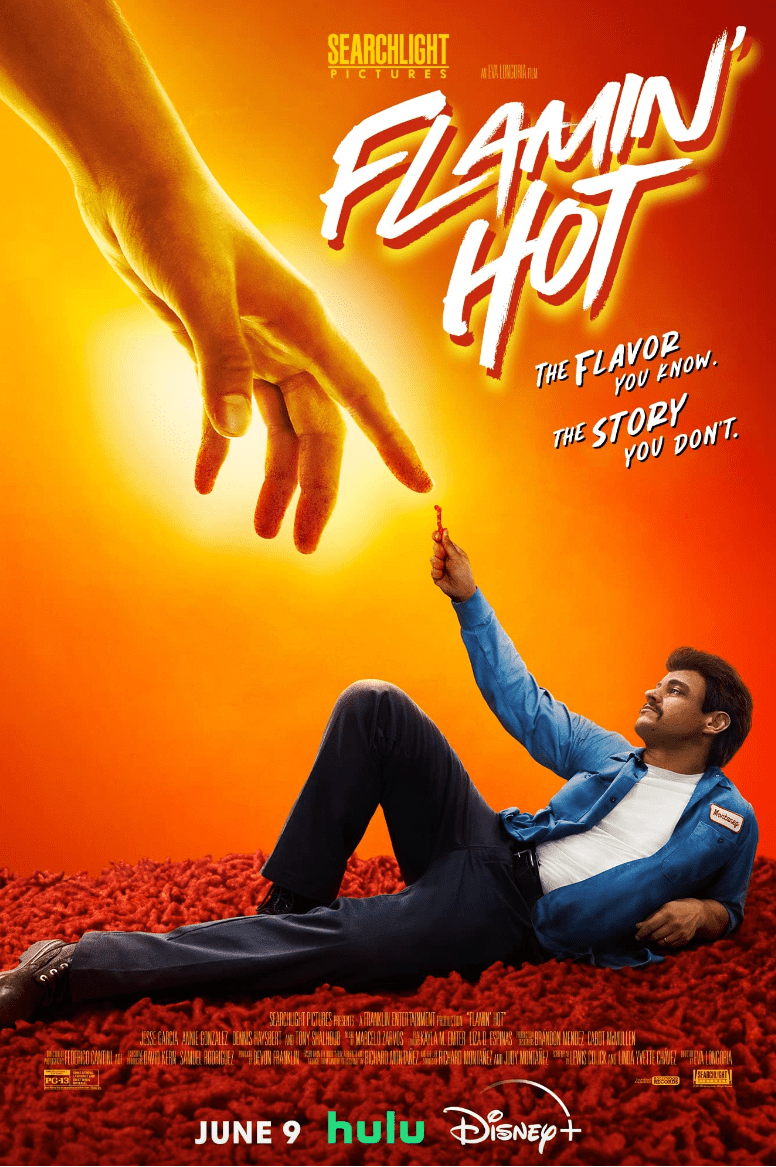
Uplifting! Flamin’ Hot is a thoroughly enjoyable, motivational biopic that captivates audiences with the compelling story of Richard Montañez, the man who invented Flamin’ Hot Cheetos (and other Flamin’ Hot line items) and ostensibly saved his Southern California FritoLay plant from closure in the 90s. Directed by Eva Longoria and written by Lewis Colick and Linda Yvette Chávez, this movie delivers a more compelling story than AIR; however, Flamin Hot does not deliver as highly in the performative dimension. This is a movie for anyone that has ever felt like an underdog. Richard’s inspirational story serves as evidence that prayer, determination, resiliency, and refusal to allow one’s origin to determine one’s personal and professional destination, truly do work! Although the movie is tonally upbeat and even funny, it still affords intimate character moments. Structurally, the movie is well-paced and never hangs out in any scene longer than it needs. And it’s incredibly interesting! Just like AIR so successfully made the origin of a shoe captivating, the same can be said for Flamin’ Hot Cheetos.

If you’re seeking a picture that is inspirational, lean, and funny, then checkout Flamin’ Hot on Hulu and Disney+ starting June 9th.

Ryan teaches Film Studies and Screenwriting at the University of Tampa and is a member of the Critics Association of Central Florida and Indie Film Critics of America. If you like this article, check out the others and FOLLOW this blog! Interested in Ryan making a guest appearance on your podcast or contributing to your website? Send him a DM on Twitter. If you’re ever in Tampa or Orlando, feel free to catch a movie with him.
Follow him on Twitter: RLTerry1 and LetterBoxd: RLTerry

SPIDER-MAN: ACROSS THE SPIDER-VERSE movie review

Oh, what a tangled web [they] weave…with this cacophony of story threads. The highly anticipated sequel to the Best Animated Feature Oscar-winning Into the Spider-verse opens this week, but unfortunately, it suffers from a bad case of sequelitis brought on by a gluttonous consumption of excess. Spider-man: Across the Spider-verse works in title only–and all too well, as it were. The title says it all, and that is precisely what audiences get in this comic philhar-tragic symphony in the key of overindulgence.

After reuniting with Gwen Stacy, Brooklyn’s full-time, friendly neighborhood Spider-Man is catapulted across the Multiverse, where he encounters a team of Spider-People charged with protecting its very existence. However, when the heroes clash on how to handle a new threat, Miles finds himself pitted against the other Spiders. He must soon redefine what it means to be a hero so he can save the people he loves most.

Across the Spider-verse is what happens when a story idea doesn’t pass the elevator pitch litmus test (wherein an idea can be explained sufficiently enough in three-minutes or less). Quite simply, there is such a proliferation of story webs that there is virtually no plot–there is certainly no resolution before the (and this isn’t a spoiler) cliffhanger ending. Story webs lead into story webs that leads into even more story webs. Suffice it to say, it’s as if writers and producers took every incarnation of Spider-man comic series, threw them into a blender, and served the concoction o audiences. Unless you are read up on decades of Spider-man comics, you will be hard-pressed to follow any storyline. Perhaps the better expression of a collision of Spider-verses would have been in a television series that could have explored a different thread of comics each season.

Clearly, Sony took the extremely positive reception of the first one, focussed on recurring praises, and amplified those to the nth degree. Never mind that more than the visual expression of the story, plotting is crucial to structure, pacing, and coherency. The animators and artists are showcasing brilliance in animated filmmaking, but the clear evidence of screenwriting is nowhere to be found. Without a well-defined central character, a well-defined external goal, and a well-defined character of opposition between the central character and the goal, there is no plot–merely a sequence of loosely connected scenes or fragments of ideas. A fever dream, if you will.

While Across the Spider-verse suffers narratively, it certainly excels in the art of animation. The stylistic animation and editing is outstanding! Much like with the first movie, this one takes the emotive detail found in a single frame of a comic book (or graphic novel) and combines that approach with hand-drawn inspired motion picture animation. There are certainly problems with the story (or stories, as it were), but Sony Pictures Animation has demonstrably shown commitment to the boundless imagination and capabilities of animation. Across the Spider-verse, in how it is expressed in this movie, can only happen within the world of animation. In no way could this movie be expressed in a live-action way. Perhaps the writers were asleep at the wheel, but the animators gave each universe of Spider-man characters its own color palate and animation style.

Make sure to watch Across the Spider-verse in a premium format at your cinema, because the strength in this animated movie has little to do with the story as much as it does the stylistic animation. When a film, animated or live action, strikes a balance between style and substance, it can be enjoyed on the big or small screen without detracting from the storytelling; but when the movie struggles narratively but excels in form, then experiencing it on the big screen is the best approach.

Ryan teaches Film Studies and Screenwriting at the University of Tampa and is a member of the Critics Association of Central Florida and Indie Film Critics of America. If you like this article, check out the others and FOLLOW this blog! Interested in Ryan making a guest appearance on your podcast or contributing to your website? Send him a DM on Twitter. If you’re ever in Tampa or Orlando, feel free to catch a movie with him.
Follow him on Twitter: RLTerry1 and LetterBoxd: RLTerry

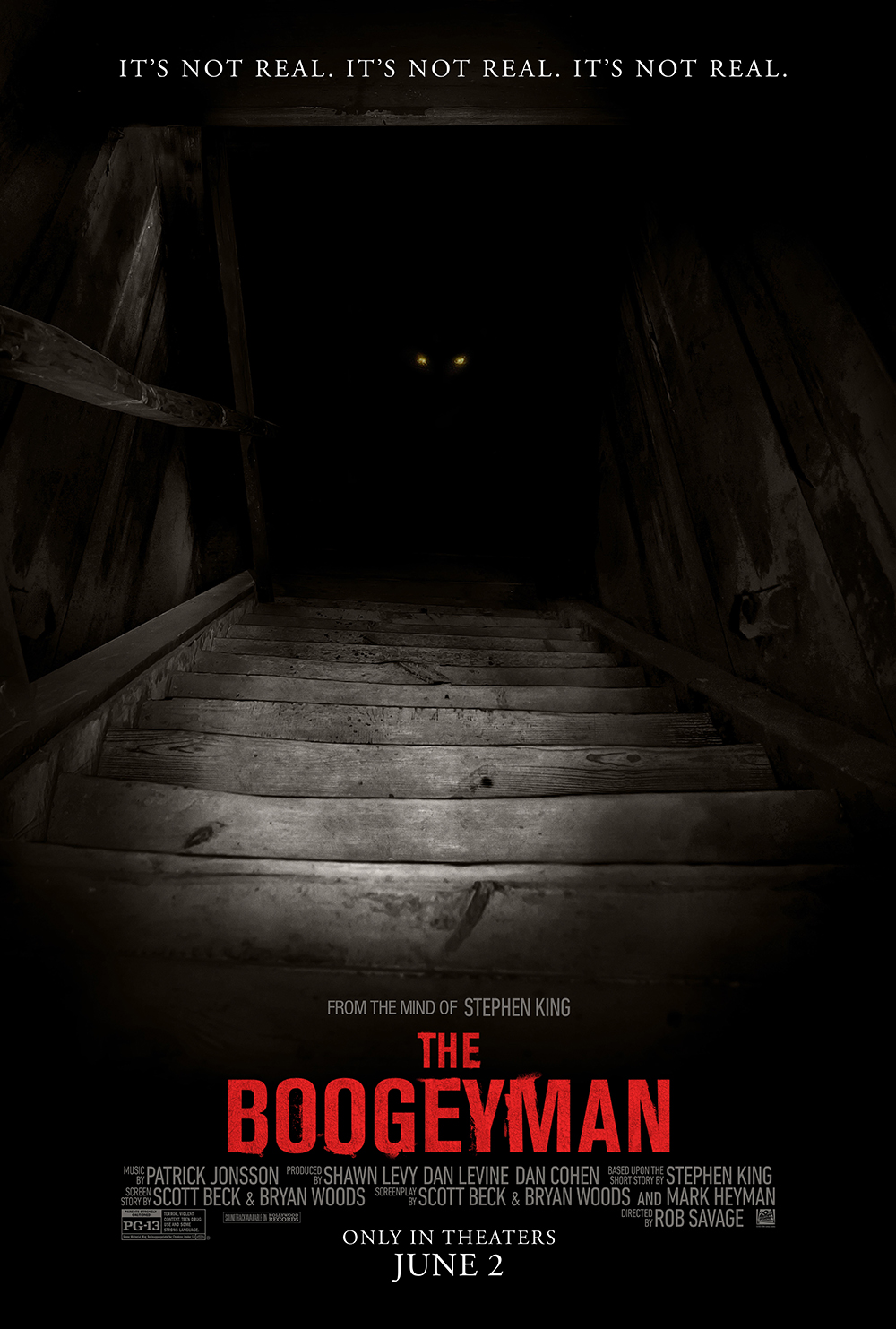
THE BOOGEYMAN (2023) horror movie review

By Kurt Feigelis

Neither fun nor scary enough. This adaptation of Stephen King’s The Boogeyman takes a short story and builds just enough tension that struggles to justify a 90 minute run time. Beautiful cinematography and wonderful performances, particularly by Vivien Lyra Blair and Sophie Thatcer. But in the end, the film leaves you wanting and waiting for just once more scare. 

After the death of his wife, psychiatrist Will Harper (Chris Messina) struggles with his loss and the responsibility of being a single father. Daughters Sadie Harper (Sophie Thatcher) and Sawyer Harper (Vivien Lyra Harper) are left to care and raise each other while their father continues to work and see patients. The same day the daughters return to school after the death of their mother Lester Billings appears on Dr. Harpers’s door step seeking help. He tells the story of the death of his three children and how he believes “something” is responsible, he calls it “the Boogeyman.” Believing this man is unstable, Dr. Harper removes himself to call the police. We soon find Lester wondering the house where the Boogeyman has found him and now attaches himself to a new family. Now it is up to the daughters to fight for survival and try to convince everyone else that the Boogeyman is real. 

Over all, this movie is successful. With writers Scott Beck, Bryan Woods, and Mark Heyman, these guys know scary and can write a scare scene. They know how to build a story with interesting characters. But the inconsistencies come from Director Rob Savage. The movie is a more about waiting for the Boogeyman to appear, or wait for the characters to start talking about the monster they don’t know anything about yet. The parts in between don’t progress the story enough. 

The mythology of the Boogeyman comes in to question when you start to think about the movie as a whole. It is said the Boogeyman attacks when the parents aren’t paying attention to their children, but this mythology doesn’t stick true to the story. The father is closer to the younger daughter (Sawyer), who sleeps with multiple lights on, and is constantly overlooking the eldest daughter (Sadie) and even walks away from her when she says “I’m trying to talk to you.” But the Boogeyman goes after Sawyer first, despite not being able to be in the light, and her sleeping with multiple lights on. But the Boogeyman also attacks adults when they are alone as well. 

Granted the mystery of the Boogeyman is what would make him scary, and I don’t need all of the answers, but consistency is the story is what makes you feel satisfied. If the Boogeyman has been around for hundreds or thousands of years, why is the first time we heard of him. Where are the stories around the school yard, late at night during sleepovers? Where are the questionable videos online with today’s technology that all children have.  

Further inconstancies with the father come into question, early on we seem him taking pills leading us to believe he is struggling with the loss of his wife, but this never comes back. He isn’t there for his children, then he is, then he isn’t. He is there for one, not the other, then vise versa, then not there for either. Either he is trying to be a good single father or he isn’t. It feels as if there needed to be one more pass on the screen play, or too much was cut in editing to keep the film at 98 minutes.

In the end the movie is about the Boogeyman, and that is where this movie shines. There is true mystery behind this (possibly ancient) monster. The build up to his reveal is a fun and enjoyable ride, and the movie is worth seeing for that alone. But I sat there at the end thinking about the movie waiting for one more scene, one more scare, or a hint of character development or progress for the family we just sat with for 98 mins. 3.5 stars/ 5. Wait 45 for streaming.

This review is from contributor Kurt Feigelis.

THE LITTLE MERMAID (2023) movie review

written by Dr. Leo Genco

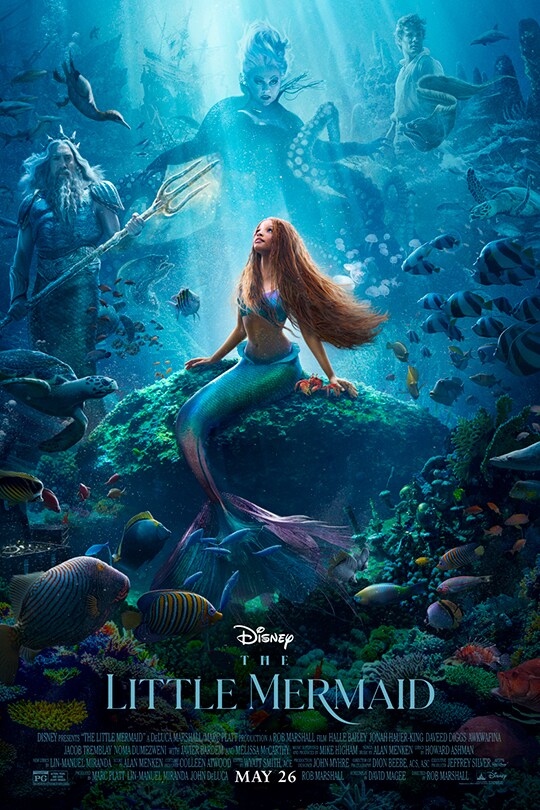
Some treasures are best left under the sea. This familiar Disney formula is only good for one thing: lining the coffers. The Little Mermaid has wonderful, bright, appealing visuals with a few new decent songs, that prove Disney is unable to capture the magic of their 2D animated films. This is unfortunate, because under the sea of this movie is the potential for a great innovative rendition of The Little Mermaid. Why? Well, Disney attempted to provide a newer telling of the original while pandering to the original material. This creates a dichotomy of moral themes in the movie, and it shows. There is a lot to unpack. If you want to skip to what the movie does right, you can skip to the end.

Let’s get the most obvious issues out the way, since they were consistently topics of discussion prior to the film’s release: race, ethnicity, and gender swapping of characters. These changes are typically common to improve diversity, and it can be done. You can look at Nick Fury in the Marvel Comics, or John Stewart as the Green Lantern in the DC Comics. One of the best race change movies is the Preacher’s Wife. The issue with the change here is how the director and writers tried to justify the change. Instead of changing the race of a whole group to maintain consistency, only individuals are changed and are rationalized through a simple bit of dialogue exhibition. Most of the human characters are an eclectic group of non-white ethnicities and races but Prince Eric is still white! The story justifies these differences by changing the location of the kingdom and having the queen adopt Eric into the family. The kingdom is not a port for the mainland but on an island, somewhere in the Americas, and this causes massive changes in the story. The whole scene with the chef and Sebastian was removed. Someone will wonder if the scene was cut because the chef was French. The essence of the original was stripped to justify the demographic changes, which would not be a problem if the movie did not pander to the original material.

The singing varies between songs and actors. The cast of a mix between stage and film actors would do that, but the main problem is how the songs were constructed. For some reason, the director added more characters into the script, but they did not contribute to the songs at all. It is very common in musicals to have the background and side characters sing the chorus and harmony for the lead singer. But this is not true for The Little Mermaid. People are expecting a chorus for Under the Sea and Kiss the Girl. This is not coming from a nostalgia perspective of the original songs. Under the Sea is a song about the sea living as a musical band of species. The dialogue before Kiss the Girl called for the various sounds of nature. For both songs we are expecting a strong sound, especially when the chorus hits. Sadly, both songs are reduced to two or three singers max and are sung as a solo piece for the majority. Overall, songs match the deaf tone of the movie.

While the animation of the under the sea creatures on par with the Lion King (take that as you will), I am not talking about the animals but the human actors who had little to not animated faces throughout their dialogue. Only three characters were animated, Queen Selina, Grimsby, and Ursula. When I say animated, I mean that their facial expression, voice, and body language spoke. Everyone seemed stiff, which is weird because Halle Bailey is a stage actor. You would think Ariel would have the most body expression because she can’t talk for half the movie. Ariel needs to be animated the most. Arial did not seem to be a curious, explorative person, but a blank manikin until a scene which required an over-the-top reaction. Luckily, this was not consistent throughout the movie. As I will mention later, the acting in the new scenes was great.

For some movie goers, background context to main characters is essential. I, on the other hand, prefer context to characters that is required to understand the journey of the main character. This means, that background context should progress information for the main character, not for the audience. The early introduction to multiple character’s background hurt the movie in two ways: (1) these small scenes for a backstory break up the pacing of the storytelling, creating jarring transitions between scenes, and (2) too many themes or messages were introduced into the film too fast. When you introduce a backstory, you need to follow through and close that story, and when you give too much information at once, people tend to forget or care about the small stories. On top of that, the movie told Ursula’s backstory but did not provide a satisfying delivery of her end. Overall, the introduction of the characters with backstory was not the best way to start the movie.

Two things carried the movie for me, the new scenes and songs and the queen and Grimsby. Adding new scenes and songs felt real. The acting in the scenes felt genuine, minus the random dancing scene halfway through the movie. These scenes had fresh magic Disney needed, but again, the director pandered to the original movie, and this created a lot of disconnect. The problem when recreating 2D animation as a real-life movie is the expression that comes from drawn imagery. This is why the drawings of human movement are different from how humans move. It allows the animator to create expressions you are physically unable to express but want to. The new scenes of the movie did not have a previous expectation of certain expressions. I believe this element allowed the actors more freedom to act.

God bless queen! Out of all the characters, the two actors who were able to pull it off throughout the whole movie was the queen and her trusty councilman, Grimsby. They were amazing. They had facial and body expressions. I had chills when the queen was on screen. Grimsby was played perfectly and became that comedy relief when the gender swapped bird, Scuttle, failed. I loved these characters, and I enjoyed every minute of screen time with them. While I would put Ursula in this category, her character was written incorrectly. While she was played very well, her lines were the least to be desired. She was written more as a grown woman who throws temper tantrums like a child than the cunning slimy sea witch, she was in the original 1991 movie. So, the queen and Grimsby saved the movie, at least for me.

Dr. Genco is a guest contributor and fellow university colleague. Follow him on Instagram at Leo.Genco.