
“Blade Runner 2049” film review

Just as mesmerizing as the original! Denis Villeneuve’s Blade Runner 2049 is nothing short of a future classic that demonstrably possesses the soul of the original and pairs it with a new plot brought to life by a fantastic cast. Every minute is filled with beautiful cinematography that is perfect in every way and a haunting score that penetrates down to the bone. At its core, Blade Runner 2049 wrestles with this one central question: what does it mean to be human? A question that can spawn hours of debates or an exquisite nearly three-hour motion picture. Considering that Ridley Scott has not delivered the same quality for which he provided precise and poignant direction, it was a solid decision to attach Villeneuve as the director. This sequel 35 years in the making may not have had the classic Ridley Scott at the helm, but Villeneuve channels his inner Scott to provide audiences with the same profound cinematic experience today as Scott did when Blade Runner first released. From the color palette to the lighting to the sound design, this motion picture is one that typifies the power of the art of motion pictures and one that will surely be regarded as iconic as the years more along, very much in the same way that the original has been regarded over time.

Officer K (Ryan Gosling) is tracking down the remaining legacy Replicant models created by the infamous Tyrell Corporation, and his latest mission takes him to an obscure farm in the middle of dessert California. After retiring the replicant at the farm, K uncovers what will become a metaphor for Pandora’s Box, as it opens a mystery that law enforcement and the Wallace Corp. seek to solve. The secret contained within the box is one that could potentially plunge all “humanity” into complete chaos, not there there isn’t enough of that already for those left on earth. K’s journey takes him from the gritty, grimy streets of Greater Los Angeles to the dust bowl that was once Fabulous Las Vegas. There, he meets former Blade Runner Deckard  (Harrison Ford) who has been hiding from law enforcement and the Wallace Corporation for three decades. Together, they must work to locate the miracle that no one ever could have thought would happen–or could happen.

Despite not pulling the numbers that Blade Runner 2049 was forecasted to bring in over its October opening weekend, the film did what fans wanted–it kept the very essence of the original movie alive and well. For all the artificial intelligence in the film, there is nothing artificial about this long-awaited and highly anticipated sequel to the Ridley Scott classic. The reason for not pulling the numbers that it was predicted to do can likely be attributed to the tone of the film and the stylistic filmmaking approach that borders on neo-noir meets the avant-garde. Although not completely necessary, it is incredibly helpful to have seen the first film. And seeing the first film gives an appreciation for the sequel that cannot be experiences without having knowledge of the first. The slow-pace and dark atmosphere may be some of the reasons why more people did not wish out to see it as the weekend moved along. Looking at the two films side by side, this film is a direct extension of the original so the authenticity of this universe and story is genuine and almost visceral. For those who prefer more dialog or higher concept plots, the film may not strike the same level of enthusiasm because of the heavy visuals and dark themes in addition to the profound questions. This combination is not one that will attract the general populous in doves; however, this film IS what it needed to be. Sometimes a long-awaited sequel has to be made to remain true to its soul because that is what the fans want to see, and it’s the true fans who continue to visit the cinema year after year. Blade Runner 2049 may not win over new fans, but it keeps the diehard ones happy.

At the heart of Villeneuve’s cinematic masterpiece are existential questions that drive the plot forward. A plot driven by such questions told through a sedated pace is one that is not as easy to digest as one that is more superficial and more rapidly paced. Still, these questions are profound and cause one to think hard about what it means to be human. What sets this film apart from other science-fiction rapid fire blockbusters is the commitment to visual storytelling and the art of creating a motion picture. Blade Runner 2049 mirrors its predecessor and remains true to the experience of the first. Cinephiles will especially appreciate this film for it harkens back to a time when German expressionism was at the foundation of the set design and lighting. There are many exaggerated and elongated shapes that exist in a world of harsh shadows and dimly lit alleys throughout the film. Although the look of the future world in the original was one that audiences may not have believed would come true or could come true is seen differently by today’s audience that can easily see just how accurate the world of the Blade Runner movies actually is–the mediation of society today seems to be not that far off from this not-so-distant future.

Cinematographer Roger Deakins captures a wold through the lens that seems to go on forever in a world of greys and beiges. The only color to be found is in the prolific advertising on the sides of buildings. Deakins further extends the artistic approach to the cinematography by paying homage to Stanley Kubrick’s The Shining in a shot that was actually added to one of the more recent recuts of Scott’s Blade Runner. That score, though. The sound design and score are an audible extension of the visual landscape. Composers Benjamin Wallfisch and Hans Zimmer have created one of the most haunting scores to ever be heard in the cinema. The combination of ghostly groans and blood curdling howls echo the very look and feel of the landscape. I’ve rarely encountered such an immersive sound design and score in a film. Just as the world on screen is an uneasy place to live and one that contains faint images of the grandeur of a world that once was, the score accompanying this motion picture places you in the midst of this post-apocaltyic world that most natural-born humans have left.

Definitely a film that I want to watch for a second time in order to appreciate this film, boasting with artistic achievement, even more than I already do. Although most of the themes and subtext are centered in and around “what it means to be human,” there is a real message regarding the importance of bees. An important visual statement in the film because the populations of bees, the most prolific pollinators, are dwindling. Not for the casual movie-goer, this film is for those who want to experience a sequel in the vein of the original that shows the artistic side of the creation of motion pictures.
“Gifted” movie review

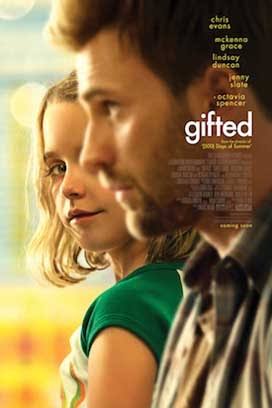
A cute paint-by-the-numbers heartwarming drama. Although Gifted may be in the vein of a Hallmark Original, it doesn’t shy away from nor sanitize the real problems faced by adults and children. Fresh off the Spider-Man series, director Marc Webb switches gears from superhero action movie to family drama. However, this drama stands out from its counterparts due to the organic feel of the dialog and in how it follows a blockbuster formula. Webb is certainly not new to directing cinematic dramas; he directed the wildly popular 500 Days of Summer which has a cult following in and of itself. Diegetic contrast can easily be drawn between Gifted and 500 Days of Summer in the simple fact that the former is chronologically out of order–but it can easily be said that the movie would not have the artistic or emotional impact that it did if it were told in order–whereas the latter is traditional in linear storytelling. If it were not for Chris Evans and Octavia Spencer’s billing in the film, this one would likely go by the wayside. Over the course of a director or writer’s career (although not limited to those roles), there are occasionally films that provide audiences with a glimpse into a director getting in tough with his or her roots, and this is one of those. More polished and comprehensive than a typical Hallmark movie, Gifted is satisfying enough but does not leave a lasting impact.

Faced with raising his niece Mary (McKenna Grace) after the untimely death of his sister, Frank Adler (Chris Evans) lives a modest, hardworking life in a small coastal town in Florida. Mary is no ordinary child; she is a mathematics prodigy. Against the advice of friend and neighbor Roberta (Octavia Spencer), Frank enrolls Mary in a typical elementary school. When Mary’s unparalleled, brilliant mathematical skills come  to the attention of Mary’s teacher Bonnie (Jenny Slate) and principal, her school encourages Frank to enroll her in an exclusive school for cognitively gifted children. With a deep desire for Mary to have a normal, fun childhood, Frank declines the full-scholarship. News of Mary’s ability and the scholarship soon reach Frank’s mom Evelyn (Lindsay Duncan), a genius in her own right. After failing to reason with her son, Evelyn takes him to court in order to secure parental rights. Throughout the custody battle, skeletons come out of the closet and the reasons for Frank’s decisions become clear.

Paralleling the brilliance of Mary’s cognitive abilities, a trait that runs through the entire family, the most notable element that stands out in Gifted is the casting. Child actors playing characters who are atypically outstanding in a particular field can come across as precocious, if not just plain annoying. Whether a kid genius, musical savant, or prima ballerina, attributing adult-like qualities to a child can create a character that comes across as out of touch with the majority of the audience. Not so with McKenna Grace. With her wide eyes, missing front teeth, and refreshing spontaneity, she provides audiences with a relatable character who just happens to be brilliant. This relatablity can be attributed to her down-home charm and humble demeanor. When he’s not saving the world, Captain America is raising his niece in a non-discript small coastal town outside of the bustling Tampa-St. Pete metropolitan area. While many actors become type casted after bringing an iconic character to life, Evans is working to prevent this by appearing in lead roles that are in stark contrast to his work in the Marvel Cinematic Universe. Sporting a perpetual scruffy beard, love for the outdoors, and a boyish-fatherly charm, Evans demonstrates his ability to successfully transfer his acting prowess to other genres in cinema outside of his famous Captain America.

Supporting the two leads are Spencer’s Roberta and Duncan’s Evelyn who are interestingly mirror characters in that they are the antithesis of one another. Although her screen time is limited, Roberta’s appearances are strategic and greatly support the emotional pull of the movie. Wise beyond her likely formal education, Roberta cares nearly as much about Mary’s well-being as does her father-figure uncle. Spencer’s charisma is easily seen in this chief supporting role and I cannot think of another female actor who could have done this role justice as well as Spencer did. The character of Evelyn is an interesting one to evaluate. On one hand, she is a monster of a grandmother who wants to control her granddaughter and protect the family’s academic legacy; but for fear of smothering her like she did her own daughter, tries to be as loving and concerned as she can. Although at first I thought that this was a role better suited for Jessica Lange, I do not feel that Lange could have captured the vibrant love that Evelyn has for her family–tough love maybe–but sincere love for and desire for her children to be successful. Evelyn is both an enlightened academic and tough-loving mother and grandmother.

Gifted does its best to be a tear-jerker, but it never quite hits that emotional peak. There were times that I was close to tearing up, but there was just a little something extra missing that prevented the tears from rolling down my face. The plot of this film was as structured, precise, and predictable as a chalk equation on a blackboard, but it still has a charm that will assist it in beckoning patrons to watch it at the cinema when it hits select theaters this week with a wide release predicted in the near future.

Written by R.L. Terry

Written by J.M. Wead

“The Founder” movie review

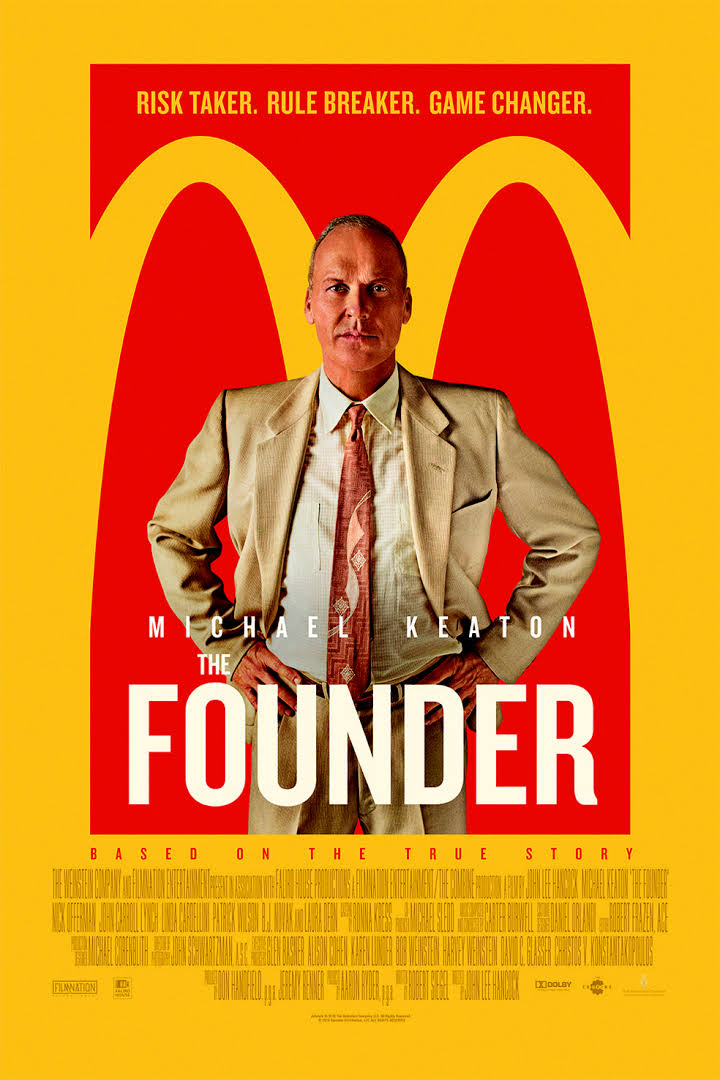
thefounderOutstanding biopic that typifies what the American dream actually looks like–but that’s the scary part. Michael Keaton’s portrayal of Ray Kroc, the (self-proclaimed) “founder” of McDonald’s, is positively brilliant! Comparing his look and performance to the real Ray Kroc seen before the credits roll, there is no doubt that director John Lee Hancock (known for The Rookie and The Blind Side) made the right choice. The Founder takes us on a journey from Southern California to Illinois and beyond as we follow the course of events that radically revolutionized an entire industry and gave birth to one of the most recognized brands in the world as well as the very concept of modern franchising. What Henry Ford did for American motorcars, Kroc did for American “speeedee” service food. Ray Kroc realized the American dream by stopping at nothing until he built his empire, even if it meant stealing from a business and breaking up a marriage–all within the confines of the law. We’ve all heard about “the American dream;” well, The Founder depicts what it takes for that dream to come true. If you’re willing to be a cut-throat bully with few if any inhibitions, then you can build an empire and claim to be the founder of another’s company or even run a country.

This biopic drama tells the story of how Ray Kroc (Keaton), a 55 year-old milkshake machine salesman from Illinois, met Mac (John Carroll Lynch) and Dick (Nick Offerman) McDonald in San Bernardino, CA during a sales transaction that would start something big. Who would’ve guessed that a man who was the definitive door-to-door salesman would see great potential in a small-town burger joint. Recognizing the great potential for a successful franchise, Kroc entered into a business proposition that would change the quick service food industry forever and essentially perfect the business practice of franchising. Over a relatively short amount of time, Kroc maneuvered himself into a position of power and dominance over the brothers, and eventually took the very company they founded away and never looked back. Kroc stopped at nothing when appropriating the intellectual property of the McDonald brothers to build a vast empire that would find its way into thousands of towns and become just an American an icon as the flag, churches, or the eagle.

Although the film is presently foundering in box offices, it is definitely worth a watch because of depicting the story of one man’s American dream that would essentially steal the laurels from baseball and apple pie to become a larger than life symbol of America recognized throughout the world. It’s unfortunate that this film is not garnering more attention because the writing, directing, and acting are absolutely brilliant. Full of irony and ambiguity, The Founder could have easily been called or at least subtitled Birth of a Salesman. While watching the movie, I could not help but compare the plot of this film with the iconic play Death of a Salesman by Arthur Miller. Both tell stories of salesman but the end result is vastly different. Both Willy Loman and Ray Kroc were dedicated to their respective craft of salesmanship; however, Kroc took the practice of sales and pitches to the next level–in fact he created his own game in which only he could win. Where else have we seen a bully play by his own rules and build an empire into a brand in and of itself? I’ll allow you to draw that conclusion. Further irony can be seen in Ray Kroc’s surname. His sheer cunning, predatory ways of conducting business can easily be likened to the crocodile itself. Despite receiving credit for inventing the fast food assembly line, much like Ford did for American car manufacturers, the “speedee” service was invented by Dick and Mac McDonald of San Bernardino. Thankfully, the brothers are receiving the credit that they deserve–albeit posthumously.

It’s difficult not to root for the villain in this film. Even though you tell yourself that he was a monster and a complete leach to the McDonald brothers, his first wife, and other friends, you may still find yourself in his corner because of McDonald’s being the American icon that it is. The cognitive dissonance that many will experience during diegesis of this film is fascinating in and of itself. Early on, you will find yourself rooting for Ray Kroc because he comes off as an underdog. He is able to provide decently for him and his wife, but it is evident that his business is in the process of collapsing. Even after striking the proverbial deal with the McDonald brothers, you may still root for him because the brothers make it difficult for Kroc to actually engage in successful franchising. The tide begins to subtly shift when the chain begins to take off. When the brothers deny Kroc a request to renegotiate the terms of the contract in order to boost capital and revenue, Kroc hires a new business partner who provides the knowhow to shift the focus from running a burger chain to being a real estate mogul. That shift from only burgers to real estate is what truly built McDonald’s Corporation into the giant that it is today. Interestingly, when confronted by the brothers on a break in the contract, Kroc points out that they could take him to court and probably win, but by the time he would drag them through hearing after hearing, and trial after trial, the brothers would be completely bankrupt. Much like the milkshake substitute that boosted revenue and mitigated refrigeration costs, but contained no milk, a handshake deal with Kroc is just as fake.

The set designs and costumes in The Founder are impressive and so incredibly well executed that audiences will be transported from 2017 to 1950s America. From the cars to the architecture to the print advertising and marketing, this movie boasts an authenticity that is on par with larger budget period films. The supporting players in the film are equally captivating too. Parks and Rec‘s Nick Offerman and John Carroll Lynch are absolutely perfect as the McDonald brothers, and I cannot think of two better actors to bring these “hidden figures” of fast foot history to life. It’s unfortunate that Laura Dern is underutilized as Ethel, Kroc’s first wife, because she is a dynamic actress capable of adding significantly to a film. Although not featured on screen a lot, Patrick Wilson plays Rollie Smith, an early investor, but his acting excellence is still showcased well. Finally, Linda Gardellini is captivating as the future Mrs. Ray Kroc–problem is, that she is married to Rollie Smith at the time they meet. It’s her suggestion to switch from real ice cream and milk to instant milkshake powder that sets the final dominos in motion to topple the McDonald brothers. In continued irony, the story of McDonald’s contains people who are excited about fake food product. But those were the times the characters lived in. The chemistry between the characters helps to reinforce the authenticity of this biographical motion picture.

Ray and Joan Kroc are well known philanthropists–in their later years. In fact, Joan Kroc left most of her vast fortune to many charities. The most well-known recipient of the inheritance is NPR. Even today, if you listen to the programming, you will hear the Estate of Joan Kroc mentioned as a supporter of the public radio organization. Whether you appreciate NPR or not, one cannot help but think that all the philanthropy of the Kroc (namely Joan) is a result of easing the conscience since the Kroc fortune can be likened to blood money. It’s entirely plausible that much like Marion Crane figuratively cleanses her spirit in the infamous Psycho shower after having stolen the money from her employer, Joan may have very well given her fortune away in an effort to ease her conscience and do good with the figuratively ill-gotten money.

Such an incredibly fascinating movie! If you enjoy historical dramas about American icons, then you will definitely enjoy The Founder. It may prompt you to grab a McDonald’s burger and fries after the movie or perhaps never go there again after learning the company’s history. Whatever the case, it cannot be denied that the story of McDonald’s is incredibly interesting and IS the product of persistence and business ingenuity. If there is anything inspirational to take away from this film, it is the power of that persistence and looking for potential in the most unlikely of places.

Written by R.L. Terry

Edited by J.M. Wead

“A Dog’s Purpose” movie review

adogspurposeYou’re going to need tissues! Ever wonder what your dog was thinking? You’ll find out in Universal, Amblin Entertainment, and Walden Media’s glorified Hallmark movie that follows the soul of a loving dog. As such, A Dog’s Purpose is one of those films that is so simple yet emotionally touching. Based on the novel written by W. Bruce Cameron, this movie will tug at even the toughest of hearts. Although the film does not follow a traditional diegetic arc, three-act structure, and is filled with constant verbal exposition in the form of a voiceover, it is still enjoyable and works as a great date movie. No critical thinking required. Still, the author’s tagline “a novel for humans” can be seen in the social commentary on primarily human relationship dynamics followed by the relationship between a pet and his or her owner. Filled with moments of laughter and tears, A Dog’s Purpose is a film that everyone who either has or has ever had a dog should see. If you’re a cat person like me, then there isn’t much here for you–sorry. However, I was moved to tears during a scene in which the focus was on a human romantic relationship getting rekindled. You will never look at your dog the same way again and will likely go home and hug him or her just as a friend of mine did after she screened the film with me.

A Dog’s Purpose is about a dog who discovers the purpose for his existence as he is reincarnated into different dogs over the course of his life. Finding himself part of different families–or as he likes to refer to them–as packs, Bailey does his best to affect humans by influencing their respective needs to laugh and love.

Despite the rather two dimensional nature of A Dog’s Purpose, there is a deeper theme within the mostly shallow story if you examine the film closely enough. Not shallow in that there lacks emotional appeal or enjoyment, but shallow in that there is very little that is complex and dynamic in the narrative. Although Bailey spends most of his on screen life with Ethan (K.J. Apa), Bailey’s soul finds itself in other dogs who are part of their own respective family. Doing a close reading of the film reveals that each family unit represents a different kind of relationship dynamic or lack thereof. I won’t spoil it by describing each type of relationship, but knowing that there is social commentary on human and pet relationships could likely increase the appeal and enjoyment of the film for those who prefer movies with a more cerebral plot. Interestingly, the movie includes families/human relationships that represent a good cross-section of the types of relationship dynamics that exist in our lives.

For those who typically enjoy Hallmark movies, then you’ll definitely enjoy this one. Last January we had glorified Lifetime movies and this year it must be Hallmark’s turn. As I have not read the novel, I cannot comment on differences between the book and the film adaptation.

Written by R.L. Terry

Edited by J.M. Wead

“Whiskey Tango Foxtrot (or WTF)” movie review

WTFQuite the unexpected surprise from comedienne Tina Fey! Paramount Pictures’ Whiskey Tango Foxtrot is one part self-reflexive film on television news production and one part self-discovery. Unlike the feel of the previews, WTF is not really a comedy–not in the traditional sense anyway. There certainly are moments throughout the film that are funny and will cause you to chuckle, but it is definitely more of a drama. The brilliance of Fey’s acting in this movie is truly showcased by her ability to display that she can do serious just as well as funny. Most of the funny parts are given away in the previews, so don’t think you’re going to get more laughs during the movie. Based on actual events, WTF takes you behind the camera and behind enemy lines to depict what it is like for television news foreign correspondents in a war zone. Although the movie was not what I expected at all, I am very pleased with the story, all be it, slow burning. Beyond the self-reflexive subplot in the movie is the foreground story of self-discovery. Fey represents so many of us who just feel like we are spinning our wheels, treading water,  or even moving backwards. The inspirational elements of the movie come from her willingness to take chances, make mistakes, and get dirty (as the Magic School Bus‘s Miss Frizzle would say).

What would you do? You’re dissatisfied with your job as a television news writer/producer, have a mildly depressive boyfriend, small apartment, and just need to get away. If you’re Kim Barker (Tina Fey), then you head off to Kabul, Afghanistan to become a foreign correspondent during the early days of the War on Terror. After an expedited visa and passport, Barker embarks on her journey as a representative of the U.S. press in one of the most dangerous places on earth. Armed with her laptop, camera, notepad, and two staff members, she sets out to discover the real stories in Kabul and the surrounding areas. Thinking that she is the only girl in a military barracks, Barker is relieved to meet Tanya Vanderpoel (Margot Robbie) who takes Barker under her wings to show her the ropes of reporting the news amidst a war and hundreds of “thirsty” journalists and military personnel. While covering the stories of the war, Barker concurrently takes a journey of self-discovery that is filled with mountains and valleys.

Let’s be real here. Even if you analyze movies on a regular basis like me, you too were probably thinking that this would be a dramedy (drama/comedy). And yes, comedy is really drama in disguise; but I digress. The previews are certainly cut together in such a way that it looks like a very Fey-esque wartime comedy. I am not going so far as to saying that Paramount pulled a bait ‘n switch–because the movie is of a good quality and enjoyable–but the is no doubt that I went in expecting classic Fey and was presented with her more serious side. Still, through her witty quips and non-verbal dialog, she infuses conventional comedy and self-deprecating humor throughout the narrative. Like many dialog-driven dramas, even ones during a war, this movie has a very slow pace especially in the first act. Some additional comedy probably would have helped in the beginning to hook the audience. Speaking of the hook, that is probably what’s missing from the first few minutes of the movie. I think the studio sacrificed a traditional hook because the hook was Tina Fey herself. Fortunately, the film wastes no times in getting Kim Barker to Afghanistan, and that is definitely a good move. Although we are introduced to several chief characters in the movie, the focus is definitely on the character development of Barker with some minor development and introspect on the other principle players.

There are really two stories here: the foreground story of self-discovery and the background self-reflexive plot. Both are seamlessly married together in order to accurately tell both without sacrificing the other. Although we all know that there are foreign correspondents in war zones, we don’t always get to see what it’s really like to uncover stories, pitch to executives back in the states, and maintain sanity and safety; but through this film, we witness just how hard it really is to be a foreign television news correspondent. From networking, to interviewing, to shooting B-roll and stand-ups, Barker takes us on the journey from concept to delivery of producing news int he middle of a battle zone. Beyond the battle field, Barker is coping with her own personal and professional battles. If it isn’t the cheating boyfriend, it is the network who put her on the hourly plan and gives her no screen time. But, through it all, Barker never gives up and refuses to sit idly by and allow herself to be walked over. Fortunately, Barker does get her big break during the climax of the movie, but you’ll have to watch the movie to see what that is.

If you plan to see just one movie this weekend, I definitely encourage you to see this one. It’s gritty, funny, and inspirational. This is also a great opportunity to watch Fey in a more serious role and decide for yourself if she convinces you that she can play serious just as well as the comedy we all know and love her for. You may have seen other wartime movie, but this one plays out differently in that the focus is truly on the character development of the protagonist with the war merely being the backdrop and conduit through which we see her story of summits and pitfalls.