“On Cinema and Theme Parks” (part 5)

My Book

Over the decades, there has been a strong convergence between cinema and theme parks. Studio executives, filmmakers, and theme park designers are working together in ways that serve to support both the movies and the parks that have rides based on the movies. Historically, the beginning of the convergence of cinema and theme parks became apparent in the late 1970s. Following the decline and eventual fall of the original Hollywood studio system in the 1960s, there are some areas that have changed in the production of films (and other entertainment media). According to Allen Scott of UCLA in the writings of Dr. Ralph Casady (1957), some of the changes and transitions dating back to the 1970s are: (1)The penetration of digital technology into all stages of motion picture production (2)The intensified geographic decentralization of production in the greater LA area (3)The proliferation of new markets based on the cross-promotion of intellectual property rights (4)The increased penetration into themed entertainment and video gaming and (5)The merging of, or buying out of major studios by giant multinational media conglomerates (2001). Along with anti-trust government regulation as a result of the Paramount Decision* and the reluctance of big banks to continue to finance motion pictures, film studios were forced to seek new revenues from other sources.

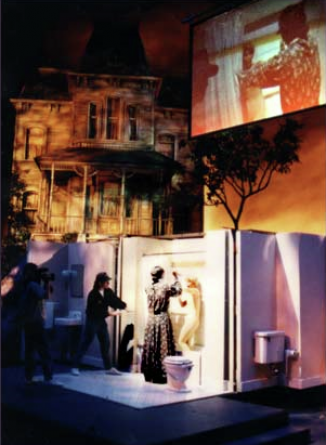
Inside the show building from the former Hitchcock: the Art of Making Movies attraction at Universal Studios Florida.

Inside the show building from the former Hitchcock: the Art of Making Movies attraction at Universal Studios Florida.

More than ever, filmmakers and attraction designers need to know what the cinema patron and park guest both want in order to create a synergistic and dynamic entertainment experience based on a single narrative. The idea is to generate a similar or complementary emotional response during the themed attraction to that experienced by the movie patron during the respective movie. According to researchers Enrique Bigne, Louisa Audreu, and Juergen Gnoth (2004) of Tourism Management, visitor emotions, in a theme park environment, influence satisfaction and behavioral intentions; and, emotions consist of two independent dimensions: pleasure and arousal (2004).  Theme parks are a form of leisure activity because they provide an opportunity for entertainment during an individual’s discretionary time (Milman, 1991). More specifically, movie-based theme parks provide live themed entertainment experiences that immerse the individual into the world of filmmaking or into the narrative itself. As media conglomerates continue to grow and acquire theme park properties (either through the development of new or re-envisioning of old ones) and intellectual property licenses, the popularity of movie-based theme parks will likely continue to grow.

(Check out what you missed by buying my book on Amazon)

Harry Potter and the Forbidden Journey at Universal's Islands of Adventure

Harry Potter and the Forbidden Journey at Universal’s Islands of Adventure

The creators of theme park attractions from movies have to keep in mind two areas to communicate through the attraction: (1) selecting elements from the setting, characters, and narrative to translate; (2) Translating the aforementioned elements in a manner which can be communicated in a physical, tangible, multisensory way. Theme parks have traditionally used two models for cinema-based attractions. Examples of these models can be found at the Universal Studios Florida park (Failes, 2014). One model is the behind the scenes of movie-making and the other model is the ‘ride the movie’ concept (“ride the movies” is the original slogan for Universal Studios Parks). The former is traditionally more of a stage show that takes the park guests on a journey through the production process of a movie (i.e. Earthquake: Ride it Out or Hitchcock: The Art of Making Movies). The latter is usually a more conventional amusement ride that involves moving vehicles through the world and characters of the movie, often facing some sort of challenge within the narrative (i.e. Harry Potter: The Forbidden Journey and StarTours: The Adventure Continues). In recent years, there has been a move from the “behind the scenes” rides/shows to more participatory rides, placing the park guest into the narrative as a de facto character from the movie.

* U.S. V. PARAMOUNT PICTURES, INC., 334 U.S. 131 (1948) The US Government forced the eight major/minor studio players to end the practice of block booking (meaning, films would now be sold on an individual basis), divest themselves of their respective theatre chains (sell them off), and modify the practice of long-term employee contracts (though, this would continue until the 1960s). This marked the beginning of the end of the Studio System, AKA Hollywood’s decentralization.

For previous articles this series, click here:

The Man Vanishes

ShrinkingManEvery once in a while, I make observations of trends in entertainment and media that I like to explore in hopes of encouraging further discussion; this is one of those topics: The portrayal of white heterosexual men in media has definitely changed since the days of Father Knows Best, Silver SpoonsAndy Griffith, and Leave it to Beaver. Just so we are clear, I am neither condemning nor condoning this changing portrayal in television and advertising. I am merely highlighting an element of the media based on both empirical and anecdotal evidences that, if for no other reason, is simply interesting to think about. Media should aim to be fair to all races, ethnicities, sexual orientations, religious beliefs, and genders in terms of their respective narrative portrayals. Of course, there is nothing wrong with stereotyping for comedic or dramatic effect; but, it should not become the norm or the status quo. But I digress; you could call the white heterosexual male in media the vanishing man because of how he has been treated over the years, especially in the last 20. The title I selected for this article is a play on of one of Hitchcock’s earliest film titles The Lady Vanishes.

Lucille Ball in her most famous roles in the series, except the Freezer episode.

Lucille Ball in some of her most famous roles in the series.

During the early days of entertainment media (both radio and television, and to some extent movies), the traditional male stereotype was one of strength, intelligence, rationale, and leadership; whereas the stereotype of women was unfairly characterized as ditzy, homebodies, less intelligent, overly emotional and mainly concerned with house chores and child rearing. Note: Lucille Ball’s character in I Love Lucy definitely doesn’t fit the aforementioned stereotype–and thankfully so–she did so much for the portrayal of women in media and gave us one of the most iconic characters that became such a part of Americana. Perhaps that’s why the show is still relevant today. On a side note, I watch it every morning at Planet Fitness while I use the elliptical. Anyway, over time, the stereotypes of men and women (and for the most part, unless otherwise stated, this article is referring to white heterosexual men and women) have shifted greatly. In recent decades, the past traditional female stereotypes have been rightly criticized for being unfair to women.

Cast of "Married with Children"

Cast of “Married with Children”

But, in an effort to be more fair to women, have men been dealt an unfair blow? In the past 10-20 years–mostly concentrated in, but not limited to, sitcoms–men are now almost regularly portrayed as unintelligent, irrational, disconnected, bumbling, and child-like; however, women are now shown as the grownups, leaders, intelligent, rational, and practical. This new type of man is seen in shows like The SimpsonsMarried with Children, Home Improvement, and most any Disney Channel or Nickelodeon show. When men are now shown in traditional roles, they are often portrayed as buffoons, clueless, and in need of guidance, often times by a woman or their kids. On the other hand, female characters in the media, like Progressive’s Flo, have evolved over time to be highly intelligent and superior to any male in the commercial. [Please note that I absolutely adore Flo, and find her commercials to be as entertaining as a typical television show.]

Throughout the media, we are seeing a greater diversity of players and representations of various groups such as gay men, in popular entertainment media; we are also seeing different roles for straight men. Mixed race couples can be seen, single parents are no longer regularly shown to be helpless, and non-traditional and extended family units can be found regularly. But in this effort to do good, the scales may have tipped in the opposite direction too much. Among other attributes mentioned earlier, the role of the father in the home is often devalued if existent at all; and men/partners/husbands are often seen as ineffectual and incompetant. A recent example of this can be seen in the Gogurt commercials where the father is preparing his kid’s lunch and the wife “busts his balls,” so to speak, for not packing a well-balenced lunch, which, for purposes of the commercial, means a Gugurt. Another example is the Allstate commercial where the couple is sitting in a cafe and the female driver receives the safe driving bonus check where as her husband or boyfriend does not. That is a common theme in many Allstate commercials. Interestingly enough, this vanishing man dilemma appears to be mostly limited to white men, while black men are usually portrayed as strong, masculine, and leaders in the house. However, in movies, black men are still more often portrayed as the villain and the white guy as the hero–a discussion for another time.

The cast of "Will and Grace." From left: Will, Jack, Karen, Grace

The cast of “Will and Grace.” From left: Will, Jack, Karen, Grace

Switching gears for a moment, the portrayal of gay males (mostly white) in the media has also changed over the last decade. Traditionally when portrayed, if portrayed at all, they were portrayed as silly, goofy, socially awkward, and the side-kick. But a lot has happened since the days of Will and Grace, which is arguably the launchpad of positive portrayal of a principle gay cast in a popular show. Generally speaking, gay [mostly white] males are now shown in a very positive light with characteristics from the silly to the serious in ads, television, and movies. A good example of this would be ABC’s Modern Family or the cancelled NBC show The New Normal, SmashProject Runway, and Glee are also examples of recent shows that feature prominent gay characters in a very positive/normal light, as opposed to the exaggerated characters of gay males in past shows.

Critically examining the media, it becomes clear that white heterosexual men are being systematically stereotyped as week, stupid, immature; and, it appears as though they are the only demographic group being portrayed that way on a regular basis. The desire not to offend gay men and heterosexual women has caused heterosexual men to be on the short end of the stick. In an effort to balance the scale of the representation of white men versus all other demographic groups/minorities, the media has tipped the scale in favor of the minority groups and not thought of how the portrayal is affecting men over the long run. In real life, there are gay, straight, black, white men of all personality types from the serious and responsible to the silly and ill-driven. So when we see only one side of that picture, the media just isn’t portraying a realistic portrait of men as they are today. In both television and movies, it appears as though women are being appealed to by making fun of men and showing them as ineffectual lovers and incompetent. This is increasingly witnessed in sitcoms because dramas have to be more serious and realistic, and not as regularly portrayed in works of cinema.

Not only in narrative television do you find this depiction of men, but you can increasingly find it in advertising as well. Advertisers have always known they need to write the commercials for the one in the family (or household) who does the shopping. Since a growing number of women are the keepers of the purse strings, it makes since for advertisers to gear advertisements toward women because it increases the probability that the product will be purchased. In the past, advertisements showed women how they could please their men by purchasing the right products and services. But now, we see advertising appealing to women by making fun of men. And, this is often combined with the topics that often come up during a girls night out. So, you will often see commercials highlight the incompetent father. In recent studies, research shows that 2/3 of younger men (teens, 20s, and 30s) enjoy shopping. Furthermore, with the numbers of married or partnered couples dwindling and young professionals staying single much longer than in the last generation, it will become necessary for advertisers of household items to appeal to both men and women. And if they are to sell to men, advertisers will need to ease up on how men have been portrayed in household item commercials. Again, this is a generalization because obviously there are commercials that are either neutral or appeal to the men of the house.

By making fun of men in order to appeal to women, are producers and advertisers accomplishing their goal? And, does this actually affect women’s attitudes toward produces, services, and entertainment? Perhaps this is a backlash to being looked down upon for such a long time. Many may see it that way. But, it still does not make it right or fair. Whatever the case, societal norms are changing and men and women are finding themselves in new roles. And, the American idea of masculinity is evolving rapidly as there is a wide range of stereotypes of male in the media ranging from the abusive to the grotesque and from the serious to the silly. In these roles, men are portrayed from only being able to solve problems through brut force to the gay male who relies upon sensitivity and creativity to the metrosexual (straight/effeminate) male. And in that realm of confusion, that may explain why we see these more negative representations of heterosexual males.

Striking a balance in the portrayal of genders in the media is a game

Striking a balance in the portrayal of genders in the media is a game

Hopefully, highlighting this issue will open the door for communication and discussion in terms of gender roles in todays’ society and how various groups of people are represented in the media. Perhaps, maybe this will help producers and advertisers to show all types of people in a more realistic light and not stereotype one group more negatively than another. Due to children being probably more porous than ever, and shaping their world view of men by how they view males in the media, perhaps this will encourage the creators of content not to paint men in such a negative way because there are plenty of examples of wonderful fathers, husbands, and boyfriends out in the world. Research shows that kids’ perceptions of men on television are not positive. And this is a dangerous slope. Many children see men on television as stupid and inept and women are portrayed as effective and intelligent. However, more recent commercials and shows have made an effort to show men in a more favorable light, and we could be seeing the pendulum swing back to a more neutral position.

One thing is for sure, it is up to the parent(s) to guide children as to what is real and not real. And, that males and females in television may not always exhibit characteristics that are desirable in the real world. It is important to stress that stereotypes do not represent reality, but merely a creative twist or embellishment on reality. At the end of the day, characters are created to sell a show. But, it is important to recognize that men may be being dealt a bad hand by the media, and creators should step back to see that the very thing that happened to women and gay males in the past is effecting the portrayal of heterosexual men today.

Ryan teaches Film Studies and Screenwriting at the University of Tampa. If you like this article, check out the others and FOLLOW this blog! Interested in Ryan making a guest appearance on your podcast or contributing to your website? Send him a DM on Twitter or email him at RLTerry1@gmail.com! If you’re ever in Tampa or Orlando, feel free to catch a movie with him.

Follow him on Twitter: RLTerry1

References

  • Abernathy, M., Professor of Communication Studies, Indiana University
  • Lucas, S., Professor of Sociology and Anthropology, Lake Tahoe Community College
  • Gender Ads Project, Accessed from http://www.genderads.com
  • Basow, S.A., Stereotypes and Roles, Thomson/Brooks Cole, 1992
  • Reeves, B., Children’s Perceptions of TV Characters, Human Communication Research, Vol 3, Issue 2

“Deadpool” movie review

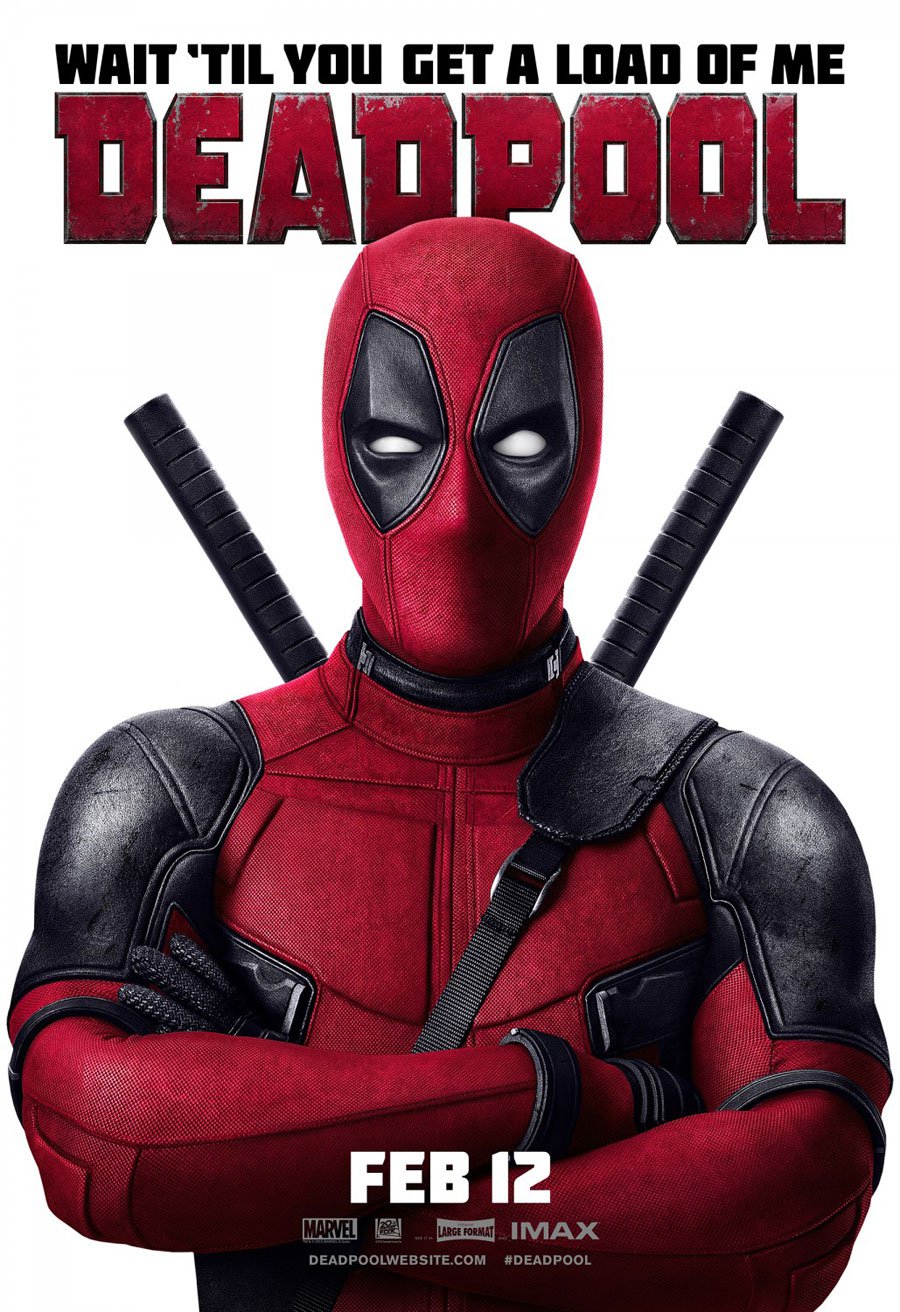
Deadpool-poster-2Absolutely brilliant super not-hero film! For those who often get the feeling that I simply do not like high-concept or superhero movies, let this be evidence that there certainly ARE superhero films that I feel are exceptional. And this is definitely one of those movies. As many memes across social media have indicated–and I will reiterate–this movie is NOT for kids (and no, your kids are not the exception). This is a super not-hero [and the not is important, but you must see the movie in order to understand] movie that is written for a mature audience. From the groundbreaking self-aware opening credits to the perfectly paced and strategic adult-humor, this movie is sure to have you laughing from beginning to end. And it’s not just the writing that is super but the visual effects, stunt sequences, and fight scenes are far above par for this action movie genre. Ryan Reynolds captures the character of Deadpool so incredibly effectively that you will swear that he was made for this role. Not your Disney-Marvel movie, Fox and Marvel bring you a spectacular combination of action and comedy to show off this unique anti-hero, so to speak, for fans of the comic and those who just enjoy a super movie.

Former special forces Wade Wilson (Reynolds) leads a very interesting post-dishonorable discharge life as a mercenary. The last man you’d ever expect to fall in love with anyone, Wilson falls for a burlesque dancer (who most likely moonlights as a hooker–let’s be honest). Following months of unparalleled passion and ecstasy, and after the unconventional proposal, Wilson finds out that he has an aggressive form of cancer that is unfortunately late in discovery. Devastated, Wilson has no idea what to do, but does not want his fiancé to have to go down the cancer road with him even though she clearly states that she is in it for the long haul. Acting upon a chance meting with a mysterious and well-dressed man in a bar, Wilson takes the man’s advice and undergoes a treatment from another equally mysterious but more sinister scientist. The results of the treatment will become clear as Wade Wilson becomes Deadpool and develops into the most unusual super anti-hero ever to come to the screen.

Simply from the opening credits, it is clear that this movie is incredibly self-aware and playing to the audience one hundred and ten percent. BEST opening credits ever, in terms of creativity and being an extension of the narrative itself. The idea of a self-aware movie is not a common one to begin with and certainly not a trope of traditional superhero movies. I think that is what I appreciated most about the movie. The brilliance behind the self-awareness is that the film is equally self-aware as it does take itself seriously as a superhero movie. Never before have I witnessed the fourth wall being broken so incredibly much. For those of you who do not know what breaking the fourth wall is, in its simplest form, it is when the character addresses the audience. This is apparently an element that was brought over from the comic, according to my comic and anime enthusiast coworker that went with me to screen the movie last night. What makes Deadpool’s continuous commentary so effective and entertaining is the fact that he says what many of us would be thinking given if we encountered the same scenario. The candor is such a breath of reality within this world of fantasy or augmented reality.

So often a movie will either choose to rest upon its strong writing, impeccable acting/direction, or visual effects; the sheer remarkable innovation in this movie is supported by not one but all the aforementioned elements. Ordinarily, I am able to find flaws in a movie–especially within the superhero genre–but not this time. I suppose, the fourth wall was broken a little too much, but that would be the only flaw I could identify. Sometimes a movie can be a great superhero movie but not a great film; however, Deadpool exceeds expectations both as a superhero movie and as a film in and of itself. At first thought, you may feel that a movie with endless diegetic and non-diegetic commentary may overshadow or steel attention or coherence from the narrative itself, but the writers did such a fantastic job of integrating the narrative and commentary so seamlessly that the movie is doubly entertaining as it would be without the offensive, explicit, hormonal commentary from the earthiest and most human of superheroes. And yes, I realize I am using superhero even though Deadpool reminds me over and over again that he is not a hero, but you get the idea.

Ryan Reynolds is one of those actors who is equally talented as he is attractive, and he gets to show off for this movie in ways that many actors wish they could in movies. But, it does not come off as obnoxious at all. That’s the beauty in the direction of this movie. You’d think that his over sexualizing of himself and the continuous adult commentary that he (or the movie) would play off as exceedingly obnoxious, but you’d be mistaken. There is a perfect balance struck by the writers and director that enable Deadpool to be a total douchebag, but oddly enough, in the most endearing way. For fans of the X-Men comics, 90s cartoon, or the X-Men movies, you will get to witness a crossover of movies in Deadpool. In an ever growing effort to recruit Deadpool to join the elite mutant force lead by Charles Xavier, Colossus and Negasonic Teenage Warhead confront Deadpool. This subplot is an important elements to Deadpool because it helps to build Fox’s X-Men universe by bringing two franchises.

Without getting into a lot of IP (intellectual property) rights discussion, despite the procurement of Marvel in 2012, as long as Fox keeps making X-Men movies, Sony makes Spiderman movies (even though he is appearing in the Avengers series), and Universal Studios Florida keeps modifying and improving attractions, then Disney does not have the rights to use the respective characters in movies or rides. Now, IP rights are a little more complicated than that, but I wanted to provide you with a general idea. Back to the crossover. Including the X-Men in Deadpool is strategically important for three simple reasons: (1) as I mentioned earlier, it helps to rebuild and reinforce the respective timelines of both franchises (2) it builds the foundation for a larger character universe, much in the same way Disney is doing with the Avengers and related movies and (3) part of what makes Deadpool so incredibly fascinating is his ability to play the anti-hero off of legitimate superheroes or, as Fox is able to officially call them, mutants.

If you are a fan of Disney-Marvel’s Guardians of the Galaxy, and you are NOT a kid, then you will definitely enjoy Fox-Marvel’s Deadpool. Prepare yourself to experience a superhero-action movie like no other. From being mesmerized at the stunning visual effects and editing to the incredibly funny writing and acting, you are sure to be entertained and will definitely crave more. Good thing that Deadpool has already received the green light for a sequel.

The Hollywood Studio System: Employment Then and Now

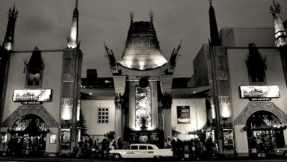
One of the last remnants of Hollywood’s Golden Age, Grauman’s Chinese Theatre stands as a tribute to the movies that started it all.

One of the last remnants of Hollywood’s Golden Age, Grauman’s Chinese Theatre stands as a tribute to the movies that started it all.

In light of the recent film Hail, Caesar!, I thought it would be interesting to take a closer look at the old studio system and whether resurrecting some of the practices might actually prove to be a positive affect upon employment in media and entertainment.

The entertainment industry is evolving more quickly than it ever has, and film production companies and distributors are of no exception. Just like the advent of television had a major influence on the sharp decline of movie patrons in the 1950s and 60s, the advent of on-demand and streaming “television” and movie content today is having a major impact on entertainment sources today. But this article does not aim to analyze distribution, production, nor revenue; its aim is to analyze the state of employment opportunities in the film and narrative television industries. What better way to begin to explore this controversial topic than with the studios that started it all.

HISTORY

The famous entry gate to Paramount Pictures as seen in the 1950 film, all about the studio system, “Sunset Blvd.”

The famous entry gate to Paramount Pictures as seen in the 1950 film, all about the studio system, “Sunset Blvd.”

The rise and fall of the former “studio system” lasted for a period from the 1920s to the late 1960s, with the 1940s to the 1960s being the period of the downfall. During this time, there were five major film studios known as the Big Five, essentially controlling the film industry from production to distribution. The Big Five consisted of Paramount, MGM, RKO, Loew’s, Fox Pictures, and Warner Brothers. Though not as prominent, three smaller studios known as the Little Three, consisting of United Artists, Universal, and Columbia Pictures, were the chief competition. Regarded as the end of Hollywood’s Golden Era, the landmark Supreme Court decision in United States v. Paramount in 1948 marked the delcine of the Studio System. In short, over about a 15-20 year timespan, studios began opening their lots to independent filmmakers–independent of the Big Five (not independent by today’s definition), terminating permanent staff members, and refraining from entering into longerm contracts with performers and movie houses. Although the Walt Disney Company was not part of the Big Five nor the Little Three, it is the only studio today still operating as a studio from the old Studio System.

PRESENT DAY

The Bronson Gate at Paramount Pictures as seen today

The Bronson Gate at Paramount Pictures as seen today

With the major studios today only producing about 20 films a year, the majority of films releasing in first-run movie theatres are produced by independent producers. As stated earlier, this is not independent as we think today; independent by this definition means movies produced outside of the major studios, but often distributed by them (or a subsidiary). Think: Star Wars or Jurassic Park. Since the fall of the Studio System, big banks are more reluctant to invest in or finance films, so producers are responsible for securing their own funding. Less funding means fewer job opportunities for film and television graduates. Most film and television professionals in the entertainment business today are independent contractors–being attached to films and television shows for however long the production time or run-length is. Although a long-running television show provides more employment stability than films do, both are high risk professions. Of course, along with the high risk comes potentially great rewards.

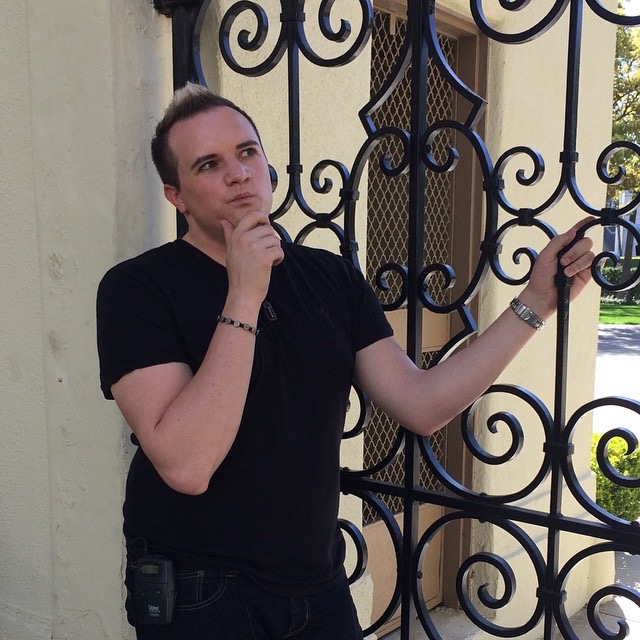
According to Hollywood folk lore, making a wish at the famed Bronson Gate is said to bring good luck. This is me (30lbs ago!) on the Paramount Studio tour in March 2015.

According to Hollywood folk lore, making a wish at the famed Bronson Gate is said to bring good luck. This is me (30lbs ago!) on the Paramount Studio tour in March 2015.

Why would the return of some semblance of the old Studio System be a good turn of events in today’s economy? Simply stated: more jobs and opportunities for budding professionals and college graduates. Why is that? Any first-year film student can tell you that studios keep a low threshold of permanent staff members in administration and production. The majority of talent and crew on each film is independently contracted. And with gaining entry into a union becoming increasingly difficult, it leaves many potentially talented professionals out of work or in low-pay positions on low and moderate budget films. If the Studio System were to return, they would have the collateral that big banks are looking for to invest in films. After all, film, television, and to some extent theatre, are the United States’ largest exports even though they are only recently counted as part of the U.S.’ GDP (gross domestic product) in terms of evaluating the health of the economy. If there were more permanent positions in production with studios and production companies, the unemployment rate would drop significantly in entertainment because budding professionals and college graduates could land positions in which they could grow and excel.

An aerial shot of the Desilu Stages in Hollywood in the 1960s

An aerial shot of the Desilu Stages in Hollywood in the 1960s

But what about exploitation and monopoly? Are those not reasons why the Supreme Court stepped in? Yes. However, there are many reasons why personnel in entertainment today, as permanent staff members, would not undergo the same treatment. The reason: unions. SAG-AFTRA, IATSE, TEAMSTERS, and EQUITY do an excellent job at protecting creative peoples’ rights and opening doors of opportunity. But, it is becoming increasingly difficult to gain access into these organizations. And with the unions being the gatekeepers to opportunity in the industry, where is a budding professional or college graduate supposed to go? If studios produced more in-house movies and television shows, then that would require them to hire permanent staff members. Those seeking a career in the industry would find their place. Some may argue that production companies offer internships to recent graduates; but with lawsuits increasing in the last few years, internships are increasingly being seen in a negative light. One hypothesis is that unpaid internships are taking the place of entry level jobs. With the number of entry-level jobs decreasing since the recession began, the unemployment rate in entertainment is rising.

One way to combat the increased unemployment in entertainment business is to bring back the large studios that have the financial assets to offer and hire permanent positions. This would enable the studios to hire a number of cinematographers, writers, directors, etc. And, those individuals would work on the films produced by the respective studios. If studios were to increase the number of films produced each year, as they once did, then there would be more opportunities for professionals. Regarding the monopoly studios had on movie houses, the present laws on the books would not allow for a studio to have complete control over a particular theatre chain.

There is plenty of room for studios and production companies large and small. Unlike the days of the Studio System, in which outside companies could not shoot films or television shows on another company’s lot, the smaller studios should be allowed to still rent the stage and lot space as they do today. Of course, if Studios were producing more movies on their lots, that may cause the smaller companies to have to look elsewhere for locations. But, that could be a good thing; because if they purchased land for a backlot or sound stages, that would create more jobs for craftsman. In order to combat the rising unemployment rate in the entertainment business, professionals need to get together to develop ideas as to how to hire more personnel. Bringing back the Studio System is just one idea as to how to create more full-time jobs in film and television production.

One of the entrances to MGM Studios (now owned by Sony Pictures) in Hollywood

One of the entrances to MGM Studios (now owned by Sony Pictures) in Hollywood

With studios forced to produce more movies in order to make payroll, that could potentially mean more writers can sell their scripts and perhaps more original ideas will make their way to the silver screen. This action could create human resource databases at the various studios and production companies that would advertise vacant positions. Just like applying for a job at Disney World, you could see what positions are available. Bringing back a new Studio System would allow for studios to advertise full and part-time regular positions. For instance, you could see which studios are hiring cinematographers, directors, composers, etc. Professionals in the creative and technical arts would also benefit from employer provided health insurance and retirement. Although as independent contractors, film and television professionals make more money than working as a regular employee, regular employees benefit from regular paychecks and benefits, and to an extent job security.

Technology is making the production of movies and television shows more efficient than ever, so a major studio could hire permanent staff members to work as producers, directors, screenwriters, cinematographers, etc. Employment opportunity and stability are key elements to the health of an industry–even creative ones. Even though the old Studio System ran unchecked for many years, causing the eventual breakup, carefully constructed and regulated today, the return of a new Studio System could mean more jobs and opportunity for college graduates pursuing entertainment business careers. And just maybe, more movies!


BIBLIOGRAPHY

  • US adds entertainment and innovation to GDP, Time Magazine, http://entertainment.time.com/2013/08/01/hey-america-entertainment-just-made-you-hundreds-of-dollars-richer/
  • History of the Studio System, Encyclopedia Britannica, http://www.britannica.com/EBchecked/topic/394161/history-of-the-motion-picture/52153/The-Hollywood-studio-system
  • Paramount Pictures v United States, 334 U.S. 131 (1948)
  • Glatt v. Fox Searchlight Pictures, New York Southern District court, http://www.nysd.uscourts.gov/cases/show.php?db=special&id=300
  • US Bureau of Labor Statistics, http://www.bls.gov/ooh/entertainment-and-sports/home.htm
  • Glatt v. Fox Searchlight Pictures Inc. 2013 WL 2495140 (S.D.N.Y.) – See more at: http://blog.legalsolutions.thomsonreuters.com/legal-research/westlaw-topical-highlights-labor-and-employment-july-10-2013/#sthash.J9tcpnM1.dpuf
  • Hollywood Studio System Collection, http://mediahistoryproject.org/hollywood/
  • Bigelow v. RKO Radio Pictures, Inc., 327 U.S. 251 (1946)

“Magical” Data Collection (part 3 of 3)

MagicBands(cont’d from part 2)

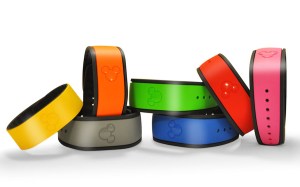
One of the initial praises for this smart technology was the ability for it to collect and assess data through algorithms by assigning a pseudonym to the user—collecting data anonymously. This is not the case with the Disney Magic Band. The Magic Band is just one tool in the entire My Disney Experience vacation management platform. Once a user receives his or her Magic Band (whether a “tourist” or a local annual passholder), he or she has to go online and customize the band with names, select a profile picture (from a list of Disney characters), and other contact information. This, in and of itself, takes the pseudonym (anonymity) out of the equation. For now, not only can information and data be gathered, but it is attached to a specific person whose identity is not a secret. Unlike your smartphone or other mobile devices (e.g. tablet), in which the user can turn off the location sharing features (either for the whole device or app-specific), the location sharing and smart technology in the Magic Band (RFID and GPS) cannot be turned off. The inability for the user to not turn off the location sharing features can be viewed as an encroachment upon personal privacy. However, Disney World does not require park guests to wear/use the Magic Bands. Therefore, if a part guest chooses to wear/use the Magic Band, then he or she accepts the fact that prolific amounts of information are being shared, including but not limited to: location, dining preferences, FastPasses, etc).

Although conspiracy theorists can tout the whole “big brother—or in this case Big Mickey—is watching,” it is more likely that issues of database privacy should be explored (Mokbel, 2006). The treasure trove of information gathered and processed by the My Disney Experience system provides the media giant with unparalleled data that can be integrated into the park operations and, by extension, can be presumed to be integrated into other decisions. Still, the program is too new in order to know for sure where the data is going. Looking at other models of smart data, we can certainly explore the possibilities. The goal in database privacy is to provide access to the gathered information without risk of breaching privacy (attributing numbers instead of names to the sources of information).

The GPS technology built into the Magic Band builds upon decades of GIS  (global information system) research and integration in order to factor location into the database. Location provides a way to link information on a user (or subject) from one database into another. This method of data collection and organization is referred to as data matching (Curry, 2015). Without location, then the information would not be as valuable because it would be more difficult to find links between what the park guests want to experience, and in which order, during a vacation or visit to the Walt Disney World Resort. Since data matching requires the use of a figurative data map anyway, actually using a map of Disney World adds to the effectiveness of the data when factoring it into an algorithm. Integrating GIS technology into how the Magic Bands are monitored and used, allows Disney to create hyper-sensitive remote surveillance technologies (Curry, 2015). This is the basis for the character meet and greet feature referred to earlier in this series of articles.

By designing the Magic Bands to work with GPS, GIS, RFID, and POS (point of sale) technologies, Disney can take data matching to the next level and create data profiles based on the smart data collected (Curry, 2015). Whether in name or anonymously, this degree of smart data is highly effective because once a profile archetype is formed, Disney can reflect upon that profile type’s history and forecast what that particular archetype is going to do in the future and could target ads, characters, purchases, etc to that person.

But what about invasion of personal privacy while at Disney World? How should Disney respond if accused of invading the privacy of its guests? “One traditional response, here, has been that just because the data in a profiling system are not “real facts,” there can be no invasion of a person’s privacy, at least in the traditional informational sense…just as the development of GIS has been associated with the devaluation of the local, where attributes of the local come to  be seen merely as contingent features of a Euclidean set of spatial coordinates, so too has it been associated with a devaluation-or at least revaluation-of the individual and of the nature of identity” (Curry, P258, 2015). Although Curry is not referring to the Magic Bands, his research can be applied to them by extension since little is actually known about the digital data collected and all the ways that the media giant uses it.

The information collected through MyDisneyExperience (and the Magic Bands) aid in creating digital people, places, and lives. Just like an individual is responsible for one’s financial identity (credit score), then should not a Disney park guest be responsible for and how their digital self is used? But because of the aforementioned reasoning, the data collected may not be legally treated as “real facts,” this splitting of the proverbial hair gives Disney carte blanche to use the data however it chooses. It may be that the data is simply used to make park visit logistics more efficient and convenient for park guests, but it is clear that the collected data could be used in figuratively infinite ways without any due compensation for the park guest or details notification of how the data is used or interpreted.

Although privacy conspiracy theorists and some legalistic Christian fundamentalists may see this smart data technology as a gateway to the apocalypse, the truth is, this technology has been part of our lives for a long time—at least the basics of the hard technology. This is really no different than the introduction of the printed barcode back in the 1970s (Laugheinrich, 2007). RFID/GPS technology (as a means of location and payment) is found in every automated toll stickers and units in cars in order to use the express-thru lanes on the turnpikes and expressways without having to stop at the booth. Similar technology can be found in keyless electronic ignition in many contemporary cars that responds to a particular key fob instead of metal key—takes the RFID chip to the next level. That technology does not seem to fall under scrutiny or appear to be frocked with privacy concerns.

Laugheinrich highlights that RFID [and by extension RFID-GPS technologies for purposes of this paper] has three distinct advantages over more traditional means of collecting or processing data: (1)Automation—the scanners/receivers provide the company with nearly unsupervised readouts. (2)Identification—RFID offers much more in the way of information density. (3)Integration—embedding the technology in unobtrusive ways thus freeing the product design (2007). Think of RFID technology as the latest version of the now antiquated barcode. Programmed to only work with a specific person allows for RFID to be integrated into token-based authentication based applications because of the size (Laugheinrich, 2007). Token-based authentication (which is essentially the foundation of the Magic Band) provides a means to issue and then collect information that cannot be [easily] duplicated or forged. Sorry, that means you can no longer print your own or hoard past FastPasses to skip the long queue at ToyStory Midway Mania or the Seven Dwarves Mine Train.

Whether the Walt Disney Company has plans beyond park operations and planning for its Magic Bands will have to wait to be seen; however, just because Disney may not be engaging in any illegitimate or unethical uses of the smart data gathered by the Magic Band readers, that does not mean that there do not exist those who use data gathering technologies that can hack into the RFID/GPS system the Magic Bands use and modify or sell that data, or anything else unscrupulous. Potential digital privacy violations may happen if an authorized reader eavesdrops on authorized transactions  or if a rogue sensor tricks the transmitter to divulging personal information since MyDisneyExperience includes all kinds of personal and financial information on a given park guest. (Laugheinrich, 2007). Echoing the three benefits to RFID/GPS technologies, there are principally three privacy concerns as well: (1)Clandestine scanning—simply stated, the RFID is scanned or read without the user/owner’s consent. (2)Eavesdropping scanning—“listening” in on authorized or authenticated transactions between a transmitter and reader. (3)Data leakage—reading out more information from a transaction than is necessary to carry out the task (Laugheinrich, 2007).

A fairly innocent invasion of privacy in the Disney Parks could be something like this: you stop by the Brown Derby at Hollywood Studios to look at the menu. There are readers all over the place anyway, and having on in the menu board at the Derby is no different. You receive a text message or email from WDPR (Walt Disney Parks and Resorts) that asks why you did not dine at the restaurant or offers you a coupon or something along those lines. Another scenario is a little more sinister. An unauthorized individual has developed a reader that as he or she walks past park guests, picks up on the personal, park, or financial information on an individual’s Magic Band. As far as business development or pushing products, Disney could examine the attractions or characters you visit most and target merchandise at you through your mobile phone or email. Since RFID/GPS technology-driven devices are extremely small and can be integrated into almost any item, it would be very difficult for WDPR security to monitor the entrances for said devices. At the end of the day, the biggest privacy concern with the Magic Bands is the unauthorized automatic data collection that is not explicitly stated in the terms of use or user agreement that comes with the Magic Band—where WDPR finds indirect loopholes to monitor your movements in financial information while visiting the parks.

Although RFID/GPS technologies have come a long way and security company and user security measures have better developed over time, clearly more research needs to be done in order to truly understand the ramifications of the implementation of the Magic Bands into the daily operation of the Disney parks. Literature has shown us how the technology works and how it could be used. Most of what has been written about in these articles requires looking at past research on either privacy or wearable technology and apply it to how it may affect the manner in which Magic Bands are used. Furthermore, it is not always one of the two parties in the RFID relationship (i.e. WDPR and the park guest), but it can be other park guests with intrusive technologies that breach the relationship that can pose a privacy or security threat.

Click HERE for part 1

Click HERE for part 2


Bibliography

Ball, R., et al (2015). The Future of Luxury: Capital of Creation, Fashion Institute of Technology, Capstone Research Project, Master’s Degree Program.

Curry, M.R. (2015), Digital People, Digital Places: Rethinking Privacy in a World of Geographic Information, University of California Los Angeles, Ethics and Behavior 7:3, P253-263

Dockterman, E. (2014). Now Disney Can Track Your Every Move with NSA-Style Wristbands, Time.Com, 1.

Kuang, C. (2015, March 15). Disney’s $1 Billion Bet on a Magical Wristband. Retrieved May13, 2015, from http://www.wired.com: http://www.wired.com/2015/03/disney-magicband

Laugheinrich, M. (2007), RFID and Privacy, Security, Privacy, and Trust in Modern Data Management, Part V, P433-450.

Mokbel, M.F. (2006). Towards Privacy-Aware Location-Based Data Servers, Department of Computer Science and Engineering, University of Minnesota, Twin Cities.

Palmeri, C., & Faries, B. (2014). Big Mickey Is Watching. Business Week, (4370), 22-23.

Panetta, K. (2014). Why I’m A-OK with Disney tracking me “NSA-style.” ECN: Electronic Component News, 58(2), 10.

Schnell, E. (2013). Near Field Communications: Features and Considerations, Journal of Electronic Resources in Medical Libraries, Vol.10, No.2.

Thierer, A. (2014). Permissionless Innovation: The Continuing Case for Comprehensive Technological Freedom, George Mason University, Mercatus Center.

Thierer, A. (2015). The Internet of Things and Wearable Technology: Addressing Privacy and Security Concerns without Derailing Innovation, George Mason University, Mercatus Center.

Winsor, R.M. (2015). The Magic of the Mouse: An Exploration of Brand Personality in the Walt Disney Company, University of New Hampshire, Senior Honor’s Thesis.