
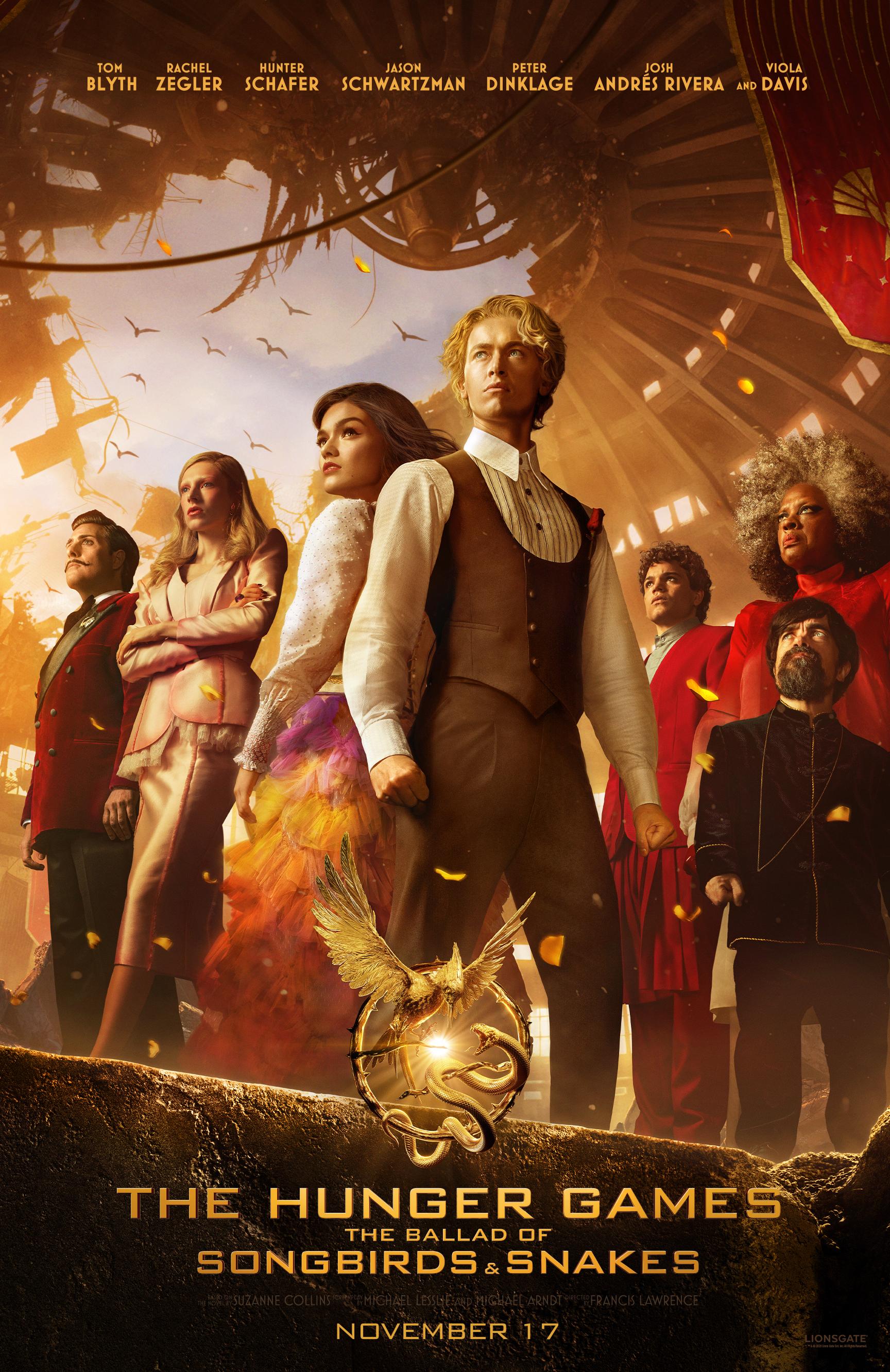
THE HUNGER GAMES: THE BALLAD OF SONGBIRDS & SNAKES movie review

Starts strong, ends off-key. Return to the gritty world of Panem in The Ballad of Songbirds & Snakes. What we have here is too much story crammed into a single movie, which results in poor pacing and forced character and plot development. Despite the uneven screenwriting, there is no doubt that you will be completely enthralled by Rachel Zegler’s (West Side Story) charismatic and courageous Lucy Gray! Moreover, you will also be charmed by her excellent chemistry with Tom Blyth’s (future President) Snow. But the performance that stands out the most is Viola Davis’ campy, delightfully ruthless Dr. Gaul (Game Maker)! In contrast to the struggling third act, the first two acts are well-written, but the third act desperately tries to keep your attention. Ultimately, there is enough material both presented and hinted at, in the film, to support two or even three films. Perhaps audiences were hungry for more Panem, but this movie leaves audiences feeling overstuffed, with little room to breathe and digest the story.

Years before he becomes the tyrannical president of Panem, 18-year-old Coriolanus Snow remains the last hope for his fading lineage. With the 10th annual Hunger Games fast approaching, the young Snow becomes alarmed when he’s assigned to mentor Lucy Gray Baird from District 12. Uniting their instincts for showmanship and political savvy, they race against time to ultimately reveal who’s a songbird and who’s a snake.

Come for the event-like movie, but stay for Davis’ and Zegler’s performances. I don’t know if Zegler’s Lucy Gray felt like she came from District 12 or not, but her command of the character is fantastic! And how could Zegler be cast in the Hunger Games and not take advantage of her beautiful voice? If she ever wants to switch careers or add to her entertainer resume, she can add country singer to it, because her country singing should be opening for the likes of Dolly, Reba, or Shania. I am confident that she could own that country stage for an entire set, and audiences would be ecstatic! Beyond the singing, her Lucy Gray feels human. And by that, I mean both strong and vulnerable, with deep convictions for how she treats others. While many will be drawn to her character’s confidence and independence, I am drawn more to her flaws and vulnerabilities, because it is that with which we struggle that makes us most human.

Viola Davis’ Dr. Gaul steals every scene in which she appears. I cannot think of this role belonging to any other actor after witnessing her bring this sinister character to life. I know nothing of this character from the book, as I have not read it, but it feels like a role that was written for Davis. Even though there is a significant element of camp in her performance and physical appearance, she isn’t always over the top–in fact–there is a great deal of emotive nuance to her character. And that’s in part of what makes her character great–she strikes a perfect balance between camp and playing it straight. As diabolical as President Snow is in the original trilogy, her character is far more terrifying and dangerously sly. She doesn’t simply enjoy the Hunger Games, she is the Hunger Games. Suffice it to say, she slays with this role, and the film benefits greatly from her immense screen presence.

Not to be overlooked, Blyth’s Coriolanus Snow is a complex character, with whom the audience will empathize. Granted, the character isn’t quite as likable as he should have been, to achieve the full effect of the struggle of empathizing with him now with the foreknowledge of whom he becomes, but he does connect with the audience. Blyth’s performance is mildly uneven, but not so much so that it isn’t sufficiently compelling. It’s really in the third act that the performance is hit or miss, but that blame is partly laid upon the poor screenwriting in the last act. When he is on screen with Zegler or Davis, his performances shines best. The chemistry he shows with Zegler is solid, as is his interactions with his closest friend.

Since we are familiar with the games from the original trilogy, this movie is more of a character study and origin story for future President Snow than it is about the history of the games. After the prologue, which takes place one year before the first Hunger Games, the rest of the movie takes place during the tenth anniversary of the games. Ever since Disney’s Maleficent, there has been a trend to give villains origin stories so we can understand why they are how they are. And I am on the fence about this, as I believe that some people are born predisposed to sociopathy or psychopathy; and some system is not to blame, but rather it is a heart and mind struggle within that individual. But I digress. It is established that Snow comes from a once proud, well-to-do Capital family, but in the wake of his General father’s death, the family struggles to keep their house and food on the table. Coriolanus Snow struggles with needing to provide a future for his cousin and grandmother, but not lose his humanity in the process. Unfortunately, we’ve seen the original trilogy, so we know what happens. Lucy Gray and Dr. Gaul may steal steal the scene, but no mistaking it, this story is about the emotional and psychological development of future President Snow.

And I’d be remiss not to mention that it was a treat to see that Peter Dinklage still “drinks and knows things” (for my fellow Game of Thrones fans).

If you’re interested in returning to Panem, definitely catch The Hunger Games: the Ballad of Songbirds & Snakes on the big screen. I saw it in Dolby Cinema at the screening. As I honestly, could take or leave the exhausting YA genre, I do feel there could be another movie or two in this Hunger Games saga. I’d like to see more of Dr. Gaul and future President Snow.

Ryan teaches Film Studies and Screenwriting at the University of Tampa and is a member of the Critics Association of Central Florida and Indie Film Critics of America. If you like this article, check out the others and FOLLOW this blog! Interested in Ryan making a guest appearance on your podcast or contributing to your website? Send him a DM on Twitter. If you’re ever in Tampa or Orlando, feel free to catch a movie with him.
Follow him on Twitter: RLTerry1 and LetterBoxd: RLTerry

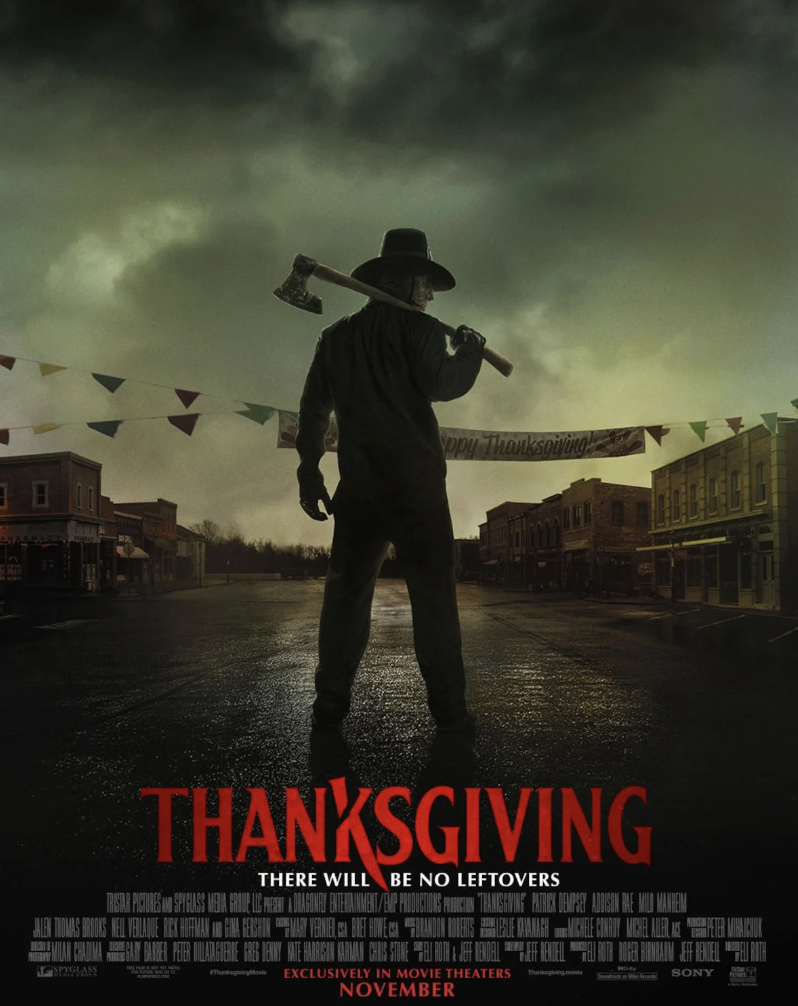
THANKSGIVING (2023) horror movie review

I know what you did last Thanksgiving! Eli Roth’s Thanksgiving is IKWYDLS meets Jaws with a dash of Scream in a scathing critique of toxic, insatiable consumerism that is destined to be an instant holiday horror fave! Complete with great kills and stuffed with laughs, it’s a highly entertaining slasher!

An axe-wielding maniac terrorizes residents of Plymouth, Mass., after a Black Friday riot ends in tragedy. Picking off victims one by one, the seemingly random revenge killings soon become part of a larger, sinister plan.

The slasher has a formula, and Eli Roth is serving it up in heaping helpings that simultaneously check all the boxes for the horror stable yet find ways of seasoning it with style and flare. While some non-slasher fans may get hung up on all the nods to classic slashers, it’s how Roth uses the homages and references that express his original recipe for this future holiday horror classic. Beyond the cleverness of the screenplay, Eli Roth has crafted a horror movie that is entertaining from the first course to dessert. It’s a sheer blast that demonstrates the art of identifying the balance between comedy and horror. Even though it isn’t a horror-comedy per se, it is a horror movie that takes the story seriously but punctuates it with laughter to form a fantastic roller coaster of a ride.

For the most part, Thanksgiving has remained the only major U.S. holiday largely untouched by the horror genre. In fact, I can only think of the absurd Thankskilling (2007) and its even worse sequel (2012). There are endless holiday horror examples for Halloween, but we also have Valentines Day (My Bloody Valentine), St. Patrick’s Day (Leprechaun), Easter (Night of the Lepus), Independence Day (IKWYDLS and Jaws), Christmas (Black Christmas, Silent Night, Deadly Night, Krampus), another exhaustive list), but Thanksgiving has been a rather conspicuous absence from that holiday horror library. Not anymore! This movie has it all, turkey dinner with all the trimmings, including blood and guts, some male-sploitation abs, and an axe-wielding masked killer.

From The House with a Clock in its Walls to Green Inferno, Roth’s horror library is stratified from the whimsy to the horrific. And on that spectrum, I’d place Thanksgiving somewhere around the middle, which is right where it needs to be. It’s neither too dark nor does it play it too safe, and it has a healthy level of intentional camp. Despite being set in our present day, it has the soul of a 90s slasher in the vein of IKWYDLS. The holiday theming works to the movie’s advantage because it provides both opportunities to provide commentary on our society and integrate some subversive whimsical elements as well.

Audiences are queued into the type of horror movie they are about to watch at the very beginning. Simply stated, the first act of Thanksgiving is incredibly effective at setting the tone and thesis for the movie. While he may not be going for scares in the conventional sense, he is going for some–and what I characterize as–more deeply troubling scares. His critique of toxic consumerism (as represented by Black Friday monsters–uhh-I mean, shoppers) is simply scathing, and oh so effective! Even before the killer shows up, there is bloody mayhem at the hands of the people of Plymouth themselves. And it’s not just the physical harm befalling the shoppers, but the emotional and psychological suffering is spotlighted.

We witness a mob outside of a (not Walmart) store that is all clamoring for door buster sale items and behaving inexcusably. Perhaps Roth is exaggerating for illustrative purposes, but it’s honestly not that far removed from how awful, greedy, and thankless shoppers are often times, especially on Black Friday. If everyday people can cause this kind of harm, that liminal space between killer and victim begins to blur. And that is more terrifying than any masked slasher. Eli Roth challenges audiences to ask themselves to what extent will they devolve in order to get 50% off a waffle iron.

The movie additionally spotlights the disruption to family time around the Thanksgiving table by greedy corporations that insist on starting Black Friday sales on Thursday night and the horrendous, deplorable behavior by the consumers that feed these corporations with their insatiable, selfish behavior. Roth isn’t trying to scare people, in the conventional sense, with his holiday horror offering, but rather scare them into behaving like human beings and remembering to be grateful for what we have instead of being greedy and selfish with time and resources. After watching this movie, you may think twice before supporting a store on Thanksgiving Day; moreover, you may find yourself behaving more civilly during the Black Friday sales.

All the kills are over-the-top and creative, typically underscored with dark humor, which removes them from reality. The comedy is very much character-driven, with some slapstick sprinkled throughout. It’s primarily a cozy (throwback-style) slasher with a side of gore, so the gore will be a little more intense than in a classic 80s or 90s slasher, but because of its punctuated nature, it is not nearly as gnarly or grotesque as in say Roth’s Hostile. Suffice it to say, Roth thankfully leans far more into the slasher subgenre than he does the torture porn subgenre.

Thanksgiving is a well-written and directed holiday slasher that delivers a clever story, thoughtful plotting, and fun characters. I can totally see the John Carver mask becoming one that you may very well see on Halloween along with Ghostface, Jason, Michael and the rest.

Ryan teaches Film Studies and Screenwriting at the University of Tampa and is a member of the Critics Association of Central Florida and Indie Film Critics of America. If you like this article, check out the others and FOLLOW this blog! Interested in Ryan making a guest appearance on your podcast or contributing to your website? Send him a DM on Twitter. If you’re ever in Tampa or Orlando, feel free to catch a movie with him.

Follow him on Twitter: RLTerry1 and LetterBoxd: RLTerry

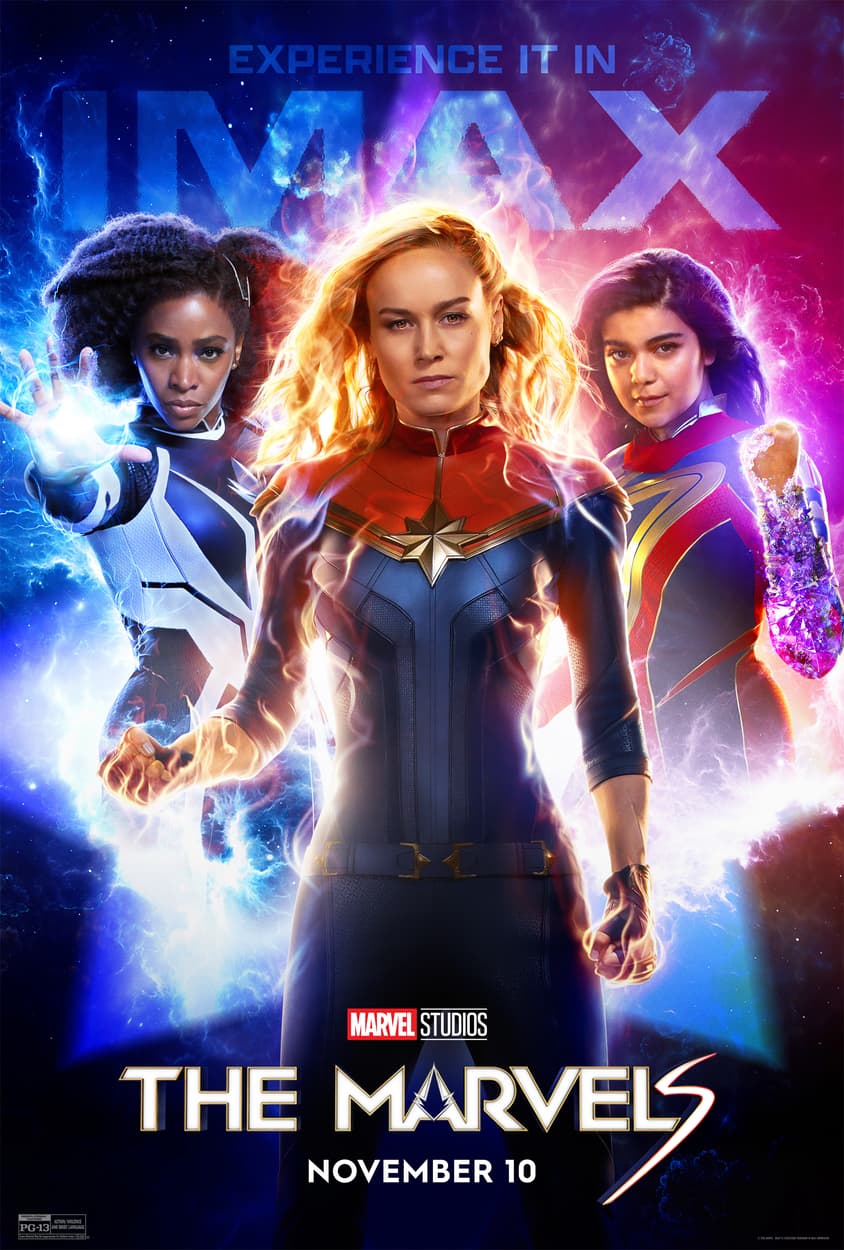
THE MARVELS movie review

by Amanda Firestone, Guest Contributor and Film Professor

I don’t know about you, but I’m burned out on superhero movies. By the time we got to Infinity War (2018) and Endgame (2019), I wasn’t sure I could sit through another CGI-explosion, epic battle fight fest. And I didn’t – until Wakanda Forever hit the screen (2022). While I loved seeing Shuri become Black Panther, that same drained feeling returned after two hours and forty-one minutes in the theater seat. Leaving the cinema, I complained to my spouse that superhero filmmakers squeeze in fight after fight, sacrificing tight storytelling. For what? I’m not sure.

Like Wakanda Forever, the draw for me to see The Marvels is the woman-led cast. When I look at the MCU lineup, I can’t help but notice that men’s stories are prioritized, particularly in Phases One and Two. While women characters are important to the teams or the general narratives, they frequently are outnumbered by their men counterparts. The Marvels unfailingly centers audiences on Carol Danvers, Monica Rambeau, and Kamala Khan. While the ever-present Nick Fury provides support, the three heroes strategize together to defeat their common enemy, Dar-Benn, who is also a woman.

In many ways, the joy of the film is the simplicity. It brings together three characters who initially have some friction. They build trust and confidence in their team, and then they fight the baddie. For my taste, Nia DaCosta understood the assignment; the movie is one hour and forty-five minutes long, and that means the pacing is solid without so many of those masturbatory fight scenes that bog down other Marvel films.

Another way that The Marvels avoids bloat is by bypassing frequent rehashing of MCU information. When I was leaving the theater, the critic behind me complained that he didn’t know what was going on because the film didn’t take the time to explain all of the backstories for the Marvels. He hadn’t seen their respective origin stories. We all know the MCU is sprawling, and very few fans are die-hard completists. The film spent the first 15-20 minutes introducing each character and situating her in her world. It was sufficient to say, “hey, this one’s a loner superhero; this one’s a teenaged superhero with a fangirl crush on the loner; this one’s a scientist superhero who has family drama with the loner.” For people who see The Marvels as their intro to the MCU, they have Captain Marvel, Ms. Marvel, and WandaVision to seek out if they want to add more layers to their knowledge. But, those other sources are not necessary to understand the heart of the movie – build a team and fight the baddie.

Speaking of villains, another success for this movie is Dar-Benn, a Kree Accuser who becomes emperor after the destruction of the Supreme Intelligence. The sun that her planet orbits is dying and as a result, so is the planet. Dar-Benn is a ruler on a mission to save her people – at any cost. While her methods are brutal, there’s a lot of empathy to be had for her, which makes her conflicts with The Marvels more interesting on an emotional level, particularly as we head to the final showdown.

I felt so much joy watching this film. Yes, there was some fanservice in the picture (one of the most dangerous creatures in the universe features prominently), and as a Marvel fan it’s nice to see those call backs. More than that, it was just an all-around great popcorn flick. There was a great balance of levity, seriousness, and intensity. I cared about the characters, and that’s especially true for the newcomers like Dar-Benn. It’s well-worth the cost of the ticket and the time.

Assessment 4.5/5 stars

Dr. Amanda Firestone is an Associate Teaching Professor at the University of Tampa where she teaches film and media studies classes including Women in Film. She is the co-editor of Resist and Persist: Essays on Social Revolution in 21st Century Narratives, Harry Potter and Convergence Culture: Essays on Fandom and the Expanding Potterverse, and The Last Midnight: Essays on Apocalyptic Narratives in Millennial Media

THE KILLER (2023) movie mini-review

The sleeper. David Fincher’s The Killer is lethargic and uninteresting. It’s an uninspired and predictable deconstruction of a hitman that is self-indulgent, lacking any concern for the audience experience.

After a fateful near-miss, an assassin battles his employers, and himself, on an international manhunt he insists isn’t personal.

From the opening credits that are reminiscent of a 1990s movie-of-the-week (MOW) to the exhaustive voiceover narration from beginning to end, this is one movie that you neither want to see in cinemas nor allocate time for at home to watch on Netflix. I am reminded of Fox and FX’s Deliberate Intent (2000), which was a MOW about a first amendment scholar whom is recruited by an attorney to sue Paladin Press after a hit man commits a triple murder by allegedly following a its how-to manual titles Hitman. The deconstruction of the book and hitman contained therein was far more engaging than this sleep-inducing character study by Fincher. Seems hard to believe that a movie about a hitman could lack less dimension and interesting qualities than sheet of cardboard. I kept waiting for the first act to transition into the second, but it’s nearly two hours of a first act and a very rushed third. Anticlimactic best describes the conclusion to this sleep-inducing character study.

Ryan teaches Film Studies and Screenwriting at the University of Tampa and is a member of the Critics Association of Central Florida and Indie Film Critics of America. If you like this article, check out the others and FOLLOW this blog! Interested in Ryan making a guest appearance on your podcast or contributing to your website? Send him a DM on Twitter. If you’re ever in Tampa or Orlando, feel free to catch a movie with him.

Follow him on Twitter: RLTerry1 and LetterBoxd: RLTerry

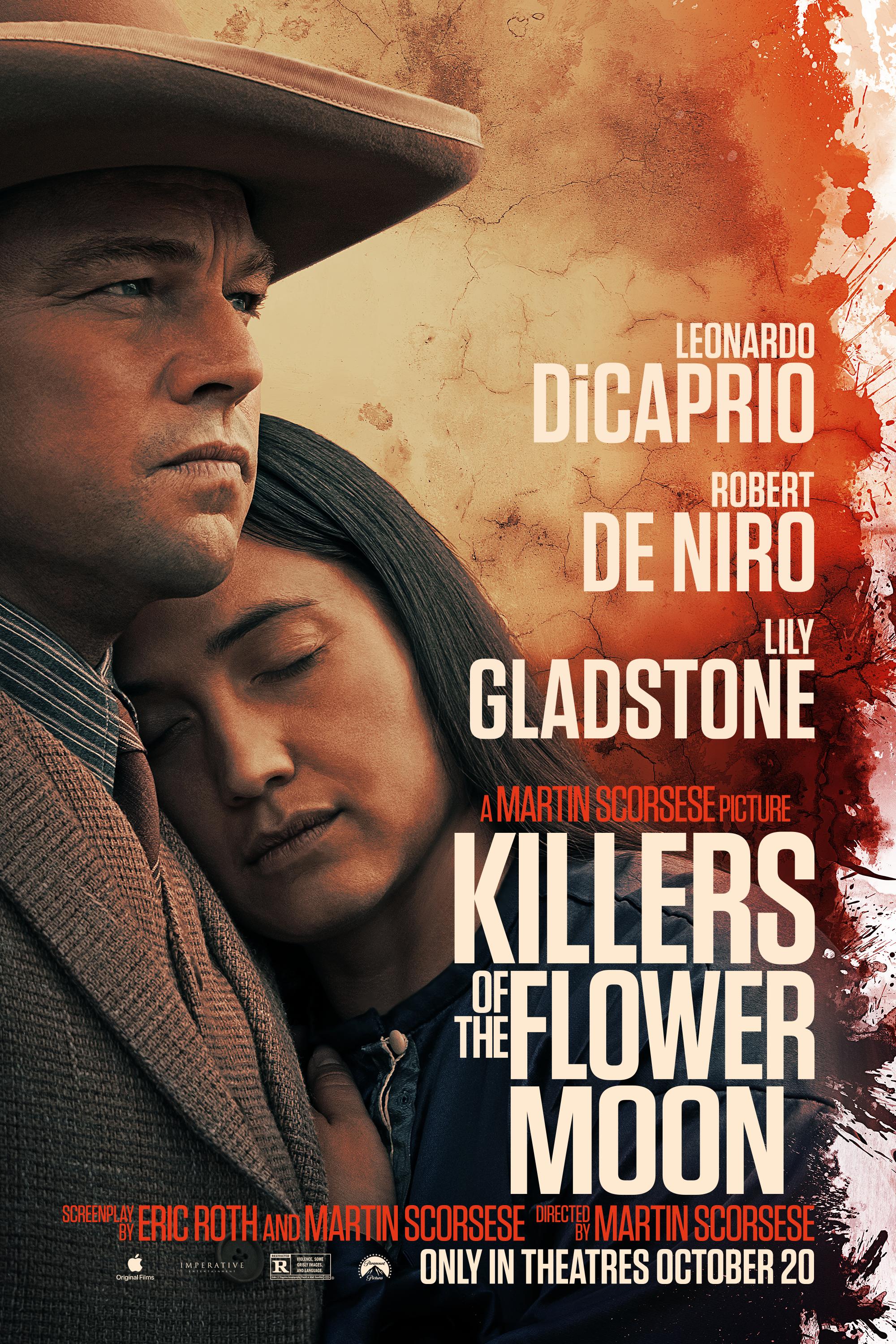
KILLERS OF THE FLOWER MOOON film review

Killers of the tension: an important story in desperate need of a better screenplay and editor. It’s a 3.5hr film that feels every bit of 3.5hrs. I’ve nothing against long run times per se; however, the run time needs to be justified dramatically. But unfortunately, the screenplay mechanics and editing (or lack thereof) hold this otherwise compelling story back from the great potential it demonstrably had. Lacking in any significant tension, this film had me looking at my watch after the first hour and a half. I kept waiting for it to kick into gear, but it never truly managed to amp up the tension. Furthermore, all the individual narrative elements never develop strong connective tissue. Even the performative dimension is good, but there lacks any singular performance that truly stands out. While cinema knows no run time, some stories are best told in 90 or 120mins, and this is definitely one of them.

In the 1920s, members of the Osage Native American tribe of Osage County, Oklahoma, are murdered after oil is found on their land, and the FBI decides to investigate.

One of the most highly anticipated films of the year over-promises and under-delivers. Which is a real shame because it depicts such an important story. While many will fixate on the run time alone, that would be unfair as it’s not the run time that is to blame for the lackluster narrative nature of this film. Rather, it is the screenplay mechanics and lack of precision editing.

As I have written many times previously, most directors are not writers. Are some? Well, sure. But most are not equally gifted in both areas. However, many writer-directors allow their ego to get in the way of excellence in writing because they feel it’s the only way to be a true auteur. Scorsese has nothing to prove to solidify him as an auteur, He is inarguably one of the greatest directors of all time. Scorsese’s Taxi Driver is one of the greatest films of all time and it’s under 120mins (2hrs). However, between The Irishman and now Killers of the Flower Moon, it’s as if he feels compelled to intentionally create films with prodigious run times to separate them from streaming content. Cinema knows no run time. Cinema is an experience, and that experience can be had in 90mins as well as 180mins. Like Nicole Kidman says, cinema is where we come together to experience the same film at the same time on a giant screen. Stories that have both plots and characters that are larger than life or incredibly intimate encounters. But I digress.

When a director is writing the screenplay, or has a significant role in the screenplay, then there lacks adequate checks and balances for screenwriting structure and mechanics. The long and short of it is that the story, ethos and all, may make sense in the director’s mind, but that doesn’t mean that it makes sense for the audience. Whereas when the screenwriter and directors are separate individuals, the screenwriter is able to focus solely on the pages in front of him or her without interference from a director. Killers of the Flower Moon strikes me as the type of story that would’ve benefitted from the director not being involved in the actual process. Because of all the nuance of the story and relationships between characters, perhaps this is a situation in which author David Grann writes the first draft and another more established screenwirter comes in from behind and shapes it into its film form (on page, anyway). We saw this with Jurassic Park, in which Crichton’s original screenplay was too novely and David Koepp was responsible for the final screen version.

Even though the screenplay is partly responsible for the improper pacing and lack of dramatic tension in the film, it shares the blame with the film editing (or dramatic montage). Alfred Hitchcock stated that writers and directors should “start each scene as close to the end of the scene as possible” What this means is that each and every scene should be lean and mean, only leaving room for that which advances either plot or character in a dramatic direction. The editing issue that plagues Killers of the Flower Moon is that scenes were either started too early or weren’t cut off in dramatic time. There is almost too much information in each scene that the lack of meaningful, precise editing acts as an anchor, dragging the film’s pacing. Contrary to popular belief, there is no too fast or too slow when it comes to the cadence of a film; but, there is such a thing as proper pacing. It’s the ideal pacing for the dramatic elements in the story.

Killers of the Flower Moon will make you want to read the book or simply look up information on the murders and investigation thereof. The film looks gorgeous and the performative dimension is solid, but as a total package, the film is underwhelming.

Ryan teaches Film Studies and Screenwriting at the University of Tampa and is a member of the Critics Association of Central Florida and Indie Film Critics of America. If you like this article, check out the others and FOLLOW this blog! Interested in Ryan making a guest appearance on your podcast or contributing to your website? Send him a DM on Twitter. If you’re ever in Tampa or Orlando, feel free to catch a movie with him.
Follow him on Twitter: RLTerry1 and LetterBoxd: RLTerry