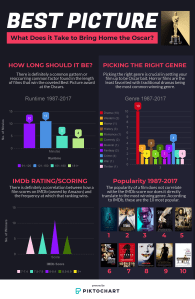
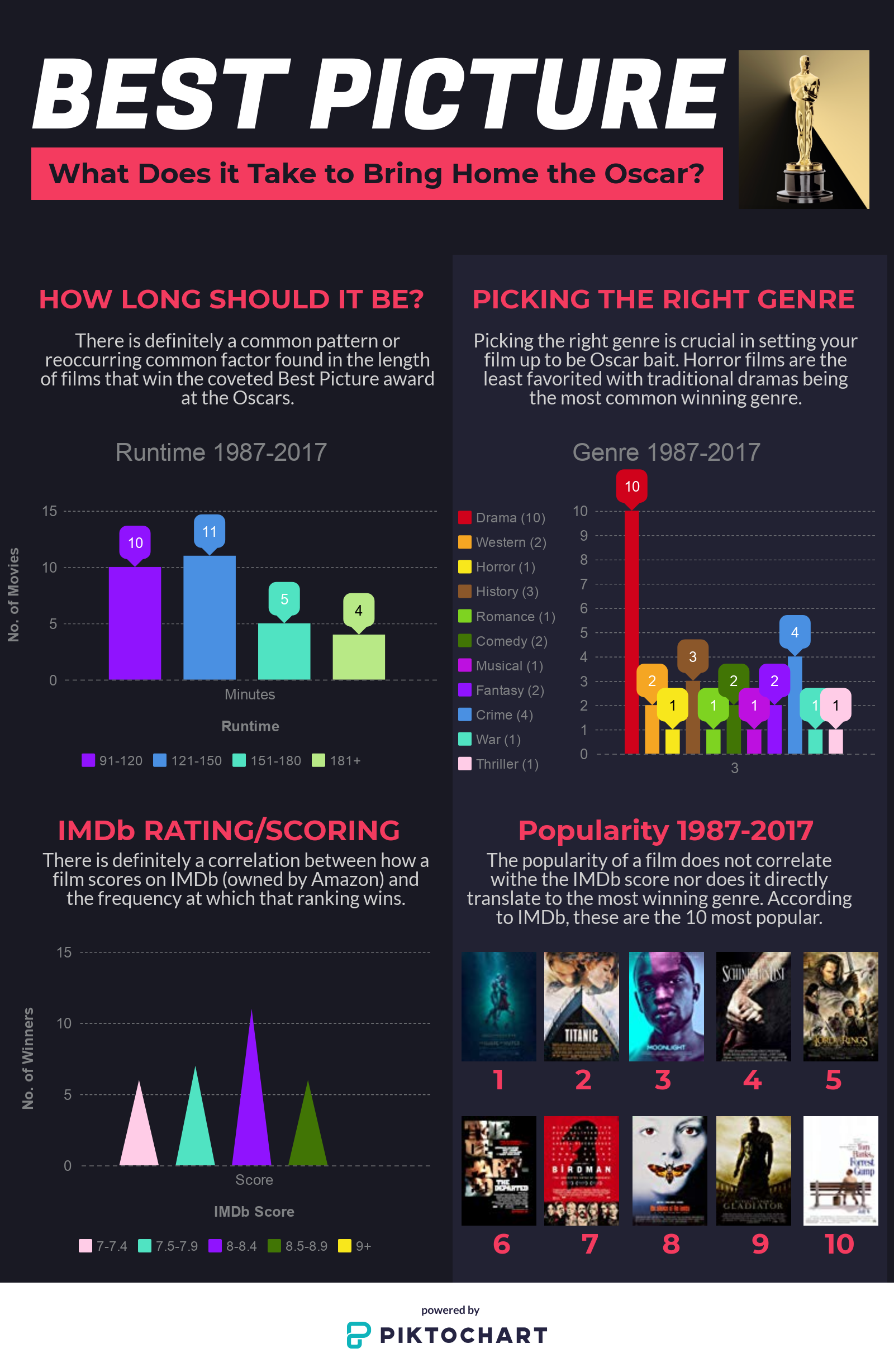
 With the Academy Awards quickly approaching and the nominations announcement early tomorrow morning, I thought that it would be interesting to dive deep into what it takes to build a film that gets nominated and wins the most coveted film award in the United States, the Oscar for Best Picture. In order to explore this topic as objectively as possible, criteria from 1987-2017 has been analyzed and broken down into a chart. Although there are many artistic and technical merits that make a film, this article selected runtime, genre, IMDb score, and popularity. According to the empirical date, it is possible to produce a film that theoretically should get nominated and even win, but there are incalculable uncontrollable variables that range from makeup of the Academy, to number of films submitted, to release times, to the socio-political climate at the time, so it is NOT an exact science. However, looking at the data does paint a portrait of what are some correlations between winning and the various elements that make a motion picture. Depicting the criteria in the form of a chart is certainly helpful and measurable, but combining a qualitative analysis to the quantitative approach will aid in developing a comprehensive exploration of what it takes to bring home the gold.
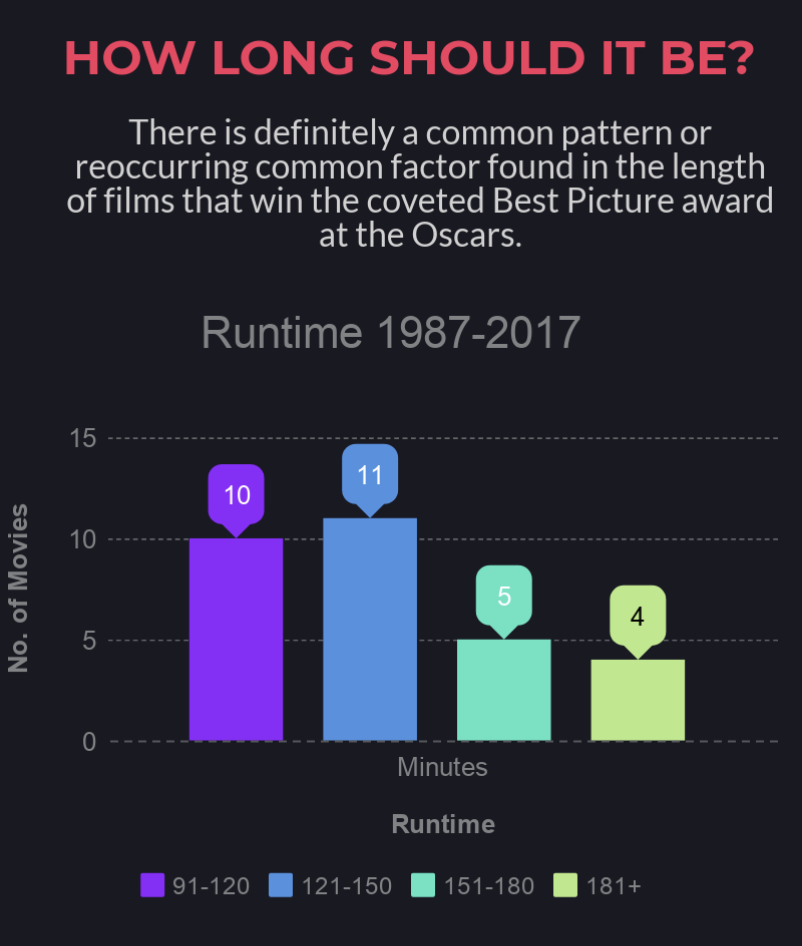
 Films range from shorts to 3+ hour epics, and there is a correlation between runtime and winning the Best Picture Oscar. The sample of winners for this data is gathered from the Best Picture winners 1987-2017 (up to 2018 Oscars) totaling 31 films. According to the sample, 21/30 films ranged from 91 to 120 minutes with 11 of them ranging from 121 to 150 minutes. The shortest and longest films to win the Best Picture award are Driving Miss Daisy at 99mins and The Lord of the Rings: Return of the King at 201mins. There were zero films to win the Best Picture award released between 1987-2017 and the number after 150mins drop off significantly. The shortest film to ever win a Best Picture award is Marty at 90mins and the longest is Gone with the Wind at 238mins. Looking to the most recent winners of this most prestigious award, there is a measurable trend toward shorter feature length films. Looking to films such as Moonlight and Lady Bird, there is clearly an intentional effort to not exceed 2hrs but get close to it. Why is this? While you may think it may have to do with film budgets, that’s incidental. Yes, money and budgets are part of the equation, but it’s because movie theatre chains want to fit as many movies as possible into a daily schedule. Two hours is a solid time not to cross because a movie theatre can play the film every three hours in a single auditorium (and stagger it with multiple auditoriums). So if you are attempting to draft your Best Picture nominees or winners, look to the runtime for one of the correlating criteria for winning this award.
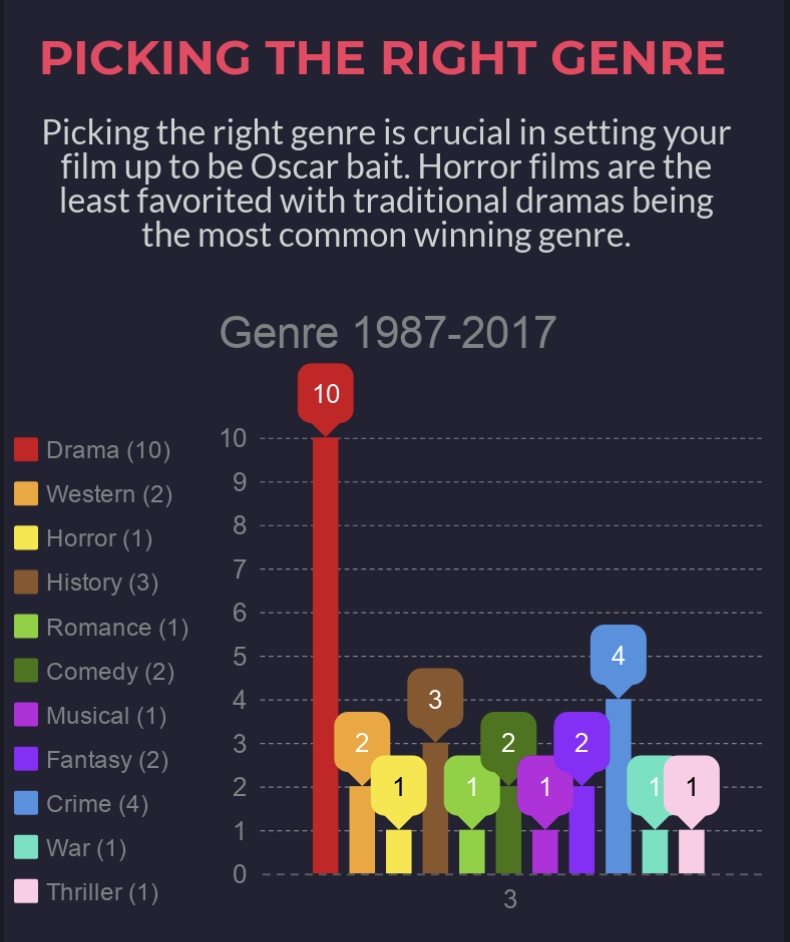
 Genre films are certainly the favorite of the Academy. Rarely do we witness a film playing around or experimenting with genre get nominated much less win. Personally, I like it when a film plays around with genre in an innovative attempt to tell a new story or provide a new perspective on a previous one; however, the Academy likes their straight forward dramas most. Yes, drama is in every story; but this label specifically refers to the cut-and-dry serious narratives that lack a significant level of comedy, horror, romance, etc. From 1987-2017, ten drama films won Best Picture. The next highest winner is a significant drop at 4 with the crime genre. While drama wins the most, horror, thriller, war, musicals, and romance win the least. While many dramas certainly contain elements of the aforementioned, these genres refer to the films that are genre purest than crossovers. There are certainly high profile, memorable exceptions to this rule. And the biggest surprise on this list is the Best Picture win of The Silence of the Lambs. Not only did it win the Best Picture award, but it also won Best Director, Best Actor in a Leading Role, Best Actress in a Leading Role, Best Director, and Best Adapted Screenplay. No other film in the last 30 years has won the Big 5 Oscars. The win of The Silence of the Lambs is also the single win for the horror genre. Over the last few years, we have seen an increase in the general popularity and critical acclaim of horror films (Get Out is a great example) but the winningest genre still remains to be drama. Another exception to the rule is Chicago’s win! Perhaps big musicals once dominated the box office but not as much anymore. Last year’s La La Land came close to winning (that is an article in and of itself) but it came in second to a hard drama. Although there are other genres represented on this graph, that covers 1987-2017 released films, it is clear that you stand you best chances of winning by writing a straight-forward drama.
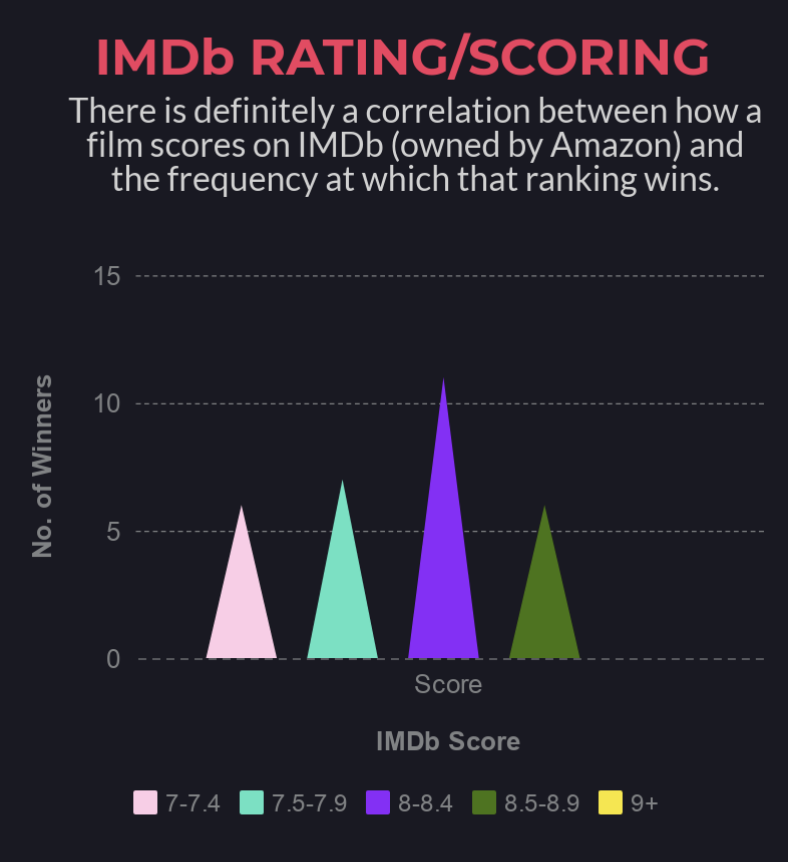
 While genre can be debated on many films, IMDb scores are hard quantifiable evidence that is not subject to interpretation. Personally, I am a qualitative researcher but even in an analysis such as this, having the hard numbers is an important part. While you think it would be the films that score high 8s and 9s that would win the most, the evidence from 1987-2017 states that it’s the low 8s and high 7s that win the most often. Unlike genre and runtime, there is no way to predict your IMDb score; therefore, this evidence is most handy when trying to pick the nominees and winner. It’s like looking as a sports team’s stats going into the playoffs of the final big game of the season. Perhaps it’s not an ingredient in the same way genre and runtime are; but you can extrapolate from the aforementioned data what plots to consider when building your story and how long your movie should be. If you are one of those who are selecting which films are going to get nominated or which nominee will win, then you definitely need to look to the IMDb score for guidance.
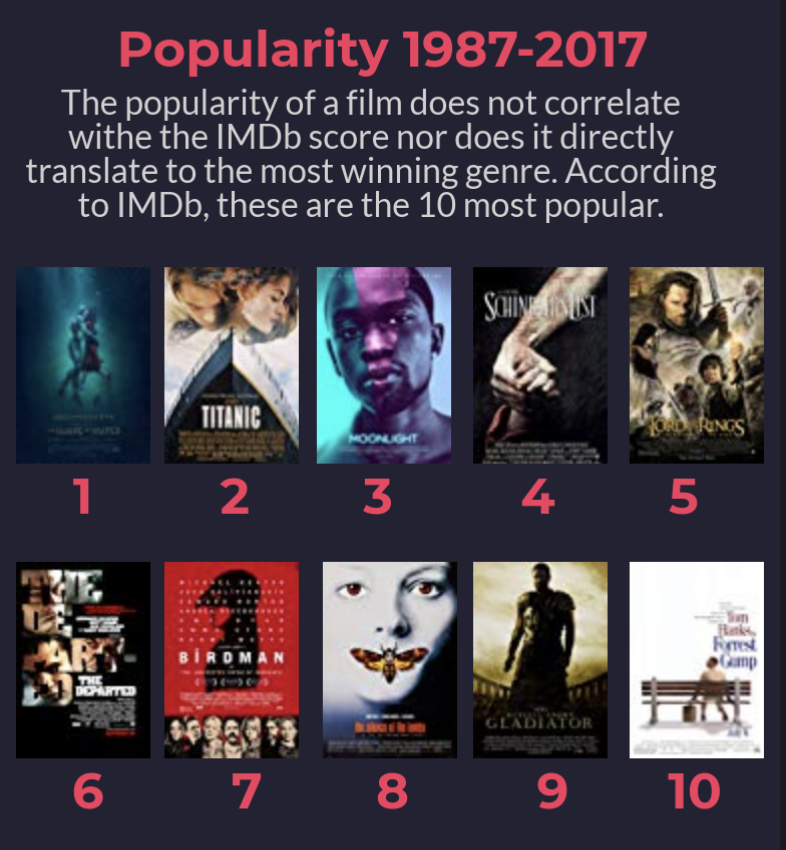
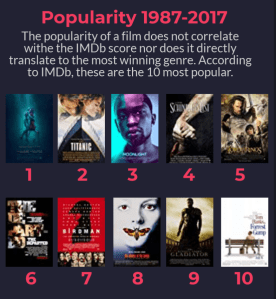 Lastly, let’s take a look at the ten most popular motion pictures to win the Best Picture award over the last 30 years. The graph referenced in this paragraph depicts the ten most popular films from 1987-2017 to win the Best Picture award. IMDb takes multiple values into account when developing this list from IMDb score, Metacritic, audience score, etc. So, this is the most subjective criteria on this list; however, since the popularity is based upon quantifiable data, it can be used as a reliable source of information. The most popular movie on this list is 2017’s The Shape of Water, directed by Guillermo del Toro, which IS an example of a film playing around with genre that won! It combines elements of science-fiction, drama, and romance. Taking the number 10 spot on this list is the Tom Hanks classic Forrest Gump. Interestingly, each of these winners is quite different from the rest. The only two to really share any similarities in plot are Silence of the Lambs and The Departed. Both of these films contain crime elements, with one skewing more towards thriller and the other more towards horror. Whereas these films differ in terms of plot, what they DO share in common is a strong lead cast. The top IMDb scorers on this list are Return of the King (8.9), Schindler’s List (8.9), Forrest Gump (8.8), Silence of the Lambs (8.6), and The Departed (8.5). All are 8.5 or higher. Beyond the IMDb score, runtime, and genre, what makes these films so popular is a compelling story comprised of a simple plot and complex characters. A superlative story begins with a screenplay, and the films on this list to also win Best Original or Best Adapted screenplay are Birdman, Moonlight, The Departed, The Return of the King, Forrest Gump, Schindler’s List, and Silence of the Lambs. With 7/10 of these Best Picture winners also winning the best screenplay award, it is imperative that the film begin with strong writing.
For aspiring writers and directors, look at this data and take it into account if it is your intention to write or direct the next Best Picture nominee or winner. Following this data does in no way guarantee that you have an award winning film, but it does help to highlight some important and controllable elements to consider when crafting your story. With the new additions to the academy this year to include more women and other underrepresented groups amongst the Academy’s makeup, we may see a new pattern to observe over the next 5-10 years. There have been many changes to the landscape of motion pictures in the last few years with Netflix and Amazon throwing their respective hats in the ring, and with increased at-home viewing as opposed to watching first-run films in the cinema. It’s an exciting time to analyze the films that have a shot at winning the golden man, especially as the socio-political climate is becoming increasingly influential on the nominees and winners. What this data shows us is what we can observe over the last 30 years and apply that to the nominee predictions that are going on now and the eventual predictions for the winner in this category.
For more on the awards talk, you definitely want to follow #FilmTwitter on Twitter and the podcasts of Mike, Mike, and Oscar, Next Best Picture, and InSession Film. These are just a few of the great folks I follow, but ones that specialize in awards talk.
Ryan is a screenwriting professor at the University of Tampa. If you like this article, check out the others and FOLLOW this blog!
Follow him!
Twitter: RLTerry1
Instagram: RL_Terry
Thrillz (theme parks): Thrillz.co


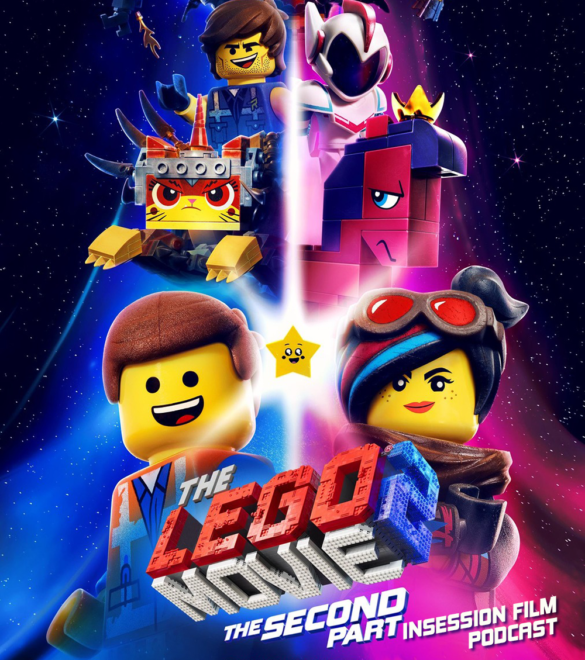 Return to Bricksburg where everything is no longer awesome. Picking up where the first LEGO Movie left us, and jump right back into the action as the invaders from planet Duplo threaten the very existence of Bricksburg and its inhabitants. After the Duplo invasion reduces Bricksburg to a city that is barely recognizable. Now living in a dystopian society, a mysterious figure arrives and promptly kidnaps several of Emmet’s (Chris Pratt) friends, including Lucy/Wyldestyle (Elizabeth Banks). Emmet sets off on his rescue mission to save his friends, but along the way meets allies and enemies who test him at every turn. I enjoyed LEGO Movie 2 nearly as much as the first one! Unfortunately, hosts JD and Brendan do not quite share my sentiment; however, they provide some great talking points! But the only way for you to find out what we think of this movie is to listen to the episode.




 R.L. Terry ReelView