A knockout!!
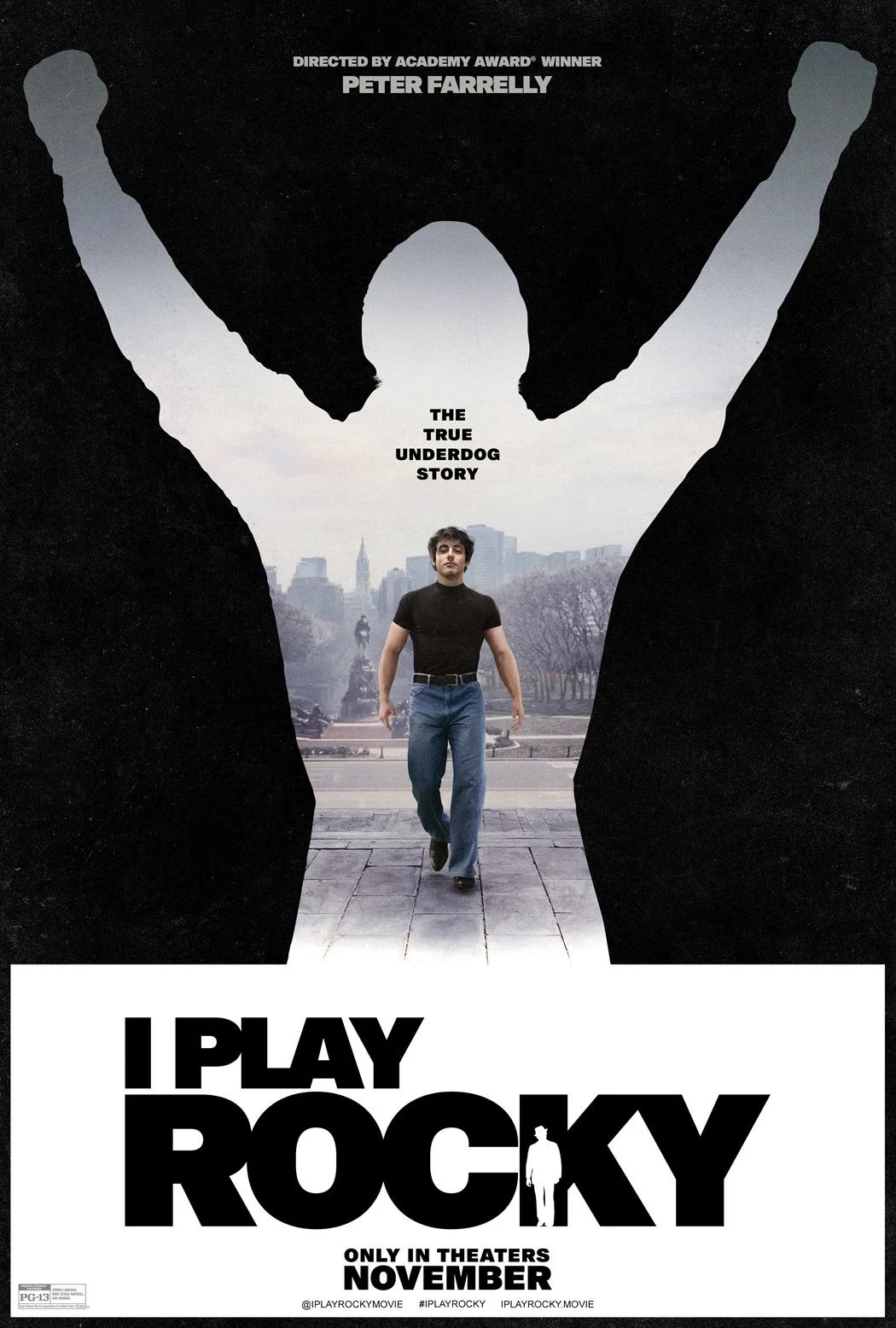
I Play Rocky is every bit as inspirational as the timeless motion picture behind it. This biopic goes the distance to deliver cinematic gold that should resonate with anyone who has ever possessed a drive and a dream. Like Rocky, this is not really a story about boxing. Nor is it merely the story of a future movie star rising from poverty and rejection to the Academy Awards stage. It is about going the distance.He becomes him. Director Peter Farrelly and screenwriter Peter Gamble understand that the making of Rocky mirrored the film Stallone was struggling to create. The fictional Rocky Balboa wanted one opportunity to prove that he belonged in the ring. Stallone wanted one opportunity to prove that he belonged onscreen. Both men were told no. Both absorbed the punches. And both kept moving forward. That parallel gives the biopic its humanity. The story feels intimate rather than manufactured, and its emotional power cannot be overstated.
For the full ReelTalk conversation with my returning guest and friend of the show film critic Sean Boelman, you can listen on one of the following links
Apple
Spotify
Podbean
Anthony Ippolito does not merely play Sylvester Stallone. Ippolito looks, sounds, speaks, and moves so convincingly like Stallone that you may believe you are watching the future star himself at age twenty-six. No computer-generated transformation was used. What appears onscreen is the result of an extraordinary level of preparation, physical commitment, and performance.
It is nearly peerless.
The closest comparison that came to mind was Faye Dunaway transforming into Joan Crawford in Mommie Dearest. The films are tonally very different, but each performer convinces us that we are witnessing a famous actor during a particular period of life—not merely an impersonation.
The entire cast is firing on all cylinders. AnnaSophia Robb is especially compelling as Stallone’s wife, Sasha. She is strong and vulnerable, supportive without becoming passive, and unafraid to challenge Sylvester when his determination begins to consume everything around him.
The tone and pacing are brilliantly handled. My only reservation about giving the film a full five stars is the feeling that it needed perhaps ten additional minutes—the elusive dramatic element separating a very good picture from an exceptional one. Who knows what remains on the cutting-room floor? Even so, I Play Rocky is a fantastic biopic. In the cynical world we seem to inhabit, there is something deeply refreshing about a movie that encourages us not to collapse under pressure, but to rise, absorb the blows, and continue pursuing the goal in front of us.
Perhaps the most fascinating thing about I Play Rocky is how many unintended ironies accumulate around a movie devoted to the triumph of the independent artist over institutional thinking. The most obvious exists outside the frame.
This is an Amazon MGM Studios movie celebrating Sylvester Stallone’s refusal to surrender Rocky to a Hollywood system that knew what kind of movie it wanted but could not recognize the value of the man who had written it. Amazon, of course, acquired MGM in 2022, placing one of Hollywood’s most historic studios—and the Rocky franchise itself—inside one of the largest corporations in the world.
That makes the movie’s occasional swipes at old Hollywood consolidation and institutional arrogance rather amusing in retrospect.
The irony became even more pronounced by the time I Play Rocky reached theaters. Paramount Skydance completed its acquisition of Warner Bros. Discovery in October 2026, combining two of Hollywood’s major studios under one corporate roof. The deal was not complete when I Play Rocky was conceived or when Amazon MGM became involved with the project, so it would be unfair to pretend Peter Farrelly and screenwriter Peter Gamble were consciously commenting upon that transaction.
Nevertheless, watching an Amazon MGM movie criticize the enormous institutions standing between artists and their work at precisely the moment Hollywood is consolidating into still larger corporate entities produces an almost unavoidable contemporary resonance.
The movie is considerably less subtle when it turns its attention toward organized labor.
Farrelly presents the union difficulties surrounding Rocky as one more obstacle that Stallone, John G. Avildsen, and the production have to outmaneuver. In one of the movie’s broadest comic sequences, non-union workers hide to avoid detection while the filmmakers attempt to stretch an already threadbare budget. The audience is clearly invited to enjoy the rebellion. And, it fits nicely into the movie’s larger worldview.
Again and again, I Play Rocky presents institutions as people telling Stallone what cannot be done. The studio tells him he cannot star. Executives tell him what a movie star should look and sound like. Budgets dictate what the production supposedly cannot accomplish. And organized labor becomes another collection of rules standing between the artist and the work. That creates an interesting philosophical tension.
Here is an interesting television parallel.
For decades, Nickelodeon demonstrated how dramatically production economics could change outside the traditional Hollywood labor structure. When Nickelodeon established its production operation at Universal Studios Florida around 1990, Florida’s right-to-work environment and comparatively inexpensive production infrastructure were genuine attractions. Nickelodeon subsequently produced an extraordinary volume of programming in Orlando.
Nickelodeon’s animation operation was also non-union during much of its formative period. In 1998, while Disney and DreamWorks animation were unionized, the Los Angeles Times reported that Nickelodeon remained a non-union shop, even as organizing efforts were underway.
It would be too simplistic to argue that Nickelodeon succeeded because it was non-union. Its success involved programming philosophy, branding, risk-taking, inexpensive production models, demographics, talent and a willingness to invest in original children’s television. But lower production costs undeniably helped create an environment in which the network could experiment prolifically. Had every Nickelodeon production been required to operate under the same labor economics as traditional Hollywood production, the network’s extraordinary volume of inexpensive original programming might have looked very different.
Upon reflecting on the film’s rather overt commentary on organized labor unions, a question manifests–when do institutional protections preserve an industry—and when can institutional rigidity make experimentation prohibitively expensive?
This movie has already chosen its answer, and its hero is the guy who ignores the rulebook.
But the heroes of Rocky aren’t only on the screen, calling the shots, or writing the screenplay. In fact, one of the (until now, to the best of my knowledge) unsung heroes of Rocky figures into one most delightful discoveries in I Play Rocky–Garrett Brown.
Brown invented the Steadicam, the body-mounted stabilization system that fundamentally changed how a camera could move through physical space. Its connection to Rocky is legendary. Brown followed Stallone through Philadelphia, moved through the meat locker, worked inside the boxing ring and, most famously, followed Rocky Balboa up the steps of the Philadelphia Museum of Art.
But the technological lineage begins somewhere wonderfully unexpected: Sesame Street.
Before Steadicam, Brown ran a small filmmaking company that produced commercials and live-action shorts for the young children’s program. Brown later explained that his frustration with the equipment available to him helped inspire the invention. Camera dollies were enormously cumbersome; handheld photography offered mobility but introduced unwanted shake. Brown wanted the freedom of handheld cinematography with the visual stability of a dolly.
So the man who would eventually help create one of the most iconic images in American cinema was, in part, wrestling with the problem while making films for Sesame Street. The National Inventors Hall of Fame explicitly traces Brown’s dissatisfaction with bulky dollies and unstable handheld work during those early productions to the experimentation that eventually produced Steadicam.
Perhaps that is the real secret hiding throughout I Play Rocky: great movies are rarely produced because every condition is perfect. Sometimes the limitations are precisely what force somebody to invent the thing that was missing.
I Play Rocky reminds us that success is not always about winning. Sometimes it is about remaining on your feet when the final bell rings. And this movie goes that distance.

Ryan is the morning host on WLRH Public Radio in Huntsville, AL and host of the show ReelTalk “where you can enjoy the cinematic conversations frame by frame each week.” He also teaches film studies at the University of Alabama in Huntsville. Additionally, he is the author of the upcoming film studies book titled Monsters, Madness, and Mayhem: Why People Love Horror. Prior to public broadcasting, he taught film studies for over eight years at the University of Tampa. He is a member of the Critics Association of Central Florida and Indie Film Critics of America. If you like this article, check out the others and FOLLOW this blog! Follow him on Twitter: RLTerry1 and LetterBoxd: RLTerry

