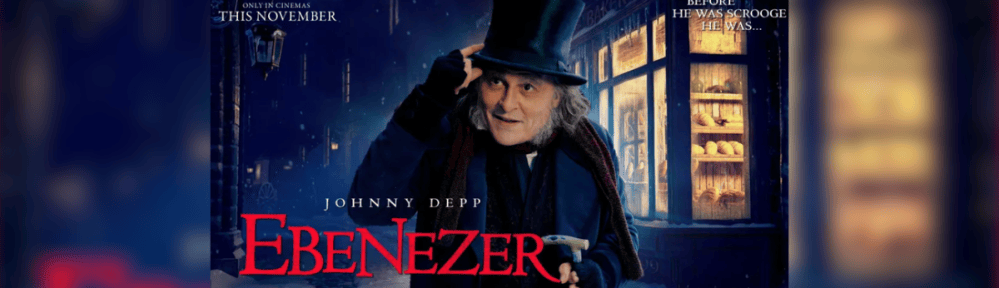
A Ghost Story That Forgets Why the Ghosts Came
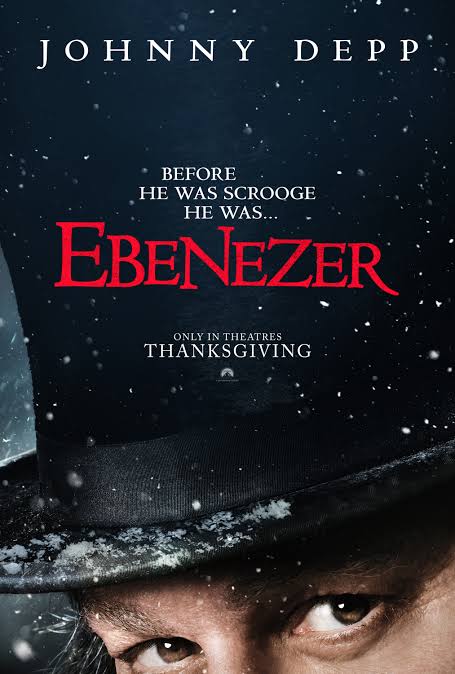
Charles Dickens did not call A Christmas Carol merely a Christmas story. Its full subtitle identifies it as A Ghost Story of Christmas, a distinction that generations of adaptations have occasionally seemed reluctant to embrace. Ebenezer has no such hesitation. Director Ti West plunges headlong into the macabre possibilities of Dickens’s tale. Graveyards feel cold and damp. Spirits emerge as genuinely threatening supernatural presences. Death hangs over the story rather than politely waiting for the Ghost of Christmas Yet to Come to arrive. This is a Christmas Carol that wants audiences to remember that Ebenezer Scrooge spends Christmas Eve being haunted.
That decision is among the movie’s greatest strengths. It also makes its shortcomings considerably more frustrating. There is certainly nothing sacred about reproducing the book scene for scene. Adaptation demands interpretation, and A Christmas Carol has endured partly because filmmakers, actors, animators, and playwrights have found so many different ways into it.
But Dickens presents an unusual problem for anyone determined to reinvent him: He already drew the map.
To listen to the conversation I had with Brad Biewer of the CinemaSpeak Podcast…
Apple https://podcasts.apple.com/us/podcast/wkgc-public-media/id1811432995?i=1000802302906
Spotify https://open.spotify.com/episode/3dw36bH6oQX0l5GL0BIaBD?si=39810bbe9f29443e
Podbean https://www.podbean.com/eas/pb-fu8mc-1bb23d3
A Christmas Carol is one of the most exquisitely constructed character transformations in literature. Nearly everything Scrooge encounters during his supernatural journey exists for a particular dramatic purpose. The warmth illuminates his coldness. Generosity exposes his miserliness. Family reveals his isolation. Laughter confronts his joylessness. Mortality forces him to consider what his life has actually amounted to. Ebenezer understands the darkness exceptionally well. But, it too often misunderstands the light.
Visually, the film is frequently magnificent. There is a tactile quality to the production that feels increasingly rare in contemporary studio filmmaking. Physical sets, richly detailed costumes, atmospheric soundstage photography, and an almost film-like visual texture give Ebenezer the appearance of something transported from an earlier era of Hollywood.
Even the title cards dividing the story into Dickens’s individual “Staves” are a wonderful touch. They do more than provide stylistic ornamentation. They acknowledge the literary architecture of the source itself. Dickens did not divide A Christmas Carol conventionally into chapters; he structured it musically, with five staves composing one complete carol. Ironically, Ebenezer often exhibits greater reverence for Dickens’s structural vocabulary visually than it does dramatically. West’s horror instincts are nevertheless exceptionally well suited to portions of the material.
Jacob Marley ought to be frightening. The apparition of a dead business partner dragging the physical manifestation of a wasted life through Scrooge’s bedroom should not feel cozy simply because the story takes place at Christmas. Likewise, the Ghost of Christmas Yet to Come belongs naturally to horror. The final visitation confronts Scrooge with anonymity, death, a neglected grave, and the appalling realization that the world may actually become happier in his absence.
When Ebenezer leans into those elements, it finds something that many adaptations soften. Fear is essential to the story. But fear is not the story. The terror matters because Scrooge is being frightened back toward life.
This is where Ebenezer begins undermining itself. Dickens constructs Scrooge as the great cynic standing against a world that repeatedly demonstrates the possibility of behaving otherwise. Fred offers love despite being rejected. Bob Cratchit retains kindness despite being exploited. Fezziwig demonstrates that a businessman can possess both prosperity and humanity. The gentlemen soliciting donations for the poor expose Scrooge’s indifference by asking him to consider people beyond himself. The Cratchits possess little materially but demonstrate abundance emotionally.
That contrast is essential.
Ebenezer, however, seems so determined to discover hidden ugliness within Dickens’s world that much of the surrounding society becomes nearly as cynical as Scrooge himself. The charitable gentlemen are transformed into corrupt opportunists. Scrooge’s family history becomes substantially darker. Betrayals, conspiracies, and moral compromises accumulate around him.
Individual changes can be defended dramatically. Taken together, however, they create a fundamental problem: If nearly everyone inhabiting Scrooge’s world is venal, cruel, manipulative, or cynical, what exactly distinguishes Scrooge? And, perhaps more importantly, what is he being asked to become? Scrooge should be the exception the story must redeem—not simply the logical product of an equally miserable world.
Darkness requires contrast. Without it, darkness eventually becomes merely the lighting scheme. The movie’s reinterpretation of the spirits presents a similar problem. The Ghost of Christmas Yet to Come fares best because terror is already central to its dramatic function.
Christmas Past and Christmas Present are more complicated. The Ghost of Christmas Past is not merely there to frighten Scrooge with disturbing imagery. The spirit must excavate memory. Scrooge needs to rediscover loneliness, tenderness, lost love, youthful possibility, and the series of choices that gradually constructed the man sitting alone in his counting house.
The ghost should illuminate. Here, grotesquerie can overwhelm illumination.
The Ghost of Christmas Present presents an even greater challenge. Dickens deliberately conceives this spirit as enormous, abundant, welcoming, generous, and alive. He arrives amid food, warmth, color, laughter, and plenty because he represents everything Scrooge has refused to participate in. That warmth is not incidental characterization—it is the argument. When Ebenezer makes Christmas Present nearly as threatening as some of the other supernatural visitors, the movie gains another memorable horror image while sacrificing dramatic contrast.
I posit you this question: at what point does an imaginative reinterpretation become dramatically counterproductive? A new idea is not automatically a better idea simply because audiences have not seen it before. That distinction matters enormously when adapting material this refined.
The movie also devotes considerable energy to newly invented material while abbreviating or omitting some of the emotional payoffs Dickens already provided—the prize turkey is a perfect example. Scrooge awakening on Christmas morning and purchasing the enormous turkey for the Cratchit family is easy to dismiss as one of the story’s familiar sentimental flourishes.
It is much more important than that. For most of the story, Scrooge’s relationship with money is defined by withholding. Then he gives. More importantly, he initially gives anonymously.
That action dramatizes transformation far more powerfully than a speech explaining that Scrooge has changed. Redemption must eventually become behavior. This is one of Dickens’s great accomplishments. Scrooge does not merely feel differently on Christmas morning. He begins acting differently.
He gives.
He laughs.
He reconnects.
He participates.
He becomes present in the lives of other people.
When an adaptation removes those familiar actions to make room for new complications, it risks sacrificing precisely the dramatic payoff toward which the entire supernatural journey has been building.
Of course, Ebenezer also arrives carrying another kind of baggage: Johnny Depp’s return to a major studio production after an extended absence. Fortunately, Depp is considerably more restrained than I feared. There are recognizable mannerisms—the little eccentricities of movement and vocal delivery that have characterized much of his later work—but Scrooge never simply becomes Jack Sparrow relocated to Victorian London. Depp finds enough severity, weariness, bitterness, and vulnerability to make the performance his own.
Whether he joins the pantheon of great cinematic Scrooges is another question.
For me, Patrick Stewart remains unsurpassed. Stewart’s 1999 performance understood that Scrooge cannot simply be a spectacular old grouch until the screenplay flips a switch and turns him cheerful. He found the wounded human being underneath the miser long before Christmas morning, making the eventual release of joy feel almost overwhelming.
That remains my benchmark.
Still, Depp acquits himself far better than the movie around him sometimes does. And West slips in one particularly delightful piece of horror history: a visual reference to Depp’s unforgettable death in A Nightmare on Elm Street. It is precisely the kind of addition that works because it adds texture without altering the dramatic machinery of Dickens.
Not every change needs to justify a thesis. Sometimes a filmmaker can simply wink.
Perhaps the largest problem with Ebenezer is not any particular alteration. It is accumulation. There is so much cynicism, morbidity, corruption, and menace that the movie leaves surprisingly little room for joy. That creates an unusual problem for A Christmas Carol. If everything is miserable, why should Scrooge want to rejoin the world?
Fred’s laughter matters.
Fezziwig’s party matters.
The Cratchits gathered around a modest meal matter.
Music matters.
Food matters.
Dancing matters.
Community matters.
The entire architecture of the story depends upon Scrooge gradually discovering that the world contains pleasures, relationships, and obligations he has deliberately refused. A Christmas Carol is not simply the story of a frightened man avoiding damnation. It is the story of a deadened man rediscovering life. That is why Dickens permits the narrative to become almost deliriously joyful after spending so much of it contemplating poverty, loneliness, regret, and death.
The joy is not tonal compromise. It is resolution.
There is much in Ebenezer that I admire. It looks magnificent. The production design deserves serious consideration. Its old-school visual aesthetic gives the picture personality. West restores a welcome supernatural menace to material that can become overly sanitized in gentler adaptations. Depp delivers a credible Scrooge. And several of the movie’s creative departures genuinely find interesting ways of approaching familiar material.
But too many others seem motivated by the need to differentiate this Christmas Carol from all the Christmas Carols that came before it. That is not enough. The problem is not that Ebenezer changes Dickens. The problem is that too often it changes the very things Dickens had already solved. The novella has survived for more than 180 years because its machinery remains extraordinarily precise. Fear and warmth. Poverty and abundance. Isolation and fellowship. Death and life. The supernatural and the profoundly human. Scrooge needs all of them.
Ebenezer remembers that A Christmas Carol is a ghost story. But, it simply spends so much time searching for additional darkness that it overlooks the light Dickens placed plainly on the page.
And ultimately, that light is why the ghosts came.

Ryan is the morning host on WLRH Public Radio in Huntsville, AL and host of the show ReelTalk “where you can enjoy the cinematic conversations frame by frame each week.” He also teaches film studies at the University of Alabama in Huntsville. Additionally, he is the author of the upcoming film studies book titled Monsters, Madness, and Mayhem: Why People Love Horror. Prior to public broadcasting, he taught film studies for over eight years at the University of Tampa. He is a member of the Critics Association of Central Florida and Indie Film Critics of America. If you like this article, check out the others and FOLLOW this blog! Follow him on Twitter: RLTerry1 and LetterBoxd: RLTerry

