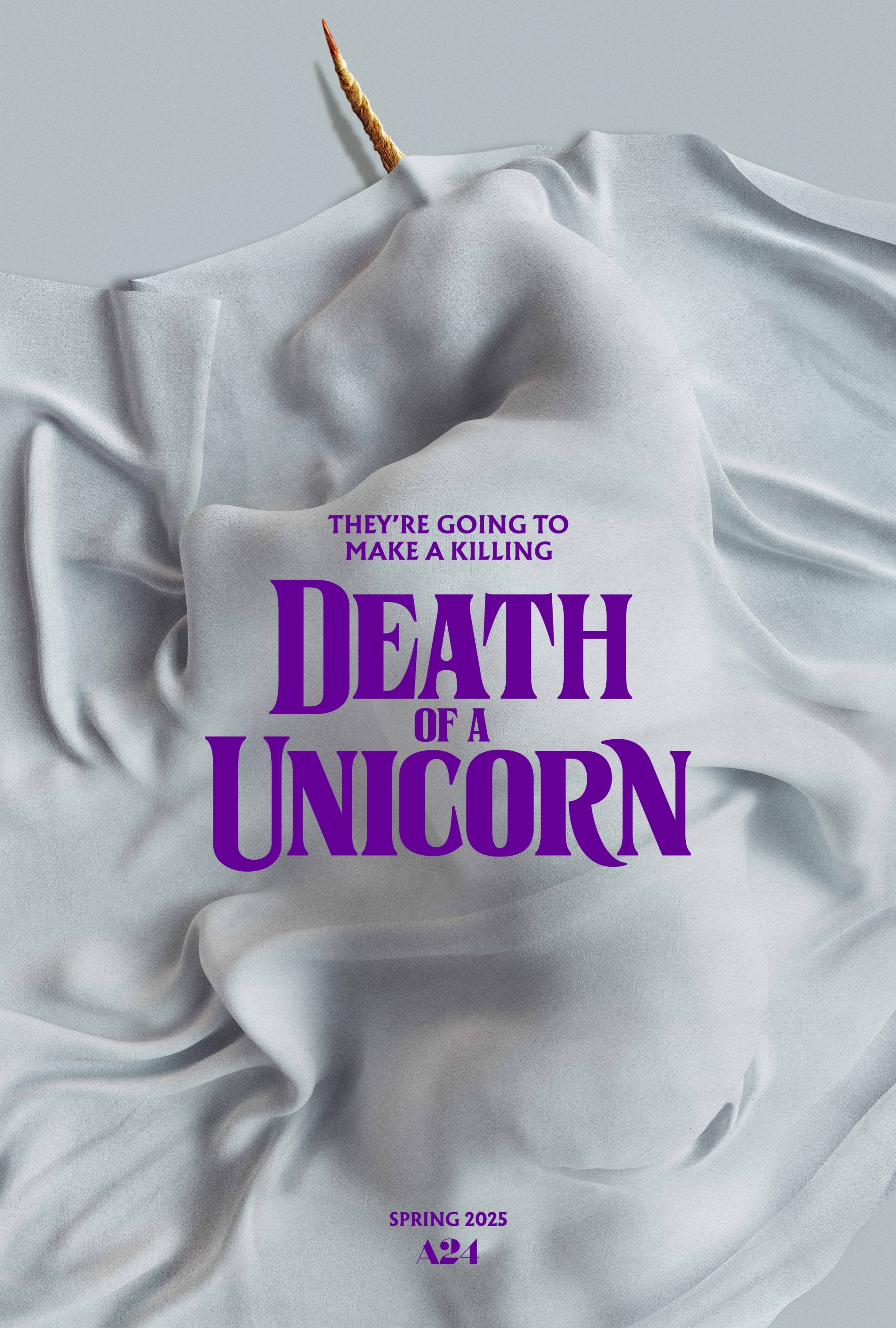
DEATH OF A UNICORN horror comedy mini review

Loads of fun! Death of a Unicorn is Atypical for A24 in all the best ways possible. It’s entertaining, well-written, and smartly balances horror and comedy. While it delivers the social critiques and commentary that are par for the A24 course, the outside/action plotting is strong!

When a man and his daughter accidentally hit and kill a unicorn with their car, his boss tries to exploit the creature’s miraculous curative properties — with horrific results.

While the first act drags a bit, the rest of the movie is a wildly engaging roller coaster ride as folklore and the contemporary world collide in a unicorn gorefest that simultaneously explores the flawed nature of a self-centered moral compass and acts of greed disguised as altruism. Knowing very little of actual unicorn mythology and lore, this movie piqued my curiosity to learn more about these magical creatures because the literary and cultural history is rather fascinating.

Looking to the unicorns themselves, this movie employs a combination of both practical and digital effects to bring the illusive creatures to life. By combining puppetry and computer generated imagery, the unicorns feel lifelike and the reactions from the cast appear to be borne out of genuine fear and desperation for survival. Speaking of the cast, I feel that Rudd and Ortega were miscast in the movie. I don’t buy either one of them in their respective roles, and feel that a better casting may have helped the delivery of the first act.

Clearly, writer-director Alex Scharfman has a fondness for old school creature features, and I can appreciate much of how he adapted the classic creature feature to fit a contemporary sensibility. Death of a Unicorn could become a modern creature feature that is revisited throughout the years–only time will tell.

What I appreciate most is that you can read the whole critique on big Pharma and abuse of natural resources and exploitation of wildlife, BUT you could just as easily enjoy it for the Jurassic Park-inspired survival story. Honestly, it did JP better than JP3 onward.

While I may not be high on the first act or the casting of the two leads, this is still one of my favorite A24 films. In fact, it probably ranks as the most entertaining A24 release for me.

Ryan is the general manager for 90.7 WKGC Public Media in Panama City and host of the public radio show ReelTalk about all things cinema. Additionally, he is the author of the upcoming film studies book titled Monsters, Madness, and Mayhem: Why People Love Horror. After teaching film studies for over eight years at the University of Tampa, he transitioned from the classroom to public media. He is a member of the Critics Association of Central Florida and Indie Film Critics of America. If you like this article, check out the others and FOLLOW this blog! Follow him on Twitter: RLTerry1 and LetterBoxd: RLTerry
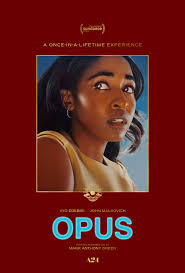
OPUS (2025) film review

An enigmatic puzzle with missing pieces. What starts as a fascinating psychological mystery quickly devolves into a series of disjointed, cryptic sequences that offer more questions than answers. Opus is certainly a haunting experience that delivers striking visuals, but the stylistic storytelling lacks substance, resulting in a film that is ultimately hollow. Like with so many A24 and Neon films, Opus is rich in atmosphere, but lacks strategic plotting, proper pacing, and demonstrable working knowledge of screenwriting mechanics. Moreover, it falls into an all too familiar trap of prioritizing aesthetic over storytelling. Opus is yet another example of modern arthouse cinema mistaking ambiguity for depth. The film posits many otherwise thoughtful questions, but leaves you wondering why you should even care about what you just watched.

Journalist Ariel (Ayo Edebiri) works for an acclaimed music magazine but has grown tired of her arrogant boss Stan (Murray Bartlett) assigning her good pitches to more senior writers. But following the reclusive, visionary pop star Alfred Moretti (John Malkovich) emerging from hiding after more than thirty years, Ariel’s boss is invited to his secluded, remote compound where he will be releasing a new album. Ariel and her boss are invited to attend as press. But not long after arriving, Ariel deduces that the compound’s collection of ardent admirers of Alfred are actually a cult with deadly plans for the guests.

Most of the film’s problems can be traced back to its screenplay. Like with many (if not most, in my opinion) writer-directors, this story likely made much more sense in Mark Anthony Green’s head, than it did on paper. I find that writer-directors often have excellent movie ideas and eyes for shot composition, but lack a working knowledge of screenwriting mechanics. Had Green collaborated with a more established screenwriter, then the film may not have had the plotting issues that plagued it the whole time.

Adding to the film’s plotting issues is its reliance on repetition rather than escalation. Scenes blend into one another with minimal variation, creating a sense of stagnation rather than rising tension. Ariel’s, our central character’s, journey is more about cycling through eerie encounters and vague hallucinations than actually uncovering deeper truths. Without a clearly defined external goal for Ariel, Opus feels like a film more concerned with its own mystique than engaging its audience. The goal could’ve been something as simple as getting the article published, but the film never quite has a throughline on which to land the diegetic plane.

While strong, the performative dimension of the film is underscored with style over substance. Ayo Edebiri’s performance is layered and emotionally compelling. Unfortunately, the film gives her little to work with beyond surface-level tension. John Malkovich, always a commanding presence, delivers an eerie gravitas, but his role feels more like a cryptic device than a fully developed character.

One of the biggest shortcomings in character development is the lack of meaningful relationships. While Opus teases conflicts between Ariel and her boss Stan, these tensions never evolve into anything substantial. All around, the film’s characters never form real, emotional connections, leaving their interactions feeling hollow. Without compelling relationships, the film struggles make us care about any of the characters, much less the central character of Ariel.

Opus seems content to let its themes remain vague, as though interpretation itself is the art. This approach works in moderation but ultimately leaves the film feeling like an unfinished composition—beautiful in pieces but lacking a resonant core.

A24 has perfected the art of marketing “prestige horror” films that emphasize mood over traditional storytelling. While this approach has resulted in some modern masterpieces such as “The Blackcoat’s Daughter,” “Hereditary,” and “Midsommar,” it has also encouraged a wave of films that mistake ambiguity for intelligence. Opus is a prime example of this trend, prioritizing its hypnotic cinematography and eerie sound design over a screenplay that provides emotional or intellectual engagement.

This raises the question: Has arthouse cinema become so obsessed with being enigmatic that it has lost sight of storytelling? Moreover, has the proliferation of “arthouse” films become the very thing they opposed: the mainstream? Films like Opus appear to be forcing audiences to assign meaning where there may be none, and delivering a film that looks great but is ultimately forgettable. The present trajectory of many arthouse film is trending is becoming the new cinematic fast food: tasty but forgettable and lacking in nutrition. In striving for profundity, these films, risk alienating viewers who crave narrative satisfaction alongside visual artistry.

There’s no denying Opus is visually arresting and technically impressive. Mark Anthony Green’s direction is meticulous, and Ayo Edebiri delivers a gripping performance. But beneath its meticulously crafted atmosphere lies a film that lacks emotional weight or thematic clarity. For fans of slow-burn psychological horror and puzzle-box storytelling, Opus may still be a rewarding experience. For others, it’s yet another reminder that style, no matter how dazzling, can never replace substance or sheer entertainment value.

Ryan is the general manager for 90.7 WKGC Public Media in Panama City and host of the public radio show ReelTalk about all things cinema. Additionally, he is the author of the upcoming film studies book titled Monsters, Madness, and Mayhem: Why People Love Horror. After teaching film studies for over eight years at the University of Tampa, he transitioned from the classroom to public media. He is a member of the Critics Association of Central Florida and Indie Film Critics of America. If you like this article, check out the others and FOLLOW this blog! Follow him on Twitter: RLTerry1 and LetterBoxd: RLTerry
CIVIL WAR (2024) film review

A gripping, thought-provoking motion picture about the power and cost of capturing the human experience in a single frame during war. While it would be easy to describe Alex Garland’s Civil War as a thoughtful, if not painful, graphic warning of what happens when society is completely deconstructed and humanity is lost, this film is actually about the power of storytelling through a single frame. Specifically, the state of what remains of humanity and the cost thereof amidst war. Not for the faint of heart, this film takes you only where imbedded journalists have been during a war, complete with all the death and destruction. The film reminds us of the human cost on the battlefield, in the neighborhood, and those that are capturing the images that will tell the story of societies darkest days.

In a dystopian future America, a team of military-embedded journalists races against time to reach Washington, D.C., before rebel factions descend upon the White House.

A picture is worth a thousand words, or so we hold true, but a picture can come at great cost, particularly during wartimes. Instead of focussing on the backstory or who is fighting for whom and for what principles, Garland uses the apparatus of a dystopian warn-torn United States to explore the human dimension and cost of a polarizing, grizzly domestic war. And he does this through a group of imbedded journalists played by Kirsten Dunst, Wagner Maura, Cailee Spaney, and Stephen McKinley Henderson. Together, they face certain death as they strive to cover the war and reach the President for a one-on-one interview.

We aren’t given enough information about the reason for the Western Front (California+Texas) and Florida Alliance secession from the rest of the country, but that’s because Garland wants us to focus on a different story, the human story told through the power of a single frame and the lives that bring these photos before our eyes. Perhaps you’ve never thought of how these photos get from the battlefield to online and traditional magazines and newspapers, but you’ll think twice the next time you are viewing photographs from current or past wars.

But it isn’t simply a motion picture depicting the difficulties in working as a wartime imbedded journalist–that is incidental–this is a picture of the human lives on the battlefield and the places seemingly removed from the atrocities of war. We seldom think of all the different human reactions to war, and this film brings us face to face with those that are fighting for their respective causes, those documenting the various campaigns, and those that go about their daily lives as though the country isn’t ripping apart at the seems a few hundred miles away. Garland doesn’t offer any particular slant, neither does he steer the audience in agreement or disagreement with any faction involved in the war; rather, he crafts a mosaic, if you will, of a collection of metaphoric still images that capture each type of reaction to the war.

I often talk about the emotive difference between film and digital in my classes, and this film is a great example of that argument. It’s the argument that film is superior to digital because with film, there is a tangible relationship between the filmmaker and the film stock, and by extension, a relationship is developed between the editor and film stock. We particularly witness this relationship in Civil War between Jessie (Spaney) and her classic Nikon SLR (film) camera. Whether as depicted in this movie or in real life, there is far more value placed on and discernment in using film to capture people and events, because the photographer/filmmaker is limited to the number on frames on each roll/reel. Therefore, the photos won’t be of just anything, the artist is only going to take a photo that has meaning. Granted, the keeper may still be 1/30, but each was taken with explicit intent, creating immense value in each still frame.

Even after the shutter has opened and closed, imprinting the image on the 35mm frame, the relationship continues through the development process because the developer sends the film through a chemical process that reveals the full spectrum of light–something tangible, that the developed can see, touch, and feel. Digital cannot capture the full spectrum of light the way film can: one is a replicated process that actually cuts off the whitest of whites and blackest of blacks, whilst the other is a chemical process that captures the full range and spectrum of light as imprinted on the film cell. Film photography (or cinematography) creates an emotive dimension between the artist and image, there is a tangible relationship, so everything is done with immense care, consideration, and discernment.

Why is any of this important in discussing Alex Garland’s Civil War? Because to gain the full appreciation of the story he is telling, it is imperative that we understand the relationship between the photojournalist and tragic, devastating events in which they are working to capture the human dimension behind the atrocities of war. Neither Jessie nor Lee (Dunst) will take photos of just anything, every move is thoughtful, the people and events being captured by their respective cameras carry meaning, they carry the human story. That story is made up of those fighting for the Western Front, Florida Alliance (which we don’t see in the movie), or what’s left of the (former) United States’ armed forces.

Beyond what emerges as the main story, Garland’s film does contain a graphic warning of a possible future in which the United States becomes embroiled in domestic warfare (civil war) due to whatever the reasons were that lead to the secession by California, Texas, and Florida (the three most populous states, by the way). It’s to the film’s credit that Garland does leave the backstory vague, as it’s less important what led to this point, but rather the importance is found in the reactions to the war. Both sides of this war are being fought by those that believe they are right, and will fight for the principles in which they believe. The problem isn’t simply the divergence of opinion and belief as it is in the complete disregard or sacrifice of humanity in exchange for a manmade or arbitrary identity.

This is witnessed in an exchange between our journalists and a group of paramilitary civilians, led by Jesse Plemons). Our journalists state they are American journalists, and Plemons’ character reacts by demanding to know what kind of American. This represents those that discriminate or hold prejudice against those that don’t look or sound like they are originally from the United States. In his mind, being from the United States looks and sounds like a particular type, and if one does not fit into that type, then they are not welcomed and ultimately expendable.

Other reactions to the war are also witnessed by our journalists. Such as the lack of reaction to that which is tearing the country to shreds. On their way from New York City to Washington, D.C., our central characters stop in a West Virginia town that is seemingly removed from the war. When the citizens of this town are asked how can they behave as though a few hundred miles away that the very foundations of the country are being shattered, the town reacts in apathy to the war. They are certainly knowledgeable that there is a war, but they choose to stay out of it. Just as the front lines are a reaction to war, this too is a reaction that bares consideration. Garland leaves it up to each audience member where they fall along the full spectrum of the human dimension in war.

In addition to the writing, directing, and technical achievement demonstrated in the film, the performative dimension is outstanding. The genuine reactions to and emotions on display are dripping with authenticity. You will feel what these actors’ characters are feeling throughout the movie. And not just the gut-wrenching parts, the strategically placed moments of humor will stir your soul as well.

Garland crafts a motion picture that serves as cautionary tale of what happens when we stop thinking about one another as unique individuals, as children of God, and instead treat those that are different in some way as a threat to our very existence. What happens when we care more about someone’s identity (with whatever the ideal or principle) than we do about them as a person. There is a time to defend that in which one believes or when one’s life is in danger, but left unchecked, that defense can turn into an offense due to primal fears, anxieties, obsession, and selfishness. Perhaps this film will serve as a reminder of what can happen when we stop treating one another with respect as fellow humans (as fellow Americans) and instead merely treat one another as threats to our very existence. Treatment with respect and dignity does not equate to endorsement or agreement, but it does leave an opportunity to change open. We’ve seen throughout history that there is sometimes a cause for war, but it should always be the last resort.

Often times, I am negatively critical of the writing in the film’s A24 produces or distributes, because I find many of these films are poorly written; however, this film demonstrates the power of acknowledging storytelling/screenwriting conventions and guidelines. Why? Because they work! At first I was wondering why with such a fantastically written screenplay was the realization missing at the end. Then I realized that it is there in character, plot, and in myself. You’ll just have to watch the film to fully understand that which I am attempting to describe without giving away any spoilers.

Garland’s Civil War is unlike anything I expected. I expected a movie dripping with overt socio-political ideology and commentary, but what I got was an incredibly thoughtful motion picture about the human dimension of war, particularly a domestic war between the states. Garland does not hold back on the violence, so those with PTSD from war or uncomfortable with violent movies should be cautioned before watching this film.

Ryan teaches Film Studies and Screenwriting at the University of Tampa and is a member of the Critics Association of Central Florida and Indie Film Critics of America. If you like this article, check out the others and FOLLOW this blog! Interested in Ryan making a guest appearance on your podcast or contributing to your website? Send him a DM on Twitter. If you’re ever in Tampa or Orlando, feel free to catch a movie with him.

Follow him on Twitter: RLTerry1 and LetterBoxd: RLTerry

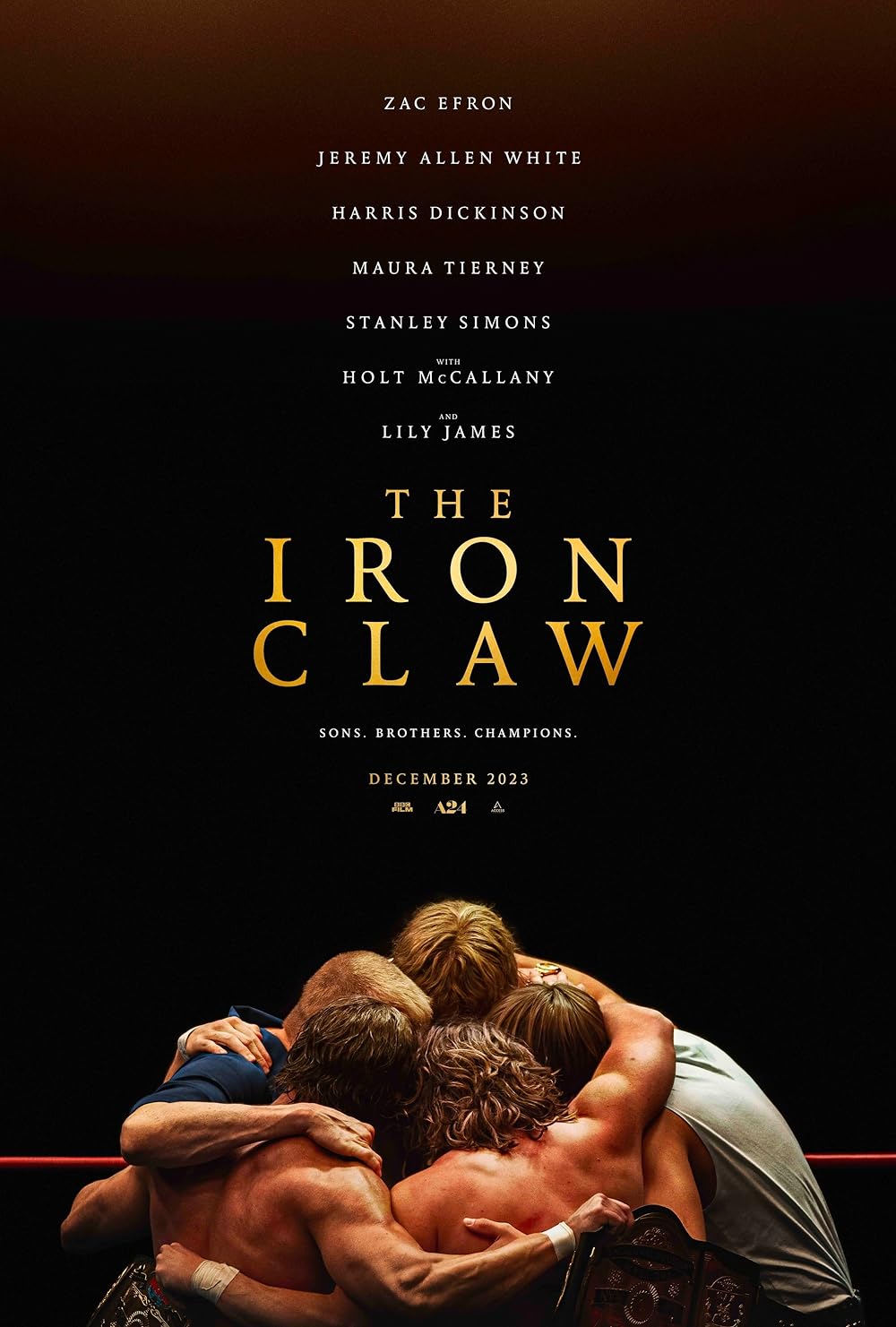
THE IRON CLAW film review

A compelling story with one-dimensional characters. The Iron Claw has all the ingredients for a masterpiece, but still misses the punch. My initial reaction to this film was an eagerness to like it much more than I did, for it was missing something. At the time, I was unsure what was missing, but the most likely culprit is the lack of character dimension and development. However, the film is saved from falling completely flat by the outstanding performance by Zac Efron. He has the weight of this film on his shoulders and it shows clearly throughout the story. Like with other sports-related biopics or sports movies, it’s not really about the wrestling; but rather, it is about the life of wrestling legend Kevin Von Erich and his relationship with his family and the tragedies that haunted them. It’s a film to watch for the excellent performance by Efron and to learn about the biggest competitor to the WWE from the 1960s-80s. Clearly the real-life story is incredibly tragic, but as it was expressed in the film, it leaves me with a feeling that there was a great film in there somewhere, but it unfortunately fell victim to lackluster screenwriting.

The true story of the inseparable Von Erich brothers, who make history in the intensely competitive world of professional wrestling in the early 1980s. Through tragedy and triumph, under the shadow of their domineering father and coach, the brothers seek larger-than-life immortality on the biggest stage in sports.

When I say I wanted to like this film more, I am certainly not alone. Most of the other critic in my screening had the same or similar reaction. We were in agreement that this film was missing something, but at the time, we did not know what that was. After much thought, I am left with the fault being in the screenwriting, specifically, the lack of character development. This is most noticeable during the three deaths (this isn’t a spoiler as this is based on real family). None of the deaths feel particularly impactful because we failed to spend a sufficient amount of time with any of the characters prior to the tragedy.

Most of our time is spent with Kevin Von Erich (Efron) and the patriarch of the family Fritz, They are the only two characters that are ever given anything substantive to do during the film. This is especially true for Kevin’s girlfriend/wife Pam Adkinsson (Lily James) and the Von Erich matriarch Doris (Maura TIerney). Neither character is given much to do; therefore, in most scenes, both ladies are unfortunately treated like little more than furniture. Yes, this is a story about the Von Erich bothers; however, your central cast is often only as interesting and dynamic as the supporting cast around them. You can remove either Pam or Doris from this movie, and it plays out nearly the same, until the very end.

While in real life, death can come at any moment, therefore there lacks a measurable buildup to the tragic passing, in a film, there is the creative latitude to both pace and structure the story in such a way that characters are developed sufficiently and there is adequate breathing room between deaths. When deaths occur occur in the film, it feels like a matter of fact. Yes, it is a factual event, but the deaths do not exactly emote much. Combine this with the lack of connection between the audience and most of the characters in the film, and it’s nearly impossible for the deaths to truly impact–suffice it to say–the deaths in this film are felt more or less cerebrally. You will find yourself thinking about them, but you won’t feel them to any great extent.

Saving the film from completely falling flat is the outstanding performance by Efron as Kevin Von Erich. We’ve seen Efron flex his acting chops in the past, but this role is certainly the most dramatic of his career. Not knowing anything about the real Kevin Von Erich, aside from what I learned in the film, it appears that Efron completely transforms into the wrestling legend. And I am not just talking physique, but mentally and physically he became Von Erich. In every scene, he delivers a nuanced performance that communicates in spades to the audience the weight of the world on his shoulders. Never once did I feel that I was watching Efron portray Von Erich, I felt I was watching Kevin Von Erich on screen. His performance and characterization of Kevin Von Erich will captivate you, and almost make you forget the film is lacking in the writing department.

Lastly, a theme that the film touches on, but fails to lean into more heavily is legacy; moreover, a cautionary story of what can happen when a parent attempts to live out his or her career or professional accomplishments through their chid even when the child is not necessarily gifted in the same way nor has the same goals and ambitions. Fritz Von Erich represents a toxic parenting trait of forcing kids to fit his mold and to accomplish what he couldn’t, thus allowing him to vicariously live out the dreams he never realized. The emotional and psychological (and sometimes physical) effects upon the child often end in negative growth because the child is rarely ever able to live up to the expectations of the parent demanding the child achieve for the family what the parents was unable to do.

If you’re a wrestling fan, I highly encourage you to watch The Iron Claw in cinemas, but if you are not particularly a wrestling fan, then it’s one that is still a good watch, but watching it at home will be sufficient enough. It’s an intimate film, but the family is larger than life.

Ryan teaches Film Studies and Screenwriting at the University of Tampa and is a member of the Critics Association of Central Florida and Indie Film Critics of America. If you like this article, check out the others and FOLLOW this blog! Interested in Ryan making a guest appearance on your podcast or contributing to your website? Send him a DM on Twitter. If you’re ever in Tampa or Orlando, feel free to catch a movie with him.

Follow him on Twitter: RLTerry1 and LetterBoxd: RLTerry
“The Night House” Sheds ‘Light’ on Spectacle Over Narrative

Plot and story take a backseat to the technical and performative elements of the mise-en-scene. The Night House represents a trend in horror that began as an emerging art house cinematic form championed by studios like A24 in the mid 2010s, continuing today. Many of the films that fall into this category are highly stylized through overtly artistic approach (artistic in that the hand of the auteur is clearly visible) or a minimalist approaches. While many of these films DO have a strong story told though established narrative conventions, some of them (and an increasing number) place so much emphasis on the look and feel of the film, that the filmmakers forget that they also need to tell a good story with a beginning, middle, and end that makes sense within the world that has been established on screen.

This house looks gorgeous, but the bones are weak. The Night House certainly delivers a haunting and unnerving atmosphere, excellent production design, fantastic editing, and a tour de force performance by Rebecca Hall, but its labyrinth-like plot and meandering story ultimately lead to “nothing.” If nothing else, this film works as a showcase for Hall in her one-woman show! And no mistaking it, her performance is outstanding–nearly Toni Collette Hereditary levels. Further notable elements in the film are the exquisite editing and cinematography that help to generate the ominous feeling of dread that you will feel the entire time. All of the aforementioned sounds like an incredibly effective mise-en-scene, doesn’t it? The problem with The Night House isn’t in the mise-en-scene as much as it is in the bones of the house itself, or the screenwriting.

My problem with films like The Night House, The Lighthouse, (am I sensing a trend here?) and others is the trend to ostensibly convince audiences, through the thoughtful craftsmanship of the mise-en-scene, that the film is more important than it is, that it has something substantive to deliver, or that the filmmaker is elevating horror (a term I despise because horror has always been the most truthful and progressive of all the genres). When this happens, the plotting suffers greatly. Why? Because the filmmaker considers themselves an artist that is above established conventions because there is a clear attempt to be unconventional, to be be a nonconformist, to rage against the system, if you will. So because they do not feel that they should abide by the guidelines or conventions of screenwriting or image montage (montage is French for assembly), they expect audiences to be so impressed by the gorgeous imagery on screen that the story or plot is of little consequence. Or there is the idea that these films aren’t for everyone or they are used as fuel for the pretentious you just don’t get it conversations on #FilmTwitter. Oh, many cinephiles just love that one, because they can elevate themselves.

Now, you are probably wondering if I think all films need to follow conventional filmmaking approaches. And the answer is NO. What?!? Did I just contradict everything I just wrote? Again, no. It’s when the filmmaker crafts a motion picture that they’ve clearly positioned to give the pretense that it’s more important than it actually is and fail to deliver the story that is so clearly attempting to be told. That is where I find fault with the filmmaker or screenwriter. Does that mean narrative/fictional films can’t be poetic in their form? Certainly not. One of my favorite horror films is Dario Argento’s Suspiria. And, even though I include this masterful work of cinema in my World Cinema class, I will also be the first to tell you that the plot is not very good. But, the beauty of Suspiria isn’t in the story, but in the euphoric experience of watching Argento create cinematic art with this violent, technicolor world accompanied by the mesmerizing score. The difference between Suspiria and The Night House is the simple fact that Argento did not create Suspiria to tell an important story. It’s a film that has grown in importance through the decades because we can find meaningful expression in the mise-en-scene. But that film didn’t hit cinemas to tell an important or thoughtful story. It hit cinemas to provide an experience!

What we have here is spectacle vs narrative. A subject I covered in my academic book On the Convergence of Cinema and Theme Parks. In the book, I look at the storytelling approached in themed entertainment when it intersects cinema. Without going too deep into that subject, I explore the idea of cinema of attractions. And films that do not tell a plot-driven story, are more about the attraction or experiential factors, not unlike a theme park attractions. With the increase in IP (intellectual property) based attractions (think: attractions based on movies), attractions have integrated story elements that aim to take the physiological experience and add the dynamic of story to it. A good example of this is found in Universal Orlando’s Hagrid’s Magical Creature Motorbike Adventure in the Wizarding World of Harry Potter: Hogsmeade at Islands of Adventure. Universal coined the term story-coaster. But I digress. When I evaluate a film, I often look at the implied attempt by the director (and marketing agency or distribution company), and I ask myself questions like: does the film give the impression that it is more important than it actually is? Is there an attempt to have a thoughtful message or some social commentary on dominant or emerging ideologies, and the film form takes precedence over the actual story? Are the films technical elements and acting so impressive that it hopes you don’t notice that the plot or story are weak?

While I have established that there is rightly a place amongst the greats for films that are visually stunning that don’t necessarily follow a traditional story structure (ie. Suspiria), the best films are often those that have a simple plot and complex characters. A simple plot forms the solid foundation and structure of the house (the bones, if you will), while the film form is everything that you see with the naked eye. It starts with the firm foundation and strong structural elements. Everything else is window dressing–important–but ultimately meaningless if the narrative is’t sound. What good is the building material of the walls, the paint, the type of windows, or kitchen cabinetry if the foundation or structure are weak??? I appreciate the intimate feel of the trend to release films that look artful so we can witness the cinema stylo of the auteur, but the filmmakers also need to remember the importance of plotting, pacing, and structure.

This image has an empty alt attribute; its file name is profile_pic.jpg

Ryan teaches American and World Cinema at the University of Tampa. If you like this article, check out the others and FOLLOW this blog! Interested in Ryan making a guest appearance on your podcast or contributing to your website? Send him a DM on Twitter or email him at RLTerry1@gmail.com! If you’re ever in Tampa or Orlando, feel free to catch a movie with or meet him in the theme parks!

Follow him on Twitter: RLTerry1