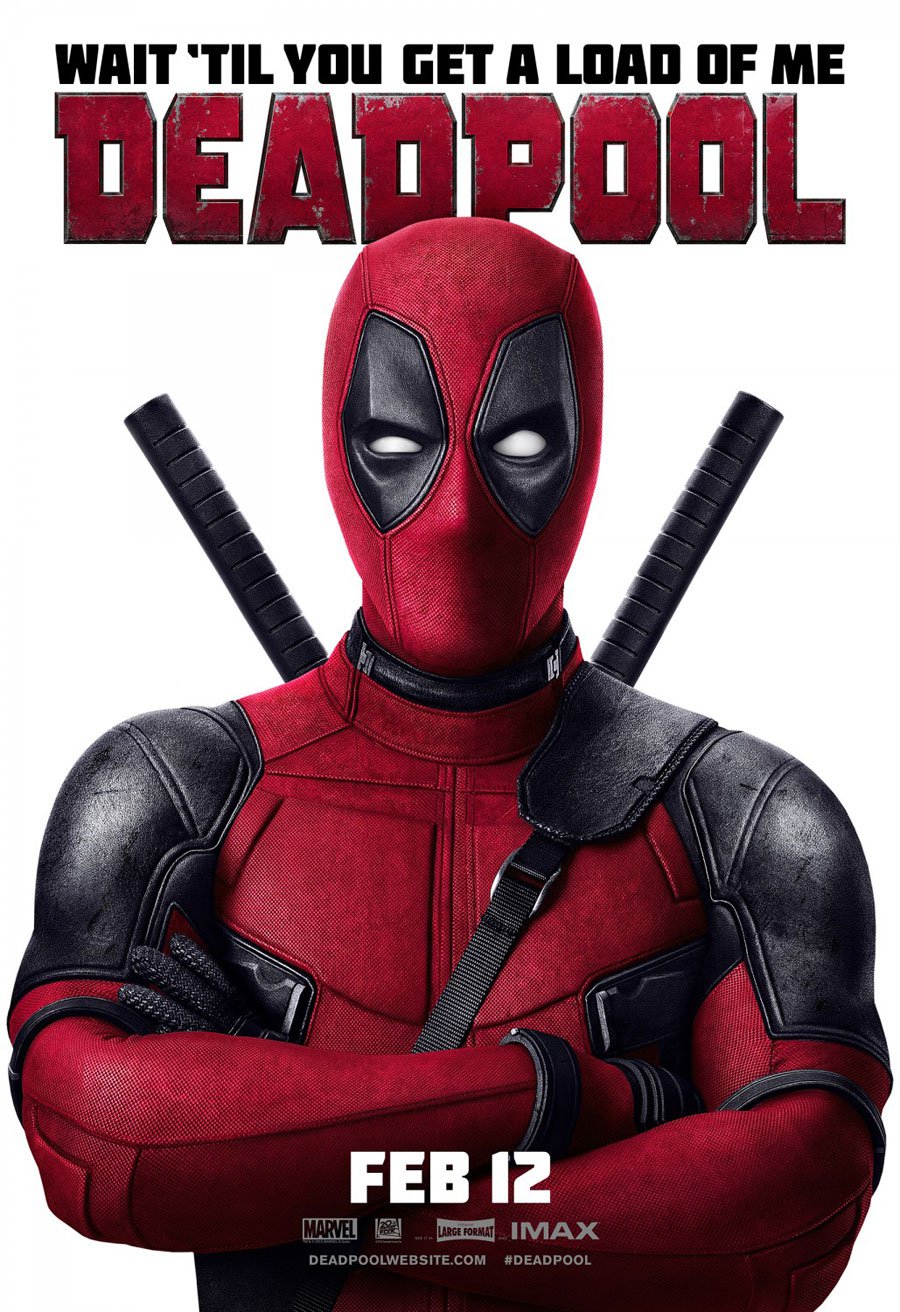
“Deadpool” movie review

Deadpool-poster-2Absolutely brilliant super not-hero film! For those who often get the feeling that I simply do not like high-concept or superhero movies, let this be evidence that there certainly ARE superhero films that I feel are exceptional. And this is definitely one of those movies. As many memes across social media have indicated–and I will reiterate–this movie is NOT for kids (and no, your kids are not the exception). This is a super not-hero [and the not is important, but you must see the movie in order to understand] movie that is written for a mature audience. From the groundbreaking self-aware opening credits to the perfectly paced and strategic adult-humor, this movie is sure to have you laughing from beginning to end. And it’s not just the writing that is super but the visual effects, stunt sequences, and fight scenes are far above par for this action movie genre. Ryan Reynolds captures the character of Deadpool so incredibly effectively that you will swear that he was made for this role. Not your Disney-Marvel movie, Fox and Marvel bring you a spectacular combination of action and comedy to show off this unique anti-hero, so to speak, for fans of the comic and those who just enjoy a super movie.

Former special forces Wade Wilson (Reynolds) leads a very interesting post-dishonorable discharge life as a mercenary. The last man you’d ever expect to fall in love with anyone, Wilson falls for a burlesque dancer (who most likely moonlights as a hooker–let’s be honest). Following months of unparalleled passion and ecstasy, and after the unconventional proposal, Wilson finds out that he has an aggressive form of cancer that is unfortunately late in discovery. Devastated, Wilson has no idea what to do, but does not want his fiancé to have to go down the cancer road with him even though she clearly states that she is in it for the long haul. Acting upon a chance meting with a mysterious and well-dressed man in a bar, Wilson takes the man’s advice and undergoes a treatment from another equally mysterious but more sinister scientist. The results of the treatment will become clear as Wade Wilson becomes Deadpool and develops into the most unusual super anti-hero ever to come to the screen.

Simply from the opening credits, it is clear that this movie is incredibly self-aware and playing to the audience one hundred and ten percent. BEST opening credits ever, in terms of creativity and being an extension of the narrative itself. The idea of a self-aware movie is not a common one to begin with and certainly not a trope of traditional superhero movies. I think that is what I appreciated most about the movie. The brilliance behind the self-awareness is that the film is equally self-aware as it does take itself seriously as a superhero movie. Never before have I witnessed the fourth wall being broken so incredibly much. For those of you who do not know what breaking the fourth wall is, in its simplest form, it is when the character addresses the audience. This is apparently an element that was brought over from the comic, according to my comic and anime enthusiast coworker that went with me to screen the movie last night. What makes Deadpool’s continuous commentary so effective and entertaining is the fact that he says what many of us would be thinking given if we encountered the same scenario. The candor is such a breath of reality within this world of fantasy or augmented reality.

So often a movie will either choose to rest upon its strong writing, impeccable acting/direction, or visual effects; the sheer remarkable innovation in this movie is supported by not one but all the aforementioned elements. Ordinarily, I am able to find flaws in a movie–especially within the superhero genre–but not this time. I suppose, the fourth wall was broken a little too much, but that would be the only flaw I could identify. Sometimes a movie can be a great superhero movie but not a great film; however, Deadpool exceeds expectations both as a superhero movie and as a film in and of itself. At first thought, you may feel that a movie with endless diegetic and non-diegetic commentary may overshadow or steel attention or coherence from the narrative itself, but the writers did such a fantastic job of integrating the narrative and commentary so seamlessly that the movie is doubly entertaining as it would be without the offensive, explicit, hormonal commentary from the earthiest and most human of superheroes. And yes, I realize I am using superhero even though Deadpool reminds me over and over again that he is not a hero, but you get the idea.

Ryan Reynolds is one of those actors who is equally talented as he is attractive, and he gets to show off for this movie in ways that many actors wish they could in movies. But, it does not come off as obnoxious at all. That’s the beauty in the direction of this movie. You’d think that his over sexualizing of himself and the continuous adult commentary that he (or the movie) would play off as exceedingly obnoxious, but you’d be mistaken. There is a perfect balance struck by the writers and director that enable Deadpool to be a total douchebag, but oddly enough, in the most endearing way. For fans of the X-Men comics, 90s cartoon, or the X-Men movies, you will get to witness a crossover of movies in Deadpool. In an ever growing effort to recruit Deadpool to join the elite mutant force lead by Charles Xavier, Colossus and Negasonic Teenage Warhead confront Deadpool. This subplot is an important elements to Deadpool because it helps to build Fox’s X-Men universe by bringing two franchises.

Without getting into a lot of IP (intellectual property) rights discussion, despite the procurement of Marvel in 2012, as long as Fox keeps making X-Men movies, Sony makes Spiderman movies (even though he is appearing in the Avengers series), and Universal Studios Florida keeps modifying and improving attractions, then Disney does not have the rights to use the respective characters in movies or rides. Now, IP rights are a little more complicated than that, but I wanted to provide you with a general idea. Back to the crossover. Including the X-Men in Deadpool is strategically important for three simple reasons: (1) as I mentioned earlier, it helps to rebuild and reinforce the respective timelines of both franchises (2) it builds the foundation for a larger character universe, much in the same way Disney is doing with the Avengers and related movies and (3) part of what makes Deadpool so incredibly fascinating is his ability to play the anti-hero off of legitimate superheroes or, as Fox is able to officially call them, mutants.

If you are a fan of Disney-Marvel’s Guardians of the Galaxy, and you are NOT a kid, then you will definitely enjoy Fox-Marvel’s Deadpool. Prepare yourself to experience a superhero-action movie like no other. From being mesmerized at the stunning visual effects and editing to the incredibly funny writing and acting, you are sure to be entertained and will definitely crave more. Good thing that Deadpool has already received the green light for a sequel.

The Hollywood Studio System: Employment Then and Now

One of the last remnants of Hollywood’s Golden Age, Grauman’s Chinese Theatre stands as a tribute to the movies that started it all.

One of the last remnants of Hollywood’s Golden Age, Grauman’s Chinese Theatre stands as a tribute to the movies that started it all.

In light of the recent film Hail, Caesar!, I thought it would be interesting to take a closer look at the old studio system and whether resurrecting some of the practices might actually prove to be a positive affect upon employment in media and entertainment.

The entertainment industry is evolving more quickly than it ever has, and film production companies and distributors are of no exception. Just like the advent of television had a major influence on the sharp decline of movie patrons in the 1950s and 60s, the advent of on-demand and streaming “television” and movie content today is having a major impact on entertainment sources today. But this article does not aim to analyze distribution, production, nor revenue; its aim is to analyze the state of employment opportunities in the film and narrative television industries. What better way to begin to explore this controversial topic than with the studios that started it all.

HISTORY

The famous entry gate to Paramount Pictures as seen in the 1950 film, all about the studio system, “Sunset Blvd.”

The famous entry gate to Paramount Pictures as seen in the 1950 film, all about the studio system, “Sunset Blvd.”

The rise and fall of the former “studio system” lasted for a period from the 1920s to the late 1960s, with the 1940s to the 1960s being the period of the downfall. During this time, there were five major film studios known as the Big Five, essentially controlling the film industry from production to distribution. The Big Five consisted of Paramount, MGM, RKO, Loew’s, Fox Pictures, and Warner Brothers. Though not as prominent, three smaller studios known as the Little Three, consisting of United Artists, Universal, and Columbia Pictures, were the chief competition. Regarded as the end of Hollywood’s Golden Era, the landmark Supreme Court decision in United States v. Paramount in 1948 marked the delcine of the Studio System. In short, over about a 15-20 year timespan, studios began opening their lots to independent filmmakers–independent of the Big Five (not independent by today’s definition), terminating permanent staff members, and refraining from entering into longerm contracts with performers and movie houses. Although the Walt Disney Company was not part of the Big Five nor the Little Three, it is the only studio today still operating as a studio from the old Studio System.

PRESENT DAY

The Bronson Gate at Paramount Pictures as seen today

The Bronson Gate at Paramount Pictures as seen today

With the major studios today only producing about 20 films a year, the majority of films releasing in first-run movie theatres are produced by independent producers. As stated earlier, this is not independent as we think today; independent by this definition means movies produced outside of the major studios, but often distributed by them (or a subsidiary). Think: Star Wars or Jurassic Park. Since the fall of the Studio System, big banks are more reluctant to invest in or finance films, so producers are responsible for securing their own funding. Less funding means fewer job opportunities for film and television graduates. Most film and television professionals in the entertainment business today are independent contractors–being attached to films and television shows for however long the production time or run-length is. Although a long-running television show provides more employment stability than films do, both are high risk professions. Of course, along with the high risk comes potentially great rewards.

According to Hollywood folk lore, making a wish at the famed Bronson Gate is said to bring good luck. This is me (30lbs ago!) on the Paramount Studio tour in March 2015.

According to Hollywood folk lore, making a wish at the famed Bronson Gate is said to bring good luck. This is me (30lbs ago!) on the Paramount Studio tour in March 2015.

Why would the return of some semblance of the old Studio System be a good turn of events in today’s economy? Simply stated: more jobs and opportunities for budding professionals and college graduates. Why is that? Any first-year film student can tell you that studios keep a low threshold of permanent staff members in administration and production. The majority of talent and crew on each film is independently contracted. And with gaining entry into a union becoming increasingly difficult, it leaves many potentially talented professionals out of work or in low-pay positions on low and moderate budget films. If the Studio System were to return, they would have the collateral that big banks are looking for to invest in films. After all, film, television, and to some extent theatre, are the United States’ largest exports even though they are only recently counted as part of the U.S.’ GDP (gross domestic product) in terms of evaluating the health of the economy. If there were more permanent positions in production with studios and production companies, the unemployment rate would drop significantly in entertainment because budding professionals and college graduates could land positions in which they could grow and excel.

An aerial shot of the Desilu Stages in Hollywood in the 1960s

An aerial shot of the Desilu Stages in Hollywood in the 1960s

But what about exploitation and monopoly? Are those not reasons why the Supreme Court stepped in? Yes. However, there are many reasons why personnel in entertainment today, as permanent staff members, would not undergo the same treatment. The reason: unions. SAG-AFTRA, IATSE, TEAMSTERS, and EQUITY do an excellent job at protecting creative peoples’ rights and opening doors of opportunity. But, it is becoming increasingly difficult to gain access into these organizations. And with the unions being the gatekeepers to opportunity in the industry, where is a budding professional or college graduate supposed to go? If studios produced more in-house movies and television shows, then that would require them to hire permanent staff members. Those seeking a career in the industry would find their place. Some may argue that production companies offer internships to recent graduates; but with lawsuits increasing in the last few years, internships are increasingly being seen in a negative light. One hypothesis is that unpaid internships are taking the place of entry level jobs. With the number of entry-level jobs decreasing since the recession began, the unemployment rate in entertainment is rising.

One way to combat the increased unemployment in entertainment business is to bring back the large studios that have the financial assets to offer and hire permanent positions. This would enable the studios to hire a number of cinematographers, writers, directors, etc. And, those individuals would work on the films produced by the respective studios. If studios were to increase the number of films produced each year, as they once did, then there would be more opportunities for professionals. Regarding the monopoly studios had on movie houses, the present laws on the books would not allow for a studio to have complete control over a particular theatre chain.

There is plenty of room for studios and production companies large and small. Unlike the days of the Studio System, in which outside companies could not shoot films or television shows on another company’s lot, the smaller studios should be allowed to still rent the stage and lot space as they do today. Of course, if Studios were producing more movies on their lots, that may cause the smaller companies to have to look elsewhere for locations. But, that could be a good thing; because if they purchased land for a backlot or sound stages, that would create more jobs for craftsman. In order to combat the rising unemployment rate in the entertainment business, professionals need to get together to develop ideas as to how to hire more personnel. Bringing back the Studio System is just one idea as to how to create more full-time jobs in film and television production.

One of the entrances to MGM Studios (now owned by Sony Pictures) in Hollywood

One of the entrances to MGM Studios (now owned by Sony Pictures) in Hollywood

With studios forced to produce more movies in order to make payroll, that could potentially mean more writers can sell their scripts and perhaps more original ideas will make their way to the silver screen. This action could create human resource databases at the various studios and production companies that would advertise vacant positions. Just like applying for a job at Disney World, you could see what positions are available. Bringing back a new Studio System would allow for studios to advertise full and part-time regular positions. For instance, you could see which studios are hiring cinematographers, directors, composers, etc. Professionals in the creative and technical arts would also benefit from employer provided health insurance and retirement. Although as independent contractors, film and television professionals make more money than working as a regular employee, regular employees benefit from regular paychecks and benefits, and to an extent job security.

Technology is making the production of movies and television shows more efficient than ever, so a major studio could hire permanent staff members to work as producers, directors, screenwriters, cinematographers, etc. Employment opportunity and stability are key elements to the health of an industry–even creative ones. Even though the old Studio System ran unchecked for many years, causing the eventual breakup, carefully constructed and regulated today, the return of a new Studio System could mean more jobs and opportunity for college graduates pursuing entertainment business careers. And just maybe, more movies!


BIBLIOGRAPHY

  • US adds entertainment and innovation to GDP, Time Magazine, http://entertainment.time.com/2013/08/01/hey-america-entertainment-just-made-you-hundreds-of-dollars-richer/
  • History of the Studio System, Encyclopedia Britannica, http://www.britannica.com/EBchecked/topic/394161/history-of-the-motion-picture/52153/The-Hollywood-studio-system
  • Paramount Pictures v United States, 334 U.S. 131 (1948)
  • Glatt v. Fox Searchlight Pictures, New York Southern District court, http://www.nysd.uscourts.gov/cases/show.php?db=special&id=300
  • US Bureau of Labor Statistics, http://www.bls.gov/ooh/entertainment-and-sports/home.htm
  • Glatt v. Fox Searchlight Pictures Inc. 2013 WL 2495140 (S.D.N.Y.) – See more at: http://blog.legalsolutions.thomsonreuters.com/legal-research/westlaw-topical-highlights-labor-and-employment-july-10-2013/#sthash.J9tcpnM1.dpuf
  • Hollywood Studio System Collection, http://mediahistoryproject.org/hollywood/
  • Bigelow v. RKO Radio Pictures, Inc., 327 U.S. 251 (1946)

“Magical” Data Collection (part 3 of 3)

MagicBands(cont’d from part 2)

One of the initial praises for this smart technology was the ability for it to collect and assess data through algorithms by assigning a pseudonym to the user—collecting data anonymously. This is not the case with the Disney Magic Band. The Magic Band is just one tool in the entire My Disney Experience vacation management platform. Once a user receives his or her Magic Band (whether a “tourist” or a local annual passholder), he or she has to go online and customize the band with names, select a profile picture (from a list of Disney characters), and other contact information. This, in and of itself, takes the pseudonym (anonymity) out of the equation. For now, not only can information and data be gathered, but it is attached to a specific person whose identity is not a secret. Unlike your smartphone or other mobile devices (e.g. tablet), in which the user can turn off the location sharing features (either for the whole device or app-specific), the location sharing and smart technology in the Magic Band (RFID and GPS) cannot be turned off. The inability for the user to not turn off the location sharing features can be viewed as an encroachment upon personal privacy. However, Disney World does not require park guests to wear/use the Magic Bands. Therefore, if a part guest chooses to wear/use the Magic Band, then he or she accepts the fact that prolific amounts of information are being shared, including but not limited to: location, dining preferences, FastPasses, etc).

Although conspiracy theorists can tout the whole “big brother—or in this case Big Mickey—is watching,” it is more likely that issues of database privacy should be explored (Mokbel, 2006). The treasure trove of information gathered and processed by the My Disney Experience system provides the media giant with unparalleled data that can be integrated into the park operations and, by extension, can be presumed to be integrated into other decisions. Still, the program is too new in order to know for sure where the data is going. Looking at other models of smart data, we can certainly explore the possibilities. The goal in database privacy is to provide access to the gathered information without risk of breaching privacy (attributing numbers instead of names to the sources of information).

The GPS technology built into the Magic Band builds upon decades of GIS  (global information system) research and integration in order to factor location into the database. Location provides a way to link information on a user (or subject) from one database into another. This method of data collection and organization is referred to as data matching (Curry, 2015). Without location, then the information would not be as valuable because it would be more difficult to find links between what the park guests want to experience, and in which order, during a vacation or visit to the Walt Disney World Resort. Since data matching requires the use of a figurative data map anyway, actually using a map of Disney World adds to the effectiveness of the data when factoring it into an algorithm. Integrating GIS technology into how the Magic Bands are monitored and used, allows Disney to create hyper-sensitive remote surveillance technologies (Curry, 2015). This is the basis for the character meet and greet feature referred to earlier in this series of articles.

By designing the Magic Bands to work with GPS, GIS, RFID, and POS (point of sale) technologies, Disney can take data matching to the next level and create data profiles based on the smart data collected (Curry, 2015). Whether in name or anonymously, this degree of smart data is highly effective because once a profile archetype is formed, Disney can reflect upon that profile type’s history and forecast what that particular archetype is going to do in the future and could target ads, characters, purchases, etc to that person.

But what about invasion of personal privacy while at Disney World? How should Disney respond if accused of invading the privacy of its guests? “One traditional response, here, has been that just because the data in a profiling system are not “real facts,” there can be no invasion of a person’s privacy, at least in the traditional informational sense…just as the development of GIS has been associated with the devaluation of the local, where attributes of the local come to  be seen merely as contingent features of a Euclidean set of spatial coordinates, so too has it been associated with a devaluation-or at least revaluation-of the individual and of the nature of identity” (Curry, P258, 2015). Although Curry is not referring to the Magic Bands, his research can be applied to them by extension since little is actually known about the digital data collected and all the ways that the media giant uses it.

The information collected through MyDisneyExperience (and the Magic Bands) aid in creating digital people, places, and lives. Just like an individual is responsible for one’s financial identity (credit score), then should not a Disney park guest be responsible for and how their digital self is used? But because of the aforementioned reasoning, the data collected may not be legally treated as “real facts,” this splitting of the proverbial hair gives Disney carte blanche to use the data however it chooses. It may be that the data is simply used to make park visit logistics more efficient and convenient for park guests, but it is clear that the collected data could be used in figuratively infinite ways without any due compensation for the park guest or details notification of how the data is used or interpreted.

Although privacy conspiracy theorists and some legalistic Christian fundamentalists may see this smart data technology as a gateway to the apocalypse, the truth is, this technology has been part of our lives for a long time—at least the basics of the hard technology. This is really no different than the introduction of the printed barcode back in the 1970s (Laugheinrich, 2007). RFID/GPS technology (as a means of location and payment) is found in every automated toll stickers and units in cars in order to use the express-thru lanes on the turnpikes and expressways without having to stop at the booth. Similar technology can be found in keyless electronic ignition in many contemporary cars that responds to a particular key fob instead of metal key—takes the RFID chip to the next level. That technology does not seem to fall under scrutiny or appear to be frocked with privacy concerns.

Laugheinrich highlights that RFID [and by extension RFID-GPS technologies for purposes of this paper] has three distinct advantages over more traditional means of collecting or processing data: (1)Automation—the scanners/receivers provide the company with nearly unsupervised readouts. (2)Identification—RFID offers much more in the way of information density. (3)Integration—embedding the technology in unobtrusive ways thus freeing the product design (2007). Think of RFID technology as the latest version of the now antiquated barcode. Programmed to only work with a specific person allows for RFID to be integrated into token-based authentication based applications because of the size (Laugheinrich, 2007). Token-based authentication (which is essentially the foundation of the Magic Band) provides a means to issue and then collect information that cannot be [easily] duplicated or forged. Sorry, that means you can no longer print your own or hoard past FastPasses to skip the long queue at ToyStory Midway Mania or the Seven Dwarves Mine Train.

Whether the Walt Disney Company has plans beyond park operations and planning for its Magic Bands will have to wait to be seen; however, just because Disney may not be engaging in any illegitimate or unethical uses of the smart data gathered by the Magic Band readers, that does not mean that there do not exist those who use data gathering technologies that can hack into the RFID/GPS system the Magic Bands use and modify or sell that data, or anything else unscrupulous. Potential digital privacy violations may happen if an authorized reader eavesdrops on authorized transactions  or if a rogue sensor tricks the transmitter to divulging personal information since MyDisneyExperience includes all kinds of personal and financial information on a given park guest. (Laugheinrich, 2007). Echoing the three benefits to RFID/GPS technologies, there are principally three privacy concerns as well: (1)Clandestine scanning—simply stated, the RFID is scanned or read without the user/owner’s consent. (2)Eavesdropping scanning—“listening” in on authorized or authenticated transactions between a transmitter and reader. (3)Data leakage—reading out more information from a transaction than is necessary to carry out the task (Laugheinrich, 2007).

A fairly innocent invasion of privacy in the Disney Parks could be something like this: you stop by the Brown Derby at Hollywood Studios to look at the menu. There are readers all over the place anyway, and having on in the menu board at the Derby is no different. You receive a text message or email from WDPR (Walt Disney Parks and Resorts) that asks why you did not dine at the restaurant or offers you a coupon or something along those lines. Another scenario is a little more sinister. An unauthorized individual has developed a reader that as he or she walks past park guests, picks up on the personal, park, or financial information on an individual’s Magic Band. As far as business development or pushing products, Disney could examine the attractions or characters you visit most and target merchandise at you through your mobile phone or email. Since RFID/GPS technology-driven devices are extremely small and can be integrated into almost any item, it would be very difficult for WDPR security to monitor the entrances for said devices. At the end of the day, the biggest privacy concern with the Magic Bands is the unauthorized automatic data collection that is not explicitly stated in the terms of use or user agreement that comes with the Magic Band—where WDPR finds indirect loopholes to monitor your movements in financial information while visiting the parks.

Although RFID/GPS technologies have come a long way and security company and user security measures have better developed over time, clearly more research needs to be done in order to truly understand the ramifications of the implementation of the Magic Bands into the daily operation of the Disney parks. Literature has shown us how the technology works and how it could be used. Most of what has been written about in these articles requires looking at past research on either privacy or wearable technology and apply it to how it may affect the manner in which Magic Bands are used. Furthermore, it is not always one of the two parties in the RFID relationship (i.e. WDPR and the park guest), but it can be other park guests with intrusive technologies that breach the relationship that can pose a privacy or security threat.

Click HERE for part 1

Click HERE for part 2


Bibliography

Ball, R., et al (2015). The Future of Luxury: Capital of Creation, Fashion Institute of Technology, Capstone Research Project, Master’s Degree Program.

Curry, M.R. (2015), Digital People, Digital Places: Rethinking Privacy in a World of Geographic Information, University of California Los Angeles, Ethics and Behavior 7:3, P253-263

Dockterman, E. (2014). Now Disney Can Track Your Every Move with NSA-Style Wristbands, Time.Com, 1.

Kuang, C. (2015, March 15). Disney’s $1 Billion Bet on a Magical Wristband. Retrieved May13, 2015, from http://www.wired.com: http://www.wired.com/2015/03/disney-magicband

Laugheinrich, M. (2007), RFID and Privacy, Security, Privacy, and Trust in Modern Data Management, Part V, P433-450.

Mokbel, M.F. (2006). Towards Privacy-Aware Location-Based Data Servers, Department of Computer Science and Engineering, University of Minnesota, Twin Cities.

Palmeri, C., & Faries, B. (2014). Big Mickey Is Watching. Business Week, (4370), 22-23.

Panetta, K. (2014). Why I’m A-OK with Disney tracking me “NSA-style.” ECN: Electronic Component News, 58(2), 10.

Schnell, E. (2013). Near Field Communications: Features and Considerations, Journal of Electronic Resources in Medical Libraries, Vol.10, No.2.

Thierer, A. (2014). Permissionless Innovation: The Continuing Case for Comprehensive Technological Freedom, George Mason University, Mercatus Center.

Thierer, A. (2015). The Internet of Things and Wearable Technology: Addressing Privacy and Security Concerns without Derailing Innovation, George Mason University, Mercatus Center.

Winsor, R.M. (2015). The Magic of the Mouse: An Exploration of Brand Personality in the Walt Disney Company, University of New Hampshire, Senior Honor’s Thesis.

“Hail, Caesar” movie review

HailCaesarA brilliant post-war self-reflexive commentary on the Hollywood studio system. Go inside classic showbiz! Before the decentralization of “Hollywood” filmmaking, the big studio was king. And Hail, Caesar captures the socio-economic mountains and pitfalls of the decline of the Golden Age of Hollywood perfectly, complete with a pure message about love, dedication, and highbrow humor along the way. You couldn’t have asked for a better cast. From the excellent writing to the impeccable acting, this film is sure to provide you with old-school style entertainment paired with plenty of topics of discussion–especially for cinema scholars and historians like myself. Return to the Hollywood that still inspires dreamers today and experience life in the studio system. This is one of the best self-reflexive films about Hollywood itself since Singin’ in the Rain. Although, the social-commentary is more or less a plot device that plays in the background while the main plot is the true focus of this exceptional narrative. Truly a remarkable film that will likely find its way into sociology and film studies classes alike.

Hail, Caesar takes place during the final days of filming of an adaptation of the story of the Christ. During a set break, Baird Whitlock (George Clooney) is drugged and kidnapped by a couple of extras and taken to a secluded beachside mansion in Malibu. Meanwhile, Eddie Mannix (Josh Brolin), head of physical production for Capital Pictures, is busy running the show–from personnel management to the shuffling around of actors. Early on, you learn that Mannix is being aggressively pursued by the Lockheed corporation and he must decide either to pursue a career that will allow him to be with his family more and retire early or remain in Tinseltown to head up production and develop motion pictures.

Where to begin?!? As a peer-reviewed published cinema [and themed entertainment] scholar and historian, there are are so many different ways of applying a critical analysis to this film. Leaving the cinema last night, I was perplexed as to how to write about it. Ordinarily, I have a general idea of the direction I will head in my review by the time the credits roll–not this time. There is definitely a subplot in the movie that would be great material to dissect and analyze but I don’t want to spoil that for you; although, I can say that is is very apropos for that period in 1940s/50s Hollywood.

In order to analyze the material that I found most interesting, I want to first spend a moment on the film itself. Even before watching it, you already know that it boasts a brilliant cast and thankfully everyone lives up to the expectation that comes with their respective talent. From the leading players down to the A list cameo appearances, all the actors bring a unique flavor to the overall recipe of the movie. One of the elements that stands out the most is the attention to detail in the classic Hollywood production design. Essentially, we are watching a movie containing the making of another movie. The matte backdrops and traditional rear projection doesn’t stop in the story of the film being made in Hail, Caesar, but the classic production styles and designs cross over into the production of the Hail, Caesar itself. From the color schemes to the wardrobe and makeup, the attention to detail is flawless. Although much more humorous and satirical than the epitome of self-reflexive post-war Hollywood films, Billy Wilder’s Sunset BoulevardHail, Caesar does a superb job of going inside the word of showbiz and highlighting positive and negative consequences of the former studio system.

The film opens up with Mannix pulling Gloria DeLamour (Natasha Bassett) from an unauthorized photoshoot because the image the studio has of her could be tainted. That is really the first glimpse into what life was like for stars who worked in the Hollywood Studio System. Not limited to the talent, Mannix even told directors who would star in the pictures that they were hired to direct. Capital Pictures pulled a cowboy off his motion picture to then star in a drawing room comedy. When you worked for the studio, you worked FOR the studio. From your image to the projects you worked on (whether talent or technical crew), your every move was managed by the studio heads. Sounds like the perfect setup for exploitation, doesn’t it? In many ways, yes. However, the studio system also provided a central hub for working in motion pictures. One of the scenes shows Mannix walking down a corridor of editing offices, and that is something that isn’t quite the same today. Studios had exponentially more full-time staff until the final collapse of the studio system in the late 1950s/early 1960s. You had a regular job Monday-Friday and were typically on a salary. You were provided meals and other amenities during the work day. Yes, many aspects of your career were managed–even down to who accompanied you to the premiere of the film you either worked or starred in. But, many more people were employed by the studio directly than today. Just something to think about.

The studio is aptly named Capital Pictures. And rightly so, because at the heart of the movie, the two-fold plot of the film contains socio-economic commentary. The counterpart to the socio-economic side is about being dedicated to one’s true passions. Mannix can easily represent anyone who has a job that they work hard at and are dedicated to but often drawn to opportunities that would be easier and make more money. Do you choose to follow your passion? Or, do you choose the easy way out that would be more profitable? You will have to see the movie in order to discover how Mannix dealt with that real-world conundrum. Although the story of the passion of Christ is a backdrop in the film, it actually plays quite an important role near the end of the third act. The message of love transcends the screenplay (being shot in the movie) and impacts the actors and studio leadership. There are so many wonderful elements to discuss in Hail, Caesar and I have just touched on a few of them. I encourage you to make your way to the cinema this weekend in order to experience it for yourself.

“Magical” Data Collection (part 2 of 3)

MagicBands

(cont’d from part 1)

Magic Bands work primarily off RFID and GPS technologies; the former is a marriage of radio frequencies and microchip technologies whereas the latter is built upon geo-locating satellite transmitters and receivers (Schnell, 2013). Think of RFID technology as the older IR (infrared) technology but not requiring the same line of sight. Both are limited to short distances. Writing on Near Field Communication (NFC), Schnell highlights that NFC is a “contactless exchange [of information] that takes place over short distances…NFC allows users to perform contactless (although sometimes brief contact is also used) access to digital content and connect to other electronic devices simply by bringing their mobile devices into close proximity” (Schnell, 2015 p.101).

Everything from reading and writing information to programming for specific tasks can be accomplished with NFC. Outside of the magical examples, NFC can be seen in the technology that tells a phone or computer to go to sleep when placed on a special stand or dock. More commonly known, there are mobile device charging stations that respond simply by placing the phone on the charging pad (with no cable connectivity required). NFC technology is also found in the growing number of consumers who are using ApplePay® to make purchases by holding the iPhone close to an ApplePay reader and using the security of a fingerprint. The method by which Apple is integrating ApplePay into the functionality of the iPhone and the experience in the Apple Store is the similar to the method by which the Magic Bands operate. Both perform similar tasks, but for different purposes.

The widespread ramifications of the Magic Band system will be felt not only by real theme parks (i.e. Universal Studios, SeaWorld Parks and Entertainment) but also by museums, airports, and zoos, aquariums, and many more places that integrate hospitality, transportation, and merchandise into the daily operations. The intel collected from the use of the bands is unprecedented (Pameri, et al, 2014). The question at hand is two fold, (1) beyond the superficial uses, how else is the tracking information used? (2) beyond the vacation management system (MyMagic+), how else does this smart data affect other business decisions?  The two fold question has one common element: privacy.

The indirect results of weeks and months of smart data collection can be used to affect decisions like how many employees (Cast Members in the Disney vernacular) to staff at each attraction, restaurant, or resort. By analyzing the number of FastPass reservations made through the My Disney Experience app (the flagship app in the MyMagic+ system) and reflecting those numbers against the number of standby guests (guests without FastPasses who have to wait in the traditional queue) all the while just qualifying those numbers against the physical number of guests through the attraction entrance, Disney World can make effective decisions based upon copious amounts of dynamic data. This same smart data can even help determine what items to stock in the various merchandise shops and even how many character performers should be strategically roaming the park (Palmeri, et al, 2014). It is conceivable to conclude that this same information can also be used in the decision making process of a new movie, television show, or Broadway show. “To infinity and beyond” with this information as Toy Story’s Buzz Lightyear would say.

At the end of the day, there really is not anything particularly magical about the Magic Band. It takes what, as Jurassic Park’s Ian Malcolm would say, “others have done and took the next step” (Jurassic Park, 1993). The Magic Band is next evolution in the wearable technology trend of integrating technology seamlessly into the everyday or more mundane tasks for which, otherwise, time has to be separately allocated. Experiences with a brand or product are customized by collecting, tracking, qualifying, and quantifying data created by the [perceived] end user. The word perceived is in brackets because it is truly the company who is the end user of the data because they decide what to do with it and whether to sell it to another buyer. According to Adam Thierer, “wearable technologies are among the fastest-growing segment of internet-based technologies and promise to have widespread societal influences in the coming years” (p1 2015). These positive and negative consequences can include challenges to present societal norms, mores, and more. Economic and legal norms and guidelines may also find themselves challenged by the data provided by wearable technologies. This is not so unlike Disney’s decision-making in the parks about staffing and merchandise.

Like with any new technology, safety (including, but not limited to privacy and security) is a major concern and the skeptics often outweigh those who are welcoming of new communications technologies with open arms. If safety was always paramount and truly dictated innovation, then it is likely that entrepreneurship, economic growth, ingenuity, and invention could be greatly mitigated (Thierer, 2015). There must be a balance struck between acknowledging safety (in the case of this paper, privacy) but permitting new communications technologies to breach it to a small extent to pave the way for a more efficient means of conducting business or creating experiences. The best means of dealing with privacy issues, in terms of wearable technologies, is to creatively deal with them as they rise up (Thierer, 2015). Unfortunately, sometimes privacy issues are ignored or seen as passé in order to commodify data. That is the crux of the issue. Beyond the obvious uses of the Magic Bands, is the privacy of consumers compromised and is the data being sold off? Without conducting an empirical research study and interviews with those who monitor and support the technology, it is entirely possible that the answer will not be known for some time yet since the MyMagic+ system is still relatively new. But, past research can show us how similar technologies are used, and by extension, apply those practices to the MagicBands and the data collected by them.

Interestingly, privacy awareness over what is now referred to as smart data can be traced back to 2006—a time in which many were unaware that the aforementioned technology existed, at least in its present form (Mokbel, 2006). The idea of location-based information is not new—that is how Google Maps mobile app works as well as just the basic GPS in your vehicle. But, that same technology has become smaller, less expensive, and can be integrated into many different items including the Disney Magic Bands. Why integrate this technology into items like the Disney Magic Bands? Simply stated, it is because “user requests to location-based services can be modeled as spatio-temporal queries that can be efficiently executed over large numbers of mobile users through database management modules, e.g., data indexing, query processing, and query optimization” (Mokbel, P1, 2006). The possibilities of channeling the data in copious ways provides an unprecedented quality and quantity of data that can be cited in the development of various decisions. It is not that this same data could not be quantified in any other way, but this method is far more efficient because it would take exponentially more hours and resources to achieve the same results through more conventional means—at least convention as it was known until the advent of smart data devices.