Zero to sixty in three seconds, but loses traction toward the end. When I first read David Ehrlich describe Julia Ducournau’s Titane as “the sweetest movie ever made about a serial killer who has sex with a car,” I as instantly intrigued. And for the first half of the movie, that is exactly what I got. It was a brutal, thrilling, and raw (pun intended!) ride. The main character, Alexia, is an erotic dancer at a car venue with a sadistic side – hinted at in her interactions with a fellow dancer in the showers and made even more obvious with her murder of a fanboy later in the evening. While it may seem like a one-off act of self-defense, the mechanical precision and heartless manner in which she swiftly kills and stows her victim suggest otherwise. We later learn she is a wanted serial killer terrorizing the south of France.
Her heartless nature can be reflected in her relationship with cars. After surviving an automotive accident as a child, a titanium plate is inserted into her head with the scars of the procedure following her onward into adulthood. She physically has become more machinelike form this operation, and when discharged, she does not take solace with her parents, but rather begins to passionately kiss their car. As an adult, this “auto” eroticism will manifest into her literally having sex with cars and later, even conceiving.
Alexia continues on with her killing spree, until one night she miscalculates – what she thinks is a quiet secluded night in to kill her colleague turns out to be a small gathering, with several guests in the home. It becomes a massacre, as she stresses over making sure each new witness meets their demise in order to keep the situation under control. But it all goes wrong when one girl escapes. From this moment on, she will no longer be a mysterious killer able to move freely in plain sight, she will be a wanted criminal with her police sketch plastered everywhere.
At this point, around midway, the movie takes an odd pivot and never recovers the thrill of the first half. What started as a violent adventure with a sensual huntress becomes a drawn-out family melodrama as the film slams on the brakes in tone and pacing.
Alexia is on the run and sees a sign for missing children that have been digitally aged. She decides she can pose as one of them and goes into a bathroom to undergo a brutal transformation involving a haircut, binding her breasts, and several excruciating attempts – one finally being successful – to break her own nose. She turns herself in at a police station and is now “Adrien” the long-lost son of an unknown man who instantly “recognises” her and takes her home – even refusing a DNA test to confirm.
Whilst Alexia was an alluring figure –leading men and women to their deaths through seduction, once she makes the transformation to Adrien, she loses that spark. Even her attempt to murder her foster father comes across as half-hearted. She, like this film, has lost her gusto.
Adrien hardly mutters a word – a presumptive attempt to prevent outing herself as a female – and takes on a shy, timid nature. Maybe it is deeper- a commentary on the silencing of women in a “man’s world” and her change in demeanour and “worth” due to the loss of her alluring sexuality. In any event, Alexia as Adrien must work hard to keep her secret, which becomes especially harder as she realises she is pregnant and beginning to show. She binds her stomach and breasts at all times unless showering or sleeping. Still, there are many close-call instances where she must quickly grab a blanket or a towel to prevent her foster father from seeing her naked body as he busts into the room unannounced. The challenge is greater still when whatever is growing inside her starts causing motor oil to secrete from her mammary glands and groin.
Her new father is a fire chief and gets his “son” to start working at the station. Fitting in is difficult, with Adrien coming across as awkward and weak. One fellow firefighter even starts to catch on to the ruse and poses yet another challenge to keeping the secret intact. However, it soon becomes clear that the task will not be so difficult, as the father simply does not care if this person is truly his son. Even when confronted about it, he refuses to discuss it. And when his estranged ex-wife arrives to see their newly found son, she tells Alexia she knows she is a con (even seeing her naked to remove all doubt), but that she does not care because it is helping her ex-husband to cope with his trauma. The father’s apathy to the truth and is finally made blatantly clear when the he ultimately does see Adrien’s breasts in the shower and is completely unphased, and then later when he helps her as she goes into labour. She dies during childbirth, with the final scene showing the father embracing the new-born, who like its mother is a hybrid of human and titanium with a metal spine protruding on its back.
This film certainly has a lot to say – although it is not always clear what that is. It touches on gender roles and androgyny, misogyny and the objectification of women, and delusion as a coping mechanism – willful ignorance, or even denial, can be bliss. There are Biblical references, with a perverse protocol son scenario and even mention of Adrien being Jesus-like figure. The line is blurred between the “human” and the “mechanical.” And it certainly has its fair share of brutal bodily pain – from an older man shooting up steroids and overdosing to a woman scratching, taping, and even secreting motor oil from her pregnant body. Whatever she has conceived with the car is causing her immense physical pain, with metal cutting through her flesh.
Fire plays an important role, even Alexia’s car – yes, the one she has intercourse with – is covered in flame motives. She later decides to entrap her family in a burning house as she makes her great escape from the law. Her newfound father is a firefighter and finds himself surrounded by fire in both simulations and real-life scenarios. The destructive power of fire acts to both destroy and provide opportunity – Alexia can leave her old family behind without a trace and later the fellow firefighter, who suspects Adrien is not what he/she seems, succumbs to a forest fire, his inquisitive distrust dying with him. The father even sets himself on fire when a match falls on his alcohol drenched shirt from a drink he has coughed up on his chest.
The second half of Titane is almost unrecognizable from the first half – it feels like an entirely different film. Had the movie unfolded in the reverse – the slow, crawling pace of the Adrien portion leading up to a motorized, satisfying payoff, perhaps as a flashback– then I probably would have left with a different view. But starting with a bang and then faltering towards the conclusion, the film left me unsatisfied. I found myself wishing that the movie that it started as was the movie it finished as; namely “the sweetest movie ever made about a serial killer who has sex with a car,” which, in the absence of any competition, I suppose it still technically is.
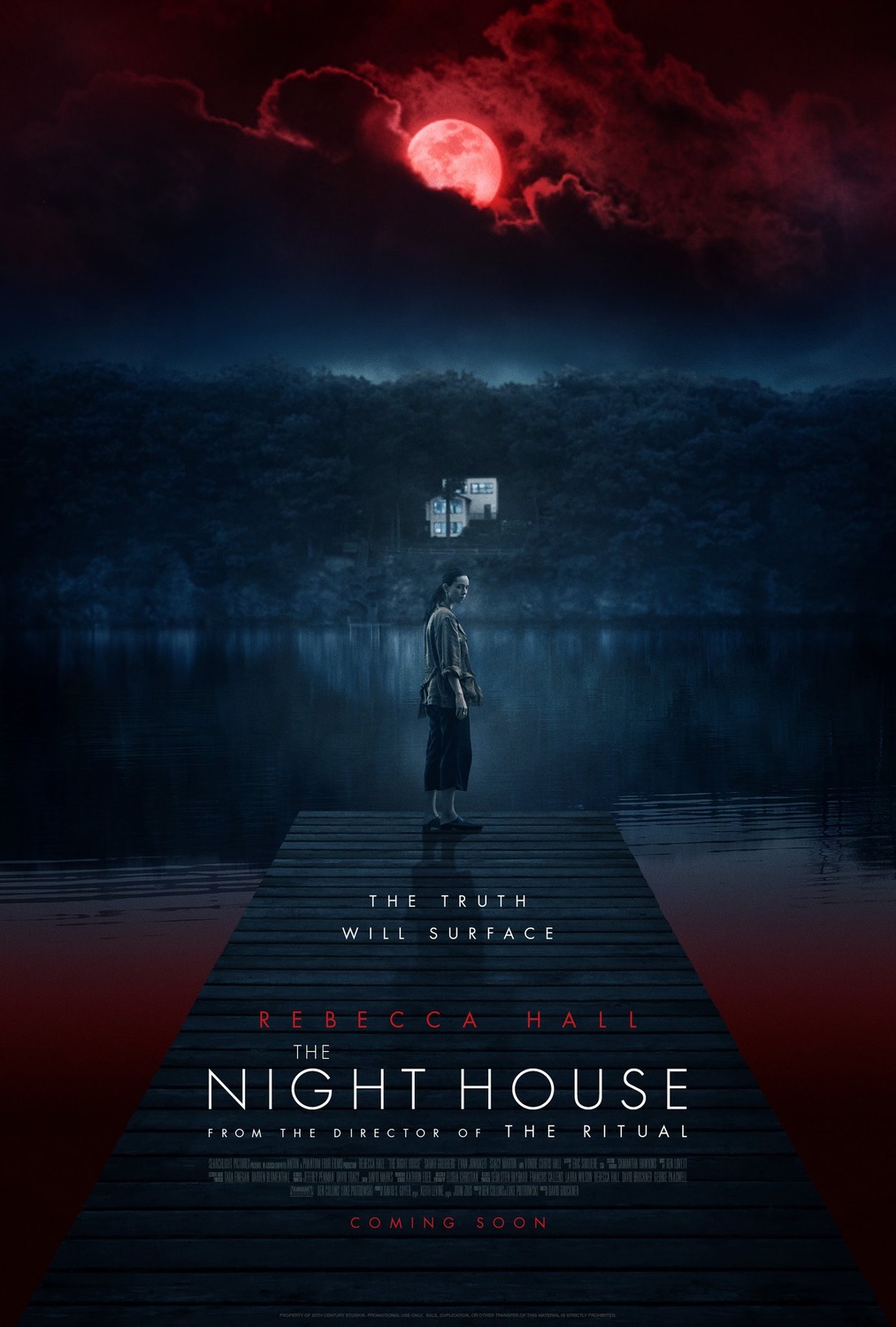
Plot and story take a backseat to the technical and performative elements of the mise-en-scene. The Night House represents a trend in horror that began as an emerging art house cinematic form championed by studios like A24 in the mid 2010s, continuing today. Many of the films that fall into this category are highly stylized through overtly artistic approach (artistic in that the hand of the auteur is clearly visible) or a minimalist approaches. While many of these films DO have a strong story told though established narrative conventions, some of them (and an increasing number) place so much emphasis on the look and feel of the film, that the filmmakers forget that they also need to tell a good story with a beginning, middle, and end that makes sense within the world that has been established on screen.
This house looks gorgeous, but the bones are weak. The Night House certainly delivers a haunting and unnerving atmosphere, excellent production design, fantastic editing, and a tour de force performance by Rebecca Hall, but its labyrinth-like plot and meandering story ultimately lead to “nothing.” If nothing else, this film works as a showcase for Hall in her one-woman show! And no mistaking it, her performance is outstanding–nearly Toni Collette Hereditary levels. Further notable elements in the film are the exquisite editing and cinematography that help to generate the ominous feeling of dread that you will feel the entire time. All of the aforementioned sounds like an incredibly effective mise-en-scene, doesn’t it? The problem with The Night House isn’t in the mise-en-scene as much as it is in the bones of the house itself, or the screenwriting.
My problem with films like The Night House, The Lighthouse, (am I sensing a trend here?) and others is the trend to ostensibly convince audiences, through the thoughtful craftsmanship of the mise-en-scene, that the film is more important than it is, that it has something substantive to deliver, or that the filmmaker is elevating horror (a term I despise because horror has always been the most truthful and progressive of all the genres). When this happens, the plotting suffers greatly. Why? Because the filmmaker considers themselves an artist that is above established conventions because there is a clear attempt to be unconventional, to be be a nonconformist, to rage against the system, if you will. So because they do not feel that they should abide by the guidelines or conventions of screenwriting or image montage (montage is French for assembly), they expect audiences to be so impressed by the gorgeous imagery on screen that the story or plot is of little consequence. Or there is the idea that these films aren’t for everyone or they are used as fuel for the pretentious you just don’t get it conversations on #FilmTwitter. Oh, many cinephiles just love that one, because they can elevate themselves.
Now, you are probably wondering if I think all films need to follow conventional filmmaking approaches. And the answer is NO. What?!? Did I just contradict everything I just wrote? Again, no. It’s when the filmmaker crafts a motion picture that they’ve clearly positioned to give the pretense that it’s more important than it actually is and fail to deliver the story that is so clearly attempting to be told. That is where I find fault with the filmmaker or screenwriter. Does that mean narrative/fictional films can’t be poetic in their form? Certainly not. One of my favorite horror films is Dario Argento’s Suspiria. And, even though I include this masterful work of cinema in my World Cinema class, I will also be the first to tell you that the plot is not very good. But, the beauty of Suspiria isn’t in the story, but in the euphoric experience of watching Argento create cinematic art with this violent, technicolor world accompanied by the mesmerizing score. The difference between Suspiria and The Night House is the simple fact that Argento did not create Suspiria to tell an important story. It’s a film that has grown in importance through the decades because we can find meaningful expression in the mise-en-scene. But that film didn’t hit cinemas to tell an important or thoughtful story. It hit cinemas to provide an experience!
What we have here is spectacle vs narrative. A subject I covered in my academic book On the Convergence of Cinema and Theme Parks. In the book, I look at the storytelling approached in themed entertainment when it intersects cinema. Without going too deep into that subject, I explore the idea of cinema of attractions. And films that do not tell a plot-driven story, are more about the attraction or experiential factors, not unlike a theme park attractions. With the increase in IP (intellectual property) based attractions (think: attractions based on movies), attractions have integrated story elements that aim to take the physiological experience and add the dynamic of story to it. A good example of this is found in Universal Orlando’s Hagrid’s Magical Creature Motorbike Adventure in the Wizarding World of Harry Potter: Hogsmeade at Islands of Adventure. Universal coined the term story-coaster. But I digress. When I evaluate a film, I often look at the implied attempt by the director (and marketing agency or distribution company), and I ask myself questions like: does the film give the impression that it is more important than it actually is? Is there an attempt to have a thoughtful message or some social commentary on dominant or emerging ideologies, and the film form takes precedence over the actual story? Are the films technical elements and acting so impressive that it hopes you don’t notice that the plot or story are weak?
While I have established that there is rightly a place amongst the greats for films that are visually stunning that don’t necessarily follow a traditional story structure (ie. Suspiria), the best films are often those that have a simple plot and complex characters. A simple plot forms the solid foundation and structure of the house (the bones, if you will), while the film form is everything that you see with the naked eye. It starts with the firm foundation and strong structural elements. Everything else is window dressing–important–but ultimately meaningless if the narrative is’t sound. What good is the building material of the walls, the paint, the type of windows, or kitchen cabinetry if the foundation or structure are weak??? I appreciate the intimate feel of the trend to release films that look artful so we can witness the cinema stylo of the auteur, but the filmmakers also need to remember the importance of plotting, pacing, and structure.
Ryan teaches American and World Cinema at the University of Tampa. If you like this article, check out the others and FOLLOW this blog! Interested in Ryan making a guest appearance on your podcast or contributing to your website? Send him a DM on Twitter or email him at RLTerry1@gmail.com! If you’re ever in Tampa or Orlando, feel free to catch a movie with or meet him in the theme parks!
Sweet on the outside, sour on the inside. Avisually impressive attempt to provide a thoughtful exploration on duality and identity, is overshadowed by heavy-handed ideology. Nia DaCosta delivers audiences a spiritual sequel to the cult horror film Candyman (1992) that is grounded in much of the lore of the original, yet forges a new frontier that simultaneously serves as a vehicle for horror legend Tony Todd to pass the hook onto Yahya Abdul-Mateen II. DaCosta is joined by writer-producer Jordan Peele and screenwriter Win Rosenfeld to “tell everyone” who dares to look in a mirror and call out his name five times. Admit it, even in our most rational state, we are still a little apprehensive to stare at our reflection and call out Candyman, Candyman, Candyman, Candyman, Candym–. That’s the power of horror films! These fictional stories on screen have their mystical ways of affecting the collective conscious in such a manner that we change or question our behavior. Another great example of this effect is the iconic highway scene in Final Destination 2. And challenging audiences was certainly what the three screenwriters had in mind when writing the story for Candyman (2021). Unfortunately, the agenda-driven message steels the focus away from the stunning visuals, and ultimately fails to effectively paint a portrait of reality that invites all to engage in the important conversations the film is trying to have, instead, alienating audience members that don’t share the filmmakers’ opinions. Suffice it to say, this film is Peele for the course.
In present day, a decade after the last of the Cabrini towers were torn down, rising star artist Anthony (Abdul-Mateen II) and his partner move into a loft in the now gentrified Cabrini. A chance encounter with an old-timer exposes Anthony to the true story behind Candyman (Todd). Anxious to use these macabre details in his studio as fresh grist for paintings, he unknowingly opens a door to a complex past that unravels his own sanity and unleashes a terrifying wave of violence. (IMDb)
If you’ve never seen the original Candyman, don’t worry. While having seen the original will certainly help audiences to appreciate world-building and backstory elements, there is enough context given to help those that may be unfamiliar. Following the screening I attended, I heard individuals negatively critique the retconning of plot elements in the original; truth is, the parts of the original that were reimagined to fit the backstory of 2021’s Candyman were thoughtfully adapted.
While I have my reservations with the film, I would be remiss to not highlight the excellent direction, cinematography, editing, costuming, production design, and even the performances! Visually, the movie is stunning! All the mise-en-scene elements work together to create a BIG SCREEN experience. And talk about outstanding performances. Back in the heyday of the slashers (late 70s through the 90s), we did not expect to be impressed by the performances of the cast. And while there are notable exceptions of horror films WITH brilliant performances, usually it’s not expected. Over the last 7–10 years, horror films have been stepping up their performance game. The lead and most of the supporting cast will all captivate you. Unfortunately, there are useless characters like Brianna’s (Anthony’s girlfriend’s) brother and his boyfriend. Having no real affect on the plot, this interracial gay couple was little more than a token that could be removed from the movie, and the movie still play out the same way. However, if it weren’t for these two characters, the movie would be lacking ANY humor. So I suppose that was their purpose, to add humor.
There are so many beautifully crafted shots and shot sequences in this film. From juxtapositions of the old meeting with the new to geometric shapes and lines, there are many excellent compositions. The production and set design and lighting, of this film, are used in similar ways that the designs in expressionism are used. Expressionism uses the design of buildings, costumes, lighting, and camera angles to externalize emotions, psycho-social states of being, and ideas. And with expressionism being part of the formula of horror (expressionism+surrealism+Poe+Freud), it makes sense how and why there would be this care shown in the mise-en-scene.
All the backstory elements are communicated through the brilliant use of shadow puppets. The shadow puppet sequences are perhaps my favorite recurring diegetic device used in the film. Not only do these shadow puppets provide exposition, they also move the plot forward in action and subtext.
The idea of shadow puppets as a storytelling device is best explored in Plato’s Cave. French film theorist Jean-Louis Baudry likened the movie theatre to Plato’s famous allegory Plato’s Cave found in Plato’s Republic. But since we’re not all film or philosophy theorists, here is a quick explanation of Plato’s Cave:
The allegory states that there exists prisoners chained together in a cave. Behind the prisoners is a fire, and between the fire and the prisoners are people carrying puppets or other objects. This casts a shadow on the other side of the wall. The prisoners watch these shadows, believing them to be real. Essentially, what Plato is exploring is the concept of “belief vs knowledge.” The prisoners (or audience) in this analogy believe the images on the wall as reality; when in actuality, it is only the puppeteers version of reality. The analogy goes on further to describe a prisoner breaking free and venturing from the cave out into the real world. Two things happen (1) the newly freed prisoner completely rejects the imagery in the cave and returns to warn the prisoners of their one-dimensional view of reality, and risk being killed for a radical view, or (2) the freed prisoner fears or cannot reconcile actual reality and retreats back into the cave, where there is comfort in the surroundings, to warn the prisoners not to leave. Therefore, this highlights how a lack of knowledge leads to blind belief.
Despite being centuries old, the allegory is appropriate for filmmaking. After all, the audience watches images on a screen. We’re meant to believe it to be real, but we know it’s false. Only when we step out of the theater back into reality can we take what we’ve learned in the cinema and apply it to our lives. In a literal sense, a movie is just a series of images. But digging deeper, they present unique ideas and themes that we can take with us into the real world. Numerous movies utilize this concept in their plots and themes. You have probably seen films where a character believes one reality and then becomes exposed to another, greater reality and is never the same. In the case of 2021’s Candyman, DaCosta, Peele, and Rosenfeld have metaphorically trapped the audience in an ideological cave to present their versions of our reality that exists outside the cinema’s doors.
The movie has some great kills! But it highlights a moral problem plaguing this movie. From the art gallery to the critic to the girls at the prep school, the only victims, to meet their gruesome demise ON screen, are white characters. While there are a couple of off-screen deaths of black characters, the only ones in the visible mise-en-scene to meet with Candyman’s iconic hook are white. Had this movie been directed and/or written by a white writer-director and only killed and disparaged black characters, there would already be a #cancel campaign on Twitter. In my five years as a film professor and seven years as an active critic, I cannot ever recall a horror movie (in particular, a slasher movie) that ONLY killed black characters and disparaged the black community in virtually every scene from the opening to the closing. So if that would not be tolerated by the public–and for good reason, a movie released like that in 2021 (or ever) would be in incredibly poor, despicable, disrespectful taste–then the inverse should not be acceptable here.
I get what DaCosta, Peele, and Rosenfeld are trying to do with this horror movie. From the time of Cabinet of Dr. Caligari and Nosferatu, horror has been used to comment on societal observations to either warn of an impending dangerous ideology, to provide allegorical material that can be used as a framework to better understand marginalized groups, or even to challenge systems or institutions. Which is why horror is often far more truthful than a straight drama. Of course, one can make the argument that this is a fictional film in a fictional Chicago, which is not untrue; however, the problem therein is that little (if anything) in this fictional Chicago sets it apart from the real world, except for the supernatural character of Candyman, because these filmmakers have a point to make. But the problem here is that the very people that these writers want to challenge are the very people that are being unfairly represented in the movie. How is any of that constructive to the conversations of race relations and policing??? Short answer: it’s not.
The symbolism I did appreciate in the film are the moments that we explore the duality in ourselves and our environments. This is represented through literal and metaphoric reflection. Mirrors (or reflections) are regularly used to communicate duality. One of the best examples in recent years, in how mirrors are an effective cinematic device, is the mirror scene in I, Tonya. Just before her final competition in the film, as Tonya is applying her high contrast makeup, we witness in the mirror the internal struggle. On the outside, she is this accomplished figure skater (probably the best athlete the sport has ever seen) but on the inside she is tormented by her mother, her abusive marriage, and what she did or didn’t know about the incident. Likewise, in Candyman we explore the history and identity of Anthony and his neighborhood. Anthony has a secret in his past that has been painted over, that is trying to resurface, and his neighborhood of Cabrini Green has a sordid history that it has tried to cover and hide behind a fresh coat of paint. History is always there. It cannot be erased. And if it’s not dealt with, it can become a specter and haunt you and your environment. The mirrors and other reflective surfaces of Candyman are brilliantly used to communicate this idea of duality.
It is clear that DaCosta is a gifted director, but I hope that she works with different writers in the future that can find that balance of commenting on or raising awareness of something important, but also finding the ways to bring everyone to the table for a thoughtful discussion. The power of cinema, and in particular horror films, is that it can bring diverse groups of people together from all walks of life to both be entertained and challenged through screams, jumps, and laughter.
Ryan teaches American and World Cinema at the University of Tampa. If you like this article, check out the others and FOLLOW this blog! Interested in Ryan making a guest appearance on your podcast or contributing to your website? Send him a DM on Twitter or email him at RLTerry1@gmail.com! If you’re ever in Tampa or Orlando, feel free to catch a movie with or meet him in the theme parks!
“Welcome to prime time” in the final article of my 2021 Sinister Summer series. This month’s article is covering the much lauded tertiary installment in the A Nightmare on Elm Street (ANOES) franchise Dream Warriors written by Wes Craven & Bruce Wagner (Maps to the Stars) and directed by Chuck Russell (The Blob, 1988), with returning ANOES stars Heather Langenkamp reprising her iconic role as the (in my opinion) definitive final girl Nancy Thompson, John Saxon as her father and the now disgraced former police Detective Thompson, Patricia Arquette in her breakout role, Laurence (credited as Larry) Fishburne, and of course Robert Englund as the terrifying and hilarious nightmare-inducing Freddy Krueger! Talk about a powerhouse cast! It’s not often that a sequel can rival the original installment in a horror franchise, much less the third installment. But A Nightmare on Elm Street 3: Dream Warriors (from hereon out Dream Warriors), is a heavy hitter that some even argue is better than the first one (a sentiment that I don’t share); however, it is certainly on par with the original, and that is largely due to the outstanding writing of Wes Craven. Dream Warriors is not simply a great horror film, it’s a great film period! And it’s Craven screenplays like the original, Dream Warriors, and New Nightmare that cement him as one of the great horror screenwriters of all time, not to mention his brilliant direction in the SCREAMfranchise (particularly the original and SCRE4M). While cinema academics and critics can argue all day long which is better (I or III), what both camps of subject matter experts can agree on is that THIS is the film that transformed Freddy from great horror villain to the revered, timeless icon of the horror genre that he is!
For those of you who haven’t seen this excellent work of horror cinema (what are you waiting for?!?). Expanding the story universe, the action takes place outside of the titular address 1428 Elm Street this time around; and instead focuses on a bunch of Springfield teens who occupy the local psychiatric institute. These teens are the last of the Elm Street children, and all suffer from various sleep disorders. The clinic’s answer: keep them doped up on dream blocking drugs (hypnocil). Nancy Thompson is now a graduate student at the institution whom specializes in sleep disorders. Through a series of accidents, she realizes that the patients are being hunted by Freddy Krueger in their dreams. Over the years, the stories of Freddy and the kills from seven years prior are all but the stuff of legend, and so Freddy has lost much of his power because no one remembers (or fears) him. That is all about to change when he figures out how to gain his former strength. Nancy becomes a de facto general as she leads her Dream Warriors into battle against the malevolent Freddy IN the dream realm.
The Dream Master is back, and with all the one-liners and signature kills that are on brand for him! Having seen his beloved character completely misinterpreted in the first sequel (Freddy’s Revenge, which was panned by critics but has sense seen a cult following within the gay community because of the homoeroticism in it), it was completely understandable that he wanted to return as the Godfather of Freddy this time around. He took on both co-writer and executive producer duties. Sharing story by and screenwriting credits with Bruce Wagner. The film’s director Chuck Russell also contributed to the script but only officially holds the director credit–not a bad deal. Before the first draft of Dream Warriors was written by Wes Craven, he conceived of an idea that the film’s characters be self-aware and the plot would play around with the idea of knowing what the horror tropes are and play it to both dark comedy and tragedy. New Line did not go for the idea, and said it wouldn’t work. Gee, a Craven-helmed self-aware horror movie that plays around with horror tropes to create a meta horror movie? Nah, that’ll never work. It would be another seven years before we would get meta horror in Wes Craven’s New Nightmare and nine years before SCREAM.
The final product of Dream Warriors differs greatly from Craven’s original ideas and screenplay for the film, which was much darker in tone (even darker than Freddy’s Revenge). In fact, the characters themselves were quite different in Craven’s original script. For example, Freddy does not have his trademark one-liners, so yes that means no “welcome to prime time, bitch!” (arguably his most Freddy line out of the whole series). Instead, he was much more brutal and violent, and even more graphic in how he taunted and terrorized the teens. The two elements that all, involved in the writing of this film, agreed on was that the teens would have special powers when in the Dream World with Freddy and the plot should include Nancy Thompson. When it was conceived to bring the teens into Freddy’s dream world, Craven questioned “why would Freddy be the only one to have powers here?” So the Dream Warriors were born. New Line eventually ordered a rewrite of the script to increase Freddy’s memorable, twisted sense of humor and witty one-liners and to transform the screenplay from an action-driven plot to a character-driven one. And it’s that character-driven nature of Dream Warriors that gives it the high level of quality that it has. It’s not just about Freddy or his kills, but it’s about the emotional hero journey of these vulnerable teens.
Responsible for the rewrites were Russell and Wagner. Analyzing the screenplay itself, it is clear that both Russell and Wagner were knowledgable in not only the previous two ANOES movies, but the nuance of the horror genre itself. Much more than in the original film, the rewrites also show a penchant for integrating pop culture influences into the dream-state personalities of the characters; and it’s the obsession with pop culture that ultimately contributes to their demise. Among other narrative elements, Russell and Wagner are particularly responsible for the demographic makeup of the teens that we get in the final product by changing many of the ages, sexes, and ethnicities of them. And talk about diversity in ethnicity, physical ability, intelligence, and gender! Jennifer, the young girl obsessed with TV and becoming an actress in Hollywood. Will, the young man confined to a wheelchair who is a huge nerd Dungeons and Dragons geek. Phillip, a young man who loves to create marionette puppets. Taryn, a former heroin addict looking to stay clean and sober. Joey, the quieter one in the group but incredibly horny for the ladies. Kristen (Arquette), who dreams of being an olympic gymnast and has a special kind of ESP that connects her with others. And Kincaid, a tough, short-tempered, and at times violent teen with a sarcastic sense of humor. Outside of Nancy, the other important adults include the often misinterpreted Nurse Ratched-like Dr. Simms, whom really is doing what she thinks is medically best for the teens to help them recover. And Max (Fishburne), the brave orderly.
Dream Warriors‘ screenplay is incredibly lean, and wastes no time in establishing the world of the disturbed teens before launching the audience, full-throttle, into the action plot. For starters, the opening scene of Dream Warriors is fantastic! I would put it up there with the opening to SCREAM, although SCREAM is at the top of my list of best openings–not just in horror-but in all of cinema. The opening to Dream Warriors is perfect because it re-introduces us to Freddy, including his grisly past and insight into the epic, terrifying dream world he creates for his victims. Furthermore, we get an elaboration on his backstory, including more insight into his fiery earthly death and his origin as “the bastard son of a hundred maniacs.” Adding to his intriguing, horrific origin is the idea that his mother was a nun, which is a terrifying idea that this horrific figure could have been spawned by any number of madmen raping a nun. All this adds to Freddy’s mythos and is perfectly accompanied by the iconic ANOES score. All these storytelling elements work together to set the tone for a masterful work of horror cinema. One that is more concerned with the characters, themes, and social commentary than merely the elaborate, entertaining, showman-like kills and memorable one-liners.
Showing the depth and complexity of the American horror film, this film tackles the tough, taboo subject of teen suicide. While teen suicide remains an issue today, it was more pronounce in the 1980s. Beyond after-school-specials and PSAs, this was a difficult subject for films (certainly at that time) to tackle. But when there is a tough subject to tackle, leave it to the American horror film to provide insight into and comment on it in unique ways. Much like Nancy and the Dream Warriors face their worst nightmares, the horror battles tough subjects face on! Not only does Dream Warriors tackle teen suicide, it also tackles drug addiction, broken families, self-esteem, and identity issues. A close reading of the imagery associated with the trauma experienced by the teens can be read as a metaphor of adolescence, transitioning from childhood into adulthood. Whether experiencing direct or implied trauma from Freddy, their family, friends, or the hospital staff, the teens endure gaslighting, imprisonment, mental rape, and attempted murder (and times, murder itself) all within the confines and intimacy of the mind. One can easily make the argument that Dream Warriors is a clever PSA on these subjects masquerading around as a horror movie.
Langenkamp’s Nancy’s return to the series showed us more mature side of Nancy. Gone was the shy girl turned bad ass from the original; now she truly was a survivor! And in Dream Warriors, she is the only adult authority figure that actually takes the time to listen to the teens, which is what ultimately points her in the direction of Freddy. Interestingly, her care for these teens evolves into a sort of maternal role in this film. Throughout this film (and franchise) there are images of mothers (and parental figures) that are explored through the conflicts, kills, and dreams. We know that Nancy had an absent mother before she got fired, so Nancy is striving to be the mother to these teens that she never had. While Detective Thompson is washed up at the beginning of this film, and took him a while to come around to Nancy’s plight in the original, he is actually one of the better parents (and fathers) we have in horror. And this film gives him a sort of redemption arc that I greatly appreciate.
Nancy also demonstrates the ability to be in a constant state of learning, even though she is a subject matter expert graduate student in this film. But Nancy is not without her own vulnerabilities. She may have exchanged her pink rose pajamas for 80s power suits, but she is still the same Nancy. Despite her more mature, calm, collected exterior, she is still haunted by her former Freddy nightmares and the ordeal from seven years prior. This makes her character incredibly relatable because she isn’t (and neither is anyone else in the movie) a superhero, she isn’t morally/ethically perfect, she is a flawed person like you and me. But she is harnessing the energy of these fears and flaws, and channeling them into making a difference in the lives (and dreams) of these teens.
The film is called Dream Warriors for a reason, and that reason is because each of the tormented teens gains supernatural power in Freddy’s dream world. And it’s not some arbitrary super power–no–it’s a power that is an answer to their vices and weaknesses. One of the common themes of horror is perceived powerlessness. And there is no better franchise for exploring powerlessness than ANOES because Freddy attacks you when you are your most vulnerable–when you’re sleeping. And we must all sleep at some point–it is unavoidable. Except in this film, his victims band together to battle Freddy on his own turf. While most of them wind up dead–after all, we are usually left with the final girl in slashers–they do not go down without a valiant fight! Through their nightmares, they show that they can overcome that which torments them. On the surface, they are fighting Freddy, but really, they are fighting their own personal demons that have traumatized them.
Now, it wouldn’t be ANOES movie without Freddy’s magnificently creative kills and catchy one-liners. And Dream Warriors has some of the best kills in the entire franchise! I do not have time to go through each of them, but I just have to highlight my absolute favorite Freddy kill and one-liner of all time. Not only is it mine, but this kill and accompanying one-liners are often in the Top 5 and even Top 3 from fans, critics, and scholars alike. And it’s Jennifer’s Welcome to Primetime kill!
The beauty of this particular kill lies not only in its simplicity, but in this scenes’s energy and showmanship that is 100% trademark Freddy from beginning to end! Jennifer is trying to stay awake by watching television in the TV room. Max comes in to escort her to bed because it’s late, but she begs him to let her stay up a little while longer. Reluctantly, he agrees to let her stay up and watch TV but he warns her that if she’s caught that he won’t help her out. She agrees and Max leaves. Thinking that the TV alone may not be enough to keep her awake, she burns herself with a cigarette. While much of this film could very well happen today, we get a totally 80s moment here with Jennifer watching the Dick Cavett Show featuring an interview with (and cameo by) the legendary Zsa Zsa Gabor! During the interview, Dick turns into Freddy and slashes at Ms. Gabor! Then the TV turns to that static screen that we don’t get anymore. Confused by what is happening and at the sounds of those all-too-familiar Freddy victim screams, Jennifer gets up and turns the channel knob, but it does seem to fix the problem. Angry at the TV, Jennifer smacks it and suddenly two razor-clawed mechanical arms burst out of the side and pick up Jennifer. Then Freddy’s TV antennae-wearing head emerges from the top of the TV and makes cinema history by saying, “this is it Jennifer, your big break…welcome to primetime, bitch!” Then smashes Jennifer’s head into the TV. And it is likely due to that kill and line that Freddy continued to develop more of a twisted sense of humor throughout the series. Of course, too much of a good thing is a bad thing, which we also see in the subsequent installments.
If Welcome to Primetime is the film’s (and possibly series’) best kill, this next kill is the most shocking out of the series. And it’s the death of final girl Nancy Thompson. Even though Nancy goes out as a ballsy warrior, it was completely unexpected that she would die. But that death made her return in New Nightmare all the better! In dying, Nancy successfully passes on the torch of the Elm Street protector to Kristen. While Freddy’s motivation for killing the other Elm Street teens in this movie is an extension of what drove him to murder the teens in the previous installments, his motivation for killing Nancy was more than revenge brought on by his death at the hands of the Elm Street parents; it was revenge for doing the impossible–defeating him by taking away the source of his strength: her fear. While it was “nothing personal” in the other murders, his desire to kill Nancy was very personal.
Dream Warriors was a hit with both critics and fans! How often do you hear that with horror movies, much less sequels. In fact, in my opinion as a film professor specializing in the American horror film, I argue that the best films in the ANOES franchise are: A Nightmare on Elm Street, Dream Warriors, New Nightmare, and Freddy vs Jason. The final script was praised highly for its pacing, thoughtful commentary, character development, and imagery. With a higher budget thanks to the successes of the original and Freddy’s Revenge, the special effects and set design were cutting edge! This is especially true of the scenes in Freddy’s Hell. Is the film flawless? No. However the few flaws the film does have in no way detract from the cinematic experience of the story. More than 30 years old, this film is widely considered to be among the best horror films of all time, and will continue to be the stuff of nightmares for decades to come.
Ryan teaches American and World Cinema at the University of Tampa. If you like this article, check out the others and FOLLOW this blog! Interested in Ryan making a guest appearance on your podcast or contributing to your website? Send him a DM on Twitter or email him at RLTerry1@gmail.com! If you’re ever in Tampa or Orlando, feel free to catch a movie with or meet him in the theme parks!
Welp, that’s an hour and a half, or 18 months, of my life on which I’ll never see a return. M.Night Shyamalan is up to his old tricks again in his latest film about one of the most primal fears of all: aging. From the moment we are born, we start to die, and it’s that fear of aging and death that links everyone on earth together. While many horror films feature slashers, ghouls, demons, monsters, the living dead, nature on a rampage, or just your mother-in-law, the chances of you encountering any of those are about as slim as Netflix reviving Santa Clarita Diet–well, except for the mother-in-law; that one is likely. Shyamalan chooses to focus on the one fear we all share: the ravages of aging. And it’s because of this, that virtually every character in the film is relatable on some level (unfortunately that level is quite minimal). Combine the primal fear of the inevitability of aging with the ticking time bomb literary device, and you have the makings of a thrilling plot. That is, if this plot and these characters weren’t written by the cinematic king of head-scratch bizarre endings, huh?, and what the? moments. Since his feature debut of The Sixth Sense in 1999, I am convinced that M.Night is a gifted director. But he should probably work with more talented screenwriters. What we have here is an original premise (as far as I know) with so much potential for intense windup and explosive delivery; moreover, there is even a prime opportunity to have thoughtful commentary on aging, emotionally, physically, and mentally. It’s all there! But sadly, and to my bewilderment, M.Night chooses to simply move the characters around the island aimlessly, with only occasional meaningful conflict that serves a greater purpose than simply the shortest distance between action beats A and B. Other than the mechanics of screenwriting themselves, perhaps the biggest problem is trying to focus on too many main ideas. He should have had one main action plot, and then supported it with emotionally or psychologically-driven subplots that weave together to point back to the central idea he was trying to convey. Unfortunately, OLD is a convoluted collection of ideas, none of which are ever thoughtfully developed and strategically executed.
For my full thoughts, you will need to listen to me on the Reel Spoilers podcast on July 29, 2021.
Ryan teaches American and World Cinema at the University of Tampa. If you like this article, check out the others and FOLLOW this blog! Interested in Ryan making a guest appearance on your podcast or contributing to your website? Send him a DM on Twitter or email him at RLTerry1@gmail.com! If you’re ever in Tampa or Orlando, feel free to catch a movie with or meet him in the theme parks!




 R.L. Terry ReelView