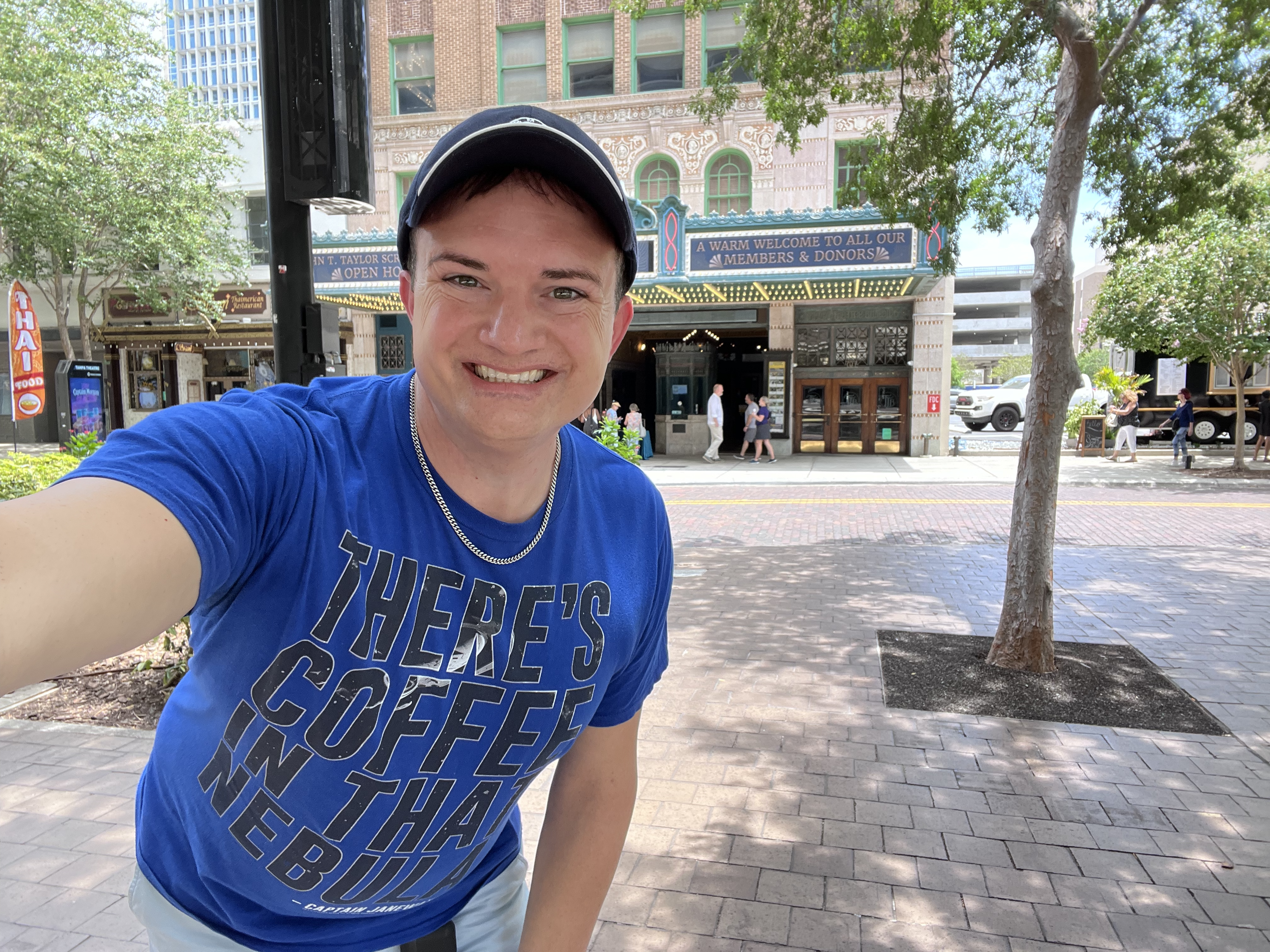
Ryan “Professor Horror” Terry teaches film studies and screenwriting at the University of Tampa. He holds graduate and undergraduate degrees in film and media studies. He has regularly published film reviews since 2014 and has been a featured speaker at Tampa Bay Comic Con, Spooky Empire, and the historic Tampa Theatre. His work has appeared in both political and entertainment magazines.
A mediocre thriller that is sufficiently enjoyable. M. Night Shyamalan’s TRAP, starring nineties heartthrob Josh Hartnett, is a perfectly satisfying way to spend a rainy afternoon. The most enjoyable aspect of the movie is the performative dimension. Hartnett delivers a chilling performance as the serial killer The Butcher. Before you @ me, his identity is revealed early in the movie. But that’s the point, it’s not a movie that builds its suspense on the identity of the killer; rather, the suspense is built upon how he is going to escape the FBI after being tracked to the Lady Raven concert in Philadelphia. Hartnett’s performance is completely unsettling from the beginning when we sense that there is something a little off about his character. There is a side-plot that goes nowhere, that feels superfluous, but otherwise, it is a tightly written script with thoughtful pacing and a nice payoff. I appreciate this vehicle that allows Hartnett to showcase the range of his talent. Because he pulls off warm and charming and completely unnerving. The cameo by screen legend Hayley Mills was a nice touch, and Shyamalan’s daughter also delivered a solid performance as the trusting daughter. While I cannot say that I was particularly wowed by this movie, I can say that I enjoyed my time well enough. It’s a fun movie that provides a thrilling ride for the relatively brief runtime.
Ryan teaches Film Studies and Screenwriting at the University of Tampa and is a member of the Critics Association of Central Florida and Indie Film Critics of America. If you like this article, check out the others and FOLLOW this blog! Interested in Ryan making a guest appearance on your podcast or contributing to your website? Send him a DM on Twitter. If you’re ever in Tampa or Orlando, feel free to catch a movie with him.
Exhausting. Deadpool & Wolverine is a step down from its predecessors in terms of quality and cleverness of storytelling. While clearly intended to be a movie that reinvigorates the MCU, the screenwriting is both pandering and derivative. While effective in smaller doses, the hyper-meta humor is overplayed to the point of being obnoxious. Moreover, there are many gags that are recurring to the point of boredom. While expertly choreographed, shot, and edited, the endless barrage of fight sequences overstays its welcome. In terms of the premise, the whole multiverse idea that has been integrated into so many superhero movies (both MCU and DCEU) is overplayed. Had the movie been closer to 90-100 minutes, then perhaps the pacing would’ve been better and the Deadpool jokes, satire, and gags would not have felt overplayed, but the 2+ hours runtime works against the full potential of the narrative. If you can’t get enough of the Deadpool schtick, then you’ll undoubtedly like this movie. But if you were hoping for something as clever as the first two Deadpool movies, then you may be as disappointed as was I.
When the multiverse is threatened by a powerful Omega class mutant, Deadpool’s services are retained to protect the multiverse from complete collapse. In order to defeat this new deadly enemy, Deadpool teams up with the Wolverine, whom is recovering from psychological injuries.
Because of the movie’s setup, I had hoped that Deadpool and Wolverine’s goal would have been to eliminate all timelines except the sacred timeline (I guess that’s supposed to be the real/our world), putting an end to the multiverse, but that wasn’t the motivation or goal. So, I suppose that means the multiverse theory will continue steamrolling through this and other franchises. The whole multiverse theory needs to die. At this point, it is way past its half-life and rather limiting on the stories that can be told. Sounds counterintuitive, right? For how could a multiverse limit the stories that can be told? Simple. Everything is connected in a codependent sort of way. In a cinematic (including television counterparts) multiverse, no story, character, or plot is truly independent of the other; therefore, a filmmaker is unable to craft an original story; for any story involving the characters in a multiverse, has to fit in with the rest of the multiverse.
In a manner of speaking, a multiverse actually mitigates freedom of expression and variety of storytelling. When filmmakers return to crafting original expressions of stories and plots for comic book characters, then the quality of comic book movies may agin reach the levels of the Burton-verse. To this day, Batman 89 and Batman Returns are still the two best examples of superhero/comic book movies with X-Men the Animated Series being the best example of a superhero/CBM television series.
Fortunately, Hugh Jackman’s Wolverine’s gritty, no nonsense personality helps to balance out Ryan Reynolds’ manic Deadpool. While I have many reservations with this movie, I cannot deny the great chemistry between the two of them. Jackman’s X-Men the Animated Series inspired Wolverine was my favorite part of the whole movie. Partly because I grew up with X-Men TAS and have enjoyed the X-Men 97 series. Seeing that yellow and blue suit filled me with such happiness. Additionally, there are other nods to X-Men TAS and the Fox X-Men movies, including a particular surprise cameo that I know my friend Shawn of the Solving for X podcast will immensely enjoy! (If you’re an X-Men fan, then you should add this podcast to your lineup). What I liked most about this movie was the X-Men dynamic. Even though I have my reservations, I am curious how this newest iteration of cinematic X-Men will be adapted for the big screen. It is my hope that it will have the quality of storytelling of X-Men TAS that successfully addressed difficult topics in the real world both creatively and accessibly, all while bringing everyone to the table. Just as Professor X dreamed humans and mutants could engage in meaningful discourse one day.
Breaking the fourth wall and meta-humor can be effective tools for both humor and plot/character development; however, recurring pot shots and real-world references detract from the cleverness of the humor, and can ultimately take the viewer out of the movie. More so than the previous installments in the Deadpool franchise, this one is particularly packed with, what I am calling, hyper-meta humor. Hyper in that it’s so over the top and repetitive that it loses its charm quickly and grows stale. Most movies serve as a means of escape from the dullness, harshness, or complexities of reality; this is certainly true of superhero/comic book movies–or rather, was. I don’t know about you, but I don’t go into most movies hoping to be reminded of reality. Unless of course, for example, it’s based on a true story or a melodrama that is intended to evoke a real-world emotive response. So many of the jokes in Deadpool & Wolverine take me out of the movie, especially one recurring pot shot, that I won’t mention, that is borderline disrespectful of an historic Hollywood institution.
Despite most of the movie, in my opinion, to be lacking in genuine, clever humor, I manages to at least laugh here and there. The problem with a movie built entirely on the humor of middle school boys is that the move is ironically inappropriate for that same age group. When the first Deadpool released (by 20th Century Fox), they did the responsible thing by reminding parents that, even though this was a superhero movie, that its intended audience was 17+. I’ve yet to see an effort on Disney/Marvel’s part to remind potential audiences that this movie is rated R, and not appropriate for younger audiences due to the sexual innuendoes and language. Violence wise, other than the increased amount of blood, it’s on par with many PG-13 movies. When Deadpool hit the scene, he was different from that of most other superhero characters at that point, and his schtick was refreshingly funny; now, with the increased amount of middle school base humor in many comic book movies (mainly the MCU), it’s no longer refreshing and now borderline obnoxious. If I had to select one word that best describes Deadpool & Wolverine it would be obnoxious.
Ryan teaches Film Studies and Screenwriting at the University of Tampa and is a member of the Critics Association of Central Florida and Indie Film Critics of America. If you like this article, check out the others and FOLLOW this blog! Interested in Ryan making a guest appearance on your podcast or contributing to your website? Send him a DM on Twitter. If you’re ever in Tampa or Orlando, feel free to catch a movie with him.
Plot chasers. Despite the great chemistry between the leads of Daisy Edgar-Jones and Glen Powell, this cinematic storm is lacking the necessary elements in both thoughtful plotting and character development to form a compelling story. And while most of the special effects are excellent, it comes off feeling like one long storm chase. If it wasn’t for Edgar-Jones and Powell, I’d just as soon watch the Weather Channel instead. Twisters tries to be too many different kinds of stories, and isn’t successful at any one of them. There is an attempt at underscoring the outside-action narrative(s) with a heart-felt inside-emotional story, but even that isn’t fully developed. While there are some well-written scenes that will pique your interest, aside from the disaster porn dimension of the movie, there isn’t much here of any great interest.
Haunted by a devastating encounter with a tornado, Kate Cooper (Edgar-Jones) gets lured back to the open plains by her friend, Javi, to test a groundbreaking new tracking system. She soon crosses paths with Tyler Owens (Powell), a charming but reckless social-media superstar who thrives on posting his storm-chasing adventures. As storm season intensifies, Kate, Tyler and their competing teams find themselves in a fight for their lives as multiple systems converge over central Oklahoma.
The lack of a compelling narrative has far less to do with Lee Isaac Chung’s directing than it does Mark L. Smith’s screenwriting. No real surprise there since his other recent screenwriting credit is The Boys in the Boat, which also suffered from poor plotting and character development. While Joseph Koskinki receives a story-by credit, clearly he has demonstrated that he is a much better director (Top Gun: Maverick) than he is a writer. Both Twisters and The Boys in the Boat have a compelling story to tell, but the plotting itself (the map of how you get from beginning to end) lacks meaningful direction or focus. The movie sets up one story of overcoming trauma, then becomes a white collar vs blue collar story, then turns into a story about storm profiteering, which morphs into a melodrama about overcoming fear and guilt, just to finish as a romcom. All the while, the external goal of the story, which is setup successfully in the beginning, doesn’t get revisited and become clear until the third act. There is about as much narrative depth in Twisters as any given episode of Storm Chasers. Where is will give Smith, Kosinski, and Chung credit is that they didn’t choose to make this a “preachy” movie about ecoterrorism or climate change. Sometimes bad storm just happen. And that’s what makes them scary; there is no explanation.
Even though the themes of the movie are not very well developed, I like that Smith was trying to do with the subtext of the movie. Without getting into spoilers, there is an attempt at spotlighting how some people that appear that they are trying to help storm victims are actually more interested in profiting off the disaster. Which, I imagine does happen in real life. The movie also has something to say (and this was actually pretty well developed) about not judging the level of competence or motivation based on face-value or first impressions. The very people that look unprofessional may be even more professional and genuine than the ones that appear like they have it all together.
Other than some badly CG’d dandelion fuzz (which should’ve been done practically, c’mon). the rest of the special effects in the movie are excellent. Okay, so maybe excellent is being a bit generous, but I’m trying to give the film some credit for not putting me to sleep. I screened the film in Dolby Cinema, which is the best way to watch this movie because aside from the chemistry between the leads, the reason to watch this movie is for the storms and disaster porn thereof. Perhaps the story is on SyFy or Weather Channel levels, but the storm effects are executed very well. I was disappointed that we did not get a flying cow as a nod to one of the most memorable moments in the wildly popular original Twister. It’s well-known that the first movie literally built and destroyed houses to achieve the full effect and impact of the tornadoes, and it appears that Twisters used miniatures and models for some of the disaster scenes. Practical beats CGI nearly all the time. Also like the first movie, this one also appeared to integrate real footage of tornadoes and the disaster left in their wake.
The force that keeps this movie from falling completely apart is the chemistry between our leads of Daisy Edgar-Jones and Glen Powell. Playing Kate and Tyler, respectively, there is a throwback style (almost romcom-like) romance between the two in the vein of “will they, won’t they.” Even though Kate is our central character, it’s Tyler that receives more thoughtful development. Kate is largely the same from beginning to end, despite a great setup for overcoming trauma and guilt. Both of these characters (and their respective actor) keep this movie from falling completely flat. The playful chemistry between the two gives the film a human dimension that it is sorely lacking otherwise. Moreover, I like the fact that the budding romance between the two did not become the focus of the movie, but it certainly adds to the film in a constructive way. Both Edgar-Jones and Powell have an old-school charm that feel refreshing to see in contemporary cinema.
Whether or not you have recently rewatched the first movie, you can confidently go into this movie knowing all you need to know. There is little, if any, connection to the original 1996 blockbuster. For those that are super fans of the original, I imagine there are more nods to the first movie than that which I identified. If you’re looking for movie this summer to escape the heat with the whole family, then this is a good pick, but don’t expect much more than a mildly entertaining couple of hours.
Ryan teaches Film Studies and Screenwriting at the University of Tampa and is a member of the Critics Association of Central Florida and Indie Film Critics of America. If you like this article, check out the others and FOLLOW this blog! Interested in Ryan making a guest appearance on your podcast or contributing to your website? Send him a DM on Twitter. If you’re ever in Tampa or Orlando, feel free to catch a movie with him.
We all go a little mad sometimes. Once nearly banned on bookshelves, American Psycho (2000) is the film adaptation of a book about materialism, narcissism, yuppie culture, and the inter-personal empty feeling that comes along with it. Interestingly, despite this film commenting on and taking place in the 1980s, it also holds strong relevance for the 2020s. Except, if this movie were made in the 2020s, its social commentary would be on toxic consumerism, social media influencer culture, and political polarization.
Even though the central character of Patrick Bateman (Christian Bale) reeks of snobbery and pretension, Mary Herron’s brilliant horror-meets-dark comedy motion picture is raw, gritty, and unapologetic. The movie that was once protested by women was, in fact, directed by a woman. It’s a candid, fantastical exploration of the state of humanity when it loses its identity in exchange for the facades of prestige, money, and power. Herron externalizes all the emotions and thought processes she is exploring through the actions of Bateman. It’s a visual representation of what happens when we become so consumed with the image we project to others that we lose ourselves and are left feeling empty.
Not only is this a great horror film, but a great film period. Equal parts horror and comedy, this film can be characterized as a motion picture that forces us to reconcile our aspirations for wealth, power, and what happens when we fail to make genuine emotional connections with other individuals because we are completely consumed by image and status. Furthermore, there is a fascinating character study here on trying to fit into a society that you really don’t want to fit into, but don’t know what the other options are. Therefore you act on impulses instead of recognizing them in order to critically analyze if they indeed are the right things to do.
One of the qualities of the experience of watching a horror film compared to other genres is the power it has to force us to face our fears, look in the mirror (pun intended), and question the world around us. Moreover, it allows us to explore hard-to-talk-about subjects because it approaches them in creative, visual ways. that force us to think about some societal observation or construct in new and different ways.
In many ways, Patrick Bateman is us; the us we are when no one is looking. Perhaps most of us are not serial killers, but we certainly have a running commentary on the world around us. Also like Bateman, if we are not careful, we can fall prey to our own animalistic, self-centered instincts. I also love how this movie parallels the vicious nature of Wall Street with the murder sprees of Bateman. In this movie, it’s Wall Street, but it could very well be any number of work places. Perhaps there is little relatability to the characters on the surface, but dig a little deeper and this film is quite the microcosm of the world we live in.
American Psycho provides audiences a complex central character whose existence is more indebted to the dire strife of his reality than to the antagonism or conflicts posed by others. It’s an internal conflict that manifests itself in the elaborate, personal murders as well as the masturbatory discussions of dinner reservations and business cards. Through all of this, Bateman tries to feel something because society’s expectations have made him numb to humanity.
Although the topics of materialism, narcissism, and yuppie culture are explored in the film, the core of the film is actually about one’s self-identity. And much like Bateman’s iconic character, society in the 2000s (and by extension, the 2020s), was and is also concerned with issues of identity and where to find it after the transitional 1990s. The world of Bateman is hermetically sealed, yet there is a yearning to be set apart as an individual within this otherwise homogenous world of high rises, offices, business cards, and physical fitness. Efforts to be recognized as an individual are not limited to Bateman, but can be found in his colleagues. Moreover, any effort made by our officious, pretentious characters to be individuals within the confines of the depicted toxic culture, are shunned, ridiculed, and even ostracized.
These trivial assets are used as a means to form something resembling a personality, but so benign and meaningless that they can’t be anything other than a shallow, soulless facade, lacking any substance. There is an arbitrary box that everyone must fit into, but it’s merely a device to validate one’s existence. Validation through some arbitrary societal contract that somehow defines what one is supposed to be and how one is suppose to act WHEN people are looking. Sounds a lot like social media in the 2010s and 20s.
Many horror films began to incorporate more overt socio-political arguments and conflicts that paralleled during and emerged after the terrorism events of 9/11. The source of the terror in the real world was transported into the fictional diegesis of the horror film. This era of horror was much darker and more disturbing than its 80s and 90s counterparts. More than merely an increase in the viciousness on screen, additionally, this era of horror was socially aware of the cultural context that gave birth to it. By 2004, the news was filled with stories of enhanced-interrogation techniques that came under scrutiny from some anti-war and human rights groups. And this idea found its way from the news media into horror media.
One of the great mysteries of American Psycho is whether or not Bateman has actually committed any of the murders and violent acts in the movie. There are hypotheses that suggest that it’s all in his head, that we as the audience have witnessed the imagery of his mind and not his actions in real life. While the book American Psycho doesn’t leave anything to the imagination, Harron chose to withhold dramatic information from the audience in order to afford the audience the opportunity to form images in the mind, which can sometimes (and often are) more potent and powerful.
Ryan teaches Film Studies and Screenwriting at the University of Tampa and is a member of the Critics Association of Central Florida and Indie Film Critics of America. If you like this article, check out the others and FOLLOW this blog! Interested in Ryan making a guest appearance on your podcast or contributing to your website? Send him a DM on Twitter. If you’re ever in Tampa or Orlando, feel free to catch a movie with him.
An entertaining and thoughtful exploration of the complexities of the human condition. And one of the best hockey movies ever! Disney-Pixar’s Inside Out 2, the highly anticipated followup to 2015’s Inside Out, builds upon the original to deliver a far better movie! At best, I find the original mediocre, so I was not anticipating to like the sequel. I was wrong. I had such a great time with this movie because it’s full of many laugh out loud moments. And not just that. But this movie delivers much stronger plotting and character development compared to the first movie and that which has been released by Disney/Pixar in the last several years. I find myself sending most of what Disney releases to the penalty box anymore these days, but not so with Inside Out 2. Perhaps this movie demonstrates a return to simple plots with complex characters that strike the right balance between humor and insight. Much better than its predecessor, this movie truly personifies the emotional complexities we develop as we get older. While our central character of Riley may be a 13 year-old girl, the lessons we learn from the movie are relevant for teens and adults alike. Between the thoughtfulness of storytelling the moments of hilarity, and the commentary on human emotion, this is a fantastic movie.
Joy, Sadness, Anger, Fear and Disgust have been running a successful operation by all accounts. However, when Anxiety shows up, they aren’t sure how to feel. Meanwhile, Riley is faed with the challenges of transitioning to high school and the desire to secure a place on the hockey team.
Inside Out 2 excels where Inside Out failed to deliver. Everything that transpires in this movie feels authentic, feels like an organic cause and effect sequence of events. Whereas in the first movie, clearly there was an overt attempt to elicit emotionally manipulative responses from the audience. The challenges Riles faces when learning her closest friends are going to a different high school and the desire to (1) land a spot on the high school hockey team and (2) build relationships that she can lean on when entering the world of high school, all feel close enough to reality to be believable yet there is still a whimsy about them. Where many movies fail these days is in proper plotting and pacing. Inside Out 2 satisfies both, and does so very well. We have a clearly defined central character with a clearly defined external goal motived by a clearly defined internal need, both of which are met with a character(s) of opposition. Yes, there is an emotional journey, which we have in the first one, but this one defines a measurable, external goal that Riley will either achieve or fail to achieve, thus raising the stakes.
One of the biggest changes between the first movie and this one is the degree to which humor is integrated into the story to balance out the more emotionally challenging moments. In fact, there are truly some laugh out loud comedic bits that I think adults will find even funnier than kids and teens. I won’t reveal any of those to you because I want you to experience them for yourselves, but there is a recurring gag that delivers every time. And the honesty about the emotions we all have and when they develop is also responsible for some of the humor. There is a refreshing candor about the expression and personification of emotions in the movie that makes the movie accessible for anyone, no matter where they are on their emotional journey.
This film also reminds us of the complexities of the human condition. There are so many areas of life that are not clear cut, black and white, right and wrong, and as such, these grey areas make life challenging. While the movie may not formalize this concept, as it is designed to be most accessible by kids and teens, one of the theses in the film posits that as we grow up, our ability to discern and reason are increasingly important as there are times we are faced with decisions that demonstrate no clear right or wrong direction, but both will have their own respective sets of consequences, both good and bad. The journey on which Riley and her emotions find themselves teaches them that both positive and negative experiences, successes and failures, and that which we regret are all needed to form our personality and value system.
Inside Out 2 is entertaining and thoughtful! Should you choose to watch it, I’m confident that you will find it as enjoyable as did I.
Ryan teaches Film Studies and Screenwriting at the University of Tampa and is a member of the Critics Association of Central Florida and Indie Film Critics of America. If you like this article, check out the others and FOLLOW this blog! Interested in Ryan making a guest appearance on your podcast or contributing to your website? Send him a DM on Twitter. If you’re ever in Tampa or Orlando, feel free to catch a movie with him.