
DUNE: PART TWO movie review

A visually spectacular motion picture with a killer score that’s the storytelling equivalent of a bridge to nowhere. Denis Villeneuve’s DUNE: PART TWO is perhaps the most movie you will watch this year, as there is such a prolific amount of a variety of subplots and conflict that all converge in a single intersection to create figurative gridlock on the highway of cinematic storytelling. There is no argument, Dune: Part Two delivers cinematic scale and scope, but the grand potential of this modern-era epic is hampered by poor screenwriting.

Paul Atreides unites with Chani and the Fremen while seeking revenge against the conspirators who destroyed his family. Facing a choice between the love of his life and the fate of the universe, he must prevent a terrible future only he can foresee.

Word to the wise, be sure to rewatch the first movie before watching Part 2, because you will likely feel as lost as I was in trying to follow the central characters and main plot. With so much going on, the plot map is all over the place; in fact, one can hardly call it a map, as it’s lacking any meaningful direction. Think of an entire limited run series, jampacked into a single movie. I spent most of my time feeling completely lost in attempting to follow the outside/action plot. Fortunately, there is more action in this second installment compared to Dune: Part 1, but, ironically, more action makes for an even less engaging movie. And since the first part was sleep inducing enough, I was shocked it was possible to achieve twice.

The real star of this movie isn’t one of the A or B-listers, it isn’t the director or writer, but it’s Hans Zimmer. Zimmer’s score is mesmerizing and immersive. It truly feels like a character in and of itself. There is a beautiful otherworldly quality about his score that draws you in (too bad there’s nothing of great substance into which to be drawn) to the Duniverse. An extension of the environment is how the score plays throughout the movie.

Not even the movie’s performative dimension is sufficiently engaging, save Austin Butler, his deplorable character of Feyd-Rautha is the most entertaining out of the ensemble. Except for a few moments here or there, the performative dimension is completely uneven as some actors over-act, others under-act, some are clearly phoning-in, whilst others are visibly bored with their character. Character development, or lack thereof, is another storytelling process that is rushed in some places and creeping along in others. Ultimately, there lacks any characters with whom the audience can empathize or with which to connect as there isn’t a single likable character in the whole Duniverse. But perhaps that’s the idea: sometimes in the real world, it can be difficult to identify the most likable side in a conflict, and that is what we have here. One of life’s complexities.

During the second act (and I use that term loosely as it feels like one big second act) of the movie, there is a sequence of scenes that take place on a grayscale planet–and it looks gorgeous!!! This was probably my favorite part of the movie because it felt like an old-school gladiator-like epic in a classic sword and sandle picture.

If there were miniatures used in the film, I had difficulty identifying them. Nearly everything that wasn’t a sand dune felt like it was computer-generated. When the special/visual effects, ships, and palaces feel more computer than practical, it takes me out of the movie. That’s not to say the CGI isn’t high fidelity–it certainly is. Speaking to the quality of Dune: Part Two‘s CGI, it is exceptionally well-made. But the problem is, and yes, I know I’ve said it a hundred times, you cannot replace the way real light bounces off real objects into the camera lens. Had this movie leaned into practical effects, models, and sets more, then used the CGI for extreme wide shots or to fill in what couldn’t be made through craftsmanship, then it may have helped to compensate for the poor writing.

It’s well-known that Frank Herbert’s novel was a response to the global powers and conflict during the Cold War. That thematic idea is carried into David Lynch’s original Dune in 1984 and even in the SyFy Channel limited run series from 2000. Even though there are elements of the Cold War commentary in this adaptation of Dune, the socio-political themes and critiques are far less cohesive. While I greatly appreciate the ability to read a film differently over the years and identify what a film’s message or commentary could mean at that given time, the ability to be read differently over time does not negate the need for coherency, cohesion, and consistency. What Villeneuve and Jon Spähts’ movie is missing is consistency in representation in their interpretation of the socio-political commentary they find is more important or relevant to spotlight today.

On a side note, one of the parts of the movie that I did find surprising was Rebecca Furguson’s character’s (I don’t even remember her name) unborn baby being treated like a person. There is even a scene in which it is all but acknowledged that a human exists within her character’s womb. Certainly caught me off-guard, because the manner in which this part of the movie is presented challenges the dominant ideology so often found in media and pop culture today.

If you plan to watch it, definitely watch it in cinemas in a premium format such as Dolby. I must say, I am glad I screened it in Dolby because the score, sound design, and the grand scale is what I enjoyed most.
Ryan teaches Film Studies and Screenwriting at the University of Tampa and is a member of the Critics Association of Central Florida and Indie Film Critics of America. If you like this article, check out the others and FOLLOW this blog! Interested in Ryan making a guest appearance on your podcast or contributing to your website? Send him a DM on Twitter. If you’re ever in Tampa or Orlando, feel free to catch a movie with him.
Follow him on Twitter: RLTerry1 and LetterBoxd: RLTerry

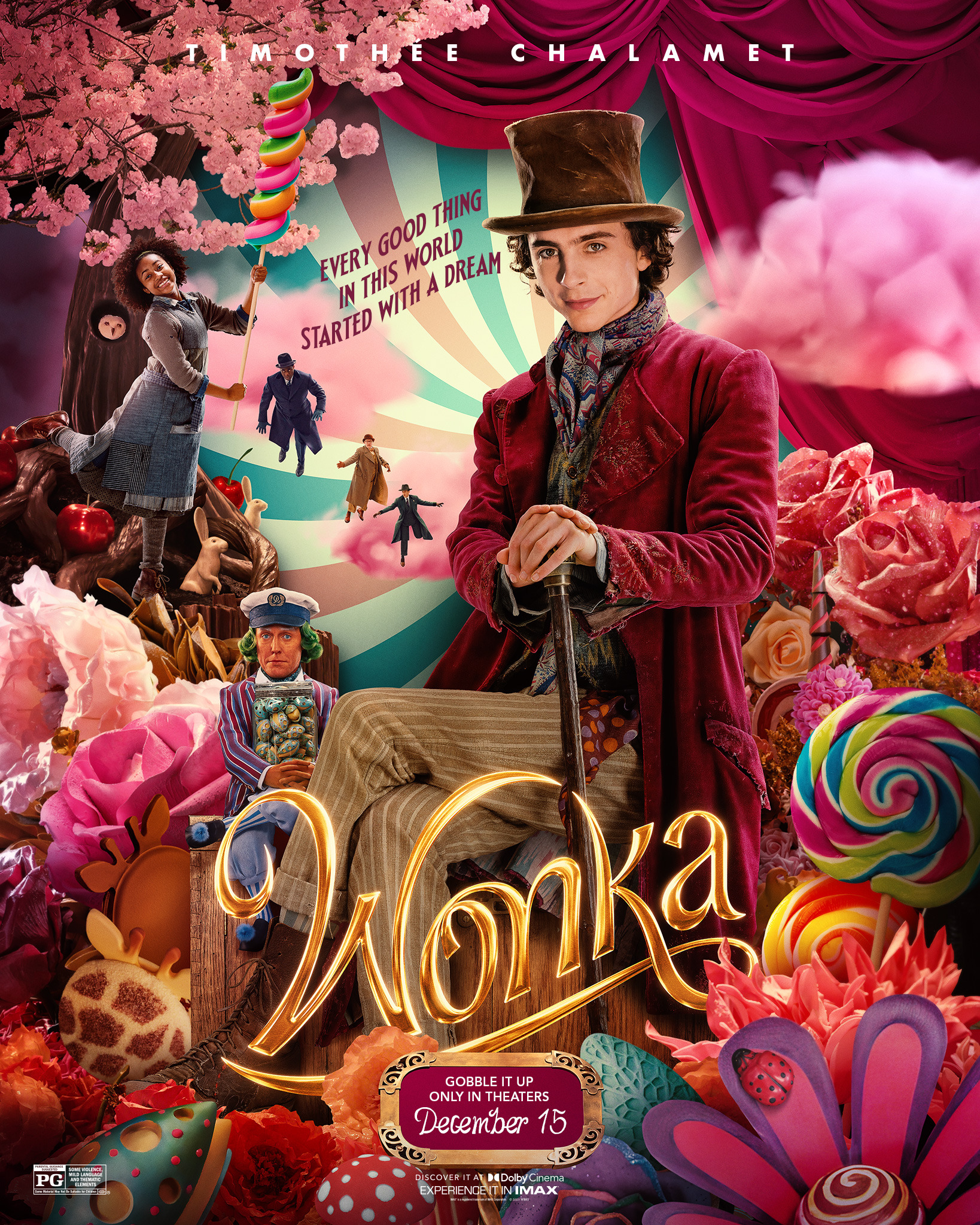
WONKA movie musical review

Charming but forgettable. Wonka is like a rich piece of candy, tasty in small amounts, but less appetizing the more you consume. However, the sufficiently charming musical will keep you entertained. But, it’s missing the moments of horror adjacency and the commentary on greed, pride, gluttony, etc. that gave the OG Willy Wonka and the Chocolate Factory some real bite! While it may not deliver the depth or quality of storytelling of the original, Wonka still delivers an entertaining diversion from the stressors of life with its whimsical world of chocolate and magic. The standout musical number is the Scrub Scrub number that is the G-rated answer to Chicago‘s infectious Cellblock Tango. Over all, Wonka will delight audiences with a throwback style musical that tastes best if not much thought is placed into the quality of ingredients.

Armed with nothing but a hatful of dreams, young chocolatier Willy Wonka manages to change the world, one delectable bite at a time.

Gone is the clever commentary on gluttony, pride, greed, sloth, lust, envy, and wrath as represented by the children and Wonka in the original book and film, but what this Wonka origin story lacks in thoughtfulness it makes up for in–well–the candy-like nature of this throwback style movie musical. It’s not deep and the quality of ingredients may be average, but it’s still sufficiently entertaining for the duration of the movie.

The casting is mostly solid! Despite his popularity, I find Chalamet to be an average actor–neither inordinately good or bad–just average; however, he was perfectly cast in this film even though there are plenty of moments that he looks like he’s phoning in his performance. He has the right look and energy for Wonka, so his casting works well. The other standout performance is Olivia Coleman as Ms. Scrubbit–she’s a great villain! And while it was great to see Sally Hawkins, she has little more than a cameo in the movie. We are treated to a brief performance by Rowan Atkinson, but he is also little more than a cameo. The rest of the actors play their respective roles sufficiently well, and each has some moments of hilarity. But the comedic stylings of Keegan Michael Key as the chief of police went grossly underutilized.

It isn’t so much the cast or music that are the true stars of this film as much as it is the outstanding production design and costuming. The whimsical production design and creative costuming are the highlights of the film. We are never told where the movie is taking place, but it’s most likely London; however, the imaginative set design creates an other-worldly sense about the movie that transports audiences from the auditorium to someplace magical that feels adjacent to our own. There is an expressionistic quality in the production design, externalizing the emotive dimension of the characters and story. It’s a combination of neo-Gothic and industrial revolution-inspired designs.

Despite its clear desire to be this year’s Greatest Showman, one of the biggest differences between the two movie musicals is the quality of original songs. Other than the Scrub Scrub number, none of the other songs are memorable. Scrub Scrub works very well, and I love how it’s clearly inspired by the Cellblock Tango from Chicago. The lyrics are rhythm are memorable and I foresee it being the material for many future GIFs. It’s a fun number along with it’s easy to sing. The rest of the songs are lacking in any degree of inspiration, and thus fall flat and forgettable. In the moment, they are fun and entertaining, but are soon forgotten. For fans of the original film, the memorable, beautiful song Pure Imagination is referenced in both score and lyric. The score for the timeless song is at the bedrock of much of the score for the film, and Wonka applies new lyrics to the music at the end, which acts as a fantastic nod to the original without feeling like it’s a vapid attempt to inject nostalgia to remind us of a better movie. It is tastefully done.

While the plotting for the A-story is good enough, there are ancillary B and C stories that are setup and resolved, but they lack any kind of development, and just come off as a lazy attempt to give the film some emotive depth. It would’ve been better to have taken the time it took to think-up the B and C stories and applied it to the A-story or the music. What the film is lacking is any meaningful subtext. One of the brilliant attributes of the original film is the commentary on the Seven Deadly Sins are represented by the kids and even Wonka. The film provides audiences with a cautionary tale of what can happen when any of those sins takes hold of the mind and body. Plus, we get those iconic Oompa-loompa musical lessons as a result of the kids’ missteps.

Wonka will provide a couple hours of laughter and glee during this Holiday season, which may come in handy if the stressors of the Holidays begin to pile up and family drama occurs while you’re home for Christmas. It may not be one that will earn near the rewatchability of the original, but as I’ve stated several times, it is sufficiently entertaining.

Ryan teaches Film Studies and Screenwriting at the University of Tampa and is a member of the Critics Association of Central Florida and Indie Film Critics of America. If you like this article, check out the others and FOLLOW this blog! Interested in Ryan making a guest appearance on your podcast or contributing to your website? Send him a DM on Twitter. If you’re ever in Tampa or Orlando, feel free to catch a movie with him.

Follow him on Twitter: RLTerry1 and LetterBoxd: RLTerry

BLUE BEETLE superhero movie review

High energy! Blue Beetle is a charismatic superhero movie that delivers vivacious action, laughs, and heart. Undoubtedly, Blue Beetle will become a fan-favorite superhero in the coming years ahead. However, the full potential of this movie to forge new frontiers for heroes and characters we haven’t had on the big screen before is ultimately curbed by some character choices and recurring thematic expressions.

Jaime Reyes suddenly finds himself in possession of an ancient relic of alien biotechnology called the Scarab. When the Scarab chooses Jaime to be its symbiotic host, he’s bestowed with an incredible suit of armor that’s capable of extraordinary and unpredictable powers, forever changing his destiny as he becomes the superhero Blue Beetle.

Before you begin thinking that if you’ve seen one superhero origin story, you’ve seen them all, Blue Beetle manages to make fresh a familiar plot to keep audiences entertained. The strength of Blue Beetle is in the casting, lesser so the characters themselves. That’s not to suggest that none of the characters are crafted and developed well, but there are some odd character/screenwriting choices that mitigate the full impact the movie could have had.

Susan Sarandon and Xolo Mariduēna are the standout performances and characters in the movie. Sarandon’s villain and Xolo’s hero are a perfect match for one another. She was cleverly fiendish and he was humble and strong. For me, it’s these two characters and cast members that made the movie for me. I cannot think of two other actors that could have brought these characters to life as well as these two. It’s also incredibly poetic: a screen legend and a relatively newcomer to the big screen. The chemistry and narrative poetry between our hero and villain was excellent. Anytime I get to enjoy Sarandon’s performances on the big or small screen is a good day!

While the plot for this origin story is fairly standard, the method of expression and the character choices give it an air of originality. But it’s in some of the expression of themes and characters that the movie falters, curbing the full potential of the story. Specifically, this is witnessed in the comedic stylings of George Lopez and the recurring commentary and themes borne out of postcolonial theory. While Lopez’ character was intended to be the comedic relief, the method of expression of his comedy became obnoxious and even exhausting. Moreover, his character plays right into negative stereotypes that the movie could have easily avoided.

Likewise, there is conspicuous, recurring imagery and commentary on postcolonial theory that mitigates the positive affects of the movie. It’s as if the screenwriter was message first and plot second. Even when filmmakers desire to exhibit their personal interpretation of a worldview, it is important that the filmmaker employs more clever means of expressing these opinions.

To bring us around to a more positive note, there is a wonderful depiction of a father-son (and father-family) relationship, and I highly respect the movie for this. Far too seldom do we get movies that spotlight healthy relationships between fathers and their families (in this case, the focus is on the father-son relationship). It’s so very important in narrative storytelling to remind the world of the important role a father plays in his family. Does that mean mothers cannot provide the same emotive dimension? Of course not. But there are many more movies that depict healthy, constructive mother-family relationships. This was a brilliant opportunity to spotlight the love a father has for his family and the love the family has for him.

Blue Beetle represents an MCU type of storytelling in a DC movie, but DC still manages to make this expression of a superhero their own. I really like Jaime/Blue Beetle, so I hope that I see him on the big screen again.

Ryan teaches Film Studies and Screenwriting at the University of Tampa and is a member of the Critics Association of Central Florida and Indie Film Critics of America. If you like this article, check out the others and FOLLOW this blog! Interested in Ryan making a guest appearance on your podcast or contributing to your website? Send him a DM on Twitter. If you’re ever in Tampa or Orlando, feel free to catch a movie with him.

Follow him on Twitter: RLTerry1 and LetterBoxd: RLTerry

THE FLASH movie review

Electrifying! From beginning to end, The Flash is a highly entertaining, funny, well-written thrill ride with a tremendous amount of heart! In an oversaturated superhero/CBM (comic book movie) live-action cinema landscape, dominated by MCU (and MCU-adjacent) movies, comes a breath of fresh air that works both visually and narratively.

Worlds collide when the Flash uses his superpowers to travel back in time to change the events of the past. However, when his attempt to save his family inadvertently alters the future, he becomes trapped in a reality in which General Zod has returned, threatening annihilation. With no other superheroes to turn to, the Flash looks to coax a very different Batman out of retirement and rescue an imprisoned Kryptonian — albeit not the one he’s looking for.

Andy Muschietti delivers a superb superhero motion picture that defies expectations set for anything the DCEU had to offer audiences. Christina Hodson’s fantastic screenwriting paired with John Francis Daley, Jonathan Goldstein, and Joby Harold’s story, provides a solid foundation upon which Muschiette crafts the motion picture for the screen. Nearly everything about this picture works incredibly well, except the CGI battle sequence at the end that felt right out of an early 2010s video game. In addition to the compelling visual storytelling, Muschietti and Hodson successfully, and organically) pay homage to Tim Burton, Zach Snyder, and even Richard Donner. Never before has a superhero multiverse been explored so well! Where other multiverse movies struggle narratively, this one excels in both form and function. And of course, the movie features THE definitive Batman Michael Keaton in a triumphant return to the screen as the Burton-verse caped crusader! While many other films in recent times have placed far less emphasis on plotting than visual composition, The Flash delivers on both.

Just when the general public and critics alike were genuinely wondering if there was anything left in the DCEU, The Flash is the strongest cinematic story to come out of this universe of characters since Wonder Woman, and perhaps the most fun superhero movie since Batman Returns. I know, positively using The Flash in the same statement as Batman Returns is high praise, as it’s my opinion that Batman Returns is the best comic book (or superhero) movie of all time. While The Flash isn’t as campy as the Batman 1960s TV series or the Schumacher movies, it strikes a balance between camp and melodrama in the same vein as Batman Returns struck a brilliant balance between camp and gothic romance. Wherein character expression may lean into camp. The Flash delivers heartfelt thoughtfulness in character interpersonal dynamics and plot. We empathize with Barry Allen’s obsessive plight to save the life of both his mother and father.

Simple plot, complex characters. That is precisely what you get in this movie. I know, what must he be thinking equating a multiverse setup with simple plot. That’s because the plot can be boiled down to when Barry Allen realizes that he has the ability to travel back in time, he returns to stop the death of his mother, but in doing so, unleashes a cataclysm of effects throughout the space-time continuum that must be corrected. There is one plot: save the life of his mother and father, whom is on trial for the death of his mother. Everything that Barry/The Flash does revolves around the central plot of stopping the death of his mother which will keep his father from being accused of her murder. No matter where we go in the multiverse, the external goal motivated by the internal need never changes.

The complexities in the narrative are character-driven. Barry Allen (Sr.) is hyper-focused on stopping the murder of his mother, no matter the cost, Bruce Wayne/Batman is wrestling with his identity as the caped crusader in a world that doesn’t need him anymore (or so it seems), and Barry Allen (Jr.) is struggling to find his place in the world as he is caught between childhood and adulthood. And the central plot connects all these characters and forces them to grow emotionally and psychologically. Apart from the central plot, none of the character growth would occur. Never once does the focus of the story shift, but the central themes of identity, overcoming trauma, and the dangers of obsession with control allow the movie to explore deeper meanings in the otherwise high concept story.

The central cast is fantastic! Never having seen The Flash TV show, I cannot comment on that expression of Barry Allen/The Flash, but Ezra Miller delivers a compelling performance of the lightning-fast superhero struggling with anxiety. We haven’t has a superhero that feels this genuinely human and vulnerable since Tim Burton’s Bruce Wayne/Batman played by Keaton. While they express their humanity differently, both play their respective everyman identities and super-alter egos with equal charisma and authenticity that is maintains its own identity depending on if they are wearing their respective masks. The idea of and meaning of the masque is something that entire books have been written on, but for the sake of argument, the masque represents a different identity and should be expressed differently unless, for dramatic purposes, the character’s humanity peaks through the superhero masque.

Miller’s portrayal of Allen/Flash is one that is unapologetically relatable and without pretense. Furthermore, I appreciate the inclusion of an individual struggling with anxiety, social awkwardness, and comes from average beginnings with no superhuman characteristics other than the ones bestowed through the electrical/chemical accident.

Many articles and podcasts have been published on Michael Keaton’s Batman, so I won’t spend too much time on him; however, we cannot talk The Flash without acknowledging the impact of the definitive Batman and Bruce Wayne returning to the big screen in a big way! At very first sights of Keaton, the Batcave, and the iconic Burton Batmobile, there were waves of applause and cheering from the audience, but nothing compares to the sheer deluge of cheering, shouting, and applauding for Michael Keaton when he appears in his Batman uniform for the first time since 1992. If this was a live performance in front of a studio audience, then all action would have stopped on stage for several minutes as the audience showed their affection for Keaton’s Batman. Even though he is not the central character, he factors heavily into the second and third acts of the movie. And you know what? He’s still got it!

Where the film simultaneously delivers and falters is in the integration of heavy CGI. The CGI works very well in the various effects of The Flash’s super speed and when exploring the multiverse; where the CGI is conspicuously unrealistic is in the final battle scenes. This is where and why the Tim Burton Batman movies will forever be timeless, but prolific use of CGI will date a film. You cannot replace the way real light bounces off real objects into the camera lens. There is a sense of real danger when practical effects, stunts, and pyro is used–it’s REAL–the danger is real. There is a dimension to practical sets and effects that CGI will never be able to replicate. Simply stating, the CGI in the battle sequences at the end takes the audience out of the film. However, the film doesn’t cheapen out on anything at Wayne Manor, the Batcave, Batmobile, or Batplane.

The score for The Flash is excellent, especially when Danny Elfman’s iconic Batman theme is integrated into the original score for this film. While I could have gone for the film to lean a little more heavily into the Elfman Batman theme, I appreciate the nuance of the theme when anything Burton-verse is on the screen. Outside of the Elfman Batman theme, the orchestration feels like an extension of each scene that never becomes the center of attention, but is always present.

About the cameos. Yes, there are some great cameos, but I am not going to disclose them as you need to experience them for yourself. What I will divulge on that subject is the conspicuous absence of Michelle Pfeiffer’s definitive Catwoman. Even though she’s stated in interviews that she hasn’t been asked to reprise her career-defining role, even thought she admittedly would love to wield the whip again, I thought that perhaps is was all a ruse and she would surprise us in this movie. But with the unparalleled positive response from audiences concerning Keaton’s return to the Batsuit, then perhaps we will get the incomparable Michelle Pfeiffer as Catwoman one last time.

Thrilling and fun for the whole family, I highly recommend watching The Flash. It was certainly the most fun I’ve had at the cinema all year.

Ryan teaches Film Studies and Screenwriting at the University of Tampa and is a member of the Critics Association of Central Florida and Indie Film Critics of America. If you like this article, check out the others and FOLLOW this blog! Interested in Ryan making a guest appearance on your podcast or contributing to your website? Send him a DM on Twitter. If you’re ever in Tampa or Orlando, feel free to catch a movie with him.

Follow him on Twitter: RLTerry1 and LetterBoxd: RLTerry

DON’T WORRY DARLING film review

Don’t worry about seeing this. Olivia Wilde’s Don’t Worry Darling works best when viewed as an exercise in the boundaries of the filmmaking apparatus; unfortunately it shows little concern for the art of plotting, and is overstuffed with metaphors and analogies that ultimately struggle to tell a compelling story. Clearly it’s striving to be a Stepford Wives, but lacks the nuance of what makes the original (and the remake to an extent) excellent films with a degree of horror-adjacency. Don’t Worry Darling is certainly unsettling and delivers an overwhelming sense of dread despite the idyllic atmosphere, but the writing is not up to the degree of excellency as are the visual elements of the film. Wilde certainly has a keen eye for shot composition and knows the capabilities of editing; but for all its trappings, the film will leave audiences wondering what they watched and why should they care.

Don’t Worry Darling is a 2022 American psychological thriller film directed by Olivia Wilde from a screenplay by Katie Silberman, based on a story by Carey Van Dyke, Shane Van Dyke, and Silberman. The film stars Florence Pugh, Harry Styles, Wilde, Gemma Chan, KiKi Layne, Nick Kroll, and Chris Pine.

From a design perspective, the film is stunning! I absolutely loved everything about the romanticized 1960s aesthetic from the women’s fashion to the colors to the music, houses, and cars. Unfortunately, the brilliantly crafted set and production design are not enough to makeup for the lethargic pacing and poor plotting. It takes more than an hour before anything of measurable consequence significantly affects the story. Although the pacing quickens in the latter part of the second act and through the third, the showdown is riddled with convenient–nearly deus ex machina, plot devices–and simply unbelievable character actions that aren’t properly setup.

The performative element of the mise-en-scene is demonstrably lackluster as well. While Florence Pugh delivers a solid, believable performance, Harry Styles is acting to the back of the room and Chris Pine is clearly phoning-in his performance. With his background as a music entertainer, perhaps Styles is better suited for the Broadway stage than he is the silver screen. The film contains some interesting montage, but many of the stylistic editing choices do not pay off dramatically and I’m left to interpret them as an exercise in film assembly. But, the scenes right out of Footlight Parade were a nice touch.

Don’t Worry Darling is another example of a film wherein a writer-director may have benefitted from taking their idea and giving it to a different screenwriter in order to develop into a motion picture that not only has an outstanding look, but thoughtful storytelling as well. Wilde certainly has a message that she is communicating to audiences, but it’s more of a message better suited for the era depicted in the film than in the era in which we live. Often times, what audiences desire is a good story with a great outside-action plot. And if a writer and/or director can add depth of theme through subplots and subtext, then that’s how you create something more thoughtful–not making the message the A-story.

Ryan teaches Film Studies and Screenwriting at the University of Tampa and is a member of the Critics Association of Central Florida. If you like this article, check out the others and FOLLOW this blog! Interested in Ryan making a guest appearance on your podcast or contributing to your website? Send him a DM on Twitter. If you’re ever in Tampa or Orlando, feel free to catch a movie with him.

Follow him on Twitter: RLTerry1