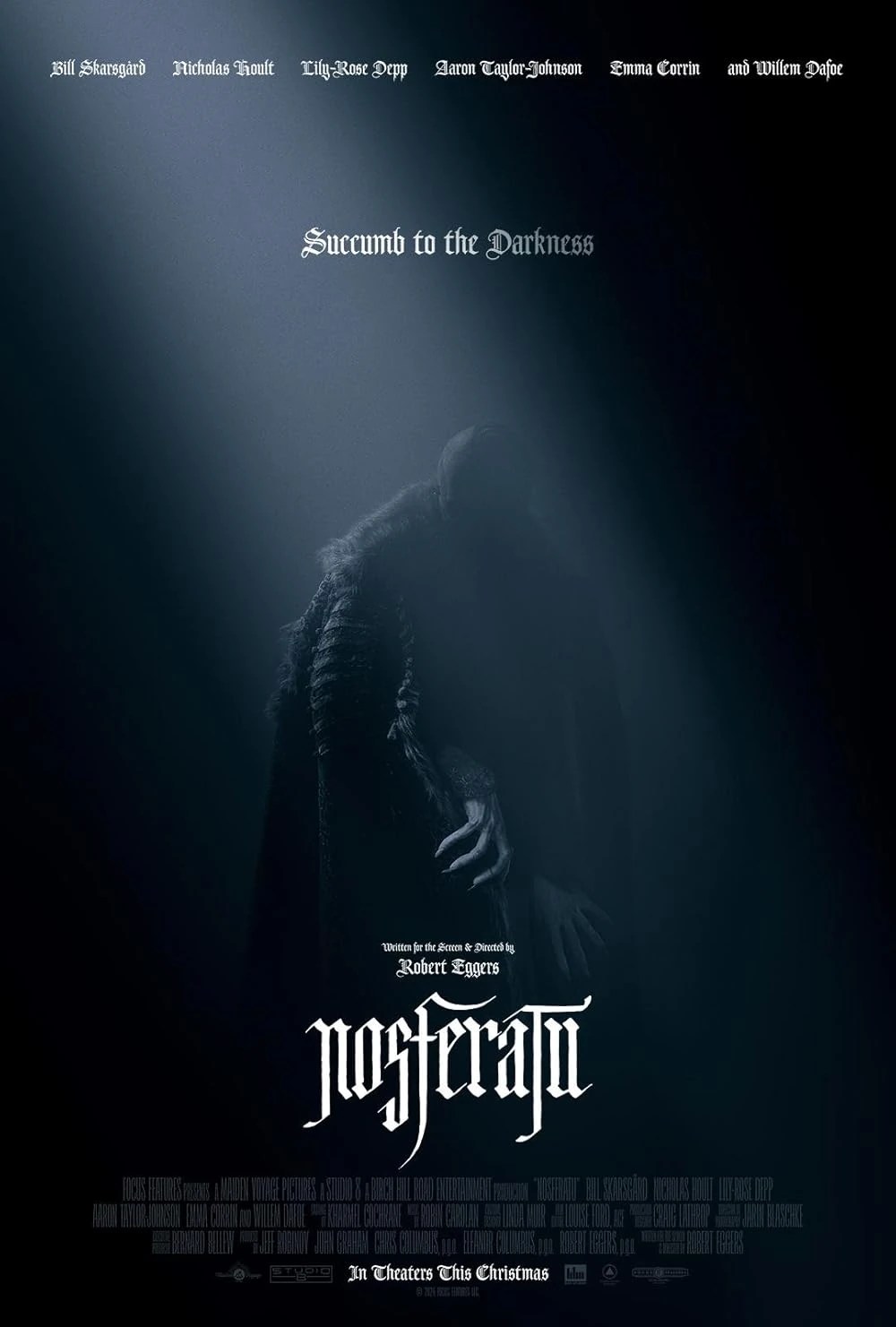
NOSFERATU (2024) horror film review

Gothic horror is truly timeless. Universal is going back to its roots in horror with its latest motion picture. More than a century after F.W. Murnau gifted us with the original Nosferatu (1922), director Robert Eggers delivers audiences his take on Murnau’s unauthorized Dracula adaptation; however, Eggers’ vision for his expression of Nosferatu is more closely aligned with Warner Herzog’s Nosfertatu the Vampyre (1979) than with Murnau’s original film. Ostensibly, Eggers’ adaptation sets out to bridge elements of both the 1922 and 1979 versions, whilst incorporating the postmodern ideologies that he has integrated in his past works. This expression of Nosferatu combines the atmosphere, mood, and settings from the 1922 version with the characters and erotic tone of Herzog’s version. Each iteration of Nosferatu reflects its director’s vision and the cinematic sensibilities of its time. For it was Oscar Wilde whom reminded us that all art is self-portraiture, “Every portrait that is painted with feeling is a portrait of the artist, not of the sitter.” As cinema is art, and the director is often considered the author thereof, then each of these versions expressed something to us about his beliefs, fears, anxieties, or worldview. Eggers took the expressive techniques and vampire lore of Murnau, the existentialism and romanticism of Herzog, and combined those with his applied postmodernist worldview to create 2024’s Nosferatu.

In the 1830s, estate agent Thomas Hutter travels to Transylvania for a fateful meeting with Count Orlok, a prospective client. In his absence, Hutter’s new bride, Ellen, is left under the care of their friends, Friedrich and Anna Harding. Plagued by horrific visions and an increasing sense of dread, Ellen soon encounters an evil force that’s far beyond her control.

Egger’s expression of Nosferatu demonstrates a desire to explore themes of mortality, isolation, corruption, and desire all while underscoring each theme with a sense existential dread. The primal fear of death is perhaps the most overt theme, because Orlok represents the lengths people will go in order to escape that which is inevitable. While monstrously depicted in the film, there is a parallel here between that and the obsession people can have in the real world over youth, vitality, and longevity. We can even draw further parallels between the desire vampires have for human blood with the desire humans have for medications and medical procedures that claim to prolong life and youthfulness. 

A recurring there of vampiric imagery is obsession, not only with youth and life, but obsession in connection with desire—specifically primal desires for that which appears or feels forbidden. Long since has the vampire been used as a personification of forbidden desires. While this was particularly true in the Victorian era—what with its many romantic and sexual mores—it can also be seen today by some as the informal boundaries that Western culture places upon depictions of romance and sexuality. In the postmodern era, many feel that the Eastern ways of life are more liberating, and that is represented in the fact that Orlok hails from Eastern Europe (presumably in the area of Transylvania).

Our central character of Ellen (which is a switch from the typical male central character in variations of the Dracula story), represents the idea that some women feel confined by the boundaries placed upon them by a patriarchal society. By Eggers’ endowing the character of Ellen with a greater sense of agency, he is able to convey more focus on the confines of the Western and/or patriarchal world upon the primal desires of Ellen, and how she must overcome the ties that bind her to both written and unwritten societal expectations. In turn, Orlok can be read as the means to free oneself from all societal inhibitions, but that liberation comes at a great cost. Ellen’s desire for Orlok is both attractive and repulsive—she wants what he represents but doesn’t want the monster himself. In the end, the only way to save her town of Wisborg (and world) is by giving into her primal desires as a means of sacrifice. 

One of the biggest differences in both previous versions and Eggers’ is the imagery of Count Orlok himself. In both previous iterations, there was something sympathetic, darkly whimsical, and even suave about the Count; but in this version, Count Orlok is exponentially more monstrous looking, which offers a stark contrast to that of the alluring appeal of the vampire. Interestingly, Eggers’ interpretation of a vampire is much more closely aligned with traditional eastern European folklore than the words and descriptions of Bram Stoker. Reaching beyond the Dracula novel and both previous versions of Nosferatu, Eggers set out to create an interpretation that demonstrated concern for historical detail and traditional folklore to give his version a sense of realism. Unfortunately, this realism is somewhat hampered from beginning to end, given the film takes place in Germany but none of the characters speak with a German accent, much less in Deutsch. But I digress.

Another difference between this Nosferatu and past versions of both Nosferatu and Dracula is the absence of consistent religious iconography or ritual. Even our esteemed Dr. Albin Eberhart (played by Willem DaFoe) incorporates Western medicine, Eastern medicine, and religions from around the world in his cocktail of methods for healing Ellen and vanquishing Count Orlok. This can be read as Egger’s commentary on how all religions are variations of the same thing, and that the best parts of each can be used in dealing with the obstacles of life. In many ways, this is a reflection of the views many have of religion and tradition in a postmodern world—the strength of a religious practice is in the belief itself and not in the person or object at the center of it. Interestingly, however, in contrast to the views many have of evil in a postmodern world, the movie posits the idea that there is evil in the world, and it isn’t a matter of perception or opinion—that there is evil out to devour all good and innocent in the world. What I appreciate about the character of Dr. Eberhart is his views that science and religion are not mutually exclusive; his character demonstrates that both science and religion are two sides of the same coin, and we need both in our lives.

Like with Eggers’ past work, this one too suffers from the same lack of thoughtful plotting that plagues his other films. Whether we are talking The Witch, The Lighthouse, or The Northman, Eggers demonstrably places far more emphasis on atmosphere, production design, and cinematography than he does plotting or character development. In fact, the original Nosferatu demonstrates stronger plotting despite the lack of spoken dialogue and title cards. This remake is yet another example of the shortcomings of prestige horror—focusing on how everything looks versus how it is written and plotted. Moreover, this continues to be a problem I have with many (if not most) writer-directors—the lack of strategic checks and balances. When the writer is also the director, then there isn’t usually someone that is part of the preproduction of a film that is in a position to state that something works on paper that doesn’t work on screen, or something that looks great an screen doesn’t make sense for reasons of storytelling mechanics. While I have many reservations for the demonstrable trends in postmodern horror, I will say that prestige horror works more effectively as the equivalent of the type of art that hangs in a museum beckoning for guests to sit in front of it for hours, contemplating that which is being conveyed by the collection of images.
Ryan is the general manager for 90.7 WKGC Public Media in Panama City and host of the public radio show ReelTalk about all things cinema. Additionally, he is the author of the upcoming film studies book titled Monsters, Madness, and Mayhem: Why People Love Horror. After teaching film studies for over eight years at the University of Tampa, he transitioned from the classroom to public media. He is a member of the Critics Association of Central Florida and Indie Film Critics of America. If you like this article, check out the others and FOLLOW this blog! Follow him on Twitter: RLTerry1 and LetterBoxd: RLTerry
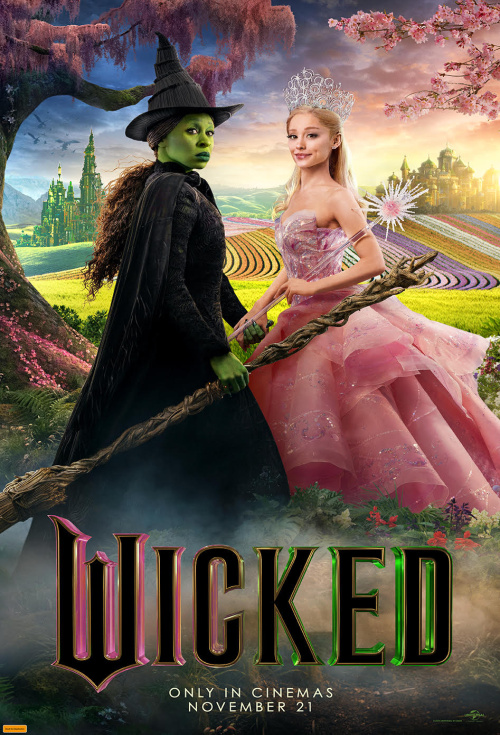
WICKED movie musical review

By Kurt Feigelis

“A true cinematic spectacle!”

Dear Journal,

It’s been so long since we talked it honestly feels like the first time. Well it happened the Wicked movie finally came out–well partly. I was lucky enough to attend the Press Screening in Tampa. The beloved musical from Broadway has been turned into a film (or more correctly two film installments), and everything leading up to this movie makes you think it wouldn’t work. But surprisingly it did.

I know you know the show, but just in case you forgot. This is the story of the Witches of Oz, of The Wizard of Oz, and boy did a lot happen before Dorothy dropped in. It follows Elphaba (Cynthia Erivo), while at Shiz University and her inevitable journey in becoming the Wicked Witch of the West. Alongside her roommate Glinda (Ariana Grande), an unlikely friendship grows. The themes of being an outsider and yearning to belong rings true in this adaptation. 

Everything leading up to this release makes you think that it should not have worked. Split into two films, Part 1 is too long, the cast has “too many stars”, and has been in development hell for over a decade. Rumors of a movie have been online for about as long as the musical has been on Broadway. Cast rumors include everyone from the original Broadway Cast, to Lea Michele and Amy Adams. But the core of the team was the producers, some of the same names you will find from the original Broadway show, and I think that is why the film works. The rare exception where the producing team delaying the movie for the right cast and director worked. Maybe development hell isn’t always a bad thing.

Wicked Part 1 sings with the feel of classic cinema. I think that came down to the Direction of Jon M. Chu (Crazy Rich AsiansIn the Heights). With a focus on real and large 360° sets, practical FX, live singing, and stunts. There is this feeling of realism to this fantastical world. The attention to detail and to do as much on camera as possible captures a live energy most movie musicals do not. Chu has a history of work in music videos, musical films, and large ensemble casts. This properly prepared him for this piece. 

Erivo is just wonderful as Elphaba. This roll is so well known with productions of the show playing all over the world in six different languages. But this is what the magic of what film does. In the theatre you got to play big, to the back of the house. Here, she is able to play it small, the little moments and movements play big for the screen. You get a closer connection to Elphaba you cannot get from the stage.  

Grande shines as well, and you know me, this was the role I was most concerned about. Grande is a very talented performer but many times it is Ariana Grande singing, when she is acting it’s always Ariana, not her character. I am happy to say she truly disappears into Glinda, the (very) Good Witch of the North. This is a testament to her work with vocal and acting coaches she started using even before she auditioned for the part. The comedic role is so often overlooked, but Grande brings something deep to Glinda in this adaptation. Erivo and Grande together, their friendship, is the heart of the movie. The rest of the supporting cast are as wonderful as you would expect with the names listed. There honestly wasn’t a surprise there. 

The musical numbers are pure entertainment. Usually in a movie musical the song and dance just doesn’t seem natural but Wicked does it right. The songs are already well know but they are modified and changed just enough to make them truly cinematic. The Wizard and IPopularDancing Through Life, and the film’s finale Defying Gravity are highlights for sure. 

If you want to nitpick some issues, the sound mixing was unbalanced throughout the movie. Between some of the musical numbers and dialogue scenes, there is an inconsistency. I don’t know if it was the theatre I was in, or the film itself. But, I feel it was the film. There are times when the score is overpowering the vocals. A film this long is always a bit intimidating, especially when trying to bring in a new audience.   But somehow the pacing works. The film doesn’t feel long while watching it. The extra moments with the characters and being brought into this world is much needed. There was not much added into this half of the story. But when transitioning from the stage to the screen. We need extra time for the camera to bring us into the world, to sit and connect to the characters. That is the reason for the additional time. Like Kill Bill, it feels more organic than forced or a money grab like other movies that get split into two.

Live musicals and Broadway adaptations are still a hard sell for audiences, even more so after Joker 2. I think the movie will do well, but with Gladiator II and Moana 2, there is stiff competition, Universal knows this which is why they upped the release date. It feels as though if a movie doesn’t make $1 Billion, it’s not a success to producers or the zeitgeist. Wicked Part 1 will do well with those who love the musical already, but I don’t know if new audiences will be pulled into this one. Which is a shame because it is a good film on its own. I’m curious what newcomers will say about the story and its quirkiness. 

The fandom of Wicked have been talking rumors for over ten years for this film. Then picking apart every visual and audio clip, still, and poster leading up to the premier. Sometimes the fandom does a disservice to what they love. Because of this I think the studio is nervous about the movie, releasing multiple interviews, behind the scenes and clips of the movie online leading up the premier. But out of context these clips are splitting its audience already familiar with the show. The reality is, the film does work. But remember this an adaptation not a remake or recreation of the stage show. Cinema has the power to expand the storytelling and that is what Wicked Part 1 is doing here.

Journal, in the end we need to remember what this movie is. It is the long awaited film adaption of a beloved Broadway Musical. To those that have seen the show I think they will love this movie without taking anything away from what they can see on stage. For a new audience, I think like Chicago, this will breathe new life into an existing phenomenon. People familiar with the show and The Wizard of Oz will see homages to both throughout the film. 

Part 2 comes out sometime in 2025, probably in November as well. We don’t know the run time of the follow up, or any details at all really, but until then we have this film to enjoy. What comes next is all the speculation, rumors and judgments for Part 2 that we had with Part 1. There is something about judging something or someone before getting to know it (or see it) that is unsettling given the story we are all here for. I think Elphaba might have something to say to us about this, but she wouldn’t be surprised.

You’re Movie Buddy,
Kurt Feigelis
R.L. Terry ReelView contributor

THE WILD ROBOT movie review

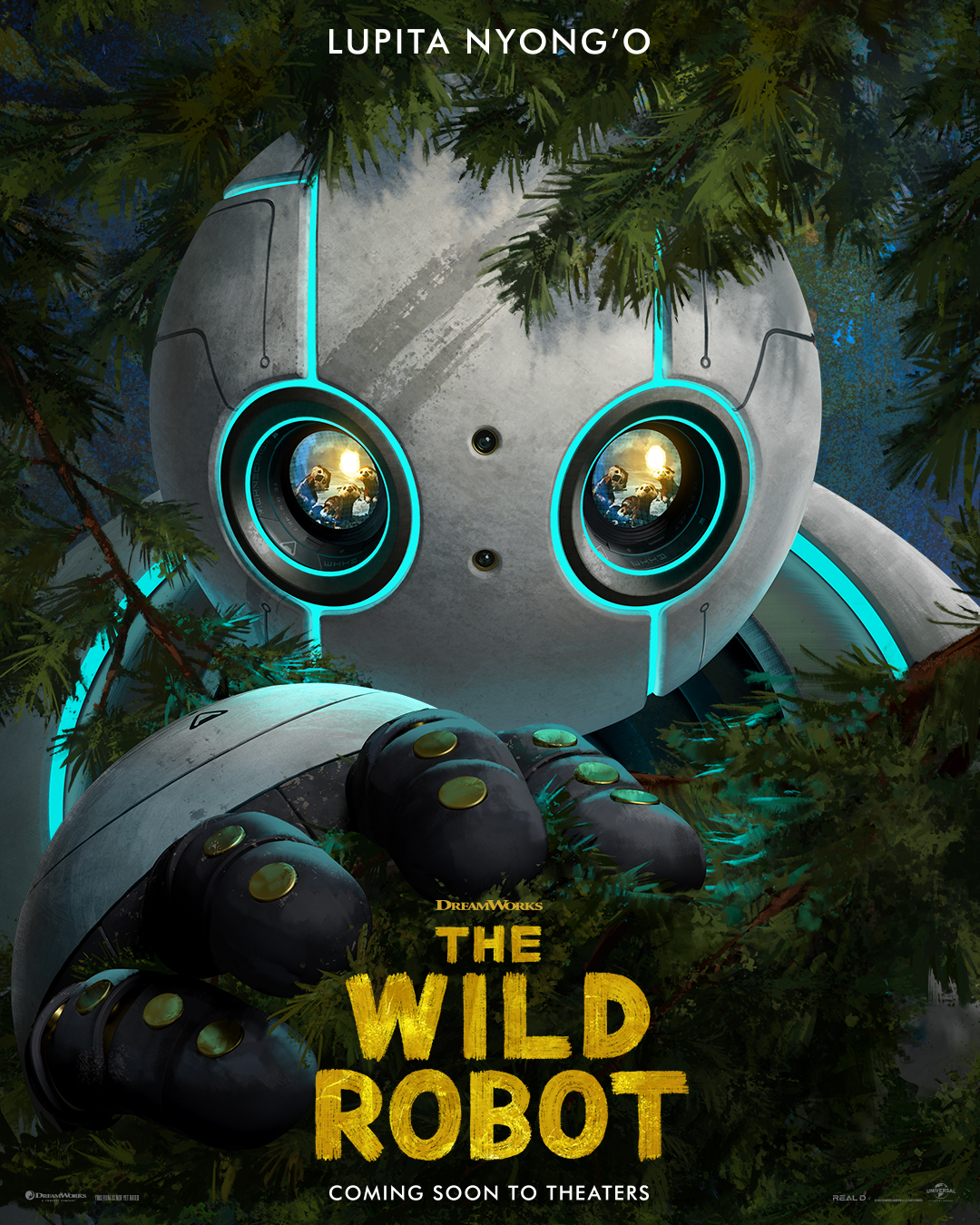
Wildly heartfelt and uplifting! Universal and DreamWorks Animation’s The Wild Robot is among the best films of the year, period. Director Chris Sanders delivers a truly compelling and smartly written fish-out-of-water story about found family and being more than the sum of our parts–or programming. Easily on track to make my Top 10 Films of the Year list. Based on the book by the same name, DreamWorks Animation hits a homerun with this outstanding animated motion picture that will challenge you, thrill you, and tug at your heartstrings.

Shipwrecked on a deserted island, a robot named Roz must learn to adapt to its new surroundings. Building relationships with the native animals, Roz soon develops a parental bond with an orphaned gosling.

I’ll admit it up front, I cried. It really is such a beautiful animated motion picture that likely rocketed its way into my best films of the year list. Not since The Iron Giant have we had an animated motion picture with such gravitas. While I still feel that 2016’s Kubo and the Two Strings remains the best animated motion picture in the last ten years, I must say that The Wild Robot is solidly my No.2 pick. The strength of this picture is in the compelling story, relatable characters, and efficient plotting (sometimes a little too efficient). My only real negative criticism of the film is the pacing in the first act; while refreshingly lean, some scenes and sequences needed a little more room to develop and breathe. Even though The Wild Robot shares little in common with The Iron Giant‘s plot, it shares Iron Giant‘s heart and soul.

Fish-out-of-water premises have been a staple of cinema for nearly as long as films have been around. So the real challenge for writers and directors is to find original ways of expressing these foundational ideas. And what is precisely what we have in this film. There are actually three fish-out-of-water narratives within the film, and the film is better for them because each of these layers adds personal and interpersonal complexities to character relationships with the world in which they finds themselves and amongst each other. The films provides thoughtful commentary on what it is like to both be in a world that is unfamiliar and have unfamiliar tasks thrust upon oneself.

Furthermore, this film depicts the importance of adapting to one’s environment and overcoming obstacles, even those that are innate. I also appreciate what the film has to say about self-determination and taking personal responsibility for one’s circumstances and one’s mistakes. Fish-out-of-water stories are some of the most relatable, because we have all been placed in an unfamiliar environment, and know how that can feel. It’s a terrifying prospect to be dropped into a world that is alien to us, and the film does not shy away from the challenges, joys, and even the tragedies that can befall us.

Another narrative area of strength in the film is challenging us not to quickly pass judgment on that fish-out-of-water when they find themselves in your world. Or to presume that one’s past behavior is always an indication of how that person (or animal, as it were) will always behave. Yes, past behavior can indicate predisposition to moral and ethical aberrations, but that does not mean that redemption is not to be considered a possibility. I love how the film paints a portrait that we can change, if we have the will and support to do so. It rarely comes naturally, we have to work at it. We have to work at overcoming natural behaviors that may not be constructive and ultimately selfish. We are more than the sum of our parts–or our programming.

To a lesser extent, there is come social commentary on the relationships between the work place and the employee and even cultures that decry the individual in exchange for group think. Without getting into spoilers, the film depicts imagery of how some, if not many, companies treat and feel about their employees. How a company does not view the employee as an individual; rather, as a means to an end, just another cog in the machine that will be disciplined for any individuality or unique expression. But not before the company assimilates the knowledge of that employee, particularly those that do think outside the box. Difference will not be tolerated. That is the feeling of many companies and even governmental systems. The film challenges these ideas by showing cooperation between diverse groups, even groups that are naturally enemies. Furthermore, the film demonstrates how differences can be overcome or even set to the side in order to serve, protect, and survive.

Lastly I’d be remiss not to touch on the global idea of the film, which is the concept of found family. Throughout the entire film there are images of the important role one’s found family fills in life. Found family is that family-like unit that may not be blood-related, but very much fill the same role as a more traditional family in one’s life. It’s a group of friends that have a relationship that goes beyond typical friendship, and includes family-like dynamics. Sometimes these are formed because someone feels rejected or neglected by their real family, and find family with a close group of friends. Other times, and I’d venture say most of the time, a found family can be formed out of the significant distance between you and your family of origin. So when in a new place because of school, work, or even military transfer, it’s important to form a strong bond with friends (or a friend’s family) to fill that important role even when separated from one’s family of origin. We are creatures that have an innate need for connection and companionship.

I cannot recommend The Wild Robot enough! Don’t miss seeing this incredible animated motion picture on the big screen.

Ryan teaches Film Studies and Screenwriting at the University of Tampa and is a member of the Critics Association of Central Florida and Indie Film Critics of America. If you like this article, check out the others and FOLLOW this blog! Interested in Ryan making a guest appearance on your podcast or contributing to your website? Send him a DM on Twitter. If you’re ever in Tampa or Orlando, feel free to catch a movie with him.

Follow him on Twitter: RLTerry1 and LetterBoxd: RLTerry
SPEAK NO EVIL horror movie review

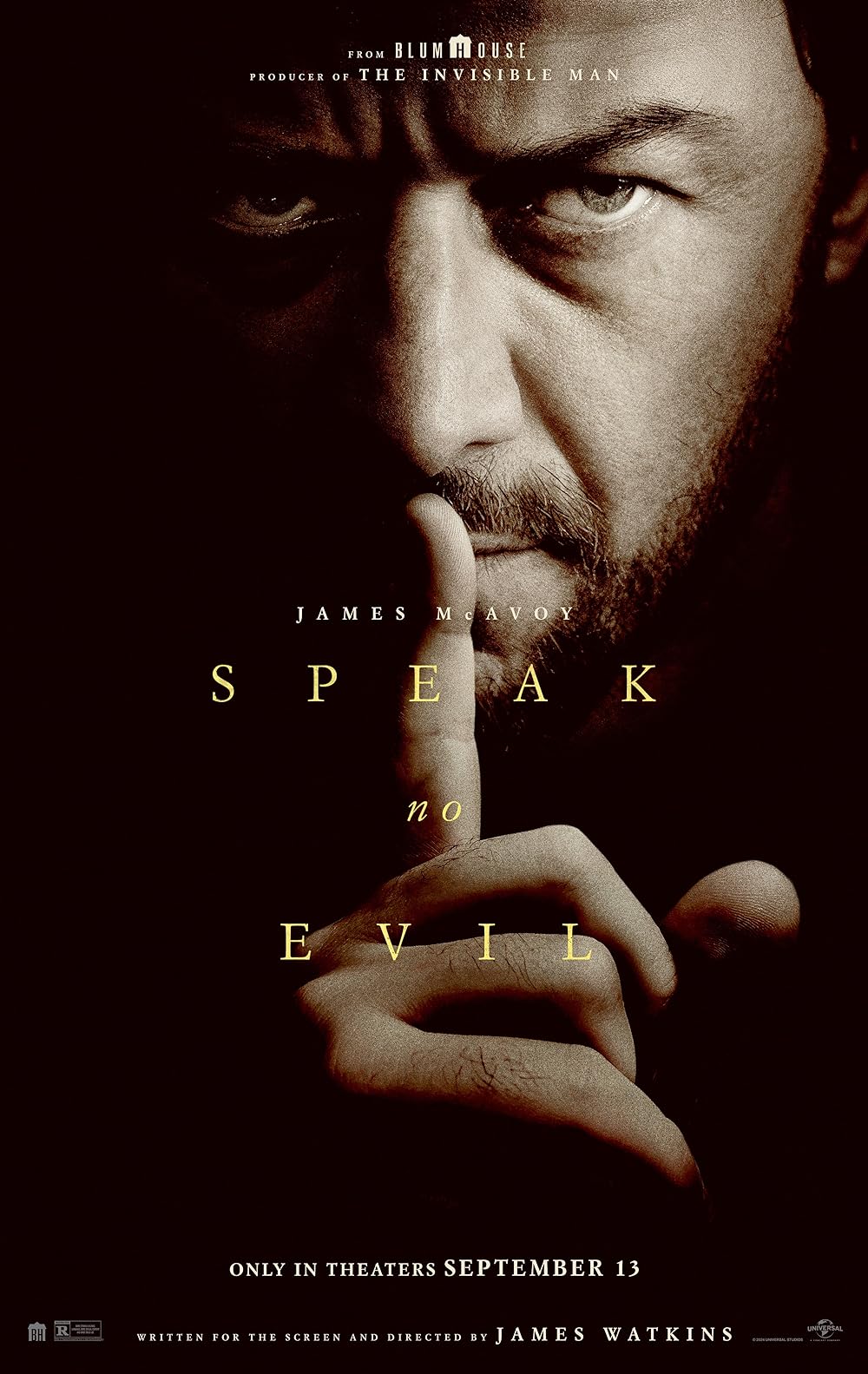
An entertaining and terrifying thrill ride. Blumhouse and Universal’s Speak No Evil, starring James McAvoy, excels in plotting and atmosphere but falters in character building and development. Based on the Danish film by the same name, director James Watkins’ version is a methodical and spellbinding descent from dream to nightmare. The highlight of the film is McAvoy’s completely manic performance that is simultaneously comedic and unsettling. Whilst Watkins attempts to bestow upon the high concept narrative thoughtful social commentary on image, isolation, and identity, the commentary is inconsistent and lacks the gravitas to truly be compelling or provocative.

A dream holiday turns into a living nightmare when an American couple and their daughter spend the weekend at a British family’s idyllic country estate.

That which is most personal is most relatable, and can be the most terrifying. And what can be more personal and relatable than the need for a relaxing vacation in the peaceful countryside? That is precisely where this decent into a nightmare begins. Speak No Evil may take its time (albeit justified) in setting up the conflict, but once that second act kicks into gear, it is a nonstop thrill ride into isolation and violation. Keep the cast small, the film is able to spend sufficient time in developing the plot and keeping with proper pacing for the tight storytelling. From the very beginning, the piping is laid for everything that audiences will encounter in the second and third acts, with every shot, scene, and sequence pointing towards the shocking conclusion.

Violence on screen is minimal; however, when it hits, it HITS. But that hit isn’t always visual; many times it is psychological in nature, which in many ways, is even more terrifying. Throughout this film, the terror on screen is transferred into the minds of the audience. Part of that is because of the degree of relatability in this story. Many of us have been on vacation in a new place or even moved to a new place unfamiliar to us–perhaps in or to another country–and we are often desperate for friendship or companionship of any kind in order to begin to feel more at home. Therefore, the setup of this film is one to which many of us can relate–and that’s what makes it particularly terrifying. The thought that we could unwittingly befriend a monster.

While the social commentary on isolation, identity, and image is inconsistent and weak, I appreciate what Watkins was trying to do; although, there is one aspect of the film that was screaming for a redemption arc that was so obviously squandered (and actually hurt the quality of the film). Speak No Evil depicts many expressions of isolation. Isolation from friends and family, isolation from the urban core, isolation within one’s family. And it’s this isolation that greatly heightens the level of suspense and terror.

Additionally, the film depicts the identities (or facades) that we project to the world when we are hiding something or feel insecure because we wield it like a sort of armor. Moreover, this identity can also harbor inconsistencies that lead to a lack of authenticity and meaningful motivation. Perhaps this identity is merely a facade that is intended to make others feel uncomfortable or to project an image that sets one apart simply out of fear of being found out as little more than keeping up with what’s trending on social media. Furthermore, the attempted commentary on image is depicted in a variety of ways throughout the film.

The weakness in the film is found in the character building and development. Not with all the characters, but enough that it mitigates the potential of the film to deliver a compelling story. Without getting into spoilers, I want to discuss where the film had an opportunity an an effective character redemption arc, but pandered to what’s presently trending in movies instead of providing a constructive character arc that would’ve benefitted the film by adding a since of compelling meaning. Strong characters are not strong because those around them are weak; to craft a strong character through that methodology makes for a weakened (and less compelling) character because ostensibly standards have been lowered.

Strong characters are at their strongest when other characters are strong, complete with dimension as well. There is a character in the movie that lost their job, and have been personally struggling with feelings of anger, inadequacy, and failure–that is completely relatable as it is very much a human response to losing ones income and livelihood. Where the film fails is setting this character up to overcome the feeling of failing their family and at life, but never doing anything with it, and merely reinforce weakness. I imagine this was done to make their counterpart appear stronger. But it amounts to lazy storytelling that reinforces negative imagery.

The character that is the most entertaining is James McAvoy’s Paddy. I cannot think of any other actor working today that could’ve brought this character to life nearly as well as McAvoy. In an otherwise par for the course performative dimension in the film, he brings a kinetic energy that draws audiences into the macabre, twisted tale. From the very beginning, we can tell that there is something a little off about his character, but never enough to know precisely where he stands. When he goes full-on manic mode, we are in for the ride because he makes us laugh and gasp in horror all at the same time.

Everything about this movie would make for a fantastic house at next year’s Halloween Horror Nights at Universal Orlando and Hollywood. The farmhouse at the center of the movie is a labyrinth and hints at a variation of the hillbilly horror aesthetic. I can see how this film’s characters and setting could adapt well to an HHN house, so I would not be surprised if we see this intellectual property featured at next year’s HHN.

Speak No Evil may lack dimension that could’ve made it a more compelling narrative than what we received; however, it’s still an entertaining thrill ride that will have you laughing and screaming. A solid popcorn horror movie that has some degree of rewatchability.

Ryan teaches Film Studies and Screenwriting at the University of Tampa and is a member of the Critics Association of Central Florida and Indie Film Critics of America. If you like this article, check out the others and FOLLOW this blog! Interested in Ryan making a guest appearance on your podcast or contributing to your website? Send him a DM on Twitter. If you’re ever in Tampa or Orlando, feel free to catch a movie with him.

Follow him on Twitter: RLTerry1 and LetterBoxd: RLTerry
TWISTERS movie review

Plot chasers. Despite the great chemistry between the leads of Daisy Edgar-Jones and Glen Powell, this cinematic storm is lacking the necessary elements in both thoughtful plotting and character development to form a compelling story. And while most of the special effects are excellent, it comes off feeling like one long storm chase. If it wasn’t for Edgar-Jones and Powell, I’d just as soon watch the Weather Channel instead. Twisters tries to be too many different kinds of stories, and isn’t successful at any one of them. There is an attempt at underscoring the outside-action narrative(s) with a heart-felt inside-emotional story, but even that isn’t fully developed. While there are some well-written scenes that will pique your interest, aside from the disaster porn dimension of the movie, there isn’t much here of any great interest.

Haunted by a devastating encounter with a tornado, Kate Cooper (Edgar-Jones) gets lured back to the open plains by her friend, Javi, to test a groundbreaking new tracking system. She soon crosses paths with Tyler Owens (Powell), a charming but reckless social-media superstar who thrives on posting his storm-chasing adventures. As storm season intensifies, Kate, Tyler and their competing teams find themselves in a fight for their lives as multiple systems converge over central Oklahoma.

The lack of a compelling narrative has far less to do with Lee Isaac Chung’s directing than it does Mark L. Smith’s screenwriting. No real surprise there since his other recent screenwriting credit is The Boys in the Boat, which also suffered from poor plotting and character development. While Joseph Koskinki receives a story-by credit, clearly he has demonstrated that he is a much better director (Top Gun: Maverick) than he is a writer. Both Twisters and The Boys in the Boat have a compelling story to tell, but the plotting itself (the map of how you get from beginning to end) lacks meaningful direction or focus. The movie sets up one story of overcoming trauma, then becomes a white collar vs blue collar story, then turns into a story about storm profiteering, which morphs into a melodrama about overcoming fear and guilt, just to finish as a romcom. All the while, the external goal of the story, which is setup successfully in the beginning, doesn’t get revisited and become clear until the third act. There is about as much narrative depth in Twisters as any given episode of Storm Chasers. Where is will give Smith, Kosinski, and Chung credit is that they didn’t choose to make this a “preachy” movie about ecoterrorism or climate change. Sometimes bad storm just happen. And that’s what makes them scary; there is no explanation.

Even though the themes of the movie are not very well developed, I like that Smith was trying to do with the subtext of the movie. Without getting into spoilers, there is an attempt at spotlighting how some people that appear that they are trying to help storm victims are actually more interested in profiting off the disaster. Which, I imagine does happen in real life. The movie also has something to say (and this was actually pretty well developed) about not judging the level of competence or motivation based on face-value or first impressions. The very people that look unprofessional may be even more professional and genuine than the ones that appear like they have it all together.

Other than some badly CG’d dandelion fuzz (which should’ve been done practically, c’mon). the rest of the special effects in the movie are excellent. Okay, so maybe excellent is being a bit generous, but I’m trying to give the film some credit for not putting me to sleep. I screened the film in Dolby Cinema, which is the best way to watch this movie because aside from the chemistry between the leads, the reason to watch this movie is for the storms and disaster porn thereof. Perhaps the story is on SyFy or Weather Channel levels, but the storm effects are executed very well. I was disappointed that we did not get a flying cow as a nod to one of the most memorable moments in the wildly popular original Twister. It’s well-known that the first movie literally built and destroyed houses to achieve the full effect and impact of the tornadoes, and it appears that Twisters used miniatures and models for some of the disaster scenes. Practical beats CGI nearly all the time. Also like the first movie, this one also appeared to integrate real footage of tornadoes and the disaster left in their wake.

The force that keeps this movie from falling completely apart is the chemistry between our leads of Daisy Edgar-Jones and Glen Powell. Playing Kate and Tyler, respectively, there is a throwback style (almost romcom-like) romance between the two in the vein of “will they, won’t they.” Even though Kate is our central character, it’s Tyler that receives more thoughtful development. Kate is largely the same from beginning to end, despite a great setup for overcoming trauma and guilt. Both of these characters (and their respective actor) keep this movie from falling completely flat. The playful chemistry between the two gives the film a human dimension that it is sorely lacking otherwise. Moreover, I like the fact that the budding romance between the two did not become the focus of the movie, but it certainly adds to the film in a constructive way. Both Edgar-Jones and Powell have an old-school charm that feel refreshing to see in contemporary cinema.

Whether or not you have recently rewatched the first movie, you can confidently go into this movie knowing all you need to know. There is little, if any, connection to the original 1996 blockbuster. For those that are super fans of the original, I imagine there are more nods to the first movie than that which I identified. If you’re looking for movie this summer to escape the heat with the whole family, then this is a good pick, but don’t expect much more than a mildly entertaining couple of hours.

Ryan teaches Film Studies and Screenwriting at the University of Tampa and is a member of the Critics Association of Central Florida and Indie Film Critics of America. If you like this article, check out the others and FOLLOW this blog! Interested in Ryan making a guest appearance on your podcast or contributing to your website? Send him a DM on Twitter. If you’re ever in Tampa or Orlando, feel free to catch a movie with him.

Follow him on Twitter: RLTerry1 and LetterBoxd: RLTerry