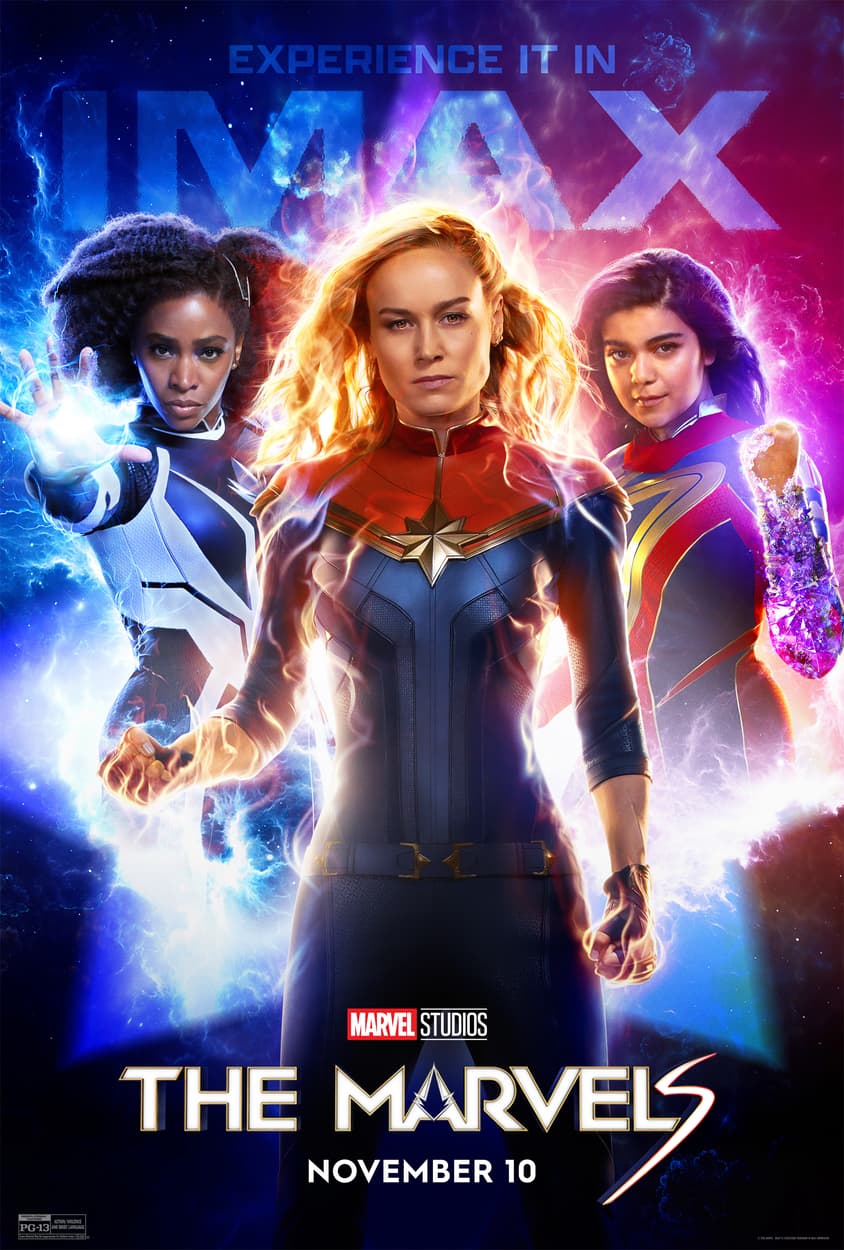
THE MARVELS movie review

by Amanda Firestone, Guest Contributor and Film Professor

I don’t know about you, but I’m burned out on superhero movies. By the time we got to Infinity War (2018) and Endgame (2019), I wasn’t sure I could sit through another CGI-explosion, epic battle fight fest. And I didn’t – until Wakanda Forever hit the screen (2022). While I loved seeing Shuri become Black Panther, that same drained feeling returned after two hours and forty-one minutes in the theater seat. Leaving the cinema, I complained to my spouse that superhero filmmakers squeeze in fight after fight, sacrificing tight storytelling. For what? I’m not sure.

Like Wakanda Forever, the draw for me to see The Marvels is the woman-led cast. When I look at the MCU lineup, I can’t help but notice that men’s stories are prioritized, particularly in Phases One and Two. While women characters are important to the teams or the general narratives, they frequently are outnumbered by their men counterparts. The Marvels unfailingly centers audiences on Carol Danvers, Monica Rambeau, and Kamala Khan. While the ever-present Nick Fury provides support, the three heroes strategize together to defeat their common enemy, Dar-Benn, who is also a woman.

In many ways, the joy of the film is the simplicity. It brings together three characters who initially have some friction. They build trust and confidence in their team, and then they fight the baddie. For my taste, Nia DaCosta understood the assignment; the movie is one hour and forty-five minutes long, and that means the pacing is solid without so many of those masturbatory fight scenes that bog down other Marvel films.

Another way that The Marvels avoids bloat is by bypassing frequent rehashing of MCU information. When I was leaving the theater, the critic behind me complained that he didn’t know what was going on because the film didn’t take the time to explain all of the backstories for the Marvels. He hadn’t seen their respective origin stories. We all know the MCU is sprawling, and very few fans are die-hard completists. The film spent the first 15-20 minutes introducing each character and situating her in her world. It was sufficient to say, “hey, this one’s a loner superhero; this one’s a teenaged superhero with a fangirl crush on the loner; this one’s a scientist superhero who has family drama with the loner.” For people who see The Marvels as their intro to the MCU, they have Captain Marvel, Ms. Marvel, and WandaVision to seek out if they want to add more layers to their knowledge. But, those other sources are not necessary to understand the heart of the movie – build a team and fight the baddie.

Speaking of villains, another success for this movie is Dar-Benn, a Kree Accuser who becomes emperor after the destruction of the Supreme Intelligence. The sun that her planet orbits is dying and as a result, so is the planet. Dar-Benn is a ruler on a mission to save her people – at any cost. While her methods are brutal, there’s a lot of empathy to be had for her, which makes her conflicts with The Marvels more interesting on an emotional level, particularly as we head to the final showdown.

I felt so much joy watching this film. Yes, there was some fanservice in the picture (one of the most dangerous creatures in the universe features prominently), and as a Marvel fan it’s nice to see those call backs. More than that, it was just an all-around great popcorn flick. There was a great balance of levity, seriousness, and intensity. I cared about the characters, and that’s especially true for the newcomers like Dar-Benn. It’s well-worth the cost of the ticket and the time.

Assessment 4.5/5 stars

Dr. Amanda Firestone is an Associate Teaching Professor at the University of Tampa where she teaches film and media studies classes including Women in Film. She is the co-editor of Resist and Persist: Essays on Social Revolution in 21st Century Narratives, Harry Potter and Convergence Culture: Essays on Fandom and the Expanding Potterverse, and The Last Midnight: Essays on Apocalyptic Narratives in Millennial Media

BLUE BEETLE superhero movie review

High energy! Blue Beetle is a charismatic superhero movie that delivers vivacious action, laughs, and heart. Undoubtedly, Blue Beetle will become a fan-favorite superhero in the coming years ahead. However, the full potential of this movie to forge new frontiers for heroes and characters we haven’t had on the big screen before is ultimately curbed by some character choices and recurring thematic expressions.

Jaime Reyes suddenly finds himself in possession of an ancient relic of alien biotechnology called the Scarab. When the Scarab chooses Jaime to be its symbiotic host, he’s bestowed with an incredible suit of armor that’s capable of extraordinary and unpredictable powers, forever changing his destiny as he becomes the superhero Blue Beetle.

Before you begin thinking that if you’ve seen one superhero origin story, you’ve seen them all, Blue Beetle manages to make fresh a familiar plot to keep audiences entertained. The strength of Blue Beetle is in the casting, lesser so the characters themselves. That’s not to suggest that none of the characters are crafted and developed well, but there are some odd character/screenwriting choices that mitigate the full impact the movie could have had.

Susan Sarandon and Xolo Mariduēna are the standout performances and characters in the movie. Sarandon’s villain and Xolo’s hero are a perfect match for one another. She was cleverly fiendish and he was humble and strong. For me, it’s these two characters and cast members that made the movie for me. I cannot think of two other actors that could have brought these characters to life as well as these two. It’s also incredibly poetic: a screen legend and a relatively newcomer to the big screen. The chemistry and narrative poetry between our hero and villain was excellent. Anytime I get to enjoy Sarandon’s performances on the big or small screen is a good day!

While the plot for this origin story is fairly standard, the method of expression and the character choices give it an air of originality. But it’s in some of the expression of themes and characters that the movie falters, curbing the full potential of the story. Specifically, this is witnessed in the comedic stylings of George Lopez and the recurring commentary and themes borne out of postcolonial theory. While Lopez’ character was intended to be the comedic relief, the method of expression of his comedy became obnoxious and even exhausting. Moreover, his character plays right into negative stereotypes that the movie could have easily avoided.

Likewise, there is conspicuous, recurring imagery and commentary on postcolonial theory that mitigates the positive affects of the movie. It’s as if the screenwriter was message first and plot second. Even when filmmakers desire to exhibit their personal interpretation of a worldview, it is important that the filmmaker employs more clever means of expressing these opinions.

To bring us around to a more positive note, there is a wonderful depiction of a father-son (and father-family) relationship, and I highly respect the movie for this. Far too seldom do we get movies that spotlight healthy relationships between fathers and their families (in this case, the focus is on the father-son relationship). It’s so very important in narrative storytelling to remind the world of the important role a father plays in his family. Does that mean mothers cannot provide the same emotive dimension? Of course not. But there are many more movies that depict healthy, constructive mother-family relationships. This was a brilliant opportunity to spotlight the love a father has for his family and the love the family has for him.

Blue Beetle represents an MCU type of storytelling in a DC movie, but DC still manages to make this expression of a superhero their own. I really like Jaime/Blue Beetle, so I hope that I see him on the big screen again.

Ryan teaches Film Studies and Screenwriting at the University of Tampa and is a member of the Critics Association of Central Florida and Indie Film Critics of America. If you like this article, check out the others and FOLLOW this blog! Interested in Ryan making a guest appearance on your podcast or contributing to your website? Send him a DM on Twitter. If you’re ever in Tampa or Orlando, feel free to catch a movie with him.

Follow him on Twitter: RLTerry1 and LetterBoxd: RLTerry

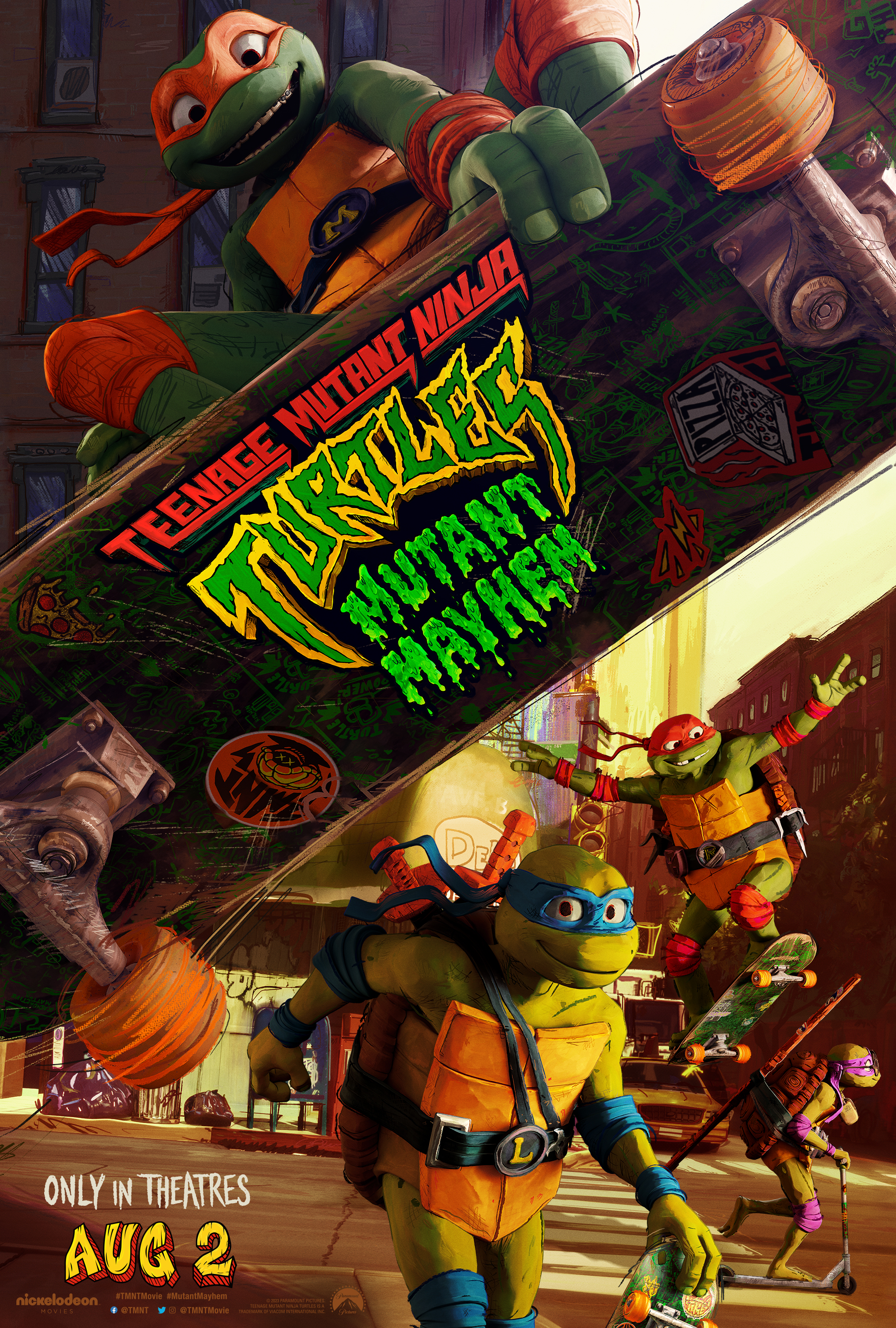
TEENAGE MUTANT NINJA TURTLES (2023) movie review

Cowabunga, you’ll have fun! Whether or not you grew up with the Teenage Mutant Ninja Turtles (TMNT) 1980s animated television show, the comic books, or even the other movies, there is so much to be enjoyed in the new TMNT movie. At just over 1.5 hours, you’ll be invested in this Mutant Mayhem that functions as a standalone origin story, plus a foundation from which to launch subsequent sequels. While Shredder is not the villain, stick around for his subtle debut in a mid-credits scene.

After years of being sheltered from the human world, the Turtle brothers set out to win the hearts of New Yorkers and be accepted as normal teenagers. Their new friend, April O’Neil, helps them take on a mysterious crime syndicate, but they soon get in over their heads when an army of mutants is unleashed upon them.

Since I have not watched any TMNT shows or movies since the animated series in the 1980s, I can’t comment on what is or isn’t canon or what would or would not be, but I can say that from what I remember about the old show, this feels like a reimagination that is simultaneously fresh yet familiar. Perhaps some characters are interpreted differently for this movie than they have been in the past, but the character dynamics, conflict, and relationships make sense within this world. Nicely plotted and paced TMNT moves quickly and leanly–sometimes a little too leanly, but I digress. Most of the humor in the movie works well, but there is one recurring joke that does grow tiring to the point that the punch is less funny than it would have been had the joke been setup and developed more sleekly.

The movie is incredibly postmodern in the sense that the characters reference real life celebrities, TV shows, movies, etc. And while it was cute for a short while, the constant pop-cultural references grew a little tiresome. It’s like salt: fantastic in small amounts; unhealthy in large amounts.

I’ve said it before, and I will say it again, I cannot figure out why studios and writers insist on sprinkling in adult language in a movie that is undeniably geared towards kids (if for no other reason, it is released by Nickelodeon). Reminder: you do not need to include foul language (in however small amounts) in order for adults to watch…they are going to watch anyway, and maybe even be more inclined to introduce their kid(s) to the TMNT.

Suffice it to say, TMNT is a lot of fun, and if you’re looking for a throwback superhero movie with some heart, then I’ve no doubt that you’ll enjoy this movie.

Ryan teaches Film Studies and Screenwriting at the University of Tampa and is a member of the Critics Association of Central Florida and Indie Film Critics of America. If you like this article, check out the others and FOLLOW this blog! Interested in Ryan making a guest appearance on your podcast or contributing to your website? Send him a DM on Twitter. If you’re ever in Tampa or Orlando, feel free to catch a movie with him.

Follow him on Twitter: RLTerry1 and LetterBoxd: RLTerry
THE FLASH movie review

Electrifying! From beginning to end, The Flash is a highly entertaining, funny, well-written thrill ride with a tremendous amount of heart! In an oversaturated superhero/CBM (comic book movie) live-action cinema landscape, dominated by MCU (and MCU-adjacent) movies, comes a breath of fresh air that works both visually and narratively.

Worlds collide when the Flash uses his superpowers to travel back in time to change the events of the past. However, when his attempt to save his family inadvertently alters the future, he becomes trapped in a reality in which General Zod has returned, threatening annihilation. With no other superheroes to turn to, the Flash looks to coax a very different Batman out of retirement and rescue an imprisoned Kryptonian — albeit not the one he’s looking for.

Andy Muschietti delivers a superb superhero motion picture that defies expectations set for anything the DCEU had to offer audiences. Christina Hodson’s fantastic screenwriting paired with John Francis Daley, Jonathan Goldstein, and Joby Harold’s story, provides a solid foundation upon which Muschiette crafts the motion picture for the screen. Nearly everything about this picture works incredibly well, except the CGI battle sequence at the end that felt right out of an early 2010s video game. In addition to the compelling visual storytelling, Muschietti and Hodson successfully, and organically) pay homage to Tim Burton, Zach Snyder, and even Richard Donner. Never before has a superhero multiverse been explored so well! Where other multiverse movies struggle narratively, this one excels in both form and function. And of course, the movie features THE definitive Batman Michael Keaton in a triumphant return to the screen as the Burton-verse caped crusader! While many other films in recent times have placed far less emphasis on plotting than visual composition, The Flash delivers on both.

Just when the general public and critics alike were genuinely wondering if there was anything left in the DCEU, The Flash is the strongest cinematic story to come out of this universe of characters since Wonder Woman, and perhaps the most fun superhero movie since Batman Returns. I know, positively using The Flash in the same statement as Batman Returns is high praise, as it’s my opinion that Batman Returns is the best comic book (or superhero) movie of all time. While The Flash isn’t as campy as the Batman 1960s TV series or the Schumacher movies, it strikes a balance between camp and melodrama in the same vein as Batman Returns struck a brilliant balance between camp and gothic romance. Wherein character expression may lean into camp. The Flash delivers heartfelt thoughtfulness in character interpersonal dynamics and plot. We empathize with Barry Allen’s obsessive plight to save the life of both his mother and father.

Simple plot, complex characters. That is precisely what you get in this movie. I know, what must he be thinking equating a multiverse setup with simple plot. That’s because the plot can be boiled down to when Barry Allen realizes that he has the ability to travel back in time, he returns to stop the death of his mother, but in doing so, unleashes a cataclysm of effects throughout the space-time continuum that must be corrected. There is one plot: save the life of his mother and father, whom is on trial for the death of his mother. Everything that Barry/The Flash does revolves around the central plot of stopping the death of his mother which will keep his father from being accused of her murder. No matter where we go in the multiverse, the external goal motivated by the internal need never changes.

The complexities in the narrative are character-driven. Barry Allen (Sr.) is hyper-focused on stopping the murder of his mother, no matter the cost, Bruce Wayne/Batman is wrestling with his identity as the caped crusader in a world that doesn’t need him anymore (or so it seems), and Barry Allen (Jr.) is struggling to find his place in the world as he is caught between childhood and adulthood. And the central plot connects all these characters and forces them to grow emotionally and psychologically. Apart from the central plot, none of the character growth would occur. Never once does the focus of the story shift, but the central themes of identity, overcoming trauma, and the dangers of obsession with control allow the movie to explore deeper meanings in the otherwise high concept story.

The central cast is fantastic! Never having seen The Flash TV show, I cannot comment on that expression of Barry Allen/The Flash, but Ezra Miller delivers a compelling performance of the lightning-fast superhero struggling with anxiety. We haven’t has a superhero that feels this genuinely human and vulnerable since Tim Burton’s Bruce Wayne/Batman played by Keaton. While they express their humanity differently, both play their respective everyman identities and super-alter egos with equal charisma and authenticity that is maintains its own identity depending on if they are wearing their respective masks. The idea of and meaning of the masque is something that entire books have been written on, but for the sake of argument, the masque represents a different identity and should be expressed differently unless, for dramatic purposes, the character’s humanity peaks through the superhero masque.

Miller’s portrayal of Allen/Flash is one that is unapologetically relatable and without pretense. Furthermore, I appreciate the inclusion of an individual struggling with anxiety, social awkwardness, and comes from average beginnings with no superhuman characteristics other than the ones bestowed through the electrical/chemical accident.

Many articles and podcasts have been published on Michael Keaton’s Batman, so I won’t spend too much time on him; however, we cannot talk The Flash without acknowledging the impact of the definitive Batman and Bruce Wayne returning to the big screen in a big way! At very first sights of Keaton, the Batcave, and the iconic Burton Batmobile, there were waves of applause and cheering from the audience, but nothing compares to the sheer deluge of cheering, shouting, and applauding for Michael Keaton when he appears in his Batman uniform for the first time since 1992. If this was a live performance in front of a studio audience, then all action would have stopped on stage for several minutes as the audience showed their affection for Keaton’s Batman. Even though he is not the central character, he factors heavily into the second and third acts of the movie. And you know what? He’s still got it!

Where the film simultaneously delivers and falters is in the integration of heavy CGI. The CGI works very well in the various effects of The Flash’s super speed and when exploring the multiverse; where the CGI is conspicuously unrealistic is in the final battle scenes. This is where and why the Tim Burton Batman movies will forever be timeless, but prolific use of CGI will date a film. You cannot replace the way real light bounces off real objects into the camera lens. There is a sense of real danger when practical effects, stunts, and pyro is used–it’s REAL–the danger is real. There is a dimension to practical sets and effects that CGI will never be able to replicate. Simply stating, the CGI in the battle sequences at the end takes the audience out of the film. However, the film doesn’t cheapen out on anything at Wayne Manor, the Batcave, Batmobile, or Batplane.

The score for The Flash is excellent, especially when Danny Elfman’s iconic Batman theme is integrated into the original score for this film. While I could have gone for the film to lean a little more heavily into the Elfman Batman theme, I appreciate the nuance of the theme when anything Burton-verse is on the screen. Outside of the Elfman Batman theme, the orchestration feels like an extension of each scene that never becomes the center of attention, but is always present.

About the cameos. Yes, there are some great cameos, but I am not going to disclose them as you need to experience them for yourself. What I will divulge on that subject is the conspicuous absence of Michelle Pfeiffer’s definitive Catwoman. Even though she’s stated in interviews that she hasn’t been asked to reprise her career-defining role, even thought she admittedly would love to wield the whip again, I thought that perhaps is was all a ruse and she would surprise us in this movie. But with the unparalleled positive response from audiences concerning Keaton’s return to the Batsuit, then perhaps we will get the incomparable Michelle Pfeiffer as Catwoman one last time.

Thrilling and fun for the whole family, I highly recommend watching The Flash. It was certainly the most fun I’ve had at the cinema all year.

Ryan teaches Film Studies and Screenwriting at the University of Tampa and is a member of the Critics Association of Central Florida and Indie Film Critics of America. If you like this article, check out the others and FOLLOW this blog! Interested in Ryan making a guest appearance on your podcast or contributing to your website? Send him a DM on Twitter. If you’re ever in Tampa or Orlando, feel free to catch a movie with him.

Follow him on Twitter: RLTerry1 and LetterBoxd: RLTerry

SPIDER-MAN: ACROSS THE SPIDER-VERSE movie review

Oh, what a tangled web [they] weave…with this cacophony of story threads. The highly anticipated sequel to the Best Animated Feature Oscar-winning Into the Spider-verse opens this week, but unfortunately, it suffers from a bad case of sequelitis brought on by a gluttonous consumption of excess. Spider-man: Across the Spider-verse works in title only–and all too well, as it were. The title says it all, and that is precisely what audiences get in this comic philhar-tragic symphony in the key of overindulgence.

After reuniting with Gwen Stacy, Brooklyn’s full-time, friendly neighborhood Spider-Man is catapulted across the Multiverse, where he encounters a team of Spider-People charged with protecting its very existence. However, when the heroes clash on how to handle a new threat, Miles finds himself pitted against the other Spiders. He must soon redefine what it means to be a hero so he can save the people he loves most.

Across the Spider-verse is what happens when a story idea doesn’t pass the elevator pitch litmus test (wherein an idea can be explained sufficiently enough in three-minutes or less). Quite simply, there is such a proliferation of story webs that there is virtually no plot–there is certainly no resolution before the (and this isn’t a spoiler) cliffhanger ending. Story webs lead into story webs that leads into even more story webs. Suffice it to say, it’s as if writers and producers took every incarnation of Spider-man comic series, threw them into a blender, and served the concoction o audiences. Unless you are read up on decades of Spider-man comics, you will be hard-pressed to follow any storyline. Perhaps the better expression of a collision of Spider-verses would have been in a television series that could have explored a different thread of comics each season.

Clearly, Sony took the extremely positive reception of the first one, focussed on recurring praises, and amplified those to the nth degree. Never mind that more than the visual expression of the story, plotting is crucial to structure, pacing, and coherency. The animators and artists are showcasing brilliance in animated filmmaking, but the clear evidence of screenwriting is nowhere to be found. Without a well-defined central character, a well-defined external goal, and a well-defined character of opposition between the central character and the goal, there is no plot–merely a sequence of loosely connected scenes or fragments of ideas. A fever dream, if you will.

While Across the Spider-verse suffers narratively, it certainly excels in the art of animation. The stylistic animation and editing is outstanding! Much like with the first movie, this one takes the emotive detail found in a single frame of a comic book (or graphic novel) and combines that approach with hand-drawn inspired motion picture animation. There are certainly problems with the story (or stories, as it were), but Sony Pictures Animation has demonstrably shown commitment to the boundless imagination and capabilities of animation. Across the Spider-verse, in how it is expressed in this movie, can only happen within the world of animation. In no way could this movie be expressed in a live-action way. Perhaps the writers were asleep at the wheel, but the animators gave each universe of Spider-man characters its own color palate and animation style.

Make sure to watch Across the Spider-verse in a premium format at your cinema, because the strength in this animated movie has little to do with the story as much as it does the stylistic animation. When a film, animated or live action, strikes a balance between style and substance, it can be enjoyed on the big or small screen without detracting from the storytelling; but when the movie struggles narratively but excels in form, then experiencing it on the big screen is the best approach.

Ryan teaches Film Studies and Screenwriting at the University of Tampa and is a member of the Critics Association of Central Florida and Indie Film Critics of America. If you like this article, check out the others and FOLLOW this blog! Interested in Ryan making a guest appearance on your podcast or contributing to your website? Send him a DM on Twitter. If you’re ever in Tampa or Orlando, feel free to catch a movie with him.

Follow him on Twitter: RLTerry1 and LetterBoxd: RLTerry