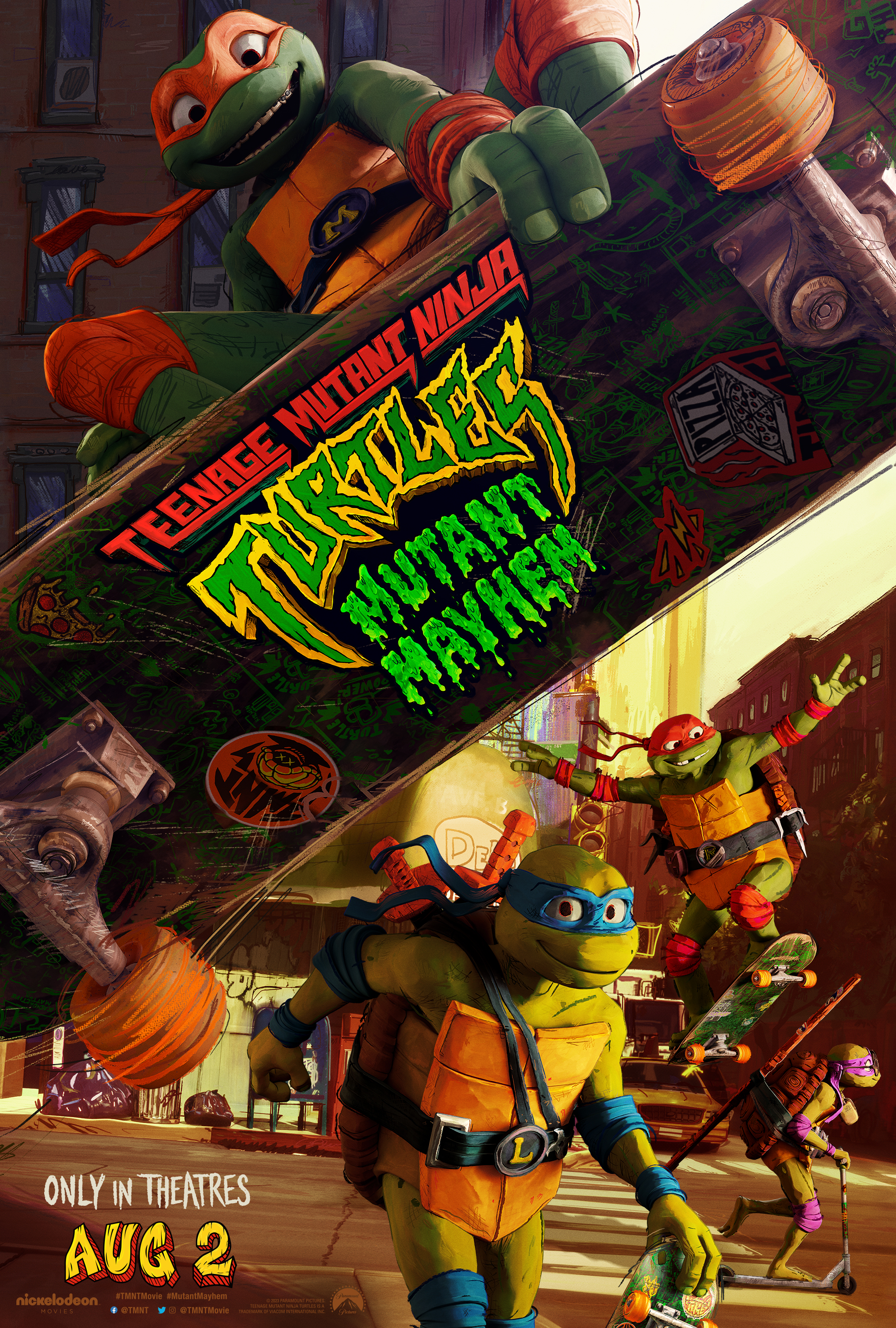
TEENAGE MUTANT NINJA TURTLES (2023) movie review

Cowabunga, you’ll have fun! Whether or not you grew up with the Teenage Mutant Ninja Turtles (TMNT) 1980s animated television show, the comic books, or even the other movies, there is so much to be enjoyed in the new TMNT movie. At just over 1.5 hours, you’ll be invested in this Mutant Mayhem that functions as a standalone origin story, plus a foundation from which to launch subsequent sequels. While Shredder is not the villain, stick around for his subtle debut in a mid-credits scene.

After years of being sheltered from the human world, the Turtle brothers set out to win the hearts of New Yorkers and be accepted as normal teenagers. Their new friend, April O’Neil, helps them take on a mysterious crime syndicate, but they soon get in over their heads when an army of mutants is unleashed upon them.

Since I have not watched any TMNT shows or movies since the animated series in the 1980s, I can’t comment on what is or isn’t canon or what would or would not be, but I can say that from what I remember about the old show, this feels like a reimagination that is simultaneously fresh yet familiar. Perhaps some characters are interpreted differently for this movie than they have been in the past, but the character dynamics, conflict, and relationships make sense within this world. Nicely plotted and paced TMNT moves quickly and leanly–sometimes a little too leanly, but I digress. Most of the humor in the movie works well, but there is one recurring joke that does grow tiring to the point that the punch is less funny than it would have been had the joke been setup and developed more sleekly.

The movie is incredibly postmodern in the sense that the characters reference real life celebrities, TV shows, movies, etc. And while it was cute for a short while, the constant pop-cultural references grew a little tiresome. It’s like salt: fantastic in small amounts; unhealthy in large amounts.

I’ve said it before, and I will say it again, I cannot figure out why studios and writers insist on sprinkling in adult language in a movie that is undeniably geared towards kids (if for no other reason, it is released by Nickelodeon). Reminder: you do not need to include foul language (in however small amounts) in order for adults to watch…they are going to watch anyway, and maybe even be more inclined to introduce their kid(s) to the TMNT.

Suffice it to say, TMNT is a lot of fun, and if you’re looking for a throwback superhero movie with some heart, then I’ve no doubt that you’ll enjoy this movie.

Ryan teaches Film Studies and Screenwriting at the University of Tampa and is a member of the Critics Association of Central Florida and Indie Film Critics of America. If you like this article, check out the others and FOLLOW this blog! Interested in Ryan making a guest appearance on your podcast or contributing to your website? Send him a DM on Twitter. If you’re ever in Tampa or Orlando, feel free to catch a movie with him.

Follow him on Twitter: RLTerry1 and LetterBoxd: RLTerry

THE FLASH movie review

Electrifying! From beginning to end, The Flash is a highly entertaining, funny, well-written thrill ride with a tremendous amount of heart! In an oversaturated superhero/CBM (comic book movie) live-action cinema landscape, dominated by MCU (and MCU-adjacent) movies, comes a breath of fresh air that works both visually and narratively.

Worlds collide when the Flash uses his superpowers to travel back in time to change the events of the past. However, when his attempt to save his family inadvertently alters the future, he becomes trapped in a reality in which General Zod has returned, threatening annihilation. With no other superheroes to turn to, the Flash looks to coax a very different Batman out of retirement and rescue an imprisoned Kryptonian — albeit not the one he’s looking for.

Andy Muschietti delivers a superb superhero motion picture that defies expectations set for anything the DCEU had to offer audiences. Christina Hodson’s fantastic screenwriting paired with John Francis Daley, Jonathan Goldstein, and Joby Harold’s story, provides a solid foundation upon which Muschiette crafts the motion picture for the screen. Nearly everything about this picture works incredibly well, except the CGI battle sequence at the end that felt right out of an early 2010s video game. In addition to the compelling visual storytelling, Muschietti and Hodson successfully, and organically) pay homage to Tim Burton, Zach Snyder, and even Richard Donner. Never before has a superhero multiverse been explored so well! Where other multiverse movies struggle narratively, this one excels in both form and function. And of course, the movie features THE definitive Batman Michael Keaton in a triumphant return to the screen as the Burton-verse caped crusader! While many other films in recent times have placed far less emphasis on plotting than visual composition, The Flash delivers on both.

Just when the general public and critics alike were genuinely wondering if there was anything left in the DCEU, The Flash is the strongest cinematic story to come out of this universe of characters since Wonder Woman, and perhaps the most fun superhero movie since Batman Returns. I know, positively using The Flash in the same statement as Batman Returns is high praise, as it’s my opinion that Batman Returns is the best comic book (or superhero) movie of all time. While The Flash isn’t as campy as the Batman 1960s TV series or the Schumacher movies, it strikes a balance between camp and melodrama in the same vein as Batman Returns struck a brilliant balance between camp and gothic romance. Wherein character expression may lean into camp. The Flash delivers heartfelt thoughtfulness in character interpersonal dynamics and plot. We empathize with Barry Allen’s obsessive plight to save the life of both his mother and father.

Simple plot, complex characters. That is precisely what you get in this movie. I know, what must he be thinking equating a multiverse setup with simple plot. That’s because the plot can be boiled down to when Barry Allen realizes that he has the ability to travel back in time, he returns to stop the death of his mother, but in doing so, unleashes a cataclysm of effects throughout the space-time continuum that must be corrected. There is one plot: save the life of his mother and father, whom is on trial for the death of his mother. Everything that Barry/The Flash does revolves around the central plot of stopping the death of his mother which will keep his father from being accused of her murder. No matter where we go in the multiverse, the external goal motivated by the internal need never changes.

The complexities in the narrative are character-driven. Barry Allen (Sr.) is hyper-focused on stopping the murder of his mother, no matter the cost, Bruce Wayne/Batman is wrestling with his identity as the caped crusader in a world that doesn’t need him anymore (or so it seems), and Barry Allen (Jr.) is struggling to find his place in the world as he is caught between childhood and adulthood. And the central plot connects all these characters and forces them to grow emotionally and psychologically. Apart from the central plot, none of the character growth would occur. Never once does the focus of the story shift, but the central themes of identity, overcoming trauma, and the dangers of obsession with control allow the movie to explore deeper meanings in the otherwise high concept story.

The central cast is fantastic! Never having seen The Flash TV show, I cannot comment on that expression of Barry Allen/The Flash, but Ezra Miller delivers a compelling performance of the lightning-fast superhero struggling with anxiety. We haven’t has a superhero that feels this genuinely human and vulnerable since Tim Burton’s Bruce Wayne/Batman played by Keaton. While they express their humanity differently, both play their respective everyman identities and super-alter egos with equal charisma and authenticity that is maintains its own identity depending on if they are wearing their respective masks. The idea of and meaning of the masque is something that entire books have been written on, but for the sake of argument, the masque represents a different identity and should be expressed differently unless, for dramatic purposes, the character’s humanity peaks through the superhero masque.

Miller’s portrayal of Allen/Flash is one that is unapologetically relatable and without pretense. Furthermore, I appreciate the inclusion of an individual struggling with anxiety, social awkwardness, and comes from average beginnings with no superhuman characteristics other than the ones bestowed through the electrical/chemical accident.

Many articles and podcasts have been published on Michael Keaton’s Batman, so I won’t spend too much time on him; however, we cannot talk The Flash without acknowledging the impact of the definitive Batman and Bruce Wayne returning to the big screen in a big way! At very first sights of Keaton, the Batcave, and the iconic Burton Batmobile, there were waves of applause and cheering from the audience, but nothing compares to the sheer deluge of cheering, shouting, and applauding for Michael Keaton when he appears in his Batman uniform for the first time since 1992. If this was a live performance in front of a studio audience, then all action would have stopped on stage for several minutes as the audience showed their affection for Keaton’s Batman. Even though he is not the central character, he factors heavily into the second and third acts of the movie. And you know what? He’s still got it!

Where the film simultaneously delivers and falters is in the integration of heavy CGI. The CGI works very well in the various effects of The Flash’s super speed and when exploring the multiverse; where the CGI is conspicuously unrealistic is in the final battle scenes. This is where and why the Tim Burton Batman movies will forever be timeless, but prolific use of CGI will date a film. You cannot replace the way real light bounces off real objects into the camera lens. There is a sense of real danger when practical effects, stunts, and pyro is used–it’s REAL–the danger is real. There is a dimension to practical sets and effects that CGI will never be able to replicate. Simply stating, the CGI in the battle sequences at the end takes the audience out of the film. However, the film doesn’t cheapen out on anything at Wayne Manor, the Batcave, Batmobile, or Batplane.

The score for The Flash is excellent, especially when Danny Elfman’s iconic Batman theme is integrated into the original score for this film. While I could have gone for the film to lean a little more heavily into the Elfman Batman theme, I appreciate the nuance of the theme when anything Burton-verse is on the screen. Outside of the Elfman Batman theme, the orchestration feels like an extension of each scene that never becomes the center of attention, but is always present.

About the cameos. Yes, there are some great cameos, but I am not going to disclose them as you need to experience them for yourself. What I will divulge on that subject is the conspicuous absence of Michelle Pfeiffer’s definitive Catwoman. Even though she’s stated in interviews that she hasn’t been asked to reprise her career-defining role, even thought she admittedly would love to wield the whip again, I thought that perhaps is was all a ruse and she would surprise us in this movie. But with the unparalleled positive response from audiences concerning Keaton’s return to the Batsuit, then perhaps we will get the incomparable Michelle Pfeiffer as Catwoman one last time.

Thrilling and fun for the whole family, I highly recommend watching The Flash. It was certainly the most fun I’ve had at the cinema all year.

Ryan teaches Film Studies and Screenwriting at the University of Tampa and is a member of the Critics Association of Central Florida and Indie Film Critics of America. If you like this article, check out the others and FOLLOW this blog! Interested in Ryan making a guest appearance on your podcast or contributing to your website? Send him a DM on Twitter. If you’re ever in Tampa or Orlando, feel free to catch a movie with him.

Follow him on Twitter: RLTerry1 and LetterBoxd: RLTerry
SPIDER-MAN: ACROSS THE SPIDER-VERSE movie review

Oh, what a tangled web [they] weave…with this cacophony of story threads. The highly anticipated sequel to the Best Animated Feature Oscar-winning Into the Spider-verse opens this week, but unfortunately, it suffers from a bad case of sequelitis brought on by a gluttonous consumption of excess. Spider-man: Across the Spider-verse works in title only–and all too well, as it were. The title says it all, and that is precisely what audiences get in this comic philhar-tragic symphony in the key of overindulgence.

After reuniting with Gwen Stacy, Brooklyn’s full-time, friendly neighborhood Spider-Man is catapulted across the Multiverse, where he encounters a team of Spider-People charged with protecting its very existence. However, when the heroes clash on how to handle a new threat, Miles finds himself pitted against the other Spiders. He must soon redefine what it means to be a hero so he can save the people he loves most.

Across the Spider-verse is what happens when a story idea doesn’t pass the elevator pitch litmus test (wherein an idea can be explained sufficiently enough in three-minutes or less). Quite simply, there is such a proliferation of story webs that there is virtually no plot–there is certainly no resolution before the (and this isn’t a spoiler) cliffhanger ending. Story webs lead into story webs that leads into even more story webs. Suffice it to say, it’s as if writers and producers took every incarnation of Spider-man comic series, threw them into a blender, and served the concoction o audiences. Unless you are read up on decades of Spider-man comics, you will be hard-pressed to follow any storyline. Perhaps the better expression of a collision of Spider-verses would have been in a television series that could have explored a different thread of comics each season.

Clearly, Sony took the extremely positive reception of the first one, focussed on recurring praises, and amplified those to the nth degree. Never mind that more than the visual expression of the story, plotting is crucial to structure, pacing, and coherency. The animators and artists are showcasing brilliance in animated filmmaking, but the clear evidence of screenwriting is nowhere to be found. Without a well-defined central character, a well-defined external goal, and a well-defined character of opposition between the central character and the goal, there is no plot–merely a sequence of loosely connected scenes or fragments of ideas. A fever dream, if you will.

While Across the Spider-verse suffers narratively, it certainly excels in the art of animation. The stylistic animation and editing is outstanding! Much like with the first movie, this one takes the emotive detail found in a single frame of a comic book (or graphic novel) and combines that approach with hand-drawn inspired motion picture animation. There are certainly problems with the story (or stories, as it were), but Sony Pictures Animation has demonstrably shown commitment to the boundless imagination and capabilities of animation. Across the Spider-verse, in how it is expressed in this movie, can only happen within the world of animation. In no way could this movie be expressed in a live-action way. Perhaps the writers were asleep at the wheel, but the animators gave each universe of Spider-man characters its own color palate and animation style.

Make sure to watch Across the Spider-verse in a premium format at your cinema, because the strength in this animated movie has little to do with the story as much as it does the stylistic animation. When a film, animated or live action, strikes a balance between style and substance, it can be enjoyed on the big or small screen without detracting from the storytelling; but when the movie struggles narratively but excels in form, then experiencing it on the big screen is the best approach.

Ryan teaches Film Studies and Screenwriting at the University of Tampa and is a member of the Critics Association of Central Florida and Indie Film Critics of America. If you like this article, check out the others and FOLLOW this blog! Interested in Ryan making a guest appearance on your podcast or contributing to your website? Send him a DM on Twitter. If you’re ever in Tampa or Orlando, feel free to catch a movie with him.

Follow him on Twitter: RLTerry1 and LetterBoxd: RLTerry
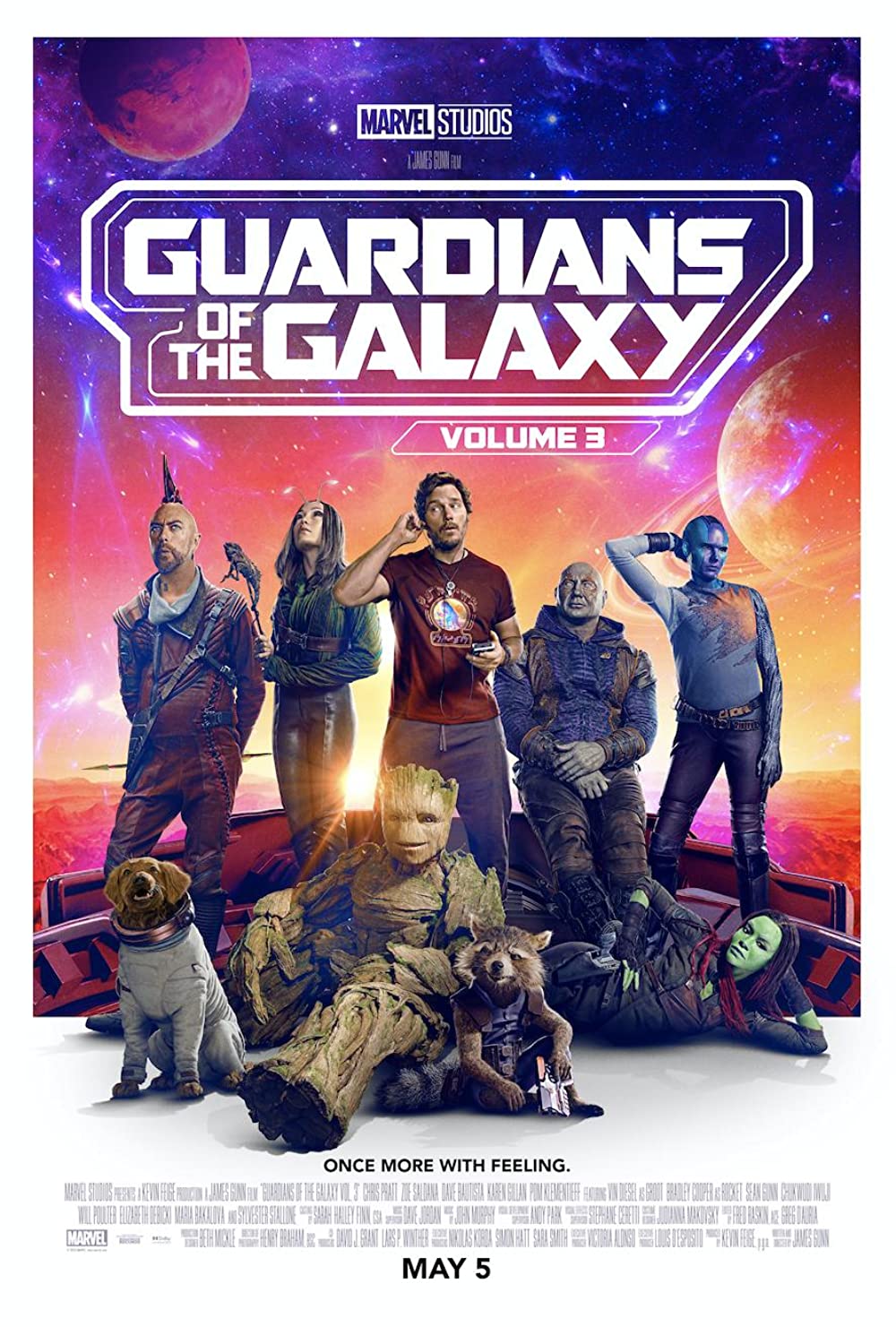
GUARDIANS OF THE GALAXY VOL.3 movie review

Whoa! That’s a lot of movie, and a lot to unpack. While James Gunn’s MCU swan song Guardians of the Galaxy vol.3 works well as an allegory of the Third Reich, exploring the atrocities of that nightmarish ideology and movement, the superhero movie is greatly lacking in entertainment value.

Still reeling from the loss of Gamora, Peter Quill must rally his team to defend the universe and protect one of their own. If the mission is not completely successful, it could possibly lead to the end of the Guardians as we know them.

The story is emotionally manipulative and many scenes and dialogue are inappropriate for young audiences. (As a reminder, kids are NOT little adults; kids are lacking in critical thinking skills). Furthermore, the movie suffers from squeezing too much plot into a single movie–the film overstays its welcome by about 30–45-minutes.

Clearly, James Gunn loves theses characters, and I can tell that he is a writer that genuinely cares (a trait I spotlight in my screenwriting classes), but I feel he forgot that a large segment of his MCU audience is comprised of kids, whether he accepts or likes that fact or not, and should have considered that dynamic when crafting this story. A storytelling element that is common amongst the MCU, especially within the Guardians of the Galaxy previous two movies, is levity. There is too little levity to counterbalance the dark elements of the movie. As such, the movie is incredibly heavy and sucks all the joy out of going to the cinema to attend a superhero movie. The movie is not completely without redeeming qualities or uplifting moments, but they are vastly outweighed by the somber tone of the movie as a whole.

Even though the film’s incredibly dark visual elements and themes are tastefully handled for older teen and adult audiences, as whole, this MCU installment is not appropriate for kids. If the movie’s marketing made it a point that this Guardians of the Galaxy movie was not for kids, I wouldn’t have a big a problem with content of the movie, but it’s the fact that kids were not dissuaded in any way from attending this, insofar as I am aware. When Deadpool first released, there was an entire tongue in cheek campaign to remind parents and siblings that this Marvel movie was not for kids–tastefully handled. Perhaps the studio dropped the f-bomb and increased the crass language and violence as a means to warm kids up to Deadpool 3, but that is a completely unhealthy approach as is disrespectful of what it means to be a child and young.

Looking to another franchise with which a whole generation of kids grew up, the Harry Potter movies became more mature as the seminole audience grew. Which is important, as life IS complicated and success, grief, loss, death, and disappointment are part of the human experience. However, the movies never became overly violent, increased crass language, or went to too dark a place (without counterbalancing it with levity and more lighthearted moments). Guardians of the Galaxy vol.3 is representative of the direction Marvel and Disney are going, and it’s not good nor healthy. If the MCU wants to create more movies that are adult in nature, then do that–but don’t take what has appealed to kids and decide to increase the more mature content. As I understand it, there is a whole universe of Marvel characters, and I am confident that a sub-franchise can be started that is geared towards mature audiences from the onset. And when kids get older, they can choose to eventually experience the Marvel movies that were, at one time, inappropriate for them.

What I found most fascinating about the movie is the commentary on the Third Reich (and for those that don’t remember, that is the ideology turned movement that was manifested by the Nazi party). Without going into great detail, one of the common practices at Nazi-controlled concentration camps was to further medical science by experimenting on the prisoners. Unfortunately, some of what we know today, some of the advancements that we use for healing today, came out of those nightmarish compounds. The idea was to learn from the experiments in order to increase the life experience of the master race perfect–correct that which was flawed. Moreover, the idea of a master society was carried into the idea of creating a utopia (something the Nazis had in common with the Soviets). But of course, utopia is an impossibility, and the pursuit of it often comes at the cost of life, individuality, and freedom.

The big bad villain in this movie known as the High Evolutionary is representation of and analogous with Hitler. At the core of the High Evolutionary’s goals and ambitions is the same ideology that drove and inspired Hitler. Furthermore, his speeches that feel they could have been written for a modern day Hitler. I appreciate what James Gunn did here, because it is monstrously challenging to craft a story around such heavy subject matter. Analogy and extended metaphor are outstanding tools to use in storytelling to provide commentary on a topic without talking about it. The ideology that inspired Hitler didn’t go away with him and his party, but it’s still out there, and must be kept at bay. Fictional storytelling can be used as a means to explore an observation of reality that may otherwise be uncomfortable.

If only as much thought had been put into the sets and effects of the movie. Like the perennial house guest that has worn out their welcome but continues to return anyway, prolific CGI continues to be employed instead of showcasing the craftsmanship of practical effects, real sets, and models. I’ve said it before, and I will say it again, CGI can never replace the way real light bounces off real objects into the camera lens. When I look at a monstrous creation of CGI, I am never left with the feeling that I witnessed the hand of an artist—brilliant engineer, yes–artist, no. Furthermore, not only is the CGI screaming in your face, but the movie’s music and sound effects mixes are also deafening. The kid seated next to me had his hands over his ears for a good portion of the movie. There is nothing subtle or nuanced about this movie.

Guardians of the Galaxy vol.3 represents James Gunn’s MCU swan song as he is now working on DCEU (or whatever it’s going to be called) movies. And he certainly left an indelible mark upon the MCU because few other directors (if any) could have worked the magic he did with the Guardians, a one-time obscure Marvel comic series. While I have many reservations of taking your kids to see this movie, it is one that should inspire thoughtful conversations about the parallels the villain(s) shares with the Third Reich.

Guardians of the Galaxy review | Guardians of the Galaxy vol.2 review

Ryan teaches Film Studies and Screenwriting at the University of Tampa and is a member of the Critics Association of Central Florida and Indie Film Critics of America. If you like this article, check out the others and FOLLOW this blog! Interested in Ryan making a guest appearance on your podcast or contributing to your website? Send him a DM on Twitter. If you’re ever in Tampa or Orlando, feel free to catch a movie with him.

Follow him on Twitter: RLTerry1 and LetterBoxd: RLTerry

SHAZAM! FURY OF THE GODS movie review

Sufficiently entertaining. SHAZAM! Fury of the Gods starts and ends well, but the middle wanders aimlessly with the only goal to inflate runtime. After the explosive first act, the second act mostly serves as filler material to augment the narrative by making it about twenty to thirty minutes longer than it needed to be. Fortunately, the third act delivers a climatic showdown, which greatly aids in the audience experience. But the movie struggles narratively between the inciting incident (at the beginning) and the showdown at the end. Clearly, there was a good superhero movie in there, but it gets lost during the meandering developmental stage. To the movie’s credit, though, it’s the enthusiastic cast that ultimately saves the audience from complete disengagement. This is especially true with Helen Mirren and Lucy Liu, playing our villains, and Jack Dylan Grazer in his well-played comedic relief. While it’s not terribly memorable superhero movie, neither is it a bad movie.

Bestowed with the powers of the gods, Billy Batson and his fellow foster kids are still learning how to juggle teenage life with their adult superhero alter egos. When a vengeful trio of ancient gods arrives on Earth in search of the magic stolen from them long ago, Shazam and his allies get thrust into a battle for their superpowers, their lives, and the fate of the world.

If you have not seen the trailer, DON’T. While I have not seen the trailer myself, I’ve read that the BIG cameo at the end of the movie is spoiled. So, do yourself a favor and do NOT watch the trailer. As I stated in the beginning, it is sufficiently entertaining; moreover, I honestly enjoyed myself more than I thought I would for a movie aimed at kids and young teens. When I say aimed at kids and young teens, I do not use that as a pejorative or as a tool to belittle the movie. In fact, I am glad to see that there is a superhero movie that is aimed at kids. Seems like the majority of superhero movies nowadays are inappropriate for developing minds. It pleases me that we have a movie here that is suitable for the whole family.

Ryan teaches Film Studies and Screenwriting at the University of Tampa and is a member of the Critics Association of Central Florida and Indie Film Critics of America. If you like this article, check out the others and FOLLOW this blog! Interested in Ryan making a guest appearance on your podcast or contributing to your website? Send him a DM on Twitter. If you’re ever in Tampa or Orlando, feel free to catch a movie with him.

Follow him on Twitter: RLTerry1 and LetterBoxd: RLTerry