
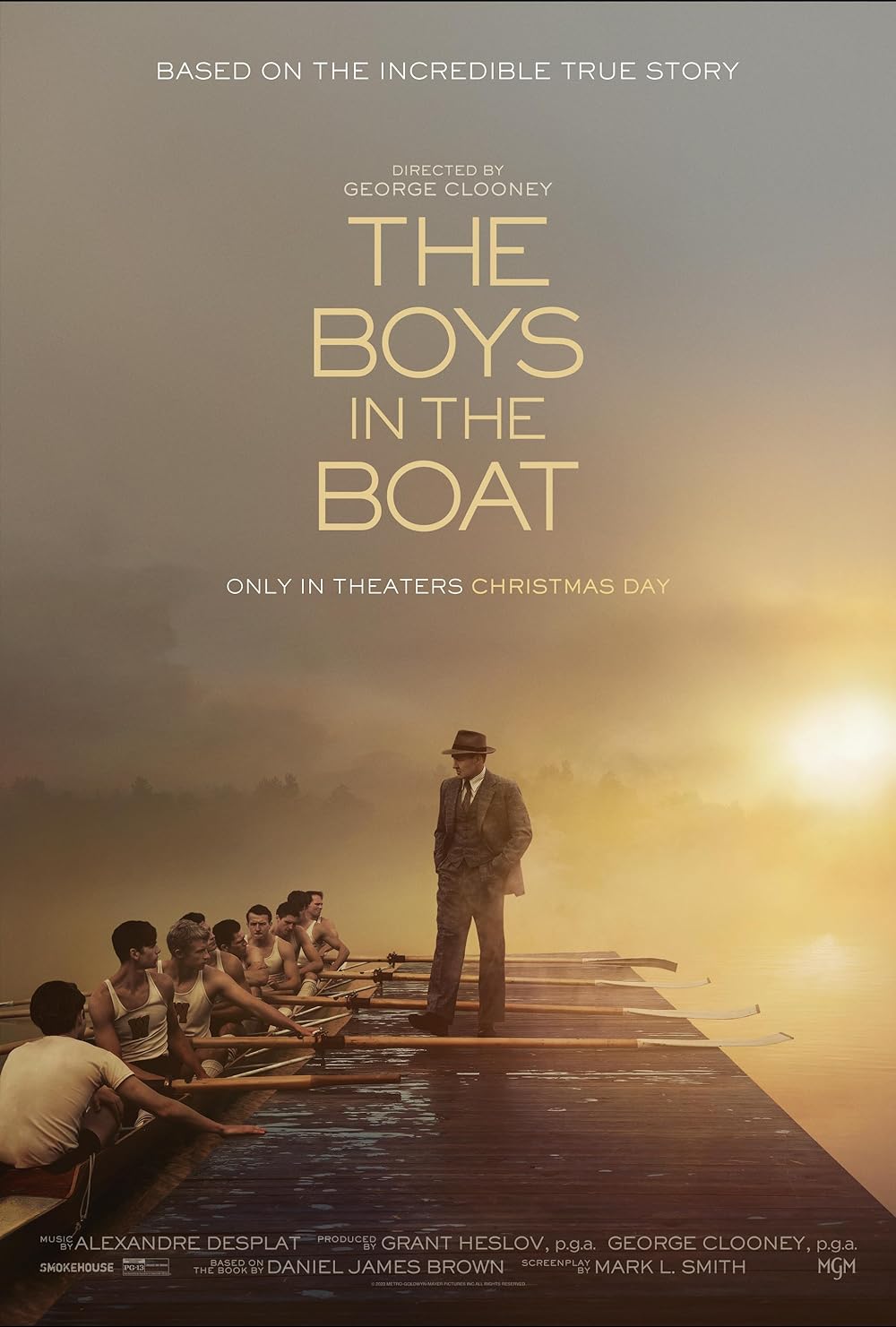
THE BOYS IN THE BOAT film review

A solid but unremarkable film. The Boys in the Boat is a standard historical drama that sufficiently meets expectations. Unfortunately, there lacks anything truly remarkable about the film. While the performances are better than average, the directing and screenwriting fall slightly short of where they should have been for this film. Thematically, the film delivers a big screen adaptation of a truly inspirational story, but beyond the uplifting feeling of a traditional underdog story, the film itself doesn’t particularly leave an emotive mark upon the mind and soul. Still, I was unaware of this story connected with the 1936 Summer Olympics held in Berlin, and am thankful that I now know about it. If nothing else, this film does a sufficient job of reminding us that we are more than the sum of our parts and really can achieve greatness by working collaboratively with one another to overcome the obstacles of life.

During the height of the Great Depression, members of the rowing team at the University of Washington get thrust into the spotlight as they compete for gold at the 1936 Olympics in Berlin.

While the screenplay demonstrates an understanding of what it means and the importance of a well-developed outside/action story with solid plotting, the screenplay falters in delivering a well-developed emotional drive that supports the action plot. Moreover, the screenplay fails to develop ancillary plots that it sets up in the first act. Without going into details, our central character has a need for a job (which is what leads him to go out for Rowing Crew) but we never revisit that need. And later, a member of the crew is deathly ill, but we never revisit that either. The author of the book upon which the film is based, co-wrote the screenplay, and it shows. Often times, novelists demonstrate difficulties in a storytelling medium that is cognitively-driven to one that is visually-driven. And we have a lot of telling instead of dramatizing in this film.

George Clooney makes some questionable directorial choices that leave me scratching my head. Clearly the talent for directing is there, but scenes that should be allowed to breathe aren’t given the chance, and other scenes that steep, should have been ended or started later. Some scenes work very well, but there are too few of those. Funnily, there is this sexual tension that is observable in two characters between whom there is no romantic interest, and that is based upon how the scenes were directed and subsequently assembled in the editing room. There is even a quick scene (and scene is being generous as it’s more of a cutaway) between the Crew from Washington and famed Olympian Jesse Owens that was sloppily executed.

The Boys in the Boat reminds me more of a movie that I’d expect to find as content on a streaming platform than it does genuine cinema. In the hands of a different director and screenwriter, this movie could’ve easily been crafted to be more impactful that it presently is. It has it’s high points, and for that, the filmi s above average, but the lack of anything truly remarkable about it drags it down from where I feel it wanted to be. Perhaps had more attention been paid to developing characters instead of focusing on the outside/action story, then we may have had something more meaningful than it is. Many movies these days place a substantial amount of focus on the ethos, subtext, or emotional parts of a story, thus sacrificing the art and science of proper plotting, so I am glad to witness proper A-story plotting; however, that does not excuse the lack of care paid to the B and C stories and emotional drive that parallels and supports the outside/action narrative.

While I don’t find anything remarkable about the film, it’s not a bad film either. In fact, I am so glad that I now know of this inspirational underdog story. I wish more than the mere knowledge of the historical event is was what was inspirational, but we can take from it that those that are perceived to be least likely to succeed, may just need the right coach and opportunity to demonstrate to the world what they are made of and capable to accomplish.
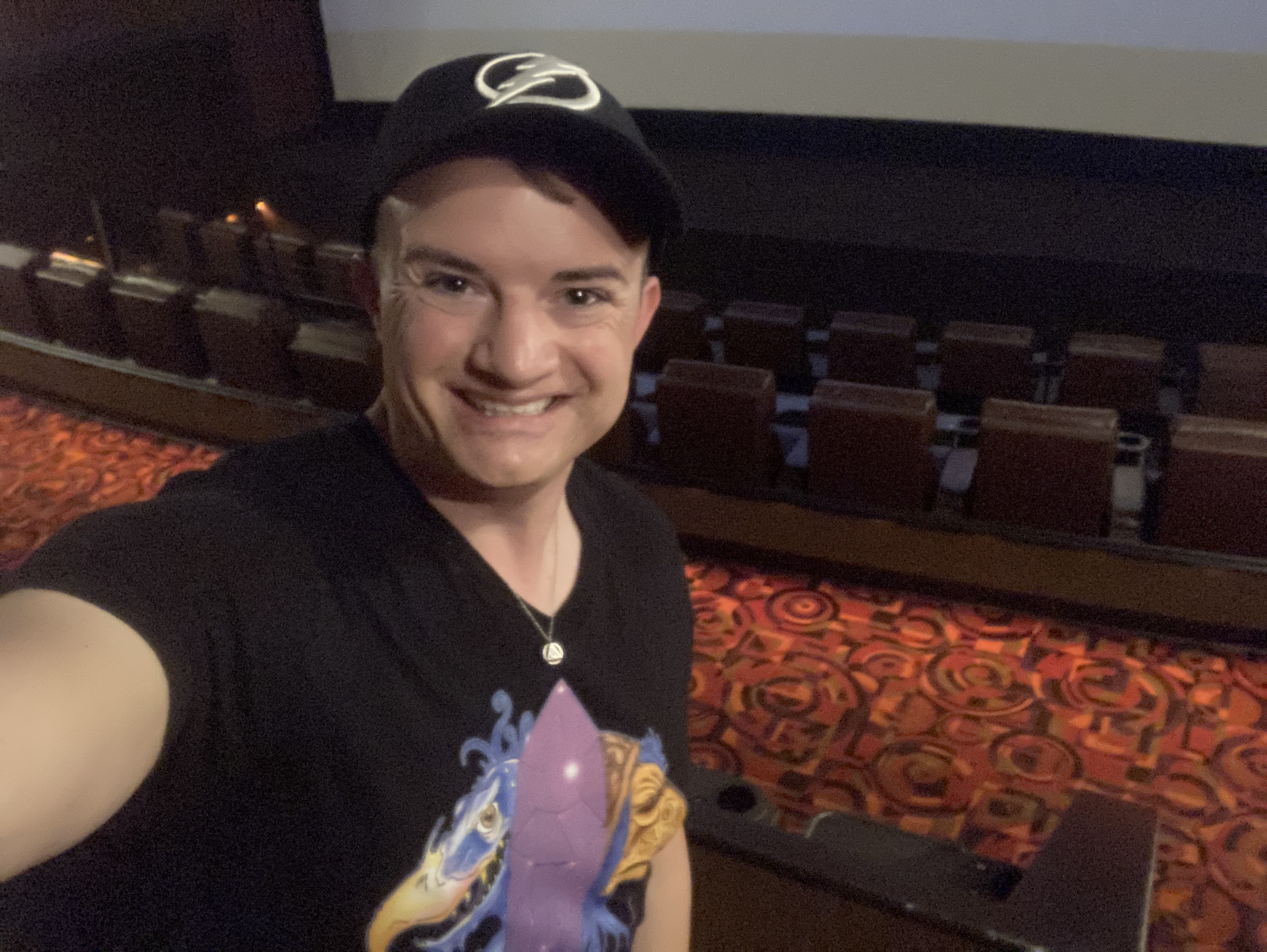
Ryan teaches Film Studies and Screenwriting at the University of Tampa and is a member of the Critics Association of Central Florida and Indie Film Critics of America. If you like this article, check out the others and FOLLOW this blog! Interested in Ryan making a guest appearance on your podcast or contributing to your website? Send him a DM on Twitter. If you’re ever in Tampa or Orlando, feel free to catch a movie with him.
Follow him on Twitter: RLTerry1 and LetterBoxd: RLTerry

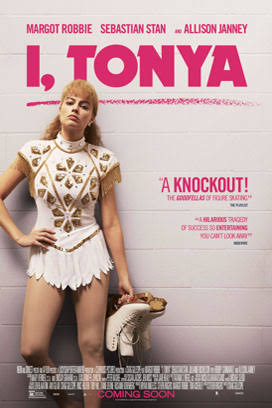
“I, Tonya” film review

Of skates and class. Margot Robbie stars as the first US woman to successfully land a triple axel…also the most infamous woman in the history of US Figure Skating in what is likely one of the most difficult and controversial biographical films ever produced. Tonya Harding is back in the headlines and on TV, and even on the ice if you caught last night’s 2-hour Truth and Lies special on ABC. While most Olympiad names are forgotten within a short amount of time, Harding and Nancy Kerrigan’s names will always have notoriety through the years. Nearly 25 years later, we find ourselves still talking about Tonya Harding. The biopic I, Tonya directed by Craig Gillespie and written by Steven Rogers provides audiences with an unapologetic glimpse into Harding’s early life through “the incident.” It is unlike any biographical film that I have ever seen before. Most often, biopics slant toward making the central character more likable than perhaps they were in real life. This film approaches Harding from the perspective of not shying away from her foul-mouthed, inability to take responsibility, violent temper; instead, showing us an authentic Harding who struggled through life to break the chains of classless poverty and emerge onto the scene as a professional figure skating record-setting champion. While this movie does not set out to prove what really happened, it does show what is likely to have happened. Although “the incident” is what everyone remembers, this movie shows a struggling young person attempting to change but thwarted at every angle by hearing that she cannot because she isn’t what America is looking for and has no class. But why couldn’t it have been just about the skating???

Tonya Harding (Margot Robbie) took to ice like a fish takes to water. She was an ice skating prodigy from the soft age of four when she took her first lesson from coach Diane Rawlinson (Julianne Nicholson). Growing up poor, she faced obstacle at every triple toe loop. From mental and physical abuse to sexual abuse, she weathered it all. Her mother LaVona (Allison Janney) was a monster of a woman who pushed and pushed in order to toughen “soft” Tonya. Even hot-tempered Tonya found love–albeit brief–with Jeff Gillooly (Sebastian Stan). The mental and physical abuse continued and only worsened after she set the world record for being the first US woman to successfully land a triple axel in 1991. But she would come in fourth in the 1992 Olympics. She fell into despair after that crushing defeat. When the US Figure Skating association gives Harding a second chance at the 1994 Winter Olympics, all seems like it is finally going her way, and she would finally experience the success she dreamt of her entire life, until “the incident.” Of course, as we all know, she went on to become a national punchline, material for comedians and sitcoms, and the most well-known name in the US after Bill Clinton.

Even though crime and ice skating are central elements in this film, it is truly a commentary on class and abuse. From the moment the movie opens with Harding and her mother smoking a cigarette at the ice rink in Harding’s hometown of Portland juxtaposing them against the pretty and proper coach with her students, we know that we are about to watch a story of class warfare. All Harding wanted was to excel at the sport she was naturally gifted at. Only one small problem: society and the figure skating association made it incredibly difficult–if not nearly impossible–for Tonya Harding to break free of her roots in classless poverty. But don’t allow the beginning of the film fool you into thinking she Harding is a kind soul who finds herself the underdog, she has a volatile temper and foul mouth that constantly gets her into trouble during practice and in competition. This film is an underdog story, but quite the unconventional one. Because we already know going in that she went from the first woman to land a triple axel, national champion to disgraced skater and unsuccessful boxer. For all its various plot points, the common theme throughout the movie is whether or not to allow your financial station in life to determine your behavior on and off the ice. Class has little to do with money, but rather, is a state of mind and demeanor. Perhaps we have a better idea of why Tonya behaved the way she did. The film never excuses her behavior or indirect knowledge (after the fact) of what her husband mastermind, but peels back the 24-hr 1990s news coverage in order to empathize and understand what made Tonya tick.

Is it possible for a square peg to fit into a round hole? Certainly, the life of a figure skater, especially one who represents the US on the global stage, is incredibly structured, polished, and constructed in such a way that the skater always looks his or her best to the public–a facade if you will. But, the once bright career of Harding serves as evidence that if you don’t come from the right family, have the right costume (or clothes), or speak eloquently, then the arena has no place for you. Perhaps that is why Harding still has fans despite her infamy. Although according to the film, she could have spoken up a lot sooner to help the investigation along instead of being fully consumed by having to make the 1994 Olympic team and indirectly covering for her ex-husband, she was dealt a dirty hand by judges and rivals who felt she just didn’t belong with them; and America generally liked an underdog. Unfortunately, this underdog got caught up in a scandal the followed a long history of irreverent behavior. The media coverage certainly did not help Harding’s case any. With the availability of CNN’s 24-hour news coverage, birthed out of the Gulf War now able to capture everything in order to have stories constantly grabbing audience attention, the film paints a picture that the media treated her unfairly and convicted her before the court’s decision to prohibit her from ever competing or coaching again, and the subsequent stripping of titles. Just some food for thought.

The topic of abuse is not shied away from in this film. We witness Tonya suffering from the brutal tongue of her mother, as well as constant physical abuse. Because there lacked the number of social programs for the protection of children and teenagers we have today, and schools were not as in tuned to abuse at home, she had little choice but to deal. Eventually, she would succumb to lashing out in similar ways to what which she experienced every day growing up in that house–house, not home. Her mother attempts to rationalize and excise her behavior because she tells Tonya that fear and anger will drive her to be a champion, but that doesn’t change the lasting affect the lifelong abuse had upon Tonya. It’s entirely possible that Tonya sought out Jeff because she was used ot abuse and felt that she needed it. Talk about warped.

The quality of this biopic is incredible! I absolutely loved the “interview” footage in the 4:3  format whereas the main narrative was in 16:9. Felt like we were watching actual news coverage in 1998. At first, I thought we were, but then I recognized Margot Robbie behind the exquisite makeup and costuming job. It has such an organic–no pretense–feel to the film. Robbie and her costars had me fully convinced that they were their respective characters. All around, the commitment to character was outstanding. Robbie commented in an interview that she studied footage of Harding for over a year, and it shows brilliantly! When the actual footage rolls at the end of the film, it is incredibly difficult to tell the real Tonya from her screen counterpart. Robbie’s monologue in front of the mirror is certainly one for the record books because of just how authentic and powerful it is. The production design and cinematography create a time machine; you will feel as though you have been whisked back 20-30 years throughout the film. Authenticity in spades. Director Craig Gillespie should be immensely proud of the film he crafted! Excellent writing, acting, technical elements. This biographic motion picture has it all. And will certainly get you to once again talk about Tonya Harding.

Highly recommend for those who enjoy controversial biographical films. The high profile critics are not exaggerating when referring to it as one of, if not the, best film of the year. There is so much to like, and for some, hate about this film. Whether you believe her to be criminal or not, there is no doubt that you will be blown away by the quality of this motion picture.