
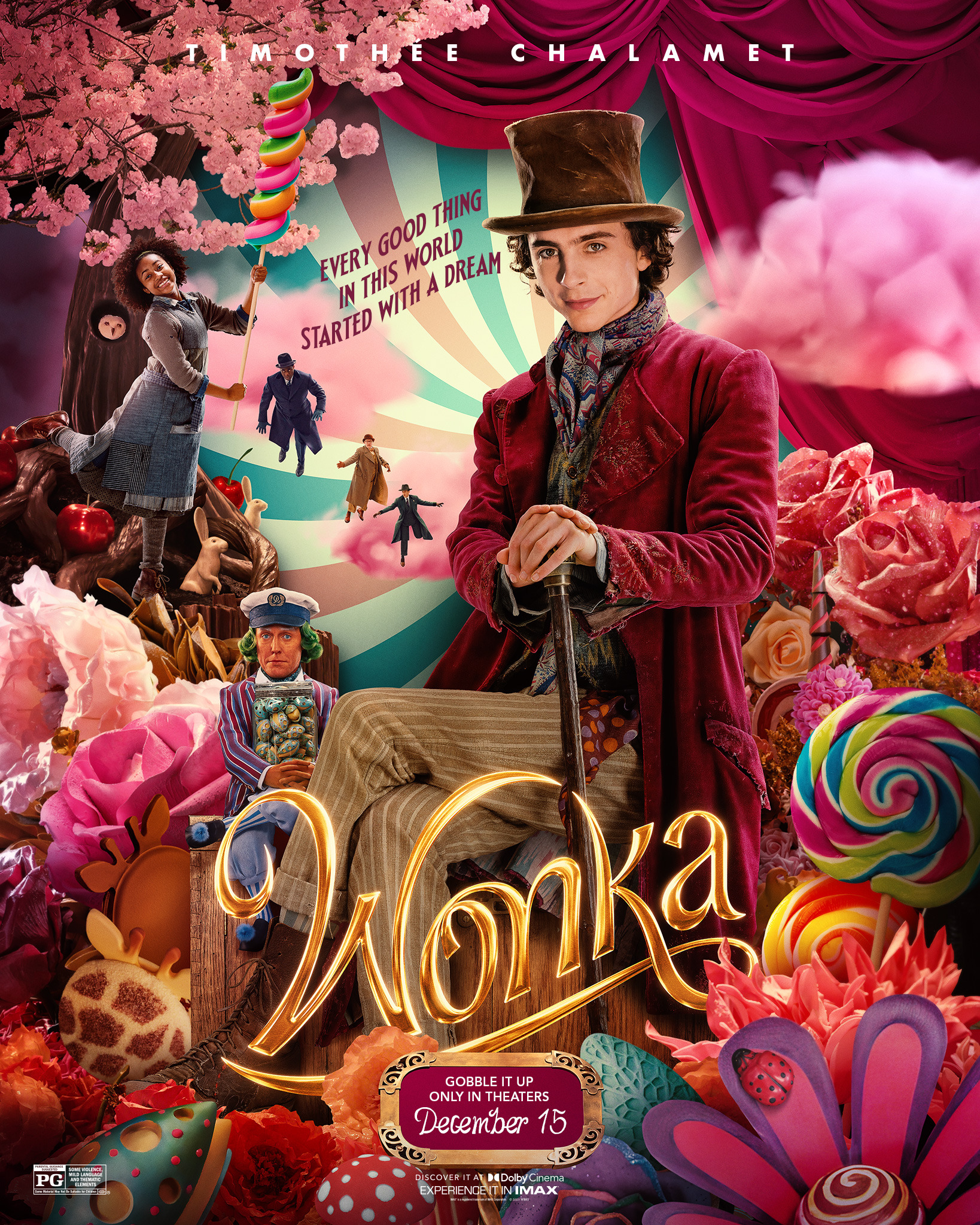
WONKA movie musical review

Charming but forgettable. Wonka is like a rich piece of candy, tasty in small amounts, but less appetizing the more you consume. However, the sufficiently charming musical will keep you entertained. But, it’s missing the moments of horror adjacency and the commentary on greed, pride, gluttony, etc. that gave the OG Willy Wonka and the Chocolate Factory some real bite! While it may not deliver the depth or quality of storytelling of the original, Wonka still delivers an entertaining diversion from the stressors of life with its whimsical world of chocolate and magic. The standout musical number is the Scrub Scrub number that is the G-rated answer to Chicago‘s infectious Cellblock Tango. Over all, Wonka will delight audiences with a throwback style musical that tastes best if not much thought is placed into the quality of ingredients.

Armed with nothing but a hatful of dreams, young chocolatier Willy Wonka manages to change the world, one delectable bite at a time.

Gone is the clever commentary on gluttony, pride, greed, sloth, lust, envy, and wrath as represented by the children and Wonka in the original book and film, but what this Wonka origin story lacks in thoughtfulness it makes up for in–well–the candy-like nature of this throwback style movie musical. It’s not deep and the quality of ingredients may be average, but it’s still sufficiently entertaining for the duration of the movie.

The casting is mostly solid! Despite his popularity, I find Chalamet to be an average actor–neither inordinately good or bad–just average; however, he was perfectly cast in this film even though there are plenty of moments that he looks like he’s phoning in his performance. He has the right look and energy for Wonka, so his casting works well. The other standout performance is Olivia Coleman as Ms. Scrubbit–she’s a great villain! And while it was great to see Sally Hawkins, she has little more than a cameo in the movie. We are treated to a brief performance by Rowan Atkinson, but he is also little more than a cameo. The rest of the actors play their respective roles sufficiently well, and each has some moments of hilarity. But the comedic stylings of Keegan Michael Key as the chief of police went grossly underutilized.

It isn’t so much the cast or music that are the true stars of this film as much as it is the outstanding production design and costuming. The whimsical production design and creative costuming are the highlights of the film. We are never told where the movie is taking place, but it’s most likely London; however, the imaginative set design creates an other-worldly sense about the movie that transports audiences from the auditorium to someplace magical that feels adjacent to our own. There is an expressionistic quality in the production design, externalizing the emotive dimension of the characters and story. It’s a combination of neo-Gothic and industrial revolution-inspired designs.

Despite its clear desire to be this year’s Greatest Showman, one of the biggest differences between the two movie musicals is the quality of original songs. Other than the Scrub Scrub number, none of the other songs are memorable. Scrub Scrub works very well, and I love how it’s clearly inspired by the Cellblock Tango from Chicago. The lyrics are rhythm are memorable and I foresee it being the material for many future GIFs. It’s a fun number along with it’s easy to sing. The rest of the songs are lacking in any degree of inspiration, and thus fall flat and forgettable. In the moment, they are fun and entertaining, but are soon forgotten. For fans of the original film, the memorable, beautiful song Pure Imagination is referenced in both score and lyric. The score for the timeless song is at the bedrock of much of the score for the film, and Wonka applies new lyrics to the music at the end, which acts as a fantastic nod to the original without feeling like it’s a vapid attempt to inject nostalgia to remind us of a better movie. It is tastefully done.

While the plotting for the A-story is good enough, there are ancillary B and C stories that are setup and resolved, but they lack any kind of development, and just come off as a lazy attempt to give the film some emotive depth. It would’ve been better to have taken the time it took to think-up the B and C stories and applied it to the A-story or the music. What the film is lacking is any meaningful subtext. One of the brilliant attributes of the original film is the commentary on the Seven Deadly Sins are represented by the kids and even Wonka. The film provides audiences with a cautionary tale of what can happen when any of those sins takes hold of the mind and body. Plus, we get those iconic Oompa-loompa musical lessons as a result of the kids’ missteps.

Wonka will provide a couple hours of laughter and glee during this Holiday season, which may come in handy if the stressors of the Holidays begin to pile up and family drama occurs while you’re home for Christmas. It may not be one that will earn near the rewatchability of the original, but as I’ve stated several times, it is sufficiently entertaining.

Ryan teaches Film Studies and Screenwriting at the University of Tampa and is a member of the Critics Association of Central Florida and Indie Film Critics of America. If you like this article, check out the others and FOLLOW this blog! Interested in Ryan making a guest appearance on your podcast or contributing to your website? Send him a DM on Twitter. If you’re ever in Tampa or Orlando, feel free to catch a movie with him.

Follow him on Twitter: RLTerry1 and LetterBoxd: RLTerry

EMPIRE OF LIGHT film review

Underwhelming. Sam Mendes’ Empire of Light tries to be too many things, and winds up being none of them sufficiently enough. Furthermore, it’s a story out of time that would have played better had it come out 30-40 years ago. Moreover, it’s poorly paced, and Olivia Coleman’s Oscar-reaching performance is simply not enough to save this film that so desperately desires your affection. Is it a story about the challenges of a mixed race couple in the 1980s? Is it a story about the love and healing nature of cinema? Is it a story commenting on and challenging ageism in romance? Or, is it a story about trauma and mental illness? It’s all of those subjects–and–none of those. None of them effectively enough, anyway.

A romance develops in a beautiful old cinema on the south coast of England in the 1980s.

In an age in which mixed-race couples are increasingly common, movies about the healing power of cinema have been done–and much better (ie Cinema Paradiso), and films about mental illness are common, the story that needed to be the central focus was the one on ageism in dating. And yet, that subplot takes the furthest backseat to the others. Empire of Light never lands on any one outside/action story paired with an inside/emotional story. Neither does Coleman’s character effectively go though a growth arc–she is largely the same at the end of the movie as she is at the beginning–save the healing power of cinema (which isn’t her chief struggle).

This film stands as another example of a director with an idea(s) that should have worked with a screenwriter, because any screenwriter with his/her weight in salt would’ve cautioned Mendes against the plethora of subplots and inner-needs. A closer look at this film suggests that Mendes desired to create this generation’s Cinema Paradiso, but the movie simply doesn’t deliver on that theme or subplot. Like with all the other themes and motifs, the narrative feels desperately forced. I’ll leave you with this: where the film does excel.

Empire of Light ‘shines’ best through the brilliant eye of director of photography Roger Deakins. It’s because of his incredible talent that the film looks as gorgeous as it does. Furthermore, the setting and production design shine brilliantly. I wish that the outside/action story included the renovation of the older auditoriums and ballroom. Would’ve made for a fantastic manifestation of one of the inside/emotional stories.

Ryan teaches Film Studies and Screenwriting at the University of Tampa and is a member of the Critics Association of Central Florida. If you like this article, check out the others and FOLLOW this blog! Interested in Ryan making a guest appearance on your podcast or contributing to your website? Send him a DM on Twitter. If you’re ever in Tampa or Orlando, feel free to catch a movie with him.

Follow him on Twitter: RLTerry1

The Father (2020)

While The Father takes an innovative approach to expressing the personal horrors of dementia as seen through the mind and eyes of the afflicted, this cinematic exercise is ultimately a plotless sequence of events that works best in its previous stage adaptation or in the original novel; moreover, it’s ostensibly an acting vehicle for the leads. That said, this is a film that should be required screening in a gerontology class. Not since One Flew Over the Cuckoo’s Nest and Terms of Endearment has there been such a powerful film in the exploration of the affects dementia has on the mind of the afflicted themselves and their family. Interestingly both of the films mentioned won Best Picture, Best Director, Best Adapted Screenplay, and Best Lead Actress (with OFOtCN additionally winning Best Lead Actor, giving it the Top 5). What separates the referenced award-winning films from The Father is the screenplay, specifically the plot. Yes, The Father illustrates an emotional, powerful story, but there is more to a motion picture than just the emotional component. Think about the differences between a poem and a narrative. The former is emotionally-driven while the latter is plot-driven. For those whom may be unfamiliar with screenwriting, story and plot are not the same things. Story is a series of events recorded in their chronological order; whereas, plot is the deliberate arrangement of those events as to reveal dramatic, thematic, and emotional significance. I liken The Father to a poem more than a typical narrative work. What I appreciate about The Father is its approach to depicting dementia. Never before has a writer-director told a story through the eyes and mind of the individual afflicted with dementia. And it’s that perspective that sets this film apart from others that feature characters experiencing cognitive breakdowns.

A man (Anthony Hopkins) refuses all assistance from his daughter (Olivia Coleman) as he ages. As he tries to make sense of his changing circumstances, he begins to doubt his loved ones, his own mind, and even the fabric of his reality.

Before I elaborate on why this film fell short of following the basic rules of plotting, I must highlight the incredible performance by Sir Anthony Hopkins as our lead Anthony. It’s no surprise that he delivers a command performance. Whether it was for a future critically acclaimed film such as The Silence of the Lambs or a melodrama like Hearts in Atlantis, Hopkins puts every once of his being into every scene. He is truly an actor whom loves the art of performance, and recognizes the importance of delivering the same quality performance in every role, no matter of big or small. In The Father, Hopkins gifts audiences with a tour de force performance as an aging man that is slowly losing his grasp on what he knows to be reality and experiencing the psychological and emotional turmoil that comes part and parcel with dementia. His performance transcends the screen, and cuts straight to your heart. You will feel only a fraction of what his character feels, yet you will feel so completely drawn into the story that your views on demential will be radically challenged. That what this film is, it’s an actors vehicle. In addition to the mindblowing performance of Hopkins, Olivia Coleman delivers an exceptional performance as the daughter. Personally, I like this performance even more than her award-winning role in The Favourite. Essentially taking place in one room, it’s up to the actors to carry the scenes, and each of them keep the audience drawn into their characters.

While The Father showcases outstanding performances in an intimate setting, it neglects the importance of plotting. What we have here is a powerful story (made of a sequence of events) that is missing a deliberate arrangement of those events as to reveal the dramatic and thematic significance. Fortunately the film boasts a prolific amount of emotional conflict, but the characters are missing goals, goals they either achieve or fail to achieve. A well-written and developed screenplay is more than a script, it’s a map of through three acts that take the audience and the characters on a journey. While film scholars and critics may argue over the number and placement of the various dramatic turning points, there is little argument over the importance and necessity of a well-defined central character with a well-defined external goal. The Father certainly has a well-defined and developed central character in Anthony and even a clearly defined leading character in Ann; however, writer-director Florian Zeller does not provide any external goals for our central or supporting characters. Dealing with life is not a goal, it’s incidental to achieving the external goal. What is the external element that Anthony wants? Answer: his flat. Only problem is, the flat isn’t his from the beginning. Therefore, he doesn’t own a flat to lose. Since he doesn’t have an external goal, we are left with dealing with life, which is not a goal. And without a goal, we have no destination for the characters. What are these characters working towards? Answer: nothing.

Better suited for the stage, The Father is an innovative cinematic exercise that delivers exemplary performances in spades, and challenges our preconceived notions of what dealing with dementia must be like. We are ostensibly placed in the mind and body of an aging individual like has never been done before. But the film is held back from it’s full potential by neglecting the importance of plotting. But there is a powerful, emotionally driven sequence of events that taps into our empathy in true poetic fashion.

Ryan teaches screenwriting and film studies at the University of Tampa. If you like this article, check out the others and FOLLOW this blog! Interested in Ryan making a guest appearance on your podcast or contributing to your website? Send him a DM on Twitter or email him at RLTerry1@gmail.com! If you’re ever in Tampa or Orlando, feel free to catch a movie with or meet him in the theme parks!

Follow him on Twitter: RLTerry1