
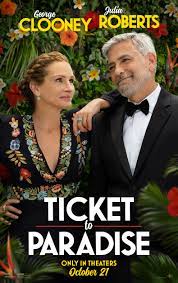
TICKET TO PARADISE romcom movie review

Refreshing and utterly delightful! George Clooney and Julia Roberts shine in Ticket to Paradise! Not only does this outstanding romantic comedy deliver a highly entertaining and heartfelt performative dimension, the script is solid! Excellent plotting for the familiar yet fresh story paired with dialogue that snaps, crackles, and pops! It’s an honest romcom featuring authentic true-to-life characters (albeit slightly exaggerated for dramatic purposes) that will resonate with audiences across the relationship spectrum. Whether you are a in new love, still in the honeymoon phase, or a cynic, you will find characters and predicaments that are inspired by real life. It’s been a long time since the romcom dominated cinemas, but Ticket to Ride is a great example of the classic romcom being reimagined for today’s audiences. And you know what? It’s fun for the whole family! Just goes to show that a comedy can be good, clean fun and still deliver laughs and heart. With a lean, mean script and brilliant casting in the lead and supporting roles, let this be your ticket to cinemas on your next date night!

A divorced couple teams up and travels to Bali to stop their daughter from making the same mistake they think they made 25 years ago.

Ticket to Paradise manages to seemingly do the impossible with an genre that sees few well-written directed, and acted examples nowadays, it simultaneously checks off the conventions and expectations audiences have of a romcom–yet–it delivers a story that will surprise you! Furthermore, this movie entertains audiences with a subject matter so seldom touched by romcoms–new love versus cynical love. Oh, there have been moves that have tried such as Love Actually, but this one strikes all the right tones. Over the last few years, we’ve seen some excellently written romcoms such as Last Christmas and I Want you Back. And if you enjoyed those two as much as I did, then you are sure to enjoy this one!

What’s better than a smartly written romcom with excellent casting? Well, one that takes place in an exotic landscape, of course! You may find yourself booking your next vacation to Bali after watching this movie, and for good reason, it looks like paradise. While there is nothing particularly remarkable about the cinematography, the setting serves as its own star. From sunrises to sunsets and all the crystal clear water in between, you will wish you had ordered a maitai to enjoy along with the movie. It’s easy to see why anyone would be tempted to fly to Bali on vacation and desire to stay. What I appreciate about the cinematography is that it could have so easily been distracting by increasing stylistic approaches to capturing the action and setting, but it never overshadows the story, which is why we go to the cinema, “the greatest art in the world is the art of storytelling” (C.B. DeMille).

Clooney and Roberts’ chemistry is uncanny! They’ve always played off each other so incredibly well. Such a natural couple, whether in love or fighting. And their relationship (or lack thereof) in this movie is completely believable. Of course it’s exaggerated for dramatic purposes, but this IS a romcom. Think of their relationship as real life, but edited. I’ve read some critics that have claimed the story is weak and the only redeeming dimension of this movie is the chemistry between Clooney and Roberts. Suffice it to say, that is an unfair evaluation, because the script gives them everything they need to deliver the laughs and a great story. Moreover, their respective characters have depth and dimension. Yes, there is an element of whimsy in their delivery and in the character mix, but again, this is a romantic comedy. We want to see a romanticized version of real life, but these characters and story work because they also exhibit human dimension, feelings, reactions, and flaws.

I highly recommend Ticket to Paradise! In a year that has had few stand-out movies, this is definitely one of them. Perhaps we will see more smartly written and cast romcoms return to the cinema, because as important as heavy films are, lighthearted ones are just as important because they provide an emotional balance.

Ryan teaches Film Studies and Screenwriting at the University of Tampa and is a member of the Critics Association of Central Florida. If you like this article, check out the others and FOLLOW this blog! Interested in Ryan making a guest appearance on your podcast or contributing to your website? Send him a DM on Twitter. If you’re ever in Tampa or Orlando, feel free to catch a movie with him.

Follow him on Twitter: RLTerry1
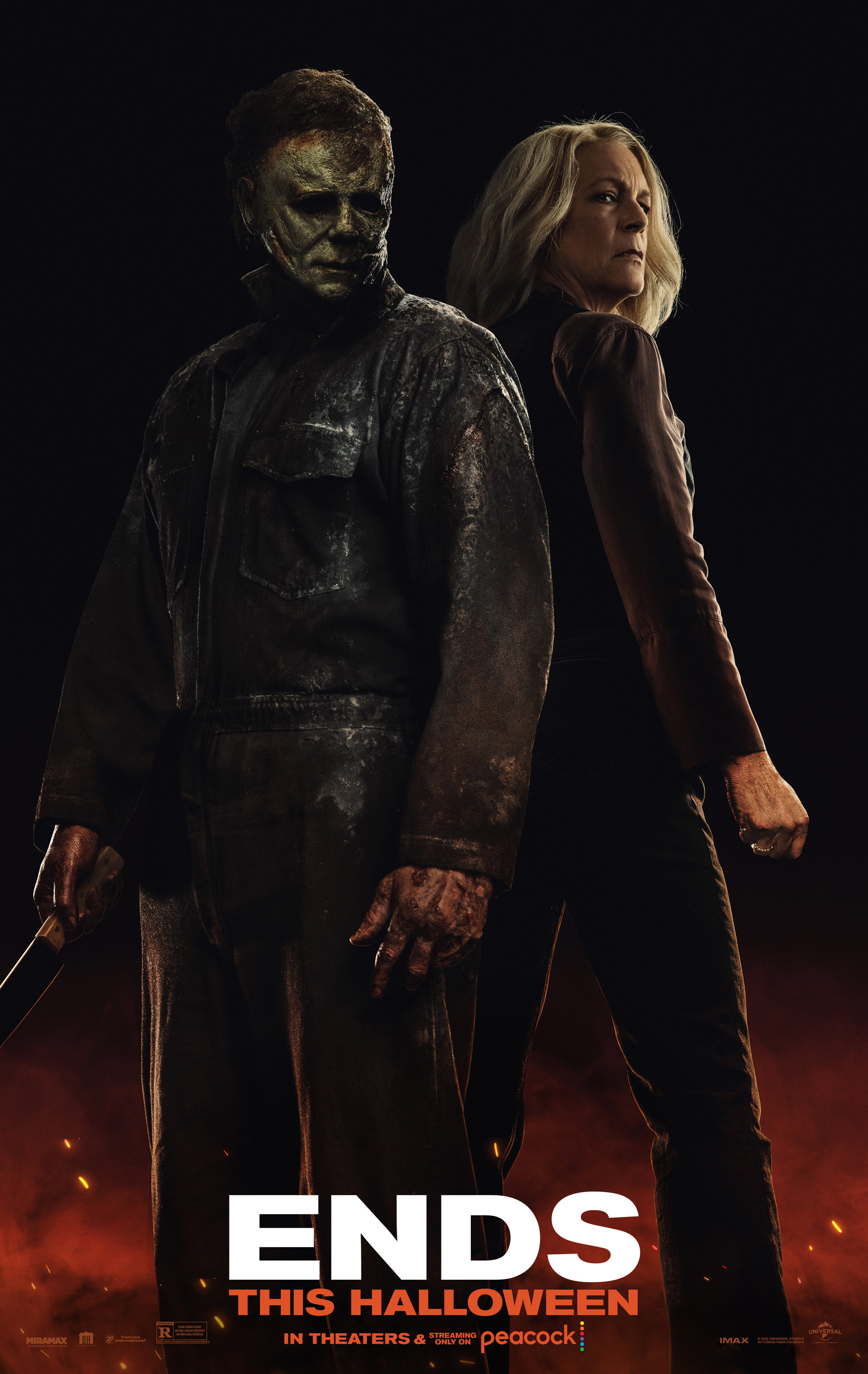
HALLOWEEN ENDS horror movie review

Well, it’s better than Kills. While Halloween Ends still struggles narratively, I appreciate what David Gordon Green attempted to do in order to add a thoughtfulness to the action plot and diegetic subtext. What we have here is a melodrama maskerading around as a slasher that delivers an insufficient amount of fun and genuine suspense. After the hugely disappointing and largely forgettable (except for how bad it was) Halloween Kills, expectations were set incredibly low for the final installment in Green’s take on the Laurie Strode/Michael story. Thankfully, the final chapter isn’t bad–that’s not to say it’s good–it’s more accurately described as watchable. As an added bonus, there is prolific exposition at the beginning that negates the need to watch Kills, so audiences can go from H40 to Ends and not miss anything, really. Even though there is one distinct kill inspired by, and some other shot compositions and camera movements that pay homage to the 1978 original, none of these moments feel like gross attempts at winning audiences over with pure nostalgia. Halloween Ends continues the trend for horror films, particularly the (what I like to call the) neo-slasher to focus so hard on atmosphere, social commentary, and melodrama that both the fun and suspense layers are so thin that they may as well be non-existent. From Halloween (1978) to SCREAM, the slasher delivered creative kills and icons but it also delivered highly entertaining movies in which we have found thoughtful subtext and social commentary in hindsight. Aside from the wandering narrative direction of Halloween Ends, it suffers from a lack of a demonstrable ability to generate a fun atmosphere for the audience.

Four years after her last encounter with masked killer Michael Myers, Laurie Strode is living with her granddaughter and trying to finish her memoir. Myers hasn’t been seen since, and Laurie finally decides to liberate herself from rage and fear and embrace life. However, when a young man stands accused of murdering a boy that he was babysitting, it ignites a cascade of violence and terror that forces Laurie to confront the evil she can’t control.

No spoilers.

The boogeyman, no more. “Was that the boogeyman?” –Laurie, “Yes, I believe it was.”–Dr. Loomis. Sorry, Sam, apparently not. In addition to sucking the fun out of the neo-slasher, filmmakers are also removing the boogeyman or monster factor from the killers. Instead of accepting that our killers are monsters that have evil running through their veins, filmmakers feel the need to explain why a monster isn’t a monster; rather, the killer is created by society. Up to Halloween Kills and Ends, you may have asked yourself “what makes Michael tick?” The short answer: we do not know enough–or at least we used to have an insufficient amount of knowledge about–his psychology, sociology, or physiology to know for sure. And that was a good thing! No longer is that the case.

Why? There no longer exists a mystery. Because now we do know too much about his mind and body; therefore, he ceases to be the boogeyman. Being the boogeyman (or a monster) was so important to, not only this franchise, but horror in general. That little bit of mystery and fantasy allowed him (and icons like Michael) to remain monsters that were to be feared and never truly understood or explained. That’s what made them scary–there was no explanation, which mitigates any control may feel we could achieve.

But since we are voyeurs who are obsessed with knowing, David Gordon Green decided that we needed to know why Michael (and those like him) was the way he was. What’s funny, is that in the original 1978 Halloween, the best sequel Halloween H20, and in H40, we can gather enough evidence to hint at what may make him tick, but at the end of the day, it’s fun speculation. Even before we had to have Michael’s behavior (directly or indirectly) explained to us, Michael likely suffered from and displayed signs of a combination of antisocial personality disorder, schizophrenia, and obsessive compulsive disorder. But none of that truly matters any longer because we now know that Michael and those that admire him are created by society’s negative impacts on their young, impressionable lives. True evil is does not exist.

Many fans of the Halloween franchise have a fondness or even love of the (seemingly) one-off Halloween III: Season of the Witch. And while I do not share a particular fondness for this installment, I can appreciate the creativity behind the expression of this tale of Halloween. And maybe if it wasn’t indirectly connected to Halloween, I may like it more. Anyway, I digress. I bring up Season of the Witch, because there are some shared elements between this Halloween movie and Jason Goes to Hell: the Final Friday and Halloween Ends, And I will leave it at that, as to avoid spoilers. If you’ve seen both of these movies I’ve referenced, then you may be able to make connections.

David Gordon Green and his team of writers inject a heaping helping of melodrama into Halloween Ends. Right up there with melodrama perfectly suited for–you fill in the blank–show on The CW or Freeform. Clearly, this was an attempt at adding some gravitas to this poor excuse for a slasher by spending time on dysfunctional family dynamics. After this trilogy, I am convinced that no family unit is healthy in Haddonfield. Bullies, manic and demanding moms, overbearing and weak fathers, nobody feels real in this town–all caricatures of what we don’t like about some people in society. There is no normal ever established. Establishing a sense of normalcy is important because it’s only then that the slasher can upset the order.

Even though this is the final chapter in the Michael/Laurie story, the movie does tip its hat to future Halloween movies. This is one of those movies that isn’t bad enough to warn people to spend their money and time elsewhere, but it’s also not good enough to where it needs to be seen at the cinema. While I firmly believe that horror movies are best experienced at the cinema in a crowded auditorium, the experience of this one will be good enough at home with some friends.

Ryan teaches Film Studies and Screenwriting at the University of Tampa and is a member of the Critics Association of Central Florida. If you like this article, check out the others and FOLLOW this blog! Interested in Ryan making a guest appearance on your podcast or contributing to your website? Send him a DM on Twitter. If you’re ever in Tampa or Orlando, feel free to catch a movie with him.

Follow him on Twitter: RLTerry1
THE BANSHEES OF INISHERIN film mini-review

Thoughtful exterior, vapid soul. A gorgeous-looking film that fails to deliver any substantive meaning or motivation behind anything that occurs in this ominous snoozefest. The Banshees of Inisherin is another 2020s cinema example of what happens when filmmakers fail to follow screenwriting conventions like a clearly defined external goal for the central character, supported by an internal need or motivation, and clearly defined opposition to the external goal. Furthermore, “a [day] in the life of…” is neither a plot nor a goal. The first act of the film holds hostage nearly half the screentime. And when something finally happens, the motivation behind it lacks any logic or rational reasoning. The outside/action story is nearly non-existent. Filmmakers should remember that a film can have depth, dimension, and deeper meaning BUT those layers should never take the place of a clearly defined linear or nonlinear plot map. Diegetic accessibility is important, even in more thoughtful films. Undoubtedly, this will become one of those films that pretentious cinephiles defend by the cliche “you just didn’t get it.” While the film looks gorgeous and the attempt to parallel the civil war between two (former) friends to the real-world Irish Civil War of the 1920s is intriguing, writer-director Martin McDonagh struggles to establish a plot to support the story he wants to tell. None of the characters are likable nor are the performances exceptional. Extreme/manic behavior does not a compelling character make. In many ways, this film reminds me of a more coherent The Lighthouse. So, if you enjoyed The Lighthouse, then you may enjoy this movie. The Banshees of Inisherin feels like a vanity project that means something to the filmmaker, but holds little value or meaning for the audience. Contrary to the accolade associated with this film, it is one of the most boring break-up movies ever made.

Ryan teaches Film Studies and Screenwriting at the University of Tampa and is a member of the Critics Association of Central Florida. If you like this article, check out the others and FOLLOW this blog! Interested in Ryan making a guest appearance on your podcast or contributing to your website? Send him a DM on Twitter. If you’re ever in Tampa or Orlando, feel free to catch a movie with him.

Follow him on Twitter: RLTerry1

BARBARIAN horror film review

Outstanding! Each and every layer of this masterful horror film is crafted with care and precision. Barbarian strikes an uncanny balance of unsettling terror juxtaposed against clever irony and humor. Writer-director Zach Cregger delivers the best horror film so far this year, and among the strongest in recent years. Not only does the film boast exceptional shot composition, the screenplay is sleek and no scene goes wasted. The fine-tuned plot mapping and story structure provide a solid foundation upon which the thoughtful story is told. I heard some in the audience make statements related to the observation that this film is largely flying under the radar, but I posit that is a good thing. While I had only seen the trailer for this film in passing, I’m glad that I didn’t know more about the premise (aside from the AirBnb setup) because it may have detracted from the visceral experience of a film that has the soul of an arthouse motion picture but the high concept of a more commercial feature. If you see it before your friends, DO NOT spoil any of the twists or turns as this film should be appreciated for the emotional and physiological roller coaster that it is. My advice is go in as blind as possible. Oh, if modern horror films had already promoted you to question ever visiting Detroit, this film will convince you to avoid the motor city.

A young woman (Tess) discovers the rental home she booked is already occupied by a stranger (Keith). Against her better judgment, she decides to spend the night but soon discovers there’s a lot more to fear than just an unexpected house guest.

Simple plot, complex characters. The recipe for a great film! But don’t let the high concept outside-action story lull you into a state of projecting predictability upon the story. Just when you feel that you may have it figured out, Cregger throws you for a loop–a loop that was setup earlier in the film unbeknownst to you. Zach Cregger has demonstrably studied masters of suspense and horror such as Hitchcock, Argento, and Craven because he took the best parts of Psycho, Suspiria, and The Hills Have Eyes to create his original expression of tried and true tentpoles of horror. In an age wherein most features are remakes of previous motion pictures, this film serves as a reminder that there are fresh ideas out there to be expressed on the silver screen. And not just original ideas, but well-written stories with solid plotting that don’t leave you wondering what you just watched. Accessibility should never be thought of as lacking meaningful substance for those that want to read the film more closely.

Whereas I won’t venture too far into the story progression, I do want to comment on the opening scene(s) because it reminded me of Suspiria. What’s funny, is that I was wearing my Suspiria t-shirt last night to the screening. I liken the opening of Barbarian to Suspiria because of the central character driving in the rain to a house whereat there is no room for her accompanied by an ominous score. Even though the score isn’t as iconic as Goblin’s score in the Argento masterpiece, the score was an extension of the increasing tension at the opening of the film. And who should finally answer the door to this rather quaint, Instagram-worthy house in the middle of a neighborhood long-condemned, but a Norman Bates-like character. The opening and entire first act setup everything that is to follow.

Georgina Campbell, who plays our central character of Tess, and Bill Skarsgard, who plays Keith, demonstrate excellent on-screen chemistry. Later on in the film when we meet actor AJ Gilbride, played by Justin Long, he complements the fantastic character dynamics and mix. Speaking of Long, there is a clever nod to Jeepers Creepers that you’ll just have to watch the film to find out. Often times, it’s horror films with small casts and intimate settings that deliver the best thrills. Because a writer can spend time on developing central and supporting characters and making sure that every scene has a beginning, middle, and end, and that every scene sets up the scene to follow. Even in a film with figurative and literal layers to the story, each scene should teach us more about the individual characters and further develop plot beats in a manner that does not make the story more convoluted, but slowly reveal the end, one layer at a time.

While I find this film to be overwhelmingly smartly executed, there are a couple of ideas that I find to be problematic, and furthering stigma and misrepresentation instead of using the opportunity to provide a more constructive depiction or argument. Of the two observations I made, I can really only touch on one of them without getting into character or plot spoilers.

When Tess discovers that there is something seriously wrong in the idyllic suburban cottage, she eventually receives a response by the police, after waiting some time. On one hand, I appreciate the setup to and this scene itself because it shows how dangerous is it for cities to reduce the public safety workforce (call it what you will), but where I find the scene problematic is that both police officers dismiss Tess’ concerns even though she is demonstrably in distress. In an era wherein a large number of media portray law enforcement in an unfair, misrepresentative light, this could have been an opportunity to show that the police could very well have been skeptical, but chose to act upon Tess’ claims. This would’ve made for a more constructive, accurate scene versus what we got. This doesn’t mean the police should have found concrete evidence or were instrumental in saving the day, but it would have helped to combat the dangerous ideology that law enforcement is irresponsible.

Deserving of a rewatch, this film is one you don’t want to miss seeing on the big screen! Not only does this film standout compared to the horror films we’ve had this year, but it is one of the best-written films of the year, period. I hope that Cregger’s next feature is as thoughtfully written and directed as this one.

Ryan teaches Film Studies and Screenwriting at the University of Tampa and is a member of the Critics Association of Central Florida. If you like this article, check out the others and FOLLOW this blog! Interested in Ryan making a guest appearance on your podcast or contributing to your website? Send him a DM on Twitter. If you’re ever in Tampa or Orlando, feel free to catch a movie with him.

Follow him on Twitter: RLTerry1

THREE THOUSAND YEARS OF LONGING mini review

More like an hour and forty-five minutes of boredom. In a gorgeous-looking film all about the very concept of storytelling, ironically, this film struggles to tell a good story. With so much promise, and a fresh expression of the legendary tales of djinn (genies), this movie should have been able to deliver a fantastical story. Unfortunately, it suffers from poorly organized and structured plotting. A story is there, but there is lacking a map to navigate from beginning to end. Swinton and Elba demonstrate excellent on-screen chemistry; I’d really like to see them star in a future film together. Three Thousand Years of Longing starts with an intriguing first act, but the second and third acts are sloppily executed. The inverse approach to the Tales of Arabian Nights is not enough to generate substantive interest in the fates of the characters. Again, the setup is interesting. Ostensibly, Elba’s djinn takes on the role of Scheherazade, and regales Swinton’s narratology (the study of story) professor of his 3000 years as a djinn, and the trauma therein. There simply isn’t enough character development for the film to serve as a character study nor is there enough plot to serve as a commentary on the mountains and valleys of love. That’s not to say there isn’t any magic in the film; the cinematography, editing, and visual effects are incredibly impressive!

Ryan teaches Film Studies and Screenwriting at the University of Tampa. If you like this article, check out the others and FOLLOW this blog! Interested in Ryan making a guest appearance on your podcast or contributing to your website? Send him a DM on Twitter! If you’re ever in Tampa or Orlando, feel free to catch a movie with him.

Follow him on Twitter: RLTerry1