BARBARIAN horror film review

Outstanding! Each and every layer of this masterful horror film is crafted with care and precision. Barbarian strikes an uncanny balance of unsettling terror juxtaposed against clever irony and humor. Writer-director Zach Cregger delivers the best horror film so far this year, and among the strongest in recent years. Not only does the film boast exceptional shot composition, the screenplay is sleek and no scene goes wasted. The fine-tuned plot mapping and story structure provide a solid foundation upon which the thoughtful story is told. I heard some in the audience make statements related to the observation that this film is largely flying under the radar, but I posit that is a good thing. While I had only seen the trailer for this film in passing, I’m glad that I didn’t know more about the premise (aside from the AirBnb setup) because it may have detracted from the visceral experience of a film that has the soul of an arthouse motion picture but the high concept of a more commercial feature. If you see it before your friends, DO NOT spoil any of the twists or turns as this film should be appreciated for the emotional and physiological roller coaster that it is. My advice is go in as blind as possible. Oh, if modern horror films had already promoted you to question ever visiting Detroit, this film will convince you to avoid the motor city.

A young woman (Tess) discovers the rental home she booked is already occupied by a stranger (Keith). Against her better judgment, she decides to spend the night but soon discovers there’s a lot more to fear than just an unexpected house guest.

Simple plot, complex characters. The recipe for a great film! But don’t let the high concept outside-action story lull you into a state of projecting predictability upon the story. Just when you feel that you may have it figured out, Cregger throws you for a loop–a loop that was setup earlier in the film unbeknownst to you. Zach Cregger has demonstrably studied masters of suspense and horror such as Hitchcock, Argento, and Craven because he took the best parts of Psycho, Suspiria, and The Hills Have Eyes to create his original expression of tried and true tentpoles of horror. In an age wherein most features are remakes of previous motion pictures, this film serves as a reminder that there are fresh ideas out there to be expressed on the silver screen. And not just original ideas, but well-written stories with solid plotting that don’t leave you wondering what you just watched. Accessibility should never be thought of as lacking meaningful substance for those that want to read the film more closely.

Whereas I won’t venture too far into the story progression, I do want to comment on the opening scene(s) because it reminded me of Suspiria. What’s funny, is that I was wearing my Suspiria t-shirt last night to the screening. I liken the opening of Barbarian to Suspiria because of the central character driving in the rain to a house whereat there is no room for her accompanied by an ominous score. Even though the score isn’t as iconic as Goblin’s score in the Argento masterpiece, the score was an extension of the increasing tension at the opening of the film. And who should finally answer the door to this rather quaint, Instagram-worthy house in the middle of a neighborhood long-condemned, but a Norman Bates-like character. The opening and entire first act setup everything that is to follow.

Georgina Campbell, who plays our central character of Tess, and Bill Skarsgard, who plays Keith, demonstrate excellent on-screen chemistry. Later on in the film when we meet actor AJ Gilbride, played by Justin Long, he complements the fantastic character dynamics and mix. Speaking of Long, there is a clever nod to Jeepers Creepers that you’ll just have to watch the film to find out. Often times, it’s horror films with small casts and intimate settings that deliver the best thrills. Because a writer can spend time on developing central and supporting characters and making sure that every scene has a beginning, middle, and end, and that every scene sets up the scene to follow. Even in a film with figurative and literal layers to the story, each scene should teach us more about the individual characters and further develop plot beats in a manner that does not make the story more convoluted, but slowly reveal the end, one layer at a time.

While I find this film to be overwhelmingly smartly executed, there are a couple of ideas that I find to be problematic, and furthering stigma and misrepresentation instead of using the opportunity to provide a more constructive depiction or argument. Of the two observations I made, I can really only touch on one of them without getting into character or plot spoilers.

When Tess discovers that there is something seriously wrong in the idyllic suburban cottage, she eventually receives a response by the police, after waiting some time. On one hand, I appreciate the setup to and this scene itself because it shows how dangerous is it for cities to reduce the public safety workforce (call it what you will), but where I find the scene problematic is that both police officers dismiss Tess’ concerns even though she is demonstrably in distress. In an era wherein a large number of media portray law enforcement in an unfair, misrepresentative light, this could have been an opportunity to show that the police could very well have been skeptical, but chose to act upon Tess’ claims. This would’ve made for a more constructive, accurate scene versus what we got. This doesn’t mean the police should have found concrete evidence or were instrumental in saving the day, but it would have helped to combat the dangerous ideology that law enforcement is irresponsible.

Deserving of a rewatch, this film is one you don’t want to miss seeing on the big screen! Not only does this film standout compared to the horror films we’ve had this year, but it is one of the best-written films of the year, period. I hope that Cregger’s next feature is as thoughtfully written and directed as this one.

Ryan teaches Film Studies and Screenwriting at the University of Tampa and is a member of the Critics Association of Central Florida. If you like this article, check out the others and FOLLOW this blog! Interested in Ryan making a guest appearance on your podcast or contributing to your website? Send him a DM on Twitter. If you’re ever in Tampa or Orlando, feel free to catch a movie with him.

Follow him on Twitter: RLTerry1
THREE THOUSAND YEARS OF LONGING mini review

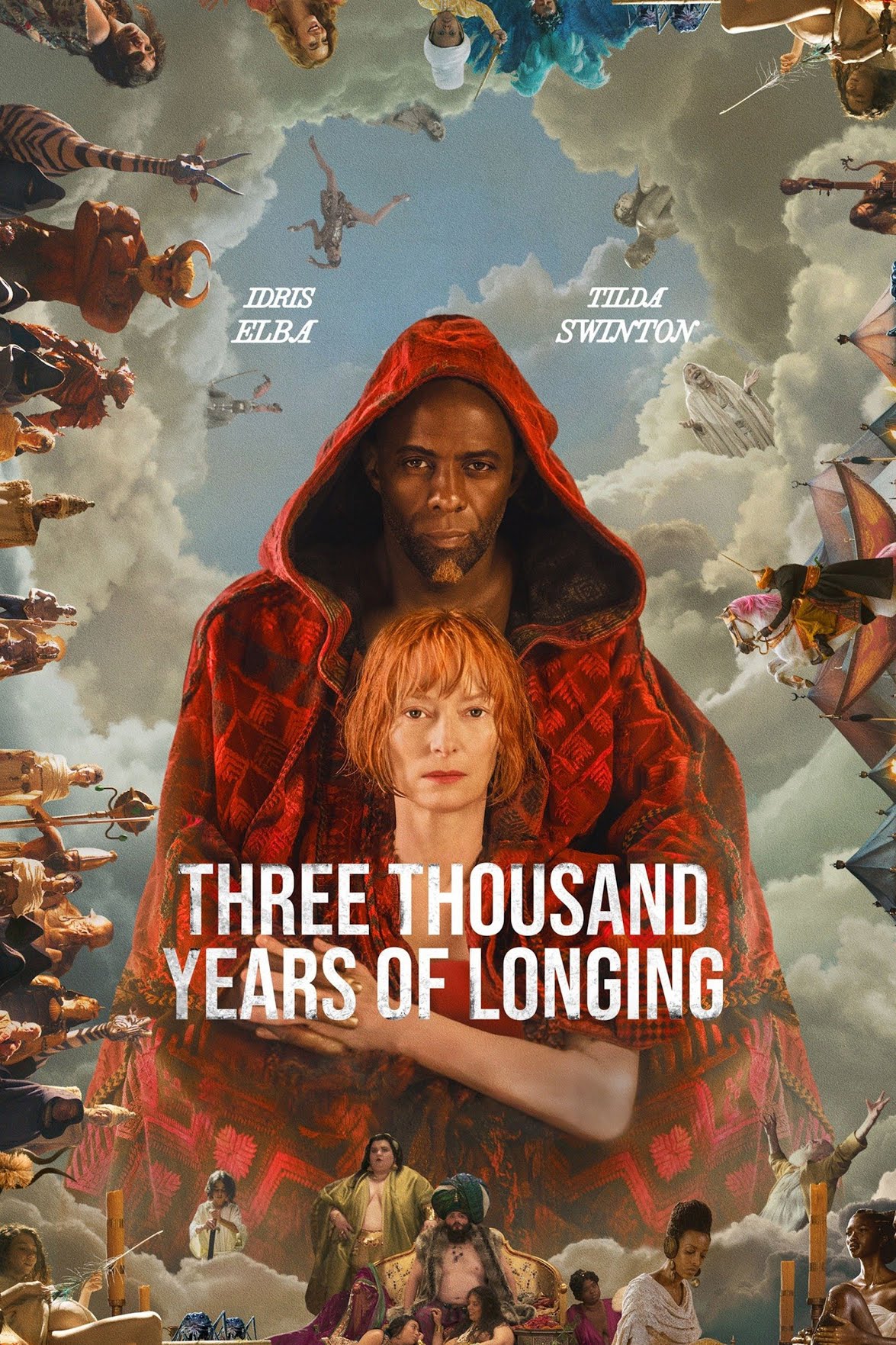
More like an hour and forty-five minutes of boredom. In a gorgeous-looking film all about the very concept of storytelling, ironically, this film struggles to tell a good story. With so much promise, and a fresh expression of the legendary tales of djinn (genies), this movie should have been able to deliver a fantastical story. Unfortunately, it suffers from poorly organized and structured plotting. A story is there, but there is lacking a map to navigate from beginning to end. Swinton and Elba demonstrate excellent on-screen chemistry; I’d really like to see them star in a future film together. Three Thousand Years of Longing starts with an intriguing first act, but the second and third acts are sloppily executed. The inverse approach to the Tales of Arabian Nights is not enough to generate substantive interest in the fates of the characters. Again, the setup is interesting. Ostensibly, Elba’s djinn takes on the role of Scheherazade, and regales Swinton’s narratology (the study of story) professor of his 3000 years as a djinn, and the trauma therein. There simply isn’t enough character development for the film to serve as a character study nor is there enough plot to serve as a commentary on the mountains and valleys of love. That’s not to say there isn’t any magic in the film; the cinematography, editing, and visual effects are incredibly impressive!

Ryan teaches Film Studies and Screenwriting at the University of Tampa. If you like this article, check out the others and FOLLOW this blog! Interested in Ryan making a guest appearance on your podcast or contributing to your website? Send him a DM on Twitter! If you’re ever in Tampa or Orlando, feel free to catch a movie with him.

Follow him on Twitter: RLTerry1
BEAST movie review

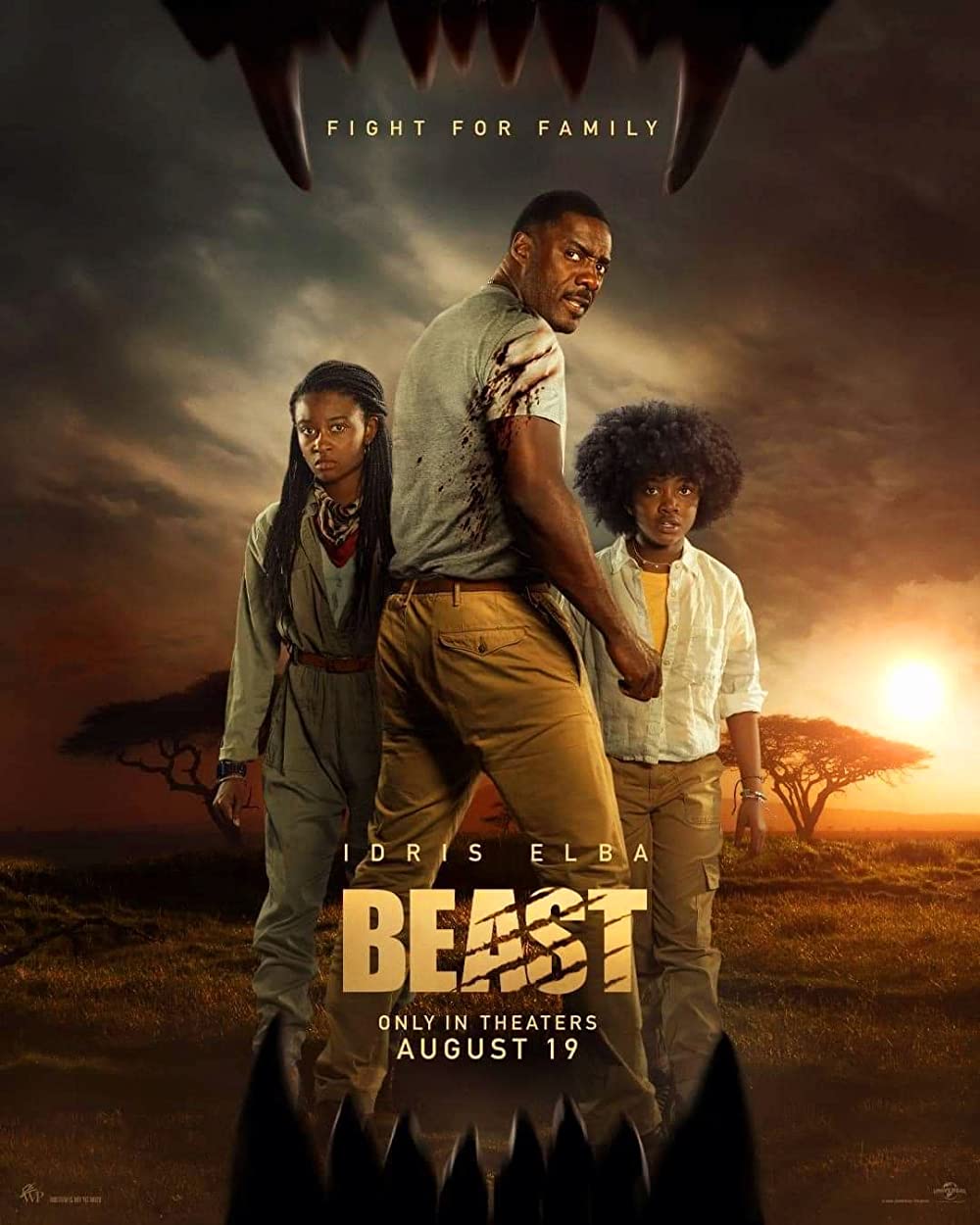
A roaring good time–the one time you’ll watch it. BEAST is a fantastically fun popcorn movie that will leave you on the edge of your seat, even though it’s moderately predictable. The script is lean and mean, and doesn’t overstay its welcome. At an hour and a half, Beast delivers what it promises: Idris Elba facing off against a man-eating monstrous lion! Where the movie underperforms is in the one-dimensional dialogue, leaving little to no room for subtext. But, the way I see it, we don’t enjoy these glorified B-movies for razor sharp dialogue, but rather for the engaging escapism they provide.

Recently widowed Dr. Nate Daniels and his two teenage daughters travel to a South African game reserve managed by Martin Battles, an old family friend and wildlife biologist. However, what begins as a journey of healing soon turns into a fearsome fight for survival when a lion, a survivor of bloodthirsty poachers, begins stalking them.

Underscoring the main action plot of survival against the t-rex-like lion, is a heartwarming story of the father’s (Elba) redemption with his estranged daughters in the wake of his ex-wife’s death. It’s incredibly refreshing to watch a movie in which the men are not stupid (in fact, no one is stupid in this movie) and the father is responsible and loving. Perhaps Universal should have used this movie as its Father’s Day weekend release instead of Black Phone.

On an almost meta level, this movie shares some elements with Jurassic Park, which is expressed through one of the daughters wearing a Jurassic Park tank-top. Some might find this lazy, but I feel it works well because it does foreshadow the thrilling and terrifying adventure that will soon befall our small central cast. It’s also fun to think of one of the greatest movies of all time in the real world of the movie, which helps to prime the audience that what you’re about to watch could happen in the real world. Yes, the lions are CG; but I gotta say, they looked pretty good. Certainly better than the CG animals in The Lion King. In no small part is the suspension of disbelief possible with the CG in this movie due to the fact that most of the screentime features our human characters. There is an attempt at a conservation message, but it ultimately falls flat; however, there is a theme of supporting and appreciating that which deviates from your plans or passions, and it is tied up nicely with a bow in the end.

The responses of the audience at the screening were mixed. Some thought it was a lot of fun, while others were rooting for the lion. Perhaps my experience is characterized by knowing when a popcorn movie is to simply be appreciated for its ability to keep us entertained for the duration of the picture. Interestingly, the movie Crawl was released in August of 2019, and it was received far more favorably. Which is puzzling, because I would say that both of these movies have a lot in common.

Ryan teaches Film Studies and Screenwriting at the University of Tampa. If you like this article, check out the others and FOLLOW this blog! Interested in Ryan making a guest appearance on your podcast or contributing to your website? Send him a DM on Twitter! If you’re ever in Tampa or Orlando, feel free to catch a movie with him.

Follow him on Twitter: RLTerry1
THIRTEEN LIVES docudrama mini review

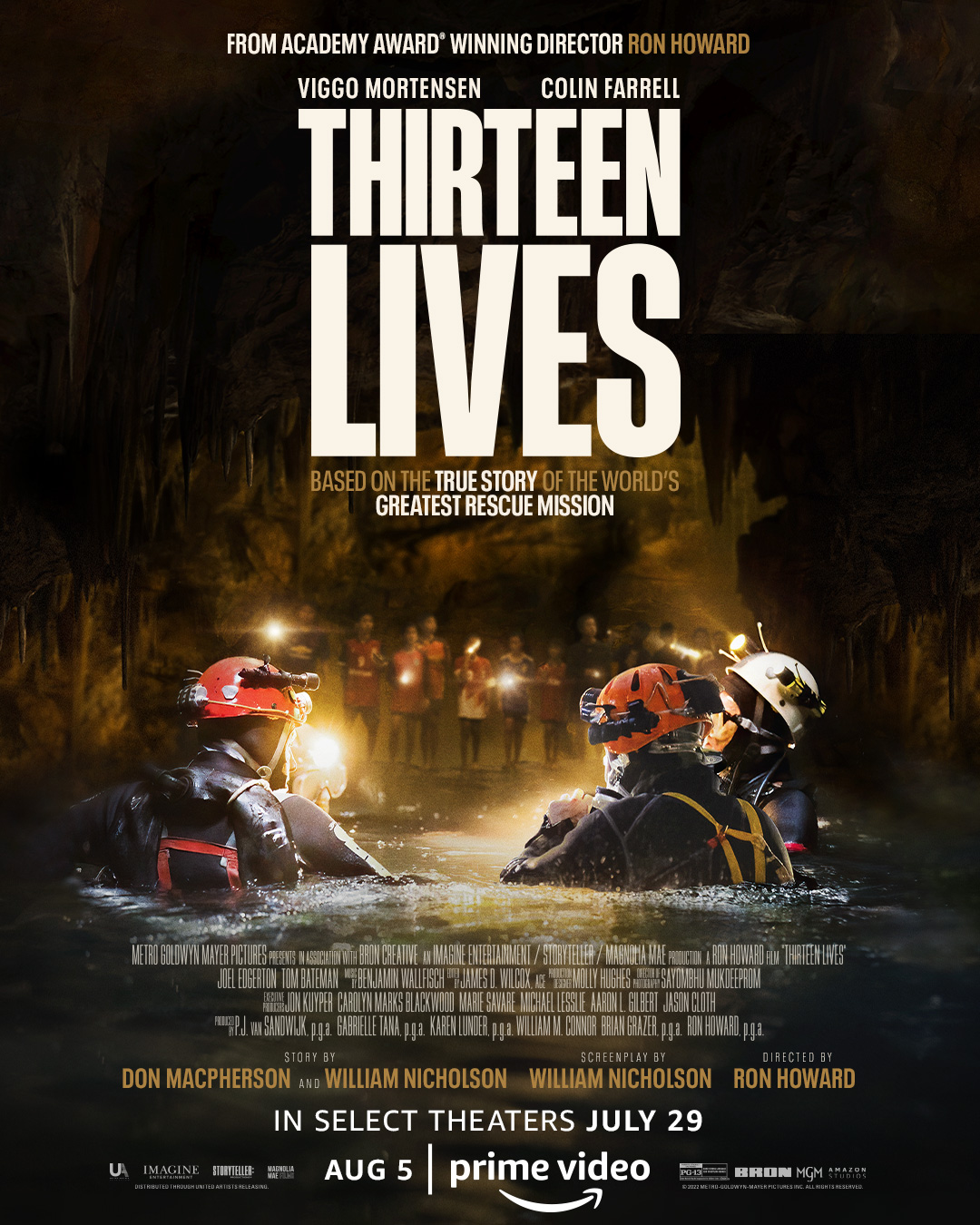
Interesting. Ron Howard’s big screen adaptation of the true story of the daring rescue of the Thai youth football (soccer) team from the flooded cave is faithful to the wikipedia page, but with an impressive addition of underwater cinematography. Thirteen Lives chronicles the seemingly impossible rescue that captured the attention of the entire world in summer 2018. While Howard’s docudrama is well-made all the way around, what audiences will find most fascinating is the mechanics of the rescue. It took thousands of volunteers in the labyrinth of caves, mountain peaks, and basecamps to bring all the boys and their coach to safety. Although none of the performances particularly stand out, the film delivers solid casting. Thirteen Lives is a different kind of “based on the true story” film, because it does not have particularly strong plotting to map-out the narrative. On one hand, it is a simple plot rescue the boys, but the film ultimately plays as a blow by blow description of what happened. Upon viewing the film, I thought to myself, why not just make a documentary instead; and then it occurred to me, that there would have been little to no footage of the inside of the caves. Therefore, docudrama was the way to go. There really isn’t much in the way of connective tissue between plot points; events just happen. That’s not to say that what we are watching isn’t terrifying in places–it certainly is–especially if you have kids; but at the same time, it doesn’t feel like a cinematic story in the conventional sense. Even though we all know how the true story ends, the film focuses on the steps that were taken in order to rescue the youth soccer team. Is it good? Well, it’s not bad. It just kind of is. Often we see based on a true story films that take so much dramatic license that it’s no longer a faithful big or small screen adaptation; sometimes, character or situational nuances or motivations are lost in translation. Thirteen Lives is so incredibly focuses on a dutiful adaptation, that it sometimes forgets that it’s also supposed to be finding the narrative amongst the facts. I wouldn’t wait to see this on the small screen, catch it during its limited theatrical run because the visuals are impressive.

Ryan teaches Film Studies and Screenwriting at the University of Tampa. If you like this article, check out the others and FOLLOW this blog! Interested in Ryan making a guest appearance on your podcast or contributing to your website? Send him a DM on Twitter or email him at RLTerry1@gmail.com! If you’re ever in Tampa or Orlando, feel free to catch a movie with him.

Follow him on Twitter: RLTerry1

NOPE horror film review

Nope, no plotting here. With a sensory explosion of stunning shot composition, outstanding sound design, and unnerving score–combine those with a refreshingly original expression of the classic monster movie–and you should have a great horror film, right? That was almost the case here, had it not been for the meandering narrative and thoughtless plotting. Brilliant idea, but poorly mapped out. There is so much to like about NOPE, but the full potential of this beautifully looking film is ultimately held back by screenwriting mechanics. Peele’s NOPE feels like a combination of The Birds, Close Encounters of the Third Kind, and Signs. Unfortunately, it lacks the structure and substance of any of those. Clearly, Peele had a wonderfully original idea for his latest feature film, but his idea fails to deliver narratively. The plotting is all over the place; there are scenes that simply do not pay off dramatically. Individually, each scene is meticulously crafted, but many are not connected methodically to the rest of the film. What we have here is a film, that clearly demonstrates a love for horror cinema and film history, that pushes experiential boundaries, but the plotting leaves much to be desired. Moreover, there is a disconnect between the performative element of the mise-en-scene and characterization. Fantastic performances; but the characters, as they are written, are not very well developed. The pretense of the film is one exuding cinematic gravitas, but the pretense is the equivalent of a beautiful house with a shaky foundation and infrastructure.

To go into why this film’s plotting does not work would be incredibly spoilerific, so I cannot go into many details. All throughout the film, I thought to myself “I can tell that this is supposed to mean something, perhaps subvert something, but those idea are not being communicated effectively.” What this film will likely become is one of those that a pretentious cinephile or armchair critic will respond to those that express difficulty in following the plot with “it’s not for everyone” or “you just don’t get it.” Whenever I hear those remarks in defense of films that objectively fail to deliver narratively (plot+story), it makes me want to vomit. They are copouts for explaining away why a film doesn’t have to follow established storytelling conventions; furthermore, the “you just didn’t get it” is a tool for the cinephile to establish intellectual superiority over the individual rightly questioning the screenwriting of a film.

Caretakers at a California horse ranch encounter a mysterious force that affects human and animal behavior.

Where the film excels is in the very concept of the film itself and the technical achievement! Upon watching it, I was reminded of great films such as The Birds, Signs, and Close Encounters of the Third Kind. Moreover, I was also reminded of the sci-fi/horror movies of the 1940s and 50s. Because I was reminded of those, that demonstrates Peele’s love for classic horror cinema! And I applaud him for attempting to craft something for modern audiences that feels familiar yet fresh. To the best of my knowledge, there has yet to be a film (classic or more contemporary) that expresses the alien plot in the manner that Peele does. Where the films to which he’s harkening surpass NOPE is in the plotting. Original ideas are very much needed in 21st century cinema, but these ideas need to be paired with coherent plots.

Peele’s eye for shot composition is exceptional. He knows precisely how to frame and shoot a scene dramatically, even when the shot is largely static. What makes his shot compositions work so well is that the shot is a direct extension of the emotion of the scene. The camera isn’t merely documenting the course of events, but is ostensibly an active participant in how the scene unfolds.

The brilliant sound design and unnerving score work in tandem to draw the audience into the film, especially when watching the film in Dolby Cinema (which is what I did). No sound effect or bar of score is wasted. Every sound, every note is intentionally selected as an extension of the action or emotion of a scene. Although a film should not rely upon a great score to carry the story, sound and music are two very important tools in a filmmakers tool belt to increase the sensory stimulation of the film.

Peele is such a gifted director, but I hope he chooses to work with other screenwriters in the future to take his original ideas and map them out methodically and chronologically (whether linear or nonlinear) more soundly. We need refreshing ideas such as his, but we also need them executed in more conventional ways. Have the thoughtful subplot and subtextual theming that will inspire discourses, but make the outside/action plot more accessible because it’s the vessel through which the subplot and theming is communicated.

Ryan teaches Film Studies and Screenwriting at the University of Tampa. If you like this article, check out the others and FOLLOW this blog! Interested in Ryan making a guest appearance on your podcast or contributing to your website? Send him a DM on Twitter or email him at RLTerry1@gmail.com! If you’re ever in Tampa or Orlando, feel free to catch a movie with him.

Follow him on Twitter: RLTerry1