Marvel “Ant-Man and The Wasp” movie review

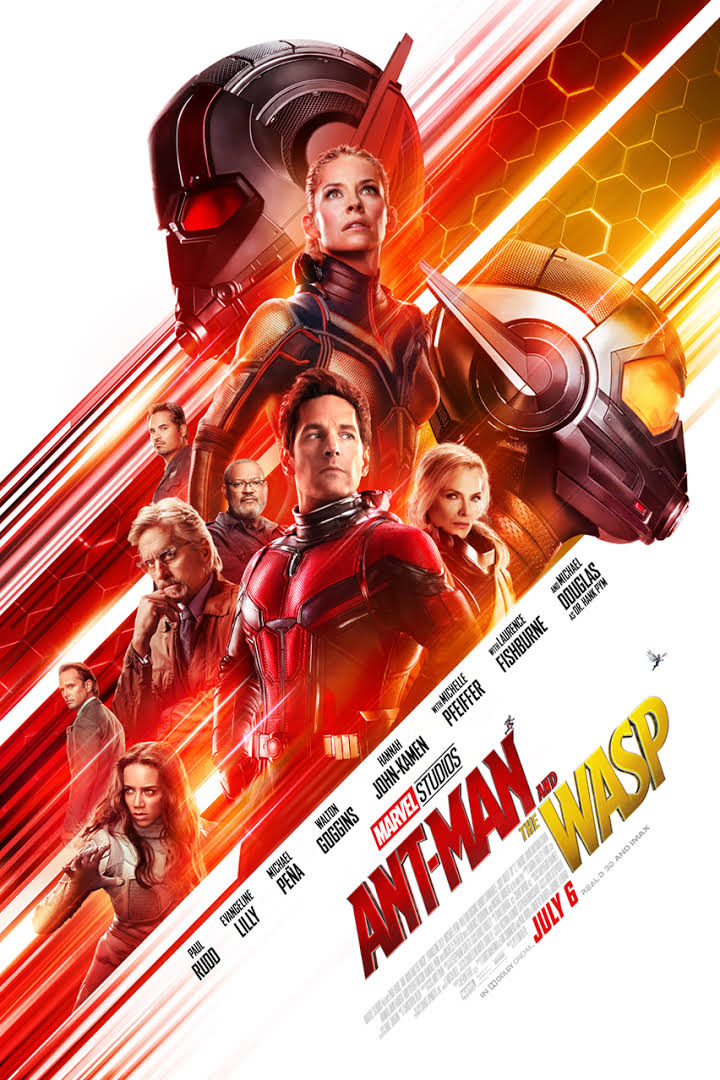
fANTastic! Although this installment may lack the grandeur of many of the Marvel Studios films, including the recent Avengers: Infinity War, director Peyton Reed delivers a fun, heartfelt, action-packed movie in the Ant-Man series that is sure to be a crowd pleaser. As someone who doesn’t typically fawn over superhero movies, with some exceptions like Batman Returns, I went into this movie with moderate expectations at best. Needless-to-day, my expectations were exceeded and I had a great time. Perhaps the story is rather shallow and even paint-by-the-numbers, but the straight-forward story is made fun and exciting by the incredible cast. This installment in the MCU is also marked by the significance of the captivating Michelle Pfeiffer’s return to the superhero genre. It’s been more than 26yrs since she wowed audiences with her roll as the definitive Cat Woman, and she still packs a punch during her short time on screen in Ant-Man and The Wasp. Is this a movie that requires a close reading or in-depth analysis? Certainly not. But, there is a running theme of change/size that is both literal and metaphoric. This may not be the at the top of your MCU favorites, but I can honestly state that you will not feel as if your time is wasted if you choose to take the quantum leap into this micro superhero movie.

After the events in Germany, Scott Lang (Paul Rudd) is under house arrest. Dealing with the consequences of being both a superhero and a father, Lang is challenged to still be a loving father to Cassie while figuring out how to continue his role as Ant-Man. Compounding the demands of being a father and superhero, Lang is also working diligently from home to build his security company in order to be the provider he wants for his daughter. Just when he has his routine down, and is getting close to being released from house arrest, he is kidnapped by Hope van Dyne (Evangeline Lilly) and Dr. Hank Pym (Michael Douglas) to help with a mission to rescue Janet van Dyne (Michelle Pfeiffer) from the quantum realm, a result of disarming a nuclear bomb many years prior. The search and rescue operation is thwarted by a ruthless southern businessman and a mysterious new ghost-like adversary. Under the ever-oppressing constraint of time and place, Ant-Man and The Wasp must cooperate in order to protect the quantum technology from falling into the wrong hands that could prohibit Dr. Pym from rescuing his wife.

While the movie, by in large, is pretty basic (solid, but basic), there is a great example of Hitchcock’s MacGuffin! If you’re unaware, a MacGuffin is the object that drives the plot forward, begins the domino effect, but ultimately does little more than trigger the plot. The definitive example of this is the money Marion Crane steals from the real estate office that sends her on the journey that lands her at the Bates Motel in Psycho. Not nearly as macabre, the MacGuffin in Ant-Man and The Wasp is the size-shifting office building of Dr. Hank Pym. Sometimes it was as large as a city block, and other times it was the size of a roller suitcase. In fact, if it isn’t already, I imagine that we will soon see this AS luggage that can be purchased at a Disney Park near you. The theme of size is demonstrated through small objects that become large and large objects that become small. Furthermore, this idea of playing around with size can also be witnessed figuratively through egos. Some egos are inflated–large–and need to shrink down to size or others are barely there and need to grow in order to not be overrun or overlooked. This theme is also displayed in how small people or objects can rise to the occasion, become a metaphoric giant in order to stop those who pose as obstacles to the goal. It is well-known that ants can carry several times their body weight, and we see characters in this film shouldering more than their fair share, but still manage to overcome any resistance or hurdles to accomplishing the mission.

Be sure to state for the mid-credits scene because it will answer the question that has been on your mind, “where was Ant-Man during Infinity War”? There is also a post-credit scene that is cute but won’t provide any further insight into the next Ant-Man or Avengers movie. With the return of Michelle Pfeiffer to the superhero genre, I am excited to see how the MCU will integrate her into the narrative because she possesses a powerful screen presence that should not be under-utilized. Unfortunately, this could mean that we may not get to see her reprise her role as Cat Woman in a future DCEU film, but her beauty and charisma will certainly add a touch of class and strength to the MCU.

While most MCU movies are suitable for all audiences, there is some content in the dialogue that may not be appropriate for those under 13. So parents and siblings, just be aware of this before taking children to this film. It’s not nearly as adult as Deadpool but it leans more toward a teen and adult film more than kids.

Blumhouse’s “Upgrade” movie review

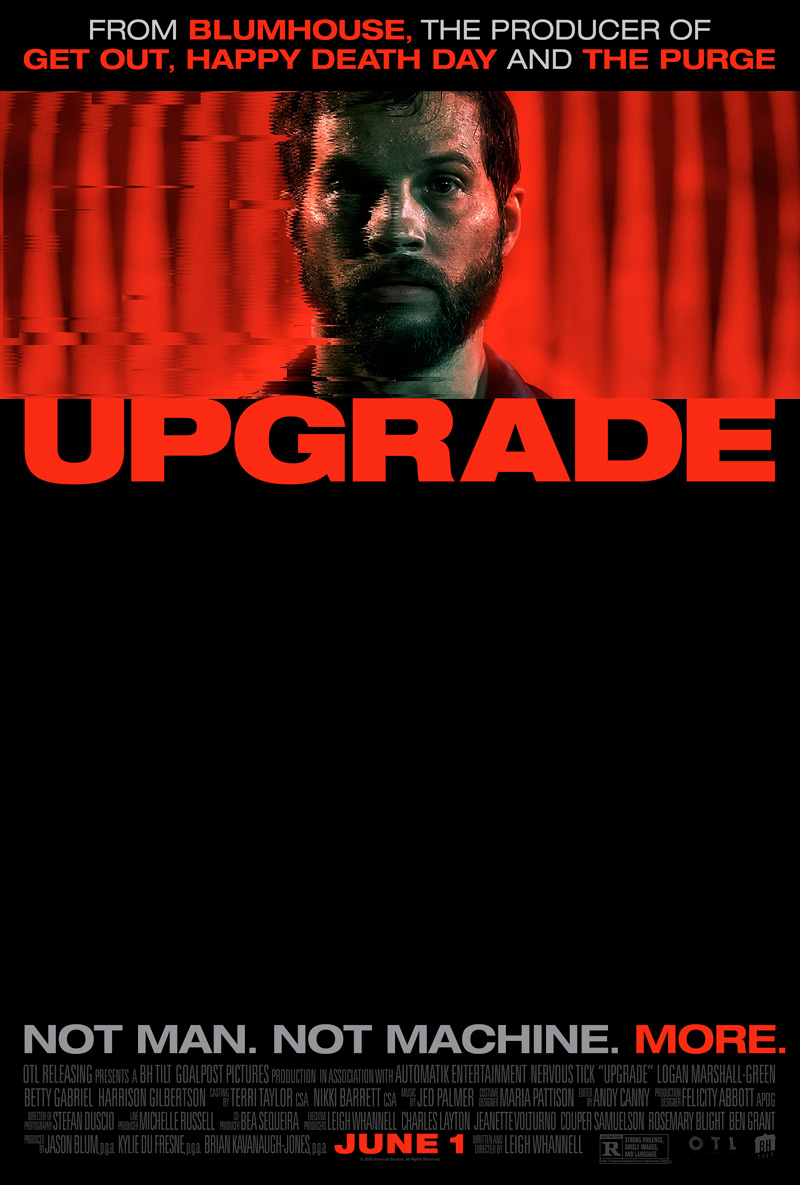
Black Mirror on crack. That is precisely what Blumhouse’s Upgrade can be likened to. Outstanding commentary on the convergence of humanity and technology that provides many thought-provoking moments. Best known for its horror, this action thriller from Blumhouse will have you on the edge of your seat the entire time. Rooted in classic science-fiction, this thriller will also deliver a healthy dose of dark comedy, heart-pounding action, and acutely shockingly violent scenes. Writer-director Leigh Whannel crafts a brilliant motion picture that is one part vigilante Robocop and another part Dr. Frankenstein’s Monster. On the surface, Whannel’s thriller comes across as a B-movie done well, but it contains prolific content that will likely inspire conversations about the relationship between humanity and technology. Perhaps it was not the intention of Whannel (co-creator of Insidious and Saw) to write a motion picture steeped with commentary on the human condition and a harbinger against allowing technology to fuse with our minds and bodies, but there is certainly material here to discuss those deeper topics. Bumhouse’s Upgrade is certainly a big screen experience, so catch it while it is there!

Set in the not-so-distant future, cars drive themselves, pizzas can be printed at home, and Alexa is built into your house. After dropping off a completely rebuilt 1980s Firebird Trans-Am at a client’s hosue, Grey Trace (Logan Marshall-Green) is left a quadriplegic following a brutal car accident and mugging that also leaves his wife dead. While recovering in the hospital, Grey is approached by a major tech company owner about an experimental surgery that is theorized to enable Grey to regain his motor skills. It worked! Only now, Grey’s realized that he has cat-like agility and reflexes as well as increased strength. With his newfound abilities, Grey seeks to assassinate those he blames for his wife’s death.

Better have an iron stomach in order to watch this thriller, because Whannel prefers shocking moments in abundance. Whereas this film is certainly not a horror–as the intent of the film is NOT to horrify audiences–it certainly contains elements borrowed from horror films in order in increase the level of threat. A director friend of mine from Germany characterized the film has having tones of a John Carpenter movie combined with Drive by Nicholas Winding Refn. Though set in a possible near-future, the cinematography, score, and lighting are quintessential 1980s. No surprise as 80s is en vogue in our movies and TV shows. Grey’s “everyman” character archetype enables audiences to identify with him quickly, thus root for him as he takes the law into his own hands to avenge the brutal death of his beloved wife. It’s the simple revenge plot that enables Whannel to build a complex character delivering dark humor and visceral violence.

Definitely an entertaining science-fiction thriller! If you enjoy TV shows like Netflix’ Black Mirror and movies like DriveHalloween, Frankenstein, and Robocop, then you’ll certainly like Blumhouse’s Upgrade.

“A Quiet Place” horror film review

Heart-pounding. Spine-chilling. A creepy creature-feature that will leave you speechless. The demonstrable excellence in terrifying visual storytelling can effectively be summed up by the queen of silent film herself Norma Desmond, “we didn’t need dialogue, we had faces” (Sunset Boulevard). A Quiet Place truly earns its place among “certified fresh” horror films. Not since Don’t Breath and 10 Cloverfield Lane have I encountered such a thrillingly intelligent motion picture. Writer-director John Krasinski’s post-apocalyptic horror masterpiece showcases the power of visual storytelling within the horror genre. Furthermore Krasinski brilliantly channeled the soul of the iconic (mostly Universal Pictures) silent and early horror films for his modern interpretation of the creature-feature. No gimmicks here. Only a solid plot that builds an incredible, immersive cinematic experience upon the foundation of a simple plot with simple limitations. Simple plot, complex characters. That basic screenwriting principle is where so many filmmakers and writers go astray. Film is a visual medium, often supported by well-crafted, lean dialogue, and this film has visual storytelling in spades. This film represents one of the best examples of embracing the concept of “show don’t tell.”

Shhhh. Don’t make a sound. One family finds themselves surviving a post-apocalyptic world now inhabited by an alien species that hunts by sound.

There has certainly been a resurgence of exceptional horror films over the last few years. I mentioned Don’t Breath and 10 Cloverfield Lane earlier, we also have the Academy Award nominated Get Out from last year and many others. While many may shrug their shoulders at horror because it is a proliferated genre with many cheep, tawdry horror flicks, this same genre can be incredibly intelligent in how it makes an observation of society and offers commentary, a new perspective, or provides a means to a discussion. Some of the most critically acclaimed films over the decades have been horror. Being among the first films commercially released, horror has also stood the test of time and provides audiences with a experience that challenges worldviews, provokes physiological responses, and fuels nightmares and imaginations.

One of the most brilliant aspects to A Quiet Place is the film’s innate ability to instantly hook the audience with loud silence. Going into the movie, audiences know that the arachnid-like creatures kill anything within an earshot. Therefore, the audiences hang onto every bump, snap, or thud as the tension rises and suspense is drawn out to terrifying levels. Impeccable audience engagement. It takes a special kind of movie to completely immerse the audience into the world of the film in a multidimensional way. In terms of viability of the film and cross-promotion, this movie certainly has what it takes to be a popular and successful adaptation for a house at Universal’s Halloween Horror Nights or Busch Gardens’ Howl-O-Scream. Definitely has a place among the best horror film experiences to date.

The successful suspense and tension building can be attributed to seldom getting a good look at the alien-arachnid-like creatures. Had the audience seen the creature repeatedly throughout the film, it would lose fright value. As Hitchcock stated, “there is nothing scarier than an unopened door.” Meaning, the filmmaker’s ability to transfer the terror on screen to the minds of the audience is far more powerful and impressive than relying upon on-the-nose scares and jump-scare gimmicks. Well-crafted suspense and rising tension carries far more weight, and has the ability to support a narrative so much more effectively than a cheap scare. Although the atmosphere in this film may remind you of Don’t Breath, and rightly so, Krasinski’s film does not quite measure up to the macabre, terrifying atmosphere that Fede Alvarez provided audiences; however, Krasinski’s A Quiet Place is extremely close to the aforementioned and deserves the accolades that it has received.

In terms of how to closely read A Quiet Place, the film provides exceptional social commentary on the perils parenting and, by extension, protecting one’s offspring. In fact, I imagine that the experience for parents watching this film exceeds the levels of terror felt by those of us who do not have kids. There is also plenty of material on how far a parent is willing to go in order to protect their children. I also appreciate the film’s commentary on expected mothers, and how they stop at nothing to protect their unborn child from that which seeks to do it harm. Responding to and working through grave tragedy is another heavy and shocking subject matter in the film. We all respond to death differently; many of us grieve differently than one another. Some bottle up all the negative feelings for fear of how to deal with them, and others blame themselves because they feel that there is something that could’ve been done differently to protect a lost loved one. On a lighter note, the film also provides metaphor on how to work with and handle your older kids when they seek to push the boundaries–boundaries that may be dangerous and place them in harm’s way. There is so much here to talk about, and I have just touched on the surface. That is why horror is the best genre for creatively exploring psycho-social constructs and other observations about humanity and the world in which we live.

Quietly make your way to your seat in the auditorium. A Quiet Place is definitely a film to be experienced on the big screen with a theatre full of others who seek to be frightened. Enjoy the refreshing originality of a film that could have so easily went by way of so many other creatures features that lack anything memorable, and just blend into the background with countless others in this subgenre of horror. It may not have the well-defined external goal and end game of Don’t Breath, but it is certainly exciting and fun! You’ll certainly be absorbed into this terrifying post-apocalyptic world, where YOU are afraid to go bump in the night.

“Red Sparrow” film review

Intense. Riveting. Spine-tingling, A masterful spy thriller crafted in a classical fashion with sex appeal. Red Sparrow will harness your full attention from the opening. Directed by Francis Lawrence, this spy movie is the level of excitement that 2015’s Bridge of Spies wished it was. Whereas many espionage movies fail to develop a plot that keeps you guessing from beginning to end–allowing you to feel like a covert operative or detective–this film delivers a mesmerizing story filled with intriguing characters and close calls. In many ways, this film contains elements that could be likened to a Hitchcockian suspense thriller with influences from Billy Wilder and David Fincher. Jennifer Lawrence displays an uncanny performance that truly shows the versatility of the Oscar-winning actress. With tensions rising between the US and Russia in real life, this films comes at a perfect time because we may find ourselves in a cold war that’s reminiscent of the latter part of the 20th century. Not for those who are weak in the stomach, this film contains cringy visceral horror that will get under your skin. Without the need to rely on science-fiction gadgetry to carry the story, this film provides well-developed characters and an intriguing plot that’s filled with twists and turns.

Prima Bolshoi Ballet ballerina Dominika Egorova (Jennifer Lawrence) is faced with a bleak and uncertain future following a severe career-ending injury while on stage performing. Her high-ranking uncle persuades her to attend Sparrow School: an institution that trains seductive spies in order to pry information from targets by using extreme sensuality. Sparrows turn their minds and bodies into weapons for the state. Being determined to remain special, Dominika completes the sadistic training more quickly than the other students and is recruited for a covert assignment to track and report on an American CIA operative (Joel Edgerton) who Russia feels will lead them to the mole within their own ranks.

The beautiful opening of Red Sparrow is abruptly ended when Dominika suffers a horrific injury that instantly ends her ballet career. This acutely intense moment will cut you directly to the bone–you will undoubtedly wince or cringe, feel the break in your own legs. This is but a taste of what is to come throughout the movie. In an exquisite fashion, the gorgeous dance at the opening is juxtaposed against the alleged drug deal gone bad. Paralleling one another, the event that unfolds concurrently enable the plot to get a quickly paced fantastic start out the gate. Unfortunately, this excellent start does lead into a slower paced latter half of Act I. However, there is important background information that is revealed during Act I that foreshadows and sets up the remainder of the turning points in the plot. You will also notice the use of the color red in many places during the movie. Analyzing the shades of, and placement of the crimson hue has the potential to generate conversations between cinephiles.

The color red is not the only symbol in the movie that can be analyzed; there is a theme of your body belonging to the state. Essentially, this can be read as a commentary on celebrity. As a prima ballerina, Dominika’s body was weaponized for the stage and figuratively belonged to the Bolshoi and by extension to the public. Much in the same way her Sparrow weaponized body literally belongs to The State. It’s her body, but the Bolshoi and The State determine her career. But she is determined to not allow herself to become a commodity that can be abandoned, traded, or punished. This can be said about conventional celebrities and the public. In a manner of speaking, the public decides whether or not you are worth seeing on screen and how you should behave. Back during the days of the Studio System, this was a big problem because the Studio controlled your image, who you dated, slept with, when/if you had kids, your marriage, and more. There was mass exploitation in that system, and one of the reasons why it was ended. The empowering message of rebelling against The State, who is determined to own you and your body, can be witnessed through the covert actions of Dominika.

In the grand Hitchcockian fashion, there is a lot of suspense that increases tension but does not always provide a release. Though Hitch would have handled the level and pacing of the suspense more perfectly, you can read his famous bomb theory in Red Sparrow. Hitchcock knew how to take a two-dimensional situation and find a third-dimensional approach to impress the audiences and hold firm their attention. And to the film’s credit, there are a few times that the level of suspense coupled with the symphonic score channels Hitch. Unlike many spy movies that rely too heavily on a love story, the film brilliantly leaves you wondering whether or not Lawrence and Edgerton are in love or rather it is a facade employed in order to extract vital information for their respective allegiances. The level of romance and eroticism is just enough to add the sex-appeal to the relationship without the movie becoming about the romance between two individuals who serve two opposing countries.

Not for the faint of heart, there are some incredibly intense moments in the film that might make you queasy in the stomach. But the movie chooses to place more emphasis on the action, plot, and characters more so than that which threatens your eye. It’s certainly a new breed of spy movie, but it’s one that is incredibly interesting and will hold your attention for the more than 2hr runtime.

“Black Panther” movie review

A groundbreaking new perspective on the typical high concept superhero movie. Marvel’s Black Panther directed by Ryan Coogler is the type of movie that began with the desire to make a bold statement and then a narrative was built around the message. If you’ve heard it’s unlike any superhero movie you’ve seen before, then you’ve heard correctly. One of the things I’ve always appreciated about the Marvel universe (and DC by the same token) is the diversity of the characters. There are characters from a variety of backgrounds, creeds, cultures, ethnicities, etc that are represented in the characters. However, just because the characters were there does not mean they received reasonable screentime (or page time in comics). Up to this point, X-Men’s Storm (my favorite Marvel character) seems to be the only black character who receives comparable screen and page time to that of her white male or female counterparts. In a world that should teach us that our universe is a diverse place, filled with incredible people from a variety of backgrounds and origins, the representation of black heroes lagged behind. The beauty of Black Panther is not that is was simply created to finally give a predominantly black cast in a superhero universe the spotlight, the beauty is that the movie has something to teach everyone. There is a particularly strong message for young black boys and girls that their mythology is as fascinating as the Greeks and Romans, and that they can achieve greatness through teamwork, education, and loyalty.

Chadwick Boseman plays King T’Challa, of Wakanda, the fictional African nation housing secret sci-fi technology, who must step up and embrace the weighty responsibility of his birthright after the assassination of his father. When T’Challa returns home Wakanda to take his rightful place as king, a powerful enemy suddenly reappears and challenges T’Challa’s claim to the throne — and as Black Panther — T’Challa gets tested when he’s drawn into a conflict that puts the fate of Wakanda and the entire world at risk. Faced with treachery and danger, the young king must rally his allies and release the full power of Black Panther to defeat his foes and secure the safety of his people. (IMDb)

Although there is a lot of technology in Wakanda (and by extension, in the film), the focus is not on gadgetry or superpowers but on how T’Challa can be a better king than his father who made a poor judgment call that ultimately cost him his life and put the land of Wakanda at risk of rape, pillage, and plunder. That is a message that resonates with everyone–we all want to strive to be better as we go through life. Perhaps we are trying to be better than we were as kids or maybe you are trying to be a better parent than yours were. Whatever the case, we can all place ourselves in T’Challe’s boots. There is also a powerful message regarding how isolation can be detrimental to society at large. Not that the film is advocating the loss of sovereignty–Wakanda is highly sovereign–but there is the message that a country with so much to offer should return some of that to the world in order to help create a better society, more opportunities for growth, and the sharing knowledge that can heal and protect.

The cast is incredible! So many talented performers who truly bring their respective characters to life. My only negative critique regarding the cast is the underused Michael B Jordan as the main opposition character. His charisma shines brightly on screen! But sadly, he does not get much screen time. He is the type of opposition character that you love to see, but unfortunately, you don’t get that much time with him. Although many may be quick to liken Black Panther to Captain America—and for good reason, both shoot straight and almost piously righteous–there is a big difference between the two–and it’s a good one. Black Panther is humanized by his endearing relationship with his brilliant sister Shuri portrayed by the delightful Letitia Wright. Honestly, she was my favorite character in the entire movie. Every moment she was on screen was outstanding. She was the only one who wasn’t bruting–always positive–and has the BEST lines. Just her character alone is enough to give the movie rewatchabiity. On the topic of dialogue, I would like to have seen a powerful monologue that embodied the message of the film and evoked strong emotion. There are emotional parts, but I think an acute moment would have done the film well.

The film opens with a beautiful long tracking shot of exquisite editing that has a mystical feel to it. The opening alone is enough to hook your attention for the remainder of the narrative. No surprise here that all the technical elements were exemplary. There were only a few times that the visual effects felt artificial. For all the action movie tropes in the film, it plays as more of a character-driven story than action-driven. And that’s the brilliance of Black Panther. Simple plot, complex characters–that’s what I tell my screenwriting students at the University of Tampa.

Intensely riveting, Black Panther is clearly a standout Marvel film distinguished from the others in the MCU. All the elements that give it the fresh take on the superhero movie genre work to its advantage. You’ll certainly be left with a lasting impression.