POOR THINGS film review

Imaginative and provocative! Yorgos Lanthimos’ adaptation of POOR THINGS is a fascinating motion picture that takes audiences on a whimsical, otherworldly exploration, but unfortunately suffers from sluggish pacing midway through the adventure. This interpretation of Frankenstein, in both substance and form, delivers a labyrinth of social commentary on expectation versus reality, pretense versus disillusionment and the consequences of metaphoric prisons.

Brought back to life by an unorthodox scientist, a young woman runs off with a lawyer on a whirlwind adventure across the continents. Free from the prejudices of her times, she grows steadfast in her purpose to stand for equality and liberation.

The most striking element of the film is stunning production design! It’s whimsical and dark, gothic and post-modern all at the same time. Audiences will be completely transported to a highly stylized variation of the real world that is clearly inspired by the gothic imagination of Tim Burton filled with quirky characters that feel lifted right out of a Wes Anderson film. If it sounds like a Frankenstein’d film, you’d be correct because the very apparatus of the film is a bunch of pieces sewn together to create a new whole that arrives on screens by way of The Isle of Dr. Moreau. There is even a nod to a famous sene and shot in Metropolis!

From what I could tell, the entirety of the film was shot on a sound stage with highly theatrical, emotive sets and costuming. Lanthimos combined the best of German Expressionism and French Surrealism to craft a 19th century world that both felt part of our own, yet, not of our world. I liken the highly stylized designs to the motion pictures of Tim Burton in the 1980s-90s with exaggerated shapes, harsh shadows, and a substantial helping of dark whimsy. This intentional move to create a world that resides in this liminal space between that which we know to be real(istic) and fantasy works to the film’s advantage because we are prompted at the very beginning that we are about to embark on a bizarre adventure. Lanthimos’ story needed this stylized version of our 19th century world to be the playground for his quirky characters so that we believe and become vested in the journey. 

Without getting into plot points that spoil the film, it’s difficult to go into the degree of detail that I would like in order to analyze the very apparatus of the film itself, as it is in many ways self-reflexive of the narrative itself. But, I’d be remiss to not spend some time on spotlighting the Frankenstein’s creation-like form the film takes in telling this reimagined interpretation of Frankenstein. It is not simply by chance that this Lanthimos film looks different that his previous works such as The Lobster, The Killing of a Sacred Deer, and The Favourite, he intentionally took discernible tropes and elements of his own cinematic authorship and combined it with the gothic-inspired stylized worlds of Burton with the quirky characters and dry humor of Anderson to create a new experience for audiences. In essence, he Frankenstein’d his film, which is populated by Frankenstein and Isle of Dr. Moreau characters and animals. There are animals that are right out of the latter and characters that are expressions of the former. 

Poor Things captures the imagination and whisks audiences away to this whimsical world, but this adventure is not without its rich subtext and theming. Honestly, this is going to be one of those films wherein each member of the audience may read it differently. In my screening alone, I overheard conversations ranging from #MeToo to modernity versus postmodernism to capitalism versus socialism and even a critique of the affects of Victorian culture on society. 

My reading of the film consists of arguments around the ideas of the expectation versus reality, the expectations placed upon us by the world and society in which we live (which can feel like a prison) and the reality of when the world and society do not meet our expectations placed upon it. Moreover, we can expand upon this idea by including what happens to us when we become disillusioned by the pretenses and facades that are projected by various individuals in our lives—we learn who and how they really are. And lastly, the film depicts many different images of prisons. These prisons can be our family of origin, our occupation(s), or the norms and mores of society—we feel trapped and long for adventure; we long to stimulate our senses with new experiences that challenge the status quo.

Tony McNamara and Alasdair Gray’s screenplay is mostly well-crafted; however, after a solid first act, the second act drags on and on to the point there are many redundant scenes and repeated sexual exploits that cross the line from being able to justify them dramatically to self-indulgent and gratuitous. As a film professor, my philosophy for sex, drugs, and violence in screenplays (and in motion pictures)  is that as long as it can be justified dramatically and adds to character or world-building, then it is appropriate. However, it’s when these elements are used for shock value or to indulge warped fantasies that they become inappropriate. And I must say that the sexual content of the film borders on gratuitousness.

I don’t bring this up as some sort of moral judgment on the film as much as I bring it up because it’s due to this borderline gratuitousness that the second act gets bogged down, which it could have easily been written much more leanly. Beyond the repeated sexual exploits of the second act, there are other sequences and scenes that simply drag. Sufficient time developing the story is one thing, but some of the sequences and scenes become superfluous and excessive, revisiting the same conflicts or relationships over and over to the point that it feel pedantic. 

Fortunately, after the protracted second act, the third act returns to proper pacing and delivers a satisfying resolution. However, there is a coda (of sorts) that I could take or leave. It is definitely setup, but was it necessary? I’ll leave that up to you. 

For everything in the film that works so incredibly well, it needed another editing pass to mitigate the self-indulgent second act that continues to the improper pacing. Fortunately, the cast is superb and the candid, brutal honest of the film is intoxicatingly funny. Because of the phenomenal production design, it is a film that will be best experienced on the BIG screen, so I advise not waiting until it’s available to rent on-demand to watch at home. 
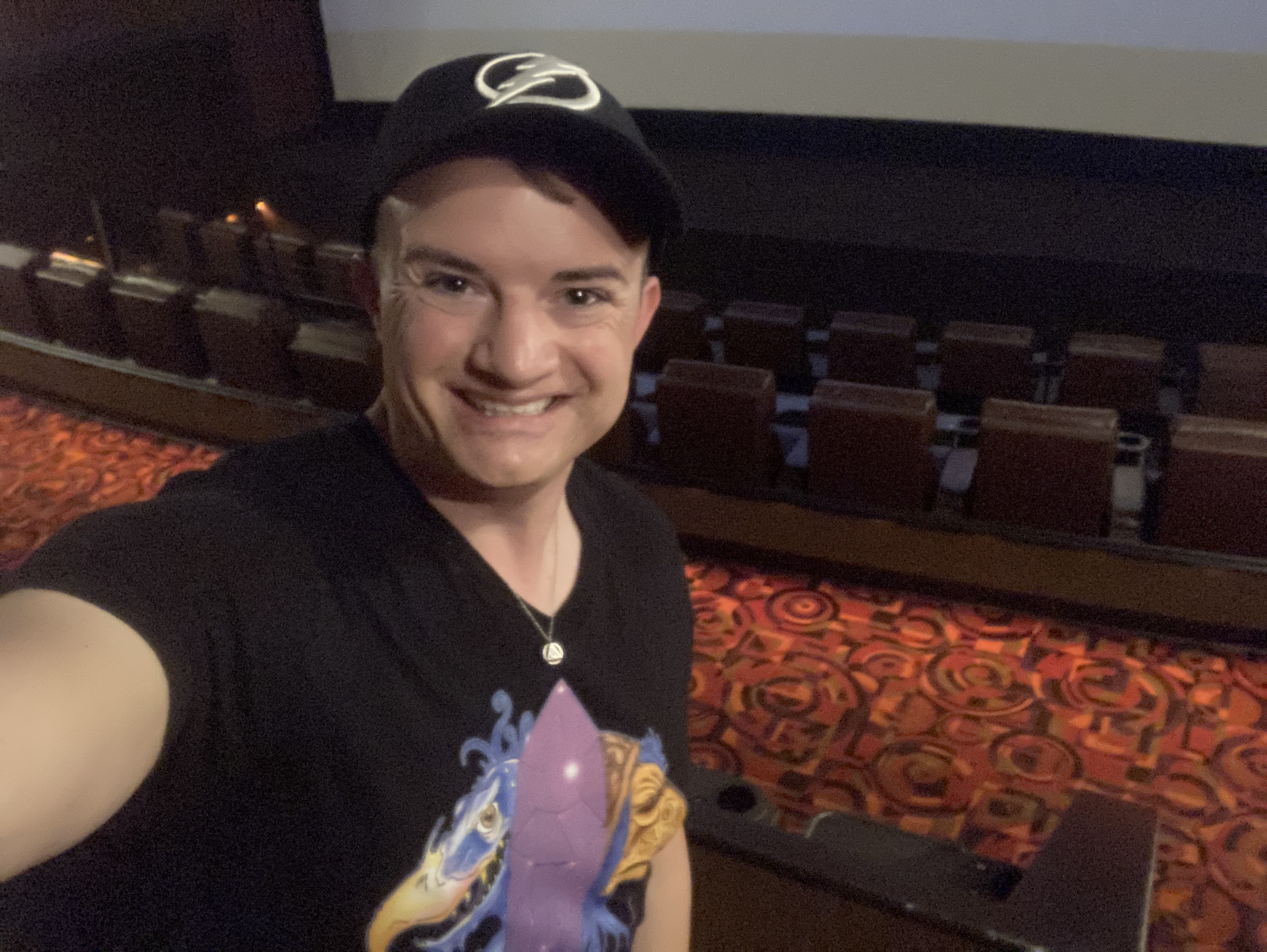
Ryan teaches Film Studies and Screenwriting at the University of Tampa and is a member of the Critics Association of Central Florida and Indie Film Critics of America. If you like this article, check out the others and FOLLOW this blog! Interested in Ryan making a guest appearance on your podcast or contributing to your website? Send him a DM on Twitter. If you’re ever in Tampa or Orlando, feel free to catch a movie with him.
Follow him on Twitter: RLTerry1 and LetterBoxd: RLTerry

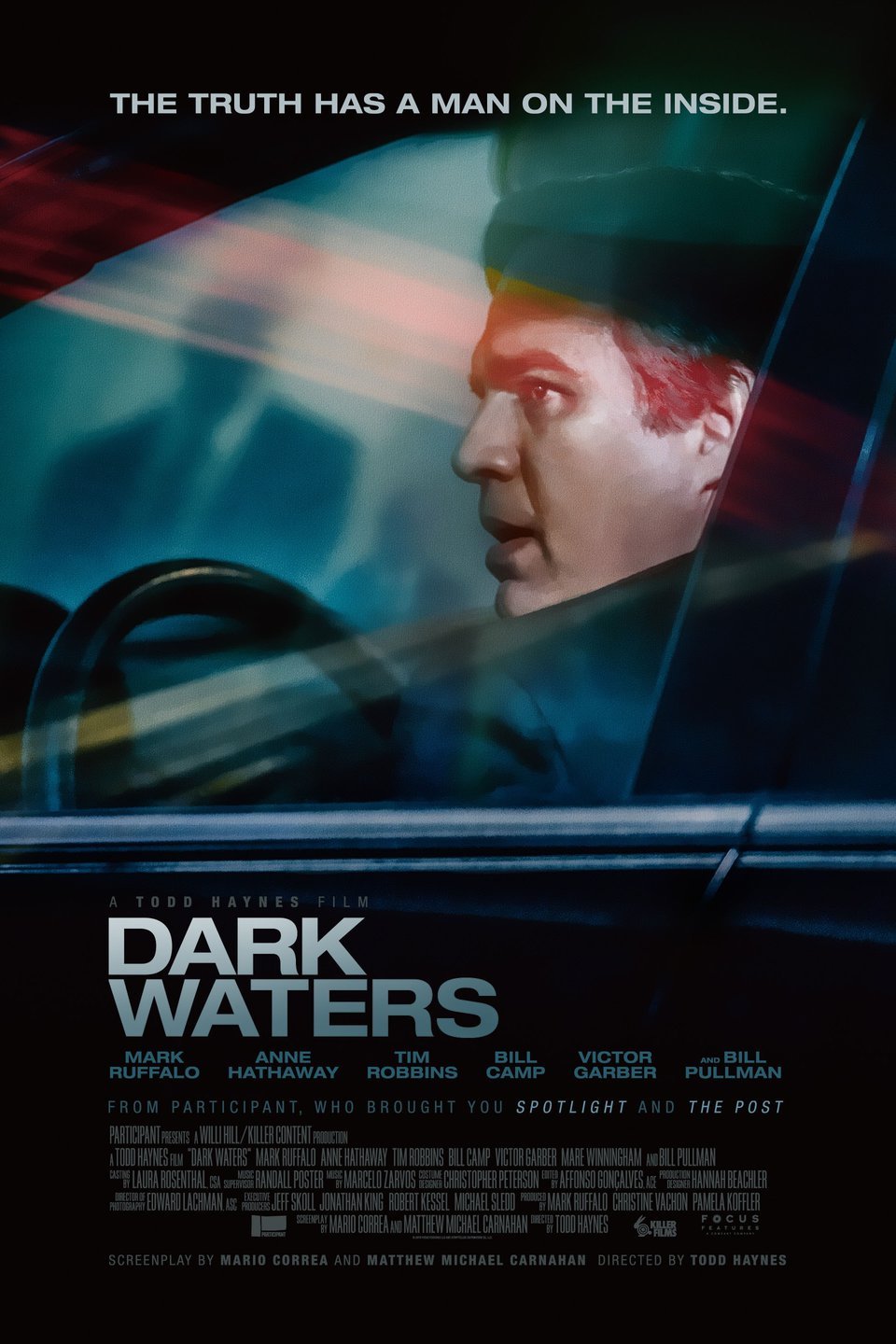
“Dark Waters” mini film review

For the full audio review, checkout One Movie Punch!

Better living through chemistry??? Oh how that DuPont slogan reeks of unfortunate irony. More like “better dying through chemistry.” Not since Erin Brockovich have I seen such a compelling legal drama about a corrupt coverup by a massive company and its attempt to silence the victims and all those whom would help take it down. If you haven’t heard of Dark Waters, it’s because the nationwide release is still very limited. It’s the film about the massive lawsuit against the American institution DuPont company and the residents of Parkersburg, WV. Specifically, the film follows tenacious corporate defense attorney Robert Bilott (played by Mark Ruffalo) in his continual uphill battle against the DuPont company after he uncovers a deep, dark secret that is poisoning a sleepy West Virginia town that is home to the DuPont plant that manufactures Teflon. Not your typical issue-oriented film. This one will impact everyone whom watches because more than 98% of the world’s population has the dangerous PFOA (or C8) chemical (that cannot break down) in their bodies. Fortunately, most people are well below the limits that can cause permanent damage but the town of Parkersburg was basically bathing in it. When you learn that the DuPont company was knowingly poisoning people, it will make you sick. And think twice about that non-stick pan in your cabinets. Dark Waters is brilliantly crafted from start to finish and the ominous feeling that something isn’t right, hits you right away. You will be held in incredible suspense the entire time as you’re on the edge of your seat eagerly awaiting the results of the legal war, and if DuPont will be held accountable and brought to justice. Mark Ruffalo is truly the heart and soul of this cinematic adaptation of the real cases. Several years have passed since we have bene able to see Ruffalo as a character other than the big green guy, and this is the perfect vessel for demonstrating to audiences that he is more than the Hulk. He is a complex actor with a wide range of acting chops. After watching this film, you will likely hit Wikipedia for the true story behind the film. And you will likely be shocked at how accurate the film is and even the parts that are even scarier in real life. In short, if you liked Erin Brockovich, then you will also enjoy Dark Waters.

Ryan teaches screenwriting at the University of Tampa. If you like this article, check out the others and FOLLOW this blog! Interested in Ryan making a guest appearance on your podcast or contributing to your website? Send him a DM on Twitter or email him at RLTerry1@gmail.com! You can catch Ryan most weeks at Studio Movie Grill Tampa, so if you’re in the area, feel free to catch a movie with him!

Follow him!

Twitter: RLTerry1

Instagram: RL_Terry

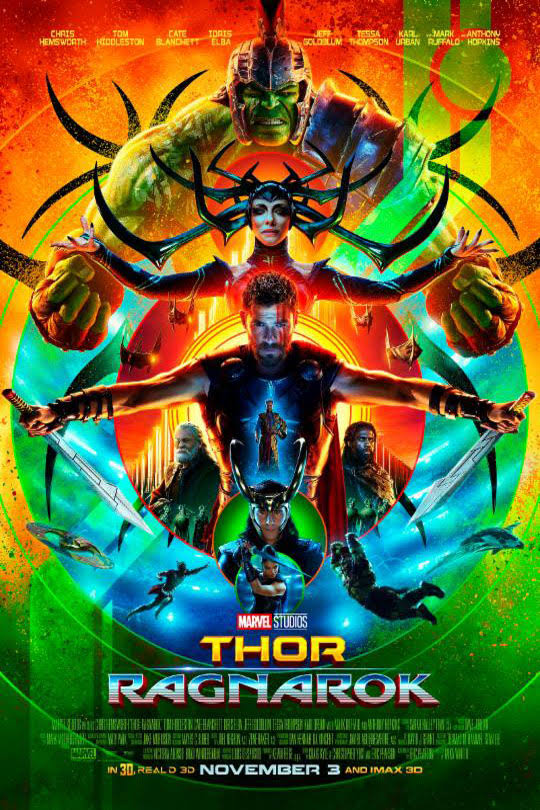
“Thor Ragnarok” movie review

Norse mythology meets Gladiator meets 80s vintage video game in this non-stop adrenaline pumping action film. Suffice it to say, everything you’ve heard about Thor Ragnarok from your friends is true. It is an incredibly fun movie that is equally well written and directed. For anyone who follows my blog, it is no secret that I typically do not like the Disney-Marvel films (and for good reason), but the focus of this review is on THIS particular film. I state that because, honestly, I very much enjoyed this film! So, it comes from liking the structure, characters, plot etc. not just from being a fan boy, or lack thereof in this case. Not only an excellent third sequel, but this movie can easily stand on its own. Whether you have watched the other MCU (Marvel Cinematic Universe) films or not, you can rest assured that you can enjoy this superhero movie. With the way the initial trailers were cut, I thought that this was MCU’s way of jumping onto the 80s nostalgia band wagon–not so. Oh, there is definitely an 80s video game vibe about the film, but the focus is on the characters and storytelling, not the nostalgia. There is also a self-aware element of this film. Not to the extent Deadpool is self-aware, but Chris Hemsworth’s Thor has a twinkle about his eye that winks at the audience so that we know that he is aware of the corniness and ridiculousness of the characters and plot. But the magic of this film is just how well balanced the content of the film is. There were many times that the plot lended itself to falling apart, but the solid cast held the film together and provided audiences with one of the best movies in the MCU.

When Thor learns of a dark, hidden family secret, he must confront the deadliest enemy he has ever faced off with in his life. But the legendary hero encounters far more than he ever expected. The mighty Thor finds himself imprisoned on a faraway planet and forced to battle in gladiator-style games. Little does he know that the winningest challenger on the planet is his former ally The Hulk. Thor must survive the deadly gladiator-like battles in order to build his team to defeat Hela, the Asgardian goddess of death who is destroying his home world.

One of the principle themes in this film that enables this one to be more and deeper than other MCU films is just how similar it is to a conventional war picture. There are hints of courts of intrigue as well. The complex plot provides a comprehensive foundation upon which a more superficial story can be developed in order to appeal to wide audiences, with few appreciating the deeper themes and subtext. But it takes more than effective and well-developed writing to build such a solid movie, it takes multi-dimensional characters portrayed by impeccable screen talent. You’ll find all of that in Thor Ragnarok. Although his screen time is brief, Anthony Hopkins’ Odin commands the screen with confidence, wisdom, and sincerity. Few actor’s can take a few minutes of screen time and put more cinematic magic in it than Hopkins. After all, he won his Oscar for Silence of the Lambs for his collectively few minutes on screen. Joining the cast are Jurassic Park’s Jeff Goldblum and the beautiful, talented Cate Blanchette. Goldblum’s Grandmaster of Sakkar is hilarious and brilliant. As you’d expect a Goldblum character in a film like this to be: detached intellectually from that which is seen as conventional, smart-alecky; yet, he is also petty, sadistic, and relentless. Blanchette’s Hela is elegant, sadistic, and intelligent. She is perfectly able to be the comic book-esque villain she needs to be, all while bringing about a pedigreed acting to it.

All the technical elements of the film works excellently together. The most memorable of those elements is the music, for me, followed by the visual effects. I absolutely loved the nod to Willy Wonka and the Chocolate Factory during Thor’s transport to through Sakkar. This works because (1) the scene it shot and edited similarly to the boat scene in the aforementioned movie and (2) Goldblum’s Grandmaster is a Willy Wonka type. Throughout the film, there are 80s video game sound effects and a score that could fit into a nostalgic 8bit video game. However, the nods to Willy Wonka and video games do not overpower the more conventional score. Whereas the visual effects could have gone overboard and made the film play off as a video game, the video game like effects where carefully integrated in order for the film to maintain a high show quality.

The film was initially sold as a funky, colorful, comedic MCU film. And there are times that the film also encroaches upon that animated feel, but it never crosses that line–thankfully. The more serious aspects to the film balance out the slapstick moments. All of this works together to execute perfect pacing and plot/character development. Like with most MCU films, the more adventurous parts of the film are not quite adventurous enough to be an adventure film and there is typically a predictable nature about the film. I find that this film is not as predictable as previous MCU movies, but there is still that experience with this one. There is one particular part to the showdown of the film that prohibits this from falling victim to another cliche MCU ending with an epic battle, bodies flying through the air, and cities on fire, but I cannot reveal that without giving away the ending.

Looking for a fun movie to watch with your friends? Then this is a solid choice. Although the film has its diegetic flaws, the ways it succeeds outweighs the shortcomings. You also do not have to have seen the other Thor movies and really don’t even need to have seen the previous Avengers films, albeit helpful to understand some of the minor plot points. It’s definitely one that has re-watchabbility.

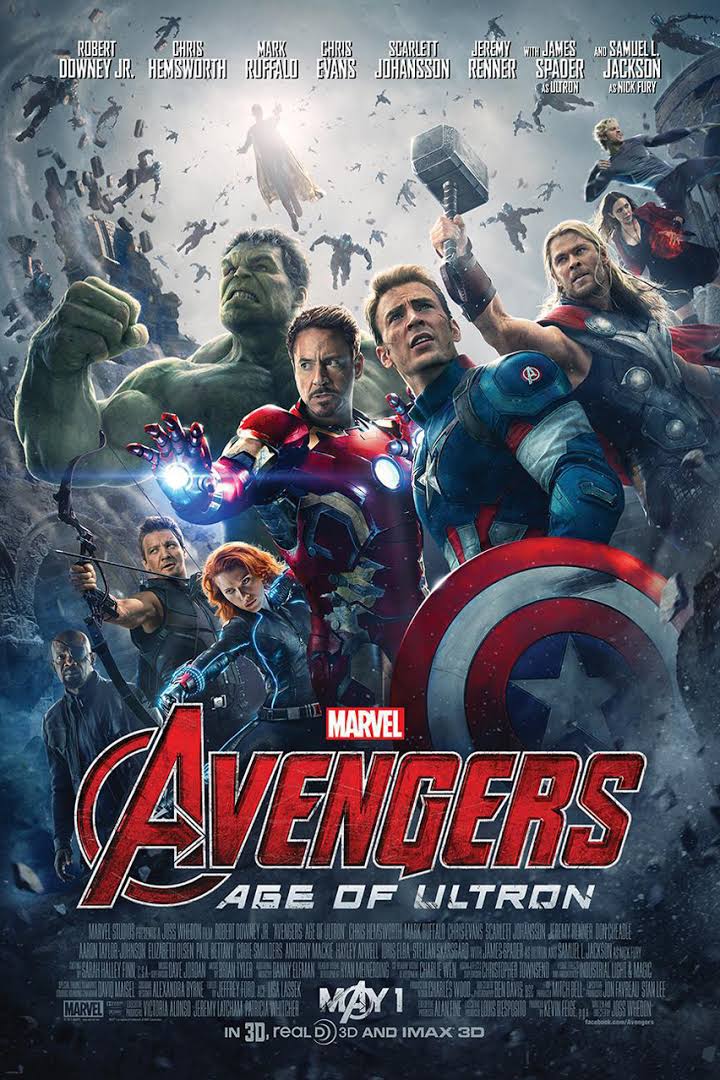
The Avengers: Age of Ultron

Avengers2The Avengers: Age of DULLtron. Get ready for the first big movie to usher in the summer blockbuster season. Only, you will probably find you enjoyed the first Avengers better. Writer-Director Joss Whedon returns with the highly anticipated sequel to the 2012 smash hit. The Avengers: Age of Ultron is a mesmerizing, overly stuffed science-fiction/fantasy that will, in the end, leave you hungry and unsatisfied. Unlike the previous installment, this flashy yet underperforming sequel lacks satisfying plot development. It’s almost as if the movie is at its climax the entire time, with no apparent windup, little exposition, and nearly non-existent rising action. There are movies that are two-parters that have no business being split, and there are others that are one-movie that desperately needed its story to be told over two films–this is the latter. There was such potential in the story, but the plot was executed poorly. If the writers paid more attention to and spent more time on plot development and less time on funny one-liners and running jokes, which are quite appropriate and help keep the dialog balanced, then we may have had a better movie.

The Avengers: Age of Ultron takes us on an a high energy journey around the world from Eastern Europe to Africa to New York City. At the center of the movie is a once-dormant peacekeeping program initiative that was designed by the brilliant engineer Tony Stark (Robert Downey Jr) that was inadvertently activated and developed an artificial intelligence of its own with a dark vision of what peace should look like. Taking to the internet, the AI peacekeeping program (aka Ultron) is everywhere and nowhere all at the same time. Teaming up with Captain America (Chris Evans), Hulk (Mark Ruffalo), Thor (Chris Hemsworth), Black Widow (Scarlet Johansson), and Hawkeye (Jeremy Renner), Iron Man and the Avengers must overcome personal differences and ban together to confront the peacekeeping initiative that is hell-bent on destruction. Ultron, along with other enhanced humans designed by Striker will prove to be the most daunting enemy faced by our heroes, and will have to work together like they have never done before to save the world from catastrophe.

Sounds like a great movie right?!? Well, not so fast. As I mentioned in my opening paragraph, the movie truly had great potential and, despite its short comings, has a phenomenal cast. But, the story structure and well-crafted writing just wasn’t there. The plot is quite dull. It really is almost as though this was a glorified filler movie to make way for the next installment Avengers: Infinity War Part 1. From a technical perspective, the film is fantastic! The special-effects, practical effects, and CGI were woven together seamlessly. Both the cinematography and direction demonstrated a true gift for telling a story visually. And, to that, I applaud the filmmakers for a commitment to visual storytelling. With the exception of the casting of Maria Hill, a role better suited for Anne Hathaway than Cobie Smulders, the cast was once again brilliantly selected and truly brought the iconic comic book characters to life for the silver screen. The additional roles of Quick Silver (Aaron Tyler-Johnson) and Scarlet Witch (Elizabeth Olsen) were also cast impeccably. And I do not feel anyone besides James Spader could have brought such life and incarnate fear to the voice of Ultron.

Before I tackle the shortfalls of the plot, the character of Ultron needs to be examined. Most any competent filmmaker, or more specifically screenwriter, will tell you that a well-developed story needs a protagonist with a well-defined external goal (often accompanied by an internal goal), and in this respect this film checks that box off; however, a screenplay–especially one of this genre–needs a well-defined antagonist with both an external and internal goal as well. And in addition to the goals of the antagonist, we also need to love or love to hate the villain. Knowing WHY the villain/antagonist does what he or she does is paramount to proper character development. Unfortunately, the audience is not told why Ultron hates humanity so much, unless you count the CNN footage Ultron quickly scrubs through in his rushed genesis. It is never a good idea for a writer-director to just expect the audience to accept the actions of the antagonist without explanation or reason. Not knowing why Ultron is determined to create peace by destroying humanity without reasonable exposition does not create a well-developed character. Whether dealing with a protagonist or his/her opposition, it should never be expected for an audience to engage in blind acceptance.

Here’s where the plot went wrong. Now, in order to critique the plot, it is unfortunately necessary to reveal information that may, but not necesserilly, spoil the movie for those who are unfamiliar with the story or the comic book series. But, I will do my best to not reveal too much. At the center of the movie is this dormant peacekeeping AI initiative designed by Stark Industries called Ultron. Funny how it was never acknowledged in the previous film and came across as a plot gimmick just to hurriedly explain the vague origins of Ultron. The simple and elementary observation of the disregard for proper story structure is evident through the fact the movie lacks an adequate introduction and development/rising action. We basically go from a rushed first act and touch on the second act, then skip directly to a bloviated third act. Where’s the windup? Not here. Being a science-fiction movie, that means that certain laws of science should be adhered to in order to increase the believability and sell-ability of the story. Most anyone who has taken a science class in middle or high school knows that the higher the elevation, the lower the oxygen level, the lower the oxygen level, the slower the brain functions and the more mitigated the functionality of the lungs. I just don’t buy the fact that no one suffers from high altitude sickness when the Eastern European city hangs in the atmosphere above the mountains. The lack of oxygen isn’t even mentioned at all. Even if you buy the fact that the Avengers have somehow overcame this physiological obstacle, the citizens of the city are certainly bound by normal human respiration and circulation.

Over-all the movie is exciting and, despite its shortcomings, is a perfect movie to usher in the coveted summer blockbuster season. It is the first of many highly anticipated summer movies including Disney’s Tomorrowland and Universal’s Jurassic World. Hopefully the next installment in The Avengers series will make up for the structural and logical fallacies in this movie, and spend more time on the writing for the next one. Whether you’re a comic book or super hero fan or not, this is definitely a movie that will add excitement to your weekend. And, for those that are graduating this weekend and next, this film makes for a great way to start a weekend of parties and celebrations.