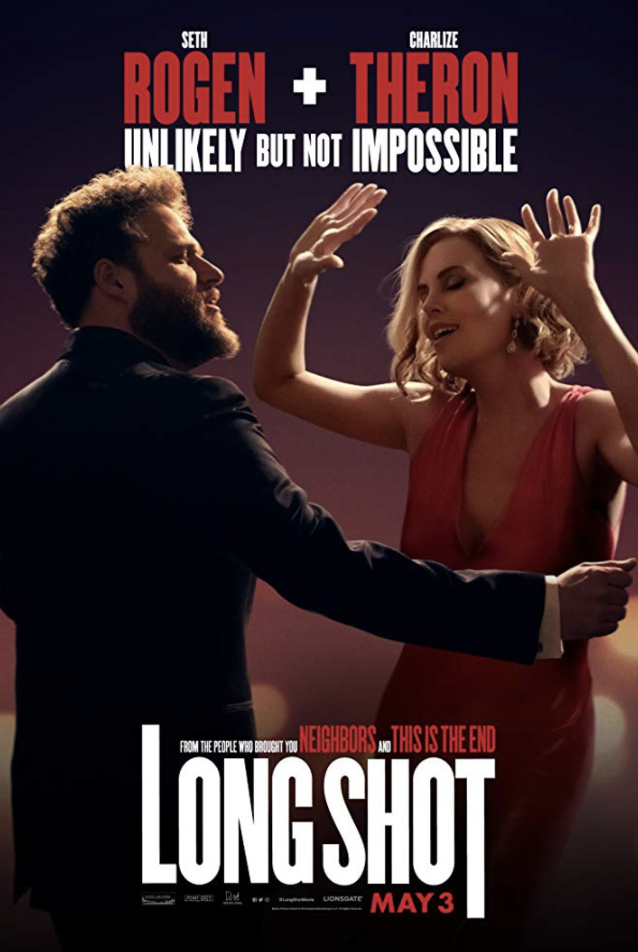
“Long Shot” full movie review

Old fashioned rom-com meets political satire in this reverse Pretty Women that’s clever, heartwarming–oh yeah–and hilarious! After years of absence, the American romantic comedy has been slowly making a comeback in recent times; take last year’s Crazy Rich Asians for example. Directed by Jonathan Levine and written by Dan Sterling and Elizabeth Hannah, this edgy, smart comedy uses its two charming yet unlikely lovers as a conduit through which the socio-political state of America is explored in unapologetic, candid ways. Starring Charlize Theron and Seth Rogen, this movie demonstrates that real issues facing us today can be acknowledged but never become the central focus of the movie. It is the superb chemistry and character development of Theron and Rogen that carries this movie. Simple plot, complex characters. Although there are very Rogian moments, Theron and supporting actor O’Shea Jackson Jr, playing Rogen’s best friend, help to balance him out. Thanks to the outstanding comedic writing powered by external and internal conflict, this movie elevates the rom-com to rise above the predictable to deliver an endearing story that is equal parts whimsical and plausible. Theron and Rogen deliver stellar performances that carry the movie from start to finish. And you know what, it looks like they are having a great time!

When Fred Flarsky (Rogen) learns that his independent newspaper has been bought out by a media conglomerate, he quits instead of having his voice silenced or conformed to fit the new business model. By sheer happenstance, Fred runs into his childhood babysitter Charlotte Field (Theron) the current Secretary of State at a party to which his best friend (Jackson Jr.) brought him to cheer him up. When Field decides to prepare for a presidential run, she hires Flarsky to punch up her speeches because she likes his honesty and chutzpah. Little did either know that this business partnership would ignite old flames that would give way to political and relational conflict.

Not to oversimplify, but everything in this movie works. And that is rare for a comedy to work this well for me. If you’re familiar with my writing, you’ll know that I do not watch many romantic comedies, and seldom truly adore one; but, I sincerely enjoyed this movie. Levine demonstrates a commitment to effective directing that builds upon the impeccable casting and solid screenplay. Long Shot is one of those rare comedies that gives us captivating characters from the onset and a plot that, albeit unlikely, could very well exist in real life. Whereas it would have been so easy for the focus of this politically charged fish-out-of-water meets romantic-comedy to be overly concerned with the politics to the point that the characters and plot suffer, the story is consistently character-driven by using the plot to explore socio-political commentary that ultimately fuels the conflict. Topics such as the environment, racism, religion, and feminism are highlighted but never steal the spotlight from the journey of Flarsky and Field. And the screenplay gives us some thought-provoking reversals that go to show that the very group that claims to be the most tolerant of differences might actually be the least tolerant of all. The fact that Field is a woman and must play by different rules than male politicians is acknowledged but doesn’t become the focus either. In short, this movie has a well-defined central character (Charlotte Field) with a clearly defined external goal (to become President), fueled by an internal need (connection, both with herself and a partner) and motivation to achieve the goal (to make a positive difference for the American people). That is why the writing works as well as it does. Everything else is icing on the cake–and it’s delicious icing that is neither too stiff nor too sweet.

Pretty Woman works as well as it does, and has found itself a beloved movie not because of the social commentary but because the audience fell in love with the stars and desired to see them find happiness. The same can be said of Long Shot. I was hesitant going into the screening since I am not usually a fan of Rogen’s comedy; but I was confident that with Theron, an actress I have long since found to be outstanding in talent, beauty, and philanthropy, Rogen’s over-the-top self-deprecating acting would have a equally charismatic actress to balance him out. The relationship between Field and Flarsky is so incredibly genuine. No pretense here. Both of them say precisely what they think, not shying away from feedback or rebuttals that could mean the end of the friendship, partnership, or careers. Combining Field’ workaholic, domineering, savvy Secretary of State turned presidential candidate and Flarsky’s radical, uncouth, abrasive journalist turned speechwriter provides audiences with a refreshing take on a staple genre of motion pictures. They have have different ways of showing it, but both characters are Type As that are stubborn, idealistic, and seek to do the right thing by the American people–Field as a politician and Flarsky as a journalist.

All throughout the movie, conflict arises out of Flarsky’s reactions to Field’s platform and policy changes; furthermore, additional conflict arises out of Field’s reactions to the choices made by Flarsky as they could damage her chances at the presidency. Despite all the conflict, it comes from being committed to a passion, and it’s that unapologetic passion that draws them to on another. That, and the fact they are childhood friends, and are affected by the power of nostalgia. The TV celebrity turned President of the Unites States is definitely built from tropes and characteristics of our current POTUS, but never feels too much or forced. Likewise, the character of the media mogul is clearly derived from Rupert Murdoch. Both these oppositional characters are entertaining without ever going over the top to make a point.

Although it is Rogen who is first billed, and therefore is likely the intended central character (from the perspective of Lionsgate), it is Theron’s Field who is the central character of this story. Just because you are introduced to a character first, doesn’t always mean that they are your central character. In a manner of speaking, Rogen plays the role of Field’s conscience, a sort of moral/ethical compass that doubles as a vessel through which Field rediscovers her ambitious youthful self and all the convictions therein. Rogen is not the only conscience/moral compass in the movie, he too has one in the form of his best friend. The best scenes in the movie are those where heated arguments or passionate disagreements take place. No real surprise there, but these arguments always have something to teach the characters and, by extension, the audience. One of Flarsky’s purposes is to remind Field why she got into politics (even during her time running for student council) at such a young age and that she should never compromise on her convictions–stay true to herself. Furthermore, he is also the vessel through which Field rediscovers and connects with her needs as a human, as a women. A need to reconnect with her playful self that will ultimately unleash who she truly is. Likewise, Flarsky’s successful best friend surprisingly emerges as his conscience. Only instead of providing moral/ethical direction in the world of politics, it is on a more relatable sociological level. Flarsky is confronted on his gross intolerance of all those with whom he disagrees in terms of religion, love and support, and even racism. He buys into the stereotypes just like those he accuses. Great scene!

Thinking of this movie and Pretty Woman, I am left with this one being the superior movie. Not knocking Pretty Woman, I still respect it, but Long Shot takes what Pretty Woman did right, and elevate it to the next level. One of the biggest differences between the two is the style of comedy. Long Shot is definitely a hard R comedy whereas Pretty Woman is more “family friendly.” You can enjoy both equally! A movie about underdogs, this movie may very well be an underdog at the box office in May, but it’s certainly worth the watch if you’re in the mood for an edgy adult comedy.

You can catch Ryan most weeks at Studio Movie Grill Tampa, so if you’re in the area, let him know and you can join him at the cinema.

Ryan teaches screenwriting at the University of Tampa. If you like this article, check out the others and FOLLOW this blog! Interested in Ryan making a guest appearance on your podcast or contributing to your website? Send him a DM on Twitter!

Follow him!

Twitter: RLTerry1

Instagram: RL_Terry
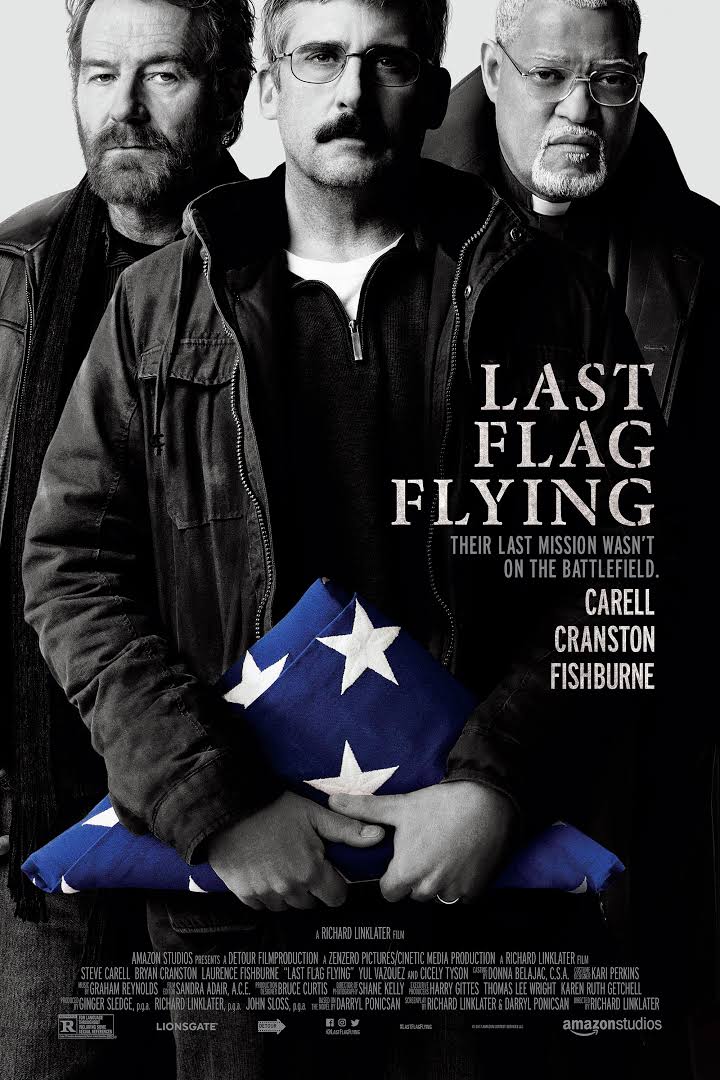
“Last Flag Flying” film review

An all-star cast takes audiences on a memory journey of war, loss, friendship, and patriotism as genuine human emotions are dealt with through comedy and grief. Amazon Studios hits a homer again with the release of Last Flag Flying distributed by Lionsgate. Now in select theaters, writer-director Richard Linklater crafts an incredible motion picture that organically deals with the loss of a loved one during a time of war through the stages of grief and irreverent comedy between friends. While this film is currently flying under the radar, don’t allow that to dissuade you from watching this incredible war film. I cannot remember the last time that I saw a film that felt so genuine. Watching this film, I truly felt like a fly on the wall, watching a Vietnam vet deal with the loss of his son and reconnecting with some of the closest friends he ever had in his life. Last Flag Flying is a subgenre of war movies that places the camera at a distance from the characters and allows them to mourn and laugh on screen without interference from censors and other outsiders. While not a conventional war movie, the topic of war is found underlying many diegetic components. Dialogue driven, this film provides social commentary on patriotism, God, and friendship. Bring your listening ear to this movie because the context of the tough subject matter contains subtle yet powerful messages that highlight otherwise unstated emotions. Sometimes the best way to go through the stages of grief is to throw caution to the wind and allow humor to work its powerful remedy.

Three Vietnam war veterans reunite for a different kind of mission that forces them to deal with the present and the past. When Larry “Doc” Shepherd (Steve Carrel) arrives at the dive bar that belongs to former comrade Sal Nealson (Bryan Cranston), he asks his Marine brother to go with him without naming where. Sal drives Shepherd to a old country church now pastored by their Marine brother Richard Mueller (Laurence Fishburne). When Shepherd doesn’t touch his pale cobbler, the group realizes there is something wrong. It’s then the Shepherd reveals that his son was killed outside of Baghdad, and wants his two Marine brothers to go with him to bury his son at Arlington. Along the journey, the three former military comrades are forced to come to terms with their shared past that continues to shape their present lives by discussing tough topics such as grief, God, war, honesty, and addiction.

The sheer storytelling beauty of Last Flag Flying is found in the solid writing made evident through the excellent direction and A-list cast (and one surprising cameo that I won’t mention because it will detract from the brief but powerful screen presence). While it may appear like a somber tragedy on the surface, beneath that surface of sadness beats the heart of dark but respectful comedy that takes audiences on the memory journey right along side the characters. War movies about the loss of loved ones is not something new; but this film allows the characters to go through the stages of grief in organic ways that paints a motion picture of how human these emotions are. Human. Truly human. At times, there are no holds barred when three very different voices all converge on the same topic. You have the grieving father, a reverend, and foul-mouthed barkeep discussing everything, just as friends in real life often do. In many ways, these three former military comrades could not be any different in their present states; but at one time, they were inseparable and very much alike. While the focus of the film could have been on Shepherd’s loss or the politics of war, the focus is clearly on what makes us human and how one genuinely has to deal with loss due to war. Not that discussions of politics and religion are not found in this film–they are–but the discussions and arguments between these friends are used as tools to comment on the human condition. Because we never see combat footage, the expositional dialogue about war and politics adds incredible weight and a little mystery to the events in the film.

Before you begin to think that Linklater uses flashbacks to connect the present to the past, think again. While that would have been the easy, lazy way of accomplishing that task, he chooses to connect the present to the past through exceptional exposition between characters that prompt the audience to engage their own emotions to connect the pieces of the story together. Because we never shift between the past and present, the main story is always the main story. When constructing strong characters as we have this this film, it is the responsibility of the actors (though proper direction) to not allow the actor to get in the way of the character. Honestly, there are times that I see the individual actors eclipse the respective character, but most of the time, the audience will see the characters themselves throughout the dark comedy. The cinematography is simple, but perfect for the story within this motion picture. Linklater uses no gimmicks to tell this thought provoking story. The movie has an intimate feel to it because you can likely identify with one of the lead or supporting characters, especially when they are talking about “Disneyland” in Vietnam (you’ll just have to watch to understand why that’s in quotes). So incredibly genuine. No pretense about any of the characters in the film.

The content of this film truly reflects the tenor of the times in which we live. Topics of war, politics, and religion seem to be inundating us from all angles. It takes a special film to deal with each of those respectfully, candidly, and effectively. The trifecta of voices in this film allows the thought provoking conversations to transcend the screen and enter the minds of the audience. While working through his grief, there were times that Shepherd could have gone on an anti-military or anti-American rant, but he never speaks a negative word against anyone, though he is sometimes in immense pain. Patriotism, God, and the human condition are shown and discussed in quite unconventional and maybe even controversial ways; yet, the manner in which these topics are discussed, as it relates to Shepherd’s loss, are absolutely perfect. In a seemingly binary world where you are either a red-blooded patriot or you’re anti-American, with no room for nuance or discussion, this film provides the platform to begin to realize that we are first human before we take sides.

Although I did not care for Linklater’s Boyhood, I can honestly tell you that this film is one that you don’t want to miss. Whether you are in a military family or not, this film offers a glimpse into a world that many people have to face on a daily basis. The genuine, organic approach to the hard topics in this film allows the humanity to shine through. Not speaking for ALL veterans, but the vets that were in the screening last night had high praise for the film. And the rest of us had many positive remarks and feedback for the screener hosts.

“The Glass Castle” film review

An organic, unapologetic emotional rollercoaster. Based on the novel by the same name written by Jeannette Walls, The Glass Castle provides audiences with a glimpse into the childhood, young adulthood, and then-present day life of Jeannette Walls. After watching the film and end-credit scenes of the real Jeanette and family, it is clear that the movie is supported by a screenplay that takes its inspiration from the tome-like book. From what I have read, this film successfully adapts the novel to the screen, inclusive of all the intangibles and the unseen or heard elements from the book. Furthermore, this film strikes a fantastic balance between family drama and biographical motion picture. For all that this film has going for it, it falls short of the big-budget tear-jerker that is expected of Destin Daniel Cretton after his hit Short Term 12. However, those who choose to see this gritty slice of life, who have not seen Cretton’s previous works, will likely miss just how safely objective this film is. Although you will likely identify with one or more of the characters, in general, audiences will feel that they are safely watching the events unfold from a removed vantage point. The danger in bringing a story like this one to screen is creating characters that are either too softened compared to the real people or too detestable. Fortunately, Cretton skillfully tells a story that plays as authentic as cinematically possible.

You can choose your friends and lovers, but you cannot choose your family. The Glass Castle is the film adaptation of the memoire authored by Jeannette Walls (the central character). Jeannette and her three siblings must learn to take care of themselves and survive life as their parents are free-spirited responsibility-adverse individuals who inspire and inhibit growth and education. When he was younger, their father generated a great deal of warmth, compassion, individualism, and creativity; but when he turned to drinking more heavily, he allowed them to go without food and watched over them like a warden watches over prisoners. Meanwhile, mom was completely disgusted with the idea of being a domestic so she allowed the children to care for themselves and even prepare her meals. Jeannette and her siblings faced great adversity growing up, but grew to become contributing members of society.

This is one of those films that you go into thinking that a particular actor or character is the main one, but in all reality, it is the antagonist, if you will, that is the main character. Jeannette Walls (Brie Larson) may be the author of the novel and a lead character, but it is actually Rex’s (Woody Harrelson) movie. On one hand, Rex is a brilliant father who is preparing his kids for the harsh realities of life and how to not fall victim to blending in or turning into someone you are not. On the other, he is a belligerent drunk who cares very little for the well-being of his children and even ships them off to live with his aged mother who is a child molester. Through all the struggles and setbacks, Jeannette and her siblings learn resilience and strength to face whatever life throws their way whether that is extreme poverty or molestation.

The Glass Castle relies upon switching between the present story and flashbacks to hone in on the relationship between Jeannette and her father Rex. Often times, flashbacks are used as means to lazily integrate exposition into the film or explain some other dynamic; however, much like the background story in Fried Green Tomatoes is just as interesting as the foreground story, the rotation between Jeannette’s childhood and her adulthood is performs well and creates quite the interesting dichotomy. Both have the central focus of showing the development or lack thereof in Jeannette’s and Rex’s relationship. Not that other relationships take a backseat, but there focus is squarely on Rex and Jennette. There is one particular scene in the film that deserves special attention, and that is the restaurant scene with Jeannette and Rose Many, her mom played by Naomi Watts. The degree to which this scene is pitch-perfect is almost uncanny. The tension, emotion, and cathartic release commands attention.

Ultimately, the strength of this film lies in the writing and lead cast. Only to a minor extent does the screenplay depart from the source material. And in doing so, the film is strengthened. For those who enjoy films in the vein of The Help, you will enjoy this story as well. To keep the film from being too dark, Cretton adds some feel-good moments to the film that do not attempt to sanitize the past but honors the complicated truth in Jeannette’s and Rex’s relationship.

Lights, Camera, MotionGate! A Look into Dubai’s Newest Theme Park

Dubai_Parks_mapWhile the themed entertainment industry continues to explode with new lands and attractions at the US’ biggest players, the luxury destination Dubai, UAE is throwing its hat into the ring. MotionGate may just be the competition that Disney and Universal were not expecting. Primarily including intellectual property (IP) from Sony Pictures, LionsGate, and DreamWorks Animation (now owned by Comcast), MotionGate will boast some of the most advanced attractions in the world. Starting out the gate with 27 attractions and shows based on some of the most well-known IP from the worlds of cinema and television, this brings the total attraction numbers to more than 100 when added to the existing offerings at Dubai Parks and Resorts (a government owned themed entertainment holdings company).

motiongate_image.fw_Unlike the public-private partnership of the parks in China, the government of UAE is uniquely positioned to capitalize on the wealth of the nation. That allure and wealth has driven millions of tourists from around the world to their nation as it is; factor in a world-class leading theme park, and those numbers will increase exponentially. This influx of revenue may actually pave the way for the non-wealthy classes of people to be able to enjoy the Dubai Parks and Resorts as additional flights, hotels, and transportation methods will be added. One of the biggest advantages that MotionGate has over its Disney and Universal competitors (Fox will soon be added to that as well) is that it is being constructed amidst digital, wireless, and multimedia technologies. Whereas the big boys have to modify existing technologies in attractions as they change, these parks are built with the latest technology which directly impacts efficiency of operation.  This same idea of being late to the game but a quickly asserted leader can be seen in nations like South Korea who only recently, relatively speaking, have had access to wireless internet technologies. As they did not have to adapt or modify existing legacy infrastructure, they built on current communications technologies and have a much faster, reliable, cheaper, and efficient ‘internet of things’ than the United States.

MotionGate_DubaiIn the vein of Walt Disney World and Universal Orlando, Dubai Parks and Resorts is a themed entertainment complex featuring separately themed parks. Specifically, MotionGate bares a striking design modeled after Magic Kingdom in that it is ONE theme park that contains five distinctly different themed lands that all center in and around the concept of motion pictures, filmmaking, and live entertainment. Each land, much like the ones at Magic Kingdom, has its own gateway, themed rides, restaurants, shows, and landmarks. Also, keeping with the Magic Kingdom layout, MotionGate contains the hub and spoke system. Unlike Universal Studios, Islands of Adventure, SeaWorld, or Busch Gardens, MotionGate employs the hub-and-spoke system in order to make maneuvering the park user-friendly and aesthetically pleasing to the eye. This provides opportunities for centralized entertainment offerings and landmarks. Prepare for the glitz, glamour, nostalgia, and excitement of the lands: Studio Central, LionsGate, DreamWorks, Sony Pictures, and the Smurfs’ Village. What makes this concept additionally interesting is the fact that MotionGate includes IP from different studios that are self-contained. Instead of taking the IP from the different companies and integrating them in more generically themed lands, each IP is contained within its respective land.

sony-motiongateOne cannot help but notice that the concept of Dubai Parks and Resort’s flagship theme park MotionGate resembles the original Universal Studios Florida or to a lesser extent Disney-MGM Studios. How so? If you are not familiar, both Universal Studios Florida and then Disney-MGM Studios were theme parks inspired by the idea of “what lies beyond the fifth dimension” (Tower of Terror, Disney); moreover, the story that exists outside of the frame–beyond mise en scene. In addition to attractions and shows inspired by filmmaking or theatre, both parks were also east coast counterparts to the Hollywood stages. Universal/Nickelodeon and Disney produced major motion pictures and television shows in the sound stages that are all but gone (or turn into conventional  attractions) in the 1980s and mid to late 90s. By 2000, most filmmaking and television production operations ceased because it was cheaper to move operations back to Hollywood and to other places like North Carolina and now Georgia. MotionGate goes back to the drawing board to resurrect a dying idea of turning filmmaking into an attraction. It truly holds up Geoff King’s studies and theories of “the cinema of attractions.” Universal founder Carl Leammle knew there was more to filmmaking than making movies. That’s why he opened his movie making ranch outside of Los Angeles to day guests to be entertained by special effects and stunt shows as well as watching the magic behind the camera.

20thCenFoxWorldIt is an exciting time for the themed entertainment and motion picture industries. For the longest time, Disney and Universal (Comcast) were the kings of cinema and TV based theme parks. Now, Dubai is becoming a heavy hitter and once MotionGate opens in October, the landscape has the potential to shift drastically. Now, the parks in the US will not only be competing against each other, but against heavy competition on the other side of the world in an area with much deeper pockets. All the while the word is focussed on the Word of Pandora, The Reign of Kong, Cobra’s Curse, Mako, Star Wars Land, Toy Story Land, and the unnamed new theme park under construction for Universal’s third park (not counting the forthcoming water park), MotionGate will open and create a whole new atmosphere of innovation amongst the chief players. In addition to the parks in Dubai, Fox is also entering into the game with their 20th Century Fox World opening in Malaysia in 2017. Also on the books is the 20th Century Fox World expansion to Zoo Miami AND another indoor Sony theme park in Wisconsin. With all these parks opening, there are more and more opportunities for careers in either cinema or themed entertainment. Or, a career that spans both (which is what yours truly is trying to do). I just love all the new completion because it will drive continued innovation. However, it’s also nice to see that we have a new park that is getting back to the roots of what started it all: motion pictures.

“The Divergent Series: Allegiant part 1” movie review

AllegiantPossibly a strong finish for the Divergent Games! Of course, we won’t know just how well it finishes until the second part. Surprisingly, The Divergent Series: Allegiant part 1 provides fans with a good start to a well-executed conclusion. After the weak sequel, it was quite unexpected that the series would begin to complete this YA series on such a high note. Unlike the disappointing conclusion of The Hunger GamesAllegiant brings back your favorite characters you love and love to hate in a very satisfying ending in the dystopian adventure to rescue a people from themselves. At the end of the day, the Divergent series will never be as successful or generate the same fandom as The Hunger Games; but simply comparing the last two films in both franchises, this is clearly the superior finish (or should be). Although Roth’s socio-political themes and subtext were fairly clear, all be it still weak, in the first two films, the message is a little vague and incoherent in Allegiant. Two YA franchises down and one to go. We will just have to see what lies in store for the Maze Runner series. Just like the Divergent series has a week middle, hopefully the weak sequel in The Maze Runner will pave the way for a strong conclusion as well. One thing is for sure, Allegiant contains far more action than the previous films which almost makes the weak and still completely explained plot worth the approximate 2-hour run time.

The first part of the final chapter in the Divergent Series takes us beyond the wall into a desolate wasteland. Follow Beatrice/Tris (Shailene Woodley), Four (Theo James), Caleb (Ansel Elgort), Peter (Miles Teller), and Christina (Zoe Kravitz) as they embark on a journey to seek help from the outside in order to stop the civil war in dystopian Chicago (or modern day Detroit). With newly asserted leader of the faction less system Evelyn (Naomi Watts) and Amity turned Allegiant leader Johanna (Octavia Spencer) at odds with one another, war is brewing in the streets and all hell is about to break loose. Barely escaping Evelyn’s security team, Tris and her band are rescued by a team from an organization of pure bloods who oversees the “Chicago Experiment.” This group of researchers and scientists led by David (Jeff Daniels) recruits Tris and her team to develop a plan to save Chicago, or so they think. When Four discovers what is really going on, he must convince Tris and the rest of her band of rebels to make right what is going incredibly wrong.

For me, and I am sure other critics, analyzing this particular series, The Hunger Games, and Maze Runner gets boring. Because, for the most part, they all have the same plot, same fallacies, and similar subtext. They are all extremely socio-political methods to spread the message that only teenagers are special and are capable of saving the world from corrupt adults. Although these movies are aimed at Generation Z (anyone born after 1995), they still attract attention from Y/Millennials (~1982-1994) and Generation Xers (~1965-1981). That is important because Generation Z does not have the spending power that generations X and Y do. In order to maximize the income potential of the films, the studios have to appeal to Generation Zers in such a way that it will also bring their Millennial friends and potentially Generation X parents. Since schools are constantly preaching the message that teenagers are the future, they are special, and uncontaminated by the greed of the world, it makes sense to create films based on books that carry that theme. The negative side effect to this approach is creating a generation(s) that automatically distrust adults and their respective decisions regarding the environment, politics, and society. Just as Allegiant depicts what happens when there is such great division among a people who view the approach to peace so very differently will devolve into a war-like state, it’s entirely possible that reinforcing this division between Generation Z and X/Y could symbolically arrive at the same precipice.

The production value and design in Allegiant definitely outshines the prior two installments. That is important due to the fact that Roth’s political subtext definitely becomes a little muddled in this last chapter. Although there is definitely way too much cheesy CGI, it is far less than the previous film. And other than some of the outlandish technology used in the story, for the most part, the defense, security, and surveillance technology used by the various characters makes sense and is perfectly believable in their universe. There is even a real reference to 21st century earth’s scientists experimenting with the human genome. That helps to create a sense of futuristic realism in the Divergent universe. One of the biggest problems I have with the plot is the still unexplained history of how exactly the Chicago experiment began. Perhaps the director and writers did not feel it was necessary to provide a clear history through character exposition, but I am still a little confused as to how the Pure Bloods and Damaged became so incredibly separate. Another thing, if there are thousands (if not millions) of Pure Bloods in existence, then why use the Chicago Experiment as a method to see if a Pure Blood can be born out of all of it??? I guess that is why it’s not worth overly analyzing films such as this one.

For what it’s worth, Allegiant is an exciting start to the last chapter in the Divergent Series! Far more entertaining than the last one. If you were disappointed by Mockingjay Part 2 than rest assured that you will definitely enjoy the conclusion of this franchise. Not a bad way to spend your Spring Break or an afternoon over the weekend. But, I wouldn’t bother seeing this film in IMAX or 3D. However, I can see some benefit to the experience of this film by watching it in a D-Box auditorium.