
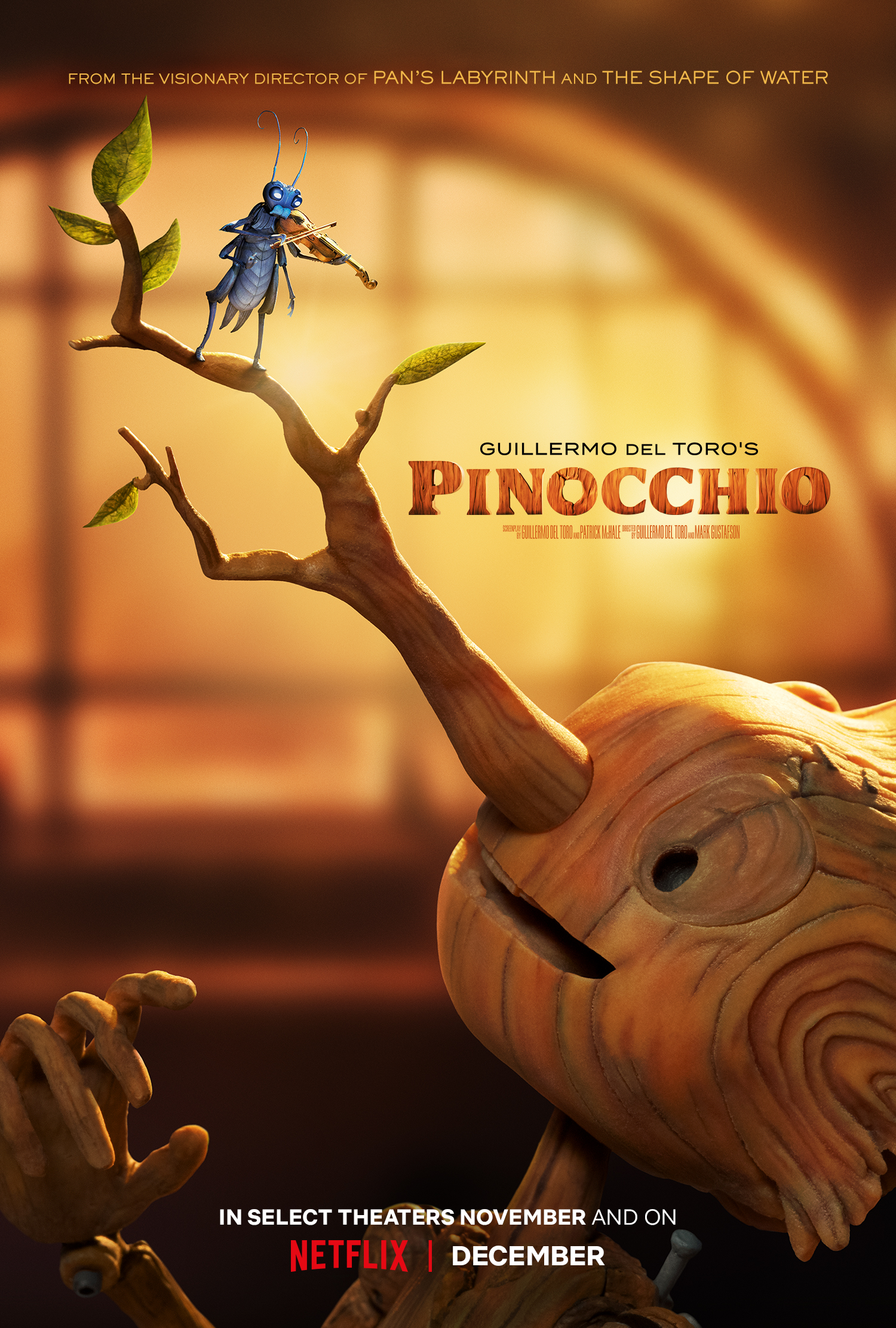
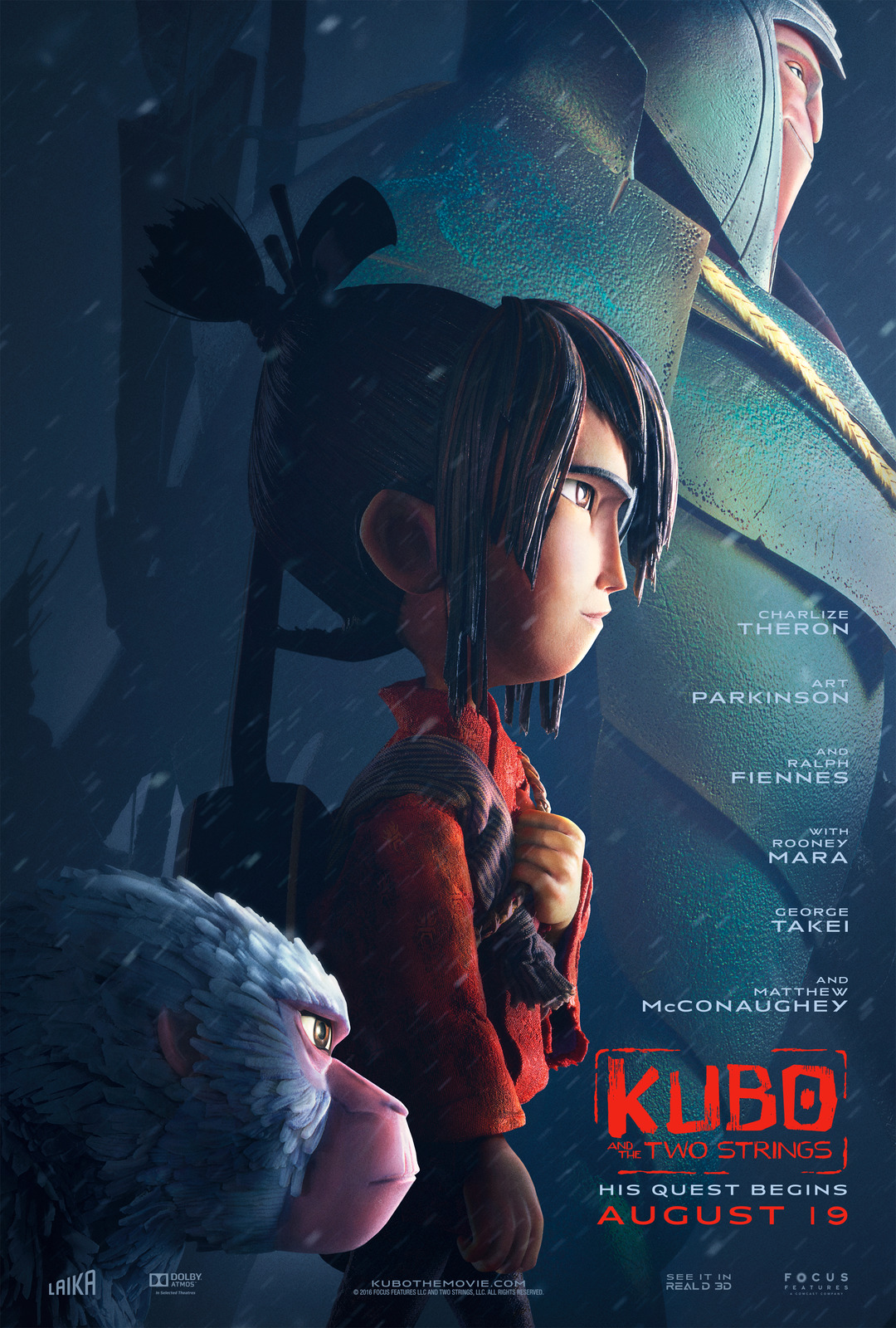
Positively avant-garde! Easily among the best pictures of the year, period. Guillermo del Toro’s Pinocchio is a brilliant stop-motion picture that will stir the hearts and minds of any audience! In many ways it’s reminiscent of 80s dark fantasies such as The NeverEnding Story and The Dark Crystal. Which should come as no surprise that del Toro worked in collaboration with the Jim Henson Company. Audience will be completely transported to the post-World War I Italian world that del Toto meticulously recreates, complete with the fascist movement, which underscores much of the film. Not since Kubo and the Two Strings have we had such a gorgeous, imaginative animated feature film–a film that was robbed of its deserved and earned Beast Animated Film Oscar (no, Zootopia is in no universe a superior film). Let’s hope that the Mouse doesn’t rob Pinocchio of it’s well-deserved Academy Award for Best Animated Feature.
The story may seem familiar: A father’s wish magically brings a wooden boy to life in Italy, giving him a chance to care for the child. But you’ve never seen Pinocchio like this before!
Before you dismiss Del Toro’s Pinocchio as another soulless, cash-grab remake, this much more macabre version of the titular puppet’s story delivers immense depth and dimension. Not only of technical achievement, but of theme, plot, and character development. This animated film proves that animation isn’t only for kids, because this film is far more thoughtfully crafted than most live action films this ear. And yes, I agree with recent comments from Quintin Tarrantino that we are experiencing one of the worst eras of cinema in history. No doubt this is true. However, this year has seen some real winners such as Top Gun: Maverick and now Pinocchio. Suffice it to say, this is not your kid’s Pinocchio. And, although there are important life lessons in the film, it goes to places, both figuratively and literally, that may not be appropriate for kinds under 12 years of age. While Pinocchio is in its limited theatrical run, see it on the BIG screen!
While there are certainly plot beats which are shared by the original 19th century story, the 1940 Disney adaptation, the wretched Robert Zemeckis’ remake earlier this year, and countless stage adaptations (funnily enough, I saw the operetta Pinocchio this week as well), Guillermo del Toro’s Pinocchio takes on a life of its own. It isn’t often that the filmmaker added a possessive to the film title. Whereas it’s commonplace for Disney to add Disney’s… to literally everything, it’s uncommon for director’s or producers to add a possessive to the film’s title. Notable exceptions include Tim Burton’s Nightmare Before Christmas (directed by Henry Selick), Bram Stoker’s Dracula (directed by Francis Ford Coppola), and now Guillermo del Toro’s Pinocchio. This possessive form of title is often employed to signify (1) the filmmaker’s confidence in his or her work of motion picture art and (2) to separate it from all other versions of the same story (and/or title). Moreover, this often indicates to audiences that they are about to witness the work of a true auteur (not the case when we see Disney’s…–that’s just plain branding).
Is it del Toro’s arrogance or an ego trip that prompts such chutzpah in this film’s title? Not at all. Del Toro has been working on this passion project for over 15 years. Before you feel that’s an exaggeration, let the finished motion picture be the demonstrable evidence of meticulous work frame-by-frame in this nearly two-hour film. Images are most often captured at 25-frames-per-second, so to achieve the fluid motion del Toro has, you just do that math. Del Toro crafted intricate animation captured by a camera that is repeatedly started and stopped over the course of day, weeks, years. Each mouth, arm ear, eye, literally any object that has movement, is moves a little at a time, frame-by-frame. Not only does del Toro’s craftsmanship translate to beautiful, seamless movement by the characters and environment in the film, he successfully captures the visual and emotional miracles that can only be accomplished through stop motion animation. There’s a reason why we go back to the Rankin & Bass Christmas classics every year; there is immense simplicity and beauty in stop-motion animation. Why? Same reason why practical effects will always be superior to (overt) CGI effects–depth, dimension, the way real light bounces off objects and into the camera lens.
Even though the film is quite dark from the moment the atrocities of war are witnessed, it is not without its levity and uplifting scenes. To get into a central theme of the film involving stages of grief (which makes it unique compared to other iterations), would mean venturing too far into spoilers, which I would like to avoid, and with that theme, there are many scenes that force the audience to confront what many fear most. Because of this theme, one might think the film is somber most of of the time, and fortunately, this is not true. There are plenty of moments that break up the sadness to inject a healthy dose of laughter. And more often than not, we have Sebastian J. Cricket to thank for that! (I’m sure the “J” is a playful jab at Disney). DelToro’s sardonic, raconteur cricket always has the perfect witty remark or anecdote to provide insight into a given plot point or emotional beat. Because of Sebastian J. Cricket’s running commentary and moral/ethical guidance, the audience is willing to go on this emotional roller coaster. The moment of levity allow for an emotional and psychological reset to face the darker moments.
Outside of the imagery of the stages of grief, there are other fascinating areas of social commentary in the film as well. I love how del Toro moves the real boy imagery, how it’s traditionally interpreted: wood vs. flesh, to one that posits ideas of what it means to be a real man. These arguments are mostly seen in the Mussolini’s youth armies scenes. In the world of fascist Italy, to be a real man meant taking up the arms and creeds of Mussolini’s Italy to fight the allied forces. Pinocchio must decide what it means to be a real man. Another area that is interesting is the relationship between Geppetto and the village (Catholic) Church. While there may be various ways of interpreting this imagery and these scenes, which are bookends for the film, I feel it is best interpreted as Geppetto never compromising on his faith in God even though the Catholic Church, at that time in Italy, was being infiltrated by Mussolini’s fascist ideals (cleverly disguised to sway some in the faith community).
Lastly, we cannot talk about this film without highlighting the moving score and outstanding original songs. While Pinocchio is not a musical, it has several original songs that will move audiences! Not only does this film boast exquisite animation, but it delivers outstanding original music and lyrics as well. Audiences will find both diegetic and non-diegetic musical numbers in the film. This combination works incredibly well to wrap audiences in the mesmerizing story!
Even though Guillermo del Toro’s Pinocchio is coming to Netflix in December, look to see if it’s playing at theatre near you for the full experience!

Ryan teaches Film Studies and Screenwriting at the University of Tampa and is a member of the Critics Association of Central Florida. If you like this article, check out the others and FOLLOW this blog! Interested in Ryan making a guest appearance on your podcast or contributing to your website? Send him a DM on Twitter. If you’re ever in Tampa or Orlando, feel free to catch a movie with him.
Follow him on Twitter: RLTerry1
 R.L. Terry ReelView