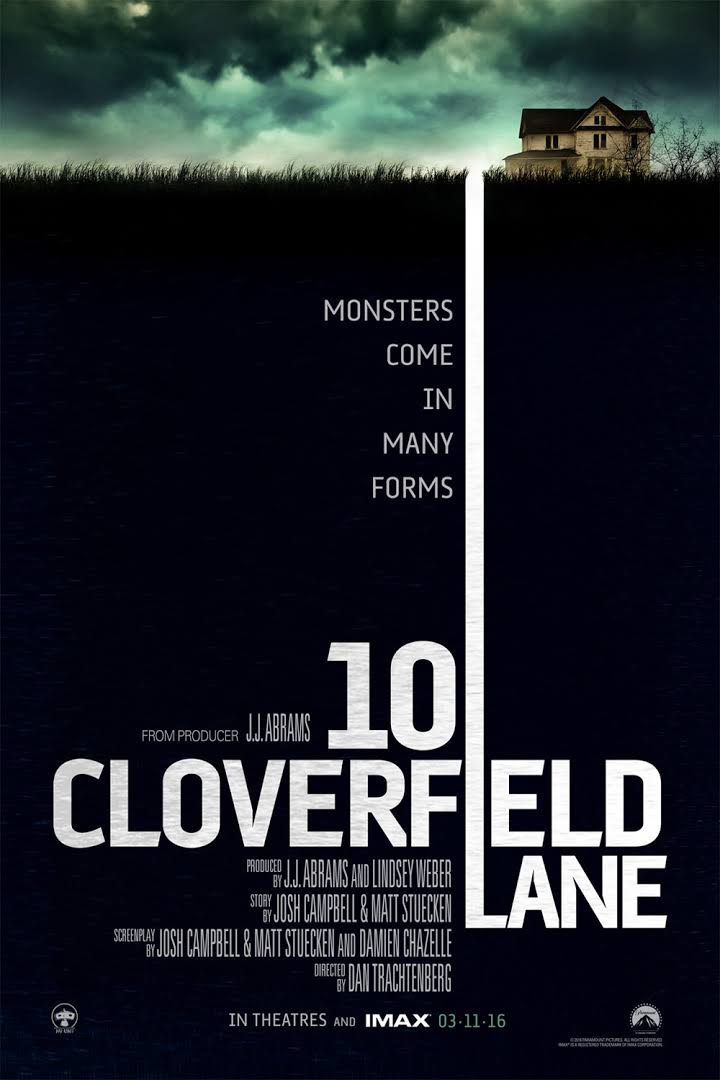
“10 Cloverfield Lane” movie review

10CloverfieldExtremely suspenseful and enigmatic! Within minutes of the beginning of the movie, you will be sucked into the twisted and claustrophobic subterranean world at 10 Cloverfield Lane. Not directly connected to Cloverfield (2008), this film quite possibly takes us to a moment concurrent to or just before/after the events in New York City caught on the handicam. Director Dan Trachtenberg and Producer J.J. Abrams work together to shock the audience with a movie that will keep you guessing right up until the end. Brilliantly cast and written, 10 Cloverfield Lane is an excellent old-school feeling horror film that you have got to experience in IMAX. Just when you think you have it figured out, you will immediately begin to second guess yourself. Probably the most brilliant part of the film is the fact that three principle characters can keep your interest and attention the entire time without ever a feeling of boredom or annoyance. From the writing to the cinematography and visual effects, this film is sure to keep you on the tip of your toes.

Following a car accident, Michelle (Mary Elizabeth Winstead) wakes up with an IV in her arm and chained to a wall [wait, is this Saw?]. With no cell reception and no recollection of what happened, she begins to fear the worst. Upon meeting her capture Howard (John Goodman), she fears for her life. Not buying his story about saving her and keeping her from the hard during the fallout from the attack, Michelle attempts to escape. Failing to overcome Howard, she slowly begins to accept the worst. To her surprise, she is not the only one in Howard’s fallout shelter. Michelle meets Emmett (John Gallagher Jr). Thinking that Emmett’s injuries are from escaping, she learn that his broken arm is from fighting to get INTO Howard’s shelter. With this new revelation, Michelle begins to settle into life with Howard and Emmett. Still, something just isn’t right. From car noises to sunshine, Michelle has doubts of the alleged apocalypse and must solve the mysteries, puzzles, and covertly plan her escape.

One of the most intriguing elements of the movie is personally feeling the claustrophobia that the principle cast is experiencing in the movie. That is thanks to the excellent cinematography, production design, and lighting. That additional experiential element is not terribly common in films, even horror cinema. But it was very instrumental in generating the feeling of suspense, anticipation, and intrigue during the movie. Much like Super 8 and in the vein of other J.J. Abrams’ Bad Robot productions, the movie begins with a fantastic and blood curdling accident. Just like a rollercoaster, once that car accident hits the screen, the movie will take you up and down thrilling hills on a track that you will struggle to see 10 feet ahead. It’s difficult to talk about how the movie keeps you guessing and second guessing yourself without giving away a lot of what makes the movie thrilling. So, you will just have to take my word for it. Like with any good horror/suspense movie, it is necessary to include strategic comedic relief or lighthearted moments. And writers Drew Goddard, Daniel Casey, Matthew Stuecken, and Josh Campbell weave together a brilliant combination of terror and humor to keep the movie alive and dynamic.

John Goodman is absolutely brilliant in the film. Not that he has anything to prove. He is one of those actors who, with the slightest tweak of the face or shift of the eyes, can have you laughing one second and terrified the next. His ability to turn his character’s emotion on a dime makes him equally weird/quirky and frightening all at the same time throughout the story. Is he a weird old man who, in his own awkward and bizarre way, is keeping Michelle and Emmett from hard or his is a sadistic serial killer who forms inappropriate intimate bonds with his “guests”? That is for you to discover in the movie. Both Mary Elizabeth Winstead and John Gallagher Jr were perfect choices for their respective roles as well. Winstead brings that independent spirit and look to the character of Michelle and Gallagher provides the audience with a country boy charm. The ability for an actor to capture the emotion of extreme terror and sell it as a legitimate, believable emotion is tough. Selling that acute and powerful emotion can make or break a horror film–if the director’s intent is to make the story as real as possible and not a parody or satire of itself.

You may be wondering how this film is even loosely connected to 2008’s Cloverfield. And that connection isn’t really made until the end of the third act of the movie. Unfortunately, I cannot go into too much detail without giving away the climactic and over-the-top ending, but I can say that it does a great job of being connected just enough that it can essentially stand on its own but when you think of how it is or could be connected to Cloverfield, then the movie becomes all the more intriguing. Interestingly, the manner in which this installment in the Cloverfield universe was directed and produced, it definitely could begin a franchise with movies that are never directly connected to the previous film or even Super 8, but are taking place at or near the same time, each with it’s own respective story.

It isn’t often that I watch movies that are best seen in IMAX, but this is definitely one that is best appreciated and experienced in IMAX; however, if you want to take the old-school feel of the movie to a who other level, then you may want to consider watching the movie at a local drive-in. However you choose to watch the film, you are going to definitely enjoy the adventure.

On Cinema and Theme Parks (part 3)

Continued from Part 2My Book

Some of the most impressive and revolutionary changes to the movie-based theme parks came to fruition in the 1970s and 1980s. This is the time that horror became the chief source of inspiration for attractions at Universal Studios Hollywood (Riley, 1998). The ride that ushered in the plethora of attractions based on some of the best horror movies of all time was Jaws. JawsThe Jaws Ride was opened as part of the studio tram tour in 1975, and was an immediate hit with the park guests. It was quickly followed by Kongfrontation and Earthquake: Ride it Out (Murdy, 2002). Just as audiences are fascinated by horror movies and seek to watch that which would be repulsive in real-life, they are equally interested in immersing themselves into the experience by way of a theme park attraction. This phenomenon is not limited to horror movies, because rides like Jurassic Park the Ride (Jurassic Park River Adventure in Florida), Revenge of the Mummy, and Pirates of the Caribbean beckon millions of guests a year (IAAPA, 2014). In addition to attractions based on the movies, movie studio executives and theme park engineers created attractions that embody what Carl Laemmle first envisioned, by taking the audience behind the magic of the movies. This is the case with the (now closed) Backlot Tour at Disney’s Hollywood Studios and Hitchcock: The Art of Making Movies at Universal Studios Florida (Murdy, 2002). The relationship between the cinema and theme parks is a strong one and creates an energetic synergy that entertains millions of people each year.

Not every movie-themed attraction is a smash hit with the guests, just like not every big-budget movie is a hit with movie patrons. Although well-intentioned by the producers of both, or even the media conglomerate that has major investments in or owns both, may desire and believe they did what it took to create the next blockbuster ride or movie, sometimes the guests fail to view the movie or attraction with the same lens the designers and backers used to create the film or ride. In terms of movie or intellectual property-based attractions, major theme parks can make mistakes or lose out because of the ownership of some parks changing from one conglomerate to another.

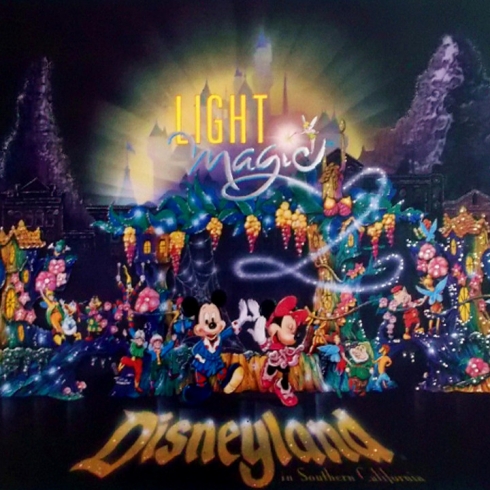
LightMagicNot every flubbed theme park attraction is a “ride;” sometimes it is a show or parade. The failure of a show/parade can be seen in the four month—yes, four—run of Disneyland’s Light Magic “street-tacular” (Krosnick, 2014).  More than another light parade, Light Magic condensed the number of parade floats ordinarily expected in a Disney parade to four large stages that, along the parade route, would burst into light, pyrotechnics, and digital projections. It was complete with a pantheon of Disney characters and music. Unfortunately, if you chose to stand in the wrong spot, all you get is darkness and vaguely familiar shapes of characters. Following a very poor reception by Disneyland passholders, the negative word of mouth was so severe that it effectively caused the closure of the new entertainment offering that sent $20MIL down the drain.

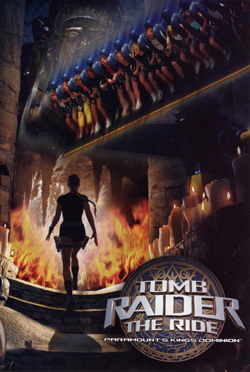
TombRaiderRideAccording to Theme Park Tourist (2014), popular seasonally operating Paramount’s Kings Island (purchased by Cedar Fair in 2007 and all Paramount property removed) spent $20MIL on a ride that lasted a mere five years. Based on the hit video game and blockbuster action movie Tomb Raider: The Ride was on par with Disney and Universal in respect to story, setting, and special audio/visual effects; however, after Paramount sold off its theme park investments to Cedar Fair, the ride got rebranded as The Crypt, a generic theme, and all direct associations with the movie and game Tomb Raider were removed following the 2007 operating year.  Interestingly, the ride attendance continually dropped following the rebranding, and the ride was eventually moved to Kings Dominion in Virginia in 2012. Although there may be other reasons as to why the ride became less popular and eventually moved to another park, it is conceivable to conclude that there is a special relationship between attractions and movies in a theme park. (Krosnick, 2014).

Continue to Part 4

Click here for Part 1

Click here for Part 2

On Cinema and Theme Parks (part 2)

My Book

(Continued from Part 1)

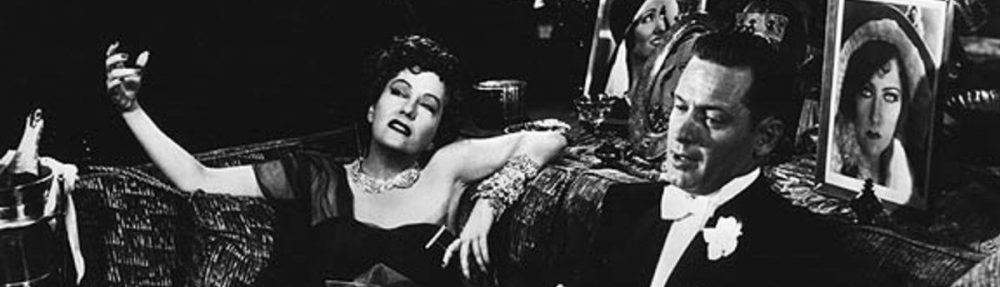
Understanding the synergy or convergence that exists between the cinema and theme parks requires looking to the history of the relationship between the two entertainment giants. Before Disney’s Hollywood Studios (formerly Disney-MGM Studios), Universal Studios Florida, and more than 40 years before Disneyland was opened, the founder of Universal Studios (studio) German immigrant Carl Laemmle, opened his 250-acre-movie-making ranch, just north of Los Angeles, to the public for a mere $0.25 (Murdy, 2002). More than side income for the trailblazing studio, most well-known for its pioneering of the horror film, the original studio tour began on the outdoor backlot in March 1915. Laemmle desired to immerse the “people out there in the dark,” as famously referred to by Norma Desmond in the timeless classic Sunset Boulevard, into the magic behind the screen (Sunset Blvd, 1950).

Interestingly, according to famed psychiatrist Sigmund Freud, horror is often concerned with revealing “other” scenes to the audience (Freud, 1919). And, keeping with this theoretical approach to horror cinema, Laemmle opened this “other” scene to the guests of Universal Studios Hollywood.  But more than horror, Laemmle also brought the studio guests face-to-face with western action/drama (Murdy, 2002). From early in the 20th century, the concept of cinema and theme park convergence was born. The happy marriage, however, was not to last very long. Upon the introduction of cinema sound, Laemmle was forced to close the studio “park” to the not-so-quiet guests in order to facilitate appropriate recording sound for the motion pictures (Murdy, 2002). The Universal Studios tour would remain closed to the general public for over 30 years. But, in 1961, the studio would once again open its gates to a new generation of movie lovers (Murdy, 2002). Between 1961 and 1964, Universal outsourced the famed tram tour to the Gray Line bus company.  Following a feasibility study, conducted by researcher Buzz Price, the same man who helped determine the locations for Disneyland and Walt Disney World, Universal decided to start its own tram tour of its facilities, and Universal Studios Hollywood opened in July 1964 (Murdy, 2002).

Following the ending of the Studio System, the now bankrupt motion picture studios had been purchased by various conglomerates looking for new sources of income (Riley, 1998). One of the sources of income that studios began investing into was the concept of movie-based theme parks. With the opening of Walter Elias Disney’s Disneyland in 1955, Universal Studios made the decision to incorporate stand-alone attractions into its newly reopened studio tour (Davis, 1996). Both Disneyland and the future Universal Studios used their intellectual property (IP) as the basis for creating theme park rides, shows, and attractions. Although movie studios as a “park” began with Laemmle, in its current incarnation, the convergence of cinema and theme park began with Disneyland, and later was perfected by Walt Disney World and Universal Studios Florida. Since the movie studios already had dedicated movie-going audiences, it made sense to capitalize on the idea of incorporating the concepts from the movies into attractions that the general public could enjoy and be immersed in (Davis, 1996). This action both acts as advertising for the respective studios and generates income for the movies and park improvements.

In today’s entertainment marketplace, media conglomerates are restructuring themselves to be as large a player in entertainment and media as possible with the ability to integrate various products and services into multiple areas of exhibition (Taubman, 1970).  This is easily witnessed in how the Walt Disney Company, Sony, and Comcast companies are setup. Walt Disney Company has significant investments in: motion pictures (i.e. Disney, Buena Vista, Touchstone), theme parks, TV (i.e. ABC, Disney Channel), leisure/tourism, radio, video games, stores, and record labels). Sony has investments in consumer/commercial electronics, computers, video game systems, motion pictures (i.e. Sony, Columbia, Tristar), television (CBS), record label, recording studios, radio, and stores. And, much in the same way, Comcast has investments in motion pictures (i.e. Universal Pictures, DreamWorks-SKG), theme parks, resorts, television (i.e. NBC, Golf, SyFy), video games, radio, record labels, and recording studios.

Whereas the fall of the original studio system set the precedent for media companies not to own or operate all the elements of media creation from conception to employment to production to the distribution, also known as vertical integration, companies are now embracing the idea of horizontal integration. Horizontal integration allows a media company to push or market its products or services through various media channels. And, this is a perfect example of why media conglomerates own and operate theme parks. This is a common practice by Disney and Universal in their respective parks and resorts. Disney can release a movie, base an attraction off that movie, use that movie as the basis for a video game, and even include costume characters in the parks and on the cruise ships. In the same vein, Universal can take one of its movie properties and integrate the characters and story into a theme park experience, use the concept for a video game, and maybe even develop a TV series as a spinoff of the movie. This type of integration allows the companies to effectively customize glorified marketing campaigns for their brand. Having a given branding on various commercial outlets allows a company to maximize its exposure to general audiences/customers (Taubman, 1970). As companies acquire more intellectual properties, media outlets, and commercial infrastructure, they are able to actively change entertainment offerings over the years; and this is definitely the case with the theme parks owned by media conglomerates that also have movie studio interests.

Continue to Part 3

“The Boy” movie review

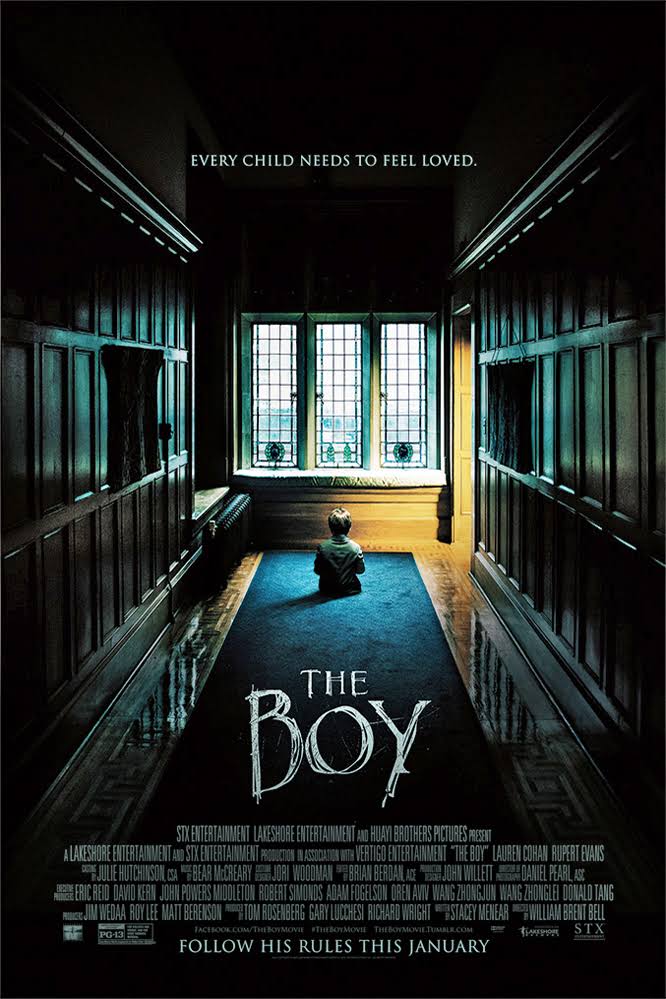
TheBoyBoy, was that scary! Quite possibly among the scariest movies in recent years; that is until The Boy drops the ball in the last few minutes of the movie. Within the first few minutes of the film, there is already an overwhelming sense of dread and an anticipation of what horror lies in store for our protagonist. This is one of the films where the plot was nearly perfect and even scarily close to real horrific circumstances. Quite interestingly and uncharacteristic of this sub genre of horror, the previews do not give away all the scares nor do they lend to revealing the shocking turning point during the climax of the story. In many ways, the plot is a tribute to a more classic way of building a horror movie and I can appreciate the effort to channel the Master of Suspense.

The Boy is about an American nanny who takes a unique position with an old-money family in the British countryside to look after the couple’s son while they are on a long awaited holiday. Upon meeting the child, Greta (Lauren Cohan) is perplexed as to why mom and dad are treating a porcelain doll as if he was their son. According to the parents, the doll IS their son and Greta must follow a strict set of instructions in order to satisfy the needs of Brahms (the boy). Worried she will be alone in this mansion with only the doll for company, Greta meets the attractive local grocery delivery man Malcolm (Rupert Evans) who informs Greta of the history of Brahms and his parents. Thinking that Brahms is merely a doll with obsessed parents, it isn’t long before Greta begins to feel that something is quite wrong after hearing voices and the doll mysteriously moving from place to place. Join Greta and Malcolm as they come too close to a long-kept secret with a devastating history.

Despite being a January horror movie, The Boy had my attention and respect for a job well done until the end. Often horror movies may not provide us with the ending that we anticipated or were prepared for, but this film really took a turn for the worse when it played out in the manner in which it did. What I find remarkable about this modern old-school tale is the instant feeling of dread or fear of the unknown from the very beginning. From the dialog to the characters, each element of the story helps to continue to reinforce the ominous presence that Greta feels in the house. Unfortunately, there are just way too many unexplained, underdeveloped, and unanswered questions by the end of the movie to give the film the credit that it would have received otherwise. It is possible that the studio is setting up the audience for a prequel or a sequel, but usually these January movies do not see future installments.

I really enjoyed the old-school pacing and feel of the movie, and if you also enjoy truly macabre suspense movies, then you will enjoy it for the most part (until the disappointing end). There was also a Hitchcockian air about the film; although Hitch would have directed a much better (or simply bizarre) ending and provided us with far fewer unexplained plot points. The film is definitely one that is very much enjoyed in a group setting, as is the case for horror in general. So, if you don’t have anything else planned to see this weekend, grab a few friends and head out to see what The Boy has in store for you.