The “Attraction” of Horror: a ‘Psycho’analysis (part 2 of 2)

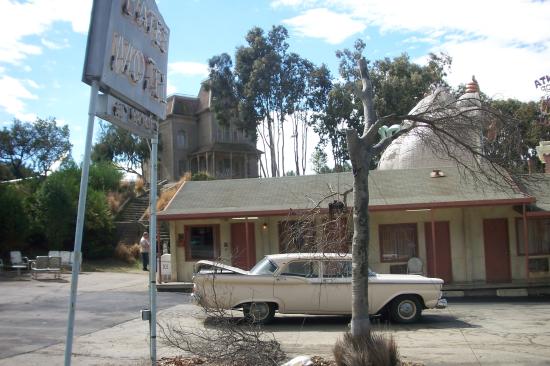
UnivHollywood_BatesMotelSuccessful movie-themed attractions (stage shows or rides) create an atmosphere that is often built upon a foundation consisting of confrontation and direct simulation rather than long, sustained narratives (King, 2000). This is true of the horror film as well. Horror is a genre nearly as old as cinema itself. The horror film, according to Linda Williams, contains three basic elements: narrative, character, and setting. These same elements can be found in movie-themed attractions at theme parks (2000).

Regarding Psycho in particular, the setting consists of very liminal* spaces such as the opening hotel, the Bates house, and bathroom. This same idea can be applied to a theme park attraction because the park guests are often corralled into smaller, intimate places that serve to advance the next element. Narrative is the foundation that both themed attractions and movies are built upon. The narrative, or diegesis, is the story. Diegetically, horror films contain a story that is segmented into the following sequence: order–>disorder–>order. Increasingly, the modern horror film is often left in disorder, or an order that is dissimilar from the original (2000). Movie-themed attractions usually introduce the park guests to a short-form story based on the original, and the ride is the vehicle that takes the guests through the story that can consist of threats and chases, followed by triumphs. In regards to the character element, the characters are those who are the instruments through which the plot is advanced. Normally, characters are people or animals, but can also be inanimate objects of significance (Williams, 2000). The park guests usually encounter characters from the source material along the journey of the ride.
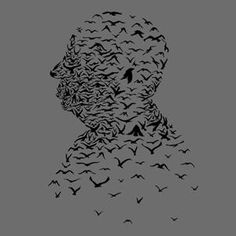
HitchcockBirds“Alfred Hitchcock: the Art of Making Movies” (Universal Studios Florida) was divided up into four distinct parts, with the famous shower scene being the central focus (ThePsychoMovies.com, 2014). Just like a horror movie is divided up into parts, or has a cinematic structure, so too did the Hitchcock attraction. Hitchcock: The Art of Making Movies was divided up into the following areas: preshow, 3D theatre, Psycho stage, and interactive area. There are may parallels between the famous shower scene and the live attraction. In the movie, the sequence leading up to the shower scene is very much a preshow in the same way the attraction contains a preshow area. The preshow in the movie is when Norman is gazing through the peephole into the room of Marion as she undresses. Just like Norman is visually gathering information about Marion, the park guests in the preshow area gather information about Hitchcock’s career. The preshow is the area that preps the audience for what they are too experience. By using the same principles of creating suspense that Hitchcock used, the preshow area reveals just enough to elicit feelings of anticipation and anxiousness.

Next, the park guests sit through clips of 3D versions of Dial M for Murder and The Birds. This preps the mind for experiencing the horror in the next room. Likewise, between the time Norman looked upon Marion through the peephole and puts on the wig and dress, he sits in the kitchen and presumably debates with mother on what to do. Following that scene, we return to the bathroom and enter the shower with Marion. After the 3D movie, the park guests enter the Hitchcock Stage and look upon recreations of the motel, shower, and house.
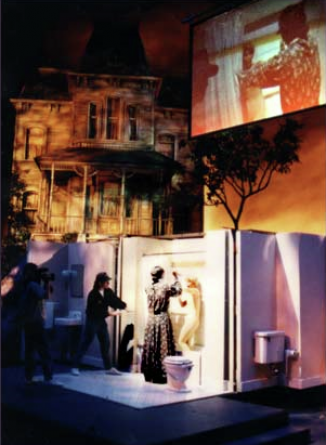
The main show at the attraction is the Hitchcock Stage where the infamous shower scene is reenacted before a live audience. In addition to the Bates House and Motel, there is a recreation of the tub/shower used by Hitchcock to film the scene. At this point in the movie, Marion is thoroughly enjoying her shower, and the audience gets both objective and subjective camera shots from inside and outside the shower. All of a sudden a shadowy figure approaches the opaque shower curtain and throws it open, wielding a knife. The sinister figure stabs Marion repeatedly and through more than fifty cuts (editing cuts), the scene is played before the people in the dark. Likewise, this same scene is brought to life for the studio audience at Hitchcock: The Art of Making Movies. Through mechanical engineering and film production techniques, the cast of the show reveals how the master of suspense filmed this iconic scene.
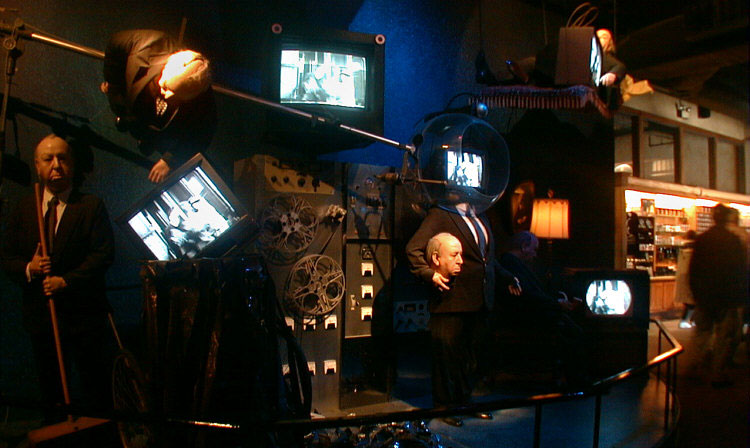
HitchcockAttractionFinalRoomFollowing the show on the Hitchcock Stage, the park guests walk into a museum-like interactive room revealing many of Hitchcock’s secrets and techniques in some of his most notable films. It parallels the end of Psycho when the psychiatrist is analyzing Norman and explaining how and why he did what he did. Just like Norman is the master of slasher films, so is Hitchcock the master of the art of suspense and horror cinema. A close reading of these areas reveals that they each take an element of the setting, narrative, or characters and use the tool of spectacle to bring them to life for the live audience. The preshow area acts as the prime for the horror/suspense pump that is gearing up. Watching the 3D scenes from The Birds and Dial M for Murder serves to generate feelings of ensuing chaos and acts as the big event that causes something to go wrong in the otherwise narrative that is in order (remember: orderdisorderorder). Following the 3D Theatre, is the central Psycho stage that takes any order and casts it to the wind and enables the horror of the shower scene to come to life for the naked eyes of the audience.
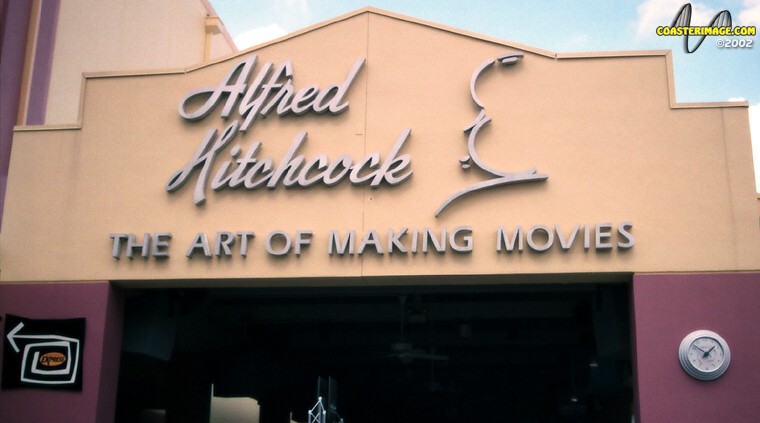
Hitchcock AttractionThis was a main attraction at the theme park until its dismantlement in 2002 to make way for the Shrek: 4D experience. From the aforementioned explanation by one of the producers of the attraction, the audience was completely immersed in the magic of bringing a Hitchcock thriller to life, and got to witness the most famous single scene in all of cinema history. This was all done with practical effects, just as Hitchcock would have done it. But, with the advent of computer generated imagery and incredibly accurate and time efficient non-linear video editing, most of the effects can be generated in other ways. Although it remained one of the most popular attractions at the theme park until its closure, Universal saw the future of attractions and decided to do away with nostalgia and pave the way for digital simulated attractions (Singer, 2013).

Click HERE for Part 1

*(adjective) 1. of or relating to a transitional or initial stage of a process; 2. occupying a position at, or on both sides of, a boundary or threshold
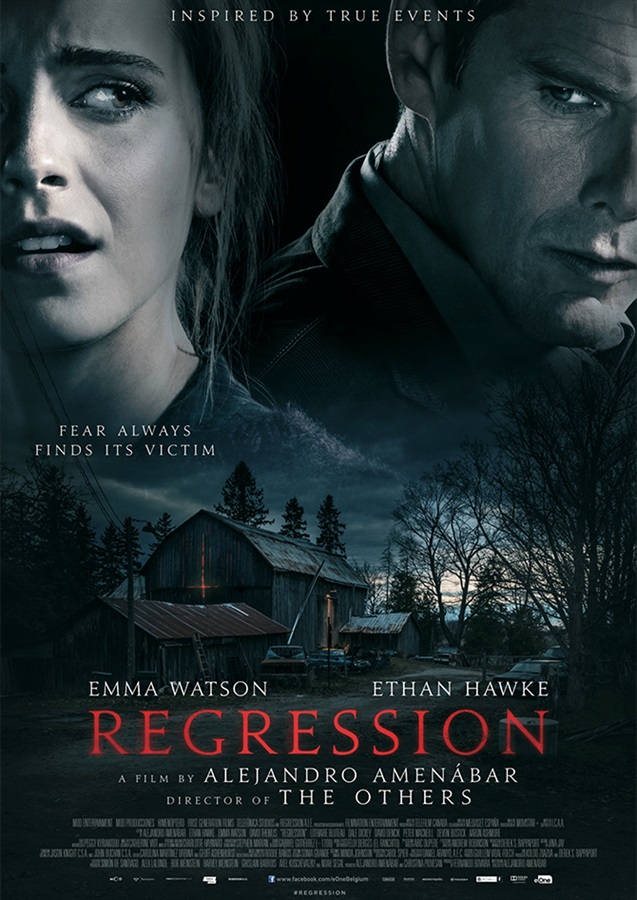
“Regression” movie review

RegressionIntimately disturbing and suspenseful. Emma Watson and Ethan Hawke star in a film that is one part crime drama and one part supernatural thriller. Inspired by actual cases and claims of growing Satanic cults in the Midwestern part of the country in the late 80s and early 90s, Regression follows one detective’s journey through science, superstition, and organized religion to discover the truth of what happened to a seventeen year old young lady named Angela (Emma Watson) who claimed her father molested her. Opening with the interrogation of her father, Detective Bruce Kenner (Ethan Hawke) is confronted with the conundrum of a suspect who does not deny the vomit-inducing allegations, but is greatly struggling to remember what happened. Cool color temperatures, dreary weather, effective acting, and a creepy small town all come together to make creepy psychological thriller of good versus evil.

Occurring at a time that reports of Satanic cults with blood curdling rituals began to hit a high, Regression brings you face to face with now-discredited psychological therapy practices, blood sacrifice, and sexual deviance. Follow detective Bruce Kenner as he attempts to put the puzzle of what actually happened to Angela together in order to solve this perplexing mystery. First approaching this as a disturbing but typical minor molestetion case, Kenner quickly learns that there is much more to this case than meets the eye. As evidence is uncovered and truths are made known, this investigation goes much deeper and crosses public safety and family boundaries.

This is one of those plots that is difficult to analyze without giving away key parts of the mystery. If you enjoy watching films that contain prolific symbolism and question institutions that exist for physical and spiritual protection, then you will undoubtedly find this film, from the Weinstein Company that flew under the radar, intriguing. Although it is definitely a slow burn, it never moves too slowly and does provide enough of a hook to keep you going. Be sure to pay close attention to every line of dialogue because (hind sight being 20/20 and knowing the ending) there are definitely clues dropped here and there that all point to the answers for which Kenner is looking.

The investigation at the core of the plot is three fold: spiritual, scientific, and legal. Bruce Kenner partners with both a local psychology professor and a reverend to uncover what happened to Angela. As one might expect in a movie such as this, the professor and reverend have vastly different approaches to this mystery. For psychology students or professionals watching this film, you will witness the practice of regression as it plays a significant part in the investigation. The aforementioned practice also raises awareness to invasive psychological therapy techniques. As this film technically falls within the horror genre, it is definitely not short on social commentary. With physical evidence in short supply and a suspect who cannot remember what happened, Kenner relies upon the psychological evidence gather by the professor. Little do our investigators know that these aggressive interview techniques play more into the mystery than they could have known.

Ugh. There is so much more about be plot I’d love to analyze but that would take the fun out of watching it and ruin the mystery for you. So switching gears. From a technical perspective, the film is not remarkable in any way. Neither is it lacking in cinematography or direction. However, movies in this sub genre of horror can so often feel and look like a Lifetime original movie, especially because it includes a significant female character who claims to have been molested. Thankfully, director Alejandro Amenabar (The Others) provides audiences with a “Lifetime” plot that is still cinematic enough to avoid the stigma of “another Liferime movie in theatres.” Emma Watson and Ethan Hawke display excellent acting prowess along with a few of the other key players in this narrative. For the most part, the acting is on par with this crime drama. All the filmmaking elements come together nicely to keep your attention for the hour and a half runtime.

If you enjoy mysteries that confront science and religion, then you will definitely enjoy this film. Right now, it is one of the movies included with your Amazon Prime subscription. Rated R for some visual sexual content, it is pretty tame as far as rated R movies go. There is a gritty and real feel to the movie that might be a little too terrifying for some viewers. However, this IS a psychological thriller that contains many of the earmarks of a good horror film.

“Rebirth” web series review

RebirthGritty and visceral. NonHuman Films’ Rebirth is a new web series that will beg for your attention. Pulling out all the cliche stops, and whatever else comes with AfterEffects templates, the prologue and episode I attempt to draw you in; and they are quite successful. The problem is that it is such a train wreck that you cannot look away. Complete with a highly ambiguous plot, choppy editing, and color temps and audio all over the spectrum, Rebirth needs to die and try to come back again another day. Adapted from the original series JacobRebirth is inspired by CreepyPasta and other urban myths. Mostly shot in the POV style, the majority of the cinematography is stylistic. However, not every style needs to leave the think tank at the fashion studio. YouTube and Vimeo present fantastic opportunities for aspiring professional visual storytellers to get films in front of people without having to rely on a distribution company; but because of this wide open door, there is a lot more mediocre content to sort through while searching for that movie with which to fill your weekday evening.

Structurally, the video suffers greatly. A traditional web series should be divided up into short segments that all tie together in an over-arching story. It should not come across as a short film that has been divided up simply by cutting the segments out of the main timeline. Unfortunately, the Prologue and Episode I come across as the latter. It is important for each web series video to follow the three-act structure while the whole series also follows the same. The dialog lacks development much in the same way the characters do. As videos (or film) are a visual medium, it is important for writers to “show, don’t tell;” and the perpetual narration serves as a distraction and occasionally comes across as redundant. For a sloppily produced web series, I’ll give it this: the editing stye is creative. I’m not claiming that it’s edited well by any means; but I can definitely infer the direction the editor was going. It’s sloppy and crude, but there is definitely potential there for horror film editing.

It is not unusual for a series to have a weak opening, although it is perhaps the episode that is the most important to hook the audience, as many will not progress past the first episode. That was certainly the case for me when I watched the then-anticipated Scream Queens on Fox. After the first episode was so painful to watch, I never gave it a second chance. Since web series don’t have near the money or publicity behind them, they more often than not have a difficult time hooking an audience. So, when I was invited as a member of the blogosphere to an early screening of Episode I part II, I went in with an open mind because perhaps it was walking out of the starting gate instead of sprinting. Unfortunately, I am left wondering what happened even after watching it twice. Due to the POV style of shooting and the disorienting music, I had great difficulty in following the story. However, it is certainly macabre and creepy. In many ways, it kind of reminds me of the previews for the Green Room horror movie featuring the accomplished Patrick Stewart, of all people. I cannot help but conclude that NonHuman Films does, albeit a moderately long shot, have a future in horror filmmaking. Just because a series is crudely produced, doesn’t mean that it is devoid of potential. I see the potential, but the company needs to spend more time developing the narrative and polishing the post-production elements.

Perhaps this cult series will find an audience, as so many online video do; but, it will not likely become material picked up by YouTube Red or other outlets for professional online distribution–not in its present form. This is one of those series that clearly has some budding talent behind it; but the leadership of the film series needs to regroup and identify methods to correct the presentation and storytelling.

“10 Cloverfield Lane” movie review

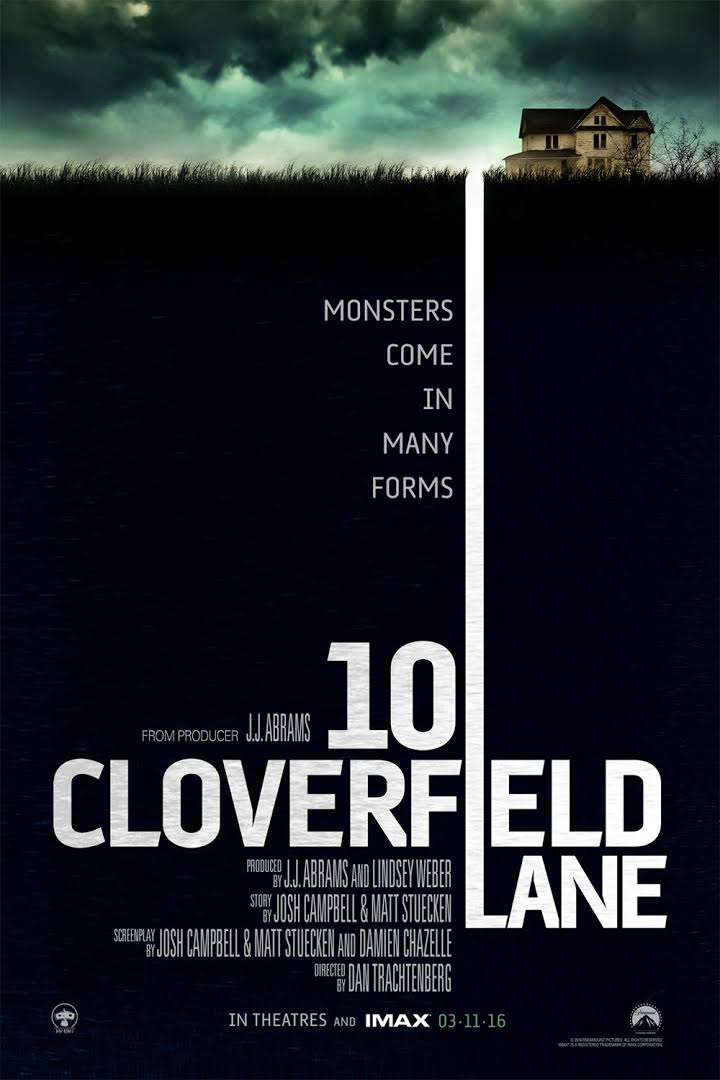
10CloverfieldExtremely suspenseful and enigmatic! Within minutes of the beginning of the movie, you will be sucked into the twisted and claustrophobic subterranean world at 10 Cloverfield Lane. Not directly connected to Cloverfield (2008), this film quite possibly takes us to a moment concurrent to or just before/after the events in New York City caught on the handicam. Director Dan Trachtenberg and Producer J.J. Abrams work together to shock the audience with a movie that will keep you guessing right up until the end. Brilliantly cast and written, 10 Cloverfield Lane is an excellent old-school feeling horror film that you have got to experience in IMAX. Just when you think you have it figured out, you will immediately begin to second guess yourself. Probably the most brilliant part of the film is the fact that three principle characters can keep your interest and attention the entire time without ever a feeling of boredom or annoyance. From the writing to the cinematography and visual effects, this film is sure to keep you on the tip of your toes.

Following a car accident, Michelle (Mary Elizabeth Winstead) wakes up with an IV in her arm and chained to a wall [wait, is this Saw?]. With no cell reception and no recollection of what happened, she begins to fear the worst. Upon meeting her capture Howard (John Goodman), she fears for her life. Not buying his story about saving her and keeping her from the hard during the fallout from the attack, Michelle attempts to escape. Failing to overcome Howard, she slowly begins to accept the worst. To her surprise, she is not the only one in Howard’s fallout shelter. Michelle meets Emmett (John Gallagher Jr). Thinking that Emmett’s injuries are from escaping, she learn that his broken arm is from fighting to get INTO Howard’s shelter. With this new revelation, Michelle begins to settle into life with Howard and Emmett. Still, something just isn’t right. From car noises to sunshine, Michelle has doubts of the alleged apocalypse and must solve the mysteries, puzzles, and covertly plan her escape.

One of the most intriguing elements of the movie is personally feeling the claustrophobia that the principle cast is experiencing in the movie. That is thanks to the excellent cinematography, production design, and lighting. That additional experiential element is not terribly common in films, even horror cinema. But it was very instrumental in generating the feeling of suspense, anticipation, and intrigue during the movie. Much like Super 8 and in the vein of other J.J. Abrams’ Bad Robot productions, the movie begins with a fantastic and blood curdling accident. Just like a rollercoaster, once that car accident hits the screen, the movie will take you up and down thrilling hills on a track that you will struggle to see 10 feet ahead. It’s difficult to talk about how the movie keeps you guessing and second guessing yourself without giving away a lot of what makes the movie thrilling. So, you will just have to take my word for it. Like with any good horror/suspense movie, it is necessary to include strategic comedic relief or lighthearted moments. And writers Drew Goddard, Daniel Casey, Matthew Stuecken, and Josh Campbell weave together a brilliant combination of terror and humor to keep the movie alive and dynamic.

John Goodman is absolutely brilliant in the film. Not that he has anything to prove. He is one of those actors who, with the slightest tweak of the face or shift of the eyes, can have you laughing one second and terrified the next. His ability to turn his character’s emotion on a dime makes him equally weird/quirky and frightening all at the same time throughout the story. Is he a weird old man who, in his own awkward and bizarre way, is keeping Michelle and Emmett from hard or his is a sadistic serial killer who forms inappropriate intimate bonds with his “guests”? That is for you to discover in the movie. Both Mary Elizabeth Winstead and John Gallagher Jr were perfect choices for their respective roles as well. Winstead brings that independent spirit and look to the character of Michelle and Gallagher provides the audience with a country boy charm. The ability for an actor to capture the emotion of extreme terror and sell it as a legitimate, believable emotion is tough. Selling that acute and powerful emotion can make or break a horror film–if the director’s intent is to make the story as real as possible and not a parody or satire of itself.

You may be wondering how this film is even loosely connected to 2008’s Cloverfield. And that connection isn’t really made until the end of the third act of the movie. Unfortunately, I cannot go into too much detail without giving away the climactic and over-the-top ending, but I can say that it does a great job of being connected just enough that it can essentially stand on its own but when you think of how it is or could be connected to Cloverfield, then the movie becomes all the more intriguing. Interestingly, the manner in which this installment in the Cloverfield universe was directed and produced, it definitely could begin a franchise with movies that are never directly connected to the previous film or even Super 8, but are taking place at or near the same time, each with it’s own respective story.

It isn’t often that I watch movies that are best seen in IMAX, but this is definitely one that is best appreciated and experienced in IMAX; however, if you want to take the old-school feel of the movie to a who other level, then you may want to consider watching the movie at a local drive-in. However you choose to watch the film, you are going to definitely enjoy the adventure.

On Cinema and Theme Parks (part 3)

Continued from Part 2My Book

Some of the most impressive and revolutionary changes to the movie-based theme parks came to fruition in the 1970s and 1980s. This is the time that horror became the chief source of inspiration for attractions at Universal Studios Hollywood (Riley, 1998). The ride that ushered in the plethora of attractions based on some of the best horror movies of all time was Jaws. JawsThe Jaws Ride was opened as part of the studio tram tour in 1975, and was an immediate hit with the park guests. It was quickly followed by Kongfrontation and Earthquake: Ride it Out (Murdy, 2002). Just as audiences are fascinated by horror movies and seek to watch that which would be repulsive in real-life, they are equally interested in immersing themselves into the experience by way of a theme park attraction. This phenomenon is not limited to horror movies, because rides like Jurassic Park the Ride (Jurassic Park River Adventure in Florida), Revenge of the Mummy, and Pirates of the Caribbean beckon millions of guests a year (IAAPA, 2014). In addition to attractions based on the movies, movie studio executives and theme park engineers created attractions that embody what Carl Laemmle first envisioned, by taking the audience behind the magic of the movies. This is the case with the (now closed) Backlot Tour at Disney’s Hollywood Studios and Hitchcock: The Art of Making Movies at Universal Studios Florida (Murdy, 2002). The relationship between the cinema and theme parks is a strong one and creates an energetic synergy that entertains millions of people each year.

Not every movie-themed attraction is a smash hit with the guests, just like not every big-budget movie is a hit with movie patrons. Although well-intentioned by the producers of both, or even the media conglomerate that has major investments in or owns both, may desire and believe they did what it took to create the next blockbuster ride or movie, sometimes the guests fail to view the movie or attraction with the same lens the designers and backers used to create the film or ride. In terms of movie or intellectual property-based attractions, major theme parks can make mistakes or lose out because of the ownership of some parks changing from one conglomerate to another.

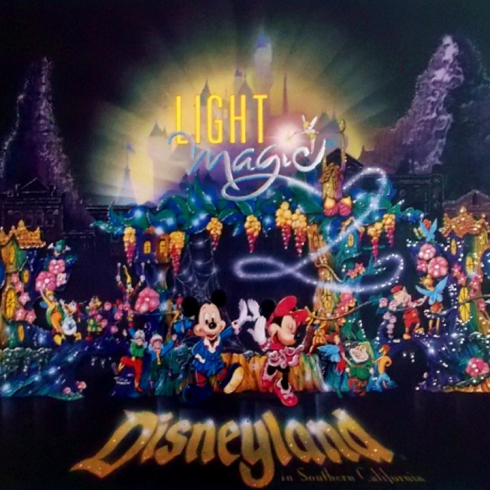
LightMagicNot every flubbed theme park attraction is a “ride;” sometimes it is a show or parade. The failure of a show/parade can be seen in the four month—yes, four—run of Disneyland’s Light Magic “street-tacular” (Krosnick, 2014).  More than another light parade, Light Magic condensed the number of parade floats ordinarily expected in a Disney parade to four large stages that, along the parade route, would burst into light, pyrotechnics, and digital projections. It was complete with a pantheon of Disney characters and music. Unfortunately, if you chose to stand in the wrong spot, all you get is darkness and vaguely familiar shapes of characters. Following a very poor reception by Disneyland passholders, the negative word of mouth was so severe that it effectively caused the closure of the new entertainment offering that sent $20MIL down the drain.

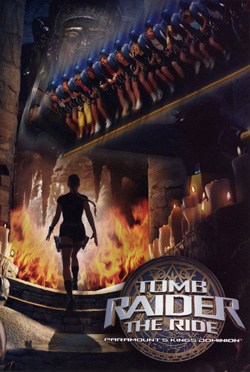
TombRaiderRideAccording to Theme Park Tourist (2014), popular seasonally operating Paramount’s Kings Island (purchased by Cedar Fair in 2007 and all Paramount property removed) spent $20MIL on a ride that lasted a mere five years. Based on the hit video game and blockbuster action movie Tomb Raider: The Ride was on par with Disney and Universal in respect to story, setting, and special audio/visual effects; however, after Paramount sold off its theme park investments to Cedar Fair, the ride got rebranded as The Crypt, a generic theme, and all direct associations with the movie and game Tomb Raider were removed following the 2007 operating year.  Interestingly, the ride attendance continually dropped following the rebranding, and the ride was eventually moved to Kings Dominion in Virginia in 2012. Although there may be other reasons as to why the ride became less popular and eventually moved to another park, it is conceivable to conclude that there is a special relationship between attractions and movies in a theme park. (Krosnick, 2014).

Continue to Part 4

Click here for Part 1

Click here for Part 2