HOW TO MAKE A KILLING movie review

A darkly comedic commentary on when ambition becomes obsession and obsession begins to rationalize itself as virtue.
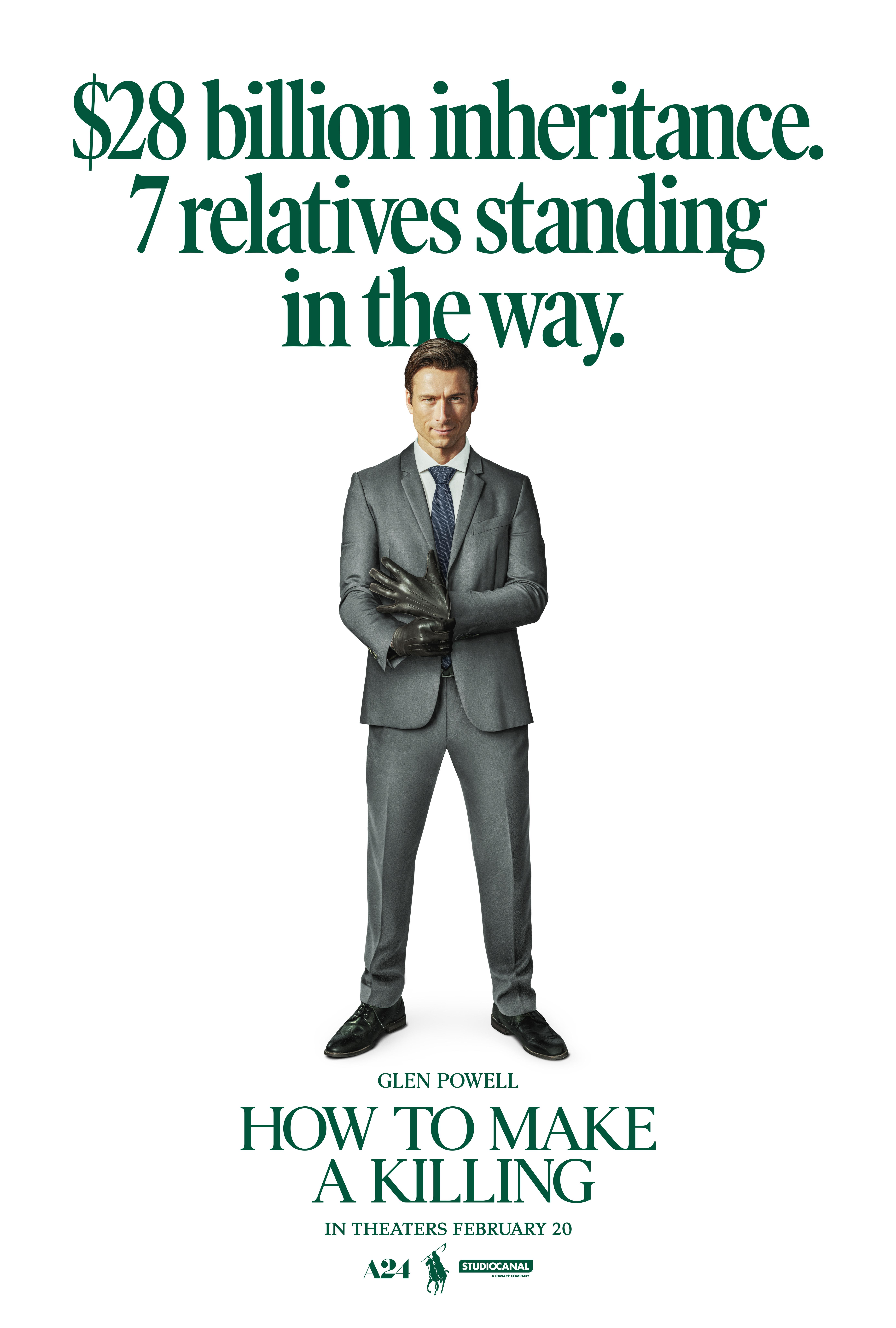
There is a fine line between genius and insanity—and How to Make a Killing lives in that narrow corridor where ambition becomes obsession and obsession begins to rationalize itself as virtue. Writer-director John Patton Ford delivers a smart, sophisticated dark comedy that feels as if it has the soul of a 1940s/50s film noir but expresses itself through more contemporary cinematic means. From the moment the movie opens, you are invested in the fascinating confession of the central character of Becket.

Disowned at birth by his wealthy family, Becket Redfellow (Glen Powell) will stop at nothing to reclaim his inheritance, no matter how many relatives stand in his way.

At its heart, the film reminds us that obsession rarely announces itself as corruption. It presents as vision. As discipline. As genius. Only later do we recognize the erosion of ethics beneath it. Read superficially, the film is a crime drama about financial manipulation and moral compromise. Read more carefully, it is a character study about how the love of money—so often misquoted, so rarely understood—can metastasize into something corrosive. “The love of money is the root of all kinds of evil” is not a condemnation of wealth itself, but of fixation. It is obsession, not currency, that corrupts. And this film understands that distinction with unsettling clarity.

Based upon an early 1900s novel, Ford’s film aligns with and falls within the vein of The Big Short in subject matter but not in spirit. Both explore financial ambition as a moral gamble, but where McKay’s film is kinetic and self-aware—almost gleefully explanatory—How to Make a Killing plays like a contemporary noir stripped of voiceover and venetian blinds. It shares The Big Short’s suspicion of capitalism’s ethical elasticity, yet rejects its comedic distance. Instead, it sinks into fatalism. If McKay’s film feels journalistic—an exposé delivered with sardonic flair—this one feels like a cautionary tale whispered from a holding cell. The satire is muted. The consequences are personal. The system may be flawed, but the focus here is the individual who chooses to exploit it. Tonally, the film feels spiritually aligned with 1940s and 50s film noir. One could easily imagine this plot transposed to postwar America—smoke-filled offices, whispered deals, fatalistic narration. Though not shot as neo-noir, its moral architecture is noir to the core: ambition curdling into self-destruction, intelligence weaponized against itself, inevitability closing in with quiet precision.

Becket is not written as a villain–which is to say that he isn’t written as a classical villain from the outset. But that is the point. He is written as intelligent, disciplined, and—crucially—persuasive to himself. Each unethical decision is internally justified. Each moral line crossed is reframed as strategic necessity. The film traces how obsession reorders one’s moral hierarchy: legality becomes negotiable, relationships transactional, consequences theoretical. It is not greed in caricature form—it is incremental self-deception. Ignoring one’s conscious repeatedly will eventually mitigate the decibel to little more than a whisper before being muted altogether. However, what keeps him from turning completely from sympathetic victim to full-bodied sociopath is that Becket’s conscious does persuade him that there is a line that even he won’t cross.

We, the audience, find ourselves in an uncomfortable position. We root for Becket because we recognize his drive. We admire his focus. We even understand his resentment. Yet we simultaneously want him to stop—to walk away before the inevitable collapse. The film’s framing device, opening where his journey will likely end, casts the entire narrative under the shadow of consequence. It is not a question of whether the fall will come, but how long denial can postpone it and we are held in suspense as to what is going to eventually bring about his downfall. What distinguishes How to Make a Killing from lesser character studies is its restraint. The writer-director demonstrates equal competence in both disciplines—an increasingly rare balance. Nothing feels indulgent. Nothing feels didactic. The film never moralizes overtly; it trusts the narrative arc to indict the behavior. The pacing is clean and deliberate. The plot is simple—but the characters are complex. That is the formula for enduring storytelling.

The film also explores the many faces of wealth—and the different kinds of monstrosity it can produce. There are those who flaunt their prosperity with vulgar bravado, mistaking excess for authority. There are others who manipulate and exploit with a polished smile, weaponizing charm and access as currency. And then there are those who inflate their own sense of importance, confusing proximity to power with moral superiority. Yet the film wisely tempers its critique. Not all wealth is predatory. There are figures of means who genuinely open doors, who extend opportunity—even if their motivations are tinged with ego or paternalism. This nuance prevents the story from collapsing into caricature. The danger, the film suggests, is not wealth itself, but the moral distortion that can accompany its pursuit—or its performance.

Becket’s love interest represents the one thing in his life that isn’t transactional. She falls for him before the money enters the frame—before the inheritance becomes a possibility, before ambition curdles into obsession. He loves her too, in his way. What she offers him is not leverage, not access, not advancement—but something rarer: affection without calculation and companionship without contingency. In another life—or perhaps in another genre—that might have been enough. But noir rarely permits redemption. His compulsion, his fixation on the promise of sudden elevation, becomes the crack in the foundation. The inheritance is not necessity; it is temptation. And temptation, once entertained, demands escalation. The tragic irony is that he already possesses what he claims to be chasing—love, validation, belonging—but he cannot recognize it because he has convinced himself that worth must be quantified. In reaching for more, he loosens his grip on the one relationship capable of saving him. And in true noir fashion, the loss will not feel dramatic when it happens—only inevitable.

There is also a pointed commentary on relationships built upon status, influence, and net worth. The film suggests that when affection is contingent upon achievement—when love materializes only after measurable success—it is less love than leverage. Becket’s romantic entanglement is not merely subplot; it is thematic reinforcement. In the second and third acts especially, he is not simply pursuing someone—he is being pursued by someone whose interest aligns conspicuously with his rising value. That dynamic becomes the first step toward moral descent. Toxic relationships here are not explosive; they are aspirational. And that makes them more insidious. The film quietly warns that those who crave financial or social influence often exploit weakness and tragic flaw, convincing their target that they are both reward and refuge. The toxin may look exquisite—may even taste intoxicating—but it corrodes judgment long before its damage is visible.

How to Make a Killing is not a loud film. It is a steady one. And in tracing the psychology of a man who convinces himself he is justified, it offers a sobering reminder: the most dangerous moral collapses are the ones that make perfect sense to the person committing them–that is, until the pattern is difficult to reverse.
Ryan is the general manager for 90.7 WKGC Public Media and host of the show ReelTalk “where you can join the cinematic conversations frame by frame each week.” Additionally, he is the author of the upcoming film studies book titled Monsters, Madness, and Mayhem: Why People Love Horror. After teaching film studies for over eight years at the University of Tampa, he transitioned from the classroom to public media. He is a member of the Critics Association of Central Florida and Indie Film Critics of America. If you like this article, check out the others and FOLLOW this blog! Follow him on Twitter: RLTerry1 and LetterBoxd: RLTerry

TWISTERS movie review

Plot chasers. Despite the great chemistry between the leads of Daisy Edgar-Jones and Glen Powell, this cinematic storm is lacking the necessary elements in both thoughtful plotting and character development to form a compelling story. And while most of the special effects are excellent, it comes off feeling like one long storm chase. If it wasn’t for Edgar-Jones and Powell, I’d just as soon watch the Weather Channel instead. Twisters tries to be too many different kinds of stories, and isn’t successful at any one of them. There is an attempt at underscoring the outside-action narrative(s) with a heart-felt inside-emotional story, but even that isn’t fully developed. While there are some well-written scenes that will pique your interest, aside from the disaster porn dimension of the movie, there isn’t much here of any great interest.

Haunted by a devastating encounter with a tornado, Kate Cooper (Edgar-Jones) gets lured back to the open plains by her friend, Javi, to test a groundbreaking new tracking system. She soon crosses paths with Tyler Owens (Powell), a charming but reckless social-media superstar who thrives on posting his storm-chasing adventures. As storm season intensifies, Kate, Tyler and their competing teams find themselves in a fight for their lives as multiple systems converge over central Oklahoma.

The lack of a compelling narrative has far less to do with Lee Isaac Chung’s directing than it does Mark L. Smith’s screenwriting. No real surprise there since his other recent screenwriting credit is The Boys in the Boat, which also suffered from poor plotting and character development. While Joseph Koskinki receives a story-by credit, clearly he has demonstrated that he is a much better director (Top Gun: Maverick) than he is a writer. Both Twisters and The Boys in the Boat have a compelling story to tell, but the plotting itself (the map of how you get from beginning to end) lacks meaningful direction or focus. The movie sets up one story of overcoming trauma, then becomes a white collar vs blue collar story, then turns into a story about storm profiteering, which morphs into a melodrama about overcoming fear and guilt, just to finish as a romcom. All the while, the external goal of the story, which is setup successfully in the beginning, doesn’t get revisited and become clear until the third act. There is about as much narrative depth in Twisters as any given episode of Storm Chasers. Where is will give Smith, Kosinski, and Chung credit is that they didn’t choose to make this a “preachy” movie about ecoterrorism or climate change. Sometimes bad storm just happen. And that’s what makes them scary; there is no explanation.

Even though the themes of the movie are not very well developed, I like that Smith was trying to do with the subtext of the movie. Without getting into spoilers, there is an attempt at spotlighting how some people that appear that they are trying to help storm victims are actually more interested in profiting off the disaster. Which, I imagine does happen in real life. The movie also has something to say (and this was actually pretty well developed) about not judging the level of competence or motivation based on face-value or first impressions. The very people that look unprofessional may be even more professional and genuine than the ones that appear like they have it all together.

Other than some badly CG’d dandelion fuzz (which should’ve been done practically, c’mon). the rest of the special effects in the movie are excellent. Okay, so maybe excellent is being a bit generous, but I’m trying to give the film some credit for not putting me to sleep. I screened the film in Dolby Cinema, which is the best way to watch this movie because aside from the chemistry between the leads, the reason to watch this movie is for the storms and disaster porn thereof. Perhaps the story is on SyFy or Weather Channel levels, but the storm effects are executed very well. I was disappointed that we did not get a flying cow as a nod to one of the most memorable moments in the wildly popular original Twister. It’s well-known that the first movie literally built and destroyed houses to achieve the full effect and impact of the tornadoes, and it appears that Twisters used miniatures and models for some of the disaster scenes. Practical beats CGI nearly all the time. Also like the first movie, this one also appeared to integrate real footage of tornadoes and the disaster left in their wake.

The force that keeps this movie from falling completely apart is the chemistry between our leads of Daisy Edgar-Jones and Glen Powell. Playing Kate and Tyler, respectively, there is a throwback style (almost romcom-like) romance between the two in the vein of “will they, won’t they.” Even though Kate is our central character, it’s Tyler that receives more thoughtful development. Kate is largely the same from beginning to end, despite a great setup for overcoming trauma and guilt. Both of these characters (and their respective actor) keep this movie from falling completely flat. The playful chemistry between the two gives the film a human dimension that it is sorely lacking otherwise. Moreover, I like the fact that the budding romance between the two did not become the focus of the movie, but it certainly adds to the film in a constructive way. Both Edgar-Jones and Powell have an old-school charm that feel refreshing to see in contemporary cinema.

Whether or not you have recently rewatched the first movie, you can confidently go into this movie knowing all you need to know. There is little, if any, connection to the original 1996 blockbuster. For those that are super fans of the original, I imagine there are more nods to the first movie than that which I identified. If you’re looking for movie this summer to escape the heat with the whole family, then this is a good pick, but don’t expect much more than a mildly entertaining couple of hours.

Ryan teaches Film Studies and Screenwriting at the University of Tampa and is a member of the Critics Association of Central Florida and Indie Film Critics of America. If you like this article, check out the others and FOLLOW this blog! Interested in Ryan making a guest appearance on your podcast or contributing to your website? Send him a DM on Twitter. If you’re ever in Tampa or Orlando, feel free to catch a movie with him.

Follow him on Twitter: RLTerry1 and LetterBoxd: RLTerry

DEVOTION film review

DEVOTION delivers an endearing story with heart, but the unevenly paced screenplay lacks the gravitas to be truly impactful or memorable. Unfortunately, this Naval Air Force biographical drama arrives on the tailwinds of Top Gun: Maverick, to which it will undoubtedly get compared (though they are different). It’s a decent film with an important, historical story to tell, but the film is held back by the lack of strategic focus and the competing story threads.

Elite fighter pilots Jesse Brown (Jonathan Majors) and Tom Hudner (Glen Powell) become the U.S. Navy’s most celebrated wingmen during the Korean War.

We cannot discuss this film without addressing the white elephant in the room, the wildly popular, critical and box office smash hit Top Gun: Maverick. Both films feature character-driven stories in the Air Force, one fictional, while the other is biographical. Funnily, both feature Glen Powell in a central role. Speaking of casting, Devotion has a solid cast, but often times, neither the lead nor supporting characters are given much to do.

Even though I was unfamiliar with this true story prior to watching the film, it certainly seems to have hit all the factual points (which–don’t get me wrong–is important in a biographical drama), but the facts of the account never fully manifest into a cinematic story. Furthermore, there are three competing story threads, each vying to be the main outside/action story (1) the Korean War mission (2) the friendship between Tom and Jesse and (3) the relationship between Jesse and his family. Underscoring each of these is the inside/emotional story of Jesse’s professional and psychological struggles being the first person of color in the Naval Air Force.

The screenplay lacks focus, lacks direction. None of the outside/actions stories ever emerges as the main (or A-story). In an effort to dramatize everything that was going on in Jesse’s life professionally and personally, the screenplay never completely landed on any one of them. Because of this lack of focus, audiences will likely experience difficulty in connecting with any one of the characters; empathize? Yes. Truly connect? Therein lies the struggle.

Compared to the cinematography and editing of Maverick, Devotion noticeably struggles. Regrettably, this struggle would have been less noticeable had both films not been released in the same year (and yes I am aware Maverick experienced delays due to shuttered theatres and mitigated operations from 2020–2021). As much as I tried to separate the two films, Maverick was such an incredible film that it’s nearly impossible to evaluate them independent of one another.

Devotion is a middle of the road film, from technical achievement and screenwriting perspectives. It’s neither bad nor great; because it has an important story to tell, and it’s clear that everyone’s hearts were in the right place, it does make for a good film, but one that won’t likely stick with you as long as Maverick did.

Ryan teaches Film Studies and Screenwriting at the University of Tampa and is a member of the Critics Association of Central Florida. If you like this article, check out the others and FOLLOW this blog! Interested in Ryan making a guest appearance on your podcast or contributing to your website? Send him a DM on Twitter. If you’re ever in Tampa or Orlando, feel free to catch a movie with him.

Follow him on Twitter: RLTerry1