
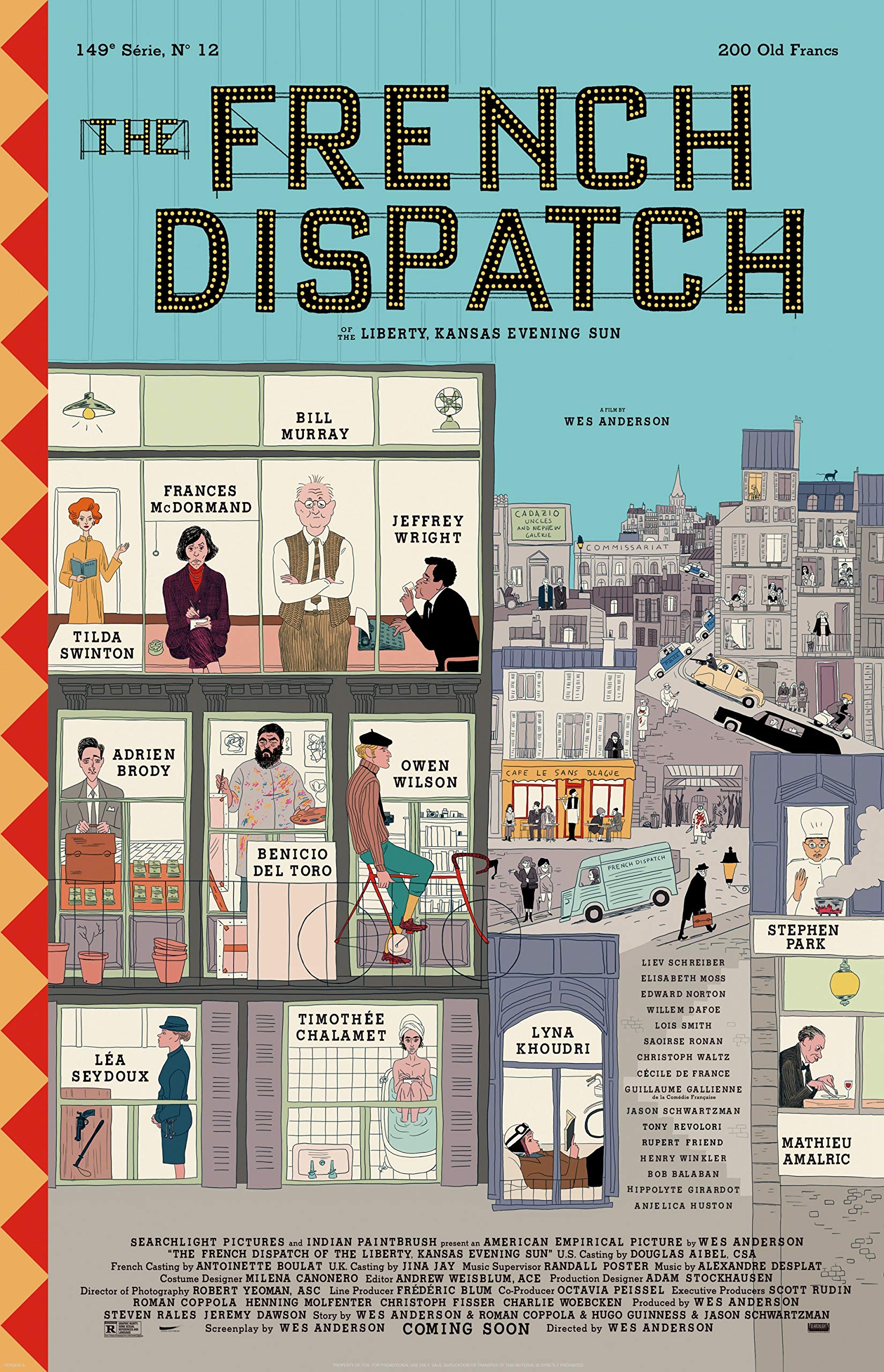
THE FRENCH DISPATCH film review

A quirky, stylistic motion picture in which the production design is the real star. Wes Anderson’s The French Dispatch delivers everything you expect from his authorship of cinema, but not much else; it’s a bountiful buffet of Andersonisms, in an anthology commenting on the dying print media industry; but while you’ll chuckle here and there, the stories themselves mostly fall flat. No doubt about it, that this film is overflowing with talent on and off screen; it’s not often that we get a single motion picture with such a prolific all-star cast. But even the whimsical production design and dry humor, that we automatically expect from an Anderson film, isn’t enough to compensate for the lackluster “short films” within the larger anthology cataloging the final printing of The French Dispatch magazine. No mistaking it, every visual element of the mise-en-scene is crafted with immense care! But the weakness in this film is the lack of ability for the vast majority of audiences (from cinephiles to those whom simply want to be entertained–and there’s nothing wrong with that, lest we forget) to connect with an of the individual characters, let alone the stories themselves. Perhaps that’s it: lack of relatability; that is the fly in the ointment.

A love letter to journalists set in an outpost of an American newspaper in a fictional 20th-century French city that brings to life a collection of stories published in “The French Dispatch.”

If you were hoping for another Grand Budapest Hotel or Rushmore, then I’m afraid that you may be disappointed. That said, if you go in with a desire to appreciate a masterful visual storytelling methodology, then you will be impressed and even delighted. While I find the characters themselves lacking in their ability to connect with the audience, this motion picture delivers abundantly in a beautifully eclectic blend of cinematic and stage craft that draws audiences into a stylistic world as can only be dreamt by Wes Anderson.

Before I talk about what didn’t work for me in this film, I want to highlight what was brilliantly executed. And that’s the imaginative visual design as can only be conceived by Wes Anderson. Even the most scholarly Anderson aficionados will be surprised by the diversity in visual expression of the immersive world on screen. Not only do we get the hybrid film/stage craft in production design, but we even have moments that the story is being told though the medium of a graphic novel. What Anderson can do that few filmmakers can is create massive depth in the world on screen. Furthermore, there is this absolute beauty in the deceptively simple approach. There is more love in the production design in a single frame of this film (and his films in general) than in most films in their entirety. From the very first frame of the film, it is clear that you are about to watch a Wes Anderson film! Few directors have achieved the degree of cinematic authorship that he has. In my classroom, I talk about him with the likes of Hitchcock and Burton (80s-90s), two filmmakers who’s stylistic approach to cinematic storytelling was so incredibly well-defined that they transformed into brands themselves.

I am often picky when I observe grayscale imagery in a film. Why? Because, most of the time, the filmmaker simply desaturates the color image to give it that old school grayscale (commonly referred to as black and white) look and feel. Not having seen any behind the scenes featurettes, I cannot confirm this, but the segments of the film that are grayscale appear to have been lit for grayscale. This is HUGE. The way a filmmaker lights for grayscale is NOT the same as it is for color. That is why, when a filmmaker simply removes the color from the image, that there is something that doesn’t look quite right or authentic in the image. In true grayscale filmmaking, the shades of gray go from a dark charcoal to almost white–that is the rage of shades of gray. So I greatly appreciate these moments in the film because I could observe the care that Anderson put into the filming of these scenes.

The French Dispatch is a collection of short stories (films) that are the visual extension of their written counterparts. Not written as in the screenplay, but written as in they are they represent the last stories for the final issue of The French Dispatch. So what we have here is a self-reflexive motion picture about the dying print media industry. If you need a reference, think LIFE magazine. We are watching the final issue of a legacy travel magazine come together as the narrator guides us through every story in the issue. It’s very much a love letter to print media, which is increasingly becoming extinct. If you are a print journalist working for a legacy publication, then this story will likely resonate with you. For everyone else, it won’t likely pack the same comedic punch.

This film is overflowing with characters! But what’s ironic, is that with all those characters, there aren’t really any that will likely connect with the audience. There is this wall there, a sort of separation between these characters and the audience. And this separation is felt all through the stories that fall flat, albeit, you’ll chuckle here and there. There is a great disconnect between the characters & story and the audience. They’re all generally likable–which is a problem. Films are comprised of characters we love and love to hate. When you generally (again, not fervently) like all the characters, the stakes are never high. The journalists writing the stories and the characters therein are incredibly one-dimensional with little to no growth arc. Neither the audience nor the characters are taken on a journey. And the short story that is the most blase´ and perfunctory of all is the one featuring Timotee´ Chalamet as the one-dimensional, self-centered student socio-political activist that has been consistently highlighted in the advertising (newsflash: kids and teens are rarely more enlightened than adults; don’t live your life by what’s on Tik Tok or presently being sensationalized).

If you are in the mood for a quirky out-of-this-world diversion into a whimsical world, then this film may fit the bill. If you’re looking for a substantive story, you won’t find that here. Go into it with an eager attitude to appreciate the art of the cinematic image, and that is the best approach to enjoying Anderson’s newest feature. If your favorite Anderson feature has been Grand Budapest or Rushmore prior to watching The French Dispatch, then you may find yourself wanting to go back and rewatch those for a better story.
Ryan teaches American and World Cinema at the University of Tampa. If you like this article, check out the others and FOLLOW this blog! Interested in Ryan making a guest appearance on your podcast or contributing to your website? Send him a DM on Twitter or email him at RLTerry1@gmail.com! If you’re ever in Tampa or Orlando, feel free to catch a movie with him.

Follow him on Twitter: RLTerry1

The Last Duel review

Captivating! Game of Thrones meets legal drama in a thought-provoking exploration of truth, perception, and inequality told through a Rashomon-like nonlinear story that is punctuated with dark comedy to provide emotional resets and strategic tonal shifts. Easily one of my fave films of the year! I was cautious going into this film because Ridley Scott has simply not lately been delivering what we came to expect from and love him for in Alien, Blade Runner, and Gladiator. So after many swings and misses, I was cautiously optimistic at best (and that’s being generous). Boy, was I wrong! The Last Duel is an outstanding film, full of thoughtful content, laugh out loud moments, and relevancy to contemporary topics. Perhaps the story takes place in the 1300s, but the characters are all archetypes we see today on screen and in real life. While the Rashomon-like approach to the central story is not new, it is an approach that isn’t used often, and can easily be abused, misused, or simply not dramatically justifiable. From the hilarious to intimate performances, the cast will keep your eyes glued to the screen. You’ve never seen a medieval period drama like this one before!

Jean de Carrouges (Matt Damon) is a respected knight known for his bravery and skill on the battlefield. Jacques Le Gris (Adam Driver) is a squire whose intelligence and eloquence makes him one of the most admired nobles in court. When Le Gris viciously assaults Carrouges’ wife Marguerite (Jodie Comer), she steps forward to accuse her attacker, an act of bravery and defiance that puts her life in jeopardy. The ensuing trial by combat, a grueling duel to the death, places the fate of all three in God’s hands.

The central focus of the plot is explored from three different perspectives, each depicting its own version of the truth. And never once did it feel repetitive; each time we revisit the incident, inclusive of the events leading up to, we learn something new. Furthermore, we learn what each version of the truth shares in common, thus affording the audience the opportunity to make the decision of what happened and how for themselves. This non-linear approach keeps the story incredibly engaging, by beckoning the audience to be completely intrigued by the events as they unfold. Even when observing a moment that we have already seen, but from a different perspective, there are brilliant nuances that separate the versions of the truth. Sometimes it’s how something was said or the expressed emotion when it was said; other times, it’s how something was done, and the attitude with which it was conducted.

While this story could have been incredibly dark from beginning to end, there is a healthy helping of levity to break up the dismal atmosphere and heavy subject matter. And it’s not limited to cleverly written humorous dialogue, there is a substantive amount of physical comedy as well. While Matt Damon and Jodie Comer play their characters fairly direct, without much in the way of humor, the characters played by Adam Driver, Ben Affleck, and Alex Lawther provide expertly timed and perfectly punctuated comedic relief. And of all those actors, it’s Affleck that get’s the lions share of the comedic bits. Some of it is slapstick, some high brow, and other parts are executed through dark comedy. Honestly, this is probably my favorite Affleck performance in a long time! He is so funny! Every time Affleck’s Count Pierre d’Alençon is on screen, he has some hilarious commentary or remark on the current state of affairs. While Alex Lawther’s King Charles doesn’t say much, his physical reactions are all that you need! Clearly the king simply wants to watch the world burn for fun, by allowing pretty much anything that is pitched to him, as long as he seen the entertaining value in it. Lastly, Driver’s Jacques Le Gris even has some moments that will make you laugh, including laughing at the most inappropriate moment; but there is simple something in his delivery of the lines and his physical acting that prompt you to chuckles and even laughter. For all the laugher that you will exhibit when watching this film, none of it is ever in poor taste or shows irreverence for a tough subject to cover.

Matt Damon and Jodie Comer’s performances as our two central characters will astound you! Damon delivers a stellar performance and Comer may have just secured herself a place on the best actress category in the award shows next year. Despite having seen Damon in plenty of serious roles, this is my favorite of his in a long time. I love when I get to see an actor surprise me! And he delivers plenty of surprising moments that convey a multitude of layers to his character, who will elicit sympathy from you even though you will disagree at his initial reaction to his wife’s report that is the catalyst for the duel. Jodie Comer shatters any expectations you go in with regarding how the central character’s wife typically acts. Her performance is one of those that you just know that she is channeling her heart and soul into every moment. You will feel her plight to be respected and believed for what she reports happened to her. Even though we do not spend an inordinate amount of time with her until her chapter, when her chapter begins, it is clear that she is the real star of the film!

While this may not look like a classic Ridley Scott film in the vein of ALIEN or Blade Runner, it does bear similarities in stylistic approaches to Gladiator. The sweeping landscapes, the intimate character moments, the visceral atmosphere sucking you into the setting of the story, it’s all here! While adhering to what we have come to expect from a medieval period drama, Scott checks off those boxes in a rubric-like fashion, but then crafts a modern story around the classic bones. That’s precisely what The Last Duel is, it’s a relevant story on the backdrop of a dark period in history. Scott’s adaptation of the actual events is delivered with raw gusto! Very few filmmakers could rise to the challenge to adapt such a heavy story, whilst keeping it entertaining–it is a motion picture after all–but he does all that and more! More than the reenactment of an actual event, this cinematic story has life, like we haven’t seen from Scott in nearly two decades (2005’s Kingdom of Heaven is the most recent motion picture if his that is truly excellent). The images aren’t simply beautiful frames flipping past the lens at 24fps, this film leaps off the screen with prolific energy.

This image has an empty alt attribute; its file name is profile_pic.jpg

Ryan teaches American and World Cinema at the University of Tampa. If you like this article, check out the others and FOLLOW this blog! Interested in Ryan making a guest appearance on your podcast or contributing to your website? Send him a DM on Twitter or email him at RLTerry1@gmail.com! If you’re ever in Tampa or Orlando, feel free to catch a movie with him.

Follow him on Twitter: RLTerry1

Halloween Kills horror movie review

Halloween Kills the momentum of H40 (aka, Halloween 2018), leaving audiences wondering why they should care about anything that happens. While the brutality is amped up to an 11 with a comedic touch, the plotting is a complete cluster that ultimately has little to no purpose. Twitter was all a’buzz with the news that the virtual screeners for press were delayed until Thursday evening; and after I saw Halloween Kills in the cinema Tuesday night, I can see why Universal made that strategic decision. It’s simply not good. Is that to say it’s a bad movie? No, it’s not bad; but the storytelling is a significant disappointment compared just how fantastic Halloween (2018) was. This sequel merely functions as filler material between Halloween and Halloween Ends. In a manner of speaking, Halloween could’ve ended with this one had the tertiary installment not already been shot. This movie doesn’t even try to justify its existence; it’s as if it knows that it’s bad, but did what it could to thrill audiences with the return of Michael Myers as much as possible. And he certainly delivers creative kills, some of which, have a hint of dark comedy. So if nothing else, you will be entertained by the brutality of The Shape, and even laugh at his twisted sense of humor. He’s no Freddy Krueger, but I like the touch of comedy in some of the kills.

The nightmare isn’t over as unstoppable killer Michael Myers escapes from Laurie Strode’s trap to continue his ritual bloodbath. Injured and taken to the hospital, Laurie fights through the pain as she inspires residents of Haddonfield, Ill., to rise up against Myers. Taking matters into their own hands, the Strode women and other survivors form a vigilante mob to hunt down Michael and end his reign of terror once and for all.

While this sequel is incredibly brutal, I appreciate how none of the kills are gratuitous nor does the camera linger on the violent acts or results thereof. However, the camera does linger on a subplot that is bonkers bad and pointless, except to provide social commentary on the negative impact of mob mentality. The idea of commenting on mob mentality shows that there was some attempt at thoughtfulness in the story; unfortunately, it was a slapdash attempt to provide substance in this otherwise forgettable sequel.

What makes a good sequel? That is perhaps the question that the writers, producers, and director David Gordon Green should’ve thought about when outlining this followup to the smash hit Halloween 2018. If there is already a predetemined trilogy, then the middle movie should deliver develop key characters and the plot should leave us with a feeling of all hope is lost. Now, this movie certainly leaves audiences hanging precariously at the end, and there is a very significant kill, but there is no substantive character development or meaningful plotting anywhere to be found. It’s simply a Michael on a rampage movie, with some moderately interesting exposition and backstory. What this movie did in 1.5hrs, it could’ve easily done in 20–30mins. While I may be exaggerating a little, it’s hyperbole to illustrate the fact there is so little substance to this movie. The plot is a real cluster.

What does work in the film? The kills. You will be highly entertained by the brute force in Michael’s kills. Massive carnage awaits audiences. No one is safe, and Michael proves that he truly is the unstoppable killing machine that is filled with evil. I appreciate how much care was put into the kills and how to show them. Wish that same level of care was found in the writing. You will also enjoy seeing familiar characters from the original film! And there is a particular character that I was absolutely delighted to see, because their appearance was completely unexpected–that I would actually see them! Those couple of moments made me smile.

After watching this movie, I still feel that Halloween H20 and Halloween 2018 are the stronger Halloween sequels. Between the two, I actually like H20 just a little more. Speaking of which, H20 has a much better story and more substantive character development than Halloween Kills. Furthermore, H20 is far more entertaining and fun to watch, not to mention the plot is significantly more structurally sound. There aren’t any real standout moments in Halloween Kills, and from what I can remember, no emotional nods to the original or Halloween II.

Perhaps the tertiary installment Halloween Ends will be the A Nightmare on Elm Street 3: Dream Warriors of the Halloween franchise. Even though Freddy’s Revenge is a better film than Halloween Kills, it’s still seen as a point at which ANOES may have died, but thankfully Dream Warriors swooped in to save the day with its outstanding characters, plot, and story. Many prefer Dream Warriors to the OG (not me, but I do place Dream Warriors as a close second behind the OG). Here’s hoping that the final film in this trilogy will have the soul of the original film but take us to new places.

This image has an empty alt attribute; its file name is profile_pic.jpg

Ryan teaches American and World Cinema at the University of Tampa. If you like this article, check out the others and FOLLOW this blog! Interested in Ryan making a guest appearance on your podcast or contributing to your website? Send him a DM on Twitter or email him at RLTerry1@gmail.com! If you’re ever in Tampa or Orlando, feel free to catch a movie with him.

Follow him on Twitter: RLTerry1

TITANE French Extremity Horror Review

Zero to sixty in three seconds, but loses traction toward the end. When I first read David Ehrlich describe Julia Ducournau’s Titane as “the sweetest movie ever made about a serial killer who has sex with a car,” I as instantly intrigued.  And for the first half of the movie, that is exactly what I got.  It was a brutal, thrilling, and raw (pun intended!) ride.  The main character, Alexia, is an erotic dancer at a car venue with a sadistic side – hinted at in her interactions with a fellow dancer in the showers and made even more obvious with her murder of a fanboy later in the evening.  While it may seem like a one-off act of self-defense, the mechanical precision and heartless manner in which she swiftly kills and stows her victim suggest otherwise.  We later learn she is a wanted serial killer terrorizing the south of France. 

Her heartless nature can be reflected in her relationship with cars.  After surviving an automotive accident as a child, a titanium plate is inserted into her head with the scars of the procedure following her onward into adulthood.  She physically has become more machinelike form this operation, and when discharged, she does not take solace with her parents, but rather begins to passionately kiss their car.  As an adult, this “auto” eroticism will manifest into her literally having sex with cars and later, even conceiving.

Alexia continues on with her killing spree, until one night she miscalculates – what she thinks is a quiet secluded night in to kill her colleague turns out to be a small gathering, with several guests in the home.  It becomes a massacre, as she stresses over making sure each new witness meets their demise in order to keep the situation under control.  But it all goes wrong when one girl escapes.  From this moment on, she will no longer be a mysterious killer able to move freely in plain sight, she will be a wanted criminal with her police sketch plastered everywhere.

At this point, around midway, the movie takes an odd pivot and never recovers the thrill of the first half.  What started as a violent adventure with a sensual huntress becomes a drawn-out family melodrama as the film slams on the brakes in tone and pacing.

Alexia is on the run and sees a sign for missing children that have been digitally aged.  She decides she can pose as one of them and goes into a bathroom to undergo a brutal transformation involving a haircut, binding her breasts, and several excruciating attempts – one finally being successful – to break her own nose.  She turns herself in at a police station and is now “Adrien” the long-lost son of an unknown man who instantly “recognises” her and takes her home – even refusing a DNA test to confirm.

Whilst Alexia was an alluring figure –leading men and women to their deaths through seduction, once she makes the transformation to Adrien, she loses that spark.  Even her attempt to murder her foster father comes across as half-hearted.  She, like this film, has lost her gusto.

Adrien hardly mutters a word – a presumptive attempt to prevent outing herself as a female – and takes on a shy, timid nature.  Maybe it is deeper- a commentary on the silencing of women in a “man’s world” and her change in demeanour and “worth” due to the loss of her alluring sexuality.  In any event, Alexia as Adrien must work hard to keep her secret, which becomes especially harder as she realises she is pregnant and beginning to show.  She binds her stomach and breasts at all times unless showering or sleeping.  Still, there are many close-call instances where she must quickly grab a blanket or a towel to prevent her foster father from seeing her naked body as he busts into the room unannounced.  The challenge is greater still when whatever is growing inside her starts causing motor oil to secrete from her mammary glands and groin.  

Her new father is a fire chief and gets his “son” to start working at the station.  Fitting in is difficult, with Adrien coming across as awkward and weak.  One fellow firefighter even starts to catch on to the ruse and poses yet another challenge to keeping the secret intact.  However, it soon becomes clear that the task will not be so difficult, as the father simply does not care if this person is truly his son.  Even when confronted about it, he refuses to discuss it.  And when his estranged ex-wife arrives to see their newly found son, she tells Alexia she knows she is a con (even seeing her naked to remove all doubt), but that she does not care because it is helping her ex-husband to cope with his trauma.  The father’s apathy to the truth and is finally made blatantly clear when the he ultimately does see Adrien’s breasts in the shower and is completely unphased, and then later when he helps her as she goes into labour.  She dies during childbirth, with the final scene showing the father embracing the new-born, who like its mother is a hybrid of human and titanium with a metal spine protruding on its back.

This film certainly has a lot to say – although it is not always clear what that is.  It touches on gender roles and androgyny, misogyny and the objectification of women, and delusion as a coping mechanism – willful ignorance, or even denial, can be bliss.  There are Biblical references, with a perverse protocol son scenario and even mention of Adrien being Jesus-like figure.  The line is blurred between the “human” and the “mechanical.”  And it certainly has its fair share of brutal bodily pain – from an older man shooting up steroids and overdosing to a woman scratching, taping, and even secreting motor oil from her pregnant body.  Whatever she has conceived with the car is causing her immense physical pain, with metal cutting through her flesh.  

Fire plays an important role, even Alexia’s car – yes, the one she has intercourse with – is covered in flame motives.  She later decides to entrap her family in a burning house as she makes her great escape from the law.  Her newfound father is a firefighter and finds himself surrounded by fire in both simulations and real-life scenarios.  The destructive power of fire acts to both destroy and provide opportunity – Alexia can leave her old family behind without a trace and later the fellow firefighter, who suspects Adrien is not what he/she seems, succumbs to a forest fire, his inquisitive distrust dying with him.  The father even sets himself on fire when a match falls on his alcohol drenched shirt from a drink he has coughed up on his chest.

The second half of Titane is almost unrecognizable from the first half – it feels like an entirely different film.  Had the movie unfolded in the reverse – the slow, crawling pace of the Adrien portion leading up to a motorized, satisfying payoff, perhaps as a flashback– then I probably would have left with a different view.  But starting with a bang and then faltering towards the conclusion, the film left me unsatisfied.  I found myself wishing that the movie that it started as was the movie it finished as; namely “the sweetest movie ever made about a serial killer who has sex with a car,” which, in the absence of any competition, I suppose it still technically is.

This review was written by Justin Schubert.

You might also like to read the review on another French horror film Knife+Heart.

007 James Bond: No Time to Die

Epic! Everything you want in a James Bond movie!! Treat yourself to the premium format in your cinema for the final chapter in Daniel Craig’s Bond saga. With gripping action and ample espionage, No Time to Die is a wildly entertaining throwback in the vein of Golden Eye, but even better! Return to the Cold War era espionage in which the Russians are the baddies and operating out of secret bunkers, vodka martinis are shaken not stirred, the one-liners, and the Aston Martin has machine-gun headlights. Oh–yeah there is a song by Billie Eilish, but enough said about that. From sweeping establishing shots of exotic destinations far and wide to intimate character moments, the camera paints a beautiful portrait of Craig’s sendoff as our Bond for the last fifteen years.

Recruited to rescue a kidnapped scientist, globe-trotting spy James Bond finds himself hot on the trail of a mysterious villain, who’s armed with a dangerous new technology.

Is the plot melodramatic? Of course, but aren’t most of these movies??? Even though the plot is motivating the actions of the characters more than the internal needs and desires of the characters, there is a great relationship between the action plot and emotional drives. The film is larger than life, but never campy or goes to ridiculous proportions that take you out of the story. All the foundational elements that make a Bond movie a Bond movie are here, and will hook you from beginning to end. This final chapter in Craig’s journey as 007: James Bond is handled with immense care, and serves up all the touchstones that will tug at your emotions. Don’t wait for this to be on-demand, you want to see this on the biggest screen, in the best format possible in your area for the full cinematic experience. No Time to Die is a perfect blend of the best of the Connery, Brosnan, and Craig years, all wrapped up into one outstanding chapter in the franchise that has been entertaining us for over fifty years.

While I feel that Skyfall still has slightly more rewatchability and is the better film. No Time to Die is a close second to it, and was just as enjoyable as Golden Eye. Many consider Golden Eye to be among the best Bond films because of the classical approach to Bond it takes, yet delivers a story that is familiar and fresh simultaneously. Yes, the Brosnan Bonds go downhill from there (except Tomorrow Never Dies is a solid installment), but Golden Eye reintroduced a new generation to the character of 007: James Bond and everyone’s favorite Agent M, Dame Judi Dench (and she makes a cameo in this film–in the form of a portrait, but still). I appreciate when franchises retain the foundation of what made the original great, but build a new structure. And that is what we have here, hence why it checks all the boxes that you want in a 007 movie. These homages to classic Bond in no way feel campy, but rather feel like an old familiar blanket that you can wrap yourself in to feel comforted.

Of everything the film did incredibly well, I wouldn’t be doing my job if I didn’t mention that the plotting is a little on the weak side. Although you won’t feel lost, there are times that you will find yourself a little confused as to all the relationships between characters and how the sequence of events unfolds. We aren’t talking TENET confusing, but it is a little muddled in places where it feels like there was a transitional scene that got cut out as the theatrical release was being assembled.

Despite the mostly melodramatic plot, there are some great character moments that help to setup how a character may be used in the future or just a little more about their personal life that helps them to be more relatable and believable. While we do not know who our next James Bond will be, we may have been given a hint as to the characters that will be included in future installments. And for anyone that is worried that future 007 movies will not have James Bond, without detracting away from the present story, this film lays the groundwork that 007 is a designation and James Bond is the name of a real person. Furthermore, the studio is searching for the next James Bond next year, so James Bond isn’t going anywhere. That said, we do have a fantastic supporting character that will surely make a great spy for MI6 in the future, regardless of her designation. But I won’t get into details, because it is slightly spoiler-ish.

Do yourself a favor and watch 007: No Time to Die on the biggest screen and most premium format you can find in a cinema near you. It’s a BIG SCREEN adventure that deserves to be watched on the big screen.

This image has an empty alt attribute; its file name is profile_pic.jpg

Ryan teaches American and World Cinema at the University of Tampa. If you like this article, check out the others and FOLLOW this blog! Interested in Ryan making a guest appearance on your podcast or contributing to your website? Send him a DM on Twitter or email him at RLTerry1@gmail.com! If you’re ever in Tampa or Orlando, feel free to catch a movie with him.

Follow him on Twitter: RLTerry1