“Captain America: Civil War” movie review

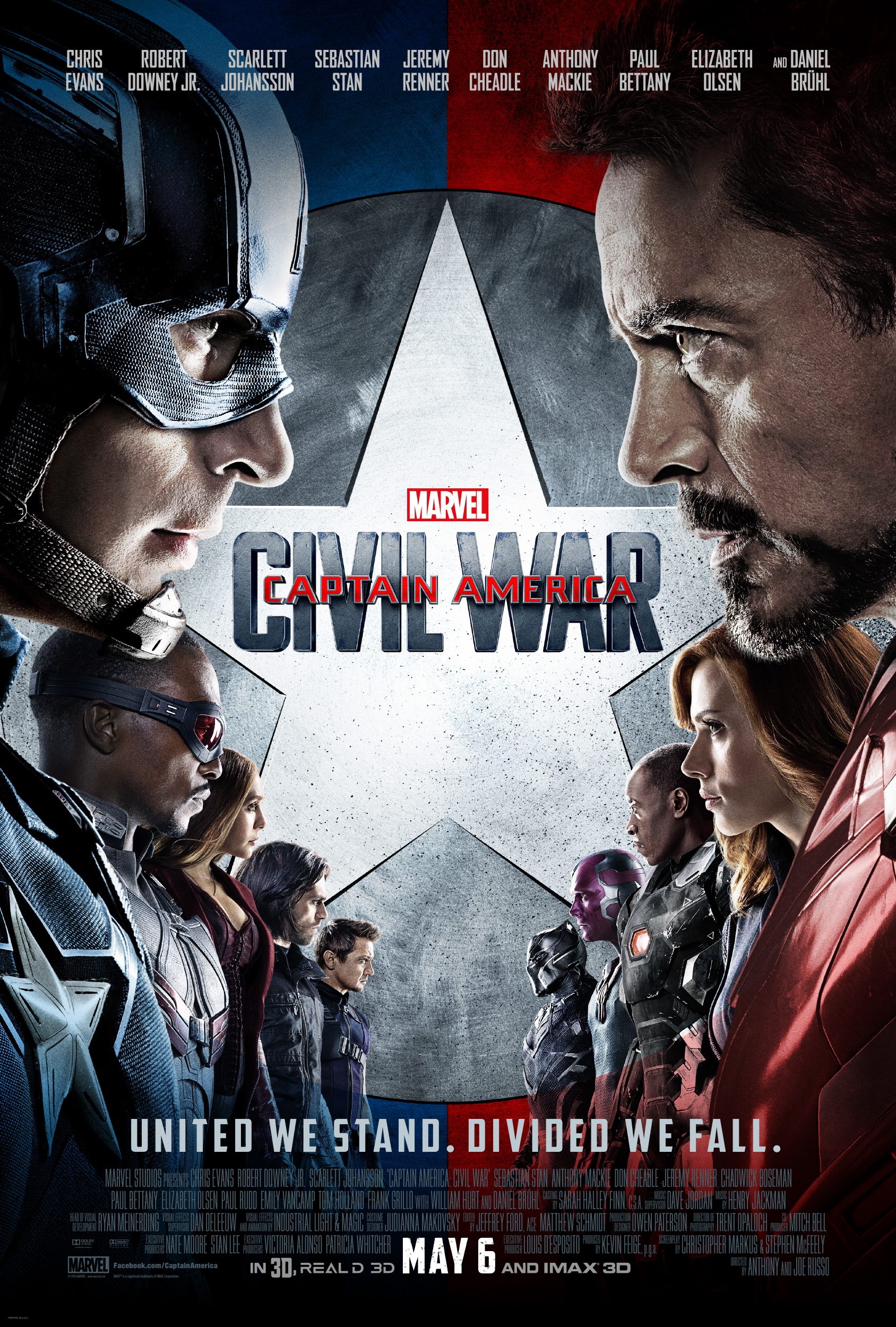
Civil_War_Final_Poster‘Marvel’ous! Nearly a complete departure from the conventional comic book superhero movie genre. Avengers 2.5 is a politically-charged superhero movie that will catch you off guard and provide you with a mostly non-cartoonish plot filled with well-developed conflict and character development. Witness some of your favorite Marvel superheroes secede from the Avengers and oppose those who they once fought side-by-side. Along the way, you also get to meet some new additions to the team that will provide some awkward comedic sequences in this otherwise serious movie. Deep dark secrets come to the surface that threaten the very possibility of the team ever having any hope of reunification. Captain America: Civil War is a brilliantly produced film that will have even those who typically do not care for most superhero films leaving the theatre satisfied and anticipating the next installment in the series. Although it is really an Avengers movie, there is still enough focus on the title character to support the choice of titles for this action-packed epic adventure.

Captain America: Civil War takes place not long after the catastrophic events at Sokovia and following another destructive battle, the United Nations and U.S. Government decide to intervene and put The Avengers in check. Opposing the team signing onto an international agreement defining how this group of “vigilantes,” Captain America (Chris Evans) falls away from the group and seeks his own destiny frocked with vengeance and misplaced allegiances. With the once unified team fracturing, a covert former Soviet operative is plotting the destruction of The Avengers from the inside out. Much in the vein of the American Civil War, The Avengers are split and Captain America forms his team while Iron Man (Robert Downey Jr) attempts to hold the team together and honor the agreement with the United Nations. The once inseparable Black Widow (Scarlett Johansson) and Hawkeye (Jeremy Renner) must choose sides and decide where allegiances truly lie.

It isn’t often that a genre typically filled with high concept, shallow plots can surprise you with a narrative radiating with anthropological and political themes and subtext. The brilliance of Captain America: Civil War is that it provides the audience with equal parts action-packed fight choreography and well-developed dramatic plot with prolific amounts of character conflict. Furthermore, the story will exceed your expectations of the ability to tap into one’s superficial response to action-packed stimuli and activate the deeper emotions of allegiance, betrayal, and self-preservation. For those who have not seen the previous movies in the Captain America series–another admirable element of this installment, is not causing those who have yet to watch the previous CA movies to feel left out of the excitement. Provided you have seen the preceding Avengers movies, this one will keep you trekking along with your favorite Avengers universe characters. There are certainly minor elements or past relationships that are introduced in the previous CA movies, but most likely you will be able to pick up on the aforementioned as you watch Civil War.

Another observation of this installment in the Captain America/Avengers franchises respectfully, is the movie’s success in both including current characters and introducing new ones without the film ever feeling too crowded, as it was with Batman v Superman. In addition to the Avengers minus Hulk and Thor, the audience is introduced to an adolescent Spider-Man (Tom Holland) and are re-acquainted with Ant Man (Paul Rudd). As I am not familiar with the comics, I cannot comment on this Spider-Man in respect to staying true to the comic, but I found this incarnation of Spider-Man to be on the verge of annoying. Perhaps that is how he is suppose to be, but it did not fit in with how he has been historically portrayed in cartoons and movies. However, the inclusion of both the respective characters did not feel forced as it so easily could have. Since the film primarily focussed on Captain America and secondly Iron Man, the large cast of characters was handled efficiently. The writers could include all these characters in one narrative, but shift the focus from character or character thus never overstimulating or overwhelming the audience with the development of such a dynamic ensemble cast.

Ordinarily, I do not speak so highly of superhero movies; but this film left me feeling quite satisfied and pleased with how well the film played off as a serious movie complete with plenty of opportunity for emotional connections. That being said, the one sequence of the movie that I did not find as entertaining or fitting is the elaborate “civil war” battle on the tarmac. Was it choreographed well? Yes. Was it instrumental in moving the plot forward? Yes. Did it effectively fit in with the rest of the mood and pacing of the film? No. Moreover, that entire sequence of scenes just felt awkward. And, that is mostly due to the inclusion of the naivety and immaturity of Spider-Man and witty/sarcastic/near-juvenile antics of Ant Man. Perhaps if only one adolescent-like character had been added, that part of the film would not have felt so awkward. As to not give away the reasons for the solemn mood of the film, I cannot go into much detail; but, the manner which this scene was written and directed just felt out of place and interrupted the otherwise excellent pacing and mood of the story. I agree that most serious movies need comedic relief in order to generate an emotional rollercoaster, but this was just a little too funny with respect to the rest of the film.

The summer blockbuster season is officially underway with the undoubtedly successful opening weekend of Captain America: Civil War aka Avengers 2.5. Unlike last year’s Avengers: Age of Ultron, this installment will take you on fantastic journey of emotional mountains and valleys of character and plot development. This film proves that a superhero movie can be both fantastically action-packed and dramatic. The political subtext will also provide friends and family countless hours of discussion and analysis. Although this is not an adult superhero movie in the way Deadpool was, there is still language and violence that may not be appropriate for young kids. Still, one of the earmarks of a summer blockbuster is a movie that can attract and please both teens and adults, and this is definitely a great example. Hopefully, this movie is an indicator of an exhilarating summer season at the cinema.

PS. Notice the nod to Disney’s D23 Club? I did!

“Blade Runner” (1982) movie review

BadeRunnerStill a visionary masterpiece? On the rare occasion that I do not feel compelled to see one of the weekly new releases, I enjoy taking my Thursday night and watching an older movie that would be fun to review. As it turns out, it dawned on me that I had never seen Ridley Scott’s Neo-Noir Blade Runner despite the fact that it it a critically acclaimed film and highly regarded by many of my contemporaries. I have found that sometimes you have seen clips, heard people reference it, and simply hear the title so much that you think you have seen it. Then you realize that you’re familiar with the ideas, concept, or story but not the movie itself. So, I decided to watch it for Throwback Thursday and review it today. Unfortunately, I have been struggling with connecting with the film as so many other filmmakers and film lovers have. When watching a movie from 30+ years ago, I do my best to place myself in the shoes of the audience then. But, I am having difficulty this time. As a peer-reviewed cinema researcher, I believe that no matter how old a film is that it should still be relevant and impact audiences many decades down the road. Truthfully, I am not entirely seeing why it is such a regarded film still to this day. However, it is definitely an artistic masterpiece due to the technical elements of the production. So in many ways, yes, it still IS an iconic visionary masterpiece; but, fails to connect or resonate with audiences today.

Travel to a dystopian Los Angeles in the year 2020, or present day Detroit; take your pick. Many have fled the city for colonies on other planets or to the far north of the city to escape the rampant chaos. In the early to mid 2010s, Tyrell Corporation invented Replicants (or human-like androids) to carry out menial tasks and hard labor in a modern slavery fashion. Each unit was programmed to last for a specific amount of time (4yrs +/-). When a small band of Replicants decided that they wanted to take their lives into their own hands, they return to earth from the planet they were slaving way on and are determined to force Tyrell Corp to fix them. These Replicants led by Roy (Rutger Hauer) will stop at nothing. Over the years, when the Replicants began to pose a threat to humanity, special operations forces known as Blade Runners were trained to “retire” the androids. Former Blade Runner Rick Deckard (Harrison Ford) has been reactivated and forced to retire the small band of Replicants that pose a threat in the already dystopian Los Angeles. Follow Deckard as he conducts an investigation and is fearful of his own life as he attempts to track down and “retire” the remaining Replicants before they achieve long-lasting life. All seems pretty routine until he encounters a special Replicant named Rachael (Sean Young) at Tyrell Corp.

It doesn’t take long to understand that this film is a neo-noir detective movie that takes place in a dystopian future. Neo-noir is regarded as a film noir style movie produced after the classic film noir period (which was relatively short (~1940s-50s). This genre [although, technically, there is sufficient evidence to suggest that film noir is more of a style not a true genre] follows many of the same tropes and elements found in film noir (think Billy Wilder’s Sunset Blvd, Double Indemnity, classic detective movies, or Orson Welles). Often, the protagonist is a solitary individual who finds him or herself in over his or her head who faces or exhibits perpetual pessimism, fatality, or menace in a plot consisting of cynical attitudes and sexual motivations. From a technical perspective, film noir (or neo-noir) is stylistically dark, high contrast, low key lighting, contains strategic shadows, and shots filled with symbolism and dichotomy. The plots are usually slow burning and contain social commentary or a self-reflexive narrative. Once analyzing this movie as a neo-noir, it becomes more fascinating but still lacks that timelessness that can be found in some of the examples mentioned earlier in this paragraph. As a artistic film, I am impressed with the vision of Ridley Scott. As a classically-regarded and praised film, I am not very impressed. Although, I find that it is an excellent example of how many in the early 1980s viewed the future and that is is a fantastic example of neo-noir style filmmaking.

One of the biggest problems I had with the film is the fact that I had trouble loving the protagonist or hating the antagonist, or feeling sympathy for either of the aforementioned. In screenwriting, it is imperative that the audience make a firm connection with either the protagonist or the antagonist. Note: the antagonist in a film/neo-noir is not always the “bad guy.” Whereas even Gloria Swanson’s Norma Desmond in Sunset Blvd made a strong connection with the audience in that we feel great sympathy for her plight, yet she is the antagonist in the story–or many agree as such. Harrison Ford’s Deckard in Blade Runner never quite garnered strong support from me in the same way his nemesis Roy failed to elicit disdain. Both Deckard and Roy are fairly static characters–meaning they lack dynamic development. There is, however, an indirect glimmer of character development in Roy at the very end that plays significantly into the plot for a brief but strategic moment. As regularly reoccurring throughout the narrative the character of Rachael is, she can almost be removed from the film and change little in the overarching story. For the most part, she simply exists and pays into Deckard’s motivation, but mildly so. She neither causes him to view Replicants differently or becomes his sole goal. It is clear from early on in the plot that Deckard already had reservations in retiring Replicants. Rachael simply amplifies or intensifies the feelings that were already brewing.

Looking back at movies from the mid to late 20th century that take place in the early to mid 21st century can be quite entertaining. Sometimes the future portrayed in the film, in one form or another, has actually come to pass. Although, other times, the future is incredibly inaccurate. The dystopian Los Angeles in Blade Runner is definitely the latter. Yes, there are themes of unchecked immigration, authoritarian power, and capitalism that can be read as not so different from today; but, for all intents and purposes, the future is much more grim in the movie than in today’s reality. Perhaps that’s why it can be difficult to connect with this movie. It takes place in a “future” that never happened, and probably won’t happen in the now near future. I think that’s the danger when writing or directing a movie set in a future that relies heavily upon technology directly related to the plot. Some movies can pull it off. Take Back to the Future for instance. It works because the technology in the culture of the future isn’t significantly integrated into the essence of the plot or are solely responsible for some dystopian world. The futuristic technology merely exists and helps to move the plot along. In Blade Runner, the whole reason for the plot is because futuristic technology in our present day has turned on its creators and became the catalyst for a world drowning in chaos.

If you have never seen Ridley Scott’s Blade Runner, I definitely encourage you to do so, especially if you enjoy film or neo-noir movies. It provides us with a glimpse into how the world viewed a possible future in the early 1980s; and prompts us to think about life and how we might behave if we knew that we only had a few years to live. Survival of the fittest maybe? Or, fight or flight? If I was a psychologist, I think that this would be fascinating to analyze from a psycho-social perspective. At the end of the day, the film was quite the visionary masterpiece for its day and still remains a favorite of many filmmakers, scholars, and just film lovers alike.

*This review is in reference to the original theatrical release

“Huntsman: Winter’s War” movie review

HuntsmanWintersWar“Let it go” Universal, Disney already has dibs on the Snow Queen. Prepare for the unnecessary prequel/sequel Huntsman: Winter’s War this weekend. It won’t take long for you to realize that you have seen this story before. Albeit, a more family friendly and Disney’d version, but this plot nevertheless. However, after researching the actual Hans Christian Andersen fairly tale The Snow Queen, it is clear that Universal Pictures does a more accurate job of adapting the fairy tale’s words than Frozen did. The problem with this attempt is that it feels like it’s coming around a little too late. With one-dimensional characters and a predictable plot, Huntsman attempts to tell the “real” story of the Snow Queen that appeals to teens and adults, but it looks so incredibly “Frozen” that it leaves you feeling like you’ve done this all before. Although there are increased action and romance scenes in the film, the whole idea of close sisters having a falling out, the one heading to the frozen north, while the other remains in the south with the north creeping on its doorstep, and love melting frozen hearts, is the foundation of the narrative and feels like a bad case of deja vu with little to add.

Travel back to the land of Snow White, and come face to face with a little known story that has yet to be told. Before poison apples and dwarfs, Queen Ravenna (Charlize Theron) and her sister were running the kingdom after the death of the good king (Snow White’s father). Ravenna’s younger sister Freya (Emily Blunt) falls in love with a man promised to another woman but has come to bare his child. After Freya finds her lover having set fire to the nursery and the innocent child, Freya becomes acutely overcome with anger, grief, and hatred and suddenly displays powers of ice and snow. Unable to control her anger and power, Ravenna send her sister to the north to find a kingdom of her own. After having her child murdered, Freya decides to raise a kingdom by making love illegal and taking children from villages and raising them up as warriors known as huntsman. When she finds that two of the huntsman Brighton (Chris Hemsworth) and Sara (Jessica Chastain) have committed the unpardonable sin of falling in love, Freya steps in to put a stop to their forbidden love. Banished from the kingdom of the frozen north, Brighton is contacted by Snow White’s kingdom to retrieve the infamous mirror filled with dark magic before it falls into the wrong hands.

Every once in a while, I come across a movie that really doesn’t require a lengthy description of the critical elements of the film; and this is one of those. Just felt very much under-developed and forced. Anyone who has seen Frozenand let’s face it, that’s practically everyone whether they wanted to or not–will instantly pickup on the parallels between both movies. Huntsman: Winter’s War is definitely geared towards an adult audience but it still feels like it stole many elements from Frozen. Even the coloring and costuming are very similar. For those who have examined Frozen from a critical perspective and read up on the development of the blockbuster, you may be familiar with the evolution of the script: it starts out as an adaptation of The Snow Queen but then the writers scrapped that idea for more of a contemporary Disney animated feature story. But then the writers didn’t like that direction either, they essentially took the first half of the first draft of the script and spliced it together with the second half of the second draft, added in some catchy music and boom! You have FrozenHuntsman is similar to what you would have got in Frozen had the first draft been the produced movie.

On the plus side, this film contains some beautiful imagery and simple but stunning visual effects. The goblins are extremely well done–too bad you get so little time with them in a scene that is completely removable from the rest of the film. That scene and others were clearly under-budgeted and under-developed. Despite the fact that you can watch this movie in D-Box and IMAX, there is really no reason to spend the extra money. Watching it in a standard auditorium will suffice perfectly. If you want to get a better idea of the darkness of the original Hans Christian Andersen fairy tale before Elsa and Anna, then you may enjoy this movie. However, if you would rather wait for it to be on Amazon Prime or iTunes, then that works too.

“The Jungle Book” (2016) movie review

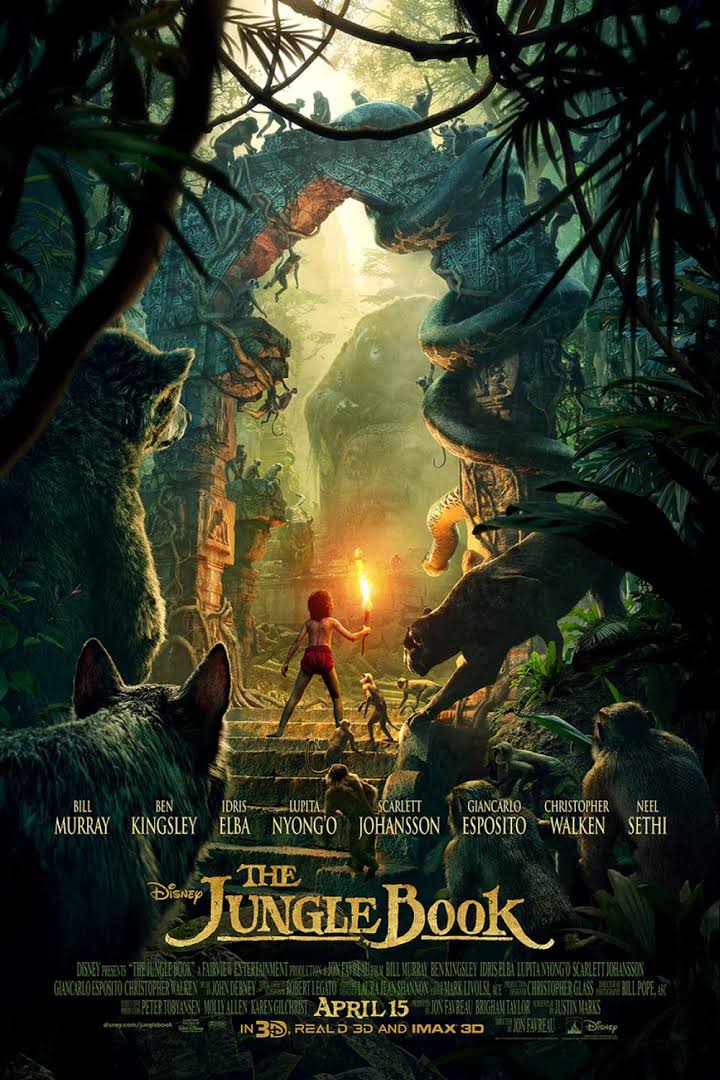
JungleBookDisney Nature meets beloved animated classic! Disney’s newest live-action remake of an animated classic surprisingly plays out very well. Unlike last year’s CinderellaThe Jungle Book strikes a perfect balance between creating a new more visceral experience of a familiar story and paying homage to the best of what the animated version had to offer–the essence of what made it “Disney.” As I was sitting in the theatre, I was amazed at how much the film truly felt like a classic Disney masterpiece that just happened to include beautiful cinematography, incredibly well engineered CG animals, and a plot; albeit, not a dynamic, thrilling, or deep plot, but a coherent plot nevertheless. That’s more than I can say about the original. Even though, I too like the classic. After the Cinderella cinematic schlock, I was not expecting much out of this film. But, I stand (or sit, rather) corrected. The Jungle Book is encouraging in that it proved to me that Disney can still tell a good story that is great for a wide audience and includes the core of the magic of an animated classic but successfully translates the narrative into a live-action movie.

Deep in the Indian jungles, an orphan human infant is found by a wise and caring panther named Bagheera (Ben Kingsley). Knowing he would die alone, Bagheera took him to a pack of wolves to be raised as one of their own. Being given the name Mowgli (Neel Sethi) spend his childhood as a wolf. When Shere Kahn (Idris Elba), a vengeful bengal tiger, threatens the wolf pack and the rest of the jungle, Mowgli decides to leave the pack and head for the man village–the jungle is no longer a place for a man cub. Guided and guarded by Bagheera, Mowgli must begin to adapt to his soon to be new life, but is having the most difficult of time. Throughout his journey through the misty jungles, Mowgli will encounter animals and beats he has never seen and even make some new friends along the way, including the lovable Baloo (Bill Murray). All the while, he must avoid an encounter with Shere Kahn while pressing on his journey of self-discovery and wild adventure.

Writer Justin Marks and director Jon Favreau demonstrate that a live-action remake of an animated Disney classic can be the best that a modern cinematic general audience movie can be and still hold onto the magic that has made it a story to stand the test of time. As I have not read the Rudyard Kipling work of literature upon which The Jungle Book is based, I’d like to imagine that this version of Mowgli, Bagheera, and Baloo’s adventures does the words of the English journalist and author justice. Unlike the original beloved movie devoid of any real coherent or conventionally structured plot, this remake tells a visual story supported by a simple but effective narrative complete with proper turning points, twists, and events. The pacing is also well-engineered, which creates a pleasant journey for the mind as well as the eyes. Using mostly on location jungle shots, supported with subtle sound stage sets gives this film a natural beauty that feels like something right out of a Disney Nature documentary. Contrary to how some CG animals can look, these creations were fantastically real–like you could reach out and stroke Bagheera’s ebony hair. Newcomer Neel Sethi is impressive to watch as Mowgli. He embodied the lovable characteristics of the animated version whilst adding in a modern twist. One of my favorite ways to evaluate an actor, in a genre such as this, is if he or she looks like they are having fun. And, Sethi definitely showed that he was having fun bringing this story to live-action cinema.

One of the reasons I was disappointed with the remake of Cinderella is that I missed the magic of the timeless music. Realizing that this was the first attempt to remake an animated classic (not a reimagination as is the case with Maleficent), it is entirely possible that Disney decided to make sure the next remake included the core of what made the animated version so beloved. And you will definitely find echoes of the original Jungle Book in this live action film. Most of the characters you remember from the original are also reprising their respective roles. Some of the roles are modified to either be more or less prominent, but it’s all very effective in building the story. One of the characters that is not as prominent in this version is the bola constrictor Kaa (Scarlet Johansson). But, in the relatively short amount of screen time, she delivers an exceptional performance, inclusive of the hypnotism, and through her interaction with Mowgli, Kaa reveals his backstory that adds to why Shere Kahn has vowed vengeance on his life. Just like in the original, King Luis (Christopher Walken) want to be just like Mowgli and possess the red flower.

There are certain elements of the original that are not included in the live-action version, but they are elements that did not fit in the world Favreau created for this film. Suffice it to say, I do not think that you will greatly miss those parts of the original because this Jungle Book holds onto the original magic and brings it into 21st century cinema. What about the talking animals??? Like with many movies, I did not read up on this one too much because I wanted to be surprised. Needless to say, I did not look up the voice actors so I was not prepared for the animals to speak. When Bagheera first began to speak, I was definitely caught off guard. However, I quickly accepted that the articulating mouths on the animals speaking perfectly good English in the jungles of India were as natural as the luscious green trees and crystal clear water or as natural as Mowgli’s ability to communicate with nearly every creature. The UN must have implanted Mowgli and his friends with those instant translator devices. But, because of the quality of the production, the adherence to the Disney magic that made the original memorable, and the solid writing, I was more than willing to engage in the suspension of disbelief in order to enjoy the movie to its fullest extent.

If you enjoyed the music, characters, and story in the original, then you are definitely going to enjoy this live-action remake. I am excited to see that the essence of the original animated classic is alive and well in this film. I hope this is what we are to expect from the next live-action adaptation of a Disney animated classic.

“The Boss” movie review

TheBossA truly diversified portfolio of comedic stock! Last year Melissa McCarthy was a spy; and this year, she’s the boss. Over and over again, McCarthy proves that she is a brilliantly talented funny lady. And whereas some may see this movie as a sloppy pandering comedy, I see it as a fantastically entertaining movie with a pretty good plot filled with well-developed characters. No story exists without conflict, and comedy is no different. The best comedies are those full of conflict that ignites the hilarity and irony. Very much in the vein of other McCarthy comedies, The Boss is over the top. But, that’s perfectly acceptable because the movie certainly opens with a larger than life scene, and the movie never pretends to be something that it’s not. This type of comedy knows exactly what it is, and it rocks it! I always have more respect for movies that do not pretend to be anything other than what they are. It’s designed to provide an escape from the doldrums and mildly depressive lives many of us have and provide us with the best medicine–laughter. Is this new comedy on par with Bridesmaids or Spy? No. But, is it funny, filled with fun characters, conflict, and satire/parody? YES.

Universal Pictures’ The Boss is a slapstick comedy about media and economy mogul Michelle Darnell (McCarthy) who has pulled herself up from the tragic and challenging roots of her childhood to become the CEO of multiple Fortune 500 companies. But, like with all good things…after inside information, Michelle is found guilty of insider trading after a tipoff from a former friend turned enemy of hers. Having all her assets frozen, personal property confiscated, and losing her house, Michelle has no where to go after her short four-month stint in a white collar correctional facility. She has to turn to her former executive assistant Claire (Kristen Bell) for help. After driving Claire and her daughter crazy, Michelle is forced to start pulling her weight, which means taking Rachel, Claire’s daughter, to her Dandelions meeting (totally a parody of the Girl Scouts). That proverbial meeting proves to be just the catalyst Michelle needs to return to the top. However, she will soon come face to face with all new challenges in her business and personal life as she rises back to her previous epic heights.

At first glance, this movie appears to be another zany comedy that only McCarthy can pull off. Much in the same way Amy Poehler and Tina Fey are often type casted. But, a closer look at The Boss reveals a surprisingly well-developed and executed plot that is incredibly well-paced and includes impeccable comedic timing. Like with Poehler and Fey’s Sisters, this movie too has a heart-warming message throughout the narrative. You’ll just have to watch it to find out what that is. Like with the opening scene at Chicago’s United Center with Darnell descending to the stage on a fiery phoenix alive with pyrotechnics, Michelle herself is larger than life. Interestingly, this opening parallels the career or acting-style of McCarthy. She is the type of actor that has yet to prove a wide range of characters; but with the characters she plays, she is often the most dominant character whether among the supporting or leading cast. We expect her to provide us with that which we are accustomed to watching and enjoying. And in that respect, she has yet to fail her audience.

The phoenix at the beginning also symbolizes, as many of us know, the rising from ashes of defeat to become even more resilient and powerful than before. The character of Michele Darnell is very much a phoenix in this story. But is she the only phoenix? No. Michelle’s former assistant Claire is also a type of phoenix. Granted, she was not on top of the world and fell from splendor, but she also takes a journey similar to the phoenix. As Michelle’s assistant, she had a good job (although not paid nearly as well as she should have been)–let’s just go with the fact that she was employed. When Michelle lost her assets, she was no longer able to pay Claire and she was forced to take employment elsewhere. From riding around with Michelle in Cadillac Escalades to working in a cubical in a administrative pool, Claire fell from the glamour she was associated with by extension. After several turning points in the movie, which you will just have to see for yourself, Claire begins to rise up to achieve goals she never thought she would–personal and professional triumphs.

Unlike many comedies, this one has a dynamic range of dialog, physical antics, and high brow humor that is sure to keep you laughing during the movie. Furthermore, contrary to how many may perceive or expect of comedies, it is important that the audience not continuously laugh the entire time. If there is so much “funny” in the story structure, then the moments that should elicit the most laughter won’t succeed because they will just fall in line with the rest. It’s like Michelangelo’s famous Sistine Chapel ceiling fresco. Although I have never been, from others who have told me about their travels, the ceiling is not nearly as impressive as one may think it to be. Why is that? Because there are many painted ceilings throughout the chapel so Michelangelo’s masterpiece is fairly anti-climactic. Fortunately, The Boss strikes a pleasant balance and timing between the high comedic elements in plot and dialog. Another component of this movie that is sure to please the audience is the cameo by Kathy Bates! Thats right. Better known for her more serious roles, Kathy Bates is one of the most amazing actors because she can truly play a wide range of characters in film or television from the serious to the funny. It takes only the highest level of acting to be able to deliver brilliance in such a short amount of screen time. Plus, having Bates just classes up the film a little!

If you love Japanese katana fights, this movie has it! If you are a fan of McCarthy’s style of comedy? You won’t be disappointed. Having a bad week and just need to laugh for a while, then this movie is for you! There is little that I did not enjoy about this comedy. By no means to I argue that this is an amazing film–certainly that isn’t the case. But, is it s FUN movie that is actually well-produced, written, and acted? Yes it is.