
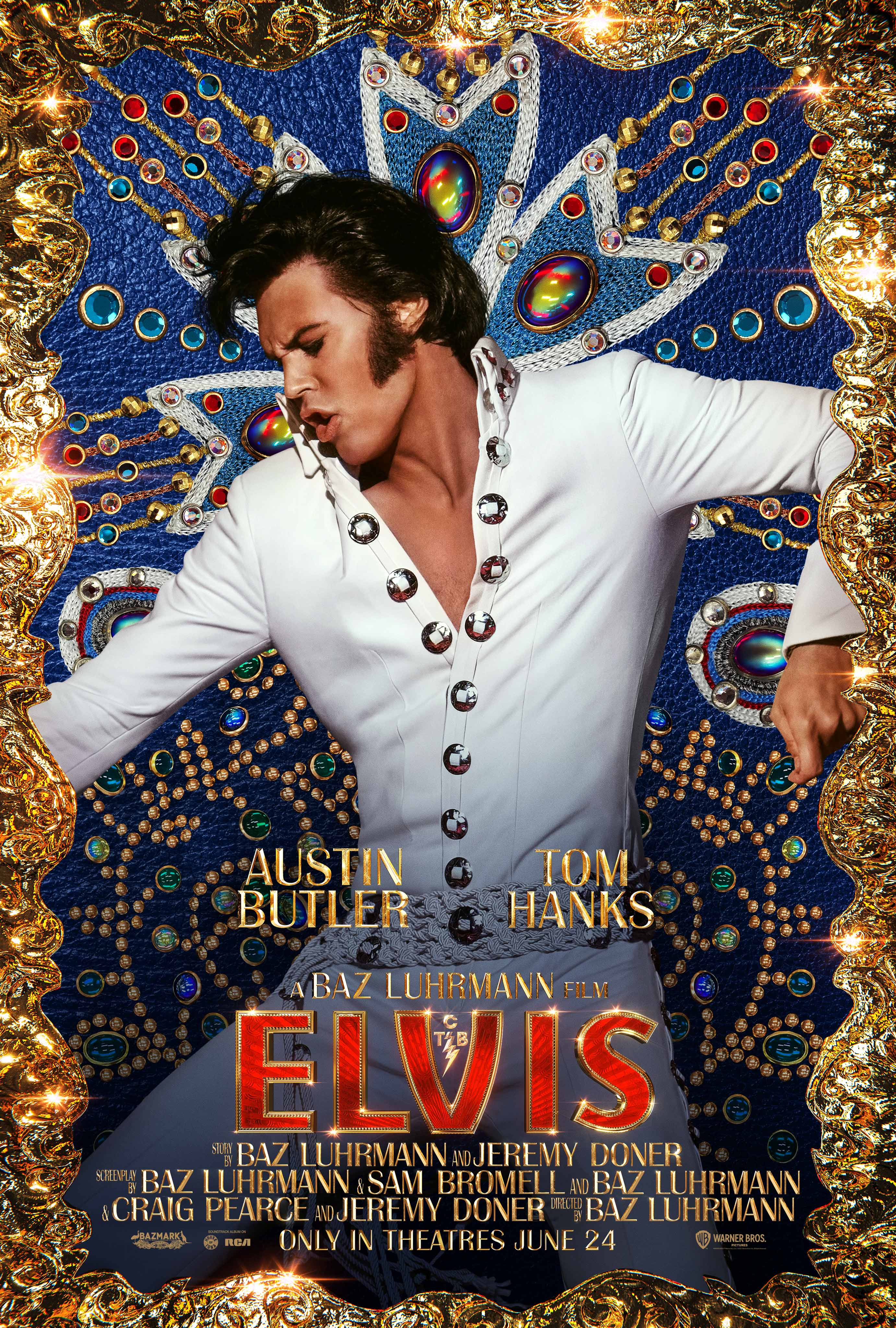
ELVIS biopic review

The King of visually spectacular biopics! Tom Hanks and Austin Butler deliver command performances that transcend impersonations and transform them into The Colonel and The King. You’ll want to sing along with this dazzling tribute to the King of Rock ‘n Roll from visionary director Baz Luhrmann. A landmark biographical motion picture for both the technical achievement and performative elements of the mise-en-scene; however, the screenwriting (inclusive of plotting and narrative) lacks the gravitas of the visual elements. Needless to say, my initial reaction to the film was higher than it is now that I’ve had some time to think on it. That’s not to say that I wasn’t impressed by it–I was! Parts of it, anyway. The more I thought about the screenwriting, the more frustrated I became with the film. Frustrated in that it felt like a hybrid biographical film meets documentary. Furthermore, the full impact of the story is hampered by the poor pacing. Perhaps Elvis would have made for a better limited run HBO series. Of course, then you’d not likely have Luhrmann at the helm, which is ultimately why this film works as well as it does. From his humble beginnings to Graceland and Vegas, the film includes milestones in Elvis’ legendary career. The influence of rhythm and blues and gospel music on Elvis’ life is witnessed throughout the filmWhile the storytelling may be weak, the sensory explosion of the film coupled with the performances are the reasons to watch this on the big screen.

Elvis Presley rises to fame in the 1950s while maintaining a complex relationship with his manager, Colonel Tom Parker.

What performances! Both Butler and Hanks are sure to wow you with their portrayal of The King and the Colonel. We could definitely see some Best Makeup Oscar nominations for both, especially for the Colonel. Other than when it was established that Elvis put on a significant amount of weight (but we cut back to Butler’s slender Elvis), he completely embodied the legendary entertainer. From his voice to his signature pelvic moves, everything about Butler screamed that he was truly Elvis. With so many impersonators out there, and some very good ones, it’s difficult for an actor to take on an iconic role such as this, and elevate it from impersonation to transformation. Fortunately for Elvis, Butler transformed with great authenticity. Moreover, Hank’s unbelievable transformation as the Colonel is on par with the Oscar award-winning hair and makeup of Jessica Chastain’s Tammy Faye last year in The Eyes of Tammy Faye. Although Butler certainly has the moves to drive you wild, it’s really Hanks’ story. Oh you get lots of Elvis, but the main action plot is really told from the perspective of The Colonel. Which is why there are narrative problems.

The movie opens and ends with The Colonel, with all the Elvis in the middle. Because of the competing plotlines, the movie suffers from poor pacing and clearly misguided diegetic direction. Audiences are never able to go as deep as they would like because as soon as we begin to focus on one element of Elvis’ or The Colonel’s life, we are then thrust into a different chapter in Elvis’ life. While that may seem like the movie to too quickly paced, it actually has the opposite effect by dragging it down. Stays too long in some places, whilst not enough in other places. BioPics like this often suffer from poor plotting, because they are ultimately a visualization of a Wikipedia page. Lots of information and chronological events, but little time and room to become emotionally involved with the characters. If this movie had not been about Elvis, and was just another tragic story of an entertainer from humble beginning, hitting it big, losing themselves, just to have a major comeback before an untimely death, then I would probably not care about these characters as much as I do. I am invested in them because of who they are, not because of the journey I witnessed in the film.

The technical achievement of the film is off the charts good! The stylistic cinematography and editing choices are Luhrmann’s signature style. It’s an experiment of the apparatus of film, and how it can be manipulated and crafted to take a typical BioPic, and transform it into a cinematic experience. And that’s what Elvis is, an experience! It is a brilliant combination of stagecraft and cinema. Yes, some of the sets look like they are on a stage, but that adds to the dimension and character of the film. It gives it this other worldly feel that wouldn’t be achieved simply by using all real places (as many still exist). Several times during the film, the cinematography and editing made me feel like I was literally at an Elvis concert! A sensory explosion that only Luhrmann could dream up. The down side to this approach is that there is so much emphasis on the visual elements and the technical achievement of the film that the actually storytelling suffers….sometimes feels like a bad television limited run series.

While I have my reservations with the screenwriting, there is no doubt in my mind how much fun I had with this film! Whether you’re a lifelong fan of Elvis or not, you will have a wonderful time!

Ryan teaches Film Studies and Screenwriting at the University of Tampa. If you like this article, check out the others and FOLLOW this blog! Interested in Ryan making a guest appearance on your podcast or contributing to your website? Send him a DM on Twitter or email him at RLTerry1@gmail.com! If you’re ever in Tampa or Orlando, feel free to catch a movie with him.

Follow him on Twitter: RLTerry1
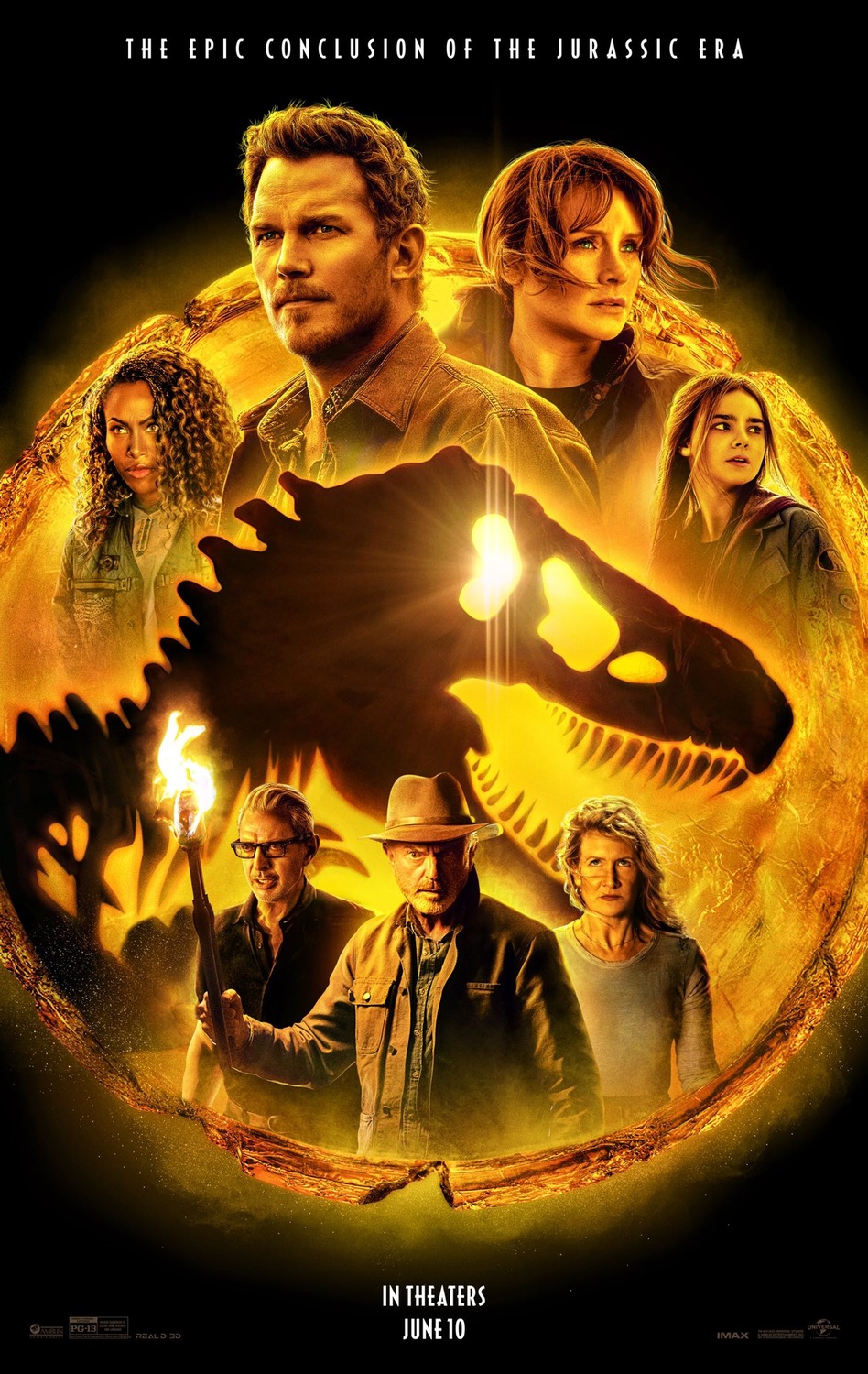
JURASSIC WORLD DOMINION movie review

Some stories are best left extinct. Looks like we need to implement the lysine contingency with this one. Don’t bring anything back that you cannot control. Jurassic World Dominion represents the final nail in the coffin of this once best picture quality motion picture property. It’s as if the writers never watched the original Jurassic Park nor read Crichton’s masterful novels Jurassic Park or The Lost World; simply watched highlight reels and read Sparknotes. After the disappointing Fallen Kingdom, I was hoping the writers and producers would take that as a cue to return to the legacy franchise’s roots. Instead, this bloated, glorified B-movie (and that’s being generous) delivers an abysmal story, a convoluted web of competing plots, and wasted characters, all underscored by a CGI crapfest of dinosaurs (or, it could be the inverse). Extinct is the magic that made the original one of the most beloved motion pictures of all time. Furthermore, this movie is perpetually in the third act, leaving little room for setup and development. With so much brilliant material from which to pull in the original film and two novels, how on earth did we get the preposterous slapdash story (rather, collection of stories) that we did??? It truly pains me to have to write about the franchise this way, as Jurassic Park is my No.1 favorite film of all time. I think I’ll cleanse my cinematic palate and rewatch Maverick for a third time or watch Jurassic Park at home. Even the first Jurassic World is far more enjoyable than Dominion.

The future of mankind hangs in the balance as humans and dinosaurs coexist following the destruction of Isla Nublar, another Biosyn/InGen dark secret is revealed, giant locusts pose an eminent threat to agriculture, and Owen and Claire embark on a dangerous rescue mission. (Yeah, all of that is in the movie).

There is soooo much going on, here. Clearly, Trevorrow, Emily Carmichael, and Derek Connolly struggled on any singular outside-action story, and made the unfortunate decision to just go with all of their ideas, everywhere, all at once. And when that didn’t work (surprised, as they may have been), they knew they had to get the Jurassic Trinity back (Dern, Neill, and Goldblum) in order to try to make something of this diegetic mess that was probably greenlit while drunk. Seeing the original cast all together is one of the few highlights from the movie, but I wish they had been given more agency and depth. Moreover, character development is a struggle all the way around.

While one may attempt to argue that all art is completely subjective–I assure you that is not the case. Yes, there is subjectivity in art, but there are also accepted best practices and conventions that are time-tested and should be adhered to in order to tell a thoughtful story with logical plotting (unless you know how to break them, and this movie did not). Jurassic World Dominion is objectively found wanting. Not even so bad, it’s good, just bad. Cheesy B-movies with dinosaurs from the first half of the 20th century are more coherent.

When I watch movies like this (like this, meaning movies that really should be taken seriously out of respect for the source material and predecessors), I wonder how on earth could a team of writers forget the screenwriting fundamental convention and best practice of simple plot, complex characters. Instead, in Jurassic World Dominion, we get simple characters, complex plots. The inverse of what works dietetically and cinematically. The outside-action story (supported by strategic and coherent plotting) should be easy to follow; however, the emotional/cerebral subplots and character development add the thoughtful complexities that provide depth for cinema. While none of the Dominion stories Trevorrow attempted to bring to to the silver screen are compelling in any way (and contradict past precedent plotting or themes set in the franchise), any two of them would have made for a better main and subplot than any combination of all 4+ of them.

The fan service is both prolific and incredibly forced. Is there anything wrong with strategically placed fan service–those moments or references that only legacy fans will appreciate? No, definitely not. Is there anything wrong with fan service that isn’t emotionally earned in the present movie? Yes, definitely yes! From beginning to end, the fan service is everywhere, and very few of those moments pay off dramatically or emotionally. Perhaps if Maverick had come out first, then Trevorrow’s team would have observed how to integrate nostalgia and throwbacks perfectly. Nostalgic gestures like most of the ones in this movie are empty–devoid of any substance. There is one moment, in particular, that is so unlikely (the logic escapes me) to have happened that it’s practically impossible; however, it’s written into the movie in an attempt to forcibly craft some poetic justice.

If you’ve read the novels Jurassic Park or The Lost World, then you’ll remember how significant the character of Lewis Dodgson is. And, I did appreciate how Trevorrow brought Dodgson and Biosyn back because the roles they play in the novels, especially The Lost World, are incredibly signifiant to the plot. No spoilers, but Dodgson is way more than the guy that paid off Nedry to steal the embryos and giving rise to the GIF and callback “Dodgson, Dodgson, we’ve got Dodgson, here!” I just wish Trevorrow and his team took more inspiration from the novels than a singular character and company. Honestly, The Lost World novel could have been adapted to fill the role as the tertiary movie in the Jurassic World trilogy, considering very little of the plot in the novel was used in the movie adaptation.

Thematically and subtextually, Dominion experiences great trouble. The themes are both counterintuitive to itself and the preceding five films. Much of the subtext defies all known logic, both logic in terms of real-life ecology and how the science of the films was presented in the past. Instead of using the world of the films to write the next and final chapter in the Jurassic era, Trevorrow forces his ecological and anthropological opinions on the plot and characters. Nothing wrong with a writer-director doing that, but it has to be setup diegetically in order to have the payoff the writer-director desires. Otherwise, it sticks out like a puzzle piece that doesn’t quite fit the rest of the puzzle. Nothing in science supports predators and prey or two competing carnivores peacefully coexisting in some sort of ecological utopia; it’s illogical.

To end on a positive note, and aside from the return of the original cast, there is only one part (well, it’s really two scenes) that put a big smile on my face. And it’s the return of the Dilophosaurus!! And considering she makes an appearance in the trailer, this is not a spoiler. It’s only taken since 1993 to give Dilophosaurus some (non-holographic) screen time! I’m glad it wasn’t turned into a main dinosaur in this movie; how she was reintroduced and used was just right, and has a great payoff.

If you love the original Jurassic Park and first 2/3 of The Lost World, then you’re probably going into this one with the wrong mindset. If you go in with a desire to be entertained by a glorified popcorn B-movie, then you’ll likely have more fun than I did. Perhaps I went in with the wrong mindset, thinking that it was going to fix what Fallen Kingdom failed to do. Do yourself a favor, and watch it in IMAX, Dolby, or other premium format because it is a visual spectacle that is in perpetual third act gear the whole time.

Ryan teaches Film Studies and Screenwriting at the University of Tampa. If you like this article, check out the others and FOLLOW this blog! Interested in Ryan making a guest appearance on your podcast or contributing to your website? Send him a DM on Twitter or email him at RLTerry1@gmail.com! If you’re ever in Tampa or Orlando, feel free to catch a movie with him.

Follow him on Twitter: RLTerry1
DOCTOR STRANGE IN THE MULTIVERSE OF MADNESS movie review

Plot sacrificed for visual FX. While Raimi’s horror adjacent direction gives Doctor Strange in the Multiverse of Madness a unique aesthetic when compared to the typical superhero movie (with the exception of Batman Returns, which has long sense been praised for its otherworldly horror-adjacency), it isn’t enough to carry the story. Better brush up on End Game and Wanda Vision because you may be slightly lost the whole time. So full disclosure, I’ve only seen End Game once and do not subscribe to Disney+. Unfortunately, this movie does not sufficiently provide exposition for those of us that do not eat, sleep, breathe the MCU because Wanda/Scarlet Witch’s motivation for her antihero behavior cannot be fully realized and understood without the events of Wanda Vision (from what I’ve been told about the show). That’s the problem with the ever-expanding MCU–but–it’s also a brilliant marketing and merchandising move. Simply because, if you want to be able to understand the motivations of the characters in the movies, you have to watch the TV shows and every single movie (main line and side line). Specific to this movie itself, there is clearly a thoughtful story, but it’s ultimately held back by the wandering plot. Ironically, you may be asking yourself a variation of the cliche question actor’s ask directors: what’s my motivation? Instead, you’ll find yourself asking: what’s Wanda’s motivation???

Dr Stephen Strange casts a forbidden spell that opens a portal to the multiverse. However, a threat emerges that may be too big for his team to handle.

Story and plot are NOT the same thing. Without getting into a lot of what I teach in film studies and screenwriting, story is the overarching narrative whereas the plot is the map (how you get) from beginning to end. Raimi’s playing up on the whole witchy aspect to this movie, was great for someone like me that loves horror, but it seems that the horror-adjacency of the movie merely compensated for the slapdash plotting. While many that watch this movie have undoubtedly seen End Game multiple times, subscribe to Disney+ to watch all the shows, and have read the comics, many have NOT. Granted, a subgenre movie such as this should not play to the lowest common denominator because then the fanboys and girls in the audience will feel slighted or unappreciated, At the same time, the writers and director should have considered integrating sufficient exposition for those that do not watch all the ancillary material. Wouldn’t have taken much to provide enough exposition so that rewatching End Game or subscribing to Disney+ for Wanda Vision, What If?, and Loki wouldn’t be a prerequisite for this movie.

For those that love visual effects, you will likely be impressed, if not blown away by the mesmerizing landscape of digital imagery; however, there are many times in the movies that the characters do not feel that they are existing within the same world in which the dazzling display of graphics exist. You cannot replace the way real light bounces off real objects into the camera lens. Not opinion–fact. Perhaps one day, we will get an MCU (and this applies to the “whatever it’s called these days” DCEU) movie that spends as much time crafting tangible sets as it does investing into digital imagery. In no multiverse will characters look to truly be within a world that primarily exists in the expression of 0s and 1s on a computer. The only saving grace for the aesthetic of this movie, and the moments we see the cinema stylo (hand of the artist), is when Raimi leans into the horror-adjacency of this MCU entry. Whenever the movie took a turn towards horror, I enjoyed it the most, and felt it was trying to be different–not your typical superhero movie.

It’s really no spoiler that Captain Picard is back as Professor Charles Xavier! Okay, so I know he is really Sir Patrick Stewart, but he will always be the definitive Starfleet captain to me. X-Men fans, like me (see, I do like superhero movies that aren’t Batman Returns), we’ve been waiting for that moment in which we witness the integration of the X-Men into the MCU. And I’ll give the writers and Raimi this: how Professor X was integrated into Doctor Strange in the Multiverse of Madness was both meaningful and strategic. It wasn’t too much, didn’t feel forced, and the applause this cameo garnered from the audience (including myself) was outstanding! At my screening, the moment Sir Patrick Stewart reprised his role as the definitive (live-action) Professor X elicited more applause and cheers than any other moment in the movie. I am eager to witness how the X-Men are woven into the fabric of the MCU.

If you can watch this movie in a premium format like Dolby Cinema, IMAX, or Cinemark’s X-treme, then that is the best way to experience it. It is a BIG SCREEN movie for sure! While I am often highly negatively critical of superhero movies, I am thankful that they are getting people back to the cinema in masses.

Ryan teaches Film Studies, Screenwriting, and Digital Citizenship at the University of Tampa. If you like this article, check out the others and FOLLOW this blog! Interested in Ryan making a guest appearance on your podcast or contributing to your website? Send him a DM on Twitter or email him at RLTerry1@gmail.com! If you’re ever in Tampa or Orlando, feel free to catch a movie with him.

Follow him on Twitter: RLTerry1
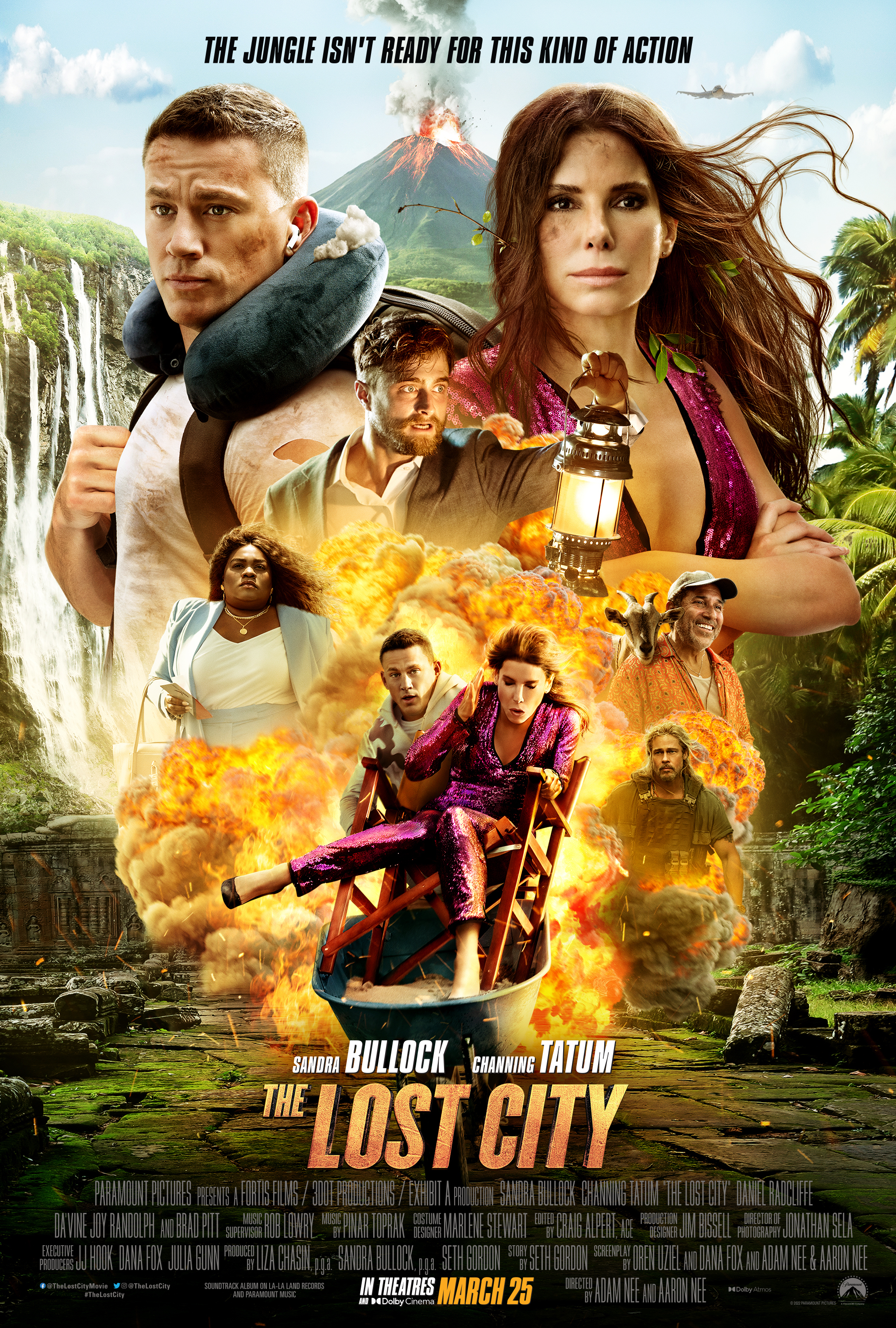
THE LOST CITY adventure movie mini-review

The lost screenplay. The whole time Loretta (Sandra Bullock), Alan (Channing Tatum), and Abigail (Daniel Radcliffe) are searching for the legendary fire crown on a mysterious, obscure volcanic island in the middle of the Atlantic (that simultaneously is developed enough to have an airport and tourism economy), I was left wondering if the writers and director lost the screenplay, and just made it up as they went along. Clearly this film is an attempt to reimagine the adventure-romance classic Romancing the Stone, but lacks nearly everything that makes the aforementioned one of the best written screenplays of all time. What The Lost City does have is undeniable chemistry between all of our lead and supporting cast. And it’s this chemistry that will keep you from completely tuning out. A screenplay with a well-paced, structured story and well-developed characters can always have the funny bumped-up; whereas a screenplay that is a laugh-a-minute has a much more difficult time bumping up the plot and characters. Unfortunately, the latter is a more accurate description of this movie better suited for direct-to-streaming than a theatrical run. When the funny is rooted in bit or gag-based humor, it simply can’t sustain a movie’s energy and entertainment value. The release date is also puzzling. Since this movie is a romance of sorts, it would have made more sense to release in February for Valentine’s Day. Nothing is left to subtext…it’s all right there on the surface, requiring nothing of the audience. Furthermore, so little is required of the actors that all look like they are completely bored with the story and phoning-in performances. Interestingly, the best-developed character in the movie is Alan (Tatum), and that’s not saying much. Believe it or not, there IS a good movie (on the level of Romancing the Stone) in there somewhere–the characters and story are thoughtful and fun–but the poorly written screenplay holds the movie back from the potential that was clearly there.

Ryan teaches Film Studies and Digital Citizenship at the University of Tampa. If you like this article, check out the others and FOLLOW this blog! Interested in Ryan making a guest appearance on your podcast or contributing to your website? Send him a DM on Twitter or email him at RLTerry1@gmail.com! If you’re ever in Tampa or Orlando, feel free to catch a movie with him.

Follow him on Twitter: RLTerry1
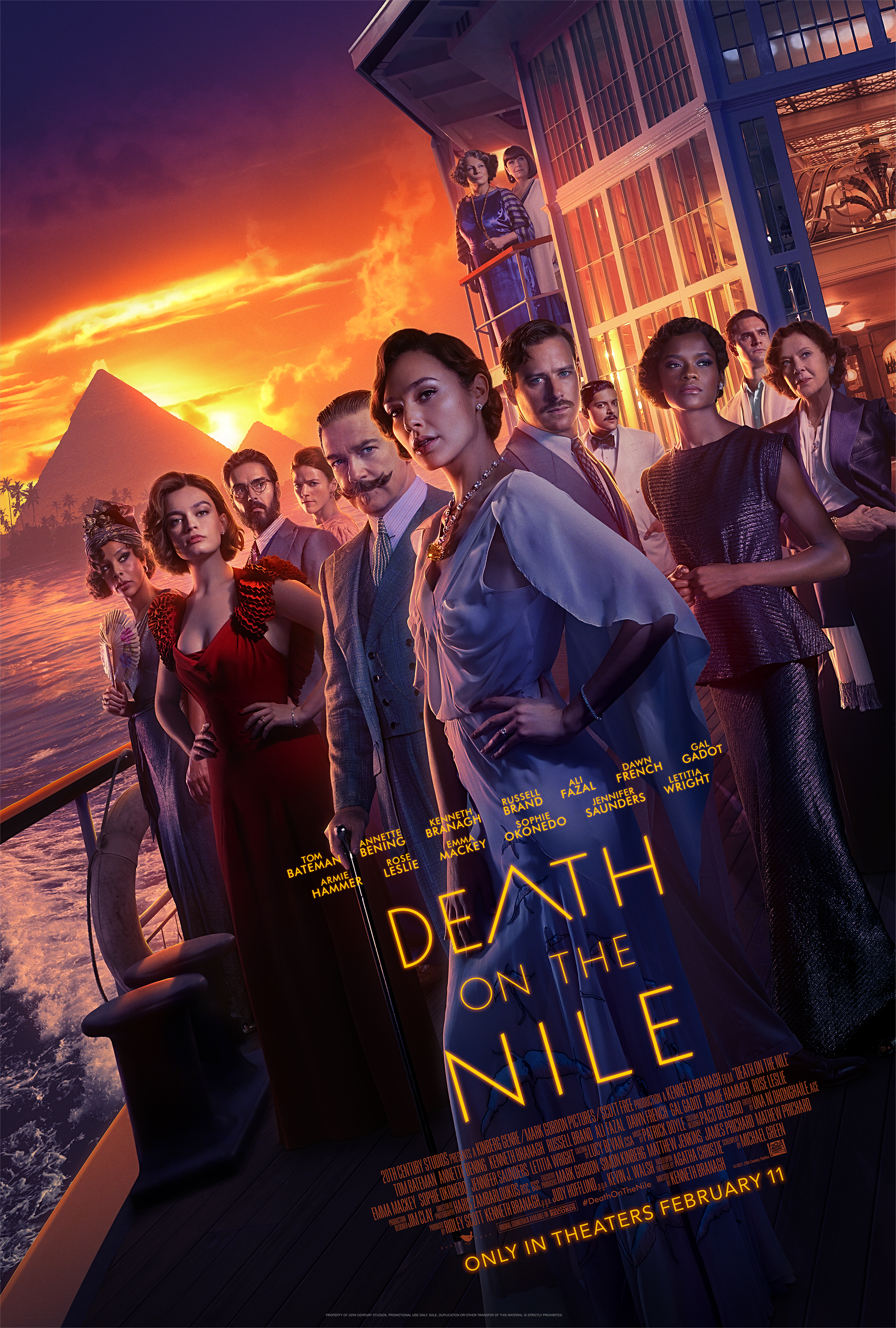
DEATH ON THE NILE whodunit film review

You’ll want to watch it again! Kenneth Branagh’s adaptation of Agatha Christie’s Death on the Nile takes everything you enjoyed about Murder on the Orient Express, and builds upon it to deliver a film that further proves that the subgenre whodunit remains timeless! Of course, much like with any murder-mystery or whodunit, it’s difficult to review without getting into spoilers. What I can tell you is that Death on the Nile boasts a stellar cast, exotic setting, and all the love and deception you want in a whodunit. Unlike the previous chapter in Branagh’s Agatha Christie adapted films, the Poirot we encounter feels more human. Contrary to previous TV and film adaptations, we witness the cracks in Poirot’s veneer, revealing his vulnerable side. Perhaps this may be another story with one of the best worst-kept secrets in literary history, but through Branagh’s direction and Michael Green’s screenplay, diegetic elements are added in order to entertain audiences with a fresh interpretation of the iconic literary work. Even after you learn who committed the murders aboard the luxury river cruise ship, you will instantly desire to watch again in order to find the clues that you missed.

Belgian sleuth Hercule Poirot’s Egyptian vacation aboard a glamorous river steamer turns into a terrifying search for a murderer when a picture-perfect couple’s idyllic honeymoon is tragically cut short.

There may be some naysayers out there that are unfairly negatively criticizing the (and I’ll be honest, somewhat predictable) solution to the mystery, you have to remember that this literary work and previous film/TV adaptations have been around for a very long time, and have served as significant influencers for all whodunits to come thereafter. Naturally, fans of the whudunit genre may be able to completely or partially guess the who, why, and how. The best way to enjoy this film is to go in as a fan of classical whodunits; if you do that, I am confident that you will thoroughly enjoy your time at the cinema!

Ryan teaches Film Studies and Digital Citizenship at the University of Tampa. If you like this article, check out the others and FOLLOW this blog! Interested in Ryan making a guest appearance on your podcast or contributing to your website? Send him a DM on Twitter or email him at RLTerry1@gmail.com! If you’re ever in Tampa or Orlando, feel free to catch a movie with him.

Follow him on Twitter: RLTerry1