Send Help is the rare survival thriller that understands the most dangerous thing on a deserted island isn’t nature—it’s the workplace baggage you bring with you.
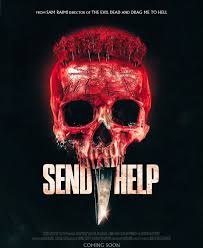
Send Help plays like a postmodern riff on Misery—less interested in replicating its mechanics than in reconfiguring its psychological cruelty for a contemporary workplace horror. One can also detect traces of Survivor, the underseen Office Killer (1997), and even a one-way echo of Fatal Attraction, though Raimi’s film resists the lurid sensationalism of those predecessors in favor of something more controlled, more ideologically curious. I went into Send Help expecting one kind of movie and walked out having experienced something far more interesting—and far more satisfying. What initially presents itself as a straightforward survival thriller gradually reveals a different set of priorities: character over carnage, tension over spectacle, and psychology over shock. The turn is not a bait-and-switch so much as a recalibration, one that rewards patience and attention.
A woman (Rachel McAdams) and her overbearing boss (Dylan O’Brien) become stranded on a deserted island after a plane crash. They must overcome past grievances and work together to survive, but ultimately, it’s a battle of wills and wits to make it out alive.
Despite containing remarkably little gore, Send Help is punctuated by moments of excruciating intensity—scenes engineered to linger in the mind the way Misery’s hobbling scene does, not because of what is shown, but because of what is anticipated. Raimi understands that true discomfort is often born from restraint. Violence, when it arrives, is not gratuitous; it is precise, purposeful, and deeply unpleasant.
Where Send Help distinguishes itself most clearly is in its thematic ambition. Raimi trades his trademark splatter for commentary on workplace dynamics—particularly the lived experience of women navigating environments shaped by misogynistic men, institutional indifference, and power imbalance. The film proposes that monsters are created—that violent behavior can be traced back to environment, circumstance, and provocation. While the film makes this argument with conviction, I remain unconvinced by its absolutism. Environment can shape behavior, yes—but it does not absolve agency. Some monsters are forged by their surroundings; others choose monstrosity despite them. Under most circumstances, we remain responsible for our actions.
That tension—between explanation and excuse—is where Send Help becomes most interesting. The film is less persuasive as a moral thesis than it is as a provocation, forcing the audience to wrestle with where empathy ends and accountability begins. In that sense, the island setting becomes more than a survivalist conceit; it is a crucible. A demented Gilligan’s Island, stripped of whimsy and comfort, where rescue is uncertain and survival demands agency. The film is clear-eyed about one thing: help does not always arrive. Sometimes survival requires seizing control rather than waiting to be saved.
Visually, the setting is striking—lush, isolating, and quietly menacing. The CGI animals, however, are nearly laughable, though thankfully used sparingly enough not to derail the experience. When Raimi relies on atmosphere rather than digital intrusion, the film is at its strongest.
Excellent casting anchors the film, thoughtful writing gives the conflict weight, and the thrills feel refreshingly old-school—earned through escalation and dread rather than excess. All of it is quietly underscored by moments of dark comedy that arrive not as winks to the audience, but as pressure valves, reminding us that sometimes the most unsettling laughs are the ones that catch us off guard. McAdams’ and O’Brien’s chemistry is exceptional. They play off one another with a rhythmic precision that feels almost musical—each reaction, pause, and escalation perfectly calibrated. Their dynamic does much of the film’s heavy lifting, grounding the psychological tension in something human and volatile. One hopes this pairing is not a one-off; there is genuine electricity here worth revisiting.
There is also an unintended—but revealing—meta-text hovering around O’Brien’s presence. In a recent Entertainment Weekly article, O’Brien noted that he has been repeatedly told by agents, producers, and directors that he needs an Instagram account—that without it, he risks losing roles deemed “appropriate” for him. He has no intention of starting one. As a film scholar, I find this deeply troubling. When talent, suitability, and longevity are increasingly filtered through social media metrics rather than craft, presence, and screen intelligence, the industry risks confusing visibility with value. Send Help, perhaps inadvertently, becomes part of that conversation—raising questions about how we identify monsters, merit, and worth in systems increasingly governed by optics.
Ultimately, Send Help is not a perfect film, nor is it a subtle one. But it is a thoughtful, unsettling, and frequently compelling genre exercise—one that uses survival horror as a vehicle for interrogating power, agency, and responsibility. Raimi may be experimenting here, but the experiment is a worthwhile one. If nothing else, Send Help reminds us that the most terrifying scenarios are not those where monsters appear—but those where we are forced to decide what kind of people we are when no one is coming to save us.

Ryan is the general manager for 90.7 WKGC Public Media and host of the show ReelTalk “where you can join the cinematic conversations frame by frame each week.” Additionally, he is the author of the upcoming film studies book titled Monsters, Madness, and Mayhem: Why People Love Horror. After teaching film studies for over eight years at the University of Tampa, he transitioned from the classroom to public media. He is a member of the Critics Association of Central Florida and Indie Film Critics of America. If you like this article, check out the others and FOLLOW this blog! Follow him on Twitter: RLTerry1 and LetterBoxd: RLTerry

 R.L. Terry ReelView