DUNE: PART TWO movie review

A visually spectacular motion picture with a killer score that’s the storytelling equivalent of a bridge to nowhere. Denis Villeneuve’s DUNE: PART TWO is perhaps the most movie you will watch this year, as there is such a prolific amount of a variety of subplots and conflict that all converge in a single intersection to create figurative gridlock on the highway of cinematic storytelling. There is no argument, Dune: Part Two delivers cinematic scale and scope, but the grand potential of this modern-era epic is hampered by poor screenwriting.

Paul Atreides unites with Chani and the Fremen while seeking revenge against the conspirators who destroyed his family. Facing a choice between the love of his life and the fate of the universe, he must prevent a terrible future only he can foresee.

Word to the wise, be sure to rewatch the first movie before watching Part 2, because you will likely feel as lost as I was in trying to follow the central characters and main plot. With so much going on, the plot map is all over the place; in fact, one can hardly call it a map, as it’s lacking any meaningful direction. Think of an entire limited run series, jampacked into a single movie. I spent most of my time feeling completely lost in attempting to follow the outside/action plot. Fortunately, there is more action in this second installment compared to Dune: Part 1, but, ironically, more action makes for an even less engaging movie. And since the first part was sleep inducing enough, I was shocked it was possible to achieve twice.

The real star of this movie isn’t one of the A or B-listers, it isn’t the director or writer, but it’s Hans Zimmer. Zimmer’s score is mesmerizing and immersive. It truly feels like a character in and of itself. There is a beautiful otherworldly quality about his score that draws you in (too bad there’s nothing of great substance into which to be drawn) to the Duniverse. An extension of the environment is how the score plays throughout the movie.

Not even the movie’s performative dimension is sufficiently engaging, save Austin Butler, his deplorable character of Feyd-Rautha is the most entertaining out of the ensemble. Except for a few moments here or there, the performative dimension is completely uneven as some actors over-act, others under-act, some are clearly phoning-in, whilst others are visibly bored with their character. Character development, or lack thereof, is another storytelling process that is rushed in some places and creeping along in others. Ultimately, there lacks any characters with whom the audience can empathize or with which to connect as there isn’t a single likable character in the whole Duniverse. But perhaps that’s the idea: sometimes in the real world, it can be difficult to identify the most likable side in a conflict, and that is what we have here. One of life’s complexities.

During the second act (and I use that term loosely as it feels like one big second act) of the movie, there is a sequence of scenes that take place on a grayscale planet–and it looks gorgeous!!! This was probably my favorite part of the movie because it felt like an old-school gladiator-like epic in a classic sword and sandle picture.

If there were miniatures used in the film, I had difficulty identifying them. Nearly everything that wasn’t a sand dune felt like it was computer-generated. When the special/visual effects, ships, and palaces feel more computer than practical, it takes me out of the movie. That’s not to say the CGI isn’t high fidelity–it certainly is. Speaking to the quality of Dune: Part Two‘s CGI, it is exceptionally well-made. But the problem is, and yes, I know I’ve said it a hundred times, you cannot replace the way real light bounces off real objects into the camera lens. Had this movie leaned into practical effects, models, and sets more, then used the CGI for extreme wide shots or to fill in what couldn’t be made through craftsmanship, then it may have helped to compensate for the poor writing.

It’s well-known that Frank Herbert’s novel was a response to the global powers and conflict during the Cold War. That thematic idea is carried into David Lynch’s original Dune in 1984 and even in the SyFy Channel limited run series from 2000. Even though there are elements of the Cold War commentary in this adaptation of Dune, the socio-political themes and critiques are far less cohesive. While I greatly appreciate the ability to read a film differently over the years and identify what a film’s message or commentary could mean at that given time, the ability to be read differently over time does not negate the need for coherency, cohesion, and consistency. What Villeneuve and Jon Spähts’ movie is missing is consistency in representation in their interpretation of the socio-political commentary they find is more important or relevant to spotlight today.

On a side note, one of the parts of the movie that I did find surprising was Rebecca Furguson’s character’s (I don’t even remember her name) unborn baby being treated like a person. There is even a scene in which it is all but acknowledged that a human exists within her character’s womb. Certainly caught me off-guard, because the manner in which this part of the movie is presented challenges the dominant ideology so often found in media and pop culture today.

If you plan to watch it, definitely watch it in cinemas in a premium format such as Dolby. I must say, I am glad I screened it in Dolby because the score, sound design, and the grand scale is what I enjoyed most.
Ryan teaches Film Studies and Screenwriting at the University of Tampa and is a member of the Critics Association of Central Florida and Indie Film Critics of America. If you like this article, check out the others and FOLLOW this blog! Interested in Ryan making a guest appearance on your podcast or contributing to your website? Send him a DM on Twitter. If you’re ever in Tampa or Orlando, feel free to catch a movie with him.

Follow him on Twitter: RLTerry1 and LetterBoxd: RLTerry

DUNE (2021) Review

Audacious sci-fi scale, but a vapid adaptation. Dune is a stunning sci-fi/action visual spectacle that delivers rich imagery and epic fight choreography; but falls short in translating the thoughtful, complex themes and mythology of the source material, which get buried in heavy handed exposition or are entirely cut. Dune (part one) is the first part of the of an epic sci-fi tale about Paul Atreides, son of Duke Leto of house Atreides and Lady Jessica, a sister of the Bene Gesserit who are sent by the Padisha Emperor from their home world Caladan to govern the Planet Arrakis after the Departure of House Harkonnen. If you haven’t read the book and this sentence sounds overly expositional and convoluted to you this is how you’re going to feel throughout 80% of the films dialogues. However, I’m sure you’re not going to see Dune for the dialogue and it has plenty to offer aside from that.

Director Denis Villeneuve wanted to make this a “Star Wars for adults” and with that he succeeded. Dune boasts impressive visuals and epic conflict but in a more mature manner than the Star Wars films. Instead of using colorful light sabers people are stabbing each other with actual knives. Still not much blood is seen, thanks to the film’s PG 13 rating, but that seems to be unavoidable in today’s industry. The Designs are kept very close to the book, especially the Ornithopters which actually have flapping wings unlike in previous adaptation by David Lynch. Some of it may be because of the improved technology after nearly 40 years but I believe the production designers were definitely trying to stay faithful to the source material. All in all the depictions of technology, lifeforms and other things will satisfy fans of the book, although the production design was a bit too monochromatic for my personal taste. The visual direction is similar to other works by Villeneuve: simple and effective. The camera itself is not here to show off. That’s what the Sandworms, spaceships and battles are for. The cinematography by Greig Fraser is dark and moody, which fits the more adult tone this film is going for.

Continuing with its mission to be an adult Star Wars, it’s also more complex editing wise with mystic visions by the protagonist Paul sprinkled throughout the film by Villeneuve’s frequent collaborator editor Joe Walker. The visual effects shots are done in similar manner to the rest of the camerawork. They are impressive but only there to move the story along and not at all show-offy. The hand to hand combat sequences, of which there are quite a few, most of which look very practical are impressive as well. One can clearly see the effort the actors put into making them appear so effortless. That also includes the main cast, no stunt doubles here! There is one early fight or rather training scene between Chalamet (Paul Atreides) and Brolin (Gurney Halleck) where their skills are put on full display.

Now the actors of which this film has many and many famous ones also did very well, even despite the fact that most of their job consists of spouting exposition and fighting. Rebecca Ferguson as Paul’s mother Lady Jessica being the clear standout and stealing every scene she’s in. Timothée Chalamet has his edgy teenager moment, which in this case fits the character who is still coming to terms with his new place in the complicated conflicts and power structures of Dune but doesn’t really have any other stand out moments. Zendaya, the other perhaps controversial star of this film, also doesn’t stand out much, neither in a negative nor positive way. Her character only really appears in the film towards the end so there’s not really enough to see for a final verdict.

Now on to the not so good aspects of the film. Although the conflict in Dune is still very complex and probably closer to Game of Thrones than Star Wars it’s still very simplified if not dumbed down compared to the complex political intrigues and power plays of the novel to fit the limited runtime of the film format. The complex world of the Dune universe also has to be explained to viewer somehow, which here is mostly done through expositional dialogue. The exposition is well integrated to the story as Paul, the protagonist is also learning about most of these things but it can become a bit overbearing as said before. This can leave viewers who are not familiar with the source material overwhelmed and confused about the particularities of the story and story world. Nevertheless the film should still be enjoyable as an epic sci fi tale about family, power and mysticism, even if it takes some time to understand surrounding lore. Hopefully this film will also motivate a new generation of Dune fans to dive into the world that Frank Herbert created in his books.

Written by German correspondent Leon Zitz.
Be sure to check out his Instagram to see what he’s working on!

“Blade Runner 2049” film review

Just as mesmerizing as the original! Denis Villeneuve’s Blade Runner 2049 is nothing short of a future classic that demonstrably possesses the soul of the original and pairs it with a new plot brought to life by a fantastic cast. Every minute is filled with beautiful cinematography that is perfect in every way and a haunting score that penetrates down to the bone. At its core, Blade Runner 2049 wrestles with this one central question: what does it mean to be human? A question that can spawn hours of debates or an exquisite nearly three-hour motion picture. Considering that Ridley Scott has not delivered the same quality for which he provided precise and poignant direction, it was a solid decision to attach Villeneuve as the director. This sequel 35 years in the making may not have had the classic Ridley Scott at the helm, but Villeneuve channels his inner Scott to provide audiences with the same profound cinematic experience today as Scott did when Blade Runner first released. From the color palette to the lighting to the sound design, this motion picture is one that typifies the power of the art of motion pictures and one that will surely be regarded as iconic as the years more along, very much in the same way that the original has been regarded over time.

Officer K (Ryan Gosling) is tracking down the remaining legacy Replicant models created by the infamous Tyrell Corporation, and his latest mission takes him to an obscure farm in the middle of dessert California. After retiring the replicant at the farm, K uncovers what will become a metaphor for Pandora’s Box, as it opens a mystery that law enforcement and the Wallace Corp. seek to solve. The secret contained within the box is one that could potentially plunge all “humanity” into complete chaos, not there there isn’t enough of that already for those left on earth. K’s journey takes him from the gritty, grimy streets of Greater Los Angeles to the dust bowl that was once Fabulous Las Vegas. There, he meets former Blade Runner Deckard  (Harrison Ford) who has been hiding from law enforcement and the Wallace Corporation for three decades. Together, they must work to locate the miracle that no one ever could have thought would happen–or could happen.

Despite not pulling the numbers that Blade Runner 2049 was forecasted to bring in over its October opening weekend, the film did what fans wanted–it kept the very essence of the original movie alive and well. For all the artificial intelligence in the film, there is nothing artificial about this long-awaited and highly anticipated sequel to the Ridley Scott classic. The reason for not pulling the numbers that it was predicted to do can likely be attributed to the tone of the film and the stylistic filmmaking approach that borders on neo-noir meets the avant-garde. Although not completely necessary, it is incredibly helpful to have seen the first film. And seeing the first film gives an appreciation for the sequel that cannot be experiences without having knowledge of the first. The slow-pace and dark atmosphere may be some of the reasons why more people did not wish out to see it as the weekend moved along. Looking at the two films side by side, this film is a direct extension of the original so the authenticity of this universe and story is genuine and almost visceral. For those who prefer more dialog or higher concept plots, the film may not strike the same level of enthusiasm because of the heavy visuals and dark themes in addition to the profound questions. This combination is not one that will attract the general populous in doves; however, this film IS what it needed to be. Sometimes a long-awaited sequel has to be made to remain true to its soul because that is what the fans want to see, and it’s the true fans who continue to visit the cinema year after year. Blade Runner 2049 may not win over new fans, but it keeps the diehard ones happy.

At the heart of Villeneuve’s cinematic masterpiece are existential questions that drive the plot forward. A plot driven by such questions told through a sedated pace is one that is not as easy to digest as one that is more superficial and more rapidly paced. Still, these questions are profound and cause one to think hard about what it means to be human. What sets this film apart from other science-fiction rapid fire blockbusters is the commitment to visual storytelling and the art of creating a motion picture. Blade Runner 2049 mirrors its predecessor and remains true to the experience of the first. Cinephiles will especially appreciate this film for it harkens back to a time when German expressionism was at the foundation of the set design and lighting. There are many exaggerated and elongated shapes that exist in a world of harsh shadows and dimly lit alleys throughout the film. Although the look of the future world in the original was one that audiences may not have believed would come true or could come true is seen differently by today’s audience that can easily see just how accurate the world of the Blade Runner movies actually is–the mediation of society today seems to be not that far off from this not-so-distant future.

Cinematographer Roger Deakins captures a wold through the lens that seems to go on forever in a world of greys and beiges. The only color to be found is in the prolific advertising on the sides of buildings. Deakins further extends the artistic approach to the cinematography by paying homage to Stanley Kubrick’s The Shining in a shot that was actually added to one of the more recent recuts of Scott’s Blade Runner. That score, though. The sound design and score are an audible extension of the visual landscape. Composers Benjamin Wallfisch and Hans Zimmer have created one of the most haunting scores to ever be heard in the cinema. The combination of ghostly groans and blood curdling howls echo the very look and feel of the landscape. I’ve rarely encountered such an immersive sound design and score in a film. Just as the world on screen is an uneasy place to live and one that contains faint images of the grandeur of a world that once was, the score accompanying this motion picture places you in the midst of this post-apocaltyic world that most natural-born humans have left.

Definitely a film that I want to watch for a second time in order to appreciate this film, boasting with artistic achievement, even more than I already do. Although most of the themes and subtext are centered in and around “what it means to be human,” there is a real message regarding the importance of bees. An important visual statement in the film because the populations of bees, the most prolific pollinators, are dwindling. Not for the casual movie-goer, this film is for those who want to experience a sequel in the vein of the original that shows the artistic side of the creation of motion pictures.

“Arrival” movie review

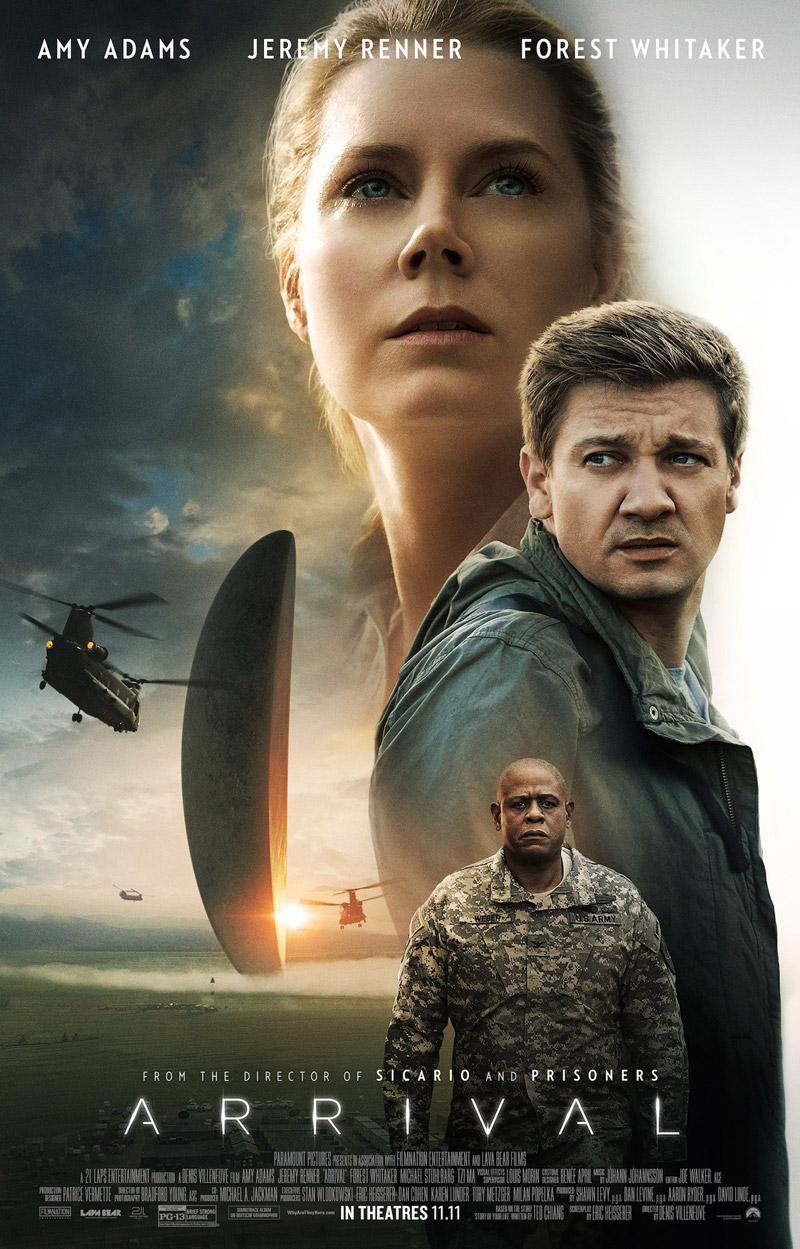
arrivalposterYou’ll want to see it again. Prepare yourself for an extraordinary cinematic journey in this science-fiction thriller complete with commentary on the human condition. From the exhilarating cinematography to the incredible awe-inspiring visual effects, Arrival will have you hooked from the very beginning. Based on the book Story of Your Life and Directed by Denis Villeneuve (SicarioPrisoners), Arrival boasts an outstanding cinematic experience that is as much cerebral as it is visceral. Your very perceptions of time and memory will be questioned and force you to open your mind to endless possibilities. Poignantly, this film takes you on a journey that will show you that we need to change and that we can change. On the verge of avant-garde, Arrival pushes the limits of traditional visual storytelling and creates an innovative method for conveying social commentary within the science-fiction genre. Following the final fade to black, you’ll want to discuss this film with your friends. Reignite your sense of wonder. Arrival is more than a story; it’s an experience!

After twelve egg-like unidentified objects land on earth, the U.S. Government calls upon expert linguist Dr. Louise Banks (Amy Adams) and theoretical physicist Ian Donnelly (Jeremy Renner) to crack the mystery and develop a means of communication with the homogenous alien species. While much of the world is on the brink of an all-out assault on the aliens, Banks is determined to establish a rapport and open communications with the species. Starting with basic words and working up to complex sentences, Banks knows she has to learn the aliens’ language in order to better understand why they have come. When things take a turn for the worst, Banks and Donnelly have precious little time to stop countries from engaging in battle with risk of war. With so little time to unravel the mystery of why the aliens are here and what they want, Banks will find herself on a mind-blowing journey of her own.

You’ve just got to see it. There is so much that I want to talk about, but it would spoil so much of the film. I’ve mentioned before that there are great ‘movies’ that are mediocre ‘films,’ but this is a prime example of an excellent movie AND brilliant film. The brilliance of this film is not in the stunning visuals, although that is certainly part of it; the brilliance lies within the cinematic and experiential storytelling. During the big reveal at the end of the film, your mind will be blown. You’ll find yourself wanting to watch it again to more clearly understand the strategic placement of the pieces of the puzzle. During a time in which the country appears so incredibly fractured, this film will provide audiences with a renewed sense of wonder and appreciation for that which one may not fully understand. Making the tough calls and putting one’s life at risk of what is right is also woven throughout this story. The theme of Arrival is not fully realized until the latter half of the film. More than a surface-level story about that which I cannot mention without giving it away, this film possesses a dynamic range of themes just beckoning for interpretation. As this film bares much similarity to avant-garde cinema in the reimagining of traditional storytelling, it will evoke a powerful emotional response.

Amy Adams and Jeremy Renner deliver outstanding performances in the lead roles. Taking center stage for most of the film, Adams breaks new ground as an actor in this role that is nearly a complete departure from most of her other roles. Both Adams and Renner display excellent chemistry in their respective characters. Although Adams is the central character and responsible for the drive of the plot, Renner is strategically placed to reinforce the affects Adams’ character has upon the plot. Forest Whitaker also plays a strong colonel and was an excellent choice for his role as well. The success of the cast can be attributed to both the outstanding direction from Villeneuve and the incredible screenplay by Eric Heisserer. Bradford Young’s cinematography is so simple but yet so beautiful and profound. It is of no surprise that this film is being touted as one of the best movies of the year and has a nearly unprecedented 100% on Rotten Tomatoes.

Whether you are a linguist yourself or just enjoy an exhilarating cinematic journey, Arrival is definitely the film to catch this weekend. For the Star Trek TNG or Voyager fans out there, you will find that Arrival possesses some of the same great content that sets Star Trek apart from other science-fiction shows due to the human condition being central to the overall plot. If you enjoy movies that prompt you to revisit how you perceive your life, time, or space, then you will not be disappointed. There are so many levels to this film. You’ll likely find yourself wanting to see it again after fully realizing the innovative plot. Hopefully this film receives some Oscar noms in the upcoming award season.