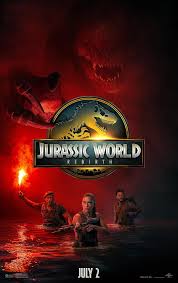
JURASSIC WORLD: REBIRTH movie review

Possesses dino DNA, but missing strands and sequences, leaving an uneven and forgettable movie. Jurassic World: Rebirth begins with an intriguing enough premise, but the characters are poorly written, which is then amplified by way of a subplot that only serves to clutter the story. After a rough first two acts–except for a thrilling and fantastically written T-Rex chase scene (that was part of Crichton’s original novel and script for Jurassic Park)–the third act is surprisingly exciting and suspenseful, and at times terrifying.

Zora Bennett (Scarlet Johansson) leads a team of skilled operatives to the most dangerous place on Earth, an island research facility for Jurassic World. Their mission is to secure genetic material from dinosaurs whose DNA can provide life-saving benefits to mankind. As the top-secret expedition becomes more and more risky, they soon make a sinister, shocking discovery that’s been hidden from the world for decades.

Perhaps Koepp’s screenwriting works best when the original version of a script is written by the novel’s author (which, I know wasn’t possible for this movie in more ways than one), and he then crafts the original version to be more effective for the screen. To put it simply, no one knows what is going on or when/where they are. Harsh? Not really, when the movie opens with lazy exposition through on screen text describing an event that happened 17 years ago…keep that in mind, 17 years (placing it in line with Jurassic World not Jurassic Park). But then the characters talk about the research and development facility as if it was connected to the original park–not possible. Even popcorn movies should adhere to the logic of their own world building. It’s as if no one thought about the events that unfold in this movie, and how they relate to the previous movies. Kind of basic storytelling logic.

There are many elements of this movie that fail to make any logical sense (and again, that is the logic setup by the movie itself) or are setup, and never developed or connected to any motivation or stakes. To go into them, would take too much time.

Aside from logic problems, the movie is plagued by poorly written characters, an extraneous, shoehorned subplot, and weak first and second acts (with one exception in the second act that was thrilling). While I appreciate the minimalistic cast of characters compared to the cast of characters in all the Jurassic World movies, there are two competing groups that are pretty much independent of one another and could have each been in their own movie altogether. Yet, somehow, they are sloppily fused together in this movie. For argument’s sake, we’ll call them the Mercenaries and the Family. The Mercenaries and their outside/action plot are fine–I’d even go so far as to say ‘that’ story is sufficiently interesting. The Family and their plot felt extraneous and ultimately of little importance to anything that happened. It’s as if there were two different movie ideas (1) centered on the Harvesters and (2) the Family. And I think either by itself would have made for a better movie than putting them together. These decisions left the movie feeling muddled and crowded.

There is a T-Rex sequence in the second act that is fantastic! It very much harkens back to the sci-fi horror-adjacency of the original movie. Of course it helps that Crichton’s original Jurassic Park novel and screenplay thereof contained a similar sequence. Fun fact: this sequence in the novel and original Crichton screenplay served as the inspiration for Jurassic Park: The Ride at Universal Studios parks. It plays out wonderfully in this movie, like a short film in and of itself, because it’s setup well, developed strategically, and resolved thrillingly.

Even though there are a couple of characters that are almost fun or compelling to watch (almost), the rest are more disposable than a red solo cup at a frat party. You’ll find yourself rooting for the dinosaurs to win. Of all the characters, there is one particularly so annoying and deplorably behaved, that you’ll want the first dinosaur you see to pick him off, (and question why on earth his girlfriend would be with him and why the dad would let the boyfriend walk all over him–answer, bad writing). Other characters are one-dimensional or the casting choice never sells the character. All around, there are many character and casting problems, resulting in a movie wherein you’ll hope the next dino attack happens soon–and preferably ends with one less character.

Where the movie “finds a way” to leave you on a high note, is in the third act. Despite the slapdash screenwriting throughout the first and second acts, the third act is wildly entertaining and even at times, terrifying! It almost compensates for the first hour and forty-five minutes. The (weird) dinos are “monsters” again, and the various chase sequences each offer something different (even though one is a recreation of the Kitchen Scene from the original movie). The stakes are raised and the level of terror leaps off the screen. So often, movies start well and fail to stick the landing; with this one, it fails to stick the launch but definitely sticks the landing.

SUffice it to say, if you took the first two acts from The Lost World: Jurassic Park, and paired them with the third act from Jurassic World: Rebirth, then you’d actually have a pretty good, memorable movie.

As an OG Jurassic Park fan (and Lost World apologist, except for the third act), I hate having to write reviews such as this one for a franchise installment. But, the more I thought about this movie, the more stupid it became. I suppose it’ll make for a fun enough 4th of July weekend watch, but doesn’t do much beyond that.

Perhaps, these movies will “find a way” back to greatness one day–doubtful as it seems.
Ryan is the general manager for 90.7 WKGC Public Media in Panama City and host of the public radio show ReelTalk “where you can join the cinematic conversations frame by frame each week.” Additionally, he is the author of the upcoming film studies book titled Monsters, Madness, and Mayhem: Why People Love Horror. After teaching film studies for over eight years at the University of Tampa, he transitioned from the classroom to public media. He is a member of the Critics Association of Central Florida and Indie Film Critics of America. If you like this article, check out the others and FOLLOW this blog! Follow him on Twitter: RLTerry1 and LetterBoxd: RLTerry
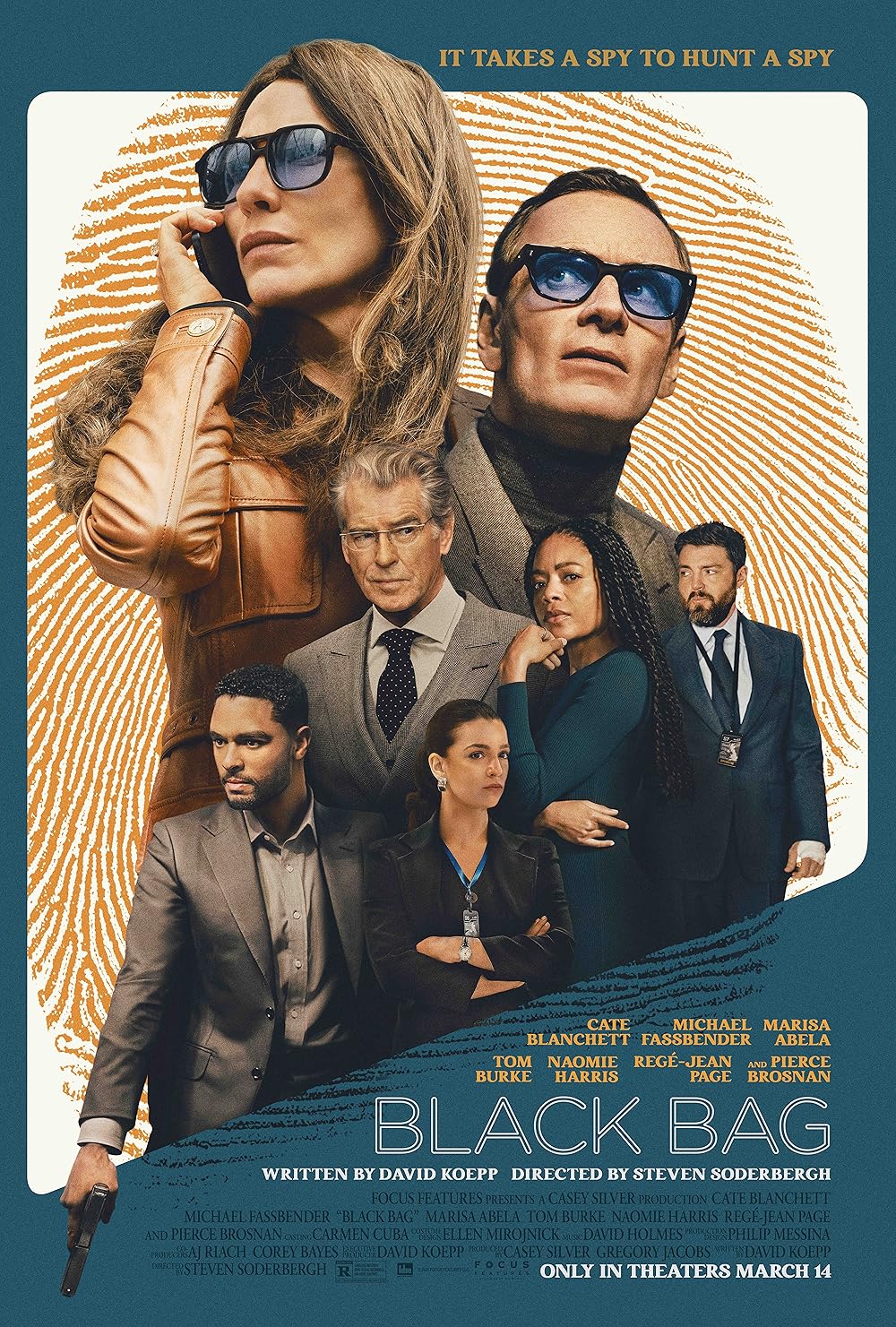
BLACK BAG film review

A sleek and suspenseful espionage thriller. Steven Soderbergh teams up with screenwriter David Koepp to craft a cinematic world of intrigue and deception in Black Bag. The duplicitous nature of the film is witnessed in the gripping marital drama that underscores the covert spy activity. Rooted in themes of trust, betrayal, and the cost of secrecy, this film places audiences deep within the labyrinthine world of British intelligence, where loyalty is as much a weapon as it is a liability.

When his beloved wife, Kathryn, is suspected of betraying the nation, intelligence agent George Woodhouse faces the ultimate test — loyalty to his marriage or his country.

Michael Fassbender and Cate Blanchett lead the charge as George Woodhouse and Kathryn St. Jean, a married couple whose bond is tested when George is tasked with unmasking a mole inside the British National Cyber Security Centre (although not stated, the Centre is reminiscent of MI6). When suspicion falls on Kathryn, the mission becomes personal, forcing the couple into a high-stakes psychological chess match where every move could be their last. David Koepp’s screenplay strikes a deft balance between razor-sharp dialogue and simmering tension, drawing audiences into a narrative that is as much about human connection as it is about spycraft.

Fassbender delivers a layered performance, portraying a man caught between duty and devotion, while Blanchett’s enigmatic presence keeps audiences guessing until the final frame. Their electric chemistry brings an emotional weight to the thriller, grounding the high-stakes espionage with raw, personal stakes.

Adding depth to the intrigue is an exceptional supporting cast, including Naomie Harris as a perceptive psychiatrist and Regé-Jean Page as a brash but brilliant operative. Each performance contributes to the film’s palpable atmosphere of uncertainty, where shifting alliances and hidden motives drive the tension ever higher.

Soderbergh’s signature directorial style is on full display, with dynamic camerawork, crisp editing, and a refined aesthetic that gives Black Bag an effortlessly cool veneer. Complemented by David Holmes’s pulsating, jazz-infused score, the film moves with a rhythmic intensity that keeps the tension taut from start to finish.

David Koepp’s screenplay is a masterclass in taut, intelligent storytelling, seamlessly blending espionage thrills with deeply personal stakes. The interplay between George and Kathryn is laced with suspicion and longing, making every conversation feel like a battle of wits. Koepp’s ability to navigate shifting alliances and hidden motives ensures that no scene feels wasted, keeping audiences engaged in a labyrinth of deception. While the plot’s complexity demands careful attention, the payoff is both satisfying and thematically rich, cementing Black Bag as a sleek and sophisticated entry in the spy thriller genre. My only negative critique of the screenwriting is that Koepp’s screenplay does suffer from some poor pacing in the first act. 

While he doesn’t play a prominent role in the film, seeing former Bond Pierce Brosnan return to (what we may as well call) MI6 was a nice treat and nod to his tenure as the definitive fictional British spy.

While some may find the intricate plotting requires a close watch, the payoff is worth the investment. More than just a spy thriller, Black Bag is a stylish, smart, and suspenseful exploration of trust in a world where deception reigns supreme. A must-watch for fans of sophisticated espionage cinema.

Ryan is the general manager for 90.7 WKGC Public Media in Panama City and host of the public radio show ReelTalk about all things cinema. Additionally, he is the author of the upcoming film studies book titled Monsters, Madness, and Mayhem: Why People Love Horror. After teaching film studies for over eight years at the University of Tampa, he transitioned from the classroom to public media. He is a member of the Critics Association of Central Florida and Indie Film Critics of America. If you like this article, check out the others and FOLLOW this blog! Follow him on Twitter: RLTerry1 and LetterBoxd: RLTerry
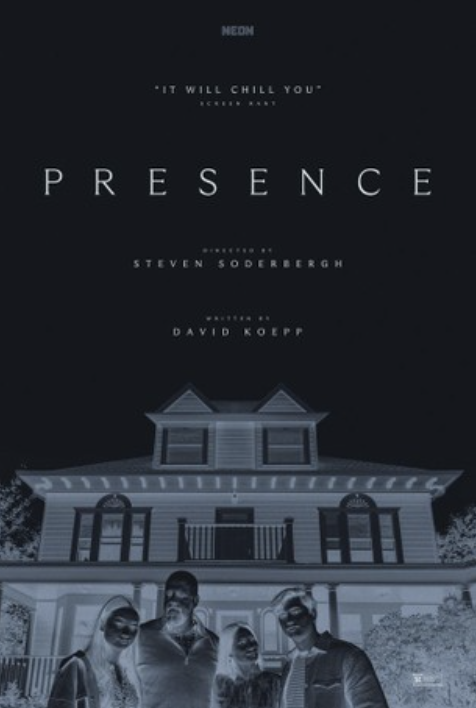
PRESENCE horror film review

It’s, well, interesting. As soon as I saw that David Koepp was the screenwriter, I was instantly intrigued. While I’m hit or miss with Soderbergh, I’m generally hit with Koepp. But, I find this film’s apparatus to be more interesting than the story itself. While Presence is ostensibly a ghost story, it derives much of its intrigue–not from its narrative–but from its formal and technological apparatus. Soderbergh, known for his experimental approach to filmmaking, employs an innovative first-person perspective; however, this stylistic choice, coupled with Soderbergh’s meticulous control over framing, lighting, and movement and Koepp’s minimalist screenplay, resulted in elevating the film’s formal qualities above its forgettable plot and one-dimensional characters.

In short, the film is about a family that moves into a suburban house and becomes convinced they’re not alone.

The film unfolds through the perspective of an unseen spectral presence, effectively turning the camera into an active participant rather than a passive observer. This shift from traditional storytelling to experiential cinema foregrounds the act of seeing and being seen, inviting viewers to consider their own complicity in the voyeuristic aspects of horror. The film’s reliance on long takes and fluid camerawork creates an unsettling sense of omnipresence, emphasizing the medium’s ability to manipulate space and perception.

While Koepp’s screenplay is serviceable in its exploration of haunted house tropes, it often feels secondary to the film’s preoccupation with its own form. Koepp’s screenwriting is characterized by minimalistic dialogue and a structure devoid of conventional plotting. Rather than relying on his penchant for exposition-heavy scripts, Koepp wrote a screenplay that relied primarily on subtext and visual cues, thus inviting the audience to experience the story through mood versus visually-driven stimuli. The film’s thees such as literal and metaphoric isolation, family dysfunction, and the effects of trauma, feel much more like scaffolding for Soderbergh’s technical experimentation than an actual story. Koepp’s unconventional screenplay paired with Soderbergh’s experimental filmmaking results in a film wherein the mechanics of cinema take precedence over traditional storytelling.

Ultimately, Presence is most compelling when considered as an exercise in film form rather than a compelling story itself. The filmmaking apparatus generates a more profound engagement than its plot and characters, which hurts the potential this film had given its pedigree of talent. Soderbergh and Koepp crafted a film that is less about a haunted house and more about reimagining the voyeuristic capabilities of cinema itself. By leveraging cutting-edge camera systems and post-production techniques, Soderbergh set out to blur the line between observer and observed, in an attempt to create an uncanny sense of intimacy and detachment, but it failed to stick with this critic long after the credits rolled.

Ryan is the general manager for 90.7 WKGC Public Media in Panama City and host of the public radio show ReelTalk about all things cinema. Additionally, he is the author of the upcoming film studies book titled Monsters, Madness, and Mayhem: Why People Love Horror. After teaching film studies for over eight years at the University of Tampa, he transitioned from the classroom to public media. He is a member of the Critics Association of Central Florida and Indie Film Critics of America. If you like this article, check out the others and FOLLOW this blog! Follow him on Twitter: RLTerry1 and LetterBoxd: RLTerry
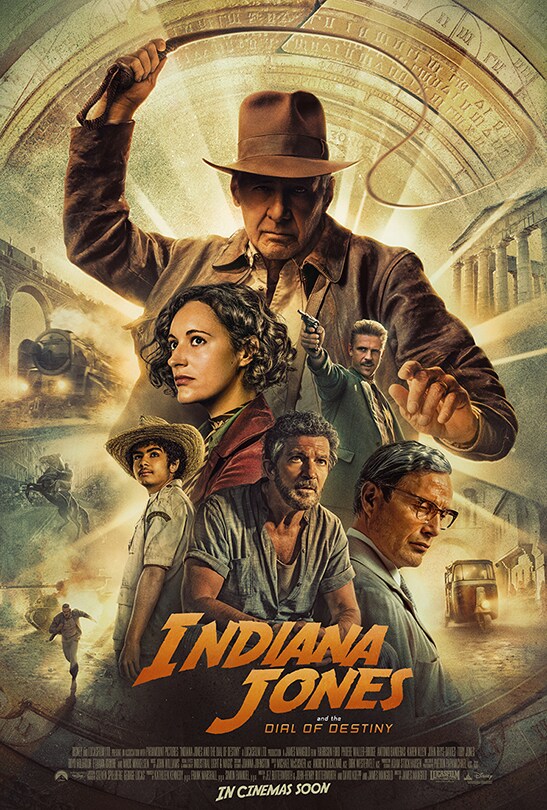
INDIANA JONES: AND THE DIAL OF DESTINY movie review

And the dial of mediocrity. While the movie’s charm lies in the classical action-adventure premise and tone, Harrison Ford’s final performance as the titular adventurous scholar ends with a forgettable movie devoid of the humor, tension, scale and scope of the first three Indiana Jones movies. Moreover, the screenplay suffers from poor pacing and lack of character-building. However, it’d be unfair to characterize the movie as being completely uninteresting. In fact, Indiana Jones: and the Dial of Destiny is a fun enough throwback movie for the whole family to enjoy.

Daredevil archaeologist Indiana Jones races against time to retrieve a legendary dial that can change the course of history. Accompanied by his goddaughter, he soon finds himself squaring off against Jürgen Voller, a former Nazi who works for NASA.

The James Mangold helmed fifth and final installment in the Indiana Jones franchise is neither bad nor good enough to be memorable. Moreover, neither does the movie deliver in setting nor technical achievement.

Speaking of technical achievement, any overly negative reports of the de-aging of Ford, in the protracted prologue, are greatly exaggerated, nor does the CGI in the rest of the movie feel obtuse or too overt. On the contrary, I was greatly concerned for the exchange of practical effects for CGI on the levels of being distracting. While I noticed here and there, it wasn’t what I would characterize as highly conspicuous.

Gone is the grand scale and scope of the first three Indiana Jones movies in exchange for a world that feels as if it could fit in a space the size of Guam. For an action-adventure movie, it struggles to deliver on either. If we boil it down to its storytelling DNA, does it check off the basic requirements of an action-adventure movie? Sure. I won’t take that away from the movie. But does it excel at any one of those elements? Aside from remaining clean enough for the whole family to enjoy, no, it does not. While it is certainly a better story than Crystal Skull, unfortunately, Crystal Skull is more memorable than this installment (albeit, for all the wrong reasons). Dial of Destiny certainly feels way closer to the first three Jones movies than Crystal Skull ever will. It is of the same DNA, but not expressed nearly as thoughtfully or charismatically as the original trilogy.

As I’ve stated countless times before, (except for rare occasions) when a movie’s writer (or editor) and director are the same person(s), then there fails to be a sufficient check and balance system narratively. Mangold has shown that he is capable of both, I cite Logan, but that was perhaps the exception while Dial is the rule. There is a good story in this movie, but nothing was executed by storytellers that truly cared. I was shocked to see David Koepp’s name attached to this movie, because he took Michael Crichton’s original Jurassic Park screenplay and shaped it into the masterful story we’ve been enjoying for three decades. Crichton provided the novel and screenplay bones and circulatory system, but Koepp crafted the muscle and skin. Dial of Destiny does not feel like a Koepp screenplay, but perhaps Mangold flexed his directorial muscles too much and Koepp’s genius was lost.

Oh, as an aside, no Helena, that’s just called stealing. Perhaps go back to school and take an economics class. Come to think of it, that would have been a funny Jones line in the movie. And the movie was in desperate need of comedic relief.

The movie opens with plundering Nazis, in classic Jones fashion, and we are introduced to a 30, 40-something Dr. Henry Jones Jr. The prologue (which makes up most of Act I) delivers all the trappings of a classic Indiana Jones movie, but it goes on, and on, and on for nearly a half-hour. And it wouldn’t’ be so bad if this half-an-hour significantly impacted events in Acts II and III, but it ultimately sets up very little. Is it a fun and somewhat exciting method for returning audiences to the 1930s and 40s world of Indiana Jones, definitely. But does it fail to justify its protracted sequence of events? Also yes. The movie’s pacing would have beeb greatly helped by cutting the prologue down to 10–15-minutes. Think: opening of Indiana Jones: and the Last Crusade. I’ve a feeling that’s what Mangold was going for in this movie.

There is one plot device that this prologue does foreshadow, and if you think it’s never going to go there, guess again. I’ll leave it at that to avoid spoilers.

I’d be remiss not to comment on the charm of the movie. While it may suffer from many problems that hold it back from reaching beyond mediocrity, there is no doubt that it delivers the throwback premise and tone we love about these classical action-adventure movies. I just wish it had more action and adventure in the storytelling mix. I appreciate the movie for remaining true to form (in its most simplistic form, but form nevertheless), and not increasing adult visual content or language in order to be perceived as with it. Increased adult content is not the mark of a franchise maturing over time, in fact, it’s a cheap gimmick that devalues. There are certainly times and places for it, but an Indiana Jones. movie was not it. So it can be praised for keeping the content, tone, and form of classical action-adventure alive–on life support–but alive.

Not sure why Disney is releasing this for the week of July the 4th, because it works much better as a Father’s Day movie.

Ryan teaches Film Studies and Screenwriting at the University of Tampa and is a member of the Critics Association of Central Florida and Indie Film Critics of America. If you like this article, check out the others and FOLLOW this blog! Interested in Ryan making a guest appearance on your podcast or contributing to your website? Send him a DM on Twitter. If you’re ever in Tampa or Orlando, feel free to catch a movie with him.

Follow him on Twitter: RLTerry1 and LetterBoxd: RLTerry