PREDATOR: BADLANDS movie review

Predator: Let’s Play. When streaming content hits the big screen.
Predator: Badlands is the equivalent of a “Let’s Play,” but with bigger explosions. The nonstop action, constant motion offer little to no substantive emotional investment. You’re an observer, not a participant—which might be fine for streaming, but it’s a strange fit for cinema. The latest in the Predator franchise plays like a two-hour sizzle reel with delusions of grandeur. It’s a glossy barrage of explosions, digital dust, and quippy one-liners that evaporate before they even hit the floor. By the time the credits roll–that’s if you haven’t fallen asleep—you’ve seen everything and felt nothing. It’s not that the film is aggressively bad—it’s that it’s aggressively empty–little more than content to pander to short attention spans with shiny movement instead of meaningful momentum.

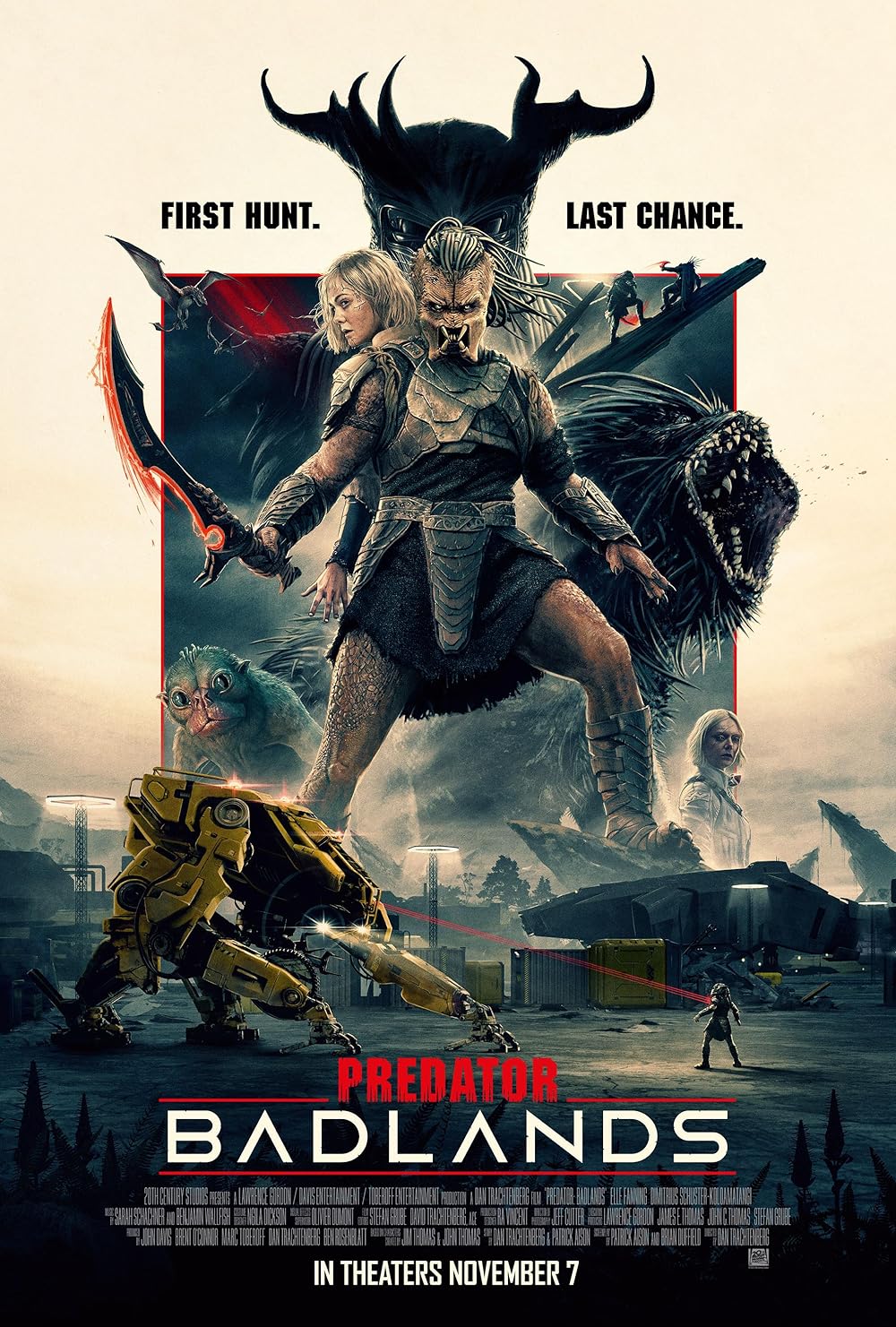
Cast out from its clan, a Predator and an unlikely synthetic ally embark on a treacherous journey in search of the ultimate adversary.

The screenplay feels like it was written by an algorithm trained on reaction videos and Reddit threads. Every line of dialogue sounds like a placeholder; it’s as if someone said, “We’ll fix it later” or “funny line here,” and neglected to return to the page in order to fix it–before principle photography. There’s no sense of escalation, tension, or rhythm; it’s a series of flashy moments loosely stitched together, like a highlight reel of a game you didn’t play. Even the humor feels synthetic–much like the characters– punching at air instead of connecting with character or tone.

As for the characters, they exist mostly as camera targets. They are little more than digital avatars running, shooting, and shouting for reasons that never feel personal or compelling. The lead could be replaced by a different actor mid-film and you might not notice. This critic isn’t even convinced that Dek (our central Predator character) wasn’t entirely CGI, though it may have only been the facial area. “What’s my motivation?” Difficult to say–there wasn’t much upon which to build. Motivations are paper-thin, arcs nonexistent. The Predator itself, once a symbol of primal fear and unseen menace, now feels like a boss-level NPC waiting to be triggered by the next quick-time event.

Visually, Badlands has all the spectacle money can buy; but its spectacle is divorced from any meaningful purpose. The explosions are massive, the sound mix thunderous, and yet it’s as emotionally engaging as watching someone else play Call of Duty. Every frame screams “look at me!” without ever inviting you to feel something. The editing, too, is manic. And it’s not even as though the narrative demanded it; rather, the dynamic editing was most likely employed because the movie was terrified that you’d look away or down at your watch, which I did several times.

And maybe that’s the point. Predator: Badlands is far less like a movie and more like a cinematic exercise in a large scale “Let’s Play.” For those that are unfamiliar with the term, it’s a type of (usually) YouTube video of someone playing a video game and often their reactions to the game play. Think of it as a passive experience of someone else’s thrill ride. The ultimate, disconnected form of living vicariously. Don’t question anything, because it won’t take long to realize that this movie is hollow. You don’t engage; you just witness. The irony is that the film could’ve been a fascinating critique of screen-mediated experiences, but it never once stops to think.

This is just the latest in a growing trend from Disney’s genre arm: a reliance on brand nostalgia and visual polish in place of storytelling. Ever since the corporate appetite turned to IP recycling, the studio has mistaken familiarity for depth. Badlands is what happens when you try to “optimize engagement” instead of crafting a narrative, resulting in the film equivalent of clickbait dressed in billion-dollar armor.

Predator: Badlands doesn’t so much hunt its audience as it does chase its own tail. A movie that is fast, flashy, and utterly pointless; and desperately wants to go viral but forgets to be cinema. You don’t leave exhilarated; you leave wondering if you accidentally spent $15 to watch a YouTube compilation in IMAX.

Ryan is the general manager for 90.7 WKGC Public Media and host of the show ReelTalk “where you can join the cinematic conversations frame by frame each week.” Additionally, he is the author of the upcoming film studies book titled Monsters, Madness, and Mayhem: Why People Love Horror. After teaching film studies for over eight years at the University of Tampa, he transitioned from the classroom to public media. He is a member of the Critics Association of Central Florida and Indie Film Critics of America. If you like this article, check out the others and FOLLOW this blog! Follow him on Twitter: RLTerry1 and LetterBoxd: RLTerry
AVATAR: THE WAY OF WATER movie review

AKA The Way of Woker. James Cameron’s highly anticipated followup to Avatar (2009) is an ambitious world-building visual effects extravaganza that is a predictable, poorly paced and plotted movie, which is plagued by many problematic elements in both substance and form. Moreover, it’s a 3-hour movie that feels like a 3-hour movie, for which no amount of impressive visual displays can compensate. Often times, a filmmaker’s ideology can be interpreted through a critical analysis (or close reading), but the blatantly anti-west (or pro applied postmodernism) sentiment is right there on the surface of this troublesome movie. Suffice it to say, all the themes can be summarized as the destruction of modernity, which is manifested in various motifs. From beginning to end, Cameron’s Avatar: the Way of Water is anti-military (literally uses Marines “semper fi”), anti-western medicine, and propagates postcolonial theory (which I write about in my review of Black Panther: Wakanda Forever). It’s one thing to critique or question a societal observation; it’s another to actively work to completely deconstruct and shame entire groups of people and cultures. Cinema is a powerful tool because film is a reflection of life and can help us better understand the human experience; however, Cameron’s latest movie is a reflection of his disdain for the west (by extension, modernity), and wielded more like an offensive weapon than clever storytelling tool. The themes, reeking of applied postmodernism, aren’t the only problematic issues plaguing this 3-hour epic, but the story structure itself suffers from poor pacing and a proliferation of subplots that fail to work together to craft a compelling narrative.

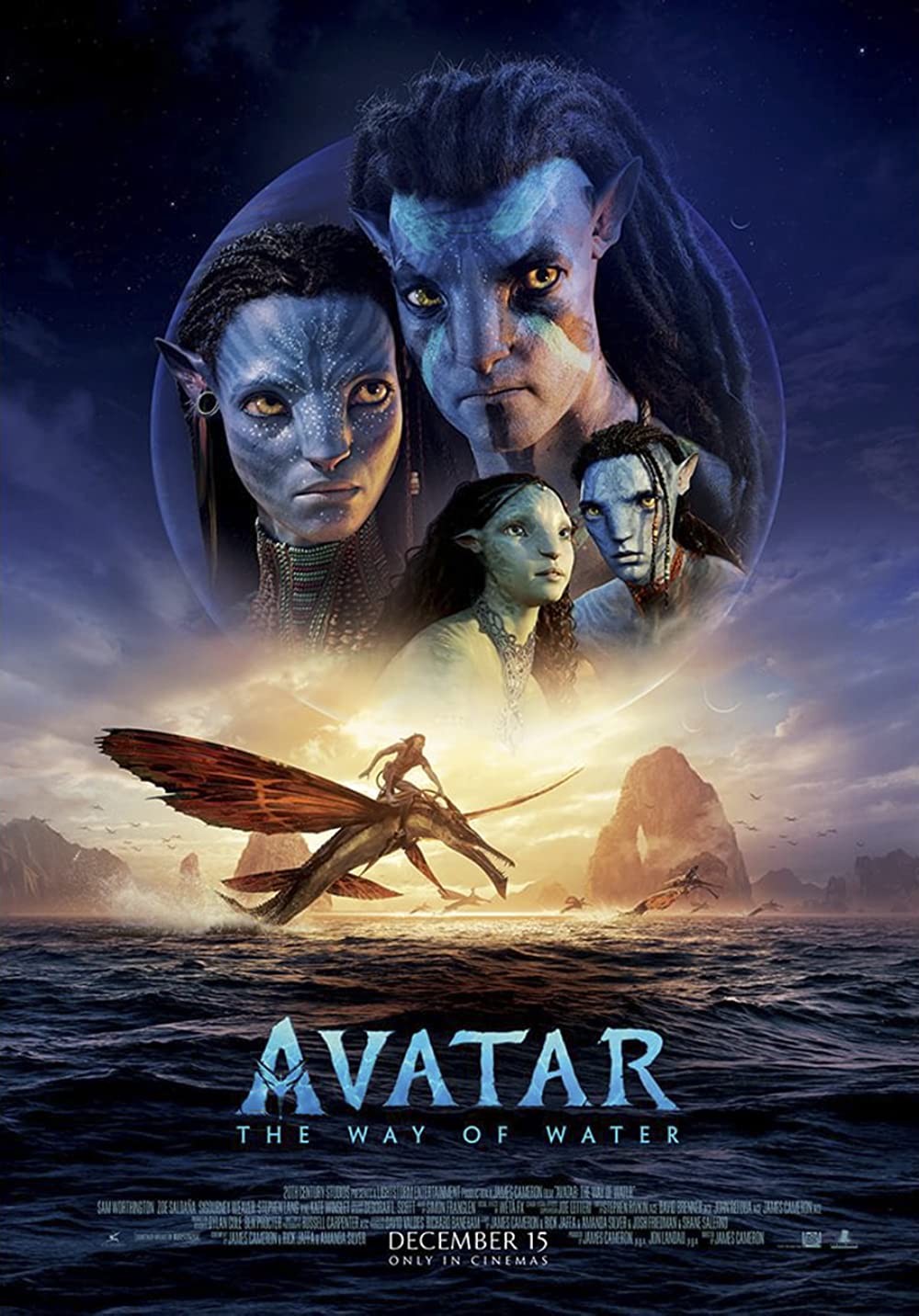
Jake Sully and Ney’tiri have formed a family and are doing everything to stay together. However, they must leave their home and explore the regions of Pandora. When an ancient threat resurfaces, Jake must fight a difficult war against the humans.

Overstuffed with one-dimensional characters devoid of character arcs, Cameron appears to be more concerned with his ideology than creating thoughtful characters. Heroes that are projected as nearly flawless and invincible seldom connect with audiences because it is often our flaws, failings, and lessons-learned that connect us to one another. When villains fail to display any likable qualities, the villain fails to connect with audiences, thus erasing any possible entertainment value. More specifically, central and opposition characters should share similar goals; however, what makes villains and heroes different is HOW they express their methodologies to reach the goal(s). The most interesting characters of opposition are those with human dimension and characteristics that can be appreciated; likewise, the most interesting central characters are those with flaws and weaknesses that make them relatable. Our heroes are flawless and our villians utterly detestable. That is NOT a good character mix or balance.

Moreover, the film’s characters demonstrate a gross representation problem. Nearly all the human characters are white men–not one person of color and only one prominent female character. In a day and age in which reasonable, fair representation in media is important (again, as film is a reflection of life, it should look like real life), Cameron ignores fairness in representation. While some may find this to be a coincidence, it is not. Every diegetic element of the mise-en-scene montaged into a film is intentional. Because of the clear manifestation of postcolonial theory, this can be read as Cameron’s method for perpetuating the sentiment that white people (particularly men) are toxic by nature. Before you say I am extreme in this interpretation, in a recent interview, Cameron stated, “testosterone is a toxin that must be worked out of the system.” Not only is this a shameful statement, it’s grossly inaccurate. Neither testosterone nor estrogen are problems that need solved. Both are biology, plain and simple. Each respectively amoral.

Cameron’s anti-military sentiment is the most provocative of all his themes concerning the complete destruction of modernity (the goal of applied postmodernism). Where he crosses the line, is referencing the para-military presence as Marines, and evoking the rallying cry of semper fi. Undoubtedly, this is not going to sit well with the U.S. military and general public (nor should it). Ostensibly painting one’s country/military in a negative, inaccurate light is inexcusable. Again, it’s one thing to critique, it’s another to actively shame and attack. If he wanted to use a para-military force, he would have been better off crafting this one to be FORMER military that have been privatized for exploratory and extraction purposes. Sell swords as Game of Thrones would put it. Even that may have painted the military in a negative light, but it wouldn’t have been so blatant and aimed at a particular branch of the U.S. armed forces.

With all the themes, symbols, and motifs Cameron includes in the movie, the plotting is insufficient to support such a mess of ideas and stories. Perhaps he should revisit the screenwriting tenants of writing lean or starting a scene as close to the end as possible, and ending it as soon as possible. These tenants of screenwriting help to prevent a bloated, fatty screenplay. As it stands, the storytelling in Avatar: the Way of Water is clunky and forced. Often times the reason for something happening is simply because the plot needed it. This makes for a predictable story, one that is devoid of anything remotely constructive, fun, or inspirational.

Lastly, I’d be remiss if I failed to mention the many references to Flight of Passage in the World of Pandora at Disney’s Animal Kingdom. Many of the creatures from the flagship attraction and surrounding area are found within this movie. I rather enjoyed identifying elements that were lifted from the hugely popular and impressive attraction. If you do see this movie and have been to Pandora, then look to see if you can find some of the land and sea creatures from the attraction.

At the end of the day, this movie is a reminder that spectacular visual effects does not a great movie make.

Ryan teaches Film Studies and Screenwriting at the University of Tampa and is a member of the Critics Association of Central Florida. If you like this article, check out the others and FOLLOW this blog! Interested in Ryan making a guest appearance on your podcast or contributing to your website? Send him a DM on Twitter. If you’re ever in Tampa or Orlando, feel free to catch a movie with him.

Follow him on Twitter: RLTerry1