MICKEY 17 film review

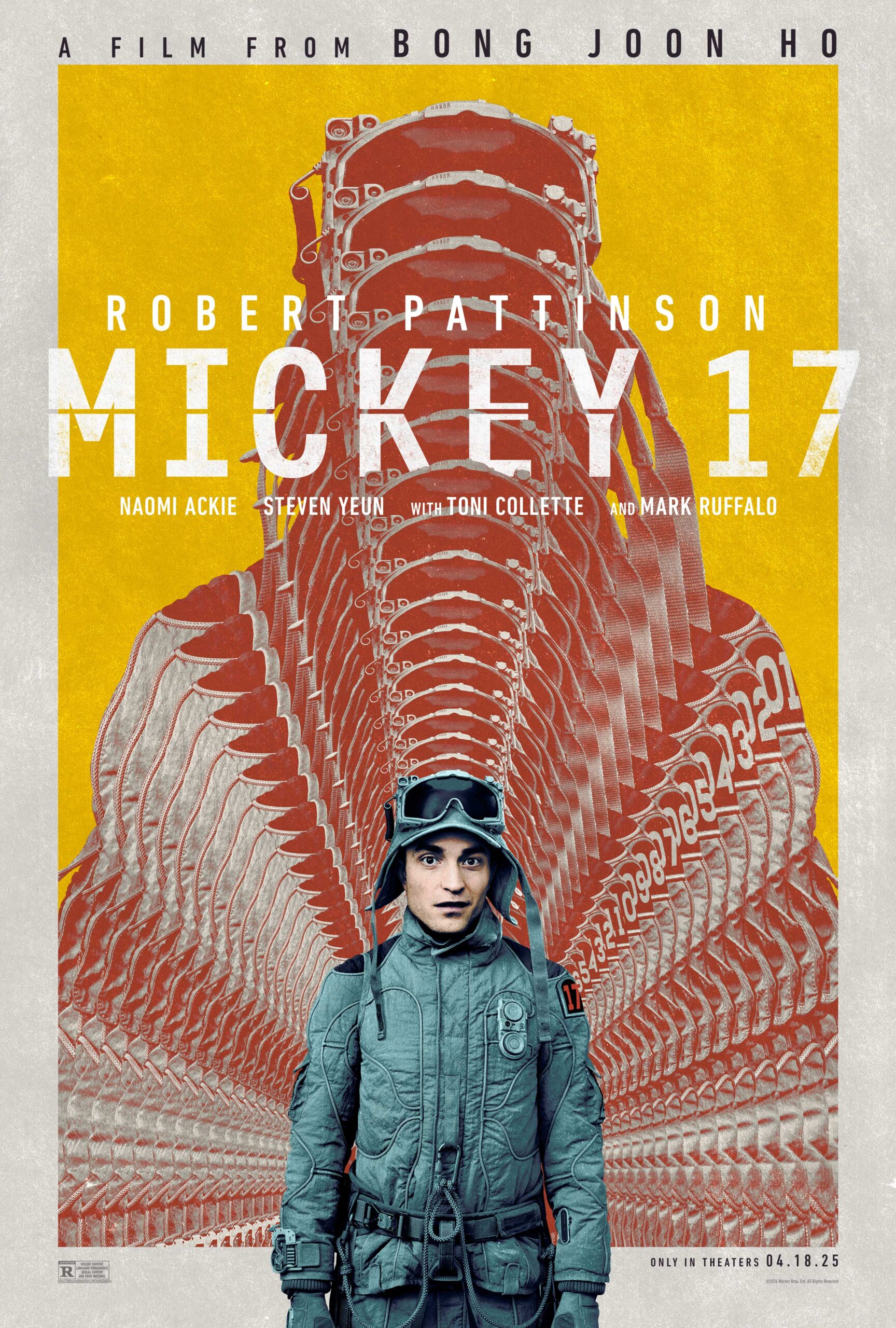
Ambitious but disjointed. Bong Joon-ho’s newest film Mickey 17 excels in technical achievement but the full impact of the story demonstrates greater concern for its satire, message, and world building than it does its plotting and structure. Blending multiple genre conventions, Joon-ho’s science-fiction, dark comedy begins with an intriguing premise underscores with existential questions, but ultimately doesn’t feel cohesive from beginning to end. Despite the exhaustive satire–which is entertaining at first–the film works excellently as a critique of the prolific mediation of society, obsession with the idea of self-made celebrity, and the camera fame. Additionally, it presents an exploration of humanity’s fixation on replication and surveillance. Perhaps the film doesn’t call out any particular app or platform, it certainly drives home the point that a monster can be created through obsession with one’s image, control, and manipulation of others.

Mickey Barnes (Robert Pattinson), a disposable employee, is sent on a human expedition to colonize the ice world Niflheim. After one iteration dies, a new body is regenerated with most of his memories intact.

Despite an intriguing premise, the narrative often succumbs to prolonged scenes and sequences, subplots that lack meaningful purpose, and over-explanation in come places whilst lack of purpose exists elsewhere. While the third act is strong and completely engaging, the first act is protracted and the second act is plagued by poor pacing brought on by a wandering direction. The protracted first act delays audience immersion into the core narrative. What would’ve served the plot better as a brief prologue, turns into most of the first act. Even though the film maintains a modicum of innovation and freshness, it struggles to sustain momentum, resulting in a clunky and disposable experience.

The film delivers a relatively strong performative dimension, which helps to keep the audience engaged–however weak the engagement–in the story. And, Robert Pattinson performance strikes a nice balance between nuanced and manic, which mimics the film’s darkly comedic tone. Between his and the other leading actors performances, collectively they add a rolling punchline to the monotony of many scenes and sequences in the film. Mark Ruffalo’s depiction of the authoritarian leader, Kenneth Marshall, is audacious and campy, but doesn’t take long for this performance to become exhaustive–a little goes a long way with Marshall. Playing Marshall’s wife is horror-fan favorite Toni Collette, and even her character overstays her welcome in most of the scenes in which she appears.

Both the plotting and character issues can be connected to the screenwriting, which lacks direction, purpose, and refinement. Mickey 17 is another example of a director with a great, even innovative movie idea, but should work with a screenwriter with a command of proper screenwriting conventions and mechanics to craft the story for the page, and eventually the screen. This issue is not unique to Joon-ho, but a recurring problem I find with many (if not most) writer-directors. Few directors can write as well as they direct; and the inverse is also true–few screenwriters can direct as well as they can write.

Mickey 17 serves as a critique of the mediation of society, wherein informative, entertaining, and surveilling media technologies devalue the individual resulting in individuality with dimension being reduced to a character or commodity to be traded and exploited for the sake of ratings and celebrity. Mickey’s existential crisis of repeatedly dying and being reprinted underscores the alienation experienced in a society that commodifies human existence. Furthermore, Keneth Marshall’s obsession with control and his self-made celebrity mirrors the obsession many have, in the real world, with their “celluloid” self–or more accurately today–their digital self.

Everything Marshall said or did was ran through an image consultant and production crew on how it would look on camera. Looking at the real world, each of those squared images on Instagram or vertical video on SnapChat or Tik Tok, only show an edited version of the subject–the framing and editing is specifically manipulated and articulated to shape the audience’s perception. While this is to be expected in motion pictures and television shows, many of these self-made celebrities and influencers on social media want the audience believe they are being authentic, when it’s all a facade. In this obsession with the camera and “framed” image, society is exchanging that which is real with a projected authenticity; furthermore, the lines between what which is real and that which is fictionalized (or augmented) are becoming increasingly blurred.

Bong Joon-ho’s Mickey 17 blends satire with science fiction but the film’s underdeveloped plot and uneven character portrayals prevent it from reaching the potential this film demonstrably had with the talent behind it.
Ryan is the general manager for 90.7 WKGC Public Media in Panama City and host of the public radio show ReelTalk about all things cinema. Additionally, he is the author of the upcoming film studies book titled Monsters, Madness, and Mayhem: Why People Love Horror. After teaching film studies for over eight years at the University of Tampa, he transitioned from the classroom to public media. He is a member of the Critics Association of Central Florida and Indie Film Critics of America. If you like this article, check out the others and FOLLOW this blog! Follow him on Twitter: RLTerry1 and LetterBoxd: RLTerry
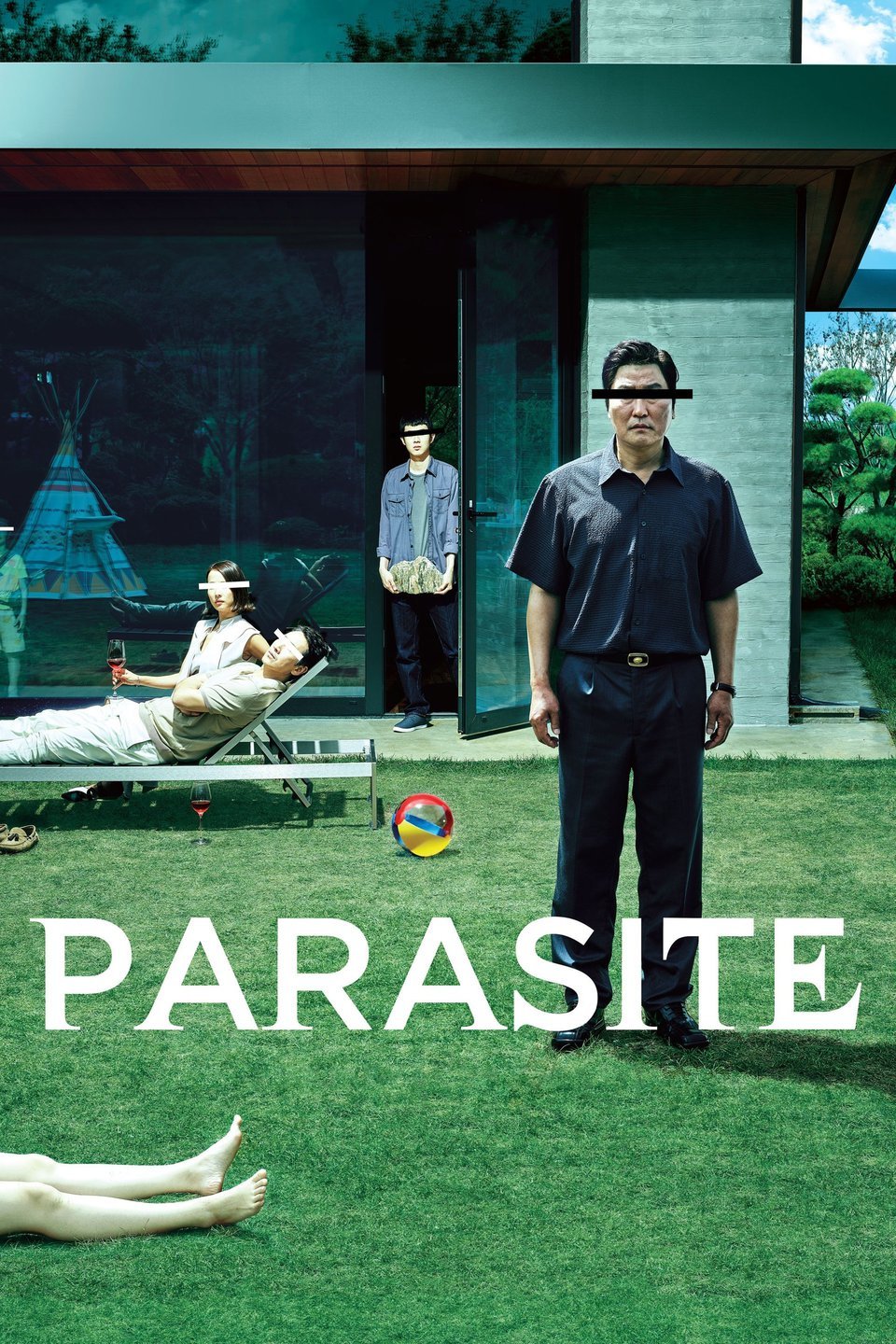
“Parasite” art house film review

An international film with domestic relevance. Writer-director Bong Joon-Ho delivers a thought-provoking satire on the widening gap between the haves and have-nots. Winning the coveted Palme d’Or at the Cannes Film Festival, Joon-Ho’s film is perhaps a new interpretation of the Wes Craven cult film The People Under the Stairs with a brilliant message of the lengths one goes to climb out of poverty in a world of massive income and opportunity disparity. For those whom may be worried that you’ll be distracted by the subtitles, you needn’t worry. To be perfectly candid, the visual storytelling and acting is so incredibly good that you won’t need the subtitles to follow the story. You’ve no doubt heard from the various critic circles that this film is a masterpiece, that it’s one of the best films of the year. That hype train is barreling past station after station, will it ever come to a stop? The short answer is not any time soon. But is the hype justified by the cinematic experience? In the opinion of this critic, no. I had incredibly high expectations for this film based upon everything I was hearing and reading, but it just didn’t do it for me. After the brilliant first half of excellently crafted suspense, foreshadowing, and plot setup, the second half loses the intrigue and just takes one convoluted turn after another for the sake of complicating the plot in an effort to make it say more than it actually does. Much of the griping tension is lost by the time the anticlimactic showdown comes to pass. What hampers the execution of the second half is taking too many predictable turns. It’s like a research paper that has a brilliant thesis, background, literature review, and method section, but the results are lacking in advancement. But, what the film lacks in plot execution, it makes up for in lavish visuals and exquisite production design. That house is a character in and of itself! While it may not be the best film of the year, it is one to watch in order to support original, independent stories that are slowly dying because of the increased difficulty to seek funding and theatrical distribution in a world dominated by superheroes, space fantasy, and remakes of animated classics.

Jobless, penniless, and, above all, hopeless, the unmotivated patriarch, Ki-taek, and his equally unambitious family–his supportive wife, Chung-sook; his cynical twenty-something daughter, Ki-jung, and his college-age son, Ki-woo–occupy themselves by working for peanuts in their squalid basement-level apartment. Then, by sheer luck, a lucrative business proposition will pave the way for an insidiously subtle scheme, as Ki-woo summons up the courage to pose as an English tutor for the teenage daughter of the affluent Park family. Now, the stage seems set for an unceasing winner-take-all class war. How does one get rid of a parasite? (IMDb)

Where this film shines brightest is the production design, specifically the house and neighborhood designed and built specifically for the film. Honestly, this is on Kubrick levels of cinematic immersion. From a principle photography point of view, this allows for the structures to (1) be designed to accommodate the action, blocking, and general movements of characters (2) externalize emotion or bring to light a reality that lies beyond our naked eye and (3) allow for efficient camera movement, artistic placement, and simply brings the setting in the screenplay to life to the very last detail. As I watched the film, I wondered where they found the perfect basement apartment and upscale house because the locations fit the characters and narrative perfectly. Then when I learned that both locations (not to mention the Ki’s neighborhood) were custom built, then it make sense how it could have been so perfect. That is commitment to narrative integrity right there! From the architecture to the interior design and furnishings, the art direction of this motion picture is astounding! It certainly stands out against the backdrop of most of the films to have hit theatres this year in terms of its visual appeal, scope, and scale of the story.

You’ll be hard pressed to find another film this year that has the brilliant setup that this one has. From the moment the film opens, you are hooked. All throughout the first act, the conflict that we are going to encounter in the second act is setup and foreshadowed with extreme precision. It doesn’t take long to develop these characters as members of South Korean society that are having a tough time climbing out of poverty; furthermore, the first act paints a portrait of a world that appears to be stacked against them. All that changes when a cousin gets one of them hired as a tutor to a wealthy family. For how the rest of the setup unfolds, you’ll just have to watch the film. I appreciate how this film takes the home invasion plot premise to a new level by subverting what we expect from home invasion or heist films. In addition to developing our ensemble cast of central characters, the first act also successfully provides excellent exposition so that the audience never feels lost in this non-english speaking film. Sometimes American audiences can get lost in international films because of the language and cultural barrier. Fortunately, the language is never an issue in this film and there is virtually  character for everyone in the audience to connect or empathize with. From the opening until about midway through the film, the plot is engaging, suspenseful, and the tension ratchets up greatly.

Unfortunately, most of the tension and suspense begins to decline as we near the anticlimactic showdown of the film. This is where the film lost me. Not lost me in that I couldn’t follow it–quite the contrary–I found the latter half of the film predictable and derivative. Gone is the ingenuity that I loved during the first half. There was such genius in the setup that I expected more out of the conflict and resolution. Don’t get me wrong, the film is still enjoyable and even intriguing at times in the second half, but not nearly to the levels it was during the first act. It’s almost as if Joon-Ho did not imagine the ending before writing the second act. There is stark contrast between the precise focus and direction of the first half and the lack of direction in the second half. There are some moments that I want to highlight from the second act though, that I truly liked. There is a scene in which the Park family boy notices that all the newly hired help smell the same. Of course, his parents dismiss that as childish foolishness, but thanks to dramatic irony, we know that he is close to ruining the entire charade.

More than than the film itself, I am mystified by the intense hype train that continues to zoom through social media, picking up new people at every turn. It’s a good film, but I cannot reconcile the motion picture I saw with the proliferated accolades on social media the the web. You’ll hear that this is “the best film of the year,” but just a couple weeks ago, The Lighthouse was the best film of the year, and before that many claimed that Midsommar was the best film of the year. Seems like we get a best film of the year every few weeks. The danger of dissenting opinions on films like Parasite and The Lighthouse is the critic and cinephile establishments seeking to revoke your membership card because your taste is simply not refined enough to appreciate the artistic masterpiece right in front of you. Of course, it is entirely possible that the film is just not AS outstanding as so many want to claim that it is, but jump on that hype train out of fear of missing out or being seen as an outsider. So to that point, I feel that Parasite is a solid film, even excellent in the first act, but the second and third acts hold the film back from its full potential to truly be a masterpiece of cinematic art.

Ryan teaches screenwriting at the University of Tampa. If you like this article, check out the others and FOLLOW this blog! Interested in Ryan making a guest appearance on your podcast or contributing to your website? Send him a DM on Twitter or email him at RLTerry1@gmail.com! You can catch Ryan most weeks at Studio Movie Grill Tampa, so if you’re in the area, feel free to catch a movie with him!

Follow him!

Twitter: RLTerry1

Instagram: RL_Terry