
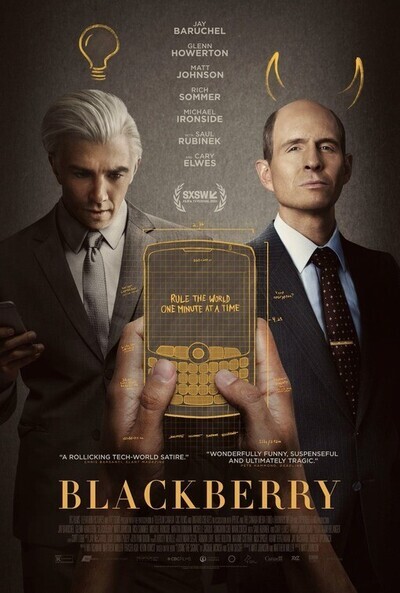
BLACKBERRY film review

Positively kinetic! This wildly entertaining biographical drama just clicks on so many levels! From beginning to end, the film commands your attention as it delivers razor sharp dialogue and outstanding performances. Whether you are a former CrackBerry addict like myself (2007–2011) or are fascinated by how the world’s first smartphone came to be, there is something for everyone in this film.

BlackBerry explores the incredible growth and tragic collapse of the world’s first smartphone and how it smashed huge enterprises before surrendering to Silicon Valley’s fiercely competitive companies.

Destined to be a film shown in business and technology classes, this cautionary tale is a brilliant depiction of what happens when you give into the system you so desperately tried to avoid or the dangers of extreme naivety and stubbornness. Moreover, the characters are both repulsive and sympathetic. You will both empathize with their plight and shake your had at the obvious missteps that would eventually lead Research In Motion, which rocketed to the top of the tech food chain, to its cataclysmic downfall. It’s in the vein of Wolf of Wall Street and The Big Short.

There is a Greek tragic or mythological quality about this film as it reminds me of the story of how Icarus flew too close to the sun and had his wings clipped. BlackBerry was king of the smartphone world for however brief a time, but its impact upon the industry will be felt in perpetuity. But this movie isn’t about the history of smartphones per se or even the company Research in Motion itself, but rather three human stories of the men whom founded, developed, and (two of which) eventually crashed the company. So, it’s a very human story.

There are three different personalities at play in the film, each represented by one of the key figures int he meteoric rise and cataclysmic fall of BlackBerry/Research in Motion. Jim Balsillie (played by Glenn Howerton) represents insatiable greed and control, Mike Lazaridis (played by Jay Baruchel represents insecurity and naivety, and Doug Fregin (played by Matthew Johnson) represents childlike pride and blind belief. Each one of these men, especially the former two, played significant roles in the rise and fall of Research in Motion. Each one demonstrated a tragic flaw that was instrumental in the eventual demise of the tech giant. Greed, naivety, and pride greatly limit resiliency, adaptability, and teachability. And it’s the refusal to apply common sense and adapt that sent BlackBerry to the exit for Defunctland.

Everything works so demonstrably well in this film! The directing, screenwriting, and performative elements are all working at peak efficiency and at incredible precision. However, even efficiency can have a downside; and in this film, the third act’s pacing isn’t quite on par with the first two. Often times in films, it’s the first or second acts that suffer from poor pacing, setup, or development; but in BlackBerry, it’s the third act. That said, it’s still mostly written and directed well, but the third act is wherein we do find flaws in the story delivery.

From the three central characters to the chief supporting players, the performances are outstanding! Supported with razor sharp dialogue that snaps, crackles, and pops, all the actors will entertain you from beginning to end! It’s one of few films this year that feels quotable and earns multiple rewatches. Perhaps the performances border on caricatures or exaggerated versions of the real people, but they are appropriate for the over-the-top nature of the film. BlackBerry was, at a time, a larger than life company, ran by larger-than-life people, so the performative dimension should be just as over-the-top, which it was, and in all the best ways possible.

One might be tempted to refer to this movie as a depiction of the word’s most famous losers that quite literally paved the way for iPhone, Galaxy, Pixel, and more. Believe it or not, if it wasn’t for Research In Motion/BlackBerry chartering new territories and pioneering new communications technologies and formulas for data/voice coverage, we may not have iPhone or Galaxy today. BlackBerry simultaneously created a new communications device and completely re-imagined how cell service works on principle. The characters are fascinating and the story mesmerizing. Easily one of the year’s best films!
Ryan teaches Film Studies and Screenwriting at the University of Tampa and is a member of the Critics Association of Central Florida and Indie Film Critics of America. If you like this article, check out the others and FOLLOW this blog! Interested in Ryan making a guest appearance on your podcast or contributing to your website? Send him a DM on Twitter. If you’re ever in Tampa or Orlando, feel free to catch a movie with him.
Follow him on Twitter: RLTerry1 and LetterBoxd: RLTerry

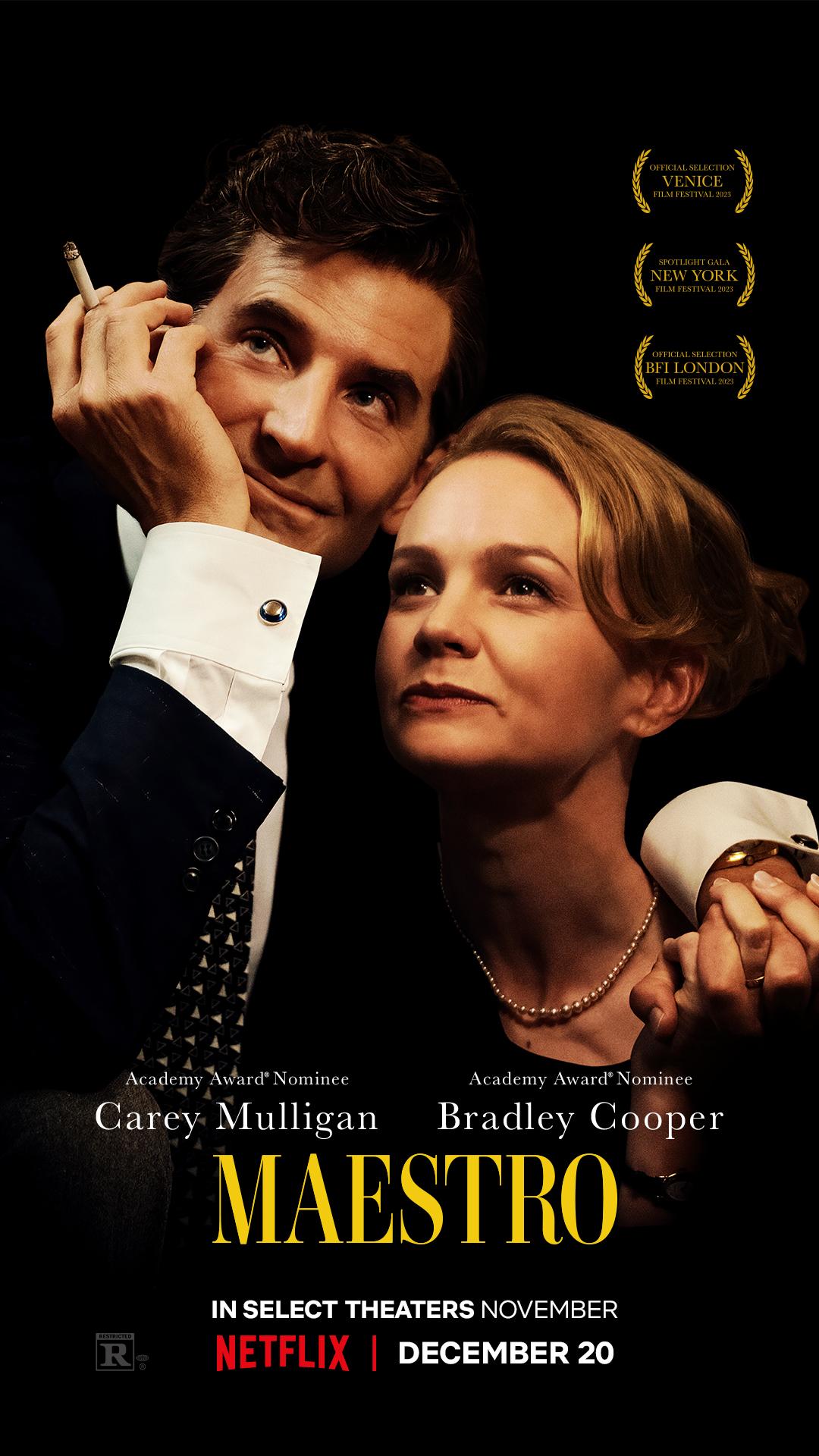
MAESTRO film review

Maestro‘s reach exceeds its grasp. Bradley Cooper’s biopic on Leonard Bernstein is an exemplary motion picture in many respects, but ultimately its potential for excellence is hampered by a disjointed screenplay. The performative dimension of the film is impressive, as is the emotive apparatus of the film itself. Furthermore, Cooper’s talent for the director’s chair is witnessed beautifully in most areas of the film except for the storytelling mechanics–not the story itself–but rather how the story is told. Another example of the dangers of being both writer and director (and in this case producer too). Most films need the checks and balances that come from having a different individual at the helm of writing, directing, and producing. If most of what you know of Bernstein’s legendary career comes from West Side Story, then you should read up on his accomplishments prior to watching the film, as it feels very inside baseball. There is a great story in this film, but the screenwriting mechanics hold it back from being truly outstanding.

Maestro tells the complex love story of Leonard and Felicia, a story that spans over 30 years-from the time they met in 1946 at a party and continuing through two engagements. It also chronicles the prolific and influential career of one of the greatest composers and conductors in American history.

The most striking dimension of the film is the apparatus of the film itself, the mechanics employed to visually craft the method of telling this story. The film starts in then-present day with an on-camera interview in color and widescreen, then as the film jumps back to the 1940s, it changes to a 4:3 ratio and is in grayscale (with a blue tint). As the story unfolds, the film transitions from 4:3 grayscale to 4:3 color to eventually 16:9 (if you will) color. To the casual observer, this was to signify time jumps alone–and to stop there would be limiting the art and affects of this tool. More than signifying chronology, it was used to spotlight the emotive dimension of the film as it evolves (or devolves, depending on how you look at it) from an old Hollywood conventional romance to post-modern subversive romance.

Bernstein goes from being in love with people to being in love with his music, but always in need of muses and people around him. He was almost never alone–he was scared of being alone. The irony in that is he simultaneously brought people together with his music but drove them away because his first love was his music. Beyond the montage of the film, this emotive apparatus incudes a complete score by Bernstein, and the inclusion of Bernstein’s music to accompany audiences along this journey was a brilliant choice to increase the intimacy of the story for audiences both familiar and unfamiliar with his library of compositions. Cooper’s use of a cinematic storytelling apparatus such as this, elevated mere storytelling montage for cause/effect chronology to that which communicates emotion and introspection.

Both Bradley Cooper and Carey Mulligan shine in their respective roles; moreover, Mulligan’s Felicia Montealegre-Bernstein is truly the heart and soul of this film. Not mere impersonations, both Cooper and Mulligan completely transform into the real-life characters they are portraying. The performances were so incredibly intimate and personal that the authenticity leaped off the screen. When they hurt, we hurt, and when they were joyous, we were joyous. While Leonard is the title role, the character with whom most in the audience will identify is Felicia. She is the conduit through which we experience most of this biopic. Furthermore, she is the character that feel the most human, because Leonard’s level of talent was so out-of-the-world that it is hard to connect with him to the same degree most in the audience connect with the unconventional romance of Felicia and Leonard.

On a more personal note, I found myself connecting with Leonard the most because there is a line from Bernstein in the movie that goes something to the effect of (and I am paraphrasing) “I am so many things, but society only wants me to be one thing. I cannot be that one thing because I am all these things, and to not be any one of them would be to deny who I am.” Despite the fact I feel that Cooper is as much a screenwriter as Sorkin is a director, this line is representative of the central theme in the film and one with which I identify greatly. For I too am so many things, but society wants me to pick (and be successful) at just one of them, but I cannot because I am all these things. I am a professor, academic writer, event planner, film critic, and public speaker. For me to not do any one of these things would be to deny who I am. On that level, this film felt incredibly personal.

With all these wonderful elements going for this motion picture, the film’s reach exceeds its grasp due to the disjointed screenwriting. I’ve said it before, and I will say it again, most directors are not screenwriters (and the inverse is also true). Very few writer-directors can do both jobs equally well. If for no other reason, a film built upon a writer-director lacks sufficient checks and balances to ensure the narrative mechanics are adequate for translating a story from the mind of a screenwriter to the screen of a director. And this is where I draw the inside baseball analogy I mentioned earlier. The full potential of this film requires audiences to be knowledgable in the career of Bernstein beyond West Side Story and Our Town.

The screenplay fails to start on common ground before its deep dive into the career and romances of Bernstein. For example, unless you are a student of music, it is doubtful that you were aware of his work outside of West Side Story and Our Town. Therefore, since that is most people, the screenplay should have established a common connection between Bernstein’s work and general audience members early on in the film. Then, once common ground was established, take audiences on the journey through his personal and professional life. His contributions to Broadway are little more than one-off mentions during the film. The pacing of the story also plagues the film as it provides few, if any, transitional scenes and simply jumps from time period to time period. The stylized editing and cinematography mentioned earlier in the review help to communicate chronology, but there is more to telling a biographical story than time and place.

Alfred Hitchcock stated to start every scene in a film as close to the end of the scene as possible and end the scene as soon as possible all while ensuring that something dramatic happens at the end of the scene (in screenwriting terms a button) that sets up the proceeding scene. Nothing should happen in scene B that wasn’t setup in scene A and every scene should in some way point to the end of the film. It is basic screenwriting conventions that are ignored in hopes that the stylistic apparatus and performative dimensions of the film will make up for the lack of care in the how the story is being told. Screenwriting is more than a narrative to be delivered on the silver screen, it’s more than dramatize don’t tell, it’s all of that plus how story is being told even before the first shot is filmed. Screenwriting mechanics (inclusive of conventions and guidelines) are important because they work.

Bradley Cooper’s Maestro is a beautiful-looking motion picture that attempts to capture the gravitas of the professional and personal life of one of the greatest composers and conductors in American history. While it’s no Amadeus or Mr. Holland’s Opus, it is a solid film that students and fans of his career will thoroughly enjoy. For those that may only know him from his contributions to Broadway, the film will still be interesting enough, but may not be as impactful without more in-depth knowledge of his career and life.

Ryan teaches Film Studies and Screenwriting at the University of Tampa and is a member of the Critics Association of Central Florida and Indie Film Critics of America. If you like this article, check out the others and FOLLOW this blog! Interested in Ryan making a guest appearance on your podcast or contributing to your website? Send him a DM on Twitter. If you’re ever in Tampa or Orlando, feel free to catch a movie with him.

Follow him on Twitter: RLTerry1 and LetterBoxd: RLTerry

SOUND OF FREEDOM movie review

Aleatoric. (Music theory folks will get it). Sound of Freedom is like Taken meets Argo, but the compelling true story ultimately falls slightly flat because of poor pacing. However, the film delivers on both technical merit and casting. While some outlets have described Sound of Freedom as a faith-based film from the same studio that produces the successful television series The Chosen, that is an inaccurate reading at best and an attempt to disparage the film’s quality at worst. Because this movie most definitely delivers on high production value and casting; but unfortunately, the performative dimension and screenplay are underwhelming. Feeling more like a visualization of the Wikipedia entry or Congressional testimony, Sound of Freedom‘s ambition is tapered by screenplay mechanics.

After rescuing a boy from ruthless child traffickers, Tim Ballard (Jim Caviezel), a federal agent, sets out on a dangerous mission to locate and free the boy’s sister, along with other children caught up in the nightmare of sex trafficking. With time running out, he quits his job and journeys deep into the Colombian jungle, putting his life on the line to free her from a fate worse than death.

There is certainly a compelling, gripping, gritty screenplay based on the true story of Tim Ballard’s mission to free children caught up in sex trafficking, but the plotting and pacing of the screenplay hold the film back from achieving the potential is so clearly demonstrates. While the screenwriting lacks finesse, there is no doubt that this film forces the world to face the nightmarish and closeness of the reality of human (specifically, child in this film) slavery and sex trafficking. Most acknowledge the importance of fighting human trafficking, but few realize how close to our own country this subject matter hits.

We often think of human trafficking as something that happens in foreign lands, but most of those that pay for such reprehensible services are operating out of the United States. Sound of Freedom is a grim reminder of the real war that is being waged in which innocent people are bought, sold, and traded as disposable commodities.

Visually, the film looks fantastic! Clearly, there was immense thought placed into the quality of image. Moreover, this same level of thought is witnessed in the settings and even in the casting. This film reminds me of the type of motion picture that we often see from Annapurna productions. In terms of the visual tone, it falls between arthouse and mainstream, which is to the film’s detriment, because had it stuck to either the look/feel of Taken or Argo, then the film would have been more surefooted. On the plus side, though, clearly Angel Studios has show the world that they are capable of releasing high quality motion pictures that can compete with the larger Hollywood studios.

Clocking in at around 2.25 hours, the film’s second act feels incredibly drawn out. I’ve written before about the litmus test I give myself, which evaluates pacing, and to that end, I did look at my watch about 1.5 hours into the film. Structurally, the first and third acts work sufficiently well, but the second act is augmented to needlessly extend the runtime. As this interpretation of the true story has it, there is enough plot for about 1.5-1.75 hours, meaning there is about 30-minutes that could have been cut out to streamline the motion picture.

I mentioned my observation that many outlets and other critics are referring to Sound of Freedom as a faith-based film, and there is little evidence to support that reading since there lacks any type of salvation or proselytizing message in the film. Because I’m sure we can all agree that God’s children are not for sale. If there is a message in the film, that is it. A universal truth that is applicable to and relatable by all.

Ryan teaches Film Studies and Screenwriting at the University of Tampa and is a member of the Critics Association of Central Florida and Indie Film Critics of America. If you like this article, check out the others and FOLLOW this blog! Interested in Ryan making a guest appearance on your podcast or contributing to your website? Send him a DM on Twitter. If you’re ever in Tampa or Orlando, feel free to catch a movie with him.

Follow him on Twitter: RLTerry1 and LetterBoxd: RLTerry

DEVOTION film review

DEVOTION delivers an endearing story with heart, but the unevenly paced screenplay lacks the gravitas to be truly impactful or memorable. Unfortunately, this Naval Air Force biographical drama arrives on the tailwinds of Top Gun: Maverick, to which it will undoubtedly get compared (though they are different). It’s a decent film with an important, historical story to tell, but the film is held back by the lack of strategic focus and the competing story threads.

Elite fighter pilots Jesse Brown (Jonathan Majors) and Tom Hudner (Glen Powell) become the U.S. Navy’s most celebrated wingmen during the Korean War.

We cannot discuss this film without addressing the white elephant in the room, the wildly popular, critical and box office smash hit Top Gun: Maverick. Both films feature character-driven stories in the Air Force, one fictional, while the other is biographical. Funnily, both feature Glen Powell in a central role. Speaking of casting, Devotion has a solid cast, but often times, neither the lead nor supporting characters are given much to do.

Even though I was unfamiliar with this true story prior to watching the film, it certainly seems to have hit all the factual points (which–don’t get me wrong–is important in a biographical drama), but the facts of the account never fully manifest into a cinematic story. Furthermore, there are three competing story threads, each vying to be the main outside/action story (1) the Korean War mission (2) the friendship between Tom and Jesse and (3) the relationship between Jesse and his family. Underscoring each of these is the inside/emotional story of Jesse’s professional and psychological struggles being the first person of color in the Naval Air Force.

The screenplay lacks focus, lacks direction. None of the outside/actions stories ever emerges as the main (or A-story). In an effort to dramatize everything that was going on in Jesse’s life professionally and personally, the screenplay never completely landed on any one of them. Because of this lack of focus, audiences will likely experience difficulty in connecting with any one of the characters; empathize? Yes. Truly connect? Therein lies the struggle.

Compared to the cinematography and editing of Maverick, Devotion noticeably struggles. Regrettably, this struggle would have been less noticeable had both films not been released in the same year (and yes I am aware Maverick experienced delays due to shuttered theatres and mitigated operations from 2020–2021). As much as I tried to separate the two films, Maverick was such an incredible film that it’s nearly impossible to evaluate them independent of one another.

Devotion is a middle of the road film, from technical achievement and screenwriting perspectives. It’s neither bad nor great; because it has an important story to tell, and it’s clear that everyone’s hearts were in the right place, it does make for a good film, but one that won’t likely stick with you as long as Maverick did.

Ryan teaches Film Studies and Screenwriting at the University of Tampa and is a member of the Critics Association of Central Florida. If you like this article, check out the others and FOLLOW this blog! Interested in Ryan making a guest appearance on your podcast or contributing to your website? Send him a DM on Twitter. If you’re ever in Tampa or Orlando, feel free to catch a movie with him.

Follow him on Twitter: RLTerry1