CLUE 40th Anniversary

40 Years Later, It’s Still One of the Smartest Comedies Ever Made From One of the Dumbest Possible Premises.
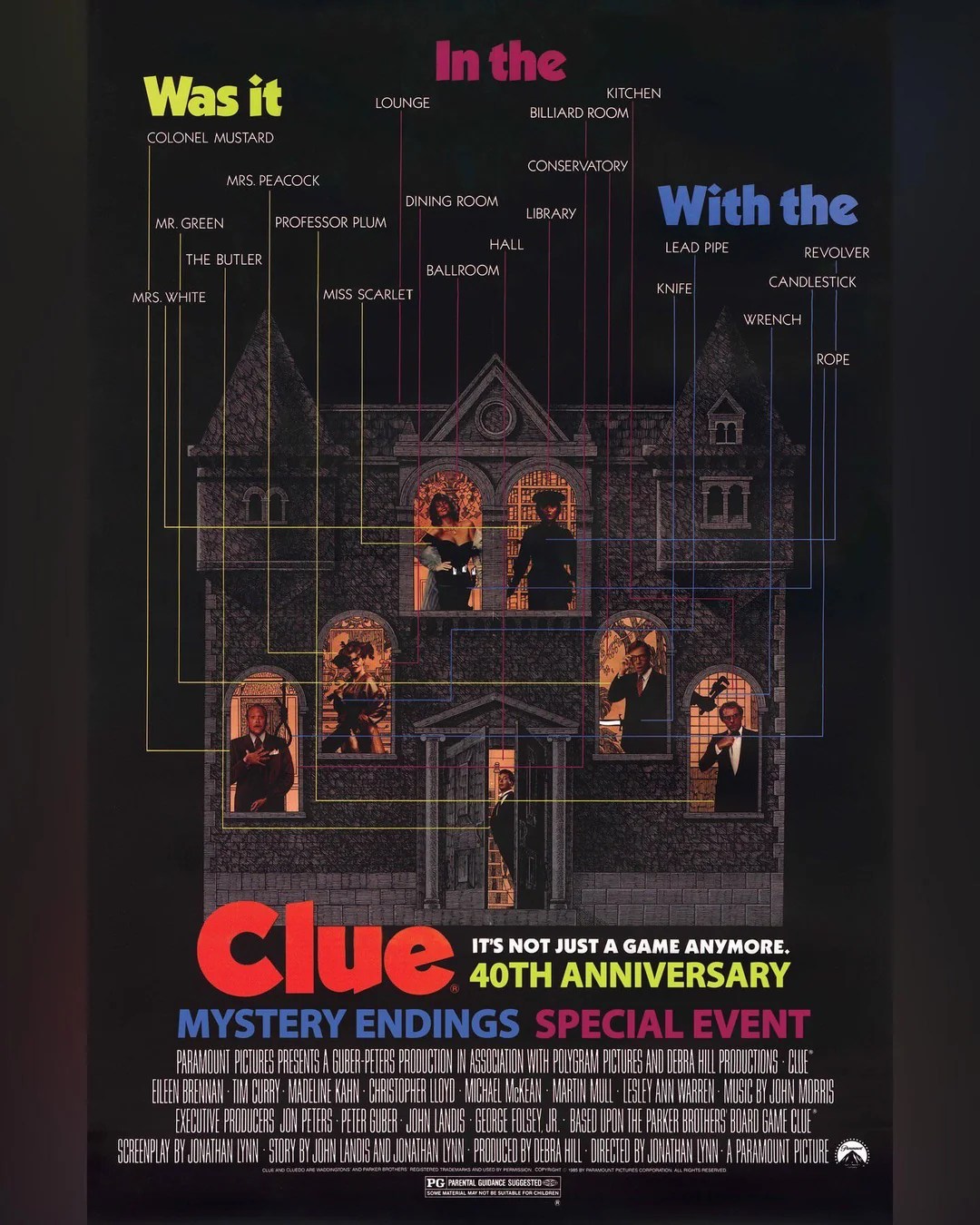
Clue (1985) somehow caught lightning in a bottle, and has held onto it for four decade; this same lightning was then shaken and thrown against the silver screen in the most delightfully chaotic ways imaginable. Forty years later, this all-star murder mystery based on the classic boardgame remains sharper, funnier, and more lovingly crafted than most prestige comedies released today. What should have been a disposable novelty became a masterpiece of comedic architecture, tonal discipline, and ensemble chemistry. I first discovered it on VHS from my local public library, and even then I knew I had stumbled onto something special. My sister loves it as much as I do. It’s a movie that works on you—and then keeps working every time you revisit it.

For my show ReelTalk on WKGC Public Media this week, I invited returning guest and friend of the show, film critic Sean Boelman to join me in our celebration of Clue‘s 40th anniversary. You can listen to the show by clicking the appropriate link below. While my article captures the highlights of what Sean and I discuss, listening to the show after reading the article, you’ll have a much more robust experience!

At its core, Clue commits fully to three things most comedic mysteries never attempt at the same time: total absurdity, airtight plotting, and theatrical precision. Most films in the genre pick one lane—either slapstick, or clever mystery, or witty farce—but Clue weaves them together with an elegance that belies how frantic the movie feels moment to moment. Unlike many modern adaptations drowning in CGI, brand synergy, or self-aware winking, Clue treats its ludicrous premise with the sincere craftsmanship of an Agatha Christie play–yet–Clue’s apparatus is actually more closely related to the boardgame play than to the typical Christie literary apparatus. The humor is character-driven, rooted in rhythm, timing, and razor-sharp verbal dexterity. That sincerity, combined with its unhinged heart, is why the film remains timeless.

Much of Clue’s durability stems from how it uses language as a weapon. This is not a movie relying on boardgame nostalgia or shallow references; it is powered by dense wordplay, screwball pacing, and overlapping exchanges that feel plucked from a stage farce running at espresso speed. Every performer is asked to treat their lines with theatrical precision. The jokes arrive in layers, often stacked on top of each other, rewarding audiences who pay attention and enhancing the comedy with every rewatch. By grounding the absurdity in craft—rather than irony—the film avoids collapsing into randomness. It feels smart, not silly; intentional, not accidental. Humor this tightly constructed simply does not age.

Another reason the film works: it respects the genre it’s parodying. Clue doesn’t mock murder mysteries from a distance. It commits to the melodrama, the red herrings, the stakes—even as it gleefully skewers them. Parody only works when sincerity lies beneath the joke. Modern adaptations often fail because they either drown in self-awareness or cling to seriousness so tightly the comedy feels bolted on. Clue threads the needle by honoring the mechanics of a whodunit while joyfully stretching them to the breaking point. It loves the sandbox it’s playing in, and the audience can feel that affection.

Of course, the film’s most unforgettable asset is its ensemble cast, which may be one of the best comedic troupes ever assembled on screen. These are character actors trained in theater, sketch, and improv—who understand timing and ensemble harmony better than any star-studded ensemble today. Tim Curry’s manic precision, Madeline Kahn’s volcanic eccentricity, Michael McKean’s brilliant awkwardness, Lesley Ann Warren’s slinky aloofness—every actor is distinct, yet completely in tune with the film’s wavelength. No one competes for the spotlight; instead, every moment becomes a relay race of comedic energy. Modern ensemble films often feel like stitched-together “bits.” Clue feels alive, reactive, and musical. It is an ensemble in the purest sense.

And then, of course, there are the multiple endings—a theatrical gamble so audacious it could have sunk the film entirely. Instead, it became an iconic part of its identity. In 1985, you never knew which ending you’d get in theaters, a cheeky nod to the board game’s replayability. Instead of feeling gimmicky, it felt organic to the world of the film—a natural extension of its playful tone and farcical structure. Today, a studio would almost certainly turn the idea into a marketing ploy or streaming bonus feature, but in Clue, the endings are crafted with sincerity and precision, not cynicism. They’re not content strategy; they’re punchlines.

The film’s simplicity is another key to its longevity. Where modern game adaptations inflate themselves into lore-heavy franchises, Clue keeps everything contained in one house with one group of increasingly frantic characters. The mansion becomes a pressure cooker where personality collisions become the main spectacle. No elaborate world-building, no digital spectacle—just smart writing, sharp performances, and a commitment to letting the humor build naturally. The film’s scale is its strength.

Would Clue still find an audience today? Absolutely—although probably through a different path. Theatrical comedy has become a rare species, and a film this verbally dense might struggle to secure screen space. But word of mouth would spread like wildfire, and social media would turn its most quotable lines into instant memes. If anything, its intelligence, compact scope, and genuine ensemble work would feel refreshingly rebellious in today’s IP-heavy landscape.

What ultimately makes Clue endlessly rewatchable—more than contemporaries like Knives Out—is that it’s a comedy first and a mystery second. The joy doesn’t hinge on solving the puzzle; it hinges on watching these characters unravel in the most glorious fashion. Puzzles fade with familiarity. Brilliant performances only deepen. The more you watch Clue, the funnier it becomes.

So what is Clue’s greatest legacy? It proved something rare: that a film can be wildly silly and intellectually sharp at the same time. It’s a miracle of tonal balance, ensemble synchronicity, and writerly discipline. A movie that treats its audience with respect even as it descends into delightful chaos. A movie that should have been forgotten…yet became unforgettable.

Forty years later, Clue remains the gold standard—not because it adapts a board game faithfully, but because it transcends one. It is lightning in a bottle. And every time we open that bottle, the spark still flies.
Ryan is the general manager for 90.7 WKGC Public Media and host of the show ReelTalk “where you can join the cinematic conversations frame by frame each week.” Additionally, he is the author of the upcoming film studies book titled Monsters, Madness, and Mayhem: Why People Love Horror. After teaching film studies for over eight years at the University of Tampa, he transitioned from the classroom to public media. He is a member of the Critics Association of Central Florida and Indie Film Critics of America. If you like this article, check out the others and FOLLOW this blog! Follow him on Twitter: RLTerry1 and LetterBoxd: RLTerry
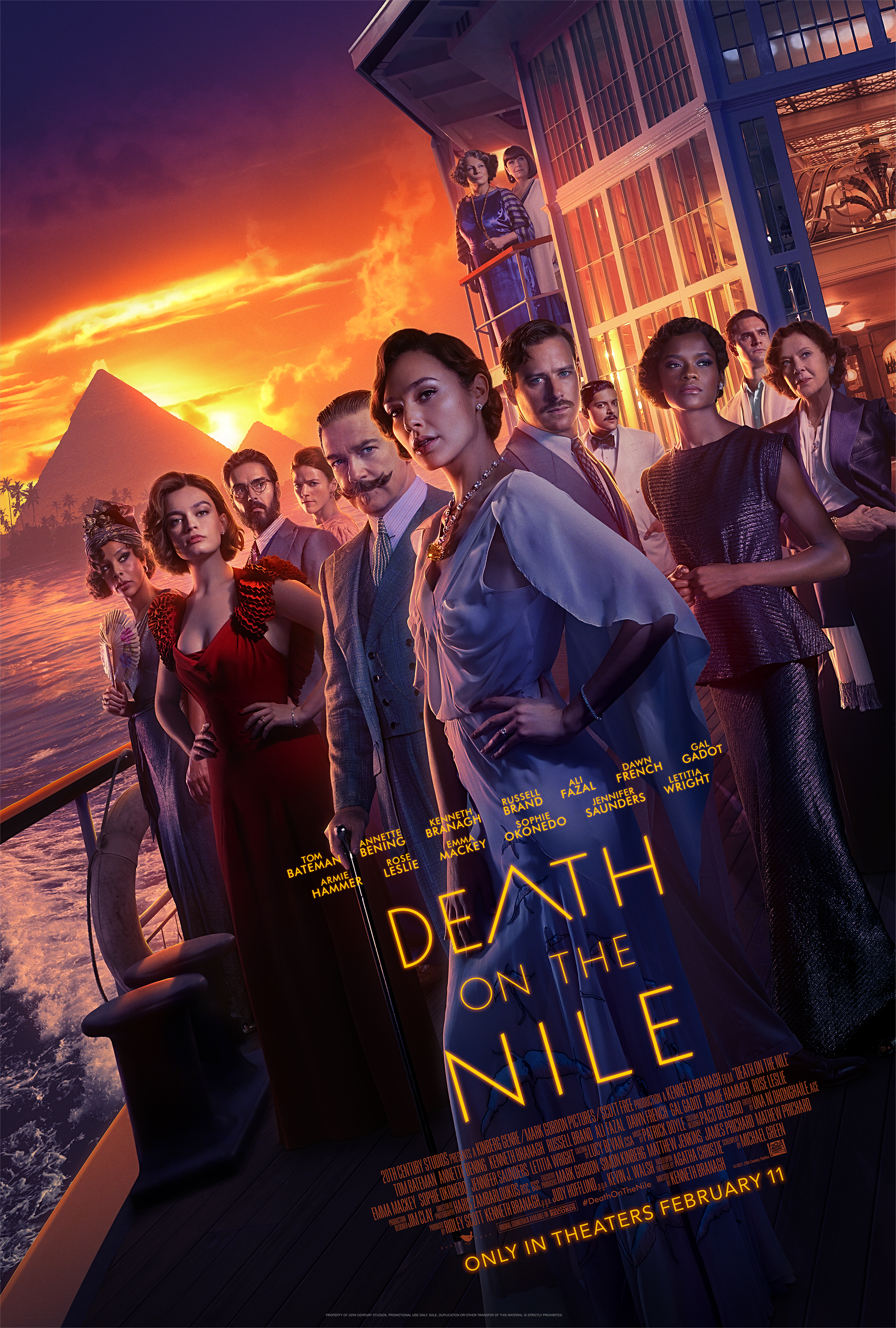
DEATH ON THE NILE whodunit film review

You’ll want to watch it again! Kenneth Branagh’s adaptation of Agatha Christie’s Death on the Nile takes everything you enjoyed about Murder on the Orient Express, and builds upon it to deliver a film that further proves that the subgenre whodunit remains timeless! Of course, much like with any murder-mystery or whodunit, it’s difficult to review without getting into spoilers. What I can tell you is that Death on the Nile boasts a stellar cast, exotic setting, and all the love and deception you want in a whodunit. Unlike the previous chapter in Branagh’s Agatha Christie adapted films, the Poirot we encounter feels more human. Contrary to previous TV and film adaptations, we witness the cracks in Poirot’s veneer, revealing his vulnerable side. Perhaps this may be another story with one of the best worst-kept secrets in literary history, but through Branagh’s direction and Michael Green’s screenplay, diegetic elements are added in order to entertain audiences with a fresh interpretation of the iconic literary work. Even after you learn who committed the murders aboard the luxury river cruise ship, you will instantly desire to watch again in order to find the clues that you missed.

Belgian sleuth Hercule Poirot’s Egyptian vacation aboard a glamorous river steamer turns into a terrifying search for a murderer when a picture-perfect couple’s idyllic honeymoon is tragically cut short.

There may be some naysayers out there that are unfairly negatively criticizing the (and I’ll be honest, somewhat predictable) solution to the mystery, you have to remember that this literary work and previous film/TV adaptations have been around for a very long time, and have served as significant influencers for all whodunits to come thereafter. Naturally, fans of the whudunit genre may be able to completely or partially guess the who, why, and how. The best way to enjoy this film is to go in as a fan of classical whodunits; if you do that, I am confident that you will thoroughly enjoy your time at the cinema!

Ryan teaches Film Studies and Digital Citizenship at the University of Tampa. If you like this article, check out the others and FOLLOW this blog! Interested in Ryan making a guest appearance on your podcast or contributing to your website? Send him a DM on Twitter or email him at RLTerry1@gmail.com! If you’re ever in Tampa or Orlando, feel free to catch a movie with him.

Follow him on Twitter: RLTerry1

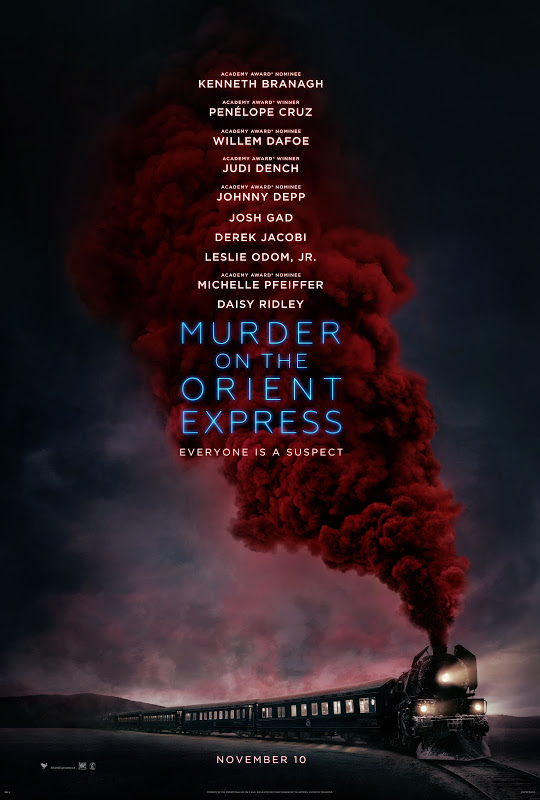
“Murder on the Orient Express” (2017) Film Review

The classic Hollywood style mystery successfully pulls into the station. Grab your ticket from the box office and board the legendary Orient Express with this all-star cast. Kenneth Branagh’s adaptation of the timeless Agatha Christie novel is as bold and elaborate as Hercule Poirot’s famous mustache. Feel as though you are traveling aboard the famous transcontinental train as you attempt to put all the pieces together to solve the mystery right along with “quite possibly the greatest detective in the world.” Hollywood style movie mysteries are nearly a thing of the past, but Branagh stokes the fire in the engine of the once popular genre and conducts an exciting journey through the classic whodunit plot. The film’s namesake is a novel that has inspired so many mystery novelists, and hopefully this film inspires a new generation of filmmakers to create their own movie mysteries fit for the big screen. Because the 1974 version including a cast ranging from Ingrid Bergman to Anthony Perkins to Sean Connery has not stood the test of time as well as it was thought to have done, this cleared the tracks for Branagh’s adaptation of Christie’s most famous novel.

After he successfully solves the mystery of the theft of precious religious artifact from the Wailing Wall area of Jerusalem, Hercule Poirot (Branagh) is beseeched to head back east to solve another mystery. Over the years, Poirot has made many friends, and one of these friends is the son of the railroad tycoon who owns the opulent Orient Express. When a passenger doesn’t show, Poirot is given his seat and boards the transcontinental train bound for western Europe. Although Poirot was promised a rail journey free of crime, a nice break, and to be pampered during his travels, he finds himself solving the most peculiar of mysteries–a most gruesome murder. The victim: an unscrupulous man with many enemies. When a freak avalanche forces the Orient Express to stop on a breathtaking, precarious stretch of track, Poirot finds the time to interview each and every one of the suspects—confined to the twelve first and second-class passengers who might have had access to the victim’s cabin. When each piece of evidence opens one Pandora’s Box after another, and the web of lies and connections between the passengers grows to Poirot’s mustache proportions, Poirot faces a complex mystery that prompts him to call his very approach to crime solving into question.

Nevermind the solution to the tentpole mystery novel is one of the worst-kept secrets in British literature history, Branagh crafts a cinematic mystery full of intrigue, revenge, lies, deceit, and the central murder. The plot revolves around a seemingly perfect crime committed on a railcar with no access to the outside, and only the passengers and crew on board the suspects. But even Poirot is stumped at the who, how, and why. Whether you know the ending or not, this film provides an excellent example of a genre that harkens back to Hollywood’s golden era. There was once a time that mysteries and musicals were a staple of the industry, but times change. Still, Branagh shows audiences that the timelessness of an old fashioned whodunit cannot be overstated. Since the ending of the mystery is known by so many people, Branagh was challenged with providing the audiences with something different, something that creates a new take on a well-known story. He accomplishes this by throwing in some additional subplots, character connections, and evidence that suggests that the solution may turn other otherwise than it does in the novel. The changes he brings to the story are organic and fit in well. The end result is a fantastic film that keeps your attention from beginning to end, even for those who know–or think they know–the solution to the mystery.

From the sweeping landscape shots of the Alps to the wide variety of shots to bring the audience onto the train with the rest of the passengers, the production design is excellent. The attention to the detail and visual elegance of the story are treated with creative precision, just as the Christie plot is woven together. Production designer Jim Clay’s meticulously recreated Orient Express is truly something to behold. Unfortunately, despite Branagh’s decision to shoot on 65mm film, there are times that the train set feels almost too perfect–a little artificial–similar to The Polar Express. Although there are times that the production design is not being showcased to the degree that it should to increasingly immerse the audience into the world of Poirot, there are plenty of beautiful shots that serve as a testament to the opulence of rail travel that once was. Of the few weak areas of this film, the cinematography is the weakest because it could have been used to truly create a visually stunning film and not fall victim to surrealism. Patrick Doyle’s score complements the film by feeling like an extension of the plot itself, in time and space. The combination of big band, jazz, and orchestral music immerses the audience into this world. All the technical elements work effectively to transport you from your seat to a compartment on the legendary train.

Branagh’s screen adaptation of Christie’s characters is brilliantly entertaining and developed well. Each character represents a different type of person, a different walk of life. No two characters are alike, which makes great for interjecting some social commentary into the mystery. From a professor spouting pro-Nazi sentiments to a nurse turned missionary, you will find the characters intriguing in and of themselves, never mind how they may be connected to the victim. Alexandra Byrne’s costumes are perfect appointed extensions of the characters that wear the authentic period clothing. Each costume was designed to be as much a part of the respective character as the accents, hairstyles, and backstories. Josh Gadd proves that we can successfully play a serious role, which will prove to bolster his career, Willem Dafoe is perfect as the professor, Dench portrays the princess in only a way that she could so successfully accomplish, and the rest of the cast are all excellent. Coming in a close second to Branagh’s screen time, as the iconic inspector Poirot, is the beautifully talented Michelle Pfeiffer as the widowed heiress Mrs. Hubbard (Lauren Bacall’s character in the original). She truly showcases her talent for adding depth to the characters she plays in order to make them complex and memorable. The diverse cast of characters is incredible to watch and couldn’t have been deleted better for this highly anticipated film.

Climb aboard The Orient Express for the whodunit that started it all. Branagh’s fresh take on the classic tale would satisfy even the harshest of critics Agatha Christie herself. He treats the source material with the respect it deserve, all the while, adding in new material to craft a new experience for those tho have read the novel and/or seen the original film adaptation of this story. Do yourself a favor and don’t ask anyone whodunit, because you need to experience the solution for yourself. Perhaps you can solve it more quickly than Poirot. Don’t let the train leave the station before you pack your bags and travel back to a time when trains went full-steam ahead into adventure and intrigue.