“A Cure for Wellness” movie review

acureforwellnessAn intriguing, provocative psychological thriller that’s an innovative example of neo-noir avant-garde cinema with a touch of mystery. Gore Verbinski’s A Cure for Wellness is a thought-provoking film that hooks you from the very beginning and continues to draw you into the narrative with its labyrinth of subplots and incredibly beautiful cinematography. Although it certainly borrows turning points and plot devices from past films, A Cure for Wellness provides audiences with an experience that is unique and protects the film from being pigeonholed into any one sub-genre of horror or directly compared to other movies that have similar attributes. With impeccable production designs and serene landscapes juxtaposed against cringe-worthy disturbing imagery, Verbinski’s ambitious film is one that cinephiles will appreciate and find enjoyment in discussing the various themes, symbols, and visual storytelling elements that seamlessly work together to create a cinematic experience that stands out against the homogeneous horror/mystery-thriller past films. Justin Haythe’s screenplay sets him up for continued success as he demonstrates, with this film, that he can cross into new genres and hook the audience early on. Despite the occasional slow-burning periods in the narrative, you will not likely feel the nearly 2.5hr runtime.

After he receives a corner office in a high rise building, a stock broker finds himself involved in an investigation that requires the presence of the entire board. Mr. Lockhart (Dane DeHaan) is forced by his fellow directors, on the board, to fly to Switzerland to retrieve the CEO in order to complete a proposed merger to save the company from closure. Little does he know that those who voluntarily check in to the mysterious wellness center seldom desire to leave the prestigious mountaintop retreat-like spa and its famous water. When the CEO of his company refuses to leave the comfort of the retreat, Lockhart decides to wait it out in the village below the hilltop. After a bizarre car accident on his way back into town from the institution, Lockhart finds himself a patient due to his broken leg. Under the guidance of Dr. Volmer (Jason Isaacs), Lockhart experiences all the wellness center has to offer to the patients and guests. However, he cannot help but feel that there is a darkness surrounding the cult-like daily operations at the spa and begins to dig into the history of the prestigious wellness institution. After meeting a rather unusual patient at the institution named Hannah (Mia Goth), Lockhart is determined to unravel the mystery of how so many people, including himself, are diagnosed with the same bizarre ailment that keeps them there for the cure.

Beautiful. The first cinematic element that will jump out at you will be the incredible cinematography and picturesque landscapes of the Swiss Alps. From the moment the film opens, there is a tone that inspires you to look at and listen for details throughout the film. The fact that the teasers and trailers reveal very little about the plot is beneficial to the overall experience of the film. Just when you think you have the plot figured out, you will be thrown for a loop and question what you thought was predictable. In all fairness, I figured out a very important aspect to the plot midway through after a particular line delivered by one of the central characters prompted me to have one of those aha moments. However, I was still continually intrigued by the film’s diegetic delivery and visual storytelling. The fact that I figured some rather crucial information did not detract from the experience. Early on, it is clear that there is something not right with the spa, and gathering information and piecing together the puzzle will draw you in closer to the film. Without giving anything away, there are definitely clues along the way that reveal the dark mystery and history behind the exclusive mountain retreat wellness institution.

Dane DeHaan delivers an excellent performance as Lockhart, and provides the perfect balance of entitled Wall Street prick, detective, and humanitarian on a rescue mission. Jason Isaacs, no stranger to playing a creepy villain, delivers a disturbingly convincing performance as the strange doctor overseeing the almost clandestine treatments for an unknown sickness. Mia Goth’s performance adds a great deal of uneasiness to the film by coming across as innocent, child-like, all the while hiding something creepy and peculiar about her very pretense at the facility. Bojan Bazelli’s cinematography is breathtaking and is successful at completely immersing the audience into the mountain top world of the Swiss Alps. Whether following a train or an extreme close-up of the human eye (a staple in horror films), the visual art he paints with the camera serves to provide solid visual storytelling. Directing such a complex film requires great patience, organization, and effective guidance. Verbinski channels his success with The Ring (2002) by integrating some similar stylistic techniques in A Cure for Wellness. Speaking of the title itself, the irony in the title isn’t realized until the third act; but, delivers an outstanding payoff that will prompt many discussions in a film studies class. Stylistically, the film sits at a crossroads between avant-garde horror and neo-noir with some science-fiction and mystery thrown in for good measure and intrigue.

Despite many reviews slamming the film for a complex system of subplots and not enough traditional terror in the narrative, this film is a fine example of an outstanding vision that is seldom seen on the silver screen due to the fact that it will not likely make a lot of money, but it adds critical value to the art of motion pictures. Instead of creating a film that would have included many of the more typical tropes in this hybrid science-fiction mystery/thriller, Verbinski chooses to meticulously craft art for the screen. For the squeamish, there are definitely some scenes that will churn your stomach and even some disturbing imagery that many will like to unsee. If you enjoy avant-garde cinema or even innovative neo-noir storytelling, then you will likely enjoy this film and appreciate the vision of the director as well as the beautifully complex themes, subplots, and symbolism.

Written by R.L. Terry

Edited by J.M. Wead

“The LEGO Batman Movie” movie review

legobatmanNonstop antics, action, and thrills! Warner Bros. and Ratpac Dune present a movie that is equally one-hundred percent Batman whilst still completely LEGO. From the moment the opening title sequence of logos appears under the voiceover of a self-aware Batman, this brilliant animated film will take captive your attention and draw you in with a batarang of perfectly choreographed fight scenes and incredibly well timed self-reflexive humor. The LEGO Batman Movie is an entertaining combination of a contemporary story on the backdrop of Batman nostalgia. Whether you are a fan of the show from the 1960s, the Burton universe (as I am), the dark world of Nolan, or Snyder’s, you will find strategically placed references that fit exceptionally well into this LEGO universe. While the film is aimed at a younger audience, there are humor, easter eggs, and allusions to the various Batman shows and movies for adults to appreciate. Underscoring the over-the-top high concept plot, is a heartwarming story of love, family, and friends. This Batman movie pulls out all the stops as most, if not all, Batman’s villains receive screen time as well as other members of the Justice League with Batgirl and Robin. Oh yeah, the Joker IS actually in this Batman movie! With a 90% on Rotten Tomatoes and an 8.1 on IMDb, this film is sure to be a huge success this weekend.

When after a failed attempt at a takeover of Gotham by the Joker (Zach Galifianakis) and his henchmen, Batman (Will Arnett) is all too happy to accept all the credit for stopping the squad of villains. However, this time is different. The Joker and his henchmen give themselves up to the new Commissioner [Barbara] Gordon (Rosario Dawson). When the law enforcement and people of Gotham conclude that there is no longer a need for a masked vigilante, Batman finds himself having an identity crisis. Meanwhile, at a party, Bruce Wayne accidentally adopts young Richard Greyson (Michael Cera), and now is faced with the challenge of balancing his newfound role as a parent with Batman’s penchant for crime fighting. With pressures from Alfred (Ralph Fiennes) and Barbara Gordon mourning in Batman’s personal and professional lives, he must work through these challenges in order to save the city. Only this time, he may not be able to do it on his own.

What’s not to like??? The LEGO Batman Movie is one of those animated films that is perfect for (1) the whole family and groups of friends, as well as (2) legacy and new Batman fans. Just the animation and production design are positively mind blowing. With few exceptions, every design in the film from people to buildings and vehicles can be created with those iconic plastic building blocks. Much like with the previous LEGO movie, other LEGO universes get screen time as well (some of which are mentioned by name and others are implied), such as Lord of the RingsHarry PotterJurassic ParkKing Kong and more. With all the characters in the film, the focus is never shifted from Batman and Joker. There are many rabbit trails the film could have gone down, but it always stays true to the central characters. Overstimulation is another risk in a film like this one; but, for all the action sequences and ensemble casts, never once does the film feel that it is way too much to take in and enjoy. On top of the brilliant animation and design, is solid writing with excellent character development. Crafting the vision is director Chris McKay. Selecting the right director to handle all the elements of a LEGO movie is no short order. And Warner Bros and Ratpac Dune made a killer choice in McKay who brought us Robot Chicken: Star Wars: Episode III.

One of my personal favorite elements from the movie is the nostalgia meticulously and strategically woven into the plot. If you grew up watching the show from the 1960s or even reruns with your parents, you will be surprised with the echoes of the past and how they fit in perfectly with this Batman world written by Seth Grahame-Smith et al. Even the pow, bam, zap sound effect bubbles make a cameo appearance. The LEGO Batman Movie offers the best of all the Batman stories over the years. As I am not familiar with the Batman comics, I imagine that there are comic book references in the film for the enjoyment of that audience as well. Not as self-aware as Deadpool, this film does contain a hint of self-awareness, but never takes the place of the foreground action; however, it supports the main story nicely. Even the costumes are representative of many Batman universes. For the most part, Batman’s costume is rooted in the one worn by Michael Keaton in Batman and Batman Returns, but Batgirl and Robin’s costumes, respectively, are more reminiscent of the show from the 1960s. Joker is an excellent combination of the, in my opinion, definitive Joker: Jack Nicholson but hints of the more recent Jared Leto and Heath Ledger Jokers are in his costume, makeup, and behavior. We even get a more accurate representation of Harley Quinn in this film. There is quite literally something for everyone in LEGO Batman.

Looking for a great film to watch this weekend that doesn’t involve some sappy victimized Stockholm Syndrome-esque warped love story? Then head to your local theatre to catch The LEGO Batman Movie on the big screen! What better way to spend the weekend leading up to Valentine’s Day than laughing with your date??? Even if you’re spending Valentine’s Batman style–flying solo–you will still have a great time at this movie.

“The Founder” movie review

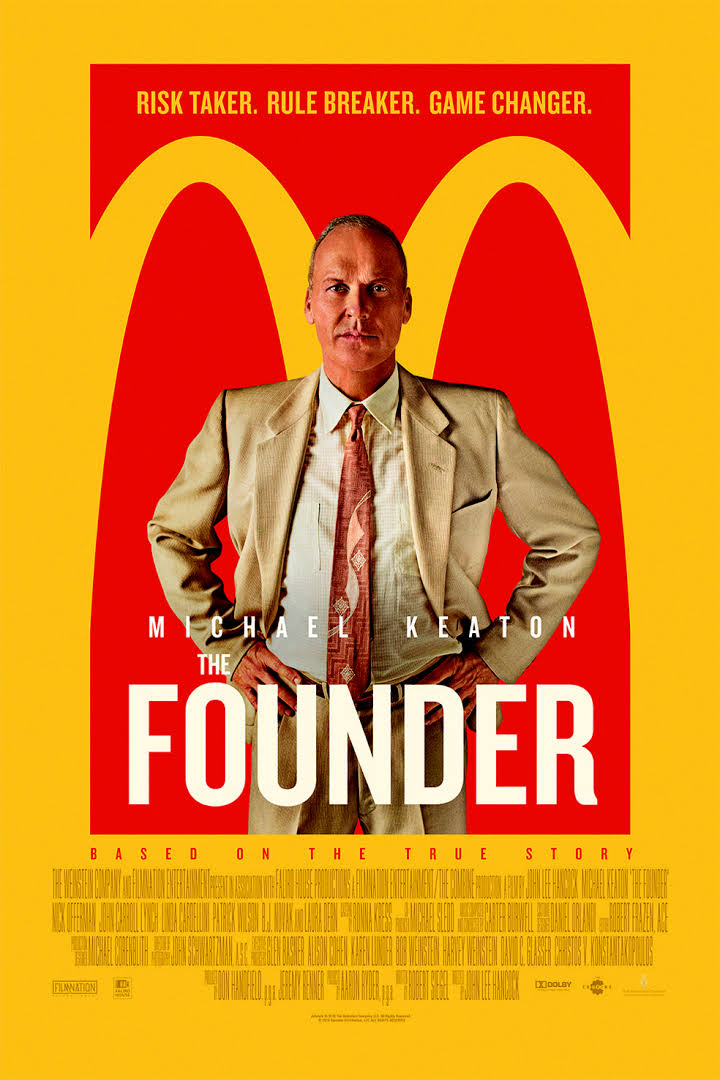
thefounderOutstanding biopic that typifies what the American dream actually looks like–but that’s the scary part. Michael Keaton’s portrayal of Ray Kroc, the (self-proclaimed) “founder” of McDonald’s, is positively brilliant! Comparing his look and performance to the real Ray Kroc seen before the credits roll, there is no doubt that director John Lee Hancock (known for The Rookie and The Blind Side) made the right choice. The Founder takes us on a journey from Southern California to Illinois and beyond as we follow the course of events that radically revolutionized an entire industry and gave birth to one of the most recognized brands in the world as well as the very concept of modern franchising. What Henry Ford did for American motorcars, Kroc did for American “speeedee” service food. Ray Kroc realized the American dream by stopping at nothing until he built his empire, even if it meant stealing from a business and breaking up a marriage–all within the confines of the law. We’ve all heard about “the American dream;” well, The Founder depicts what it takes for that dream to come true. If you’re willing to be a cut-throat bully with few if any inhibitions, then you can build an empire and claim to be the founder of another’s company or even run a country.

This biopic drama tells the story of how Ray Kroc (Keaton), a 55 year-old milkshake machine salesman from Illinois, met Mac (John Carroll Lynch) and Dick (Nick Offerman) McDonald in San Bernardino, CA during a sales transaction that would start something big. Who would’ve guessed that a man who was the definitive door-to-door salesman would see great potential in a small-town burger joint. Recognizing the great potential for a successful franchise, Kroc entered into a business proposition that would change the quick service food industry forever and essentially perfect the business practice of franchising. Over a relatively short amount of time, Kroc maneuvered himself into a position of power and dominance over the brothers, and eventually took the very company they founded away and never looked back. Kroc stopped at nothing when appropriating the intellectual property of the McDonald brothers to build a vast empire that would find its way into thousands of towns and become just an American an icon as the flag, churches, or the eagle.

Although the film is presently foundering in box offices, it is definitely worth a watch because of depicting the story of one man’s American dream that would essentially steal the laurels from baseball and apple pie to become a larger than life symbol of America recognized throughout the world. It’s unfortunate that this film is not garnering more attention because the writing, directing, and acting are absolutely brilliant. Full of irony and ambiguity, The Founder could have easily been called or at least subtitled Birth of a Salesman. While watching the movie, I could not help but compare the plot of this film with the iconic play Death of a Salesman by Arthur Miller. Both tell stories of salesman but the end result is vastly different. Both Willy Loman and Ray Kroc were dedicated to their respective craft of salesmanship; however, Kroc took the practice of sales and pitches to the next level–in fact he created his own game in which only he could win. Where else have we seen a bully play by his own rules and build an empire into a brand in and of itself? I’ll allow you to draw that conclusion. Further irony can be seen in Ray Kroc’s surname. His sheer cunning, predatory ways of conducting business can easily be likened to the crocodile itself. Despite receiving credit for inventing the fast food assembly line, much like Ford did for American car manufacturers, the “speedee” service was invented by Dick and Mac McDonald of San Bernardino. Thankfully, the brothers are receiving the credit that they deserve–albeit posthumously.

It’s difficult not to root for the villain in this film. Even though you tell yourself that he was a monster and a complete leach to the McDonald brothers, his first wife, and other friends, you may still find yourself in his corner because of McDonald’s being the American icon that it is. The cognitive dissonance that many will experience during diegesis of this film is fascinating in and of itself. Early on, you will find yourself rooting for Ray Kroc because he comes off as an underdog. He is able to provide decently for him and his wife, but it is evident that his business is in the process of collapsing. Even after striking the proverbial deal with the McDonald brothers, you may still root for him because the brothers make it difficult for Kroc to actually engage in successful franchising. The tide begins to subtly shift when the chain begins to take off. When the brothers deny Kroc a request to renegotiate the terms of the contract in order to boost capital and revenue, Kroc hires a new business partner who provides the knowhow to shift the focus from running a burger chain to being a real estate mogul. That shift from only burgers to real estate is what truly built McDonald’s Corporation into the giant that it is today. Interestingly, when confronted by the brothers on a break in the contract, Kroc points out that they could take him to court and probably win, but by the time he would drag them through hearing after hearing, and trial after trial, the brothers would be completely bankrupt. Much like the milkshake substitute that boosted revenue and mitigated refrigeration costs, but contained no milk, a handshake deal with Kroc is just as fake.

The set designs and costumes in The Founder are impressive and so incredibly well executed that audiences will be transported from 2017 to 1950s America. From the cars to the architecture to the print advertising and marketing, this movie boasts an authenticity that is on par with larger budget period films. The supporting players in the film are equally captivating too. Parks and Rec‘s Nick Offerman and John Carroll Lynch are absolutely perfect as the McDonald brothers, and I cannot think of two better actors to bring these “hidden figures” of fast foot history to life. It’s unfortunate that Laura Dern is underutilized as Ethel, Kroc’s first wife, because she is a dynamic actress capable of adding significantly to a film. Although not featured on screen a lot, Patrick Wilson plays Rollie Smith, an early investor, but his acting excellence is still showcased well. Finally, Linda Gardellini is captivating as the future Mrs. Ray Kroc–problem is, that she is married to Rollie Smith at the time they meet. It’s her suggestion to switch from real ice cream and milk to instant milkshake powder that sets the final dominos in motion to topple the McDonald brothers. In continued irony, the story of McDonald’s contains people who are excited about fake food product. But those were the times the characters lived in. The chemistry between the characters helps to reinforce the authenticity of this biographical motion picture.

Ray and Joan Kroc are well known philanthropists–in their later years. In fact, Joan Kroc left most of her vast fortune to many charities. The most well-known recipient of the inheritance is NPR. Even today, if you listen to the programming, you will hear the Estate of Joan Kroc mentioned as a supporter of the public radio organization. Whether you appreciate NPR or not, one cannot help but think that all the philanthropy of the Kroc (namely Joan) is a result of easing the conscience since the Kroc fortune can be likened to blood money. It’s entirely plausible that much like Marion Crane figuratively cleanses her spirit in the infamous Psycho shower after having stolen the money from her employer, Joan may have very well given her fortune away in an effort to ease her conscience and do good with the figuratively ill-gotten money.

Such an incredibly fascinating movie! If you enjoy historical dramas about American icons, then you will definitely enjoy The Founder. It may prompt you to grab a McDonald’s burger and fries after the movie or perhaps never go there again after learning the company’s history. Whatever the case, it cannot be denied that the story of McDonald’s is incredibly interesting and IS the product of persistence and business ingenuity. If there is anything inspirational to take away from this film, it is the power of that persistence and looking for potential in the most unlikely of places.

Written by R.L. Terry

Edited by J.M. Wead

“Split” movie review

splitIntensely captivating! M. Night Shyamalan stages a successful return to the horror-thriller genre in the brilliantly intriguing motion picture Split. When Universal Pictures, arguably the king of the American horror film, Blumhouse Productions, and Shyamalan combine their respective visual storytelling skills, the result is a dynamic thriller full of outstanding twists and turns. Shyamalan, long known for surprise or bizarre endings, provides audiences with the biggest surprise of all: he is back, and it’s a completely satisfying cinematic experience! Beginning with 2015’s The Visit, Shyamalan has been working on a comeback; and Split is the final evidence needed to support his successful return to the silver screen. James McAvoy delivers an outstanding performance–or should I say performances–every minute of the film. Although the concept of building a suspense-thriller around a character with dissociative identify disorder (DID), formerly known as multiple personality disorder, is not a new one–after all Norman Bates is the most iconic example. M. Night Shyamalan puts his own spin on the character-type by adding his special blend of what can only be referred to as “shyamalan-ness.” You’ll definitely want to see it again in order to catch everything that you missed the first time.

A film that many psych majors will find fascinating! While the mental divisions of those with dissociative identity disorder have long fascinated and eluded science, it is believed that some can also manifest unique physical attributes for each personality, a cognitive and physiological prism within a single being. Though Kevin (McAvoy) has evidenced 23 personalities to his trusted psychiatrist, Dr. Fletcher (Betty Buckley), there remains one still submerged who is set to materialize and dominate all the others. Compelled to abduct three teenage girls led by the willful, observant Casey (Anya Taylor-Joy), Kevin reaches a war for survival among all of those contained within him – as well as everyone around him – as the walls between his compartments shatter apart. (IMDb).

Just when you think the movie is going one direction, it throws you for an unpredictable loop. Split provides audiences with the same level of captivation as M. Night delivered in Signs or even in The Visit. Very much character-driven, this film could have easily taken a turn for the campy or par-for-the-course approach to a central character with DID; but Shyamalan proves that a familiar premise can be crafted into a whole new experience. After the incredible success of 1999’s The Sixth Sense, audiences everywhere set the bar for Shyamalan quite high–in fact he was prematurely compared to a 21st century Alfred Hitchcock. While it is highly unlikely that any director will reach the iconic status of Hitchcock, Shyamalan was seen as a director who would provide a similar experience to that which earned Hitchcock the moniker the master of suspense. Evidence of his admiration of Hitchcock can be been in the title sequence of Split. It bares a striking resemblance to the opening title sequence from Psycho. 

However, the danger in prematurely setting expectations too high is that you may likely be setting yourself up for disappointment. And that is precisely what happened with Shyamalan. From killer plants to invisible supernatural entities, he began to lose the cache he earned in the early 2000s. M. Night would spend years disappointing audiences to the point that he became a joke–a parody–perfect material for Family Guy. Then just when all hope for Shyamalan to regain the admiration of movie patrons–especially those who enjoy horror/suspense/thrillers–he gives us The Visit in 2015. That film was the glimmer of hope he needed to begin to rebuild his status as a thriller/suspense/horror filmmaker. And with the incredibly satisfying Split, M. Night Shyamalan is BACK!

Films like Psycho and Split only work as well as their respective director and cast–primarily the villain. Obviously, Psycho stands up to the test of time and will forever be a favorite of many cinephiles and a testament to the power of visual storytelling, Split had to be a new experience while still channeling the director that Shyamalan admires and patterns himself after. The success of Split rested upon the performance of McAvoy as Kevin (and the 23 others with a 24th on the horizon). McAvoy’s performance in this film is quite possibly the best of his career. Each identity is clearly seen as individuals. From his facial expressions to his gait to the manner in which he carries himself, every identity is unique in voice and appearance. Even in the middle of a conversation, one identity goes away while another surfaces into “the light.” Although there are only a few identities that have prominence in the diegesis, the others give audiences just enough nuance to register them as having a presence in the subconscious of Kevin.

For all the excellence in cinematic storytelling Split has to offer, there is no denying that it may be controversial in that it uses DID to construct a “beast.” There are already members of the mental-illness community who have expressed disdain for the subject matter and context of the film. However, prematurely dismissing this film as offensive to those suffering from cognitive disorders would be ill-conceived. After screening the film, it is clear that the focus is not on DID itself (or any other cognitive disorder that Kevin may have), nor is Kevin crafted to be an unredeemable monster; but, this film uses DID and the character of Casey (one of the young ladies who is captured at the beginning of the film) as tools through which to explore childhood trauma, abuse, and coping mechanisms. Isn’t that what films do? Push the envelop in an effort to provide a different perspective on an issue, problem, or circumstance? Horror is often concerned with “other” scenes–revealing that which should remain hidden–and Shyamalan does precisely that in Split.

If you enjoy horror, suspense, or thriller films, then you are definitely going to enjoy Split. There is so much to take in, that you may want to watch it again in order to catch everything that you may have missed the first time. Even if you are skeptical or think the content may be offensive to the mental-illness community, you may be surprised that there is a lot that can be gleaned from the narrative. With brilliant performances, excellent writing, and outstanding direction, Split should be on your radar of films to watch this weekend.

Written by R.L. Terry

Edited by J.M. Wead

“A Dog’s Purpose” movie review

adogspurposeYou’re going to need tissues! Ever wonder what your dog was thinking? You’ll find out in Universal, Amblin Entertainment, and Walden Media’s glorified Hallmark movie that follows the soul of a loving dog. As such, A Dog’s Purpose is one of those films that is so simple yet emotionally touching. Based on the novel written by W. Bruce Cameron, this movie will tug at even the toughest of hearts. Although the film does not follow a traditional diegetic arc, three-act structure, and is filled with constant verbal exposition in the form of a voiceover, it is still enjoyable and works as a great date movie. No critical thinking required. Still, the author’s tagline “a novel for humans” can be seen in the social commentary on primarily human relationship dynamics followed by the relationship between a pet and his or her owner. Filled with moments of laughter and tears, A Dog’s Purpose is a film that everyone who either has or has ever had a dog should see. If you’re a cat person like me, then there isn’t much here for you–sorry. However, I was moved to tears during a scene in which the focus was on a human romantic relationship getting rekindled. You will never look at your dog the same way again and will likely go home and hug him or her just as a friend of mine did after she screened the film with me.

A Dog’s Purpose is about a dog who discovers the purpose for his existence as he is reincarnated into different dogs over the course of his life. Finding himself part of different families–or as he likes to refer to them–as packs, Bailey does his best to affect humans by influencing their respective needs to laugh and love.

Despite the rather two dimensional nature of A Dog’s Purpose, there is a deeper theme within the mostly shallow story if you examine the film closely enough. Not shallow in that there lacks emotional appeal or enjoyment, but shallow in that there is very little that is complex and dynamic in the narrative. Although Bailey spends most of his on screen life with Ethan (K.J. Apa), Bailey’s soul finds itself in other dogs who are part of their own respective family. Doing a close reading of the film reveals that each family unit represents a different kind of relationship dynamic or lack thereof. I won’t spoil it by describing each type of relationship, but knowing that there is social commentary on human and pet relationships could likely increase the appeal and enjoyment of the film for those who prefer movies with a more cerebral plot. Interestingly, the movie includes families/human relationships that represent a good cross-section of the types of relationship dynamics that exist in our lives.

For those who typically enjoy Hallmark movies, then you’ll definitely enjoy this one. Last January we had glorified Lifetime movies and this year it must be Hallmark’s turn. As I have not read the novel, I cannot comment on differences between the book and the film adaptation.

Written by R.L. Terry

Edited by J.M. Wead