You know what, it’s actually good! I know, right??? For months now, many of us thought the sequel to the 90s classic was going to be a disaster. The truth is, this movie is incredibly well written, directed, and acted, and will ‘suck’ you right into the story. It’s been a long time since I’ve seen a movie that was this much fun to watch. In fact, Jumanji: Welcome to the Jungle has a high degree of entertainment value and rewatchability. Honestly, the only negative critique is that the stakes are not high enough because, at the end of the day, you know the characters are in a video game whereas the actual town was under attack in the original. Although this is a completely new story and fresh take on the 1995 film, there are enough nods and references to the original that keep it within the same universe. All the characters display excellent chemistry and are lovable! You have solid writing, characters that you love and love to hate, humor, and action! In short, it’s an excellent movie. I went into the movie expecting to laugh AT the movie, and my friend and I found ourselves laughing WITH the movie. Furthermore, I was worried about the movie having way too much CGI because the characters are in a video game, but I am delighted to report that there is, for all intents and purposes, little CGI compared to many other action-adventure films. This movie goes to show that when you have well-developed characters with well-defined external goals opposed by external forces in a visually intriguing setting supported by effective direction that you have a recipe for a successful movie. I remember in the first movie the game directions “do not begin unless you intend to finish,” and those words were taken to heart because director Jake Kasdan began and finished well. Do yourself a favor, and catch Jumani: Welcome to the Jungle this holiday season with your friends or family!
Category Archives: Movie Review
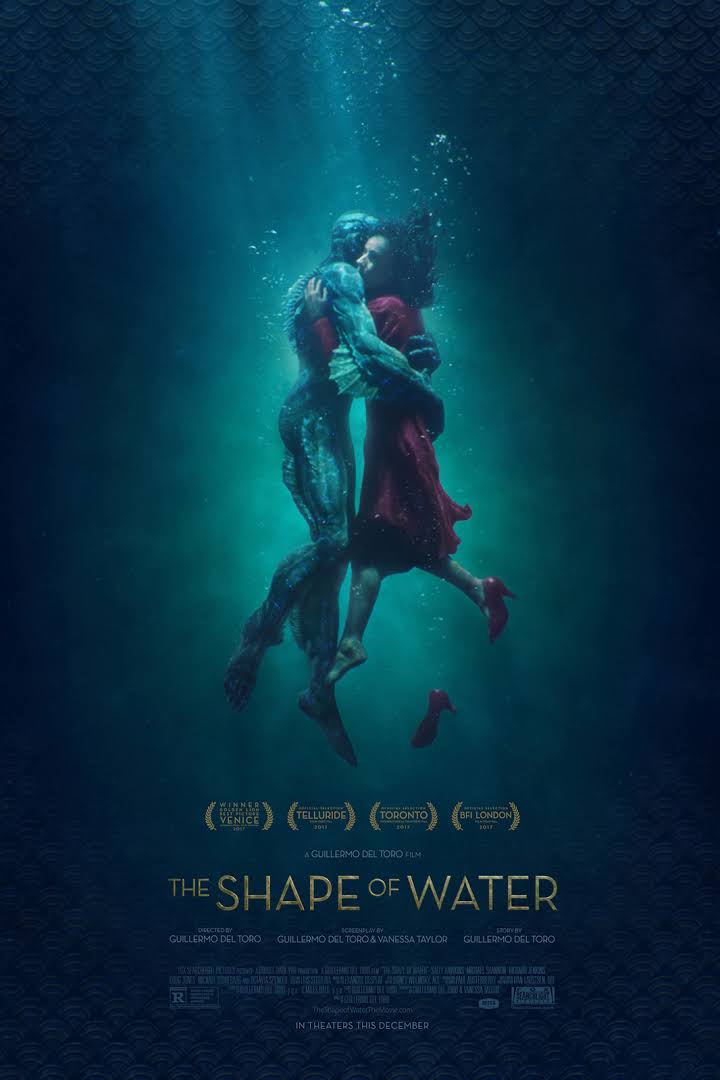
“The Shape of Water” film review
Absolutely enchanting! Guillermo Del Toro’s The Shape of Water is a beautiful modern fairy tale told through a classical means. From the provocative first scene to the endearing final moments, this film explores the human condition in an innovative way that highlights the spirits of kindness, generosity, and love. In a film that could have so easily played out like many other-worldly science-fiction love stories, this story demonstrates the power of cinematic storytelling full of brilliantly developed characters and excellent direction from Del Toro. Positively gripping. The Shape of Water provides audiences with a fresh perspective on the “monster movie” genre by taking you on a whimsical journey into the belly of a government research facility during the Cold War where you meet characters you love and love to hate along the way. As with many of his other films, Del Toro once again crafts an imaginative experience through the creation of memorable characters grounded by solid writing, direction, and cinematography. It seems like “genre films” are becoming a thing of the past, because so many want to exist in multiple planes; however, for all the elements at its heart, The Shape of Water is a classic monster genre film but breaks new ground.
Elisa (Sally Hawkins) is a mostly isolated mute young lady who works in housekeeping at a remote, underground government research facility near Baltimore. With only her starving artist neighbor Giles (Richard Jenkins) to keep her company at home and her close friend Zelda (Octavia Spencer) to watch over and speak for her at work, she leads a rather mundane life but longs for music, adventure, and romance. Taking place during the Cold War in 1962, Elisa’s encountered the strange and questionable over her time in and out of cleaning labs. Her nondescript life will be forever changed when she discovers the lab’s newest secret–a mysterious amphibian-like creature who lives in an aquarium tank. Over the days, Elisa feels compelled to visit the creature as the two of them develop a trusting bond. When the creature’s very life is at stake, Elisa must work quickly to construct a plan for his safe evacuation.
The Shape of Water has one of the most innovative openings to a film in that it juxtaposes a serene, calming yet mesmerizing sequence of underwater shots during the opening title sequence against a rather provocative first scene. Del Toro will successfully have your attention for the entirety of the film. It isn’t often that we get fairy-tale like narration at the beginning of a monster movie, and Del Toro’s choice for the beginning narration was absolutely perfect. It not only provided strategic exposition, but set the tone of the film. What we are about to watch may contain elements of monsters and mysteries, but it is a modern romantic fairy tale. Horror and science-fiction have often been used as conduits for filmmakers to explore the human condition and all its imperfections and growth; so by combining elements from both to create an innovative monster movie, Del Toro provides audiences with a fantastic opportunity to use the film’s diegesis as a mirror to our modern lives. Although the “beauty and the beast” style love story is central to the film, the film also comments on topics such as race, marriage, and class during the 1960s. There is also a side story that alludes to how members of the LGBTQ community were treated in the workplace and within the community. An incredibly comprehensive plot that never loses focus on the main story.
What an excellent cast! Sally Hawkins brings such endearing and powerful subtlety to her mute character. Her commitment to Elisa is so exquisite that you will swear that you can hear her voice through her sign language. Much in the same way we explored interspecies communication in last year’s Arrival, we witness just how the movement of hands and facial expressions know no bounds when establishing relationships with those with whom we cannot verbally communicate. In many ways, this movie is a combination of Beauty and the Beast, TV’s Swamp Thing, Arrival, and a little Creature from the Black Lagoon. Hawkins’ exceptional performance may very well land her an Oscar nomination, and quite possibly a win. Doug Jones’ creature is a brilliant combination of monster and lover. From the moment you encounter him, you will feel a human-like connection to his character. Like with Hawkins’ Elisa, Jones’ creature exhibits the power of subtlety. That seems to be a common element of this film: subtlety. So often the techniques of the pioneers of cinema are forgotten. Hitchcock proved over and over again that the camera itself can create suspense. Of course, he took many of his techniques from silent cinema where the camera was instrumental in visually communicating so much. Del Toro utilizes this power of the camera to not only visually create emotions but to work through actors to allow subtle powers of character to enhance the experience of this movie.
Beyond our central characters, Zelda (Octavia Spencer) and Giles (Richard Jenkins) have mini-movies of their own. And indirectly, their mini-movies have an impact on the larger story; however, these side stories never eclipse the central plot and only serve to bolster the overall experience. Spencer’s character enables audiences to explore marriage in the 1960s and Jenkins’s character provides a platform for discussion regarding how ostracized members of the LGBTQ community were before more modern times. There is also a scene where a classy looking black couple was denied seating at a diner. So many societal themes that can be used as a framework through which to understand the time in which this story takes place, and now the characters can be used to explore modern themes as well. Each and every chiefly supporting player has a significant impact upon the central diegesis of The Shape of Water. Del Toro took special care in integrating every element and making sure each aspect of the story was never just filler or for shock value. Each character, each scene, each camera angle moves the story forward.
The reality of love and relationships juxtaposed against an imaginative backdrop grounded in a literal view of life in the 1960s comprise this world created by Guillermo Del Toro. Whether you enjoy an excellent monster movie or old-fashioned romance, you will enjoy The Shape of Water. The brilliance of this film can be found in how this modern fairy tale is told through classical means. I also enjoyed the references to classic Hollywood movie musicals and dramas that can each be seen in the plot of this film. No image is ever wasted in Del Toro’s film. If there is one negative critique, the second act is a little drawn out and could have been trimmed a little, and some added suspense would have been appreciated in the second act as well.
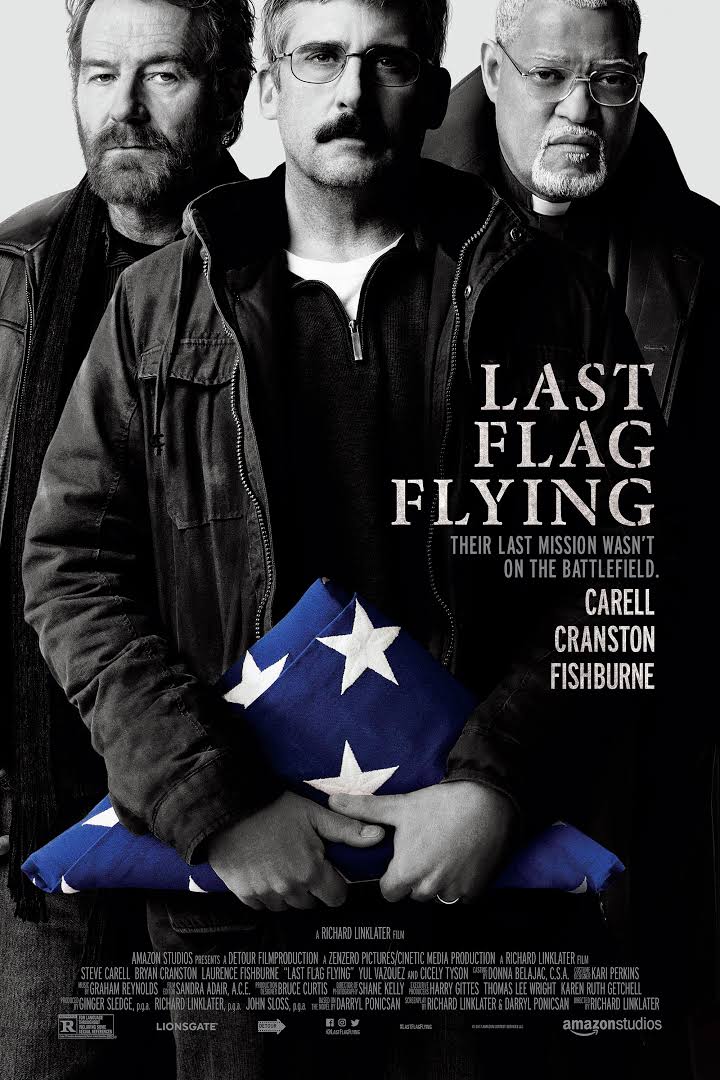
“Last Flag Flying” film review
An all-star cast takes audiences on a memory journey of war, loss, friendship, and patriotism as genuine human emotions are dealt with through comedy and grief. Amazon Studios hits a homer again with the release of Last Flag Flying distributed by Lionsgate. Now in select theaters, writer-director Richard Linklater crafts an incredible motion picture that organically deals with the loss of a loved one during a time of war through the stages of grief and irreverent comedy between friends. While this film is currently flying under the radar, don’t allow that to dissuade you from watching this incredible war film. I cannot remember the last time that I saw a film that felt so genuine. Watching this film, I truly felt like a fly on the wall, watching a Vietnam vet deal with the loss of his son and reconnecting with some of the closest friends he ever had in his life. Last Flag Flying is a subgenre of war movies that places the camera at a distance from the characters and allows them to mourn and laugh on screen without interference from censors and other outsiders. While not a conventional war movie, the topic of war is found underlying many diegetic components. Dialogue driven, this film provides social commentary on patriotism, God, and friendship. Bring your listening ear to this movie because the context of the tough subject matter contains subtle yet powerful messages that highlight otherwise unstated emotions. Sometimes the best way to go through the stages of grief is to throw caution to the wind and allow humor to work its powerful remedy.
Three Vietnam war veterans reunite for a different kind of mission that forces them to deal with the present and the past. When Larry “Doc” Shepherd (Steve Carrel) arrives at the dive bar that belongs to former comrade Sal Nealson (Bryan Cranston), he asks his Marine brother to go with him without naming where. Sal drives Shepherd to a old country church now pastored by their Marine brother Richard Mueller (Laurence Fishburne). When Shepherd doesn’t touch his pale cobbler, the group realizes there is something wrong. It’s then the Shepherd reveals that his son was killed outside of Baghdad, and wants his two Marine brothers to go with him to bury his son at Arlington. Along the journey, the three former military comrades are forced to come to terms with their shared past that continues to shape their present lives by discussing tough topics such as grief, God, war, honesty, and addiction.
The sheer storytelling beauty of Last Flag Flying is found in the solid writing made evident through the excellent direction and A-list cast (and one surprising cameo that I won’t mention because it will detract from the brief but powerful screen presence). While it may appear like a somber tragedy on the surface, beneath that surface of sadness beats the heart of dark but respectful comedy that takes audiences on the memory journey right along side the characters. War movies about the loss of loved ones is not something new; but this film allows the characters to go through the stages of grief in organic ways that paints a motion picture of how human these emotions are. Human. Truly human. At times, there are no holds barred when three very different voices all converge on the same topic. You have the grieving father, a reverend, and foul-mouthed barkeep discussing everything, just as friends in real life often do. In many ways, these three former military comrades could not be any different in their present states; but at one time, they were inseparable and very much alike. While the focus of the film could have been on Shepherd’s loss or the politics of war, the focus is clearly on what makes us human and how one genuinely has to deal with loss due to war. Not that discussions of politics and religion are not found in this film–they are–but the discussions and arguments between these friends are used as tools to comment on the human condition. Because we never see combat footage, the expositional dialogue about war and politics adds incredible weight and a little mystery to the events in the film.
Before you begin to think that Linklater uses flashbacks to connect the present to the past, think again. While that would have been the easy, lazy way of accomplishing that task, he chooses to connect the present to the past through exceptional exposition between characters that prompt the audience to engage their own emotions to connect the pieces of the story together. Because we never shift between the past and present, the main story is always the main story. When constructing strong characters as we have this this film, it is the responsibility of the actors (though proper direction) to not allow the actor to get in the way of the character. Honestly, there are times that I see the individual actors eclipse the respective character, but most of the time, the audience will see the characters themselves throughout the dark comedy. The cinematography is simple, but perfect for the story within this motion picture. Linklater uses no gimmicks to tell this thought provoking story. The movie has an intimate feel to it because you can likely identify with one of the lead or supporting characters, especially when they are talking about “Disneyland” in Vietnam (you’ll just have to watch to understand why that’s in quotes). So incredibly genuine. No pretense about any of the characters in the film.
The content of this film truly reflects the tenor of the times in which we live. Topics of war, politics, and religion seem to be inundating us from all angles. It takes a special film to deal with each of those respectfully, candidly, and effectively. The trifecta of voices in this film allows the thought provoking conversations to transcend the screen and enter the minds of the audience. While working through his grief, there were times that Shepherd could have gone on an anti-military or anti-American rant, but he never speaks a negative word against anyone, though he is sometimes in immense pain. Patriotism, God, and the human condition are shown and discussed in quite unconventional and maybe even controversial ways; yet, the manner in which these topics are discussed, as it relates to Shepherd’s loss, are absolutely perfect. In a seemingly binary world where you are either a red-blooded patriot or you’re anti-American, with no room for nuance or discussion, this film provides the platform to begin to realize that we are first human before we take sides.
Although I did not care for Linklater’s Boyhood, I can honestly tell you that this film is one that you don’t want to miss. Whether you are in a military family or not, this film offers a glimpse into a world that many people have to face on a daily basis. The genuine, organic approach to the hard topics in this film allows the humanity to shine through. Not speaking for ALL veterans, but the vets that were in the screening last night had high praise for the film. And the rest of us had many positive remarks and feedback for the screener hosts.
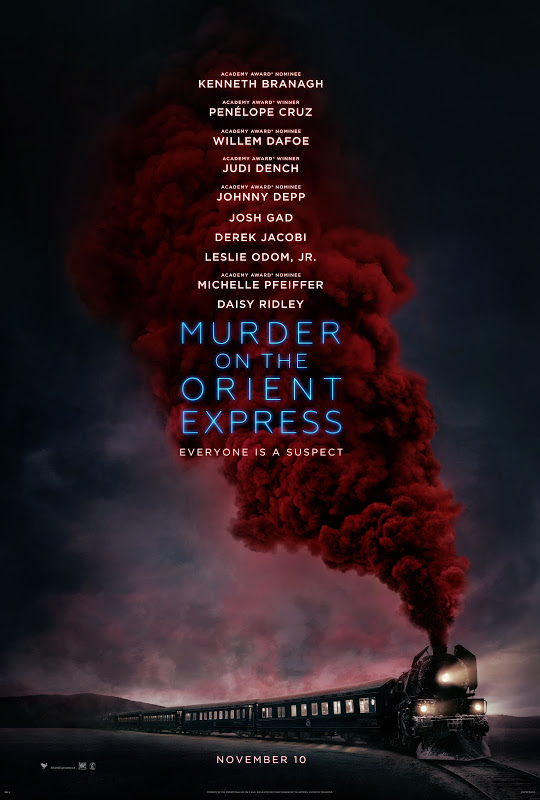
“Murder on the Orient Express” (2017) Film Review
The classic Hollywood style mystery successfully pulls into the station. Grab your ticket from the box office and board the legendary Orient Express with this all-star cast. Kenneth Branagh’s adaptation of the timeless Agatha Christie novel is as bold and elaborate as Hercule Poirot’s famous mustache. Feel as though you are traveling aboard the famous transcontinental train as you attempt to put all the pieces together to solve the mystery right along with “quite possibly the greatest detective in the world.” Hollywood style movie mysteries are nearly a thing of the past, but Branagh stokes the fire in the engine of the once popular genre and conducts an exciting journey through the classic whodunit plot. The film’s namesake is a novel that has inspired so many mystery novelists, and hopefully this film inspires a new generation of filmmakers to create their own movie mysteries fit for the big screen. Because the 1974 version including a cast ranging from Ingrid Bergman to Anthony Perkins to Sean Connery has not stood the test of time as well as it was thought to have done, this cleared the tracks for Branagh’s adaptation of Christie’s most famous novel.
After he successfully solves the mystery of the theft of precious religious artifact from the Wailing Wall area of Jerusalem, Hercule Poirot (Branagh) is beseeched to head back east to solve another mystery. Over the years, Poirot has made many friends, and one of these friends is the son of the railroad tycoon who owns the opulent Orient Express. When a passenger doesn’t show, Poirot is given his seat and boards the transcontinental train bound for western Europe. Although Poirot was promised a rail journey free of crime, a nice break, and to be pampered during his travels, he finds himself solving the most peculiar of mysteries–a most gruesome murder. The victim: an unscrupulous man with many enemies. When a freak avalanche forces the Orient Express to stop on a breathtaking, precarious stretch of track, Poirot finds the time to interview each and every one of the suspects—confined to the twelve first and second-class passengers who might have had access to the victim’s cabin. When each piece of evidence opens one Pandora’s Box after another, and the web of lies and connections between the passengers grows to Poirot’s mustache proportions, Poirot faces a complex mystery that prompts him to call his very approach to crime solving into question.
Nevermind the solution to the tentpole mystery novel is one of the worst-kept secrets in British literature history, Branagh crafts a cinematic mystery full of intrigue, revenge, lies, deceit, and the central murder. The plot revolves around a seemingly perfect crime committed on a railcar with no access to the outside, and only the passengers and crew on board the suspects. But even Poirot is stumped at the who, how, and why. Whether you know the ending or not, this film provides an excellent example of a genre that harkens back to Hollywood’s golden era. There was once a time that mysteries and musicals were a staple of the industry, but times change. Still, Branagh shows audiences that the timelessness of an old fashioned whodunit cannot be overstated. Since the ending of the mystery is known by so many people, Branagh was challenged with providing the audiences with something different, something that creates a new take on a well-known story. He accomplishes this by throwing in some additional subplots, character connections, and evidence that suggests that the solution may turn other otherwise than it does in the novel. The changes he brings to the story are organic and fit in well. The end result is a fantastic film that keeps your attention from beginning to end, even for those who know–or think they know–the solution to the mystery.
From the sweeping landscape shots of the Alps to the wide variety of shots to bring the audience onto the train with the rest of the passengers, the production design is excellent. The attention to the detail and visual elegance of the story are treated with creative precision, just as the Christie plot is woven together. Production designer Jim Clay’s meticulously recreated Orient Express is truly something to behold. Unfortunately, despite Branagh’s decision to shoot on 65mm film, there are times that the train set feels almost too perfect–a little artificial–similar to The Polar Express. Although there are times that the production design is not being showcased to the degree that it should to increasingly immerse the audience into the world of Poirot, there are plenty of beautiful shots that serve as a testament to the opulence of rail travel that once was. Of the few weak areas of this film, the cinematography is the weakest because it could have been used to truly create a visually stunning film and not fall victim to surrealism. Patrick Doyle’s score complements the film by feeling like an extension of the plot itself, in time and space. The combination of big band, jazz, and orchestral music immerses the audience into this world. All the technical elements work effectively to transport you from your seat to a compartment on the legendary train.
Branagh’s screen adaptation of Christie’s characters is brilliantly entertaining and developed well. Each character represents a different type of person, a different walk of life. No two characters are alike, which makes great for interjecting some social commentary into the mystery. From a professor spouting pro-Nazi sentiments to a nurse turned missionary, you will find the characters intriguing in and of themselves, never mind how they may be connected to the victim. Alexandra Byrne’s costumes are perfect appointed extensions of the characters that wear the authentic period clothing. Each costume was designed to be as much a part of the respective character as the accents, hairstyles, and backstories. Josh Gadd proves that we can successfully play a serious role, which will prove to bolster his career, Willem Dafoe is perfect as the professor, Dench portrays the princess in only a way that she could so successfully accomplish, and the rest of the cast are all excellent. Coming in a close second to Branagh’s screen time, as the iconic inspector Poirot, is the beautifully talented Michelle Pfeiffer as the widowed heiress Mrs. Hubbard (Lauren Bacall’s character in the original). She truly showcases her talent for adding depth to the characters she plays in order to make them complex and memorable. The diverse cast of characters is incredible to watch and couldn’t have been deleted better for this highly anticipated film.
Climb aboard The Orient Express for the whodunit that started it all. Branagh’s fresh take on the classic tale would satisfy even the harshest of critics Agatha Christie herself. He treats the source material with the respect it deserve, all the while, adding in new material to craft a new experience for those tho have read the novel and/or seen the original film adaptation of this story. Do yourself a favor and don’t ask anyone whodunit, because you need to experience the solution for yourself. Perhaps you can solve it more quickly than Poirot. Don’t let the train leave the station before you pack your bags and travel back to a time when trains went full-steam ahead into adventure and intrigue.
“Thor Ragnarok” movie review
Norse mythology meets Gladiator meets 80s vintage video game in this non-stop adrenaline pumping action film. Suffice it to say, everything you’ve heard about Thor Ragnarok from your friends is true. It is an incredibly fun movie that is equally well written and directed. For anyone who follows my blog, it is no secret that I typically do not like the Disney-Marvel films (and for good reason), but the focus of this review is on THIS particular film. I state that because, honestly, I very much enjoyed this film! So, it comes from liking the structure, characters, plot etc. not just from being a fan boy, or lack thereof in this case. Not only an excellent third sequel, but this movie can easily stand on its own. Whether you have watched the other MCU (Marvel Cinematic Universe) films or not, you can rest assured that you can enjoy this superhero movie. With the way the initial trailers were cut, I thought that this was MCU’s way of jumping onto the 80s nostalgia band wagon–not so. Oh, there is definitely an 80s video game vibe about the film, but the focus is on the characters and storytelling, not the nostalgia. There is also a self-aware element of this film. Not to the extent Deadpool is self-aware, but Chris Hemsworth’s Thor has a twinkle about his eye that winks at the audience so that we know that he is aware of the corniness and ridiculousness of the characters and plot. But the magic of this film is just how well balanced the content of the film is. There were many times that the plot lended itself to falling apart, but the solid cast held the film together and provided audiences with one of the best movies in the MCU.
When Thor learns of a dark, hidden family secret, he must confront the deadliest enemy he has ever faced off with in his life. But the legendary hero encounters far more than he ever expected. The mighty Thor finds himself imprisoned on a faraway planet and forced to battle in gladiator-style games. Little does he know that the winningest challenger on the planet is his former ally The Hulk. Thor must survive the deadly gladiator-like battles in order to build his team to defeat Hela, the Asgardian goddess of death who is destroying his home world.
One of the principle themes in this film that enables this one to be more and deeper than other MCU films is just how similar it is to a conventional war picture. There are hints of courts of intrigue as well. The complex plot provides a comprehensive foundation upon which a more superficial story can be developed in order to appeal to wide audiences, with few appreciating the deeper themes and subtext. But it takes more than effective and well-developed writing to build such a solid movie, it takes multi-dimensional characters portrayed by impeccable screen talent. You’ll find all of that in Thor Ragnarok. Although his screen time is brief, Anthony Hopkins’ Odin commands the screen with confidence, wisdom, and sincerity. Few actor’s can take a few minutes of screen time and put more cinematic magic in it than Hopkins. After all, he won his Oscar for Silence of the Lambs for his collectively few minutes on screen. Joining the cast are Jurassic Park’s Jeff Goldblum and the beautiful, talented Cate Blanchette. Goldblum’s Grandmaster of Sakkar is hilarious and brilliant. As you’d expect a Goldblum character in a film like this to be: detached intellectually from that which is seen as conventional, smart-alecky; yet, he is also petty, sadistic, and relentless. Blanchette’s Hela is elegant, sadistic, and intelligent. She is perfectly able to be the comic book-esque villain she needs to be, all while bringing about a pedigreed acting to it.
All the technical elements of the film works excellently together. The most memorable of those elements is the music, for me, followed by the visual effects. I absolutely loved the nod to Willy Wonka and the Chocolate Factory during Thor’s transport to through Sakkar. This works because (1) the scene it shot and edited similarly to the boat scene in the aforementioned movie and (2) Goldblum’s Grandmaster is a Willy Wonka type. Throughout the film, there are 80s video game sound effects and a score that could fit into a nostalgic 8bit video game. However, the nods to Willy Wonka and video games do not overpower the more conventional score. Whereas the visual effects could have gone overboard and made the film play off as a video game, the video game like effects where carefully integrated in order for the film to maintain a high show quality.
The film was initially sold as a funky, colorful, comedic MCU film. And there are times that the film also encroaches upon that animated feel, but it never crosses that line–thankfully. The more serious aspects to the film balance out the slapstick moments. All of this works together to execute perfect pacing and plot/character development. Like with most MCU films, the more adventurous parts of the film are not quite adventurous enough to be an adventure film and there is typically a predictable nature about the film. I find that this film is not as predictable as previous MCU movies, but there is still that experience with this one. There is one particular part to the showdown of the film that prohibits this from falling victim to another cliche MCU ending with an epic battle, bodies flying through the air, and cities on fire, but I cannot reveal that without giving away the ending.
Looking for a fun movie to watch with your friends? Then this is a solid choice. Although the film has its diegetic flaws, the ways it succeeds outweighs the shortcomings. You also do not have to have seen the other Thor movies and really don’t even need to have seen the previous Avengers films, albeit helpful to understand some of the minor plot points. It’s definitely one that has re-watchabbility.